Boot upgrade, current fit issues normal? | Golden Skate

Boot upgrade, current fit issues normal?

fortyeightbits

Spectator
Joined
Mar 24, 2018
Hi all!

I'm coming up on 3 years in my Edea Chorus and my coach suggested that it may be time for new boots. Even though I went to a highly reputable fitter in my area (DC area - Fairfax Ice Arena) I've not been entirely happy with the fit of these boots so I'm not sure what to look for in my next pair and was hoping to get some feedback from you knowledgeable people here.

- I skate roughly 2-3 hours a week and have up to my loop, working on flip. I've been skating in total for about 4 years (but only skated an hour a week during the first)
- I'm 138 pounds and 5'6"
- I have overpronation in both feet and my blades were moved inwards to compensate.
- I've never quite understood what having your heel locked in means because I find that if I point my foot my heel lifts off slightly from the sole of the boot.
- There's been a couple times in the past where I landed from a jump and felt an incredibly painful kind of "shock" to my ankle area. There didn't seem to be any permanent damage but when it happened it hurt for a few minutes before going away. I haven't experienced this in a while though.
- In the past year or so a new symptom I've been experiencing is the toes of my right foot going numb after about an hour of skating. I've tried to loosen the lace in the toe area but it hasn't helped much. I don't think my skates are too big because there is a decent amount of room in the toe area (sometimes I even think they might be a size too large - I'm in 255 and my street size is 8.5 )
- When I bought the Chorus the fitter did not offer for me to try any other brand. I asked about options for heat moulding or shaping and he said it wasn't possible for Edea skates.
- I've heard Edeas are meant to have loose ankles but I feel like I really struggle with getting onto a good outside edge, even with Bunga sleeves. I don't know if this is just due to my pronation or my lack of skill causing poor edge control, but this is an example photo of when I was practicing my forward crossovers and really trying and failing to get a deeper edge: https://imgur.com/a/mAWJIU1

All that said, as I'm thinking of getting my next pair of boots, I'm wondering if any of the above "issues" I've described are actually normal at all, and whether Edea is a suitable fit for me (if so, whether to get another pair of Chorus or go up to Concerto/Ice Fly), or if I should consider trying other brands. If so, any suggestions on what models to consider would be appreciated!
 
Hi all!

I'm coming up on 3 years in my Edea Chorus and my coach suggested that it may be time for new boots. Even though I went to a highly reputable fitter in my area (DC area - Fairfax Ice Arena) I've not been entirely happy with the fit of these boots so I'm not sure what to look for in my next pair and was hoping to get some feedback from you knowledgeable people here.

- I skate roughly 2-3 hours a week and have up to my loop, working on flip. I've been skating in total for about 4 years (but only skated an hour a week during the first)
- I'm 138 pounds and 5'6"
- I have overpronation in both feet and my blades were moved inwards to compensate.
- I've never quite understood what having your heel locked in means because I find that if I point my foot my heel lifts off slightly from the sole of the boot.
- There's been a couple times in the past where I landed from a jump and felt an incredibly painful kind of "shock" to my ankle area. There didn't seem to be any permanent damage but when it happened it hurt for a few minutes before going away. I haven't experienced this in a while though.
- In the past year or so a new symptom I've been experiencing is the toes of my right foot going numb after about an hour of skating. I've tried to loosen the lace in the toe area but it hasn't helped much. I don't think my skates are too big because there is a decent amount of room in the toe area (sometimes I even think they might be a size too large - I'm in 255 and my street size is 8.5 )
- When I bought the Chorus the fitter did not offer for me to try any other brand. I asked about options for heat moulding or shaping and he said it wasn't possible for Edea skates.
- I've heard Edeas are meant to have loose ankles but I feel like I really struggle with getting onto a good outside edge, even with Bunga sleeves. I don't know if this is just due to my pronation or my lack of skill causing poor edge control, but this is an example photo of when I was practicing my forward crossovers and really trying and failing to get a deeper edge: https://imgur.com/a/mAWJIU1

All that said, as I'm thinking of getting my next pair of boots, I'm wondering if any of the above "issues" I've described are actually normal at all, and whether Edea is a suitable fit for me (if so, whether to get another pair of Chorus or go up to Concerto/Ice Fly), or if I should consider trying other brands. If so, any suggestions on what models to consider would be appreciated!
When you say you feel your heel lifting within the boot when you point your toe, do you mean the heel actually comes off the sole with a little gap underneath and a rubbing along the Achilles tendon? Or is it just that pressing on the toe makes your weight come off the heel so that it feels "lifted", but the bottom of your foot is still actually lightly touching the sole? The fitter can help you determine if your heel is locked in. With the boots laced, the fitter should kneel down and hold the boot firmly on the floor, pressing on the toe and gripping the heel. Stand up and try to lift your heel up within the boot while the fitter presses the boot down. If your heel can't move upwards or sideways in either direction, then it's locked and the boot fits well at that point, the most important point since the heels can't be moulded but the rest of the boot can.

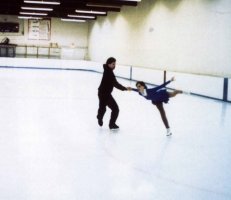
Looking at your video clip (thanks! That's a big help), the boot ankles are too soft and are letting your foot pronate while the rest of you is in a nice straight line. Your blade looks to be almost on a flat, certainly on just a shallow edge. I'm not a coach, and I learned to skate in the school figures era, where you learned solid edge control from the start. I'd have to be there in person to try to be much help (after you'd got new skates with stiffer uppers than your Edeas). But I remember one exercise we learned as beginners for edges, and that was to stand at arm's length by the boards, sideways, gripping the boards with one hand -- don't wear knitted gloves or your hand could slip -- and making that arm rigid through the elbow and shoulder until you felt the tightening across your upper back. Stand far enough away from the boards so you can lean towards them on the outside edge of whichever foot is closer to the boards, with your arm straight. Get a friend to eye you and tell you if you're body is in a straight line and you're definitely on the outside edge, maybe take a picture when you get it right. Hold the position for as long as you can, and then turn around and switch to the other foot. Work at it as you manage to hold the edge deeper and deeper. At least then you'll know what it's supposed to feel like on the move. I've got better pictures somewhere than this old one, but although I was moving into a spiral position there during a pairs combination spin, both my partner and I have rigid arms and I'm pushing against his hand as if it were the boards in the little exercise I just described.
 

Attachments

  • Sk-changespin.jpg
    Sk-changespin.jpg
    27.2 KB · Views: 102
When you say you feel your heel lifting within the boot when you point your toe, do you mean the heel actually comes off the sole with a little gap underneath and a rubbing along the Achilles tendon? Or is it just that pressing on the toe makes your weight come off the heel so that it feels "lifted", but the bottom of your foot is still actually lightly touching the sole? The fitter can help you determine if your heel is locked in. With the boots laced, the fitter should kneel down and hold the boot firmly on the floor, pressing on the toe and gripping the heel. Stand up and try to lift your heel up within the boot while the fitter presses the boot down. If your heel can't move upwards or sideways in either direction, then it's locked and the boot fits well at that point, the most important point since the heels can't be moulded but the rest of the boot can.

Looking at your video clip (thanks! That's a big help), the boot ankles are too soft and are letting your foot pronate while the rest of you is in a nice straight line. Your blade looks to be almost on a flat, certainly on just a shallow edge. I'm not a coach, and I learned to skate in the school figures era, where you learned solid edge control from the start. I'd have to be there in person to try to be much help (after you'd got new skates with stiffer uppers than your Edeas). But I remember one exercise we learned as beginners for edges, and that was to stand at arm's length by the boards, sideways, gripping the boards with one hand -- don't wear knitted gloves or your hand could slip -- and making that arm rigid through the elbow and shoulder until you felt the tightening across your upper back. Stand far enough away from the boards so you can lean towards them on the outside edge of whichever foot is closer to the boards, with your arm straight. Get a friend to eye you and tell you if you're body is in a straight line and you're definitely on the outside edge, maybe take a picture when you get it right. Hold the position for as long as you can, and then turn around and switch to the other foot. Work at it as you manage to hold the edge deeper and deeper. At least then you'll know what it's supposed to feel like on the move. I've got better pictures somewhere than this old one, but although I was moving into a spiral position there during a pairs combination spin, both my partner and I have rigid arms and I'm pushing against his hand as if it were the boards in the little exercise I just described.
Hi Diana, thanks for the response! I had my husband help me with the test you mentioned and I do feel (though it was a bit tricky to be certain) that the bottom of my foot is able to lift off ever so slightly and it's not just because my weight is off of it.

I'll definitely try the exercise you suggested when I'm back on the ice! I've been trying to work in some pronation exercises too (pen/penny, drawing out the alphabet) but have not seen any improvement so far. That said, you mentioned that the boot being too soft is contributing to my issues, do you think I'll need to go up to a stiffer boot?
 
Hi Diana, thanks for the response! I had my husband help me with the test you mentioned and I do feel (though it was a bit tricky to be certain) that the bottom of my foot is able to lift off ever so slightly and it's not just because my weight is off of it.

I'll definitely try the exercise you suggested when I'm back on the ice! I've been trying to work in some pronation exercises too (pen/penny, drawing out the alphabet) but have not seen any improvement so far. That said, you mentioned that the boot being too soft is contributing to my issues, do you think I'll need to go up to a stiffer boot?
I've never worn Edeas, so I can't be specific, but it looks as if you need either a stiffer one in their brand, if that's the brand your fitter says is best for your foot, or a stiffer one in another brand. There isn't a standard rating across the industry, so the exact number on the chart isn't as important as comparing different models within your chosen company's lineup. Edeas tend to be more roomy at the ankles; could you ask your fitter to let you try a different brand, depending on what brands the shop carries? An adult can go to a stiffness that would be overbooting for a child who might be skating at the same level. My Risport RF1s are a 90 stiffness, but I'm still skating pairs for fun and I put a lot of stress on the boots landing throws etc even if our level has dropped since we retired from competition. I'm fairly small, like all "pairs girls" (in American non-metric measurements, a bit under 5'3" and a shade under 110 lbs) but I wear out at least two pairs of 90-stiffness boots in a year. And blades the same.

Depending on the shape of your foot and the height of your arches, any of Risport, Riedell, or Graf will give you more ankle support than the popular Edeas most shops seem to be carrying these days. They have lower heels, too, which might make it easier for you to control your edges.
 
Hi Diana, thanks for the response! I had my husband help me with the test you mentioned and I do feel (though it was a bit tricky to be certain) that the bottom of my foot is able to lift off ever so slightly and it's not just because my weight is off of it.

I'll definitely try the exercise you suggested when I'm back on the ice! I've been trying to work in some pronation exercises too (pen/penny, drawing out the alphabet) but have not seen any improvement so far. That said, you mentioned that the boot being too soft is contributing to my issues, do you think I'll need to go up to a stiffer boot?
You definitely need a new boot, one that fits your foot properly. And one that is not Edea brand b/c it sounds like that brand is not working with your foot type.

What is your foot type based on that foot type chart? And also arches: Very high/high/normal/low/flat?

You also need to consider that at a pro shop (even one reputable like Fairfax) that there are Figure skating pro fitters and hockey pro fitters. Who did you get?!

Also, with the pronation, you need to see a podiatrist in order to get orthotics to wear that will work with a figure skate. Last but not least, 3 years is too long in one pair of boots.
 
Last edited:
You definitely need a new boot, one that fits your foot properly. And one that is not Edea brand b/c it sounds like that brand is not working with your foot type.

What is your foot type based on that foot type chart? And also arches: Very high/high/normal/low/flat?

You also need to consider that at a pro shop (even one reputable like Fairfax) that there are Figure skating pro fitters and hockey pro fitters. Who did you get?!

Also, with the pronation, you need to see a podiatrist in order to get orthotics to wear that will work with a figure skate. Last but not least, 3 years is too long in one pair of boots.
My foot type is orient and my arches are low-ish but not completely flat, and my fitter was Marlon, who seems to be often recommended on any discussion relating to fitters in this area. At the time, I mentioned that Edea was what my coach had suggested, so that's why he went with that. In hindsight I wished I had taken the initiative to ask to try the other brands, and I plan to do so this time (whether I return there or not, I have not decided).

It's definitely been a while in these boots and I'm way overdue, but I've been dreading the fitting process because I'm scared of spending so much money on the wrong pair!
 
My foot type is orient and my arches are low-ish but not completely flat, and my fitter was Marlon, who seems to be often recommended on any discussion relating to fitters in this area. At the time, I mentioned that Edea was what my coach had suggested, so that's why he went with that. In hindsight I wished I had taken the initiative to ask to try the other brands, and I plan to do so this time (whether I return there or not, I have not decided).

It's definitely been a while in these boots and I'm way overdue, but I've been dreading the fitting process because I'm scared of spending so much money on the wrong pair!
Thanks for the info. Many coaches have no idea when it comes to boots for others, and no matter what 3 years in the same boot is way too long, they are beyond broken down.

With your foot and arch type I would suggest looking into Jackson and Graf.

Jackson: Synergy Ignite, Supreme 5300.
Graf: Richmond Special, Galaxy

You'll need blades to go with those as well: Standard version of MK Pro or JW Coronation Ace.

Good luck!
 
Last edited:
Thanks for the info. Many coaches have no idea when it comes to boots for others, and no matter what 3 years in the same boot is way too long, they are beyond broken down.

With your foot and arch type I would suggest looking into Jackson and Graf.

Jackson: Synergy Ignite, Supreme 5300.
Graf: Richmond Special, Galaxy

You'll need blades to go with those as well: Standard version of MK Pro or JW Coronation Ace.

Good luck!
Thank you for the recommendations! I really appreciate the feedback I've gotten here from you and Diana giving me an idea of what level of boots to ask to try and what to look for. :)
 
Thank you for the recommendations! I really appreciate the feedback I've gotten here from you and Diana giving me an idea of what level of boots to ask to try and what to look for. :)
You are welcome. Remember: Not just level based on factors, but also brand suggestions here were based on your foot type.
 
BTW, if you heel doesn't lock in place on a skate boot, you could easily be injured, because the forces the hindfoot would normally absorb might be transferred elsewhere. So I wouldn't wait too long.

Boot makers don't always make boots that fit the measurements they are given, so it's normal to go back to your fitter for final adjustments. Did you? If the guy at Fairfax you saw was Marlon, he has a very good reputation with figure skaters in the D.C. Metro area. I would call him through that shop, and ask if he can help.

Would your health insurance pay for you to see a podiatrist? I've known many figure skaters who were misfit for boots who were happy with the work of Dr. Paul Meissner, who works near Baltimore. But he isn't cheap.
 
BTW, if you heel doesn't lock in place on a skate boot, you could easily be injured, because the forces the hindfoot would normally absorb might be transferred elsewhere. So I wouldn't wait too long.

Boot makers don't always make boots that fit the measurements they are given, so it's normal to go back to your fitter for final adjustments. Did you? If the guy at Fairfax you saw was Marlon, he has a very good reputation with figure skaters in the D.C. Metro area. I would call him through that shop, and ask if he can help.

Would your health insurance pay for you to see a podiatrist? I've known many figure skaters who were misfit for boots who were happy with the work of Dr. Paul Meissner, who works near Baltimore. But he isn't cheap.
Glad to hear that you want to help but honestly: They aren't even in the correct brand(s) for their foot type, so going back to this person isn't going to do anything and they have outgrown this current boot anyway, it's broken down. The end.
 
My hunch is that you've been on boots that don't fit you, are broken down, are too large size, and with a blade that is too much offset to the inside (with pronation outside edges should be easy for you, you should be struggling with inside edges, so the blade has to be way off).

For the boots you have some good suggestions already; I would just make sure to get them in the correct size (smaller than you think is probably more correct). And don't have the blade offset, ask for a straight temporary mount, try it, and if it clearly feels off, only make minor adjustments.

Good luck!
 
My hunch is that you've been on boots that don't fit you, are broken down, are too large size, and with a blade that is too much offset to the inside (with pronation outside edges should be easy for you, you should be struggling with inside edges, so the blade has to be way off).

For the boots you have some good suggestions already; I would just make sure to get them in the correct size (smaller than you think is probably more correct). And don't have the blade offset, ask for a straight temporary mount, try it, and if it clearly feels off, only make minor adjustments.

Good luck!
<<Italics added>> I will disagree with this. I pronate strongly. Pronation predisposes my foot to fall towards an inside edge, and makes it difficult to achieve an outside edge. There are three major methods to correct for pronation in ice skating: corrective orthotics, moving the blade to the inside, and shimming the blade. Depending on the degree of pronation, you might need a combo of methods.

I'm not medically trained, so I don't want anyone to take my word on this subject. But I refer readers to an article written by a D.P.M. (Doctor of Podiatric Medicine) who specializes in sports podiatry. The article is archived on the website of the American Academy of Podiatric Sports Medicine; so it's not some random info of questionable origin off the Internet. The article can be readily accessed and downloaded; no member login or paywall:

R. Neil Humble, D.P.M., "Podiatric Management in Ice Skating"

 
Last edited:
<<Italics added>> I will disagree with this. I pronate strongly. Pronation predisposes my foot to fall towards an inside edge, and makes it difficult to achieve an outside edge. There are three major methods to correct for pronation in ice skating: corrective orthotics, moving the blade to the inside, and shimming the blade. Depending on the degree of pronation, you might need a combo of methods.

I'm not medically trained, so I don't want anyone to take my word on this subject. But I refer readers to an article written by a D.P.M. (Doctor of Podiatric Medicine) who specializes in sports podiatry. The article is archived on the website of the American Academy of Podiatric Sports Medicine; so it's not some random info of questionable origin off the Internet. The article can be readily accessed and downloaded; no member login or paywall:

R. Neil Humble, D.P.M., "Podiatric Management in Ice Skating"


I guess I should clarify. Yes, I agree that pronation can make it difficult to produce a clean outside edge, especially on a straight line. What I'm referring to instead is how pronation affects balance on an outside or inside curve, because in figure skating, when we're talking about "edges", we're really talking about curves, and we rarely actually skate on a straight line. Now imagine you take a snapshot of a clean outside edge, assuming neutral foot alignment, with the center of mass correctly inside the curve. If you now add pronation, the blade is going to be biased more to a flat edge. This is not a critical failure, and you can compensate with your hips, knees, and body posture. You're certainly not falling. Now take the same snapshot, and add supination instead. This will create a hard failure point, where the bias to the outside will cause you to fall and you have far less ability to compensate. This difficulty is what I'm referring to.

To give a concrete example, strong pronation often makes movements like walleys much harder to execute properly, because you tend to fall too strongly to the inside, disrupting the mechanics of the turn and the jump (you get that "locked" edge feeling from over-engaging the inside edge). But you will probably have far better outside walleys (so toeloops without a toe). Or as another example, you may feel very secure on a Lutz takeoff, even if you have a tendency toward flat or unclear outside edges.

If this makes sense.

Edit: And this is exactly what the biomechanics paper you linked supports. Balance on an edge is not about whether the edge is easy to achieve, but whether the resulting edge angle stays within what your center of mass can support. Pronation causes you to over-engage the inside edge. That makes inside edges easier to achieve, sure, but it does not mean better balance on those inside edges.
 
Last edited:
Yes, I agree that pronation can make it difficult to produce a clean outside edge, especially on a straight line. What I'm referring to instead is how pronation affects balance on an outside curve, because in figure skating, when we're talking about "edges", we're really talking about curves, and we rarely actually skate on a straight line.
Not sure we're speaking the same skating lingo. When you skate in a straight line, you typically skate on a flat: both edges are in contact with the ice. If you skate on a clean patch of ice and examine the tracings, you should see a pair of parallel lines: | |. I suppose it's physically possible for a skater to force a straight-line trajectory on a single edge, but that's not what skaters typically do. So when I talk about skating on a single edge (outside edge or inside edge), I am indeed talking about skating on a curve,

Here's a simple dynamic test I use to check for pronation or supination. For simplicity, I will use only the example of skating forwards on the right foot (in practice we would check four scenarios: left and right foot, forwards and backwards). Stroke to get up speed and glide in a straight line on both feet. Now pickup the left foot and glide on the right foot only. If your right foot is neutral, you will continue gliding in a straight-line trajectory. If your right foot pronates, you will fall over to the inside edge, and your trajectory will curve to the left. If your right foot supinates, you will fall over to the outside edge, and your trajectory will curve to the right. If you pronate or supinate, you take the corrective actions in my previous post such that you will continue in a straight-line trajectory. [ETA: minor edits for clarity]

Now let's assume you have uncorrected pronation in your right foot. Consider the scenario in which you want to intentionally execute forward semi-circular arcs. If you want to execute an arc in the counter-clockwise direction, you will need to skate on the inside edge. Since your foot naturally pronates, this is easy, even for small-diameter arcs. If you want to execute an arc in the clockwise direction, you will need to skate on the outside edge. But since your foot naturally pronates, this is difficult. You may execute large-diameter arcs; tracings on the ice will often show both edges are still in contact with the ice (though the lines will typically be of unequal weight). With strong pronation, it may be nearly impossible to execute a small-diameter (tight) arc requiring a deep single edge.

So to me, uncorrected pronation will readily manifest itself on simple maneuvers requiring outside edges; e.g., arcs, full circles, outside figure-8's, consecutive X-overs around a circle.
 
Last edited:
Not sure we're speaking the same skating lingo. When you skate in a straight line, you typically skate on a flat: both edges are in contact with the ice. If you skate on a clean patch of ice and examine the tracings, you should see a pair of parallel lines: | |. I suppose it's physically possible for a skater to force a straight-line trajectory on a single edge, but that's not what skaters typically do. So when I talk about skating on a single edge (outside edge or inside edge), I am indeed talking about skating on a curve,
Typically, yes. And in a neutral position, you should indeed see pair of those parallel lines, with no bias to either side. And if you do have bias to either side, it means that you might indeed have troubles achieving a clean edge on the side opposite to the bias, but it does not mean that you have better balance on the biased side, quite the opposite in fact.

If your right foot pronates, you will fall over to the inside edge, and your trajectory will curve to the left.
Yes, and this is the key: you will fall over to the inside edge, and this "falling" is precisely what makes movements involving said edge harder to control.

Since your foot naturally pronates, this is easy, even for small-diameter arcs.
This misses the point. You're looking at the mere ability to achieve or produce an edge, while I'm talking about the practical implications to your balance and control in actual movements that involve said edges. Pronation doesn't make it easy for you, just because technically you can produce a clean edge tracing with incorrect body posture. It makes things harder because you over-engage the edge when you don't want to, which reduces control.

With strong pronation, it may be nearly impossible to execute a small-diameter (tight) arc requiring a deep single edge.
I think we're talking past each other a bit, and I actually don't disagree with the statement in general, I'm just talking about different implications. With strong pronation, you can absolutely have difficulty executing certain tight arcs or deep edge tracings, but in practice that difficulty often shows up differently depending on the skater. For many beginner or intermediate skaters, the issue isn't that pronation physically prevents the arc, but that they don't fully commit to the outside edge, because they would need to lean on that edge more than they feel comfortable with. And because pronation lets the body stay more upright relative to the blade in an inside edge, it can feel more comfortable and forgiving, even though the posture is not correct for a true deep edge, and they actually have less control, but they don't perhaps know it yet. As I said, what actually happens mechanically in an outside edge is that pronation biases the tracing toward a flatter edge. But that flat bias is not a critical failure. It's gradual and can be compensated for, and in fact it allows you to lean even deeper with your body. Whereas the bias to your inside edges is abrupt and harder to control.

And I now realize that my comment might have been confusing, because OP was talking about edge deepness and not balance as well. Looking at their image, it is fairly clear that their difficulty in producing a deeper outside edge here is due to their knee bending towards the flat edge. Pronation might make them more susceptible to this, but given that the blades are already offset, this is almost certainly a technique issue, and in fact if the blades are offset too much to the inside, they might even contribute to the problem. The key to deep outside edge here is stepping to that deep edge right away, not stepping flat and then trying to achieve a deep edge later. Also, you need moderate amount of speed to do deep edges, which beginners might have difficulty with as well, and I can't judge the speed based on the image, but I guess they also might not have enough speed for the deep edge they're looking for. And as mentioned before about the knee, you should be able to draw a straight line from your boot to your chest, which isn't the case here, hence bias to a flatter edge despite the upper body lean.

Anyway, I hope this clarifies the situation now.
 
Last edited:
This will be my last post on this topic. I have no further value to add.

Edit: And this is exactly what the biomechanics paper you linked supports. Balance on an edge is not about whether the edge is easy to achieve, but whether the resulting edge angle stays within what your center of mass can support. Pronation causes you to over-engage the inside edge. That makes inside edges easier to achieve, sure, but it does not mean better balance on those inside edges.

I never wrote that pronation leads to "better balance" (whatever that means) on an inside edge. I was responding to your first post on the topic:

My hunch is that you've been on boots that don't fit you, are broken down, are too large size, and with a blade that is too much offset to the inside (with pronation outside edges should be easy for you, you should be struggling with inside edges, so the blade has to be way off).

For the boots you have some good suggestions already; I would just make sure to get them in the correct size (smaller than you think is probably more correct). And don't have the blade offset, ask for a straight temporary mount, try it, and if it clearly feels off, only make minor adjustments.

You also did not initially use the term "better balance", but wrote explicitly: "and with a blade that is too much offset to the inside (with pronation outside edges should be easy for you, you should be struggling with inside edges, so the blade has to be way off)."

I have strong pronation. This is exactly opposite to my experience (and of other skaters with strong pronation that I know): with uncorrected pronation. inside edges are easy, and I struggle with outside edges. Now maybe this is the source of confusion: by "easy", I mean it's easy to get onto an inside edge, by "struggle", I mean it's difficult to get onto an outside edge. I'm talking about basics; you seem to be talking about higher-order refinements.

But refining an edge is moot if you can't get onto the edge in the first place. If I strongly pronate, my first priority is not achieving "better balance" (or otherwise improving control of or quality of) my inside edge, the edge that I can at least get onto readily. But rather, my first priority is to mitigate the pronation such that I can readily get onto my outside edge, the edge that I have great difficulty getting onto (if at all).

One method of (at least partially) mitigating pronation is to move the blade. If you choose to move the blade, then you do indeed move the blade towards the inside.

At any rate, the article I cited gives sufficient valid info for readers to decide for themselves how they wish to deal with pronation (or supination). So I'll leave it at that.
 
I never wrote that pronation leads to "better balance" (whatever that means) on an inside edge. I was responding to your first post on the topic
Yes, and I never claimed that you did. I was referring to what I actually meant in the original message, which wasn't trying to prove you wrong. And it means what I've explained it means in two posts already.

You also did not initially use the term "better balance"
Yes, I did not, but that's what I meant, which is why my second message started with: "I guess I should clarify".

Now maybe this is the source of confusion: by "easy", I mean it's easy to get onto an inside edge, by "struggle", I mean it's difficult to get onto an outside edge. I'm talking about basics; you seem to be talking about higher-order refinements.
And I understand that. My point was that the "ease" of getting into an edge you cannot control well is not the best place to be. I'm talking at a level where people can get on their edges regardless of their pronation or supination, but the affect in control is much more damning especially once they get into the more advanced sequences with brackets, rockers, counters, and jumps like walley etc. And the difficulty there with excessive pronation is exactly the poor control on the inside edges, not the outside. The problem with the outside edges and turns are mostly about potential flat edges etc. I pronate moderately too, so I know how it is, and I feel your pain.

One method of (at least partially) mitigating pronation is to move the blade. If you choose to move the blade, then you do indeed move the blade towards the inside.
Indeed it is, and indeed you do. However, moving the blade comes with it's own problems, and you definitely don't want to make too drastic changes to the blade position. Pronation itself is a natural biomechanical movement that is only a problem when it's excessive. I just see a lot of people say they pronate when it's nowhere near as bad as they think (or it's even just normal), and then they mess up their blades and keep changing them, and hindering their progress to a halt. Which is why I suggested what I did.

At any rate, the article I cited gives sufficient valid info for readers to decide for themselves how they wish to deal with pronation (or supination).

And a key element in that paper I pointed out, as it relates to my comment, is balance, not the ease of getting into an edge. If you are going to link a paper to imply that my information is incorrect, it is worth actually reading what it says. And when I try to clarify what I originally meant, it would be more productive to try to understand each other rather than focus on being "right". I understand what you mean, and I agree, you are correct. My point is: that that's not what I was talking about. It is also important to note that while the general principles of blade positioning apply across all skating disciplines, the paper itself is not addressing the specific demands of figure skating. It is explicitly focused on power skating and ice hockey, as the author states: "For the purposes of this article, however, I will focus on the biomechanics of power skating". This distinction matters because major changes to blade position, wedging, or alignment are far less problematic in power skating or ice hockey, which do not involve spins, complex turns, or jumps with much more complex biomechanics. In figure skating, those same changes can have much broader consequences.

This ends up being a circular argument, because you are disagreeing with something I did not mean, and I do not disagree with what you mean. So I will leave it at that: I agree with you.
 
Back
Top