Archive of newspaper articles | Page 20 | Golden Skate

Archive of newspaper articles

1984
USSR CHAMPIONSHIPS

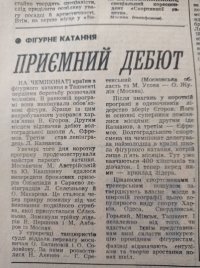
A PLEASANT DEBUT

(the article published in Ukrainian 'Sportyvna Hazeta' on April 7, 1984)

At the national figure skating championship in Tashkent, the men were the first to begin the competition. In the morning program, they performed compulsory figures. V. Egorov from Kharkiv handled this test best. Second place marked the debut of the Volgograd school for A. Efremov. Leningrader L. Kaznakov became third.
In the evening of that day, masters of pair skating demonstrated their short program. Muscovites M. Avstriyskaya and Yu. Kvashnin managed to pull ahead of the Sarajevo Olympic bronze medalists, Leningraders L. Selezneva and O. Makarov. This happened due to an unfortunate mistake during a double jump made by Selezneva. Closing the top three leaders were V. Pershina and M. Akbarov from Moscow.
In the ice dance competition, the judges gave preference to Muscovites O. Batanova and O. Soloviev. Following them were N. Annenko and G. Sretensky (Moscow Region) and M. Usova and O. Zhulin (Moscow).
After the short program in the singles event, Egorov maintained his leadership. His main rivals swapped places: Kaznakov is now second, and Efremov is third. The Volgograd athlete was delegated to the championship by the youngest figure skating school in the country, which is only five months old. Already, 400 boys and girls train there, and now they have the example of a leader before them.
With interesting athletes and coaching innovation, Kharkiv, Odesa, Sverdlovsk, Gorky, Minsk, and Tashkent are asserting their own place in the wide geography of this popular sport. Regardless of whether their representatives manage to compete with the leading skaters now, specialists note the enthusiasm and creative growth of these new schools.
1770921962513.jpeg
 
1984
USSR CHAMPIONSHIPS

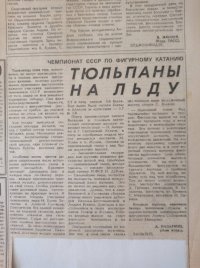
TULIPS ON THE ICE

(the article published in russian 'Sovetskiy Sport' on April 7, 1984)

Naturally, the people of Tashkent cannot yet count themselves among the refined connoisseurs of figure skating. Therefore, they enthusiastically welcome the performance of every participant in the current USSR Championship, regardless of whether they are a leader or at the bottom of the tournament table. The very fact of being in close proximity and contact with the skaters (the distance from the stands to the ice arena is not that great) cannot fail to delight the spectators.
As soon as the final chords of music faded, tulips, carnations, and roses flew onto the ice from the stands. Little girls, students of a specialized youth sports school, could barely keep up with collecting the bouquets of spring flowers.
Especially many flowers were given to the athletes after the performance of the original dance in the pasodoble rhythm. A beautiful sight! Twelve pairs, and each pair was good in its own way; each interpreted the music originally and demonstrated its own style. Particular pleasure was brought by the pairs contending for prize-winning places. First and foremost, participants of the '84 World Championships, Elena Batanova and Alexei Soloviev. They skated their program inspiredly and practically without a single mistake at good speed. The judges rightfully appreciated the performance of the Muscovites. For their composition, the students of Lyudmila Pakhomova received four scores of 5.7 and five scores of 5.6. Even higher were Elena and Alexei's marks for artistry—5.7 and 5.8.
Before the free dance, Batanova and Soloviev are significantly ahead of the second-place pair, N. Annenko and G. Sretensky. Incidentally, Muscovites M. Usova and A. Zhulin could intervene in the battle for silver medals. Their marks for the original dance were quite high.
"The final 'corrida,' as skaters jokingly call the second event of the triathlon—the original dance—was a total success," says Honored Coach of the RSFSR N. Dubova. "Despite their youth, the strongest couples showed international-class skating. This cannot but please us specialists. I think that in the person of Batanova and Soloviev, the national team has reliable backups for Natalia Bestemianova and Andrei Bukin. I am also pleased with the performance of my students, Usova and Zhulin. The guys entered a senior championship for the first time and did not falter."
The men completed their short program competition. Here is what the world ex-champion and Honored Master of Sports S. Volkov said in this regard:
"The current season has been extremely busy and difficult. The skaters began preparing for their most important starts back in June of last year. That is why some participants of the national championship lack lightness and naturalness in their movements. Only two minutes are allotted for the short program, and in this short span of time, the skaters perform seven mandatory elements of high complexity. But this time, most of the skaters succeeded with cascades and triple jumps. In my opinion, the reserve has something to work on. Nevertheless, I will note the increased mastery of Leningrader D. Gromov, Kyivan V. Baryshnikov, skater from Yerevan S. Mkhitaryan, and Muscovite M. Panin."
For the first time, Leningrader skaters Larisa Selezneva and Oleg Makarov managed to win the title of national champions in pair skating.​
A. NAZARYANTS (Our corr.)
TASHKENT
1770923249823.jpeg
 
1984
USSR CHAMPIONSHIPS

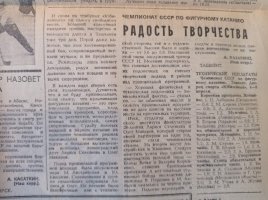
THE JOY OF CREATIVITY

(the article published in russian 'Sovetskiy Sport' on April 8, 1984)

Once again, there is not a single empty seat in the stands of the "Yubileiny" sports palace. This grand, colorful celebration of grace, mastery, and youth has been going on in Tashkent for three days now. At times, it even seems that this costume ball, accompanied by the sounds of music, never interrupts. The directors only change the scenery, delighting the breathless hall with more and more new surprises.
In every sport, there is its own culmination. I think I won't be original if I say that the culmination of figure skating is the free program—the fruit of the creativity of coaches, choreographers and, of course, the direct performers themselves, the athletes themselves. The fate of the gold medals in pair skating at the current championship was decided by a free composition performed with great inspiration by the Leningrad duo Larisa Selezneva and Oleg Makarov.
Before the free program, the Moscow pair M. Avstriyskaya and Y. Kvashnin were in the lead. The competition in the group of the strongest was opened by Larisa and Oleg. Their skating was impeccable from both a technical and artistic standpoint. The scores were high—from 5.6 to 5.8. The mentor of this pair, Honored Coach of the USSR I. Moskvin, emphasized that he considers a creative approach to working on the free program to be the main merit of his students.
"Good physical and technical preparation is an important factor," he said, "but a free program devoid of thought and plot gives no chance for high places in prestigious tournaments."
So, students of the Leningrad Institute of Physical Education, 20-year-old Larisa Selezneva and Oleg Makarov, who is one year older than his partner, became national champions for the first time. In second place were Avstriyskaya and Kvashnin. Worth noting is the success of another young Leningrad pair, Elena Bechke and Valery Kornienko, who became bronze medalists. Meanwhile, experienced tournament fighters, Muscovites V. Pershina and M. Akbarov, found themselves outside the prize-winners. A fall by the female partner, followed by the male partner, completely spoiled the impression of their performance.​
A. NAZARYANTS (Our corr.).
TASHKENT.
TECHNICAL RESULTS

USSR Figure Skating Championship. Tashkent. "Yubileiny" Sports Palace, April 4–6.
Short program. Women. 1. N. Lebedeva (Sverdlovsk) — 0.4; 2. M. Serova (Leningrad) — 0.8; 3. A. Antonova (Leningrad) — 1.2. Men. 1. L. Kaznakov (Leningrad) — 0.4; 2. V. Egorov (Kharkov) — 0.8; 3. G. Vardanyan (Moscow) — 1.2. Total of compulsory and short programs. Women. 1. N. Lebedeva — 0.6; 2. A. Antonova — 1.2; 3. M. Serova — 1.8. Men. 1. V. Egorov — 1.4; 2. L. Kaznakov — 2.2; 3. A. Efremov (Volgograd) — 2.8. Ice dance. Total of compulsory and original dances. 1. E. Batanova and A. Solovyov (Moscow) — 1.0; 2. N. Annenko and G. Sretensky (Moscow region) — 2.0; 3. M. Usova and A. Zhulin (Moscow) — 3.0.
1770972093858.jpeg
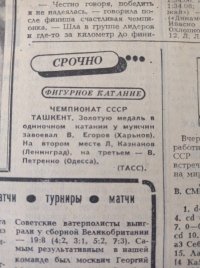
URGENT...
FIGURE SKATING
USSR CHAMPIONSHIP

(the article published in russian 'Sovetskiy Sport' on April 8, 1984)

TASHKENT. The gold medal in the men's singles was won by V. Egorov (Kharkiv). In second place was L. Kaznakov (Leningrad), and in third — V. Petrenko (Odessa).
(TASS).
1770972374240.jpeg
 
1984
USSR CHAMPIONSHIPS

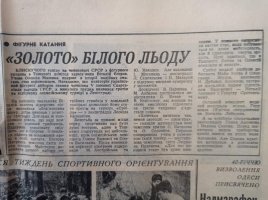
"GOLD" OF THE WHITE ICE

(the article published in Ukrainian 'Sportyvna Hazeta' on April 10, 1984)

Kharkiv's Vitaliy Egorov achieved brilliant success at the USSR Figure Skating Championship in Tashkent. The student of Alexei Mishin became a winner for the first time in the history of such competitions. We recall that the year before last, the Ukrainian figure skater won the title of champion of the V Winter Spartakiad of the Peoples of the USSR, and last December he finished third at the Olympic selection tournament in Leningrad.
In the current competitions, Vitaliy took the lead after performing the compulsory figures and performed the short program well. The free composition proved that our countryman is a good all-around skater. The results of the championship indicate that Egorov has gained support on the all-union arena in the person of Odessan Viktor Petrenko, the world junior champion. Masterful performance of a full set of triple jumps in the free program allowed him to take third place in the tournament. The "silver" went to Leningrad's Leonid Kaznakov.
The struggle for prize-winning places among pairs was very intense, as all the strongest started in Tashkent, except for Olympic champions Elena Valova and Oleg Vasiliev. After the performance of the short program, M. Avstriyskaya and Yu. Kvashnin were in the lead. But the pupils of I. Moskvin, Leningraders L. Selezneva and O. Makarov, ultimately won the dispute against the Muscovites.
Experienced V. Pershina and M. Akbarov lost to Leningraders O. Bechke and V. Kornienko, who for the first time in such competitions climbed to the third step of the podium.
"We want to skate as if today is the premiere," the new national champions E. Batanova and A. Solovyov told journalists. Their coach, six-time world champion Lyudmila Pakhomova, was the first to congratulate the students on their victory. "For us, today's start was very important. For every athlete, a stage comes when not only skill is acquired, but creative maturity arrives. It seems to me that in Tashkent, Elena and Alexei showed these qualities."
Silver medals were won by debutants Maya Usova and Alexander Zhulin, students of N. Dubova. Bronze awards went to other pupils of Pakhomova—Natalya Annenko and Genrikh Sretensky.
The last set of medals was contested by the women. 19-year-old Sverdlovsk native Natalya Lebedeva took the lead.
And Leningraders Anna Antonova and Marina Serova competed for the "silver." Before the final event, Antonova had better chances for success. But Serova managed the free composition more successfully and finished second.
1770973142734.jpeg
 
1984
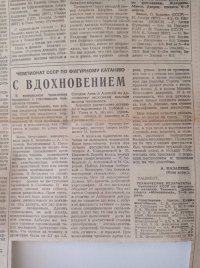
USSR CHAMPIONSHIPS

WITH INSPIRATION

(the article published in russian 'Sovetskiy Sport' on April 10, 1984)

On Sunday, the people of Tashkent said goodbye to the participants of the national championship.
As always, the ice dance couples made a special impression. This discipline enjoys highlighted favor among the audience. And when, on top of that, the performers are, as they say, "on fire," success is guaranteed.
Everyone was undoubtedly impressed by the pair E. Batanova and A. Solovyov. These students of L. Pakhomova captivated the audience not only with their flawless gliding, artistry, and delicate understanding of music but, most importantly, with their originality and their own interpretation of various elements of the free program. I spoke with specialists, trying to find out their point of view on the performance of Batanova and Solovyov. And you know, the opinions of my interlocutors were divided. Some believe that this pair, although talented, showed nothing new—that it was, so to speak, a repetition of what has already been done. Others, rightfully in my view, hold the opposite assessment. The judges, however, highly rated the Muscovites' free dance. Suffice it to say that the scores for technique and artistry ranged from 5.7 to 5.8. Today, Lena and Alexei deservedly earned the gold medals of the championship.
A good impression was also left by the pupils of N. Dubova, M. Usova and A. Zhulin, who managed to overtake N. Annenko and G. Sretensky.
And now, a word from the coach-choreographer, Master of Sports Muscovite N. Ershova:
"In the women's singles at this championship, almost all the best skaters were represented, with the exception of A. Kondrashova and K. Ivanova. The struggle was between three athletes: N. Lebedeva, A. Antonova, and M. Serova. Natasha Lebedeva's victory is indisputable. She showed masterful gliding, strength, and courage. What was she lacking? I think brightness and solid choreography. This somewhat diminishes her program. As for Serova and Antonova, unlike Lebedeva, the girls are not too familiar with the 'ABC' of figure skating—the quality of specific gliding. Because of this, they perform edges unconvincingly and do not sufficiently master the unique 'switching' of speeds. The jumps also leave much to be desired. While performing a triple lutz, Serova fell, although she demonstrated it successfully in practice, followed by two more falls. Serova does her jumps almost from a standstill, which is bad. Overall, Marina is undoubtedly gifted. I have no doubt that under the guidance of such an experienced educator as A. Mishin, she will be able to polish her skills."
I can only add that, despite such strict but benevolent criticism, the women's singles, including Serova's performance, as well as the men's, brought great pleasure. Despite our skaters having an extremely difficult sports season, they arrived in the capital of Uzbekistan in a good mood and showed everything they are capable of.​
A. NAZARYANTS (Our corr.).
TASHKENT.
TECHNICAL RESULTS

USSR Figure Skating Championship. Tashkent. "Yubileiny" Sports Palace. April 7–8.
Ice Dance. Total Score: 1. E. Batanova and A. Solovyov — 2.0; 2. M. Usova and A. Zhulin (all Moscow) — 5.0; 3. N. Annenko and G. Sretensky (Moscow region) — 5.0. Women: 1. N. Lebedeva (Sverdlovsk) — 2.0; 2. M. Serova — 4.6; 3. A. Antonova (both Leningrad) — 6.4. Men: 1. V. Egorov (Kharkiv) — 2.4; 2. L. Kaznakov (Leningrad) — 4.2; 3. V. Petrenko (Odessa) — 8.8.
1770974422306.jpeg
 
1984
Letters Review
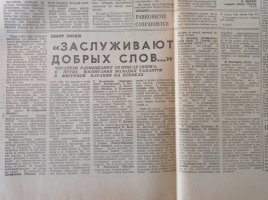
"DESERVE KIND WORDS..."

(the article published in russian 'Sovetskiy Sport' on April 13, 1984)

READERS REFLECT ON THE RESULTS OF THE SEASON, WAYS OF EDUCATING YOUNG TALENTS IN FIGURE SKATING

The 1984 season will remain memorable for many figure skating enthusiasts. Budapest, European Championship: Soviet masters won two gold medals, one silver, and two bronze. Sarajevo, Winter Olympics: our team won one gold, one silver, and three bronze medals. Ottawa, World Championship: the USSR national team added three silver and one bronze medal to its collection. And all these achievements are credited to those athletes who joined the national team practically over the last three years.
In the editorial mail, there are many interesting responses to the events of the Olympic season. Our readers note that the struggle was of a extremely intense character, and that every medal was won through great effort, thanks to the brightest creative searches. Here is what F. Saidasheva (Kazan) writes:
"The methods of the Honored Coach of the USSR Tamara Moskvina are unique. She has raised a remarkable pair, Elena Valova and Oleg Vasiliev, opening a new page in the history of the Soviet school of figure skating."
Other readers of the newspaper also pay tribute to the innovative methods of our best coaches, T. Moskvina, T. Tarasova, and others. At the same time, they emphasize again and again that much in the development of our figure skating depends on the integrity of the coaches in evaluating their work, as well as on high standards from the judges. In particular, V. Shtifanova (Moscow) notes:
"Yes, we saw cases this season where international judges overvalued the scores of skaters from their own countries. This can still be understood somewhat. But we must not put up with shortcomings in the judging of our All-Union tournaments. After all, it's no secret that in past years some athletes received high scores mainly due to their popularity. And the principle should be the same—equal requirements for everyone, regardless of titles and ranks. No 'greenhouse conditions' should be created! Only then can we raise athletes with true fighting qualities.
I am impressed by the style of Olympic champions E. Valova and O. Vasiliev, by their spirituality. L. Pakhomova and A. Gorshkov were like that in their time. But today we have few such duos, where one can feel a soulful kinship and the warmth of true feelings..."
Many authors of letters draw attention to the emotional side of performing modern programs. T. Pestryakova (Petropavlovsk-Kamchatsky), T. Ivanova (Kostroma), A. Podlisnaya (Moscow), K. Balasanyan (Yerevan), and others write with great warmth about the Olympic silver medalists N. Bestemianova and A. Bukin:
"I want to congratulate coach Tatiana Tarasova, who managed to put a brilliant free dance on the ice. In the performance of Bestemianova and Bukin, we saw a real Russian character. What speed and enthusiasm!" writes T. Pestryakova. And, as if continuing her thought, Leningrad resident V. Volk emphasizes that Bestemianova and Bukin found an original path, managing to reflect both the richness of technique, plasticity, and humor in their dances. L. Sushko (Ivano-Frankivsk region) warmly supports the choice of music for the program of our silver pair and calls for even more energetic promotion of our national music, both folk and classical, in the future.
T. Kirpichnikova (Moscow) rightly emphasizes: "With each year, Bestemianova and Bukin add new colors, improving their style. And the technical level of these ice dancers is so high that they can embody practically any, even the boldest, idea of their coach Tarasova in an ice composition..."
One of the most pleasant results of the Olympic season is a new step forward for Soviet female figure skaters in singles skating. For the first time, a bronze medal was won at the Olympics (by K. Ivanova), and for the first time, A. Kondrashova was awarded a silver medal at the World Championship. In this regard, Muscovite Titova expresses a correct thought: it's time for us to properly appreciate the 'strike force' of the Soviet national team and focus not only on the successes of our pairs and ice dance couples but also on the world-class singles skaters. Kind words are deserved by our coaches E. Pliner and V. Kovalev, who managed to bring their students to the highest level of athletic form during the most important period of the season in conditions of sharp competition.
G. Dimenko (Stavropol Krai), T. Gereeva (Dagestan ASSR), and others note that it is precisely in the programs of Kondrashova and Ivanova that the most attractive features of women's singles skating—plasticity, lyricism, and a deep connection with music—are expressed to the greatest extent. V. Zemskova (Kirovabad) believes that the current successes of our singles skaters are based on great and persistent work and the desire to improve mastery. She writes: "One cannot help but notice the stability of the performances of the GDR figure skaters, primarily the Olympic champion K. Witt. Great diligence—that is the main secret of Witt's success. And I think A. Kondrashova and K. Ivanova were able to pass the Olympic exam primarily thanks to diligence and perseverance! There is something here for those coaches who have not been able to realize their plans and ideas to think about."
T. Levanova (Polotsk), M. Trushin (Perm), N. Zlobina (Shakhty), and others, noting the progress of women's singles skating in our country, call not to be complacent with what has been achieved and to look for reserves more persistently. Especially much remains to be done in the field of music and plasticity. Our coaches and choreographers do not always have the right approach to choosing modern musical compositions. A. Kurbangaleev from Sterlitamak draws attention to the fact that some dances and programs are composed to 'suit' the unpretentious taste of part of the audience, suffering from aimless running around and grimacing. At the same time, the experience of recent years clearly says that both the depth of the plan, the brilliance of fantasy, and aesthetics are, as a rule, due to the orientation on classical music and folk melodies.
E. Klyuchareva (Tula) noticed an important feature in the ice manner of the strongest Soviet singles skaters—European champion A. Fadeev and V. Kotin. They, in her opinion, skate not only technically but with great prowess, excitement, and ease, giving a precise interpretation of the music.
"The quality of their programs," she writes, "gives us hope for real success in the coming season. I am convinced that in figure skating it is important to maintain faith in oneself, in one's direction. The path to the top is thorny. We must be patient and go firmly and purposefully."
The events of the recent World Championship in Ottawa, where not everything was perfect with the judging, where every medal had to be fought for with maximum dedication, taking into account the sharp reaction of the audience, once again confirmed: there are no easy victories, one must be in constant search and prepare oneself for any trials. Reader V. Shumilov (Gorky) rightly calls for increasing the demand on our coaches, requiring them to engage in real creative work so that the new Winter Olympics does not catch our team by surprise.
1771000299462.jpeg
 
1984
ATTENTION: EXPERIENCE


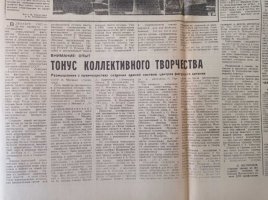
THE TONE OF COLLECTIVE CREATIVITY

(the article published in russian 'Sovetskiy Sport' on April 18, 1984)

Reflections on the advantages of creating a unified system of figure skating centers

"In December 1983, we watched the television performance of Sverdlovsk figure skater Natalia Lebedeva at the match of the strongest athletes in Leningrad. Her program pleasantly surprised us with its complexity, energy, and clean execution of jumps. We believe she fully deserves a place on the national team," wrote the Musienko spouses from Odesa in their letter, addressing their suggestions to the USSR national team coaches.
Sverdlovsk native Lebedeva ("Burevestnik") is one of those skaters who were able to reach a new qualitative level of mastery thanks to the organizational work of a number of sports schools of our trade union societies. The principles of a new direction in the activities of these schools were laid even before the 1980 Winter Games. At that time, the coaches were set a main task for the four-year cycle: to identify figure skaters with the brightest individuality and a competitive character.
The creation of a new youth "cohort" from among 15–17-year-old athletes required close attention to those cities that make up the "peripheral background" in figure skating. Let me remind you that in the five previous Winter Olympics, the national team consisted of Muscovites and Leningraders. Only in 1980 did the team include M. Pestova and S. Leonovich, who started their journey in Sverdlovsk.
It was the current Olympic cycle that was supposed to become, to a certain extent, a transition in work to a new organizational basis. One of the most effective means in this regard was the formation of several special groups under the leadership of the best, most experienced specialists. Currently, these groups are led by honored coaches of the USSR: T. Moskvina (Leningrad), T. Tarasova (Moscow), Honored Master of Sports A. Mishin (Leningrad), Honored Trainer of the RSFSR E. Pliner (Moscow), and Honored Trainer of the USSR I. Moskvin (Leningrad).
The essence of the plan was to establish close ties along the chain: children's and youth sports schools – experimental groups – specialized youth sports schools of the Olympic reserve – special groups in Moscow and Leningrad.
It was decided to leave only six specialized youth sports schools: in Kazan, Moscow, Dnipropetrovsk, Gorky, and Leningrad. Support was also provided to the Odessa specialized school under the regional sports committee; the central council of "Trud" took patronage over it. And it must be said that these six points in the current Olympic cycle played a decisive role in achieving full-fledged reserves.
The most indicative in this regard is the fate of representatives of our junior echelon in single skating, where particularly painstaking and long work is required on complex skating techniques, jumps, and the basics of plastic arts. Here, it is impossible to perform a miracle in a year. Everything is decided by planned work at different stages of forming one's own "handwriting." Already in 1981, in the central sports club of the DSO of trade unions, the issue of including young single skaters Vladimir and Viktor Petrenko (Odesa, coach G. Zmievskaya), N. Gorbenko (Kyiv, coach L. Maslyukova), I. Krundysheva, and L. Zamotina (Leningrad, coach V. Kuksinsky), T. Andreeva (Leningrad, coach T. Mishina), and a number of other figure skaters into the specialized group was resolved.
At the same time, capable young athletes A. Kondrashova (Moscow), V. Egorov (Kharkiv), L. Kaznakov (Leningrad), and A. Zakaryan (Yerevan) were attracted to the special groups of E. Pliner and A. Mishin.
Special attention was paid to the problem of the relationship between mentors and their students in connection with the transition of preparation to new conditions. In some cases, the athlete, together with their first coach, entered the group; in others, they were transferred to the care of a new mentor (of course, with the permission of their native sports school).
At the last World Junior Championships, Viktor Petrenko from Odesa won a convincing victory in single skating. In ice dance, first place was taken by E. Krykanova and E. Platov, also representatives of the trade union center for figure skating, who began their journey with Odessa coach B. Rublev and then continued their preparation at the "Spartak" school with coach N. Dubova. By the way, the transition to the "Spartak" school turned out to be painless for them, as well as for other duets formed in the "Spartak" field during this four-year period. Let us recall the rapid rise of M. Klimova from Sverdlovsk. N. Gorbenko from Kyiv successfully debuted at the junior championship.
As for the senior echelon of athletes, here the special groups of Moscow and Leningrad achieved the most significant results, in pair skating, ice dance, and single skating. Their creative face is reflected in the programs of Olympic champions, world and European champions E. Valova and O. Vasiliev (Leningrad), 1983 European champions N. Bestemianova and A. Bukin (Moscow), 1984 world championship prize-winner A. Kondrashova (Moscow), and prize-winners of the 1984 Olympics, the Leningrad pair L. Selezneva and O. Makarov.
A curious detail: at the match of the strongest figure skaters in December 1983, half of the 16 pairs were students of two trade union special groups, and these were athletes of the most promising age (14–17 years).
The results of the special groups in the Olympic cycle are a clear example for all coaches working in trade union youth sports schools. They have now become convinced that the number of ice sessions alone doesn't guarantee progress or skill development. The main thing is the focus of the coaches themselves, their methodical awareness in the fields of technology, choreography, music, psychology, and medicine, and finally, their personal interest.
Still, we must admit that the possibilities of special groups were not fully realized. The connections between these groups and coaches in societies like "Spartak," "Burevestnik," and "Lokomotiv" are very weak. In the new four-year period, it is necessary to establish constant creative ties with such centers as Gorky, Kazan, Chelyabinsk, Kharkiv, Odesa, Dnipropetrovsk, Sverdlovsk, and Riga.
A simple example: already the second season, two artificial ice rinks are functioning in Chelyabinsk, and figure skaters are provided with ice; however, there are noticeable serious gaps in the training of the coaches themselves. A set of organizational and methodical errors led to a sad outcome for Chelyabinsk: there are no good reserves. The lack of clear leadership is also noticeable in the creative potential of our figure skaters in Sverdlovsk.
An alarming situation with the preparation of reserves is in Kazakhstan. The republic posesses ice palaces in six cities – they have them in Alma-Ata, Karaganda, Temirtau, Aktyubinsk, Ust-Kamenogorsk and Rudny. But sports schools don't solve the issue of elite-level mastery. What's more, poor conditions are driving coaches to move to other republics. Thus, after two years of work, Master of Sports A. Mayorov left Alma-Ata, and after five years of work, coach M. Makoveev moved from Karaganda to Volgograd.
The transfer to a special group has a beneficial effect on mastery. N. Lebedeva, together with her coach I. Ksenofontov, has been studying the experience of the country's strongest figure skaters for two years, which helped her, finally, to reveal her individuality.
Reflecting on the search for talents in figure skating, coach I. Ksenofontov rightly noted: "Today in the coaching business, two qualities are important as never before: patience and a realistic assessment of one's capabilities. The brigade method is remarkable in that in the conditions of special groups, it reveals the true possibilities of each specialist: coach, choreographer, organizer..."
There is such a popular expression as "staying in tone." So, for figure skaters striving to reach new frontiers of mastery and stay in the national team, new forms of preparation in special groups allow them to "stay in tone." They are somewhat akin to collective creativity, but at the same time, a skillful leader always notices and develops the original beginning in their wards, just as honored coaches of the USSR T. Moskvina and T. Tarasova know how to do.
The starts in Sarajevo more clearly revealed the advantage of those figure skaters who passed good preparation in trade union centers.​

I. FILIPPOV,
Senior Figure Skating Coach of the All-Union Council of the DSO of Trade Unions.
1771003957321.jpeg
 
1984
FRIENDSHIP CUP

Figure Skating

(the article published in russian 'Sovetskiy Sport' on April 22, 1984)

SOFIA. At the "Friendship Cup" competition for young figure skaters from socialist countries, Soviet athletes won all the gold medals.
In the singles events, the winners were Tatyana Andreeva (Leningrad) and Vladimir Petrenko (Odessa). In pair skating and ice dance, the winners were Muscovites and students of the CSKA sports school: Ekaterina Gordeeva and Sergei Grinkov, and Svetlana Serkeli and Alexandr Zharkov.​
S. SHIROKOV,
International Category Judge.
1771004411289.jpeg
 
1984
ATTENTION: EXPERIENCE


THE TONE OF COLLECTIVE CREATIVITY

(the article published in russian 'Sovetskiy Sport' on April 18, 1984)

Reflections on the advantages of creating a unified system of figure skating centers

"In December 1983, we watched the television performance of Sverdlovsk figure skater Natalia Lebedeva at the match of the strongest athletes in Leningrad. Her program pleasantly surprised us with its complexity, energy, and clean execution of jumps. We believe she fully deserves a place on the national team," wrote the Musienko spouses from Odesa in their letter, addressing their suggestions to the USSR national team coaches.
Sverdlovsk native Lebedeva ("Burevestnik") is one of those skaters who were able to reach a new qualitative level of mastery thanks to the organizational work of a number of sports schools of our trade union societies. The principles of a new direction in the activities of these schools were laid even before the 1980 Winter Games. At that time, the coaches were set a main task for the four-year cycle: to identify figure skaters with the brightest individuality and a competitive character.
The creation of a new youth "cohort" from among 15–17-year-old athletes required close attention to those cities that make up the "peripheral background" in figure skating. Let me remind you that in the five previous Winter Olympics, the national team consisted of Muscovites and Leningraders. Only in 1980 did the team include M. Pestova and S. Leonovich, who started their journey in Sverdlovsk.
It was the current Olympic cycle that was supposed to become, to a certain extent, a transition in work to a new organizational basis. One of the most effective means in this regard was the formation of several special groups under the leadership of the best, most experienced specialists. Currently, these groups are led by honored coaches of the USSR: T. Moskvina (Leningrad), T. Tarasova (Moscow), Honored Master of Sports A. Mishin (Leningrad), Honored Trainer of the RSFSR E. Pliner (Moscow), and Honored Trainer of the USSR I. Moskvin (Leningrad).
The essence of the plan was to establish close ties along the chain: children's and youth sports schools – experimental groups – specialized youth sports schools of the Olympic reserve – special groups in Moscow and Leningrad.
It was decided to leave only six specialized youth sports schools: in Kazan, Moscow, Dnipropetrovsk, Gorky, and Leningrad. Support was also provided to the Odessa specialized school under the regional sports committee; the central council of "Trud" took patronage over it. And it must be said that these six points in the current Olympic cycle played a decisive role in achieving full-fledged reserves.
The most indicative in this regard is the fate of representatives of our junior echelon in single skating, where particularly painstaking and long work is required on complex skating techniques, jumps, and the basics of plastic arts. Here, it is impossible to perform a miracle in a year. Everything is decided by planned work at different stages of forming one's own "handwriting." Already in 1981, in the central sports club of the DSO of trade unions, the issue of including young single skaters Vladimir and Viktor Petrenko (Odesa, coach G. Zmievskaya), N. Gorbenko (Kyiv, coach L. Maslyukova), I. Krundysheva, and L. Zamotina (Leningrad, coach V. Kuksinsky), T. Andreeva (Leningrad, coach T. Mishina), and a number of other figure skaters into the specialized group was resolved.
At the same time, capable young athletes A. Kondrashova (Moscow), V. Egorov (Kharkiv), L. Kaznakov (Leningrad), and A. Zakaryan (Yerevan) were attracted to the special groups of E. Pliner and A. Mishin.
Special attention was paid to the problem of the relationship between mentors and their students in connection with the transition of preparation to new conditions. In some cases, the athlete, together with their first coach, entered the group; in others, they were transferred to the care of a new mentor (of course, with the permission of their native sports school).
At the last World Junior Championships, Viktor Petrenko from Odesa won a convincing victory in single skating. In ice dance, first place was taken by E. Krykanova and E. Platov, also representatives of the trade union center for figure skating, who began their journey with Odessa coach B. Rublev and then continued their preparation at the "Spartak" school with coach N. Dubova. By the way, the transition to the "Spartak" school turned out to be painless for them, as well as for other duets formed in the "Spartak" field during this four-year period. Let us recall the rapid rise of M. Klimova from Sverdlovsk. N. Gorbenko from Kyiv successfully debuted at the junior championship.
As for the senior echelon of athletes, here the special groups of Moscow and Leningrad achieved the most significant results, in pair skating, ice dance, and single skating. Their creative face is reflected in the programs of Olympic champions, world and European champions E. Valova and O. Vasiliev (Leningrad), 1983 European champions N. Bestemianova and A. Bukin (Moscow), 1984 world championship prize-winner A. Kondrashova (Moscow), and prize-winners of the 1984 Olympics, the Leningrad pair L. Selezneva and O. Makarov.
A curious detail: at the match of the strongest figure skaters in December 1983, half of the 16 pairs were students of two trade union special groups, and these were athletes of the most promising age (14–17 years).
The results of the special groups in the Olympic cycle are a clear example for all coaches working in trade union youth sports schools. They have now become convinced that the number of ice sessions alone doesn't guarantee progress or skill development. The main thing is the focus of the coaches themselves, their methodical awareness in the fields of technology, choreography, music, psychology, and medicine, and finally, their personal interest.
Still, we must admit that the possibilities of special groups were not fully realized. The connections between these groups and coaches in societies like "Spartak," "Burevestnik," and "Lokomotiv" are very weak. In the new four-year period, it is necessary to establish constant creative ties with such centers as Gorky, Kazan, Chelyabinsk, Kharkiv, Odesa, Dnipropetrovsk, Sverdlovsk, and Riga.
A simple example: already the second season, two artificial ice rinks are functioning in Chelyabinsk, and figure skaters are provided with ice; however, there are noticeable serious gaps in the training of the coaches themselves. A set of organizational and methodical errors led to a sad outcome for Chelyabinsk: there are no good reserves. The lack of clear leadership is also noticeable in the creative potential of our figure skaters in Sverdlovsk.
An alarming situation with the preparation of reserves is in Kazakhstan. The republic posesses ice palaces in six cities – they have them in Alma-Ata, Karaganda, Temirtau, Aktyubinsk, Ust-Kamenogorsk and Rudny. But sports schools don't solve the issue of elite-level mastery. What's more, poor conditions are driving coaches to move to other republics. Thus, after two years of work, Master of Sports A. Mayorov left Alma-Ata, and after five years of work, coach M. Makoveev moved from Karaganda to Volgograd.
The transfer to a special group has a beneficial effect on mastery. N. Lebedeva, together with her coach I. Ksenofontov, has been studying the experience of the country's strongest figure skaters for two years, which helped her, finally, to reveal her individuality.
Reflecting on the search for talents in figure skating, coach I. Ksenofontov rightly noted: "Today in the coaching business, two qualities are important as never before: patience and a realistic assessment of one's capabilities. The brigade method is remarkable in that in the conditions of special groups, it reveals the true possibilities of each specialist: coach, choreographer, organizer..."
There is such a popular expression as "staying in tone." So, for figure skaters striving to reach new frontiers of mastery and stay in the national team, new forms of preparation in special groups allow them to "stay in tone." They are somewhat akin to collective creativity, but at the same time, a skillful leader always notices and develops the original beginning in their wards, just as honored coaches of the USSR T. Moskvina and T. Tarasova know how to do.
The starts in Sarajevo more clearly revealed the advantage of those figure skaters who passed good preparation in trade union centers.​

I. FILIPPOV,
Senior Figure Skating Coach of the All-Union Council of the DSO of Trade Unions.
View attachment 10901
Somewhat similar to developmental questions faced in Canada, also a very large country (second largest in the world after Russia), with a climate helping to make skating popular in every part of the country,
 
1984
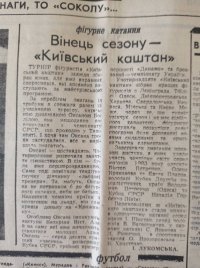
KYIV CHESTNUT

Crowning of the Season — "Kyiv Chestnut"

(the article published in Ukrainian 'Sportyvna Hazeta' on April 24, 1984)

The "Kyiv Chestnut" figure skating tournament always gathers young but already skilled athletes who confidently perform according to the master's program.
I watched the competition from the stands together with a participant of the tournament, Kyiv Dynamo member Oksana Bolila, who recently returned from the USSR Championship held in Tashkent. Although Oksana caught a bit of a cold there, she still decided to compete.
Oksana is sixteen. She started gymnastics at the age of four. By seven, she was already a first-class athlete. It was then that the "ice coaches" noticed the slender, flexible girl. However, Oksana probably wouldn't have ended up in figure skating if it weren't for her father. A former national champion in ice motor racing, he brought his daughter to the "Kryzhynka" rink himself...
Oksana is particularly impressed by the performances of Katarina Witt. But younger skaters are already starting to look up to her as well. After all, Oksana is among the top ten participants of the USSR Cup, a silver medalist of the "Dynamo" championship, and a bronze medalist of the Ukrainian championship.
For the fourteenth time, "Kyiv Chestnut" gathered the best figure skaters from Leningrad, Tbilisi, Odesa, Dnipropetrovsk, Kharkiv, Sverdlovsk, Kaunas, Minsk, and Kyiv. Perhaps because the tournament crowns the season and is not of a qualifying nature, the skaters performed more freely, and their programs were supplemented with new complex and original elements.
The competitions concluded with exhibition performances featuring the 1983 World Junior Champions from Odesa: Viktor Petrenko, Olena Krykanova, and Yevhen Platov; Friendship Cup winners of socialist countries Volodymyr Petrenko (Odesa); and USSR Cup winner Nataliia Horbenko (Kyiv).
The winners of the "Kyiv Chestnut" were all Kyivans: in women's singles — I. Shostak; in men's singles — V. Baryshevtsev; in pairs — O. Prozorovska and B. Khrystenko; in ice dance — S. Yaromova and L. Ryzhenko.​

I. LUKOMSKA
1771151195431.jpeg
 
1984
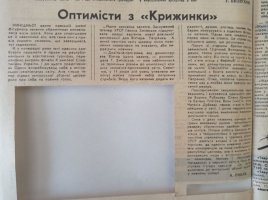
Optimists from "Kryzhynka"

(the article published in Ukrainian 'Sportyvna Hazeta' on May 1, 1984)

This spring, the Odesa figure skating school "Kryzhynka" turned eight years old. Although this is a young age for a sports school, there is reason to say now: they are satisfied with the season that has concluded.
In previous years, young Odesans won victories and prizes at republican and all-union tournaments and convincingly won the finals of the X Winter Spartakiad of Ukraine. Even before this, representatives of Odesa tested themselves in the Junior World Championships. But only now have the leaders of the junior national team made a name for themselves in full voice.
…A typical practice session was underway. Honored Coach of the UkrSSR Halyna Zmiievska was selecting the best options for a new free skate composition for Viktor Petrenko. After each explanation, the young world champion returned to the ice to test the innovation.
"The free program that Viktor demonstrated this season," said H. Zmiievska, "has already approached the technical level of the compositions of the world's best male singles skaters. For instance, at 14, my student confidently performs almost a full set of triple jumps. If we add more expressiveness to his skating, I think the boy will soon be able to compete with the leaders of figure skating. However, such a task was not set for us yet. This is a matter for the Olympic cycle that has just begun."
Next to his elder brother, 12-year-old Volodymyr Petrenko, also a participant in junior world championships, is training. He took fifth place in a tournament in Japan, competing against athletes two or three years older than him. Specialists believe that the younger of the brothers will grow into a master of at least the same class as Viktor Petrenko. Thus, men's singles skating has a good reserve in the persons of these young Odesans.
The pupils of Odesa coach Borys Rubliov, Olena Krykanova and Yevhen Platov, are also considered a promising ice dance couple. They (now trained by Nataliia Dubova) also became in Japan the best in the world this year. And the fate of the first place was decided by the Odesans' wonderful performance of their free dance.
It is in these two disciplines that the pupils of the "Kryzhynka" Olympic reserve school achieved the most success. The fruitful work of Odesa specialists with ice dancers and singles skaters, and constant internships with USSR national team coaches, are making their mark in domestic tournaments, where Odesans confidently compete not only with the republic's largest centers but also with recognized trendsetters in figure skating—the teams of Moscow and Leningrad. Let us remind you: in the world championship in Sapporo, five Odesans competed as part of the junior national team! The whole group was selected for the junior national team!​
A. RYBAK
1771153545057.jpeg
 
1984
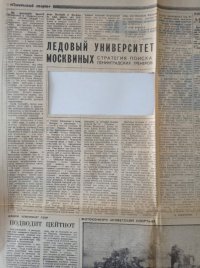
The Moskvin Ice University

(the article published in russian 'Sovetskiy Sport' on May 18, 1984)


Search Strategy of Leningrad Coaches​

At the last Winter Olympics in Sarajevo, a very rare event occurred: two figure skating pairs, coached by the husband-and-wife team of Tamara Moskvina and Igor Moskvin, stood on the podium. This can hardly be regarded as an accident or a mere coincidence of circumstances. On the contrary, such success reveals the "general line" of work of these two experienced mentors.
"Yes, in some ways our training methods are similar," admits Tamara Nikolaevna, who coached Olympic champions Elena Valova and Oleg Vasiliev.
"Of course, we discuss fundamental problems and consult with one another," says Igor Borisovich, coach of Olympic bronze medalists Larisa Selezneva and Oleg Makarov. "But I want to emphasize that our criteria and our views on the strategy of high-performance sports differ in some respects. Tamara Nikolaevna is brilliant at solving specific tactical tasks, whereas I am more interested in wide-scale goals and long-term prospects."
To be more specific, this refers to identifying an athlete's individual "type" and their inclination toward particular musical and artistic images.
"I see the origins of the Olympic programs created in the 1984 season in those long-ago compositions performed by Tamara Nikolaevna’s student, Irina Vorobieva, paired with Alexander Vlasov," Igor Borisovich explains, clarifying his thoughts. "In my view, Vorobieva embodied natural talent and sparkling power, and all of this seemed to overflow in her dances..."
This is a very accurate point. In figure skating, as in art, nothing is born out of thin air; behind every extraordinary phenomenon lie dozens of threads and paths leading back to the past.
In this regard, let us recall another judgment expressed in an interview with Soviet Sport by our wonderful ballerina, People's Artist of the USSR Natalia Dudinskaya. This is what she said at the time: "In our ballet, a young person travels a very long path before finding their true type and personal style. But for some reason, figure skaters sometimes make firm judgments about what the type of a 13-14-year-old athlete will be. Is such hasty specialization always justified?"
And indeed, the example of Valova and Vasiliev clearly shows how cautiously, without the slightest pressure or rush, the coach identified the partner’s performative and artistic abilities and the partner’s romantic type. Three years of preparation resulted in three programs of different styles, and yet, in the fourth composition, they hit the mark exactly.
The question of partners is a pivotal one in pair skating. For this reason, Tamara Nikolaevna always listened to the opinion of Igor Borisovich in this regard. It was he who suggested that she invite Igor Lisovsky—the future world champion in a pair with Vorobieva—into her group, and he also suggested inviting Oleg Vasiliev. This was particularly fitting since Oleg Vasiliev had been raised under Moskvin himself for almost ten years, training at the same rink as Igor Bobrin.
"The interaction between Vasiliev and Bobrin is a very curious point," Moskvin observes. "They had an invisible competition in every respect—in their artistry, jumps, and posture. Vasiliev was the first to perform a triple lutz and, as they say, 'got Bobrin going.' In turn, Bobrin’s performances would fire up Vasiliev every time. Everything Tamara Nikolaevna said later seemed to continue this set course, putting a logical finishing touch on the development of the partner-performer."
Moskvina’s credo was also shaped by her extensive personal experience. In 1969, Tamara Moskvina and Alexei Mishin performed a brilliant composition and became the second-ranked pair in the world. While maintaining a high level of athletic intensity, they emphasized the emotional side of the performance and deliberately sought to theatricalize their program, turning to contemporary music from film, circus, and the variety stage.
Even today, the "Gypsy Dance" (Tsyganochka) performed by Moskvina herself would likely draw applause from her students—Irina Vorobieva, Elena Valova, Elena Bechke, and the new generation of skaters. But Moskvina did not stop at exploring variety music. She boldly went further—toward the classics—analyzing all the best programs of the last decade together with choreographer V. Vigand.
Selezneva and Makarov burst onto the national team. 1981 brought victory at an international tournament in Moscow. In 1982, they perfectly executed a sequence with a double axel. By 1983, a stable triple jump was in their arsenal. Yet, these three seasons were merely steps toward a greater goal—defining their own signature style. Igor Borisovich Moskvin himself remained creatively dissatisfied, as he wanted a better realization of artistic tasks from his students.
The four-year cycle consisted of a chain of experiments, some not entirely successful, but the major Olympic season brought a new quality of mastery. In their compositions set to Negro blues and melodies from the modern ballet Crazy Day, or The Marriage of Figaro, the young duo looked fresh and original, highlighting a wide range of nuances...
"Shaved this morning, and a brand-new tie
With dark blue polka dots I wore.
I bought three asters.
At four precisely, I flew to your door..."
Many are familiar with this cheerful song and its charming foxtrot rhythm, as it has often been heard on the variety stage. However, Selezneva and Makarov, performing recently on the Luzhniki ice, offered the public an original interpretation, showcasing both extraordinary technique and an eccentric manner, along with the special lightness characteristic of first-class dance.
Contact with the audience and the ability to keep spectators in suspense—this was one of the defining advantages held in the '84 season by the top performers, the world and European champions in all disciplines of figure skating. Today, the strongest masters have reached this level, and among them are the pupils of Tamara Moskvina and Igor Moskvin. Naturally, this is no accident.
The aesthetic position of Igor Borisovich (who was also Moskvina's mentor in previous years) lies in his deliberate avoidance of trivial, fleeting trends in sport. Instead, he embodies in his programs that which should appeal to people forever, regardless of the era. After all, what pleases at first glance often ceases to please later. That which a fleeting glance can grasp often dissipates upon closer inspection, and the "makeup" disappears.
This explains the choice of many musical pieces by Moskvin’s students. This non-standard approach applies not only to the music but to all means of bringing a vision to life. Describing Selezneva and Makarov’s program, Moskvin emphasized:
"We decided to present one of the key moments—the triple toe loop—in an unusual variation, where the male partner moves ahead of the female partner and cannot see her during the jump. Psychologically and visually, this is much more difficult than a parallel jump. For Larisa, it was a great risk, but she passed the test with flying colors..."
Discussions about balanced programs and audience engagement have long been ongoing among figure skaters. However, the Moskvins were among the first to find a clear and precise answer to the question: what tips the scales when technical skill is equal? It is the dramaturgy of the performance combined with "highlights" in the technical arsenal. This was precisely the case with Vorobieva and Lisovsky’s programs in 1981, Valova and Vasiliev’s compositions in 1983 and 1984, and Selezneva and Makarov’s program set to R. Kogan’s ballet Crazy Day, or The Marriage of Figaro...
One of Tamara Moskvina’s remarkable paradoxes is being at the mercy of her emotions on the eve of major competitions, yet refusing to give in to them once the contest is over. She taught this art of self-analysis to her students as well. If one were to plot the training schedules of Valova and Vasiliev as sine waves and compare them to those of other skaters in the '84 season, it would be clear that the former won the strategic battle long before the starting whistle. Such precision is only possible with extensive experience in analyzing and synthesizing data! It is no coincidence that Moskvina is the author of two textbooks on pair skating.
There were instances when judges were overly critical of the slightest inaccuracies in the performances of Moskvina’s pupils. Others, in such cases, might simply throw up their hands and say, "It’s not our fault!" But Moskvina acted differently. "This is our miscalculation, and it is up to us to fix it," she would tell her protégés, the judges, and her fellow coaches alike. And indeed, she would rectify it through the struggle on the ice!​
A. SHELUKHIN.
1771162200575.jpeg
 
1984
KYIV CHESTNUT

Crowning of the Season — "Kyiv Chestnut"

(the article published in Ukrainian 'Sportyvna Hazeta' on April 24, 1984)

The "Kyiv Chestnut" figure skating tournament always gathers young but already skilled athletes who confidently perform according to the master's program.
I watched the competition from the stands together with a participant of the tournament, Kyiv Dynamo member Oksana Bolila, who recently returned from the USSR Championship held in Tashkent. Although Oksana caught a bit of a cold there, she still decided to compete.
Oksana is sixteen. She started gymnastics at the age of four. By seven, she was already a first-class athlete. It was then that the "ice coaches" noticed the slender, flexible girl. However, Oksana probably wouldn't have ended up in figure skating if it weren't for her father. A former national champion in ice motor racing, he brought his daughter to the "Kryzhynka" rink himself...
Oksana is particularly impressed by the performances of Katarina Witt. But younger skaters are already starting to look up to her as well. After all, Oksana is among the top ten participants of the USSR Cup, a silver medalist of the "Dynamo" championship, and a bronze medalist of the Ukrainian championship.
For the fourteenth time, "Kyiv Chestnut" gathered the best figure skaters from Leningrad, Tbilisi, Odesa, Dnipropetrovsk, Kharkiv, Sverdlovsk, Kaunas, Minsk, and Kyiv. Perhaps because the tournament crowns the season and is not of a qualifying nature, the skaters performed more freely, and their programs were supplemented with new complex and original elements.
The competitions concluded with exhibition performances featuring the 1983 World Junior Champions from Odesa: Viktor Petrenko, Olena Krykanova, and Yevhen Platov; Friendship Cup winners of socialist countries Volodymyr Petrenko (Odesa); and USSR Cup winner Nataliia Horbenko (Kyiv).
The winners of the "Kyiv Chestnut" were all Kyivans: in women's singles — I. Shostak; in men's singles — V. Baryshevtsev; in pairs — O. Prozorovska and B. Khrystenko; in ice dance — S. Yaromova and L. Ryzhenko.​

I. LUKOMSKA
Ice motor racing? Now there's a sport I've never heard of. Sounds like one that would be popular in Canada, where anything that can be done on ice is tried somewhere in the country! :yes1:
 
1984
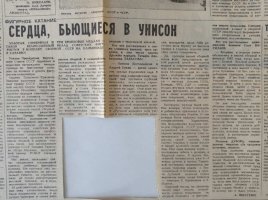
HEARTS BEATING IN UNISON

(the article published in russian 'Sovetskiy Sport' on May 25, 1984)

ONE GOLD, ONE SILVER, AND THREE BRONZE MEDALS—SUCH WAS THE MAGNIFICENT CONTRIBUTION OF SOVIET FIGURE SKATERS TO THE USSR NATIONAL TEAM’S MEDAL COUNT AT THE OLYMPICS IN SARAJEVO.
By decree of the Presidium of the Supreme Soviet of the USSR, four figure skating coaches and nine Olympic figure skaters were awarded orders and medals.
The Order of the Red Banner of Labour was awarded to Tamara Nikolaevna Moskvina, Honored Coach of the USSR and Honored Master of Sports. The Orders of Friendship of Peoples marked the achievements of her students, Olympic champions Elena Valova and Oleg Vasiliev. The Motherland highly appreciated the sporting feat of our team leaders.
Excited by the joyful news, Tamara Nikolaevna MOSKVINA, reflecting on the results of the past winter season, emphasized: "The creative successes of Soviet figure skaters reflected the professional, pedagogical, and methodological maturity of the national team's mentors, primarily such as Honored Coaches of the USSR Tatyana Tarasova and Igor Moskvin, and Honored Coach of the RSFSR Natalya Dubova.
We knew how erudite the modern spectator and figure skating fan is today. Their horizons have become unusually wide; they expect to see not only a demonstration of high technique at competitions but also an artistic spectacle”.
And indeed, the efforts of both the leading coaches and the skaters themselves were aimed at fulfilling these most difficult tasks. In the Olympic programs, the extraordinary acting abilities, creative passion, impeccable taste, and sense of music of our famous duos—Elena Valova and Oleg Vasiliev, Natalya Bestemianova and Andrei Bukin, Larisa Selezneva and Oleg Makarov, Marina Klimova and Sergei Ponomarenko, and single skater Kira Ivanova—were revealed. True to their sport, they all appeared in the '84 season not only as performers of coaching ideas but also as co-authors, people with a creative streak.
Here is what Tatyana Anatolyevna TARASOVA, a holder of three orders, including the Order of Friendship of Peoples, says about her students:
"Natasha Bestemianova and Andrei Bukin are bright personalities, mature artists of the ice. In their work on the Olympic dances, they showed deep intellect and a constant desire to analyze every step on the ice. They clearly understood why new plastic means were needed. And there is a certain logic in the fact that in the Olympic season, we came to a Russian theme, to Russian folk music. In 'Russian Fair,' my students conveyed a sense of joy, youth, and strength. They worthily fought at the highest level in Sarajevo, knowing well the strength of their rivals..."
Yes, the coaches of our national team very clearly understood the high price of medals in modern figure skating. As Tamara Moskvina noted, one of the main features of the '84 season was that our rivals—masters from England, the USA, Canada, West Germany, and East Germany—thoroughly studied the experience of the Soviet school of figure skating and took into account its main trends and course towards the spectacular nature of performances in their compositions.
Undoubtedly, special trump cards were needed to win and gain recognition in conditions of intensifying struggle. And these trump cards were found by our specialists. It is characteristic that most of the leading coaches of the USSR national team successfully used collective, brigade methods of work. They did not shut themselves within the framework of their own school or group; they willingly learned from their colleagues and generously shared their experience. Another important feature is constant concern for the reserve, for the future generation. In Moskvina's group, 6–7 new duos are already training; in Tarasova's group, young dancers constantly practice alongside Bestemianova and Bukin; and in Dubova's group, new world junior champions have grown— ice dancers E. Krykanova and E. Platov.
A broad view of the development of their sport and the need to help teammates distinguish the new generation of figure skaters. Today, the moral climate in the USSR national team contributes to the formation of athletes in the best traditions of collectivism.
Here is what Olympic champion Oleg VASILIEV says:
"I first got to know the atmosphere in our national team well in February 1983, when I debuted at the European Championships together with Elena Valova. I stayed in a hotel with Andrei Bukin. He was already a world championship silver medalist. I was a newcomer. Andrei understood my state well. And although he had many of his own concerns with training, he found the time and opportunity to be near me. He gave advice, joked, and set me up for the fight."
Over the last two seasons, the national team has been renewed by more than half, but it has not surrendered its positions. Moreover, in ice dance and women's singles, these positions were strengthened. And here, one cannot help but say kind words about our specialists who found new reserves for training first-class successors.
Natalya DUBOVA, awarded the medal 'For Labor Distinction,' said:
"We are especially happy to realize that a large group of figure skaters has been honored with high government awards. Behind the achievements at the Winter Olympics is the work of like-minded people—coaches, choreographers, musicians, sports organizers, and workers of many Palaces of Sports. The sporting honor of the USSR national team was dear to all of us. Our hearts beat in unison. And that is why success awaited us..."​
A. SHELUKHIN.
1771261383351.jpeg
 
1984
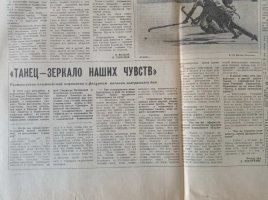
"DANCE—A MIRROR OF OUR FEELINGS"

(the article published in russian 'Sovetskiy Sport' on June 8, 1984)

Reflections of an Olympic champion on the figure skating of tomorrow

In 1978, the "Pasodoble" performed by Natalia Linichuk and Gennady Karponosov was called a "masterpiece in ice dance" by observers. At that time, the skaters were awarded the titles of world and European champions. In 1980, Linichuk and Karponosov won at the Winter Olympics, continuing the tradition of their older teammates Lyudmila Pakhomova and Alexander Gorshkov.
Natalia Linichuk has not left her skates; for the last two years, she has been training young ice dance duos at the Moscow "Dynamo" school. In a working environment on the ice of the "Kristall" training rink, our correspondent spoke with the Olympic champion.
— When do you expect to see your protégés at All-Union tournaments?

— I hope it happens soon! From the very beginning, I set high goals for the ice dancers in my group: to master not only the basics of dance but also good skating technique. I wanted the kids to show self-sacrifice in training on the ice and in the gym, so they would understand the essence of figure skating as a sport that requires self-denial and creative fire. I am glad that for the most part, the young ice dancers passed the test of willpower. I hope that a pair like Oksana Duyunova and Alexander Khaba will already earn the right to participate in tournaments of the strongest masters in the 1985 season.
— How did your coaching career take shape at first? What difficulties did you encounter along the way?
— I didn't decide to dedicate myself to raising young people right away. I tried my hand at television; I thought the work of a commentator would be to my liking. But I soon realized: for me, the most interesting thing is creating something new in sports, being a co-author of dances. The greatest joy for me, after a year's break, was to step onto the ice again.
Problems met me from my very first steps. Dozens of capable duos are already practicing in Moscow. Moreover, in children's and youth sports schools, there are very few skaters aged 12–14. It cost me a lot of effort to create a group of ice dancers, and most importantly, to keep it. Today I can name seven ice dance couples practicing at the "Dynamo" school purposefully, with full dedication.
— Ice dance has caused many heated debates recently. What do you think about trends in ice dance, and what do you prefer?
— The skill level of ice dancers in the world has grown significantly. The top ten couples at the World Championships in Canada performed highly technical, spectacular dances. They are all searching; they all draw new ideas from choreography.
The skating technique of world champions Jayne Torvill and Christopher Dean from England is unique. Their overall culture and thoughtful approach to the composition of the dance are appealing. But there is one "but." This is the construction of the program, which does not allow for a full reflection of the sporting character of the dance. Therefore, "Bolero" was not accepted unconditionally among everyone.
In my opinion, the sporting element in ice dance should still be highly valued today. In this sense, the dynamic, emotional dances of Soviet skaters at peak speeds deserved full recognition from international judges. This pair, in my opinion, came closer to the main trend in the ice dance of the future.
Let's remember that Pakhomova and Gorshkov, precisely because of their sporting direction, paved the way for ice dance as a new Olympic program event.
— How would you formulate the aesthetic principle of ice dance in the near future?
— Dance is a mirror of our feelings. And it must find a response in thousands upon thousands of spectators. When we hear beautiful, stirring music, it bursts into our hearts like a whirlwind. This is exactly how dance on ice can act. Any variety of music can become its basis; the essence lies in the performers' ability to use unique skating techniques to embody the artistic vision. Here, the process of improvement is endless.
— In your family, there is another expert on dance—Olympic champion Gennady Karponosov. Does he take any part in your coaching work?
— Certainly, Gennady does not stay away from my coaching affairs. Once a week, he definitely appears at the rink. True, he cannot devote much time to such visits. He has new, complex tasks as a senior official. But my young students look forward to each of his visits to the rink with impatience. With a fresh eye, he notices things I might miss.
— What are you seriously interested in, besides figure skating?
— Now I am studying the processes of teaching rhythmic gymnastics. But there is a professional secret in this, and I will tell you about it another time.​
Interview conducted by A. SHELUKHIN.
1771263383466.jpeg
 
1984
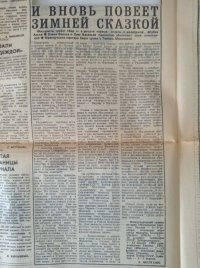
AND AGAIN THE WINTER TALE BREATHES

(the article published in russian 'Sovetskiy Sport' on August 15, 1984)

Figure skaters sound the assembly in August ● First starts in the "Alps Cup" ● Elena Valova and Oleg Vasiliev are completely updating their compositions ● French masters take lessons from Tamara Moskvina

The V.I. Lenin Sports and Concert Complex in Leningrad. These days, two winter stadiums have settled comfortably under its roof in the center. A rink for figure skaters, and around it an oval of an artificial running track. About a hundred athletes are training simultaneously. Speed skaters occasionally glance at the neighboring arena, where masters of pair skating glide to a lyrical melody. There are many duos. Honoured Coach of the USSR Tamara Nikolaevna Moskvina, after a quick count, tells us:
— Currently, there are four main pairs and seven youth pairs in my group. Plus two duos from France with their coach Anna-Marie Dorville, by invitation of our All-Union Federation, are conducting a training cycle on Leningrad ice...
Naturally, the eyes of everyone present — choreographer Valentina Wigant, cameraman Viktor Teslya, coach Nikolay Velikov (who is part of Moskvina's team), the French guests — are fixed on Olympic champions Elena Valova and Oleg Vasiliev.
The leaders of our national team have interesting creative plans for the coming season: they prepare to completely update the music, the technical arsenal, and the choreographic means in their future programs. Reflecting on trends in pair skating, Elena Valova notes:
— Spectacle of composition and originality of style have been our main trump cards in recent years. All the strongest sports pairs are searching in this same direction. At the same time, skaters' attention should be focused on complex elements. Apparently, spectators will see not one, but two parallel triple jumps in the majority of programs. Many pairs will also master the axel jump in 2.5 rotations. All this will give even greater beauty and dynamism to the competitions of the best duos. Oleg Vasiliev and I, as before, have a great attraction to modern music with its sharp rhythms and complex emotional plan. All this will find its reflection in the new programs...
Coach Tamara Moskvina plans their first start quite early — in October at a tournament in Tokyo. This is explained by the fact that it is in Tokyo where the next world championship is scheduled to take place. And for another of her pairs — USSR championship prize-winners Elena Bechke and Valery Kornienko — Moskvina has set an even more difficult task: to gain warm athletic form by August, when the "Alps Cup" begins in France and West Germany.
— In technical terms, — says Tamara Nikolaevna, — Bechke and Kornienko have achieved noticeable progress. They glide easily, with good amplitude, and work a lot on the expressiveness of movements. And now they must reach a new frontier, demonstrating psychological stability and reliability in every start — something that always distinguishes their fellow citizens Valova and Vasiliev...
Alongside experienced masters in Moskvina and Velikov's group, 12-15-year-old figure skaters train every day. And this constant communication brings very tangible benefits to the young athletes: they learn a deeper "penetration" into the spirit of musical compositions. Today, more than ever, it is important to learn to skate non-stop, without academic clichés. The group's choreographer Valentina Mikhailovna Wigant never tires of urging day after day: "Guys, love the art in yourselves, learn beauty from the great stage artists, such as Galina Ulanova! Everything you do on the ice must express your relationship to the music..."
Attention is also focused on the problems of music for those figure skaters who make up the group of Honoured Coach of the USSR Igor Borisovich Moskvin. The "Bolshevik" rink on Obukhovskoy Oborony Avenue hospitably opens its doors to many famous figure skaters of Leningrad. Bronze medalists of the Winter Olympics Larisa Selezneva and Oleg Makarov, as well as winners of All-Union tournaments Anna Antonova, Inna Krundysheva, and new pair Elena Kvitchenko and Rashid Kadyrkaev, are training here now. For each of his charges, coach Moskvin formulates precise individual tasks and plans.
— Performances in the past season for Selezneva and Makarov, — says Moskvin, — gave a lot in psychological terms. They finally felt like mature masters, allies in spirit, ready to support each other in any extreme situation. And with such an attitude towards the business, all the work on programs becomes different — more creative, more intense. I am sure that Larisa and Oleg will complete the creation of new compositions as early as October and perform at full strength at an international tournament in Holland.
Thus, by December, when the tournament for the "Moscow News" prize is held, we will have a clear picture of the balance of power.
Serious restructuring in technical and tactical terms awaits the European Championship participant Anna Antonova. In the past, qualities like her meticulousness played a positive role in developing her technical style. Later on, however, a fear of deviating from rules and instructions prevented her from finding her own voice and unique approach to technique, which ultimately stunted her growth. It is a cautionary tale. I believe that our Leningrad specialists and choreographers will help Anna find a new path.
Choreographer Yuri Potemkin has been working with Moskvin for more than a year. A well-known ballet artist in the past, he, by the way, participated in creating original free programs for European champion Igor Bobrin, and then for Selezneva and Makarov. Reflecting on the trends of the upcoming season, Potemkin expressed a very relevant thought: it is time to resolutely abandon those musical fragments that have already been heard dozens of times on sports arenas, and more boldly turn to the repertoire that is truly close to the individuality of the skaters. And this principle is embodied in the programs of the new pair of E. Kvitchenko and R. Kadyrkaev.
The new season, by all appearances, promises many interesting discoveries. And now, for figure skating fans, we will announce the dates of the main starts:
International tournament for the "Moscow News" prize, Moscow — December 5-9; World Junior Championship, Colorado Springs (USA) — December 11-16; USSR Championship, Dnipropetrovsk — January 7-13, 1986; European Championship, Gothenburg (Sweden) — February 7-13; World Championship, Tokyo (Japan) — March 5-10; USSR Cup, Alma-Ata — April 1-7.
A. SHELUKHIN.
1771664870296.jpeg
 
1984
ALPINE CUP

Figure Skating

(the article published in russian 'Sovetskiy Sport' on August 28, 1984)

PARIS. The first stage of the traditional "Alpine Cup" competitions (they take place at the start of the season on rinks in France and the FRG) brought success to Soviet figure skaters in two disciplines.
In the tournament in the French city of Saint-Gervais, the pairs skating was won by the students of Tamara Moskvina from Leningrad—Elena Bechke and Valery Kornienko. In ice dance, the winners were Muscovites Irina Zhuk and Oleg Petrov, coached by Tatiana Tarasova.
In the men's singles, Leningrad figure skater Leonid Kaznakov took third place, while Craig Henderson (USA) emerged as the winner.
1771665389480.jpeg
 
1984
ALPINE CUP

Figure Skating

(the article published in russian 'Sovetskiy Sport' on September 6, 1984)

BONN. Leningraders Elena Bechke and Valery Kornienko have won the pairs competition at the event in Oberstdorf (FRG).
This competition is the second stage of the traditional "Alpine Cup," which is contested at the beginning of the season on rinks across France and the FRG. It is worth noting that the "first round" in Saint-Gervais (France) also ended in a victory for the Leningrad pair.
The Muscovite ice dance duo Irina Zhuk and Oleg Petrov, who took first place in France, finished behind the young American dancers Lois Luciani and Russ Witherby this time. Leonid Kaznakov (Leningrad), just as in the first round, took third place in the men's singles. The victory went to Richard Zander (FRG), while second place was taken by American Craig Henderson, who had previously won in Saint- Gervais.
1771667313974.jpeg
 
1984
St Ivel International

SUCCESS OF SOVIET FIGURE SKATERS

(the article published in russian 'Sovetskiy Sport' on September 28, 1984)

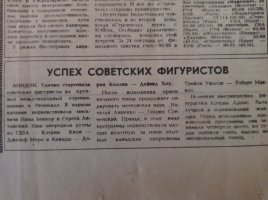
LONDON. Soviet figure skaters have made a successful start at major international competitions in Richmond. In pair skating, Muscovites Inna Bekker and Sergei Likhansky took first place. They finished ahead of duets from the USA—Katherine Healy and Joseph Mero—and Canada—Dorin Collin and David Howe.
After the performance of the original dance, the Moscow pair Natalia Annenko and Genrikh Sretenski continues to lead. However, in this part of the program, the experienced Canadian athletes Tracy Wilson and Robert McCall, who are following closely behind them, took first place.
16-year-old American figure skater Katherine Adams was the best in the women's competition. Before the free program, she held fourth place, but the judges gave her emotional dance a very high score.​
1771673377578.jpeg
 
Last edited:
1984
St Ivel International

FIGURE SKATING

(the article published in Ukrainian 'Sportyvna Hazeta' on September 29, 1984)

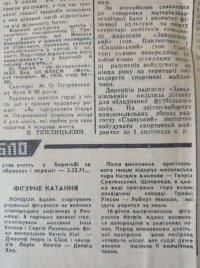
LONDON. Soviet figure skaters have started successfully at a major international competition in Richmond. In pair skating, Muscovites Inna Bekker and Sergei Likhansky took first place. They finished ahead of Kathryn Keeley and Joseph Mero from the USA and Canadians Laureen Collin and David Howe.
After performing the original dance, the Moscow couple Natalia Annenko and Genrikh Sretenski are in the lead. However, in this part of the program, the experienced Canadians Tracy Wilson and Robert McCall, who are following close behind them, took the top spot.
16-year-old American figure skater Kathryn Adams proved to be the best in the women's competition. Before performing the free program, she was in fourth place, but the judges highly rated her emotional dance.
1771676013073.jpeg
 
Back
Top