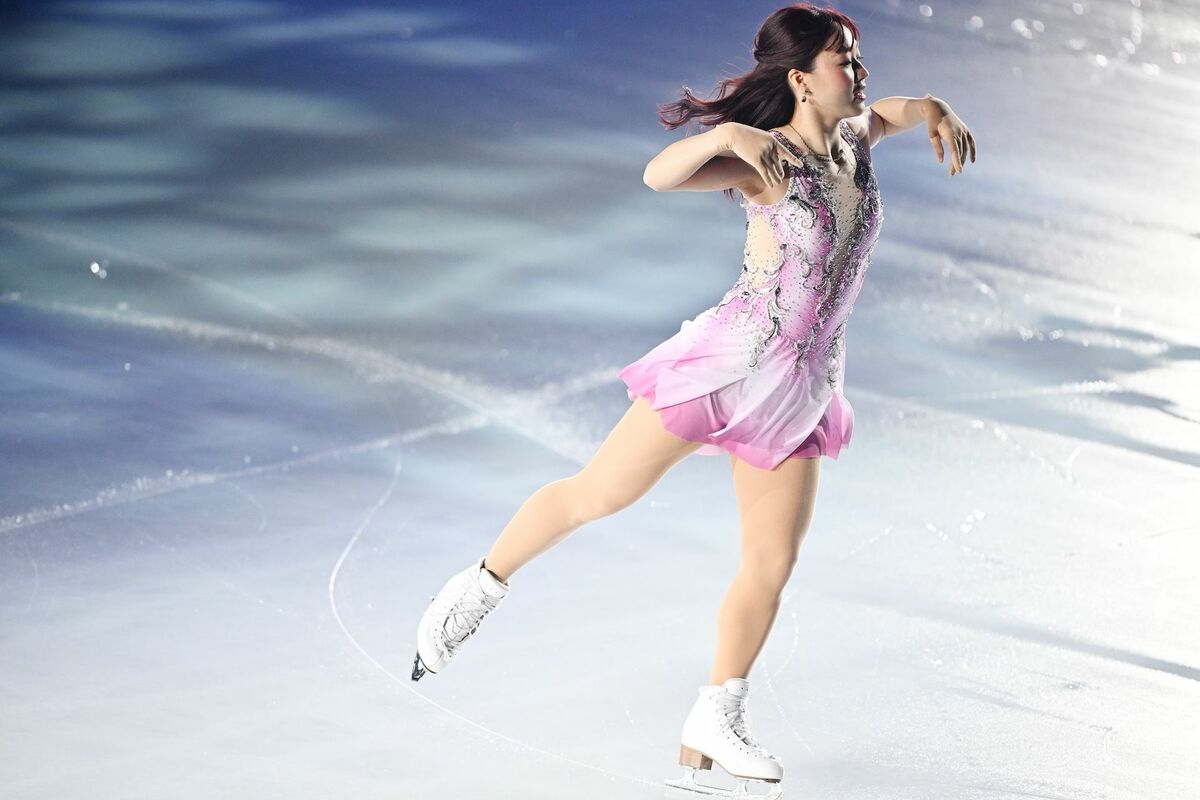
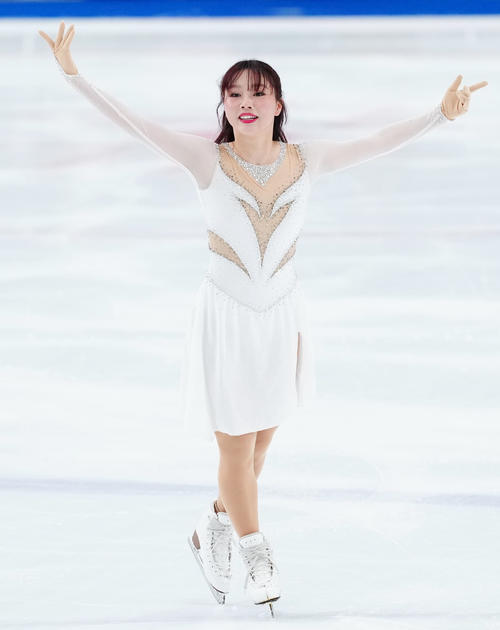
I forgot to post Part 2 of Wakaba's interview, which is also so damn good. Takaomi Matsubara is really one of my favorite interviewer and writer for Japanese figure skating.
「自分が納得して一つ一つの試合を終えられるようなイメージで過ごしていたので、それが最初から最後まで途切れることなく滑り続けられたというのがすごく印象的です」 そのシーズンを象徴するよ(1/3)

jbpress.ismedia.jp
Wakaba Higuchi on Her Thoughts and Changes Ahead of Her Third Olympic Season: "I Want to Perform Without Regrets"
A review of the 2024–2025 season and a look ahead to the Olympic season (Part 2)
__________________________
Truly Focused on Winning
"I spent the season with the mindset of wanting to finish each competition in a way I could be satisfied with, so the fact that I was able to keep skating without any breaks in my mindset from beginning to end really left an impression on me."
That season was symbolized by her performance in the free skate at the World Championships, where she was praised with applause and cheers. There was a power in her skating that captivated the audience.
Back when she first started gaining major attention as a junior high school student, people focused on her speed and jumps, and for a while, that became the dominant image of her as a skater.
However, not only at the World Championships but also starting from a certain point in her career, she began performing many programs that left a lasting impression.
"Looking back on it myself, during my junior years and the early part of my senior career, I was really obsessed with winning. I think that's natural, but when it came to expression, I was more about just doing what I was told—thinking, ‘What kind of expression is that supposed to be?’ but still going through the motions in both practice and competition."
She says the turning point came during the
2017–2018 season.
"In the season before that, I used the music Scheherazade for my free program, but it was really difficult to express. The story is very complex, so even when the choreographer would say, ‘Express it like this,’ I would think, ‘What does that even mean?’ (For the 2017–2018 season’s free skate) I used Skyfall, which is from a well-known movie, and the fact that I already knew the story might have helped too, but I think that was really the start.
As I gained more experiences—like feeling frustration, sadness, and so on—I became able to express those emotions in my performances. I started thinking, 'This part of the music should be expressed this way,' or I’d watch the movie and recall each scene as I tried to convey it on the ice. That’s really the difference between shows and competitions: how much more you can bring out those feelings. And after performing in many ice shows, I found that once I was able to let my emotions explode, I started to skate with more focus and passion for that aspect."
The benefits of becoming more in tune with her own expression extended beyond just performance.
"My jumps used to be unstable, but after I started paying more attention to expression—though I don’t really know the reason—they began to stabilize. I think being able to practice with more composure came not just from the technical side, but also because I could focus on the expressive side as well."
__________________________
Her Third Olympic Season
As Higuchi spoke about expression and reflected on the performances she’s delivered up until now, a question naturally came to mind.
—Have you ever thought about doing ice dance?
She answered immediately.
"I’ve always thought about it. I’ve always said, ‘I want to do it.’ I’ve liked pattern dance in ice dance for a long time. I think it’s amazing how two people can synchronize such difficult steps that are already hard to do alone. There are rules in ice dance that don’t exist in singles, and you have to create sections that really feel like dancing. I feel like it’s a discipline that truly lets you experience the essence of skating, so I’ve always wanted to try it."
After taking a breath, she continued with a smile:
"But I also know how tough it is. I think the reason I do singles is probably because I lack the ability to coordinate with others. I feel like syncing with someone would be a bit tough for me. Even with steps, when I try to match someone, it throws me off. Usually, the male partner adjusts to the female, but even so, there are parts you have to hold back on. Even when practicing, it's still really hard."
Back to the main story.
Now, as she approaches a new season—bringing with her the foundation built over more than 20 years since she started skating at the age of three, and the mental strength she gained during her break—she steps into what will be her third Olympic season as a senior.
"I still have that desire to go to the Olympics again. If I’m going to keep competing, I want to aim for it. That part hasn’t changed."
__________________________
“A Performance Without Regrets”
Still, she has no intention of changing her approach of taking things “one step at a time.” That mindset is rooted in her past experiences. Higuchi did not qualify for the PyeongChang Olympics, but she did earn a spot for the Beijing Olympics.
“When I was aiming for the PyeongChang Olympics, it was like everything was for the Olympics. Each competition felt like it existed only for that goal.”
The pressure was immense.
“From more than four years before PyeongChang, people around me kept talking about it—‘You’ll definitely go,’ ‘You’ve got this, right?’—and hearing those kinds of things was honestly really tough. Of course I was aiming for it, but now that I look back, it was exhausting to see nothing else but that one goal.”
After that, her mindset shifted heading into the Beijing Olympics.
“To be honest, during the Beijing season, I had decided that if I didn’t make it, I’d quit. So when I thought about the possibility of retiring without qualifying, I made it my goal to be satisfied with each and every performance, to finish each competition without regrets. In the end, that led me to the Olympics. I truly felt that building things step by step can lead to achieving a big goal.”
That’s why, just like this past season, she plans to move forward steadily and deliberately.
“This is a really important season. I think it might be my last. But rather than obsess over the result, I want to aim for a performance that I can truly be satisfied with—that’s what I believe will allow me to end this on a fulfilling note. Of course I’m still aiming for the Olympics, but I think that as long as I stay true to myself and don’t lose sight of my own goals and pace, the results will follow.”
When asked again about what makes figure skating so special, she says:
“It’s a sport where you can take your own experiences and emotions and express them directly on the ice, syncing it to music and choreography—and then, the people watching are emotionally moved by it. There really aren’t many sports like that.”
Having lived her life in the world of skating, she reflects on the kind of skater she wants to be.
“If I can say this with a bit of hope—it would be nice if my appeal could be skating that people enjoy regardless of scores, skating that never gets boring.”
The way she speaks, without pretension and with unwavering sincerity, mirrors her approach to skating itself.
And so, with the foundation she’s cultivated through it all, Wakaba Higuchi steps forward into a monumental season.