1986
USSR CHAMPIONSHIPS
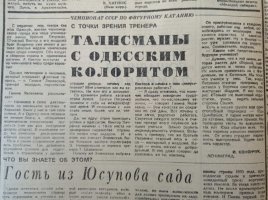
CONVERSATION BY THE RINK SIDE
A Happy Choice
(the article published in russian 'Sovetskiy Sport' on January 5, 1986)
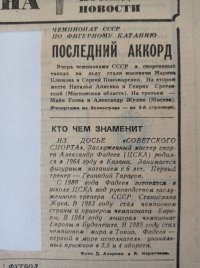
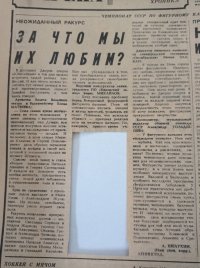
Is it easy to become a coach, let alone a specialist in a sport as complex as figure skating? Do not expect a categorical answer from Ardo Rennik. He began his path to this profession 20 years ago and believes that only now, at the 50th USSR Championship, his students can demonstrate programs with a quality mark.
"— However, this is not yet my year," says Ardo with a gentle smile. "I expect a real revenge from my guys in 1987. That is how I have it planned."
Ardo started working as a coach at the age of 17.
"— I was shocked that for the first lesson my female students came in bloomers [harem pants] rather than in sports attire," he recalls. "I asked them what the matter was. And they replied: 'We are shy around you.' To them, I was like a suitor. That's when I realized it is not so simple to establish contact with students. Two years later, I left Tallinn for Leningrad and entered the Lesgaft Institute of Physical Education..."
"— Is that where you mastered the coaching profession?"
"— No. Back then, in my year, I met a girl—Yulia Pavlina (she was a student of coach Igor Moskvin)—and suggested we form a sports duo. For eleven years we competed in pairs skating. And our last season—1978—became our peak season. Our program included a double Axel jump and double-rotation throws. At the 1978 Winter Spartakiad of the Peoples of the USSR, we won the 'bronze' in a struggle against the future world champions Marina Cherkasova and Sergei Shakhrai."
"— And what about studying at the institute?"
"— We took our exams honestly. I knew that without solid knowledge, we wouldn't be able to process our competitive experience. And later, we were invited to work at the Sverdlovsk figure skating school..."
"— Still, what attracted you to the coaching profession?"
"— And here Ardo unexpectedly recalled his youth in Tallinn again. He uttered just two words: 'Lii Piir.' The connection between generations immediately became clear. Lii Piir, an extraordinarily energetic, emotional woman, taught figure skating lessons on natural open ice and revealed the romance of winged skates to her boys. It was then that Ardo 'fell ill' with figure skating."
"— Ardo, you and your wife Yulia have been running the pairs skating school in Sverdlovsk for fifteen years now. Do you regret your choice?"
"— Not at all, the work is to my liking. Even now, I sometimes demonstrate complex elements to the kids. And our new pair, currently competing in Leningrad—Yulia Bystrova and Aleksandr Tarasov—possesses a full modern technical arsenal. They are medalists of the Winter Universiade and a major tournament in England. By the way, Sasha also graduated from the Leningrad Institute of Physical Education. He is 24 years old, and Yulia Bystrova is 19. For pairs skating, in my opinion, this is the time of true blossoming."
"— Ardo, why do you think that your year will be 1987?"
"— There are many reasons. We are looking for reserves in the artistry of the program performance and in the complexity of elements. Under the new rules, parallel triple jumps, a triple Axel twist, and triple throws represent the highest difficulty. These will form the foundation of our pursuit."
A. SHELUKHIN.
(Our spec. corr.).
LENINGRAD
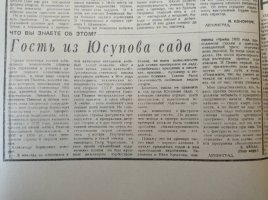
WHAT DO YOU KNOW ABOUT THIS?
What is the Filling of the "Pie"?
(the article published in russian 'Sovetskiy Sport' on January 5, 1986)
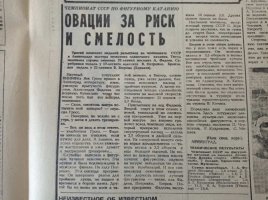
The "Yubileiny" Sports Palace has dressed up and looks younger. After eighteen years of operation, its main ice arena has undergone a capital renovation. The ice gleams and shimmers under the rays of the light fixtures. And few people think about how complex the "filling" of such an ice field is. If you ask figure skaters, "How do they 'brew' the ice for you?", at best you will hear the answer: "It is frozen on concrete. And the cold is supplied through pipes." But is it really that simple?
"— Our 'pie' has a multi-layered filling," explains the chief engineer of "Yubileiny," Viktor Ilyich Mini. "If the pipes were simply embedded in concrete, such a foundation would quickly crumble into pieces. A complex waterproofing system is needed, along with special layers that cushion, so to speak, the expansion and contraction of the arena caused by temperature differences. What is included in the eleven layers? There is a mastic primer for the foundation, styrofoam, glass-fiber roofing felt, a layer of talc, reinforcing mesh, a protective concrete slab, and only then, on top of all this, 18 kilometers of pipes are installed, 'dressed' in a new concrete jacket."
The chief engineer's story makes one remember with respect those who put their labor into the mirror-smooth ice surface. In particular—the builders of Trust No. 16 of "Glavleningradstroy" and its numerous subcontractors. They brought to life a project developed at the Leningrad Zonal Research and Design Institute of Experimental Design. At first, it was assumed that the old arena would have to be dismantled and a new one laid in its place. But it turned out to be simpler and more economical to make a multi-layered "pie" on top of the old foundation. Time was saved, and the rink was only raised by 30 centimeters.
"— But this is only part of the renovation," clarifies the chief engineer. "The entire sound reinforcement system for sports and other entertainment events has been replaced. We received the equipment from the Leningrad Optical and Mechanical Association named after V. I. Lenin]. A cosmetic renovation of many premises has been carried out. All work was completed on schedule.
Right now, 'Yubileiny' is hosting the jubilee figure skating championship. And the highest evaluation for those who prepared the multi-layered ice 'pie' will be the high mastery of the athletes."
B. AVLAS.
(Our corr.).
LENINGRAD
View attachment 11482



 . Him spinning with her in a handstand position on his boots, maybe? Or just a SBS reverse camel, with both in a supine position?
 . (I have that on an old practice videotape that I haven't been able to get transferred to a DVD or I'd post it here
  , with my partner pretending to be a boxing referee and counting me out as he stands over me.) I wouldn't be able to do it in a program unless it was the finish!