1985
MOSCOW NEWS PRIZE
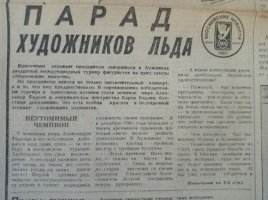
PARADE OF ICE ARTISTS
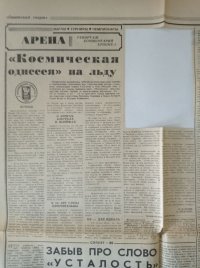
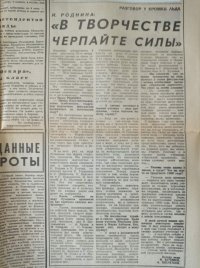
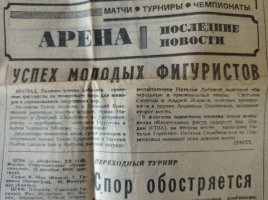
(the article published in russian 'Sovetskiy Sport' on December 10, 1985)
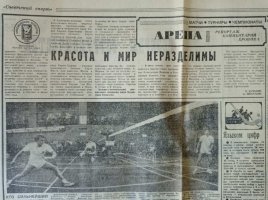
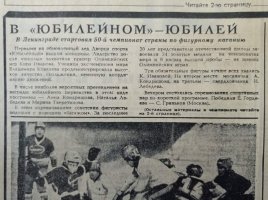
The twentieth international figure skating tournament for the prize of the Moskovskie Novosti (Moscow News) newspaper concluded in Luzhniki with a colorful ice celebration.
However, the highlight was not only the final concert, but also the events that preceded it. In the competitions, the winners of the singles skating tournament became World Champion Aleksandr Fadeev and American figure skater Caryn Kadavy, who brilliantly proved that there is a special beauty in the flawless execution of complex elements.
The Tireless Champion
World Champion Aleksandr Fadeev added another prize to his collection—for winning the Moscow tournament. Interestingly, Aleksandr began his ascent five years ago at these very same competitions (back then, he took fifth place). Fadeev showed rare dedication—from season to season, he increased the complexity of his programs. And by December 1985, he approached the competition with an arsenal of jumps that can boldly be called unique. In Luzhniki, he performed a combination: a triple axel with a triple toe loop.
"It is a pity there was little time," he said after his performance. "Only a week before the start did I finish putting together a new program with my coach, Stanislav Alekseevich Zhuk."
— And which compositions gave you the greatest creative satisfaction?
— Perhaps three short programs from recent years—the Charleston, Rock and Roll, and "Russian Fantasy." There was also another very vibrant part—the third one—in the free program of last season. But I think that right now, we will create our strongest composition.
— What made this year's tournament in Luzhniki interesting?
— The appearance of figure skaters from the USA immediately added a special sharpness to the competition. Masters arrived in Moscow who, by all indications, will be our rivals at the World Championships. And we have already been able to see for ourselves fact that Caryn Kadavy and Christopher Bowman, young American singles skaters, are already preparing for the Olympic Games in Calgary.
— In recent years, singles skating has progressed very rapidly both in the difficulty of complex elements and in artistry. Does the influence of other disciplines of figure skating play a role in this?
— I think there is an influence. The compositions of the world's strongest ice dancers made a great impression on many masters of singles skating. For example, in the case of the famous British pair and Olympic champions Torvill and Dean, I would highlight a special harmony of technique and choreography. The more new things you learn, the faster you move forward.
Fassi Finally Smiles...
It seems that for the first time in the last five days, he smiled with relief. Caryn Kadavy, his student, easily and cleanly landed a triple jump, flawlessly performed a combination, curtsied to the judges, and, gliding past the stands from which "Bravo!" was echoing, slid to the boards. There, catching her breath, she fell into the embrace of Fassi. It was then that the American girl's coach could not contain an moved smile.
Kadavy's marks had not yet been announced (and they would be the highest—from 5.7 to 5.9 points), but she herself, Fassi, and the packed arena already knew: this was the best free program among the women. Sitting next to us, Elena Tchaikovskaia commented briefly:
" Kadavy is a discovery of the season."
Yes, right here in Moscow, on the Luzhniki ice, for the first time, the name of the 17-year-old talented American figure skater resounded so loudly. Just a year ago, she competed in the junior ranks, and the Moscow tournament became only her fourth senior start. Her highest achievements until now were a second-place finish at the US National Championships and a victory at the international Skate Canada tournament a month ago.
Usually a reserved and cautious person in his judgments, Fassi was unusually talkative and energetic in gestures on this day like all people of his nationality (Italian), it was the right time to interview him.
— Mr. Fassi, you used to be one of the leaders in men's skating, holding the European Champion title in the 1950s. What is the fundamental difference between the figure skating of your youth and modern figure skating?
— Approximately the same difference as between the six-seater Douglas I once flew on to competitions, and today's fantastic airliners.
— Should I understand that you link progress on the ice only with improved execution technique and the appearance of new, ultra-complex elements?
— This explanation would be too simple. Figure skating, of course, like many other sports, is developing along the path of increasing technical difficulty, and this is a natural process. But not the only one. I think, for instance, that a quadruple jump is possible. But I am not sure that it will look more graceful than high, impeccably executed jumps in two or three rotations. So when talking about progress, I primarily mean a more perfect execution performance - the purity of skating, impeccable command of edges, and polished technique of jumps and jump combinations.
— These qualities once distinguished your famous champions Peggy Fleming, Dorothy Hamill, Robin Cousins, John Curry. Are these qualities also inherent in your new pupil?
— It is easier for you to judge from the outside. I can only say that we are striving for this. Judging by the favorable reaction of the judges and Moscow audience, we achieved something. Caryn has been figure skating for eleven years, now she needs to accomplish the hardest part—realize her skills and experience on a large scale. I believe in Caryn's future, but I wouldn't want to lavish premature compliments.
— And yet, what traits in your student's character appeal to you mostly?
— A passionate, all-consuming passion for figure skating. You believe in people like that; they won't let you down.
— Do you have a large group of skaters?
— Generally, yes. My wife Christa and I train not only Americans but also European figure skaters who wished to work with us in Colorado Springs. But Kadavy is the brightest figure among them, and we, of course, pay special attention to her.
— Which of the Soviet female figure skaters impressed you the most?
— Elena Vodorezova. A talented athlete, but as I recall, she wasn't always lucky...
Meeting in the Stands
Large, slightly surprised eyes, and a natural, trusting smile. Elena Vodorezova was sitting next to us in the box of the press, eagerly watching the ice. In that gaze, there was longing, joy, and empathy. A World bronze medalist, Vodorezova left the sport after the 1984 Olympics—leaving without fully unlocking her talent. Now, she coaches young figure skaters at CSKA.
— What impression did the women's free program make on you?
— Can I start with criticism? It seems to me that lately, female skaters have become overly preoccupied with artistry and the external flashiness of their programs. But these qualities are only good if they are harmoniously combined with high execution technique. Take, for example, the highly calculated, virtuoso composition of Aleksandr Fadeev. I did not see such a combination, such a reasonable balance, in the programs of our female skaters. Unlike, say, Kadavy.
— What did you like about the American skater?
— I already mentioned the harmony of her style. Her clean skating, precision in jumps, and clarity of style are captivating. However, our leaders—Kondrashova, Lebedeva, and, of course, Ivanova, who could not compete in this tournament—generally possess these qualities too. But Kadavy does everything on the ice effortlessly and lightly; she skates for her own pleasure. The same goes for the Canadian skater, Wainman, though her program is far from perfect. Meanwhile, a certain stiffness and fear of making a mistake can be felt in all our female skaters without exception. This prevents them from showing what they are capable of. Let's hope they will overcome this barrier of insecurity by the main competitions of the year.
V. KUCHMIY, A. SHELUKHIN.
Technical Results
International Tournament for the Prize of the "Moskovskie Novosti" Newspaper. Moscow, Palace of Sports. December 7–8.
Ice Dance. Combined Total. 1. N. Bestemianova — A. Bukin — 2.0; 2. M. Klimova — S. Ponomarenko — 4.0; 3. N. Annenko — G. Sretenski — 6.0; 4. M. Usova — A. Zhulin — 8.0; 5. O. Volozhinskaya — A. Svinin — 10.0; 6. I. Zhuk — O. Petrov (all — USSR) — 12.0.
Men's Singles. 1. A. Fadeev — 2.0; 2. V. Kotin — 5.0; 3. V. Egorov (all — USSR) — 7.0; 4. C. Bowman (USA) — 8.2; 5. L. Kaznakov — 9.6; 6. G. Vardanian (both — USSR) — 13.0.
Women's Singles. 1. C. Kadavy (USA) — 3.2; 2. A. Kondrashova — 4.4; 3. N. Lebedeva (both — USSR) — 6.2; 4. T. Wainman (Canada) — 7.2; 5. I. Krundysheva (USSR) — 9.4; 6. N. Sasseville (Canada) — 14.8.