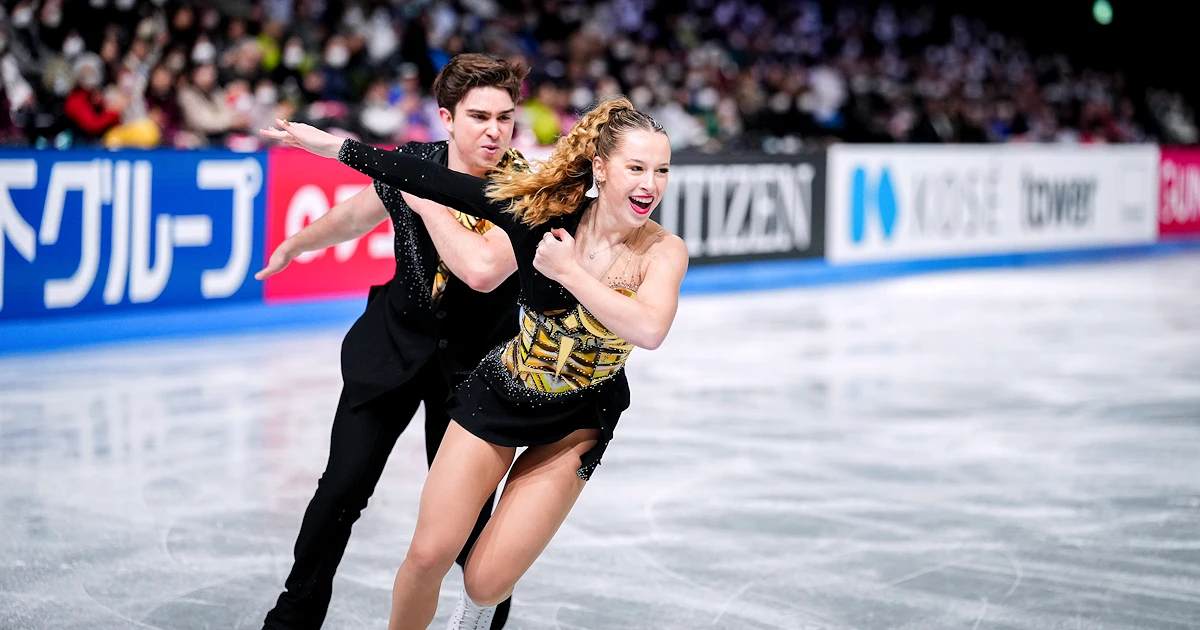
Layla Veillon and Alexander Brandys Interview | Golden Skate

News Layla Veillon and Alexander Brandys Interview

News

gsk8

🎗️AA5342🎗️
Record Breaker
Joined
Jun 21, 2003

Twelve Years, One Partnership, and a New Beginning for Veillon and Brandys​


After spending more than a decade skating together, Layla Veillon and Alexander Brandys are preparing to make the jump to the senior ranks.

In our latest interview, they discuss:
  • Their 12-year partnership and how it began
  • Training with Scott Moir and one of the world's strongest ice dance camps
  • Lessons learned from their final junior season
  • Their new Queen Rhythm Dance and Tron-themed Free Dance
  • Their goals and mindset heading into their senior debut
Discussion Questions:
  • How difficult is the transition from junior to senior ice dance today?
  • What are your expectations for Veillon and Brandys during their first senior campaign?
  • What do you think of their music choices?
  • Do you think training alongside so many established senior teams in London, Ontario gives them an advantage?
Looking forward to hearing everyone's thoughts!
 
The transition depends in my opinion, on three things :
the ability for the skaters to improve in their weaker areas because at senior level, if there is a weakness, you're in big trouble.
the federation pushing you up by sending you to many international events. Judges need to see the skaters to appreciate them.
the judging : for some reasons I ignore, some junior teams going to seniors are very appreciated by the judges while others are not... it doesn't matter really if they were on the world podium or not, it's all about what judges do with that. This may sound a bit cynical but as a fan who is not an expert in ice dance, I sometimes am perplexed by how this team moving up is suddenly passing up very experienced teams and another junior team moving up, with about the same kind of credentials, is left behind for several years.

Expectations : they come in a year where only a couple of senior teams are still intact in Canada. It's a perfect opportunity for them to establish themselves within the Canadian ice dance ladder. I expect them to be very ready early on and make their moves. Will it be enough when everyone is getting ready by nationals ?

I trust they pick good music but I don't particularly know the pieces so.. hard to comment ;)

Having good teammates to train with is often inspiring and I would say, it is an advantage. Having Scott Moir as a coach is definitely a plus. He seems to be doing very well with his teams.
 
It's nice to hear more about Veillon/ Brandys and their long career together. I think a talented young team who have been together since childhood have a great advantage in knowing each other so well. Two legendary examples in ice dance are Davis/ White and Virtue/ Moir. Obviously, it doesn't work out that every young team manages to stay together. Those who do last, appear to have strong mutual goals, consistently improving communication skills, and the ability to get along well with each other through thick and thin. These key factors come through loud and clear in this feature on V/B. I was particularly struck by their ability to recognize the growth process they have gone through and the major milestones which encouraged them to continue elevating their aspirations.

Thanks for highlighting this team and their journey to date. I have been impressed with them in juniors, especially with how they have weathered and learned from setbacks in a remarkable field of talented junior ice dancers. V/B have held their own and they are surely stronger and better prepared to embark on a senior career, as a result of the challenges they overcame. The support and advice from Moir/ Hubbell is spot-on. Don't over-focus on placements, just concentrate on training, setting goals, and learning from every competitive experience, including all the ups-and-downs.

It was enlightening to learn that V/B were brought together as youngsters by one of Scott Moir's siblings, and that the Moir family are still involved in training and guiding V/B under the IAM umbrella in London, Ontario. As students there, V/B echo (as we've heard from others) what a stimulating, uplifting, supportive, and challenging environment they train under. From the experienced coaching staff to all of the exciting young teams who train at this IAM satellite. It sounds like a wonderful place to develop as an athlete and as a caring, responsible human who will one day move on to give back to the sport and/or contribute to doing good in other endeavors.

While reading this feature, I was reminded that the sporting life doesn't last forever. So, the best advice is to prepare diligently to give it your all when you have bountiful resources & opportunity. Furthermore, learn to embrace each moment fully, in order to be able one day to look back with thanks for every experience, along with an abundance of fond memories, and no regrets.
 
I sometimes am perplexed by how this team moving up is suddenly passing up very experienced teams and another junior team moving up, with about the same kind of credentials, is left behind for several years.
Could you explain more about other teams you are referencing? There has been such a shakeup and turnover in Canadian ice dance. The sport is never fair, as we regularly witness. For young athletes, having talent, luck, and support from the right quarters can determine overall success. But nothing is set in stone in this sport.
 
Could you explain more about other teams you are referencing? There has been such a shakeup and turnover in Canadian ice dance. The sport is never fair, as we regularly witness. For young athletes, having talent, luck, and support from the right quarters can determine overall success. But nothing is set in stone in this sport.
I'd rather not. When we start talking about this, it derails the threads because fans of teams that are favoured will find all possible explanations to justify their rise. Sometimes, these explanations are objective, and sometimes they are opinions. So, yeah :) I'll skip on this. All I am wishing is for Layla and Alexander to not be held back, not just among Canadian teams but on the world scene. They are special and I hope that their "branding" will be appreciated by many, especially the judges LOL :)
 
Okay, thanks @4everchan. No need for thread drift, you are right. I was just a little confused by that comment. I realize now that I misinterpreted what you were saying, due to the phrasing. I've got more clarity now! 👍 BTW, is French your native language?
 
I was really impressed by these two last season, and wished that the pewter medal existed for these two. I know it's not about medals only, and it is really good to focus on your own growth, but I really enjoyed watching them and would have been pleased if they had gotten a medal. I like too to note how inspired they are. Good for the Moirs, Diaz and Hubbel in their coaching and choreographic efforts. I am really curious about the Queen-Waltz. I hope to see it soon.
 
It was enlightening to learn that V/B were brought together as youngsters by one of Scott Moir's siblings, and that the Moir family are still involved in training and guiding V/B under the IAM umbrella in London, Ontario.
I think Scott's siblings are hockey players and not involved in figure skating. Of the "sisters and cousins and aunts" involved in figure skating: Alma is Scott's mother, Carol is his aunt, and Sherri and Cara are his cousins.
 
This may sound a bit cynical but as a fan who is not an expert in ice dance, I sometimes am perplexed by how this team moving up is suddenly passing up very experienced teams and another junior team moving up, with about the same kind of credentials, is left behind for several years.

Please do elaborate :)

What do you mean by passing up exactly? And who? Which experienced teams? Which junior team?
 
Please do elaborate :)

What do you mean by passing up exactly? And who? Which experienced teams? Which junior team?
As I mentioned, I didn't want to bring up specific skaters. My reflexion is more along the lines that sometimes, a team moves up from junior to seniors and is buried down for years in national/international rankings while other teams, some they may have beaten when they were competing together as juniors, seem and I say seem, to be fast tracked to the top of the pack nationally and are better positioned internationally.

Is it because the latter team made a better transition or is it for other reasons like internal ranking and opportunities (or worse, politicking) ?

In ice dance, it's rarer to see juniors who already skate like seniors, with all the strength, skillset and experience that skaters who are in their late twenties or early thirties had an extra decade to develop. Yet, sometimes, a team seem to be parachuted to the front, leap frogging others. In singles, yes, a very talented skater with a big trick like Ami's triple axel, can lead her on the Olympic podium right away. In ice dance, there is no such thing as a very specific element that can make a difference up. Most likely, more junior teams will lose levels compared to the seasoned competitors and have a lower base value.

Yet, sometimes (and perhaps rarely I should say), a team seems to be "accepted" right away in the top tier of seniors, right upon arrival on the senior scene. Am I the only one noticing that ? :) It's quite possible I am overthinking things.

In other words, I am curious to see how Layla and Alexander, who finished 4th at Junior worlds, would fare compared to the other three teams who beat them in junior worlds. Two of these teams have a lot of internal competition. The other, has a perhaps clearer though never an easy path. Would Layla and Alexander benefit from the reshuffling of ice dance in Canada ? They already have a GP spot. The Ukrainians have two spots but the USA and French do not (I think they are younger and may still be skating JGP). Or will they skate a few years in senior, be buried down the rankings and then, when younger junior teams they competed with finally reach the GP circuit, be buried down even further or not ?

Ice dance junior to senior transitions are tricky this way for me because it takes not only work and talent but also years of development to reach better technique. So, sometimes, and I guess that sums up what I am trying to say, I have a hard time understanding hierarchical rankings among the younger teams in ice dance, especially once they reach senior competitions.

 
I guess I need context and specific examples so I understand what you are trying to say. Are you saying another team with more experience should have received a GP spot? :scratch2:
 
Well, for starters, let's see how Layla and Alexander do at CQÉ and Skate Canada. They will meet a bunch of the Canadian senior teams in CQÉ and the Ukrainians who beat them at Junior worlds at Skate Canada.

BTW in 2024, Layla and Alexander finished 7 or 8 places above Pidgaina and Koval. However, the year after, because the age rules changed, Canada sent two more experienced teams (who were able to stay or regain junior status) to JWC. The Ukrainians were 4th. When Layla and Alexander came back to the Junior Circuit, they didn't catch up on the Ukrainians. Is it because the Ukrainians improved a lot, so much that they went from 15th to 4th to 3rd, passing Layla and Alexander to win a medal at JWC or did the fact that Layla and Alexander were not able to compete at 2025 JWC hurt them in the standings ?

That's one example on how internal competition may have an effect on international ranking. Or maybe it's just that the Ukrainians improved drastically. It could be a bit of both.

I don't want to provide more examples because I wouldn't want to derail the thread into a discussion of other skaters. I provided one example that was in relationship to Layla and Alexander. I really like them and have been following them for a few years. I hope they transition well and keep motivated despite the strong field that is shaping up with all these new teams coming together this summer in Canada.

It will be fascinating to see how all these new teams fare against one another. Perhaps my thoughts are coloured with what is currently happening up North.
 
I think Scott's siblings are hockey players and not involved in figure skating. Of the "sisters and cousins and aunts" involved in figure skating: Alma is Scott's mother, Carol is his aunt, and Sherri and Cara are his cousins.
Thanks for the explanation. 🙂 I wasn't certain of all the relationships. I just knew Moir family members are closely involved and on the coaching staff at IAM Ontario. 👍
 
Well, for starters, let's see how Layla and Alexander do at CQÉ and Skate Canada. They will meet a bunch of the Canadian senior teams in CQÉ and the Ukrainians who beat them at Junior worlds at Skate Canada.
Ok, so you mean that you were concerned that a new senior team is moving past other senior teams that have been around? And if so, I'm assuming you mean GP spots?

There have been quite a few splits, so not sure I'm following.

Also just wanted to point out that Veillon/Brandys qualified for the Junior Grand Prix Final, won the Canadian junior national title, and had a fourth-place finish at Junior Worlds.

When looking at the Season's World Rankings for last season, Veillon/Brandys fall right below Fabbri and Ayer who have since split.

There is also still an open spot for Skate Canada...
 
Ok, so you mean that you were concerned that a new senior team is moving past other senior teams that have been around? And if so, I'm assuming you mean GP spots?
There have been quite a few splits, so not sure I'm following.
No. That's not my concern. I am talking more about world rankings. How internal competition can stall a team like Veillon and Brandys for instance, compared to a team with less internal competition. By the time Veillon Brandys may have Senior world exposure, where would a team like the Ukrainians be ?

Also just wanted to point out that Veillon/Brandys qualified for the Junior Grand Prix Final, won the Canadian junior national title, and had a fourth-place finish at Junior Worlds.

When looking at the Season's World Rankings for last season, Veillon/Brandys fall right below Fabbri and Ayer who have since split.

There is also still an open spot for Skate Canada...
Yup. I am very happy for Layla and Alexander. They deserve their SCI spot. That's not my concern at all.
In some ways, Fabbri-Ayer had a tough season. But let's think about other teams, like Sandrine and Quentin... they have split now. Was their split motivated by the fact that they were lost in the shuffle of Canadian ice dance ? They are still both very young.

Would Skate Canada need to boost their new teams to make sure they regain competitiveness against teams like CPOM, Smart-Dieck and Davis-Smolkin ? I am not talking here about Layla and Alexander but team with former LaLa members in them. We saw how a team lined up to do many competitions, getting a lot of exposure, and skating well while getting these opportunities, can rise up. Zingas-Kolesnik competed a lot, and rose quickly. Is this something that is needed for Layla and Alexander at this point ? Will Skate Canada give them more events to prepare their rise or will they need to focus on Bakerie, Spa, and Alma and Lilas -though these two cannot compete internationally this year (just having fun with the new freshly minted nicknames).

What about other countries ? France and the USA have a lot of great teams on their roster too, even more so than Canada.

I am sorry, I didn't want my confused thoughts to take so much room :)
 
Last edited:
Thanks for the explanation. 🙂 I wasn't certain of all the relationships. I just knew Moir family members are closely involved and on the coaching staff at IAM Ontario. 👍
That's why I refer to them as "his sisters and his cousins and his aunts" a la Gilbert and Sullivan, even though I know there are no actual sisters involved.
 
Back
Top