Archive of newspaper articles | Page 36 | Golden Skate

Archive of newspaper articles

1987
WINTER UNIVERSIADE

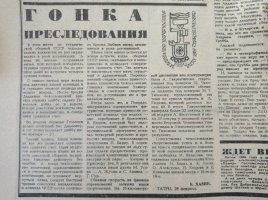
PURSUIT RACE

(an excerpt of the article published in russian 'Sovetskiy Sport' on March 1, 1987)

Yesterday here in Poprad, the figure skating competitions concluded, bringing three medals—one silver and two bronze—to the Soviet team. V. Egorov, who had been leading after the men's singles short program, finished fourth in the free skate and slipped to third place overall, missing out on the Czechoslovak athlete P. Barna. In the ice dance competition, the judges awarded the victory to the original routine of the well-known Austrian couple, Kathrin and Christoff Beck. As a result, they pushed our duets—M. Usova & A. Zhulin and S. Lyapina & G. Sur—down into the lower positions.
1784784951489.jpeg
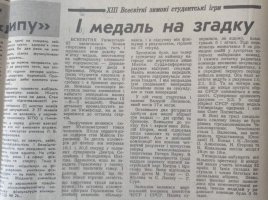
And a souvenir medal

(an excerpt of the article published in Ukrainian 'Sportyvna Hazeta' on March 3, 1987)

On the final day, figure skaters won three medals for our national team—two silver and one bronze. Vitaliy Egorov from Kharkiv was also close to success, leading after the compulsory figures ("school") and the short program. However, in the free program, he placed fourth and fell behind the Czechoslovak athlete Petr Barna. In the ice dance competition, the judges favored the well-known Austrian couple, Kathrin and Christoff Beck. They pushed down our duets, M. Usova & O. Zhulin and S. Lyapina & G. Sur.
1784785327146.jpeg
 
1987
WINTER UNIVERSIADE

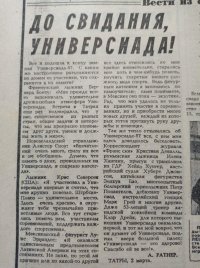
GOODBYE, UNIVERSIADE!

(an excerpt of the article published in russian 'Sovetskiy Sport' on March 3, 1987)

Mexican figure skater Luis Hernández: “I turned out to be the only representative of Latin America at these competitions. I don’t know if it was for this reason or another, but everyone here treated me with extreme care; they tried to help me in any way they could, to teach me the secrets of our difficult sport. After all, as you understand, I am a self-taught figure skater; in Mexico, it is still an exotic thing. I am glad that I managed not only to take part in the competitions but also to make many new friends, each of whom is ready to extend a helping hand of friendship and support.”
1784785843485.jpeg
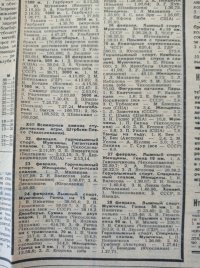
XIII World Winter Student Games. Štrbské Pleso (Czechoslovakia).
TECHNICAL RESULTS
(published in russian 'Sovetskiy Sport' on March 5, 1987)
Figure skating. Pairs. 1. E. Kvitchenko — R. Kadyrkaev (USSR) — 1.8; 2. E. Bechke — V. Kornienko (USSR) — 2.8; 3. C. Urbanski — M. Blicharski (USA) — 3.4. Women. 1. L. Zamotina (USSR) — 3.2; 2. S. Schmid (Switzerland) — 9.0; 3. Y. Gomez (USA) — 10.6. Men. 1. P. Barna (Czechoslovakia) — 4.0; 2. V. Egorov (USSR) — 5.6; 3. P. Wylie (USA) — 7.6. Ice Dance. 1. K. Beck — C. Beck (Austria) — 2.4; 2. M. Usova — A. Zhulin (USSR) — 3.0; 3. S. Lyapina — G. Sur (USSR) — 6.0.
1784787034626.jpeg
 
Last edited:
1987
UKRAINIAN SSR CHAMPIONSHIPS

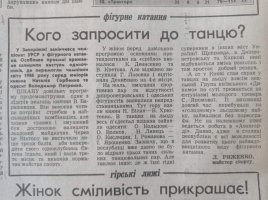
Who to Invite to the Dance?

(the article published in Ukrainian 'Sportyvna Hazeta' on March 7, 1987)

The Ukrainian SSR Figure Skating Championship has concluded in Zaporizhzhia. The performances of the singles skaters left an especially pleasant impression, where the 1986 World Junior Champions—Natalia Gorbenko from Kyiv and Volodymyr Petrenko from Odesa—emerged victorious.
AN INTERESTING free program was demonstrated by one of the tournament leaders, V. Baryshevtsev from Kyiv. He performed four triple jumps in the most difficult combinations, but suffered an injury and was forced to leave the ice early. Because of this, Viktor fell just short of the points needed to overtake his clubmate Evgen Ihdal, who took third place and fulfilled the Master of Sports requirement.
In the women's event, before the free program, K. Denysenko and V. Kretova were considered the main contenders for the silver medal. However, H. Lozovyk delivered an excellent performance and pushed Denysenko down to 4th place.
Unfortunately, due to the absence of skaters from Dnipropetrovsk and Odesa, the pairs competition turned out to be unrepresentative. The victory went to the Kyiv duo, N. Bilan and B. Khrystenko. In ice dance, the entire podium was swept by couples from Odesa: O. Koltsova & O. Volkov, N. Lynets & O. Kyslytsyn, and I. Romanova & I. Yaroshenko. I must note that our republic hasn't seen three such strong ice dance couples at once in a long time. However, another issue is concerning: where are their worthy rivals from other cities of Ukraine? Granted, a generation change is currently taking place in Dnipropetrovsk and Kharkiv, and a good reserve is growing there.
Meanwhile, in Kyiv, the state of affairs in ice dance is completely dismal. The Kyiv "Dynamo" group is essentially sustained solely by the enthusiasm of a young coach, S. Yaromova. For a long time, her students were kept on a "starvation" ice ration and practiced without a choreographer. Work is also not at the proper level in "Avangard." This is strange, considering that the republic's capital possesses all the opportunities to develop this most spectacular discipline of figure skating.​
L. RYZHENKO, Master of Sports.
1784788290601.jpeg
 
1987
Through Years and Distances

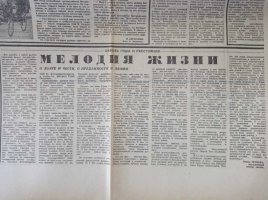
MELODY OF LIFE

(the article published in russian 'Sovetskiy Sport' on March 7, 1987)

About Duty and Honor, About Dedication and Love

Everything merged into one long, spinning waltz: one-two-three... one-two-three... The ice rink on Devichye Pole... A brass band... Barricades on Presnya... Black banners of pogroms... Scarlet banners of workers' squads... And a "figure eight" traced on the ice of Devichye Pole... one-two-three... one-two-three...
Male and female figure skaters skated only three months a year, and often on homemade skates... The first victory in the Moscow Championship... The First World War... Moscow University...
"We will build our, a new world..." NEP, industrialization, collectivization... The battle for bread... The battle for metal... The war for the right to be a workers' and peasants' state... And suddenly, completely nearby, a barely audible drum roll—could it really be a waltz?.. The ice rink... The trumpets would freeze and go silent... The waltz thundered: one-two-three... one-two-three...
In 1923, a figure skating school was opened... A waltz at the Soviet Union Championship... "Having performed a cascade of beautiful step sequences, transitions, and jumps, Yu. Zeldovich and A. Bykovskaya win the championship..." Kulak pogroms... Traces of war and devastation... Tea with saccharin... F. E. Dzerzhinsky with eyes inflamed from insomnia... Red Square... November Seventh... A parade of physical culture workers... A truck, and on it, a figure skater performing pirouettes on a platform coated with a special paste... A photojournalist snapped his camera, and figure skater Yuri Zeldovich smiled...
Memories make the head spin like the eternal melody of a waltz. And before the mind's eye of my conversation partner, faces and events flash by—seemingly insignificant details of his destiny. Such a long destiny, lived together with the country. Which means, in the deadly class struggle, in intense, exhausting labor, in the care for daily bread, and in the waves of this very waltz on Devichye Pole...
I sit opposite Yuri Samoilovich Zeldovich, listening to his story, and together with him, I immerse myself into the world of his memories, reconstructing images of a bygone time, the image of an era.
This man was born three years before the beginning of our century, yet even in my thoughts, I cannot call him old. The word "old" does not suit Zeldovich, contrary to all passport data. And the point is not only his youthful spirit or his sports titles—and he is a Honored Master of Sports, multiple champion of the USSR in figure skating, and an international referee. Look at how actively and with what civic passion he experiences the problems of our time. He speaks about current topical issues of medicine, sports, and society passionately, fervently, and energetically. He is well-informed about everything: politics, economics, and culture.
No matter how many years I have known Yuri Samoilovich, at every meeting I never cease to marvel: how strong is his charge of optimism—conscious and deeply felt. What is the secret of this optimism? It seems the answer should be sought in love: for work, family, people, and life in all its multifaceted nature, for the Motherland. I am convinced that our world has survived also because people at all times, despite everything, knew how to laugh and love. And they knew how to enjoy music. The melodies of a waltz, for example.
One-two-three... one-two-three... That is how, while dancing, he won five victories in the USSR Championship and achieved triumph at the Workers' Olympiad in Oslo. He traveled to all the continents of the world. The last time Zeldovich stepped onto the ice was in 1931, winning the USSR Championship. But the waltz on Devichye Pole continued. And its light melody carried on further through the years and days...
He successfully studied anatomy, physiology, and pharmacology. Yuri Samoilovich could no longer imagine himself without sports. The decision was made to become a sports doctor.
What is a sports doctor? It is a therapist, a psychologist, a surgeon, and a physiologist all in one... Today, these concepts have drifted apart. To work with a team, an entire staff of medics is brought in. Back then, Zeldovich performed all these functions alone. And he did it quite well, judging by the reputation of the Dynamo football team of that era, which he looked after: Yakushin, Beskov, Trofimov, Yashin, Ilyin... What names!
A great thing is the charm of personality, the ability to naturally influence others. This cannot be replaced by tests, instruments, or super-vitamins.
The entire life of Yuri Samoilovich is connected with the "Dynamo" sports society. To the question of who among those he met in life made the greatest impression on him, Yuri Samoilovich answered without hesitation: "Dzerzhinsky. An extraordinary personality. He combined simplicity, intelligence, conviction, and inner strength. The persuasiveness and weight of his arguments were astonishing..."
One-two-three... one-two-three... A vinyl record with pre-war waltzes spins in the hospitals... With parched lips, a wounded tankman hums: "one-two-three... one-two-three..." Zeldovich volunteered for a special-purpose division. He did not manage to go to the front line; he was deployed to Sverdlovsk as the head of a medical unit. But the war was everywhere: while soldiers fought on the battlefield, doctors fought for their lives in hospital wards.
Football of the 1950s... It was not just a sport, but something more. Famous football players were household names. People went to football matches as if to a holiday—with families, in groups, wearing their best suits, and they invited girls just like people now invite them to a concert of a trendy rock band. Photographs of athletes were collected just like portraits of movie stars.
Doctor Zeldovich can rightfully be called a co-author of many victories of the Dynamo team of the fifties, sixties, and seventies. He supported some in a difficult moment, made others seriously reflect, and for very many, he became a close friend and advisor for life.
The legendary goalkeeper of all time, Lev Yashin, says this about Yuri Samoilovich Zeldovich:
"I was fortunate to be alongside this remarkable person for a long time. A wonderful doctor! In big football, every day brings extreme conditions; serious injuries happen, and this means that the team loses one of its players. Yuri Samoilovich never counted his time when a sportsman needed to be returned to service. Day and night, he was wherever his help was needed. All of us remember, for example, the famous 'Zeldovich rubdown' that helped so much with bruises and sprains.
For us, he was, one could say, a father. He knew everything about a person. He could talk to any athlete on short notice, knew how to find the necessary topic in conversation. He knew the interests of everyone, showed attention to our families. He did this somehow imperceptibly, delicately. On trips, at sports training camps, in difficult situations—his advice and kind words were always with him. He knew his business, and help arrived on time. In a word, a human doctor!"
Everyone who happened to meet the "human doctor" remembers him warmly and gratefully. And Yuri Samoilovich worked with teams of swimmers, track and field athletes, and speed skaters as well.
Honored Master of Sports Zoya Kholshchevnikova recalls:
"At the age of 14, I joined the 'Young Dynamovets' speed skating section, and my entire sporting path passed under the supervision of Yuri Samoilovich. I remember how before responsible competitions I fell ill and was bedridden with a high fever. Only three days remained until the start. I called Yuri Samoilovich. He immediately came to my house with his lifesaving little medical case, helped, and cured me. I performed successfully at the competitions. Later, working in the "Dynamo" city council, I often met with Yuri Samoilovich, but never once did I see him in a bad mood—he considers it improper to project one's own poor state of well-being onto others. A bright person! Of high culture and responsibility."
Yuri Samoilovich Zeldovich has turned 90 years old. Just a year ago, as an Honored Doctor of the RSFSR, he retired. But even today, he cannot imagine himself outside the cares and problems of the "Dynamo" society, sports medicine, and sports in general, to which 75 years of his life have been dedicated. And on his birthday, greetings from all corners of the country arrived in Moscow, at Novaya Bashilovka Street near his native Dynamo stadium: "Our dear doctor...".
One-two-three... one-two-three... a brass band brings out the melody on Devichye Pole... Rolling to meet us, smiling openly and trustingly, is a boy in a gymnastics jacket... Closer, closer comes his face... An elderly man turns toward me from the window... He speaks and remembers...​
Rimma ZHUKOVA,
Honored Master of Sports.
1784791442575.jpeg
 
1987
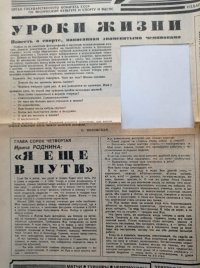
Lessons of Life

(the article published in russian 'Sovetskiy Sport' on March 8, 1987)

A story about sports, written by famous champions

I remember her from newspaper photographs and large television screens, that first trusting smile on the podium in Colorado Springs, when fame collapsed like a roaring waterfall and the nineteen-year-old girl from Taganka suddenly turned into an unattainable "star." I remember her fearlessness on the ice and desperate stubbornness, celebrated in many newspaper reports and... a tear that, like a drop on glass, rolled down in front of the whole world when Rodnina stood on her farewell podium. For the umpteenth time, I look closely at the features of a face familiar since childhood. Strong, stubborn cheekbones, soft lines of the mouth, boyishly unruly black swirls of hair, only now already with rare streaks of gray hair, deep, attentive eyes.
It would seem the portrait is complete. What else? Life is made.
Would you like to live your life over again?
— A person dies only once. But they are born more than once. A person has only one name, but sometimes they are destined to live through several lives.
What should one fear first of all?
— Self-contemplation. Self-praise.
What did you suffer from the most in life?
— From loneliness.
Do you ever feel bored?
— When everything comes easily and thoughtlessly.
What do you regret in life?— About the un-done.
After meeting Irina Rodnina, I wanted to remain silent, as one always wants to remain silent after someone's difficult confession.​

O. Polonskaya.
CHAPTER FORTY-FOUR
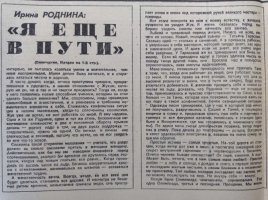
Irina Rodnina: "I Am Still on My Way"


If only I had known how long and difficult this journey would be. Not to fame and medals—but to myself. Again and again, I look into the past, as if flipping through a photo album. Different faces—different people. All of us in life owe something to someone. To mother and father—for life; to the teacher and coach—for the ability to work; to enemies—for forging and hardening our character; to friends—for warmth and a kind word. Life is always a struggle and a clash of characters.
In the spring of 1966, I was solving a difficult problem for myself. I had to choose between a specialized German school, where I was studying at the time, and figure skating practices at CSKA in the group of Stanislav Alekseevich Zhuk. I made the choice in favor of sports.
Working with Zhuk was interesting; we ran to the rink as if it were a holiday. The most terrible punishment for us was to be deprived of training. Zhuk placed identical demands on everyone. And considering that at that time the country's champions Elena Shcheglova and Valery Meshkov, Lyudmila Pakhomova and Viktor Ryzhkin, as well as world championship medalists Tatyana Zhuk and Aleksandr Gorelik were training with him, you can imagine how hard it was for us, the young ones, at times.
And so, one day my mother and I went up to Stanislav Alekseevich, and my mother said that she was planning to transfer me to the "Dynamo" society.
— "You work mainly with other, leading athletes. Will Ira even catch your eye — it was unclear.”
Zhuk listened to us carefully. He said briefly:
— "What goals do you set for yourself in sports?"
— "To fulfill the requirement for Master of Sports," — I mumbled.
My answer, apparently, shocked him, as he was used to working with ambitious young people.
— "And what else?"
I honestly replied that I wanted to master the double lutz and axel.
Zhuk fell silent. It seemed to me that he wanted to smile.
— "Can you withstand four hours of training a day?"
— "I don't know. I need to try."
I was only sixteen years old then.
At that time on the ice, a different style was in fashion—lyrical, gentle. "Reflection", "Dreams of Love". "But as for me, as for me!" — I thought, — "I skate like a boy, cheerfully, I jump, I jump...". Lesha Ulanov thought the same. He and Zhuk repeatedly had arguments regarding the sporty, athletic direction that we chose. Lesha, a student at the Gnessin State Musical College, an esthete and intellectual, was the leader and the proactive side of our duo. We went to theaters, to concerts, talked about music, about styles and philosophy, and Lesha leaned more and more toward the lyrical style being closer to him.
But Zhuk firmly knew: for every "poison" there is an "antidote". "It is precisely you—small, stocky, jumpy, like a ball—who can win. Because you are fearless. They don't believe in you, but you prove that you are better," — Zhuk kept drumming into me.
Truth be told, he was mistaken when he spoke of my courage. At first, like a child, I lost my bearings before his stronger will. Then came the fear of losing a wise and experienced mentor, without whom, it seemed, I was nothing. He was often sharp and unrestrained, but I closed my eyes to his mood swings, because we were both doing a great job.
To someone, I probably seemed the luckiest person. But fate was not kind to me. My sporting success was mixed with sweat and tears, tested by countless nerve-wracking situations and injuries. Sometimes it was so hard that after a victory, I didn't want to remember all the hardships that fell to my lot. And I habitually smiled—a sort of cheerful person—in front of the cameras, and gave interviews, without trying to seem smarter or more significant than I was perceived. My job was to skate, and I tried to skate honestly and well.
I often think: when did that crack appear, the one that turned into an abyss in our relationship with Zhuk, which neither he nor I could ever overcome? Was it when he got new, talented pupils to whom he started paying more attention? We athletes are excessively ambitious and egotistical people, and I was jealous and demanded increased attention for myself. A conflict situation arose in our small, once close-knit collective. Zhuk no longer wanted to, and could not, work with me. He grew tired of me. The same old Rodnina, the same old style, the endless cranking up of complexity: a two-and-a-half-rotation jump meant it had to be three, a two-handed lift consequently meant it had to be on one hand. He stuffed and stuffed us with complexity and technique because he wanted to, but he failed to see something new in me.
A certain stereotype of thinking has formed—to believe that sports must hide the woman inside a woman behind seven locks. Indeed, no matter how much we "make ourselves up" before competitions, no matter how much time we spend spinning in front of the mirror, conjuring over a new dress, it is all the same... When you spend eight hours a day on the ice, run exhausting cross-country races with weights, work out with a barbell—remaining feminine is difficult.
But femininity is eternal. Always, everywhere, in all ages it will be valued, becoming more and more precious. And despite the frantic rhythms of the time, the unthinkable grimaces of fashion, it breaks through again and again under the careful hand of the great master—nature.
It was precisely this turn in me toward my own nature, toward my feminine essence, that Zhuk failed to see. And I once again found myself faced with a choice: to leave entirely or to start all over again.
An unstable and anxious period of life. Nothing was clear, nothing was ready. A new, young coach—Tatyana Tarasova. As many ideas—just as many doubts. And I was used to working with a confident master who knew firmly how to go toward the intended goal. And even if he didn't know, he still carried himself confidently. With Tarasova, everything during training was different. If a good idea regarding a dance for another pair suddenly popped into her head, she would abandon us completely and switch over, catching moments of inspiration.
Little by little, quietly, I had to accustom Tanya to the fact that when she works with me, she works only with me. I had a right to this egoism, because I was aiming for a high result and knew that I would not turn off this path, that I would achieve my goal. Mixed with the desire to prove myself in a new capacity on the ice, to prove that Rodnina was not yet running on empty, was a sense of responsibility for Sasha, and even more so—for Tanya, who believed in us and risked taking on our pair in such a conflicting, almost scandalous situation.
Once after a training session where, for the umpteenth time, nothing was working out, having quarreled with Sasha and Tanya, I threw my belongings into my bag and, continuing to curse to myself both my partner and the coach and all of figure skating, rushed toward the station (this was in Voskresensk, where we were preparing for the national championship). A damp December ground wind was blowing across the ground, a wind from behind was pushing me in the back. By the time I reached the platform, I had cooled down. I looked at the tail of the departing electric train, threw my bag over my shoulder, and marched back.
Simple truths are the hardest. On that road from the station, when the wind was already blowing right in my face, I grasped another lesson: the secret of inner harmony lies in not being indifferent to your neighbor. Why is a person unhappy? From grief, of course. And what else? Maybe because there is too little love in them? Simple love—for the sky and the sun, for rain and snow, for the first green and the last yellow leaves, for their loved ones and for a stranger passing by. That love which makes you look at the world in a whole new way, not inward at yourself—but around.
Then came the Olympics, championships, competitions. Another Olympics, the third and last. The farewell. We knew that it will come, that very last day, we were preparing for it—and yet we all turned out to be unprepared.
Where to go? What to do? What to occupy myself with? Where and in what to find purpose for my abilities? We stood face to face with a life that is much more complex and strict than life in sports.
The first and only offer was a job as an instructor at the Central Committee of the Komsomol (VLKSM).
I belong to the generation for whom the word "Komsomol member" is associated with the name of Pavka Korchagin. We tried to be just as selfless and honest, just as unbending and strong. In sports, life is compressed to the limit, squeezed like a tight spring; we are used to its frantic rhythm, used to giving it our all, to being the ones with whom the final responsibility rests.
But in the new position... The day passed without anxieties. I was invited to various "events," I said the right, already quite tiresome words, which, it seemed to me, nobody listened to. I felt like a figurehead.
I don't want to, and cannot, blame anyone for the fact that I failed to grasp the specifics of the new work in a short period of time, failed to get used to its measured rhythm. Parting with sports turned out to be impossible for me—I was pulled to the ice like a magnet.
To judge one's peers, to help them, to share their cares and difficulties, one must first of all learn to understand them. And who, honestly speaking, needs to be understood better than your closest person?
I am often asked: why did our marriage with Sasha Zaitsev break up? After all, on the ice we were a wonderful pair, a well-oiled mechanism. We had one high goal, toward which we walked shoulder to shoulder. But the era of big sports ended, and ordinary life began. Day after day, we discovered new, previously unseen traits in each other. Gradually, the thought came that we are different people. He is not bad, and I am good, and he is not good, and I am bad. Just different. Sasha decided that he had achieved everything, attained everything, and now he could relax. For me, the battle continued...
When I was offered coaching work at the "Dynamo" society, I agreed with joy.
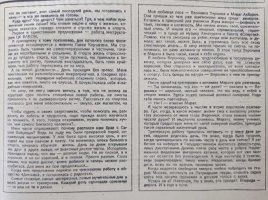
The most difficult, most interesting, most agonizing days of my life were the coaching days. Every day I was overcome by doubts—whether I was doing the right thing or not."
"My favorite pair is Veronika Pershina and Marat Akbarov. They came to me already as world junior champions. They skated in the style inherent to Zhuk’s students—speed and tempo, technique and complexity. We began to look for our own, original style. And found it—powerful, impetuous, heroic—in a dance to the music of Khachaturian to the ballet "Spartacus." I remember watching the kids skate once and thinking: this is the kind of pair I would have wanted to be all my sporting life... Due to many reasons, I couldn't, it didn't happen, but the desire remained in my memory. In this dance of Veronika and Marat, I was exactly as I saw myself.
I loved Veronika, a quiet, hardworking, and obedient girl who trusted me with her soul, though she hadn't yet become an adult. She tried and gave her all, agreed with everything, and... was psychologically completely unsuited for sports. There are fighters by nature—Veronika did not belong to them.
After one of the training sessions, I kept Marat for a conversation.
— You understand that this won't do? — I said. — Veronika is a good, wonderful person. But you and I are in elite sports. A strong-willed partner is needed here. You need to change your partner.
— No! — Marat replied.
I often return in my thoughts to this short conversation. Where, when, at what moment did the desire for a high result obscure the human soul of Veronika from my eyes? And I mentally bow to Marat, my student, who warned me against such a nasty mistake, and taught me such a serious life lesson.
I had to leave coaching work—I had two children, a daughter was recently born. I don't know when it was harder: when I trained for eight hours a day, or now? I work at the department of the State Institute of Physical Culture, I am writing a dissertation. I think about my place in the work of the National Figure Skating Federation, which has been left without a leader for many years now. I also write for newspapers, host a radio show, and am writing a book. I don't get enough sleep when the children are sick, drive them to doctors, check their homework.
When a free minute arises, I love to wander around old Moscow, look into the Patriarch's Ponds, listen to the crunch of snow under the feet of passers-by and children's voices from the skating rink.
Am I tired? Probably. But I know this will pass. Ahead is the road. And I am still on the way.
1784820807767.jpeg
1784820839109.jpeg
1784820859548.jpeg
 
1987
WORLD CHAMPIONSHIPS

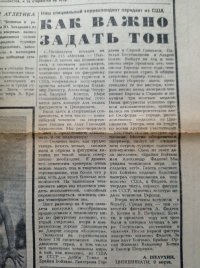
HOW IMPORTANT IT IS TO SET THE TONE

(the article published in russian 'Sovetskiy Sport' on March 10, 1987)

Our special correspondent reports from the USA

"...Boarding begins for flight No. 315 'Moscow — New York.' And then we got acquainted with the passenger list of those flying on this day to the World Figure Skating Championships. Among the group of tourists heading to the USA were popular artists of our stage: Vladimir Vinokur, Aleksandr Chepurnoy, Valery Kovtun, Mark Olsheinitsky. The artists are preparing to give a concert for our figure skaters in Cincinnati.
There were also sports specialists here, including the Olympic champion in ice dance, Gennady Karponosov. We spoke with him about the upcoming championship, and he emphasized:
— I know very well how difficult it is now to look for new, fresh ideas and images in figure skating, but such a search is absolutely necessary. I think it is very important for Soviet coaches to set the tone in this creative competition, especially since they have rich opportunities for this. At the current World Championships, we hope to see performers capable of transforming themselves, of igniting the arena with their temperament.
This conversation on board the plane served as a kind of preface to the World Figure Skating Championships, which started yesterday in the American city of Cincinnati at the 'Colosseum' Sports Palace.
More than 130 athletes from over twenty countries have been entered into the competition, including all the current world champions, and they, as is well known, are from the USA and the USSR — Debi Thomas and Brian Boitano, Ekaterina Gordeeva and Sergei Grinkov, Natalia Bestemianova and Andrei Bukin. Past years' world champions and this year's European champions and national champions from different countries will also take to the ice. In short, the starting tournament is a 'star' one...
Our national team here is represented by the same masters who a month ago won the European Championships in Sarajevo and received three gold medals. Our figure skaters have successfully acclimated, training at the university rink in Oxford — a city located near Cincinnati. Now they are at the starting line along with all the other participants.
Local newspapers are full of predictions. Many observers, for example, write about the expected fierce tournament among single men. One of the newspapers ran the headline: 'Brian Boitano or Aleksandr Fadeev? Shall we see the world champions of recent years?'. The newspaper notes that Boitano recently brilliantly won the US Championship, while Fadeev, confirming his title as the number one figure skater of the USSR, won the gold medal of the European champion.
Yesterday the men entered the competition. Among them are three Soviet figure skaters: A. Fadeev, V. Kotin, and V. Petrenko. By the way, last year all three were in the top five in the world. The competitions in the 'school' (compulsory figures) took place. After the first figure, the leadership was seized by Fadeev. He is followed by Boitano, Brian Orser (Canada), Vladimir Kotin, and Viktor Petrenko.​
A. SHELUKHIN.
CINCINNATI, March 9.
1784821784389.jpeg
 
1987
WINTER UNIVERSIADE

GOODBYE, UNIVERSIADE!

(an excerpt of the article published in russian 'Sovetskiy Sport' on March 3, 1987)

Mexican figure skater Luis Hernández: “I turned out to be the only representative of Latin America at these competitions. I don’t know if it was for this reason or another, but everyone here treated me with extreme care; they tried to help me in any way they could, to teach me the secrets of our difficult sport. After all, as you understand, I am a self-taught figure skater; in Mexico, it is still an exotic thing. I am glad that I managed not only to take part in the competitions but also to make many new friends, each of whom is ready to extend a helping hand of friendship and support.”
View attachment 11733
XIII World Winter Student Games. Štrbské Pleso (Czechoslovakia).
TECHNICAL RESULTS
(published in russian 'Sovetskiy Sport' on March 5, 1987)
Figure skating. Pairs. 1. E. Kvitchenko — R. Kadyrkaev (USSR) — 1.8; 2. E. Bechke — V. Kornienko (USSR) — 2.8; 3. C. Urbanski — M. Blicharski (USA) — 3.4. Women. 1. L. Zamotina (USSR) — 3.2; 2. S. Schmid (Switzerland) — 9.0; 3. Y. Gomez (USA) — 10.6. Men. 1. P. Barna (Czechoslovakia) — 4.0; 2. V. Egorov (USSR) — 5.6; 3. P. Wylie (USA) — 7.6. Ice Dance. 1. K. Beck — C. Beck (Austria) — 2.4; 2. M. Usova — A. Zhulin (USSR) — 3.0; 3. S. Lyapina — G. Sur (USSR) — 6.0.
View attachment 11734
1987
WINTER UNIVERSIADE

GOODBYE, UNIVERSIADE!

(an excerpt of the article published in russian 'Sovetskiy Sport' on March 3, 1987)

Mexican figure skater Luis Hernández: “I turned out to be the only representative of Latin America at these competitions. I don’t know if it was for this reason or another, but everyone here treated me with extreme care; they tried to help me in any way they could, to teach me the secrets of our difficult sport. After all, as you understand, I am a self-taught figure skater; in Mexico, it is still an exotic thing. I am glad that I managed not only to take part in the competitions but also to make many new friends, each of whom is ready to extend a helping hand of friendship and support.”
View attachment 11733
XIII World Winter Student Games. Štrbské Pleso (Czechoslovakia).
TECHNICAL RESULTS
(published in russian 'Sovetskiy Sport' on March 5, 1987)
Figure skating. Pairs. 1. E. Kvitchenko — R. Kadyrkaev (USSR) — 1.8; 2. E. Bechke — V. Kornienko (USSR) — 2.8; 3. C. Urbanski — M. Blicharski (USA) — 3.4. Women. 1. L. Zamotina (USSR) — 3.2; 2. S. Schmid (Switzerland) — 9.0; 3. Y. Gomez (USA) — 10.6. Men. 1. P. Barna (Czechoslovakia) — 4.0; 2. V. Egorov (USSR) — 5.6; 3. P. Wylie (USA) — 7.6. Ice Dance. 1. K. Beck — C. Beck (Austria) — 2.4; 2. M. Usova — A. Zhulin (USSR) — 3.0; 3. S. Lyapina — G. Sur (USSR) — 6.0.
View attachment 11734
Calla Urbanski, the predecessor to Deanna Stellato-Dudek :). Multiple pairs partners and success in her thirties.
 
1987
WORLD CHAMPIONSHIPS

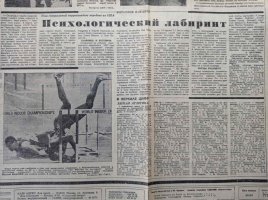
PSYCHOLOGICAL LABYRINTH

(the article published in russian 'Sovetskiy Sport' on March 11, 1987)

Our special correspondent reports from the USA

— Oxford in our understanding is a symbol of a very strict and prim world of scientists, — Honored Coach of the USSR Tatyana Tarasova told me on the morning of March 9. — But besides the English Oxford, there is also an American town with the same name. It also has its own university and, of course, a whole complex of sports halls. Our national team spent a few days in Oxford before moving to Cincinnati. There was no limit to the enthusiasm of the local fans! Every evening hundreds of spectators gathered in the stands; schoolchildren brought us letters and drawings. In those naive children's essays and pictures, there was so much love and respect for our athletes. Yes, we are well known, understood, and appreciated in America. We arrived in Cincinnati in the most wonderful mood. We believed that our kids would fight with maximum dedication, and in some ways would even surpass themselves."
In many ways, Tarasova's words were confirmed by the course of events of the first day. Judge for yourselves: the men's competition in the "school" (compulsory figures) and a small gold medal were won by Aleksandr Fadeev; the short program in pair skating was brilliantly executed by Ekaterina Gordeeva and Sergei Grinkov, while Olympic champions Elena Valova and Oleg Vasiliev were also at their best.​

LOOK BACK AND REMEMBER

Looking back at the events of the 1987 European Championship forces us to recall once again the unique case with Gordeeva and Grinkov. You, of course, remember that they failed to react in time to the referee's signal when the music stopped. They continued skating and deprived themselves of the fruits of a flawless performance, leaving the ice of Sarajevo without medals.
Will the figure skaters draw conclusions from this incident? We were all worried for them that evening. And this time, one could say with relief, they passed the durability test. 15 thousand Americans in the "Colosseum" Sports Palace received true aesthetic pleasure from the performance of our kids. 15-year-old Katya was all smiles, winning everyone over with her cheerful character. She was smiling even as she executed a difficult death spiral. And when the judges raised their placards with scores of 5.7 and 5.8, the stands erupted with applause. Katya and Sergei restored their authority as world champions and topped the tournament standings.
Another famous pair, Elena Valova and Oleg Vasiliev, also managed to pull themselves together. They started first according to the draw, and I think this gave them a good boost. Their 11 scores of 5.7 came in very handy for our pair in a tense situation. They seemed to feel that the chase behind them would be very dangerous.
Let me remind you that in July last year, Americans Jill Watson and Peter Oppegard came to Moscow — a charming blonde and an equally charming brunette. In Moscow, they conducted themselves like two of the most meticulous students, studying the training sessions of all Soviet pairs. And now, half a year later, the Americans proved that they had learned a thing or two. Watson is 24, Oppegard is 28. The figure skaters understand that this is their last chance, and they did everything to take third place with scores of 5.6 and displace the World Championship medalists, Canadians C. Coull and M. Rowsom, who by the way looked very confident. Note that American coach D. Laws shows a great interest in Russian music, and right now his students are preparing to perform with a program based on the works of Stravinsky. It will be a very serious battle.
The championship burden turned out to be heavy for Leningrad's Larisa Selezneva and Oleg Makarov. The 1987 European Champions believed that their authority was unshakeable. But the championship turned out dramatically: they made a mistake in the spin in the very first seconds. This unsettled them so much that they continued to make mistakes later on. As a result, they only took seventh place. Yet this pair was the most stable in our team.​

STAR OF THE FUTURE

The most lively commentary in the American press is dedicated to the leaders of world men's singles skating. Here is what Olympic champion, American Scott Hamilton, says:
— Compared to the competitions in Sarajevo, we will see a grand spectacle in Cincinnati. This will be a very serious psychological exam for a large group of contenders. And among them are Brian Boitano (USA), Brian Orser (Canada), Soviet figure skaters Aleksandr Fadeev, Viktor Petrenko.
The American newspaper Cincinnati Enquirer published a major article by the well-known columnist C. Stevenson under the highly symbolic title: "Petrenko — the Star of the Future." The author notes that the Soviet athlete has a combination of triple jumps with a triple axel in his arsenal. And most importantly, an unusually harmonious style.​
A. SHELUKHIN.
CINCINNATI, March 10.

TECHNICAL RESULTS
World Figure Skating Championships. Cincinnati (USA). Palace of Sports Coliseum. March 9.
Pairs. Short program. 1. E. Gordeeva and S. Grinkov - 0.4; 2. E. Valova and O. Vasiliev (all - USSR) - 0.8; 3. J. Watson and P. Oppegard (USA) - 1.2; 4. C. Coull and M. Rowsom (Canada) - 1.6; 5. G. Wachsman and T. Waggoner (USA) - 2.0; 6. D. Benning and L. Johnston (Canada) - 2.4; 7. L. Selezneva and O. Makarov (USSR) - 2.8.
Men. Compulsory figures. 1. A. Fadeev (USSR) - 0.6; 2. B. Boitano (USA) - 1.2; 3. B. Orser (Canada) - 1.8; 4. V. Kotin (USSR) - 2.4; 5. V. Petrenko (USSR) - 3.0; 6. G. Filipowski (Poland) - 3.6.
1784825506601.jpeg
 
Last edited:
1987
WORLD CHAMPIONSHIPS

Main Events — Ahead

(the article published in Ukrainian 'Sportyvna Hazeta' on March 12, 1987)

What is the balance of power between the figure skaters of European countries, the USA, and Canada today, when less than a year remains until the Winter Olympics? What are they preparing for the tournament in Calgary, which direction have they chosen? The fans of this wonderful sport hope to get answers to these questions at the current World Championships, which started in Cincinnati—an American city with a multi-million population. And no wonder: tickets, especially concession ones (for all days of competition, the cost of one is 135 dollars), sold out incredibly fast.
FIRST to take the ice of the "Coliseum" palace, the stands of which can accommodate more than 15 thousand spectators, were the men. Before the start of the competition, the 1981–1984 world champion Scott Hamilton, who arrived at the tournament as a TV commentator, told journalists: "The current champions of the USSR, USA, and Canada will compete for the awards. Who will win? Flip a coin with three sides. The chances of the leaders are equal."
It seems the famous athlete is right. After the compulsory program, our Alexander Fadeev, American Brian Boitano, and Canadian Brian Orser were in the lead. However, Vladimir Kotin, Viktor Petrenko, Richard Zander from the FRG, and Grzegorz Filipowski from Poland, who are closely following the top three, hope to improve their tournament position. And why not, since both Vladimir and Viktor have prepared very complex and interesting compositions.
Last year's world champion Brian Boitano of California claims that everything is going according to plan, and he also believes that the main struggle lies ahead. His opinion is shared by Orser, who noted that the fate of the "gold" will be decided in the free program. Regarding this, the newspaper Cincinnati Post announced: "The flying Californian intends to perform a four-revolution jump."
The fairness of the statements made by the contenders for the top spot was confirmed on the second day of the competition, when the men competed in the short program. Orser and Boitano's marks were higher than Fadeev's. However, our athlete still continues to lead after two events. Next come the American and Canadian figure skaters.
By the way, this trio is called friendly rivals at the championship. Fadeev, Boitano, and Orser can often be seen together in their free time: they have casual conversations, share impressions about the championship. And the Cincinnati Post notes: "On the ice, the athletes lead an uncompromising struggle, but this does not interfere with their friendship." And Boitano adds: "It is better and easier to be friends than to be enemies. Personally, I like our friendship. As for me, losing to friends is not so hurtful. I remember last year, the Goodwill Games. Oleksandr and his wife met me so warmly at their home, introduced me to Moscow."
A lot of praise also goes to Viktor Petrenko and Vladimir Kotin. The native of Odesa, who was fourth in the short program, is called a "rising star." And the Muscovite is considered one of the most elegant and artistic athletes.
The competitions also began for the representatives of pair skating. After the compulsory program, Ekaterina Gordeeva – Sergei Grinkov, Elena Valova – Oleg Vasiliev, and Americans Jill Watson – Peter Oppegard are in the lead.
Our dancers also made a good claim for success. After three compulsory dances, Natalia Bestemianova – Andrei Bukin are ahead. They are followed by Marina Klimova – Sergei Ponomarenko and the Canadian duet Tracy Wilson – Robert McCall.
1784869364912.jpeg
 
1987
WORLD CHAMPIONSHIPS

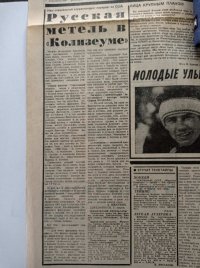
Russian Blizzard in the 'Coliseum'

(the article published in russian 'Sovetskiy Sport' on March 12, 1987)

Our special correspondent reports from the USA

One can express their admiration in different ways—throwing hands up in the air, dancing a dance of joy. Galina Zmievskaya, the coach from Odesa, has her own style of expressing feelings. When her pupil, 17-year-old Viktor Petrenko, left the ice of the "Coliseum" arena, she simply raised two thumbs up, and by this gesture, we already understood that the student had exceeded the teacher's expectations.
The courage of youth. It is a happy age when an athlete feels as if they are growing wings. This fully applies to Petrenko, who, by draw, opened the group of the strongest skaters, but proved that he is capable of challenging any favorite. All 15 thousand American fans expressed admiration for our figure skater. Judge for yourselves: the 13 scores of 5.7 and three scores of 5.8 received by Viktor for his short program, and for his unique combination with a triple Axel, can serve a very important role in the future fate of Viktor Petrenko even at this championship.
It was generally a happy evening for many virtuosos. Not a single mistake was made by those leading the chase after Petrenko. We are talking about the 1986 World Champion B. Boitano (USA), Canadian Champion B. Orser, European Champion A. Fadeev, and European runner-up V. Kotin.
A rare case occurred when it was very difficult for the judges to single out a leader across all criteria. They named Orser first because he had the most fluid style of executing the most difficult elements. Orser received almost all 5.9 marks.
And yet, in numerous interviews and responses in the American press, preference is given to World Champion B. Boitano. The personality of this athlete is extraordinary. He was born in 1963 in the small town of Sunnyvale (state of California). He started figure skating at the age of eight, and for 16 consecutive years, his training has been guided by one and the same coach—Linda Leaver.
Here is what Boitano himself says:
— For me, figure skating is a form of life, a form of expressing feelings and thoughts. I have a brother and two sisters who are interested in 5–6 sports at once, as well as music. They have repeatedly suggested that I take up something that distracts from sports. But I couldn't. I am only excited by figure skating. And, perhaps, also roller skates, because in the summer they replace ice training for me...
Experts call Boitano the most reliable guy on the US national team. He proved this reliability once again in Cincinnati in the struggle for leadership. The stunningly beautiful performance of the Canadian Orser only fired Boitano up, and this time he skated with "fury." It was as if he had rubber legs that helped him soar into the air at any moment. The American earned four scores of 5.9 and 12 scores of 5.8 for his short program.
Express commentary by Honored Master of Sports Sergey VOLKOV:
Fadeev and Kotin, they wisely solved their tactical task in a difficult situation. Both executed a combination with a triple Lutz at a high level and thereby preserved good chances for medals. Fadeev received the third-best scores of the day for his short program and remained the overall leader in the combined standings. The fourth and fifth positions belong to Kotin and Petrenko...
Cincinnati is a typical American city of the Midwest, entirely encased in concrete and glass. Its residents are rational, composed people who know how to value every hour. And it was all the more striking that even at 12 o'clock in the day, thousands of fans gathered at the rink, attracted by the sporting spectacle. We are talking about the ice dancers' tournament. Best of all on this day, the three compulsory dances were performed by our duets: two-time world champions Natalia Bestemianova and Andrei Bukin, and world and European championship silver medalists Marina Klimova and Sergei Ponomarenko. Moreover, seven judges gave the palm of victory to the champions, while two judges gave it to our second couple.​
A. SHELUKHIN.
CINCINNATI, March 11.
TECHNICAL RESULTS
World Figure Skating Championships. Cincinnati. "Coliseum" Palace of Sports. March 10.
Men's Singles. Sum of compulsory and short programs. 1. A. Fadeev (USSR) — 1.8; 2. B. Boitano (USA) — 2.0; 3. B. Orser (Canada) — 2.2; 4. V. Kotin — 4.4; 5. V. Petrenko (both — USSR) — 4.6; 6. G. Filipowski (Poland) — 6.6.
Ice Dance. Compulsory program. 1. N. Bestemianova and A. Bukin — 0.6; 2. M. Klimova and S. Ponomarenko (all — USSR) — 1.2; 3. T. Wilson and R. McCall (Canada) — 1.8; 4. N. Annenko and G. Sretenksy (USSR) — 2.4; 5. S. Semanick and S. Gregory (USA) — 3.0; 6. K. Beck and C. Beck (Austria) — 3.6.
1784871774399.jpeg
 
Back
Top