1987
WINTER IN THE MIRROR OF OUR MAIL
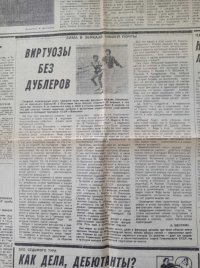
VIRTUOSOS WITHOUT UNDERSTUDIES
(the article published in russian 'Sovetskiy Sport' on April 15, 1987)
A complex, intense season was experienced by our figure skating masters. Let us recall that at the European Championship-87 in Yugoslavia, our national team won 10 medals, including three golds. And at the World Championship in the USA, the team's tally was 5 medals, two of them gold. Quite a few serious problems in training world-class athletes were also highlighted by the recent USSR Championship in Vilnius.
Our constant readers—numerous sports lovers—reflect on these three most important milestones in their letters to the editorial office.
"The review on the ice of Vilnius," notes F. Granenkov from Kharkiv, "clearly showed that figure skating is still characterized by a narrow geography. After all, among the prize-winners, we saw mainly representatives of Moscow, Leningrad, and Odesa. We have brilliant leaders, but who is standing behind them? In recent years, quite a few experienced figure skaters have finished their performances. But we do not see them as coaches in the union republics. Unfortunately, the majority prefer not coaching work, but touring in ice ballets. I am sure that in many cities, in our provinces, there are wonderful talents, but they still need to be discovered and brought out to the wide road. I think the All-Union Federation should show persistence in these matters..."
These thoughts are further developed in his letter by V. Vorozheikin (Penza). He emphasizes: "The most acute problem in our figure skating remains the preparation of female athletes in singles skating. Back in Vilnius, it caught the eye that we have a very short bench of substitutes. Practically, there was no fierce struggle for medals. And the gaps in the technical preparation of our women were clearly revealed at the World Championship in the USA. It is offensive that in the upcoming Olympic season, our national team has no one to present on the world arena as a strong leader in the women's competition. When will the coaches finally show real pride? It is time to seriously prepare a new generation."
The question of raising figure skaters with a fighting character is also raised by Muscovite V. Levashova. She believes it is necessary to boldly advance young talents, especially in women's singles skating, where for three consecutive years, the same athletes have been competing for the national team.
"Our men—A. Fadeev, V. Kotin, V. Petrenko—met the World Championship in far from their best form," writes V. Smirnova (Moscow) to the editorial office. "While previously they successfully fought in all types of single skating (at the European Championship, all three became medalists), in the USA at the World Championship, they failed to realize their capabilities in the free program."
Problems, problems. They do not disappear on their own, even amidst the most impressive victories of the national team's leaders. Our readers persistently talk about them. For example, an anxious letter was written by M. Baranovskaya from Grodno. She is troubled by an important circumstance—the lack of sufficiently broad and multifaceted promotion of the best achievements of the domestic school of figure skating. Television broadcasts dedicated to outstanding masters of our national team have become too rare. Top coaches too rarely give talks and lectures.
Right now, the USSR national team features world champions N. Bestemianova and A. Bukin, E. Gordeeva and S. Grinkov, Olympic champions E. Valova and O. Vasiliev, silver medalists of the World and European Championships M. Klimova and S. Ponomarenko, and European champion A. Fadeev. Their mastery is unique. But where are the films about their programs and training sessions? What will remain in a few years when today's "stars" leave the sports arena? We need to think about this today!
There is another important aspect to improving the mastery of our figure skaters. We are talking about the number of competitive starts.
Here is what Yu. Kalugin (Sverdlovsk) writes in this regard: "How, without competitive practice, are our figure skaters supposed to attain true competitive form? Where will they acquire endurance and determination if they take part in only one all-Union tournament — the national championship?!
It has already become a sad tradition to withdraw from participating in the majority of all-Union competitions. This is often done by V. Petrenko, E. Valova and O. Vasiliev, K. Ivanova, and A. Kondrashova. Under any pretext, leading masters evade fierce competition in domestic tournaments and refuse to compete. I consider it a logical consequence that on the ice of Cincinnati, our single skaters committed so many falls and mistakes. After all, they rarely test themselves in harsh competitive conditions. It is time for our all-Union federation to firmly make its voice heard!"
Yes, talents need moral support. But we must also demand more from them, and strictly so. Otherwise, we will be doing these young people a disservice; we will not help them cultivate maximum self-discipline.
"It will be a shame if the national team loses a talent like A. Kondrashova," continues the conversation I. Dyukov (Novosibirsk). "After all, this athlete possesses fluidity, grace, and a sense of music. But she often lacks just one step to reach the top. This means there is some flaw in her psychological preparation. To fix this, she needs to compete more often in the most challenging conditions!"
The pre-Olympic season demonstrated yet another obvious reality: victory can only be achieved through flawlessly executing super-complex and original programs. Recall the incident in Sarajevo: at the European Championship, E. Gordeeva and S. Grinkov performed their program without music, and the judges left them without any scores because they remembered an important clause in the rules (the referee's command after a music stoppage is mandatory). This incident, as many newspaper readers emphasize—specifically A. Korneev (Severodonetsk) and I. Akopov (Taganrog)—should serve as a lesson for all our candidates for the Olympic national team in all sports. After all, a single unfortunate accident or blunder can undo the efforts of many years.
The sports season has practically finished and has once again presented our figure skaters with new, highly serious problems on the threshold of the Olympic starts. The mail from readers reminds our athletes and coaches: do not get conceited, always look forward in search of new, original compositions!
A. SHELUKHIN.
As can be seen from this mail overview, even in figure skating, where our national team holds strong positions on the international arena, there are quite a few "blank spots"—unresolved problems. The main one is the cultivation of a reliable reserve. This is a task for specialists of both the Winter Sports Administration of the USSR State Committee for Sports (Goskomспорт), and the coaches of the Olympic training centers at the local level.
View attachment 11790