Archive of newspaper articles | Page 41 | Golden Skate

Archive of newspaper articles

1988
US CHAMPIONSHIPS

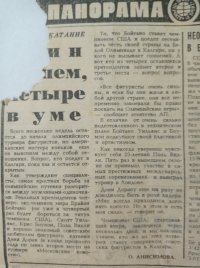
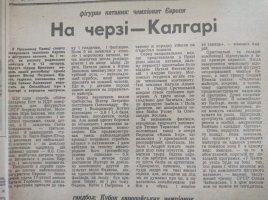
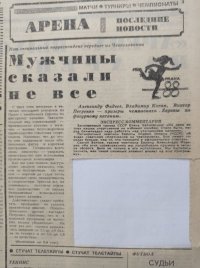
WRITE DOWN ONE, KEEP FOUR IN MIND

(the article published in russian 'Sovetskiy Sport' on January 8, 1988)

Only a few weeks remain until the start of the Olympic figure skating tournament, but American ice masters have yet to settle matters among themselves. The question of who will travel to Calgary still remains open.
According to experts, the most fierce battle for Olympic spots will erupt in the men's singles discipline. There are four realistic contenders: former world champion Brian Boitano (who is competing for his fourth U.S. championship title), Scott Williams, Christopher Bowman, Paul Wylie, and Daniel Doran (well-known to Soviet figure skating enthusiasts after placing second at the "Moscow News" tournament late last year).
No one doubts that Boitano will become the U.S. champion and go on to defend the honor of his country at the White Olympics in Calgary. However, which of the remaining four contenders will claim the second and third spots is the ultimate question.
"All of the skaters are exceptionally strong, and if they lived in any other country, every single one of them would easily earn the right to go to the Olympic Games," reports the AP agency.
Unlike Boitano, who is intensely prepared in technical terms, Williams and Bowman captivate audiences with their fluidity and artistry.
The 23-year-old Paul Wylie feels more confident than ever. This season, he has participated five times in the most prestigious international competitions and won the tournament in London.
Daniel Doran has never found himself in the leader's role before. "I always have to play catch-up with someone. But that is exactly where my strength lies," he says.
The U.S. Championships, which kicked off yesterday, will conclude in a few days, and we will finally find out which of these four will become rivals to the Soviet figure skaters in Calgary.​
O. ANISIMOVA.
1786307073719.jpeg
 
1948
From the Archivist’s Notebook

A New Balance of Power

(an excerpt of the article published in Ukrainian 'Sportyvna Hazeta' on December 26, 1987)

V WINTER OLYMPIC GAMES
January 30 – February 8, 1948,
ST. MORITZ (SWITZERLAND).

713 athletes from 28 countries took part. For the first time in the history of the White Olympics, representatives from Denmark, Iceland, Lebanon, Chile, and South Korea made their debut.
…The Norwegians also reminded everyone of their power on the ice track. However, a new balance of power was emerging here as well. This applied to figure skating as well. Only in the pairs competition did Europeans defend their leading positions. Micheline Lannoy and Pierre Baugniet brought Belgium its only gold medal in the history of the Winter Olympics.
In the final standings, the greatest number of points in the unofficial team standings of the V Winter Olympic Games was gathered by the national teams of Sweden, Switzerland, and the USA (the Americans, by the way, took the lead in figure skating). In this, a certain pattern can be traced: Sweden and Switzerland did not participate in the war. Meanwhile, Norway and representatives of other European countries suffered through occupation, and the development of sports there was generally halted.
View attachment 11894

1988
A Beautiful Fairy Entangled in Problems

Irina Rodnina: In Search of Lost Time

(the article published in russian 'Sovetskiy Sport' on January 8, 1988)

The Olympic cycle always brings new names, new styles. How has figure skating changed over the past four years? With this question, our correspondent turned to Honored Master of Sports Irina Rodnina.

— Irina Konstantinovna, in your opinion, why has the interest in figure skating, especially pairs skating, noticeably decreased in Europe? Could it be that you yourself are partly to blame for this? After all, for almost twelve years (!) on the world ice, first Rodnina and Ulanov, and then Rodnina and Zaitsev dominated, showcasing figure skating of the highest class, and defeating them was practically impossible. Yet, at the 1981 European Championship, just one year after you retired from the sport, representatives of only six countries competed.
— An interesting turn of phrase... But you know, I do not feel any guilt. After all, I didn't enter the elite of figure skating on a "green light"—I had to compete against strong, very strong rivals. Explaining the drop in popularity simply by the multi-year leadership of one or two athletes is just too simple and convenient.
— Then what is your explanation?
— Competition—that is the main, if not the decisive factor in the development of any sport. Today, there is no such fierce competition as there once was. Many national schools of figure skating are experiencing a decline—the French, British, Czechoslovak, and Polish schools. Yet, each of them used to be interesting and distinctive in its own way. Just fifteen years ago, an athlete's nationality could be determined without even looking at the competition protocol, simply by their style of skating.
Later, for a long time, the competition in pairs skating on the international arena came down to a rivalry between the figure skaters of two countries—the Soviet Union and the GDR. Now, pairs from Canada have joined this battle, and recently Americans activated as well. But representatives of the European school still remain in the shadows. And, as empty stands testify, this illness is outdated, a chronic one. Getting rid of it won’t be that simple.
— True, absolutely true. After all, you cannot force athletes to skate worse than they can just so that rivals can compete with them on a more or less equal footing, thereby increasing competition...
— You are ironizing in vain. The International Skating Union (ISU) makes repeated attempts to equalize the capabilities of athletes from different countries. But even this does not stop our leading pairs... We talked about competition inside the country...
For too long, the time belonged exclusively to coaches working under a single doctrine, where the absolute authority in this field was considered to be Stanislav Zhuk. He alone decided what was good and what was bad, dictating the fates of pairs skating. Other coaches, one after another, left our discipline. For instance, Tatiana Tarasova worked with pairs for only a short period of time before transitioning fully to ice dance. The last elite pair coached by Elena Chaikovskaya (Karelina — Proskurin) broke up back in 1973. True, during these years, Tamara Moskvina and Igor Moskvin "sat closely" in the quiet of their creative laboratories. It was they who were destined to bring pairs skating to a new level of development, to give it, so to speak, a new form, color, sound. If only they hadn't managed to preserve their own coaching and creative style, their own direction in figure skating, and their own vision... I don't know where we would have ended up then.
— Perhaps we shouldn't dramatize the situation so much. We have three wonderful, completely distinct pairs: Gordeeva and Grinkov, Valova and Vasiliev, Selezneva and Makarov. The eccentrics, the lyricals, and the athletes. And all three pairs are excellently prepared technically.
— With that listing, you have just answered all the questions yourself. Yes, three leading duets are fighting among themselves. But who is behind them? It turns out that as of today, there are only two "powerhouses" operating in the Soviet Union — the Moscow school and the Leningrad school. Moreover, the Moscow school has shouldered the bulk of the entire load in training athletes in all types of figure skating, while the Leningrad school is only pairs and singles. But our country is vast, and there are figure skating schools in many republics. Yet, there is practically no return from them.
— Well, why, in your opinion, do ice dances, where the main struggle is also between representatives of the USSR, still remain the most popular discipline in the world of figure skating?
— Ice dancing is a ball. Ice dancers generally look much more impressive than pairs, where a big disproportion in height, weight, and age is always noticeable. After all, right now in pairs skating, the complication of the technical level of programs happens largely due to this very difference. Ice dance coaches pay more attention to appearance: the athletes must match each other in height and harmonize with each other externally. Pairs coaches look primarily at the physical capabilities of the skaters. Of course, a leggy girl looks much more spectacular on the ice than a tiny, sturdy girl. But tell me: how will she land on her thin little leg after another mind-boggling throw? And besides, pairs skating is tightly constrained by technical complexity; athletes simply don't have time to use their choreographic inclinations and abilities. After all, when a triple twist is performed, it's not about embellishing the program, and not about musical accents.
But ice dancing seemingly highlights the athleticism of pairs and singles skaters, and makes people look for something new. Well, and then came a completely natural decline. And even for "ice dancers" today, the audience is not responding as eagerly as before. There is only one way out: a new search in technique, choreography, and entourage. Perhaps it is worth splitting one free program into two—three minutes each, without the right to repeat elements. Otherwise, it turns out that the spectator has become oversaturated with our sport, much like one can get sick of a sweet cake.
DOES THE JUDGE HAVE THE RIGHT TO "CALL THE TUNE"?

— Judging in figure skating is the most acute problem. The issues of objective and competent judging are increasingly worrying athletes, coaches, and the public alike...
— These questions are perhaps only so acute for ice dancers. That is truly where subjectivism reigns supreme and the principle of "you like it?, well I don't!" rules! But, as the saying goes, every house has its own troubles. Yet, there is one trouble common to all—the level of judging today is significantly inferior to the modern level of development in figure skating. Moreover—for example, in pairs skating, it becomes not a stimulus, but a brake on further progress.
— It is generally accepted that a judge's decision is, so to speak, the ultimate truth...
— The thing is, many national federations have stopped developing pairs skating. Perhaps it seems hopeless to them from the perspective of achieving high results. Be that as it may, Scandinavian countries and countries of Central Europe practically do not "supply" their athletes to the World and European Championships, or to international tournaments of various levels. Now answer me, which judge understands the nuances of figure skating better?
— Probably the one whose country has this discipline more developed.
— Absolutely right. The arithmetic regarding judging representation in pairs skating is simple: 9 judges, 4 of whom represent countries where pairs skating is in favor, while the remaining five... see pairs skating two or three times a year at best. Even if they meticulously study the athletes' training sessions before competitions, and regularly look through specialized magazines and books, gaps in their knowledge of the technical level of modern pairs—and therefore, gaps in judging technique—are inevitable.
— Let us clarify, what exactly does this "low level" of judging consist of?
— There is a single technical committee for pairs and singles skating—the exact same judges do the scoring. And since, as I already mentioned, pairs skating is not developed at all in some countries, the decisions regarding these athletes are made by singles judges. But pairs and singles skating, for all their outward similarities, are completely different disciplines.
— But the elements, with rare exceptions, are the same?
— It is a very common and crude mistake. For example, a jump in pairs skating is completely different from a jump by a singles skater.
There is another aspect. Singles skating specialists know perfectly well that a Lutz jump is harder to execute than, say, a Loop. However, many do not realize that a Loop lift is more difficult than a Lutz lift. Only a well-trained pairs-specialist judge can understand these nuances.
Flaws in the judging rules are also connected to a lack of knowledge regarding the core execution techniques of certain elements. For some reason, in recent years, the twist lift has begun to be classified under the general category of lifts. But this is incorrect—after all, a twist lift is much harder to perform. Yet, these elements are evaluated equally. And it seems to me that the ISU leadership should consider introducing a difficulty coefficient—say, like in artistic gymnastics. The more difficult and risky the element is, the higher the score should be.
Progress in figure skating is sometimes hindered by illiterate changes in the rules. A few years ago, the following decision was made: you cannot catch the female partner on your chest during a twist lift—only with a hand-to-body catch. In reality, catching a partner according to this rule requirement is only possible after a two-rotation twist.
— There has been a lot of talk in recent years about so-called balanced programs. What do you think about this?
— Because of these, to put it mildly, balanced programs, all compositions have become like identical twins—they look exactly the same, only the music is different. After all, every pair must perform a specific number of elements: at least two jumps, one or two jump combinations, three lifts (one of which can be a twist lift), a death spiral must absolutely be present, pairs parallel spins, combinations of spirals... There is simply no time to search for individuality of style or innovative solutions—one just hopes to manage to execute all the elements prescribed by the rules. In the junior ranks, this is especially noticeable. And how can one not understand that any pair should differ from another not only in their level of technical equipment, but also by the "uncommon expression of their face" [their unique identity]. Unfortunately, under the current judging rules, one can only dream about this.
THE ICE RINKS OF MY CHILDHOOD

— Irina Konstantinovna, many coaches nowadays complain that the influx of talented figure skaters into the national team is inexorably shrinking. Capable children are sought all over the country; people travel to the ends of the earth for them. What, has the Russian land grown poor in talent?
— No, it's just that talents have nowhere to skate. Probably, every person at some point begins to be haunted by a feeling of longing for something lost. For me, one of the facets of this nostalgia for the past is ice rinks. The rinks of my childhood. Brightly lit, festive, and noisy, where hot pies and tea were sold, where not only children but also quite respectable people came, and where the phrase "May I skate with you?" served as a password for getting to know someone.
Our ice rinks are melting. They are evaporating without a trace. There is no longer the massive ice area in Luzhniki around the Grand Sports Arena. The ice rink in Gorky Park practically ceased to function properly when it was moved from the center of the park to the windswept embankment. But that would only be half the trouble. Badly lit, equipped with practically no basic amenities, it became a haven not for figure skating enthusiasts, but for teenagers looking for wild fun. I am no retrogradist, but an adult is unlikely to come here anymore.
There is no longer open ice in Sokolniki, in Maryina Roshcha, at the Stadium of Young Pioneers. In Moscow, there are perhaps only two ice rinks left in the full sense of the word. Not just a space covered with ice, but something "humanized": with skate rentals, buffets, music, and good lighting. These are "Druzhba" [Friendship] and "Severnoye Siyaniye" [Northern Lights] in Luzhniki.
— And at the same time, huge, uninhabited spaces sit empty. How many ice rinks, for instance, could be set up at the VDNKh.
— And think about another fact: paradoxical as it is, both in the capital and in the country as a whole, the problem of employment for coaches is acute. There are few artificial ice rinks, and mostly venerable specialists work on them. Where should the young ones go if all the places under the sun are already taken? Well, alright, they might accept someone to coach the "younglings" at some sports school. But there, you face a quota plan. You need ranked athletes. And the coach, with the zeal of a gold digger, begins to search for talents... to fit into ranking standards. I, however, believe that before teaching an athlete how to jump, you need to instill a love for the sport, to teach them to use their imagination and create on the ice. But no, we immediately teach them to jump. If they learned it—great, if not—goodbye.
Moreover, even when talents are found, it is often disadvantageous for a young coach to work with them. Why, one might ask, waste extra effort on a promising student if you will eventually have to hand them over to a more experienced mentor anyway? But the real offense lies elsewhere—after all, hardly anyone will remember later who it was that first put the future champion on skates.
— It is hard to disagree with you. Does anyone know that the first coach of E. Vodorezova was L. Titova? That it wasn't T. Tarasova who first put N. Bestemianova and A. Bukin on skates, and it wasn't E. Chaikovskaya who taught V. Kotin how to move on ice, and it wasn't S. Zhuk and S. Volkov who witnessed the first steps of A. Fadeev. Let's be honest, we forget about the first coaches and do not reward their work properly. By doing so, we humiliate their professional pride and kill their interest in the work. As a result, almost no one wants to work with children. This, it seems to me, is the ultimate question: how do we raise the prestige of a children's coach's work?
— I think they need to be incentivized both financially and morally. Why not, for example, reward the first coach of a figure skater who has achieved notable success with a trip to an international competition? Or perhaps their salary should depend on the athlete's future successes? There could be various options. One thing is clear: this problem requires serious thought. How many times have I attended various seminars of the Figure Skating Federation. National team coaches and choreographers spoke there. But not once did I hear a speech by a children's coach. They are simply not invited there.
— Even to the naked eye, the rift between grassroots children's figure skating and training aimed exclusively at producing future champions is noticeable. Although, it would seem, the latter should naturally flow from the former. It used to be that way.
— When I came to the artificial ice at CSKA, I already had a solid track record of performances. Every year prior to that, I took part in the season's closing at the ice rink in Maryina Roshcha. Our coaches taught us to work independently. We bought vinyl records with the music we liked, made up the dance ourselves, "danced it out" on the floor first, and only then transferred it to the ice. I, for example, performed the dance of the dwarfs from "Snow White" and a waltz from the ballet "Raymonda." Thus, from an early age, figure skating was for us not just drilling and practicing certain elements, but above all, an immense pleasure.
And recently, I dropped by the choreography hall at CSKA. They were explaining to children how to hold their hand. They didn't understand. And no wonder! In ballet, as is well known, a child is placed at the barre only at the age of 9, when they are capable of comprehending choreographic techniques. Nowadays, however, in figure skating, in the pursuit of premature champions and fast results, coaches force the normal course of things. The result is right before our eyes: faceless figure skaters and programs, as alike as two drops of water.
There is also another side to the coin. Previously, people came to figure skating "for health." Now, parents send their child to the club, already calculating in advance what benefits this promises in the future—fame and everything that comes with it.
I remember once after a training session, the mother of one of my students came up to me and asked: "Irina Konstantinovna, will anything come of my boy, or are we wasting our time?". Since when has time given to a child—and, mind you, not someone else's, but one's own—been considered wasted?!..
...The ice rinks of my childhood are gone into the past. Longing for these rinks is not just nostalgia for childhood. It is also a regret for lost traditions, without which, I am sure, it is impossible to move forward.​
The interview was conducted by O. POLONSKAYA.​
View attachment 11900
I wasn't a big fan of Rodnina when she was a skater, and definitely not later as a political figure. But I have to say this is a good interview, and I do agree with much of what she says about the restrictive nature of pairs skating on choreography, compared to the greater freedom ice dancers have. What my own coaches in Canada taught was that pairs was like ballet, in that the precise movement of the body, feet, head, etc had to be standardized, but that you could perform those movements in different styles to fit different musical moods.
 
1988
EUROPEAN CHAMPIONSHIPS

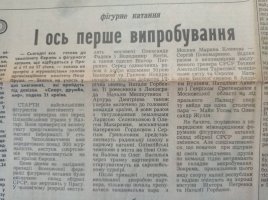
And Here Is the First Trial

(the article published in Ukrainian 'Sportyvna Hazeta' on January 9, 1988)

Today, everything is ready for the European Figure Skating Championships, which will take place in Prague from January 11 to 17, — said Petr Průša, head of the organizing committee, at a meeting with journalists. — Applications to participate in these competitions, which will be held under the motto "Sport, Friendship, Peace," have been submitted by 21 countries.
The starts of the continent’s strongest figure skaters are the final test of strength before the Olympic Games in Calgary. They have attracted significant attention from media representatives. In the capital of Czechoslovakia, more than 300 journalists have already been accredited, and the athletes' performances will be broadcast to all countries of Europe.
These days, at a meeting of the presidium of the All-Union Figure Skating Federation, the composition of the USSR national team that will head to Prague was determined. In the men's category, Muscovites Aleksandr Fadeyev and Vladimir Kotin will compete, as well as Viktor Petrenko from Odesa. Among the single women, along with the well-known Kira Ivanova and Anna Kondrashova from Moscow, 17-year-old Kyiv resident Natalia Gorbenko is making her debut. Her peer from Leningrad, Natalia Mishkutenok, alongside Artur Dmitriev, has also been included in the country’s main team for the first time. Together with their titled compatriots Larisa Selezneva and Oleg Makarov, and Muscovites Ekaterina Gordeeva and Sergei Grinkov, they will represent the Soviet school in pair skating. Olympic champions from the city on the Neva River, Elena Valova and Oleg Vasiliev, will not start at the European tournament due to the female partner’s injury.
After a long break caused by the male partner's illness, the ice dance couple from Moscow, Marina Klimova and Sergei Ponomarenko, has just started training. Furthermore, alongside the trainees of the Honored Coach of the USSR Tatiana Tarasova—world and European champions Natalia Bestemianova and Andrei Bukin, Natalia Annenko and Genrikh Sretenski from the Moscow region—another couple will take the ice of the Prague Sports Palace: Maya Usova and Aleksandr Zhulin.
As you can see, compared to previous international figure skating forums, the composition of the USSR national team has changed somewhat. But we hope that the newcomers, with the support of their experienced friends on the team, will worthily endure this difficult trial. In particular, fans of this sport in our republic look forward with hope to good performances by Viktor Petrenko and Natalia Gorbenko.
1786337890814.jpeg
 
1988
EUROPEAN CHAMPIONSHIPS

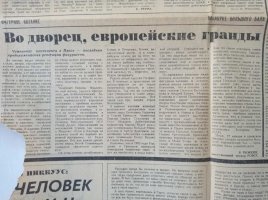
Into the Palace, European Giants

(the article published in russian 'Sovetskiy Sport' on January 10, 1988)

The continental championship in Prague is the final pre-Olympic rehearsal for the figure skaters.

In many sports, seconds, meters, and kilograms allow you to quickly determine who has reached the top positions and who is a contender for medals. What about figure skating?
Figure skaters do not have "100-meter sprints" where you can find out who is who in ten seconds. However, leaders are easily recognized by the combination of three crucial components of mastery: athleticism and speed; consistency in executing complex combinations; and originality of style.
At the European Championship, which starts in Prague, the Soviet national team will be represented by true giants. Take, for example, men's single skating—Aleksandr Fadeyev, Vladimir Kotin, Viktor Petrenko. Here, I must add: it is a team of Olympic caliber. They have an excellent opportunity to spark interest by unveiling their Olympic "weapons." In short, each has a strong short program. It is very important to execute the highly complex triple axel combination well in the short program, and in the free program, not just a set of six different triple jumps, but also a series of steps, spins, plus merging the plastic movements, emotions, and music into a single whole.
European Champion Fadeyev, in my opinion, managed to overcome two psychological barriers on the way to Prague; he mastered a world-class short program with a triple axel, which earned scores of 5.9 at the Moscow tournament. At the match of the strongest in Yerevan, he demonstrated a most difficult free program. The Vice-President of the ISU, Josef Dědič, who attended the Moscow tournament, said of Fadeyev: "If in Calgary he shows the same version of the short program, he will be first." Look how important it is to present a solid "calling card" right before White Olympics!
By the way, Kotin and Petrenko have also taken care of this. Kotin is a magnificent actor, and in the Olympic season, he has not deviated a single step from his chosen style, working extensively on stability. If he manages to handle the triple axel jump in Prague... well, let's not get ahead of ourselves.
Young Petrenko from Odesa is a joy. In technique and artistry, he demonstrates athletic maturity and originality beyond his years. It is no coincidence that he has already established himself in the elite of world single skating... That is what they say about our "three bogatyrs" (warriors).
In pair skating, the team is led by two-time world champions Ekaterina Gordeeva and Sergei Grinkov, and European champions Larisa Selezneva and Oleg Makarov. The European Championship debutants will be young Leningraders Natalia Mishkutenok and Artur Dmitriev, who replaced the injured Olympic champions Elena Valova and Oleg Vasiliev.
Let me remind you that in 1985, Gordeeva and Grinkov won the World Junior Championship and immediately broke into the ranks of the senior team. The rapid progress of the young Leningraders is also clear. So, hopes for a successful performance by Soviet pairs in the competitions of the Olympic season are well-founded.
The ice dance domestic school still holds a leading position in world figure skating. Let us recall that for three seasons, Natalia Bestemianova and Andrei Bukin, and Marina Klimova and Sergei Ponomarenko, have consistently given fans brilliant ice spectacles. Following Klimova's illness, Klimova and Ponomarenko resumed preparation for the Calgary Games, but they may not be able to compete at the Prague ice rink. Therefore, together with three-time world champions Bestemianova and Bukin, European championship bronze medalists Natalia Annenko and Genrikh Sretenski, as well as Maya Usova and Aleksandr Zhulin—who recently made a bright name for themselves in international tournaments—will fight for medals in Prague. I will note that our couples are fully capable of repeating the success of last year's European Championship, when the entire podium was swept by Soviet figure skaters.
Our female single skaters face more difficult tasks. The leaders of the national team — Anna Kondrashova, Kira Ivanova, as well as the young Natalia Gorbenko — are reaching their peak athletic form somewhat later than usual. Nevertheless, after the match of the strongest in Yerevan, grounds for optimism appeared. The fact is that despite an injury sustained in the autumn, the country's champion Kondrashova has noticeably improved her skills, managing to execute five triple jumps in her free program. It seems that in the main tournaments of the Olympic season, she is ready to battle for medals against such 'stars' as the Olympic champion Katarina Witt (GDR).
So, on January 12, the European Ball will open in the Prague Sports Palace—a prelude to the Olympic Ball.​
V. Ryzhkin,
Honored Coach of the RSFSR.
1786340078798.jpeg
 
1988
TOWARDS A HIGH GOAL


A MYSTERIOUS DUET

(the article published in russian 'Sovetskiy Sport' on January 13, 1988)

Champions of Europe, Larisa Selezneva and Oleg Makarov, managed to show an excellent result at the all-Union tournament in Yerevan this season: they received scores of 5.8 and 5.9 for their free program.
— How did the idea for this composition come about? — I asked the figure skaters.
— "Return with me to the ocean, my love, I am just a drop in the ocean too" — these lines by the American poet Walt Whitman became the leitmotif of our composition. An unusual detail — the special music for it was written by a Leningrad amateur musician, military doctor Sergei Konovalov. The plot of the piece, "The Flow," turned out to be very close to us, understandable — says Oleg Makarov.
Not fearing big words: this duet is a mysterious phenomenon, having presented too many surprises in recent years. There was a period of decline in their figure skating. Naturally, programs became more complicated, and artistry was increasingly clearly combined with powerful, forceful skating. Alas, a mistake in one element became like a chain reaction — errors followed one after another. And suddenly — a brilliant performance by the pair at the Olympic Games in Sarajevo. The third podium place for the Leningraders was considered sensational.
The loudest success came to them in February 1987: they won the gold medals of the continental championship. They set the highest goal for themselves at the World Championship in the USA, in Cincinnati. And imagine the disappointment when, during the execution of the short program, they missed a twist lift. At the cost of tremendous effort after the free program, they moved from 7th up to 4th place.
Watching the actions of these experienced athletes in training, it is hard to imagine that their new free program was born in agony.
“Work on this composition drained a lot of strength and energy. We had to overcome skepticism and doubts. One careless step could lead to a crash. And I won't say it for the sake of a clever phrase, fanatical love for figure skating saved us”, — admits Larisa Selezneva.
Larisa started as a single skater with coach Tatyana Loginova. She showed promise; it was no accident that at one of the youth championships of the country she took second place right after Kira Ivanova. Then she decided, on the advice of Tamara Nikolaevna Moskvina, to try herself in a pair with Oleg Vasiliev, the current Olympic champion. A month later, the newly formed pair broke up. And Larisa was left out of work, missing almost the entire season. Sometimes, together with her mother, she would go to the rink and practice at the most inconvenient times. Larisa grew up without a father (he was a traffic police officer and died while performing his duty).
— There was reason to despair, — says Larisa. — I just wanted one thing: to skate, to participate in competitions!
Oleg was then training under Andrei Suraikin, our famous former figure skater. In 1980, Larisa and Oleg came to one of our most authoritative coaches — Igor Moskvin.
— What do they have in common? — asks Igor Borisovich and adds with a smile: — Well, now practically everything is in common — this summer they became husband and wife.
Working with Larisa and Oleg is always interesting, though not easy. By character, they are both firm, stubborn. However, it is for the better. Personally, I don't like docile people. And in terms of creating a solid pair, this is not a hindrance. The most important thing is to never rest on your laurels, to search and to find. Then everything will fall into place!​
M. ANDZHELYAN.
YEREVAN.​
1786341400647.jpeg
 
1988
EUROPEAN CHAMPIONSHIPS

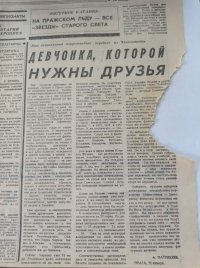
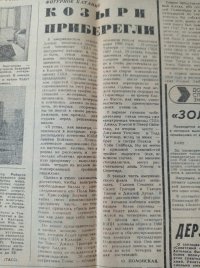
THE GIRL WHO NEEDS FRIENDS

(the article published in russian 'Sovetskiy Sport' on January 13, 1988)

Our special correspondent reports from Czechoslovakia

You can meet this lively girl on skates everywhere in Prague these days. Her extraordinary popularity is explained by the fact that she became the mascot of the European Figure Skating Championships.
The artist, Kornelia Němečková, unfortunately did not give her a name. But perhaps she could be called Hanna, or Maria, or Clotilde... Why has this fragile creation become the symbol of the main competition of the continent?
Looking from the outside, it is impossible to penetrate the artist's creative laboratory, to measure the flight of their fantasy with cold algebra. One of the interpretations is given by the words painted on the stand next to the girl's image: "Sport, friendship, peace." She, as well as all the children of the planet, needs our help, our protection, our friendship, and peace on Earth. And sport is that binding thread that connects nations in their most noble aspirations.
When you travel to the fraternal lands of this country, you sense this especially. And it manifests itself sometimes in unexpected ways, at times in fleeting meetings and conversations. It turned out, for instance, that husband of Kornelia Němečková—Zdeněk Němeček—created the sculpture installed in the Olympic sailing Center in Tallinn.
Our friendly contacts are solid and multifaceted. A man of respectable age and imposing appearance, whom we called the usher at the press center, hearing Russian speech, did not miss the opportunity to offer greetings. We struck up a conversation. It turned out that Karel Čirtek had been to Moscow, Leningrad, traveled all over the Baltic region, and made his way as far as Lake Baikal.
Now Čirtek is already 74 years old. He somewhat playfully complained about his failing memory. But he remembers Soviet athletes who performed in the Prague Sport Palace perfectly. Pakhomova, Rodnina, Gorshkov, Zaitsev from the figure skaters—Kharlamov, Tretiak, the "commander" Tikhonov, and many, many other hockey players.
Next to the Palace, a metal figure of a flying hockey player is installed. It reminds people of three World and European Championships held in Prague in 1972, 1978, and 1985. And on the pedestal are the immortalized metal autographs of the champions. Among them are the names of our famous masters: Petrov, Ragulin, Kuzkin, Maltsev, Yakushev, Shadrin...
There is no such monument in honor of figure skaters yet in the Julius Fučík Park, where the arena is located. They are destined to leave their autographs on the ice. And the ice—it melts after the finish. But the names of the winners will forever remain in the annals of European championships. Will there be representatives of the Soviet Union among them? There is every reason to hope for success.
When you read these lines, the competitions will have already begun. I am writing on the eve of the start. And today's task is to give the reader at least a minimum of information.
109 athletes from 20 countries are competing in the championship. In figure skating disciplines, the participants are distributed as follows: women—27, men—24, pairs—11, ice dance couples—18. From this simple arithmetic, it is clear with obvious certainty which discipline enjoys the greatest popularity, and which resides in relative shade.
The spectators' preferences distributed accordingly. All tickets for the exhibition performances are sold out. Almost all are for the ice dance competitions. Below that, in descending order of popularity, are the events for women, men, and pairs.
On the whole, figure skating continues to attract the close attention of mass media. More than 300 journalists are accredited in the press center of the championship. Among them are representatives of the USA, Canada, Japan, and other non-European countries. This increased interest of "foreigners" is understandable—the Olympic Games lie ahead.
Yesterday, a press conference took place, and the draw was held. ...(the text cuts off)
Out of a small box, it was necessary to draw a number—to determine the order of appearance. Our athlete, V. Kotin, handled this more elegantly than anyone else. Even in this situation, he remained an actor. Giving the gathered crowd a smile through his mustache, he drew his lot with a graceful gesture. But the lot did not prove very merciful to the fortune seeker who flirted with it — number five. But let us hope that such an early start will not affect the performance of the experienced Kotin.
Probably, it will be harder for the debutants of the European Championship Mishkutenok—Dmitriev. No one that evening could pronounce the female partner’s last name without difficulty. And fate was merciless toward this duo. They will have to open the competitions іn pair skating. And at the same time, they will open themselves—before the spectators, before the judges. I would like to believe that this difficult surname after this championship will be pronounced without hesitation just as the names of our recognized masters of figure skating already sound familiar in many languages.​
A. PATRIKEYEV.
PRAGUE, January 12.​
1786354747615.jpeg
 
1988
EUROPEAN CHAMPIONSHIPS

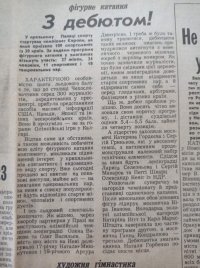
With a Debut!

(the article published in Ukrainian 'Sportyvna Hazeta' on January 14, 1988)

The European Figure Skating Championship has kicked off in the Prague Sports Palace, drawing 109 athletes from 20 countries. According to the figure skating program, the competitions will feature 27 women, 24 men, 11 pairs, and 18 ice dance couples.
A characteristic feature of this ice ball is that, in addition to 300 journalists accredited in the press center, media representatives from the USA, Canada, Japan, and other non-European countries have arrived in the capital of Czechoslovakia. This is understandable—the Olympic Games in Calgary are just around the corner.
Naturally, this circumstance, along with the opportunity to see the entire elite of the continent's figure skating, sparked increased interest among fans of this elegant and spectacular sport. Already today, all tickets for exhibition performances and almost all tickets for ice dance competitions have been sold out. Following them in popularity are the events for women, men, and pairs.
And so the ice spectacle has begun. As is known, due to the female partner's illness, the Olympic champions from Leningrad, Elena Valova and Oleg Vasiliev, are not competing in Prague. Instead, the city on the Neva delegated 17-year-old Natalia Mishkutenok and 19-year-old Artur Dmitriev. And wouldn't you know it, the debutants of such a major competition managed to draw the number one slot from the small red bag during the lottery. As journalists witnessing the ceremony aptly noted, the young Leningraders had to open the pairs competition, revealing themselves not only to the audience but also to judges and experts from various countries.
Well, the debut was successful. They performed their short program quite clearly and, receiving judges' scores of 5.4–5.5 points, took fourth place.
The leadership was seized by Muscovites Ekaterina Gordeeva and Sergei Grinkov, who, at a high tempo and with inspiration, demonstrated a proper set of technical elements. Following them are Leningraders Larisa Selezneva and Oleg Makarov, and Peggy Schwarz and Alexander König from the GDR.
Contenders for the championship awards in the women’s singles skating event have also begun their battle. After the compulsory figures, Muscovite Kira Ivanova is leading. The holder of the Olympic gold medal, Katarina Witt from Karl-Marx-Stadt, finished this part of the program in second, while Muscovite Anna Kondrashova came in third. Kyiv's Natalia Gorbenko, making her debut in the competition, holds sixth place.
1786388305355.jpeg
 
1988
EUROPEAN CHAMPIONSHIPS

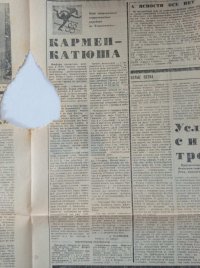
Carmen Katyusha

(the article published in russian 'Sovetskiy Sport' on January 14, 1988)

Our special correspondent reports from Czechoslovakia

Fanfares rang out in the evening, at 19:00. Music thundered, flags fluttered, and Czechoslovak athletes demonstrated their skills, speeches were made. Yesterday in Prague, with proper beauty and color, the European Figure Skating Championships opened.
But the morning was modest, businesslike. The competitions started at 8:00 AM. There were no spectators, no music, no ovations. On the training rink, the female skaters performed their compulsory figures.
Probably, in this discipline, figure skating lives up to its true name: the athletes trace figures on the ice — a first one, a second, a third. Here, the representative of the sport appears without luxurious costumes, without sparkles, without charming smiles, and without spectacular poses. But probably, if it weren't for this "school," there wouldn't be the academy that makes the stands roar with delight, freezing in awe.
No one had a complete failure, but the scores were far from what we are used to seeing during the free program. There are strictly defined rules in this school.
The most diligent students of this school turned out to be Ivanova (USSR), Witt (GDR), and Kondrashova (USSR). They took the lead after performing the first figure and in this exact order, they finished the compulsory program. Gorbenko made us worry more than anyone else. After two appearances on the ice, she was in seventh place. But she managed to squeeze back into the top six strongest skaters.
So, a small gold medal went to the Soviet skater Kira Ivanova. In the evening, the pairs competing in the short program were to build on this achieved success. Of course, the absence of Olympic champions Valova and Vasiliev is a serious loss for the team. The celebrities, who were temporarily out of action, were replaced, as already reported, by Mishkutenok and Dmitriev, who were making their debut in a competition of such a high rank.
It was they who were destined to open the pairs skating competition. Of course, there were completely natural concerns: would the young skaters lose their nerve, would they falter at the moment of making their 'debut'?
No matter, they held their ground—performing their program with confidence and dignity. Mishkutenok and Dmitriev presented what seemed like a circus act to the audience, adapted, of course, to the style inherent to figure skating. The scores were quite decent, ranging from 5.1 to 5.4 for technical merit and from 5.3 to 5.5 for artistic impression.
The debutants were followed onto the ice by the reigning European champions Selezneva–Makarov. Their czardas was marked by a subtle understanding of the dance's national character, synchronized movements, and polished gestures. The scores were in the 5.6–5.8 range.
Fourth in the skating order, the world champions Gordeeva and Grinkov appeared before the audience. Oh, Katya, Katyusha (I'm talking about Gordeeva), there is absolutely nothing in figure skating that you haven't mastered at just 16 years old! Even the passions of Carmen. And your partner is a sight to behold, too. It was no accident that the arena erupted in applause time and again. And when the final chords of Bizet's music faded, all the press photographers in the arena rushed as one to shoot our pair. They were capturing on film not just the leaders (with scores of 5.7–5.9), but a truly charismatic and charming sports duo.
Gordeeva and Grinkov, Selezneva and Makarov, and Mishkutenok and Dmitriev held the lead throughout the entire evening. Only after the final pair (Schwarz and König) performed did our debutants yield third place in the standings to the skaters from the GDR. We will get over this minor disappointment, if it can even be called that. Let us echo the words of the Honored Coach of the USSR, T. Moskvina (who, by the way, coaches Mishkutenok and Dmitriev), who, judging by her remarks, is full of optimism:
'Well done! Everyone was wonderful today. They skated lightly, cheerfully, and essentially without mistakes.'
...And so, the first day of the European Championships concluded successfully for the Soviet athletes. But, as the popular Raimonds Pauls song goes, 'the evening is not yet over.' Next up are the ice dance couples' events, the women's short program, and the pairs' free skate.​
A. Patrikeev.
Prague, January 13.​
TECHNICAL RESULTS
European Figure Skating Championships. Prague. Sports Palace. January 12.
Women. Compulsory Program. 1. K. Ivanova (USSR) — 0.6; 2. K. Witt (GDR) — 1.2; 3. A. Kondrashova (USSR) — 1.8; 4. С. Leistner (FRG) — 2.4; 5. J. Conway (Great Britain) — 3.0; 6. N. Gorbenko (USSR) — 3.6.
Pairs. Short Program. 1. E. Gordeeva — S. Grinkov (USSR) — 0.4; 2. L. Selezneva — O. Makarov (USSR) — 0.8; 3. P. Schwarz — A. König (GDR) — 1.2; 4. N. Mishkutenok — A. Dmitriev (USSR) — 1.6; 5. L. Knapova — R. Novotny (CSSR) — 2.0; 6. M. Wötzel — A. Rauschenbach (GDR) — 2.4.
1786461954341.jpeg
FIGURE SKATING
(the article published in russian 'Sovetskiy Sport' on January 14, 1988)
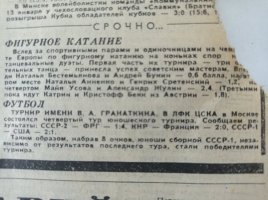
Following the pairs and the ladies' singles, the ice dance duos have begun their competition at the European Figure Skating Championships. The first part of their tournament—three compulsory dances—brought success to the Soviet masters. In first place are Natalia Bestemianova and Andrei Bukin with 0.6 points; in second place are Natalia Annenko and Genrikh Sretenski with 1.2 points. In fourth place are Maya Usova and Alexander Zhulin with 2.4 points. (Kathrin and Christoff Beck from Austria are currently in third place with 1.8 points).
1786462342922.jpeg
 
Last edited:
1988
US CHAMPIONSHIPS

SAVED THEIR TRUMP CARDS

(the article published in russian 'Sovetskiy Sport' on January 14, 1988)

The latest US Figure Skating Championships have concluded in the American city of Denver, and the names of the sixteen lucky athletes who earned tickets to the Olympic Games in Calgary are finally known. The recent US Championship stood out from previous ones due to a special intensity of passion. First, the organizers changed the competition schedule slightly; the events began late in the evening and ended well past midnight. Second, the athletes did not have a rest day before the final event as they used to.
"I am tired like never before," Brian Boitano admitted in an interview with a UPI agency correspondent. "The psychological pressure was so intense that I decided not to take risks and slightly eased my free skate program—I performed only four of the eight planned triple jumps."
However, this still proved to be enough to win the necessary points over his pursuer, Paul Wylie. Christopher Bowman skated his free program cleanly, but he also had to remove some of the most difficult elements, as a leg injury is still taking its toll.
The women's singles trio that will represent the USA in Calgary is no less impressive: Debi Thomas, Jill Trenary, and Caryn Kadavy. These athletes hardly need an introduction. The 20-year-old African American Thomas is the 1986 world champion. The 19-year-old US Champion of 1987 Tranery, 20-year-old Kadavy, won "bronze" at the last world championship and heavily relied on showcasing her dominance right at the start of the Olympic season. However, an unsuccessful landing after a triple jump thwarted her plans. Yet, she can still pull off a surprise at the Olympics—her coach, Carlo Fassi, knows better than anyone how to highlight the strengths of his students.
In pairs skating, the winners are now three-time US champions Jill Watson and Peter Oppegard. In second place are Gillian Wachsman and Todd Waggoner, followed by sister and brother Natalie and Wayne Seybold. But according to experts, only Watson and Oppegard can hope for (or, in any case, count on) a spot in the Olympic top three.
In ice dance, the honor of the American flag will be defended by Susan Semanick and Scott Gregory, and Suzanne Wynne and Joseph Druar. In this discipline of figure skating, the Americans' ambitions are more modest—they will be happy if they place fourth.
On the whole, as UPI notes, the 1988 model team looks significantly stronger and more balanced than the team from previous Olympic Games. It has real chances for medals in all four types of competitions.​
O. POLONSKAYA.
1786463199151.jpeg
 
1988
EUROPEAN CHAMPIONSHIPS

An Idea Warmed by Fire

(the article published in russian 'Sovetskiy Sport' on January 15, 1988)

Our special correspondent reports from Czechoslovakia

Ekaterina Gordeeva and Sergei Grinkov are European champions in pairs skating. In second place were Larisa Selezneva and Oleg Makarov.


At the press conference following the conclusion of the pairs skating competition, our silver medalists were asked:
"Your costumes feature flames. Do they reflect the main idea of your performance?"
Oleg Makarov answered:
"The main idea of our program is the triumph of light, sun, goodness. Hence the color palette of the costumes. Besides, the fiery colors perfectly match Larisa's character and mine.
Such a speech is rarely heard from journalists, let alone from one of the laureates of the European Figure Skating Championships. But what Makarov said applies not only to him and his partner, but, perhaps, to the performances of all the participants from our continent. The programs of many athletes were imbued with a kind of vitality, warmth, and soulfulness. And yet, this was a fierce competition.
In the strongest group (three Soviet pairs and one from the GDR), Gordeeva and Grinkov were the first to take the ice. Their performance, as usual, made a powerful impression. Even to an untrained eye, slight errors were noticeable in the skating of the world champions. Nevertheless, the scores were very high. In this case, there is every reason to say that they crossed that intangible boundary that separates first place from second: for technical execution — 5.6, two 5.7s, and six 5.8s; for artistic impression — two 5.7s, six 5.8s, and one 5.9.
Following the leaders came Selezneva and Makarov. What can be said about their performance? Perhaps the most telling indicator was the ovation given by the audience. Their coach, T. Moskvina, later remarked that she had never seen her pupils deliver such a flawless performance, at least not in the current season. And this despite the extraordinary complexity of the program, which practically bordered on acrobatic stunts.
And the scores? For technique—four 5.7s, as many 5.8s, and one 5.9; for artistry—one 5.6, four 5.7s, three 5.8s, and one 5.9. Compare these scores with the scores of Gordeeva and Grinkov, and the intensity of the struggle will become clear to you.
The skaters from the GDR, Schwarz and König, confirmed their previously high reputation. And closing the pairs skating competition—just as they had opened it two days ago—were Mishkutenok and Dmitriev. Their free program didn't go quite as well as hoped, though scores ranging from 5.3 to 5.8 kept the debutants in fourth place, which in itself is a significant success.
Now that we are familiar with the canvas of the event, it is time to give the floor to an authoritative expert, Olympic champion Gennady Karponosov:
"First of all, let's congratulate the winners. They demonstrated high-class skating. It is pleasing that Gordeeva and Grinkov, after the female partner's injury which prevented them from participating in the match of the country's strongest figure skaters, are regaining their competitive form. Their talent sparkled with new facets—a certain lightness, inspiration, and airiness. There were mistakes, of course. But let's not overlook that the Olympic Games are ahead. There are reserves that can become an active force."
The composition of Selezneva and Makarov strikes with its complexity. Their side-by-side triple toe loop is worth a lot. Yes, and only world-class masters can handle all other elements and the program as a whole.
True, the competition will get even tougher. I have in mind not only the sakters from the USA and Canada. Schwarz and König from the GDR have already proved that they are ready to fight at the highest level. In their arsenal, they also have a triple jump and – an element of the highest complexity. We will not write off another pair from East Germany, Wötzel and Rauschenbach. Their potential capabilities raise no doubts.
Fortunately, we also have promising duos. I mean first of all Mishkutenok and Dmitriev. In terms of complexity, their program is not inferior to that of the leaders. True, the execution is still lagging. But one cannot fail to notice the completely understandable anxiety of the debutants, their lack of experience, and an excessive desire to show themselves in the best light that ends up backfiring. Time will pass, and everything will return to normal, everything will stabilize. In any case, I look at this duo with hope.
Today’s discussion began from the very end, with how the latest day of the championships concluded. Prior to that, the women competed in the short program. Here, a clear disappointment was waiting for us. Natalia Gorbenko, who held sixth place after the compulsory figures, performed very poorly yesterday (13th position) and, based on the sum of the two events, dropped to eighth place overall. Kira Ivanova and Anna Kondrashova did their job well (shall we say). However, what holds one back from using more glowing epithets is the short program performance by Katarina Witt from the GDR. She not only captivated the arena but ignited it, leading the audience along and making them feel like partners in her performance.
For technical merit, Katarina received one score of 6.0 — the first at these championships. For artistic impression, she earned four perfect marks. Witt won the short program. Granted, Ivanova's advantage in the 'school' (compulsory figures) allows her to maintain the overall lead. Now, everything will be decided in the free skate.
Finally, looking back at the day, a few words about the ice dancers' morning performance. After the compulsory dances, the expected leadership was seized by Natalia Bestemianova and Andrei Bukin, and Natalia Annenko and Genrikh Sretenski. Meanwhile, the third-place position of the Austrian duo, K. Beck and C. Beck, was an unpredicted surprise.
Then again, that is exactly how sports go.​
A. PATRIKEEV.
PRAGUE, 14 JANUARY.​
TECHNICAL RESULTS
European Figure Skating Championships. Prague. Sports Palace.
Pairs. Free skate. 1. Gordeeva — Grinkov — 1.0; 2. Selezneva — Makarov (all USSR) — 2.0; 3. Schwarz — König (GDR) — 3.0; 4. Mishkutenok — Dmitriev (USSR) — 4.0; 5. Wötzel — Rauschenbach (GDR) — 5.0; 6. Knapova — Novotny (CSSR) — 6.0.
Total score for short and free programs. 1. Gordeeva — Grinkov — 1.4; 2. Selezneva — Makarov — 2.8; 3. Schwarz — König — 4.2; 4. Mishkutenok — Dmitriev — 5.6; 5. Wötzel — Rauschenbach — 7.4; 6. Knapova — Novotny — 8.0.​
Women. Short program. 1. Witt (GDR) — 0.4; 2. Ivanova — 0.8; 3. Kondrashova (both USSR) — 1.2; 4. Koch (GDR) — 1.6; 5. Kielmann (FRG) — 2.0; 6. Leistner (FRG) — 2.4.
Total score for compulsory and short programs. 1. Ivanova — 1.4; 2. Witt — 1.6; 3. Kondrashova — 3.0; 4. Leistner — 4.8; 5. Gosselin (France) — 7.6; 6. Koch — 8.2.​
Ice dance. Compulsory dances. 1. Bestemianova — Bukin — 0.6; 2. Annenko — Sretenski (both USSR) — 1.2; 3. K. Beck — C. Beck (Austria) — 1.8; 4. Usova — Zhulin (USSR) — 2.4; 5. Duchesnay — Duchesnay (France) — 3.0; 6. Engi — Toth (Hungary) — 3.6.
1786510931983.jpeg

FIGURE SKATING
(the article published in russian 'Sovetskiy Sport' on January 15, 1988)
PRAGUE. Muscovite Aleksandr Fadeev is in the lead after the compulsory figures event at the ongoing European Figure Skating Championships here. He is followed by his fellow countryman Vladimir Kotin. Heiko Fischer of West Germany (FRG) is in third place. Viktor Petrenko from Odesa is currently in fifth place.
1786510993432.jpeg
 
1988
EUROPEAN CHAMPIONSHIPS

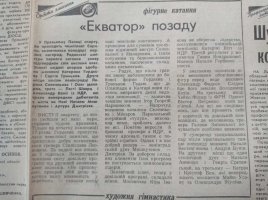
"Equator" Left Behind

(the article published in Ukrainian 'Sportyvna Hazeta' on January 16, 1988)

At the Prague Palace of Sports, where the European Championship is taking place, the owners of the first awards have been determined. Soviet masters of pair skating have once again confirmed their high class. Gold medals were won for the first time by Muscovites Ekaterina Gordeeva and Sergei Grinkov. Second place went to Leningrad's Larisa Selezneva and Oleg Makarov, third — to Peggy Schwarz and Alexander König from the GDR, who slightly edged out newcomers from the city on the Neva, Natalia Mishkutenok and Artur Dmitriev.
The performance of the quartet, which included all of our pairs, made an excellent impression. Only at the beginning of the composition did 17-year-old Gordeeva make a small mistake, which forced coach Stanislav Leonovich to worry quite a bit. But later everything went as it should. The world champions finished their free program to friendly accompaniment of applause. "We don't hide that the mistake shook our confidence in victory somewhat," the new continental champions later said. And the reason for doubts was the excellent performance of Selezneva and Makarov, with their powerful and flawless skating, filled with complex elements.
"It is pleasing that after injuries Gordeeva and Grinkov have approached the combat form again. I think that by the Olympics in Calgary, they will mange to fix some shortcomings in the composition," noted the winter Olympic champion Gennadiy Karponosov. “Selezneva and Makarov skated remarkably confidently. The parallel triple "toe loop" performed by them is something not everyone can do. The bronze medalists from the GDR have also grown noticeably, and they also have triple jumps in their arsenal. However, we also have a good reserve — the Leningrad pair Mishkutenok and Dmitriev. In terms of the complexity of the elements, their program is not inferior to the compositions of the leaders.
The final test, now in the free program, was taken by the women. Muscovite Kira Ivanova did not maintain the lead, losing to Olympic champion Katarina Witt from the GDR. The third result went to Moscow's Anna Kondrashova. Kyiv's Natalia Gorbenko is sixth.
In the men's competition, after performing compulsory figures, Muscovite Alexandr Fadeev leads. He is followed by another Muscovite, Vladimir Kotin. In third place is Heiko Fischer from the FRG. Odesa's Viktor Petrenko is currently fifth. But everyone hopes that he will show himself in the short and free programs, where Galina Zmievskaya's trainee usually feels especially confident.
In the competition of ice dance couples, after the original dance, Muscovites Natalia Bestemianova and Andrei Bukin are ahead. In second place is another capital duet — Natalia Annenko and Genrikh Sretenski. In third — Kathrin and Christoff Beck, who are ahead of Muscovites Maya Usova and Alexander Zhulin.
1786524847358.jpeg
 
1988
EUROPEAN CHAMPIONSHIPS

THE NEW TURN OF KATARINA

(the article published in russian 'Sovetskiy Sport' on January 16, 1988)

Our special correspondent reports from Czechoslovakia

The European Champion retains her title. In second and third place are Kira Ivanova and Anna Kondrashova.


It is an understandable matter: Carmen is immortal. Not only the unfortunate Don José gave his heart to her, but also Mérimée, Bizet, and Shchedrin. Opera, ballet have been created in honor of Carmen, and movies on this subject have been seen before.
And now, the sultry gypsy appears more and more frequently on the ice. At the European Figure Skating Championship, we first saw our own Ekaterina Gordeeva in this role. Yesterday, Katarina Witt created the very same image. And the thread stretches even further. As it turns out, the American Debi Thomas will also be performing to Bizet's music at the Olympic Games.
As Katarina recounted, when she first found out about this coincidence, she was taken aback at first. But then she decided—let it be so. The judges will choose whose Carmen is better.
We will not, naturally, try to guess how the dispute between Witt and Thomas will end in Calgary, but what Katarina showed in Prague was worthy, to put it mildly, of admiration. And it was given to the athlete in full measure. The stands applauded frantically, photojournalists spared no film, and the judges did not skimp on the scores. And this was despite the fact that Witt executed her program less than flawlessly. One of the judges awarded her a 5.6 for technical merit, while the rest gave her 5.8. On the other hand, for artistic impression, she received two scores of 6.0 and seven 5.9s. Thus, the European Champion of the last five years climbed to the highest step of the podium for the sixth time.
And what about our figure skaters? Let us recall the placement of forces before the free skate. Ivanova was leading, Witt occupied the second position, and Kondrashova was third. The Soviet athletes performed right after the skater from the GDR.
Ivanova's very first jump ended in a fall. While executing her second one, she touched the ice with her hand. There were other flaws too. Her scores for technical merit ranged from 5.3 to 5.6, and for artistic impression from 5.5 to 5.7. Thus, Kira parted with her leadership.
Kondrashova felt more confident. But her skating was not entirely free of serious mistakes either... Her scores for technical merit were 5.2 to 5.7, and the second set of scores was 5.4 to 5.8. Nevertheless, these scores allowed Anna to secure third place.
And Natalia Gorbenko, one can say, did great. A debutante of the championship, she took seventh place in the free skate and ultimately broke into the top six best figure skaters on the continent. Combined with the silver and bronze medals, this is, you must agree, a substantial asset for our athletes specializing in singles skating.
And now, let us ask ourselves a question: what is the secret behind Witt's staggering success? This question, as you will understand from the following conversation, is of a quite fundamental nature.
Describing Katarina's performance is a thankless task. It is the equivalent of trying to explain Bizet's opera or Shchedrin's ballet in your own words. I will only share a purely personal impression, which is that in the persona of Witt, I saw an extraordinary actress, a talented ballerina, and a great athlete all at once. The feeling that arose in the stands was later confirmed in a conversation after the competition ended. It turned out that Katarina has already been studying in the acting department at a school of arts for two years. So her sporting career, which she intends to finish after the Olympics and the World Championship, will, by all appearances, be succeeded by an acting one.
In working on the image of Carmen, an attempt was made to combine complex technique with artistry, with the latter being made up of… (the text cuts off).
As for dotting the 'i's, we will leave that to Olympic champion G. Karponosov:
“Lately, women's singles skating has been criticized for lagging behind, say, ice dancing or men's programs in terms of emotionality, expressiveness, and artistry. The widespread obsession with triple jumps naturally made performances more difficult, but stripped them of lyricism, femininity, and charm. Witt's new program is a worthy response to this criticism. The champion proved that a set of jumps is not yet harmony. True, one cannot do without such a set either..."
Well, let us consider Katarina's composition a new turn in the development of figure skating. Our strongest ice dance duo, Bestemianova and Bukin, is undoubtedly contributing their share to the progress of this sport as well. For their artistry during the performance of the original dance, they received three scores of 6.0 and are leading in their discipline.
Among the men, Fadeev is in first place after the compulsory figures. The chances of the Soviet athletes in the two remaining disciplines of the championship program are very high.​
A. PATRIKEYEV.
PRAGUE, 13 January.
TECHNICAL RESULTS
European Figure Skating Championships. Prague. Sports Palace. 14 January.
Women's Singles. Free Skate.
1. K. Witt (GDR), 2. A. Kondrashova , 3. K. Ivanova (both - USSR), 4. Koch (GDR), 5. C. Leistner, 6. Kielmann (both – FRG).
Women's Singles. Final Standings.
1. K. Witt (GDR) — 2.6; 2. K. Ivanova (USSR) — 4.4; 3. A. Kondrashova (USSR) — 5.0; 4. C. Leistner (FRG) — 9.8; 5. S. Koch (GDR) – 12.2; 6. N. Gorbenko (USSR) — 16.8.
Men's Singles. Compulsory Figures.
1. A. Fadeev (USSR) — 0.6; 2. V. Kotin (USSR) — 1.2; 3. H. Fischer (FRG)— 1.8; 4. G. Filipowski (Poland) — 2.4; 5. V. Perenko (USSR) – 3.0; 6. R. Zander (FRG) — 3.6.
Ice Dancing. Original Dance.
1. N. Bestemianova / A. Bukin (USSR) — 0.4; 2. N. Annenko / G. Sretenski (USSR) – 0.8; 3. M. Usova / A. Zhulin (USSR) — 1.2; 4.- 5. K. Beck / C. Beck (Austria), I. Duchesnay / P. Duchesnay (France) — 1.6; 6. K. Engi / A. Toth (Hungary) – 2.4.​
Sum of Original and Compulsory Dances.
1. Bestemianova and Bukin — 1.0; 2. Annenko and Sretenski — 2.0; 3. Beck and Beck — 3.4; 4. Usova and Zhulin — 3.6; 5. I. Duchesnay and P. Duchesnay — 4.6; 6. Engi and Toth — 6.0.
1786543879132.jpeg
FIGURE SKATING

(the article published in russian 'Sovetskiy Sport' on January 16, 1988)

EUROPEAN CHAMPIONSHIP

PRAGUE. Former world champion Aleksandr Fadeev, a Muscovite, having won the short program, continues to lead the men's competition.
The second result—in both the short program and the overall standings—belongs to another athlete from the capital, Vladimir Kotin.
Odesan Viktor Petrenko, who did an excellent job with his short program, occupies the third spot in the standings table.
1786544212774.jpeg
 
1988
EUROPEAN CHAMPIONSHIPS

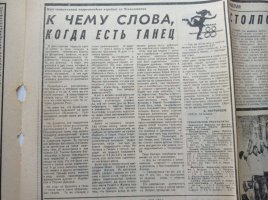
WHAT PLACE FOR WORDS, WHEN THERE ARE DANCES

(the article published in russian 'Sovetskiy Sport' on January 17, 1988)

Our Special Correspondent Reports from Czechoslovakia

In the press center, a colleague from abroad approached me, pointed his finger at the European Figure Skating Championship program, and asked in all the languages known to civilized humanity what it meant. His index finger pointed to two words, which in a literal translation mean "Polovtsian Dances." You, of course, understand what it means. But how do you give a consultation to a person who is far removed from our past?
Try to explain to him that "dances" and "folk dances" are completely different things. And what are these Polovtsians to a resident of the late 20th century? Should I give my companion a short course on the history of Ancient Rus?
I do not know what my curious colleague understood from my fleeting explanations. He thanked me, most likely out of politeness.
But it seems all misunderstandings vanished after the performance of Natalia Bestemianova and Andrei Bukin. Their free dance to the music of Borodin spoke more eloquently than any words. The judging marks matched. For technical merit, all the judges gave them a 5.9, while for artistic impression, seven "sixes" (6.0) and two 5.9s lit up the scoreboard. With these marks, Bestemianova and Bukin confirmed their leadership in modern ice dancing. But this happened almost at the very end of the competition. Prior to this, many interesting events took place. First of all, I am referring to the sensation created by the French duo—Isabelle and Paul Duchesnay.
Their start did not catch the eye—fifth place after the compulsory dances. The same position after the original dance. And suddenly, a surge—third place in the free dance. And the duo is on the list of medalists.
I am turning to a helpful reference book that contains data about all the championship participants. In the informational profile, it stated that Isabelle and Paul were ninth at the World Championship last year, and fifth in Europe. Their place of residence, which is strange for us, lists the city of Quebec. So, they are Canadian French (or French Canadians?).
But here is a highly significant detail: their choreographer is C. Dean. Let us add a clarifying note: this is the same Christopher Dean from Great Britain, the partner of Torvill in the famous duo. Exactly the same Christopher who staged a performance that was so enthusiastically received by the local audience as executed by the Duchesnays.
The applause did not subside for a long time. Annenko and Sretenski are already prepared to start their program, but the stands simply will not let Isabelle and Paul go backstage. Our athletes stepped onto the ice in a difficult psychological situation: it is difficult to perform when the arena is still under the spell of the previous dance. But Natalia and Heinrich honorably emerged from this tough position. Scores ranging from 5.6 to 5.8 both for technical execution and for artistry secured their second place.
There was another captive performance by Maya Usova and Alexander Zhulin. Their Eastern story, akin to tales from "One Thousand and One Nights," also did not leave the packed stands indifferent. Yes, the target above fourth place was missed by Usova and Zhulin. But agree that a position right behind the medalists does credit to the debutants of the continental championship.
So, two more medals—gold and silver—were added to the treasury of the Soviet team. Moreover, the success of the ice dancers deserves to be highlighted specifically. Let us pay tribute to Isabelle and Paul Duchesnay, Catherine and Christopher Beck from Austria, and the Hungarian athletes Klara Engi and Attila Toth. But the Soviet Union is the only country that fielded three top-tier, original, and highly popular duos for a competition of such a high rank. Let us not forget, at the same time, that the world vice-champions Marina Klimova and Sergei Ponomarenko were absent from the European championship due to an injury to the partner. It became clear that our ice dance school preserves its leading positions, which means it values its traditions laid down by previous generations of skaters.
This is exactly what the Honored Coach of the USSR, Tatiana Tarasova, spoke about at the press conference. She reminded journalists that Annenko and Sretenski started their path under the guidance of Lyudmila Pakhomova. "And now," said Tatiana Tarasova, "I consider it my duty to help these figure skaters prepare as best as possible for the '88 Olympics."
The theme of Calgary inevitably arises in all conversations.
"How are you preparing for the Olympic start?" journalists asked Bestemianova and Bukin.
"We train just like the 11 years we have been performing on ice fields," Andrei replied.
His restrained professionalism also showed in another reply. The question was phrased as follows:
"How did you feel about the scores of 6.0 awarded to you?"
"Our business is to skate, and not count the points," came the answer.
To a certain extent, these statements give an idea of the character of our best ice dance couple. But, of course, the main proof is there on the ice, in the crucible of struggle.
From this perspective, Viktor Petrenko's performance in the short program where he took second place deserves special attention (fifth after the compulsory figures). As a result, he moved to the third spot in the tournament table, right behind Vladimir Kotin and Aleksandr Fadeev. The men have yet to contest the final set of medals for the European Figure Skating Championship.​
A. PATRIKEYEV.

PRAGUE, 16 January.
TECHNICAL RESULTS
European Figure Skating Championship. Sports Palace. 15 January.
Ice Dancing. Free dance. 1. Bestemianova - Bukin; 2. Annenko - Sretensky (all USSR); 3. I. Duchesnay - P. Duchesnay (France); 4. Usova - Zhulin (USSR); 5. K. Beck - H. Beck (Austria); 6. Engi - Toth (Hungary).
Total score of compulsory, original, and free dances. 1. Bestemianova - Bukin - 2.0; 2. Annenko - Sretensky - 4.0; 3. I. Duchesnay - P. Duchesnay - 7.6; 4. Usova - Zhulin - 7.6; 5. K. Beck - H. Beck (Austria); 6. Engi - Toth (Hungary) - 12.0.
Men. Short program. 1. Fadeev - 0.4; 2. Petrenko - 0.8; 3. Kotin (all USSR) - 1.2; 4. Zander (FRG) - 1.6; 5. Filipowski (Poland) - 2.0; 6. H. Fischer (FRG) - 2.4.
Total score of compulsory and short programs. 1. Fadeev - 1.0; 2. Kotin - 2.4; 3. Petrenko - 3.8; 4. Fischer - 4.2; 5. Filipowski - 4.4; 6. Zander - 5.2.
1786550039418.jpeg

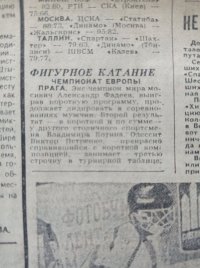
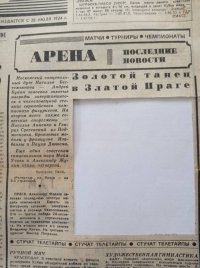
Golden Dance in Golden Prague

(the article published in russian 'Sovetskiy Sport' on January 17, 1988)

The Moscow ice dance duo Natalia Bestemianova and Andrei Bukin won the gold medals of the European Figure Skating Championship, which concluded in the Czechoslovak capital.​
In second place are also Soviet athletes—Natalia Annenko and Genrikh Sretenski from the Moscow Region.
The bronze medals went to the French skaters Isabelle and Paul Duchesnay.
Another Soviet ice dance couple, Maya Usova and Alexander Zhulin, finished fourth.

PRAGUE. Aleksandr Fadeev won the final gold medal of the European Figure Skating Championship that concluded in the capital of Czechoslovakia. This is the third victory for the 24-year-old Muscovite in the men's continental championship competitions.​
In second place is his fellow countryman Vladimir Kotin.
In third place is Odesan Viktor Petrenko.
1786550105796.jpeg
 
1988
Olympic Teletype

(excerpts of the article published in russian 'Sovetskiy Sport' on January 17, 1988)

  • Former world figure skating champion Boitano (USA) stated that he will be able to defeat the current world champion, Orser of Canada, at the White Olympics using a four-revolution jump (quadruple jump).​
  • Canadian Minister of Sport Otto Jelinek, the 1962 world figure skating champion (in pairs), will lace up his skates once again in Calgary. He will participate in the opening ceremony of the Games.​
  • 1786550534495.jpeg
 
1988
EUROPEAN CHAMPIONSHIPS

Next in Line — Calgary

(the article published in Ukrainian 'Sportyvna Hazeta' on January 19, 1988)

The European Figure Skating Championships have concluded at the Prague Sports Palace. Just like last year, Soviet masters won 9 out of 12 medals. For the second consecutive year, the bronze medal was brought to our republic by Viktor Petrenko from Odesa. So, we think the student of coach Galina Zmievskaya is heading to the Olympic Games in Calgary in a great mood.
ANOTHER attempt to surpass Katarina Witt from the GDR ended fruitlessly for USSR figure skaters. Muscovite Kira Ivanova, who led after the "school" (compulsory figures) and short program, became second, while her compatriot Anna Kondrashova finished third. The student from Karl-Marx-Stadt performed all the most difficult elements easily and effortlessly, and for her free program, she received two of the highest scores — 6.0. Thus, the future actress coped wonderfully with the role of Carmen and deservedly won.
Getting into the top six of the strongest figure skaters in Europe on the first attempt is undoubtedly a success for 17-year-old Kyiv skater Natalia Gorbenko, whose free program pleased both the audience and experts. If not for the mistakes in the "school" and short program, our compatriot could have aimed for a higher place. By the way, Natalia, together with Kira Ivanova, attempted a triple Lutz — the most difficult jump, which not every man can execute. Well, the girl has good chances to grow into a true master.
Before the final event, Viktor Petrenko was trailing Aleksandr Fadeev and Vladimir Kotin by 2.8 and 1.4 points, respectively. The distance, you must agree, was solid. But the young Odesa skater fought to the very end and caused admiration with his composition. He demonstrated his most difficult arsenal of triple jumps, skated with inspiration, and two judges rewarded him with grandmaster 5.9 scores for technique.
And although last night the judges gave Viktor the second result for his free program after Fadeev, by the unanimous assessment of experts, he was the best on the ice that night. Again, just like last year, Fadeev, Kotin, and Petrenko stepped onto the podium of honor in the same order.
Among the ice dance couples who represented various skating schools in Prague, the palm of victory at the championship was unanimously given to Natalia Bestemianova and Andrei Bukin. The Moscow students became continental champions for the fifth time. Their compatriots Natalia Annenko and Genrikh Sretensky became silver medalists for the first time. The third place, unexpectedly for many, was taken by the French couple Isabelle and Paul Duchesnay, who surpassed our Maya Usova and Aleksandr Zhulin.
By the admission of experts, the pinnacle of creativity for Tatyana Tarasova's students was the Polovtsian Dances from Alexander Borodin's opera "Prince Igor," which turned into a beautiful choreographic performance. Natalia and Andrei managed to convey the entire range of feelings, the drama of the piece. As a result, seven judges at once awarded them six points each for artistry.
"Understandably, it's pleasant when the judges are generous with such high marks, but when we step onto the ice, we don't think about it. Instead, we try to immerse ourselves into the image as quickly as possible and perform the dance," Andrei confessed.
Original and complex compositions were also prepared by other prize-winners of the championship. After the conclusion of the championship, the famous Czechoslovak figure skater, multiple European champion, and current coach Ondrej Nepela said: "Soviet masters, especially in the men's singles, demonstrated extremely difficult programs. Petrenko was highly praised. In Olympic Calgary, if their psychological preparation does not fail, they can confidently count on success. However, they will meet serious rivals in the persons of American Boitano and Canadian Orser."
Thus, the continental championship is behind us. It showed that none of the Soviet masters managed to avoid mistakes in at least one of the competitions — be it compulsory, short, or free programs. "In Calgary, success will come to those who perform all three components of figure skating evenly and cleanly," believes USSR Honored Coach Elena Tchaikovskaia. And one cannot disagree with this conclusion.
1786552438690.jpeg
 
1988
EUROPEAN CHAMPIONSHIPS

Men Haven't Said It All Yet

(the article published in russian 'Sovetskiy Sport' on January 19, 1988)

Alexandr Fadeev, Vladimir Kotin, Viktor Petrenko — medalists of the European Figure Skating Championships.

Express Comments
Elena Chaikovskaia (Honored Coach of the USSR): "None of our three athletes avoided making mistakes. Therefore, before the Olympics, we need to work on improving their skating."
Ondrej Nepela (Five-time European Champion, Czechoslovakia): "I saw the Soviet athletes during practices. They are capable of much more than what they showed in the official competition."
Sergei Volkov (Coach of European Champion Alexandr Fadeev): "At this competition, we tried a quadruple jump. It is not just about executing it. We wanted to see how such a difficult element affects the entire program."

I will begin my final report from Prague's European Figure Skating Championships with three interviews. The final event of the competition—the men's free skate—showed the absolute dominance of the Soviet athletes. As a reminder, they were already leading after the compulsory figures and the short program. Only a "small" task remained—to maintain that lead during the free skate performance.
As you have already realized, the leaders' performances were far from perfect. But let the experts and judges show their strictness toward the athletes. The spectators, I have no doubt, thoroughly enjoyed the parade of boundless possibilities in figure skating.
In truth, practically no one managed a completely smooth performance. Petrenko looked preferable to the others. Let me remind you that he also performed very convincingly in the short program. This time, his scores ranged from 5.5 to 5.8 points for technique, and from 5.6 to 5.8 for artistry.
A difficult task lay ahead for Kotin—a recognized master of expressing emotions and creating an image. In terms of artistry, everything was in order this time: 5 scores were 5.9. But the technical scores were slightly lower: from 5.5 to 5.7 points.
In terms of overall performance, Fadeev surpassed everyone. His performance earned the universal approval of the spectators, the television audience, and the judges. True, it did not reach a perfect score of "sixes." However, the scores he received (ranging from 5.7 to 5.9) secured first place for Fadeev.
Then came the traditional press conference. I have written about them more than once. And I do so because figure skaters handle them in a businesslike manner. Questions are asked bluntly, sometimes even trickily, but out of a desire to find the truth.
For example, Fadeev and Kotin were asked: "Aren't you afraid of Petrenko? After all, a new serious competitor has appeared."
To this, Fadeev’s coach, Volkov, replied: "Sport is unthinkable without competition. The appearance of a new competitor only pushes us forward."
Petrenko’s coach, Galina Zmievskaya, continued this thought: "Until now, sharp competition existed only among the pairs and ice dance couples. Now it has appeared among the men as well. This only pleases us."
But the journalists did not stop at their initial curiosity. The next probing question was: "On the ice, you are competitors. But how are your relationships in everyday life?"
Kotin took the initiative to answer (by the way, he speaks English well, so as not to create extra work for the translator): "I don't recall a single incident that could cause a conflict or even a misunderstanding."
But the journalists still did not let it go. They asked: "And what is your relationship with foreign competitors, for example, with Boitano?"
Here, Fadeev took the floor: "I am friendly with him. When he was in the Soviet Union, I invited him over to my house. We had what you call a heart-to-heart talk. And I hope he was pleased with the evening we spent together."
Questions, questions, questions...
Kotin was asked: "For quite a long time, you haven't been able to win against Fadeev. Was there a moment when you felt you could actually do it?"
"Winning against Fadeev is possible if two conditions are met," the silver medalist replied. "If I skate my program absolutely flawlessly and if my opponent makes a mistake... There are no other options, as you can understand yourself."
Among other questions asked of Petrenko, there was this one: "Have you seen John Curry, who also used to perform to Minkus's music?"
Viktor replied: "I haven't had the chance to see Curry. When he competed, I wasn't involved in figure skating back then."
Generations change, one group of athletes is replaced by another, and new "stars" light up. But the mastery that cannot be replaced by any tricks remains unchanged. Our figure skaters proved this today. Did they prove it fully?
Kotin said that not everything he planned turned out well. He missed several elements. Fadeev spoke about his quad jump more as an experiment. Petrenko self-critically spoke about needing to improve his skating style.
Well, a critical look is by no means a negative before the Olympics. But we will not jump ahead and downplay the significance of such a major tournament as the European Championship. The title of the strongest on the continent is by no means an insignificant achievement...
Now we just have to sum up the final results of the competition, so to speak, settle the accounts. Four sets of medals were contested at the European Championship. Soviet athletes won three medals of the highest value: pairs skaters Gordeeva–Grinkov, ice dancers Bestemianova–Bukin, and Fadeev. Furthermore, the medalists became Selezneva–Makarov, Annenko–Sretenki, as well as Kotin, Petrenko, Ivanova, and Kondrashova.
The next barrier on the path of figure skating development has been successfully crossed. Ahead lies a longer voyage. It remains to wish the figure skaters, if not fair winds and following seas, then a ‘storm’ of six-point scores from the judges.​
A. PATRIKEYEV.
PRAGUE, January 18.
TECHNICAL RESULTS
European Figure Skating Championships. Prague, Sport Palace, January 16.
Men. Free Skating.
1. Fadeev, 2. Petrenko, 3. Kotin (all USSR), 4. Filipowski (Poland), 5. Barna (CSSR), 6. Zander (FRG).
Sum of compulsory, short, and free programs. 1. Fadeev — 2.0; 2. Kotin — 5.4; 3. Petrenko — 5.8; 4. Filipowski — 8.4; 5. Zander — 11.2; 6. Fischer (FRG) — 11.2.
1786602173683.jpeg
1786602194076.jpeg
 
1988
SHOCKING SIGNAL

FIGURE SKATING? BAN IT!

(the article published in russian 'Sovetskiy Sport' on January 22, 1988)

Eighteen Kyiv figure skating coaches suddenly found themselves out of work. Such a "gift" was presented to them just before the New Year by the leadership of the Ukrainian Council of the "Dynamo" society. The order declared that from now on, the Kiev City Council of the society is removing figure skating from its list of sponsored sports.
What did this sport, loved by many, do wrong to deserve this from the Dynamo managers, and along with it, the two hundred children from the SDYUSSHOR that had been operating successfully for many years? As it turns out... it is due to a reduction in expenses allocated for educational and training work. There is no need to look for a logical connection between these two events. It was successfully replaced by a bureaucratic approach to solving the problem. After all, surely one shouldn't significantly cut the administrative staff because of this!
Furthermore, such a solution as developing paid services for the public was seemingly never even considered or taken into account. And it is completely impossible to explain why they refused the assistance offered by the State Committee for Sports (Goskomsport) of the Ukrainian SSR. Just ban figure skating—and that’s all there is to it. But it raises a number of questions. How does such a decision square with the decree of the Central Committee of the Communist Party of the republic regarding the development of winter sports? What will happen to the "unemployed" coaches? And most importantly, how do you explain to the children that they are no longer required to show up for their classes?​
L. VLASYUK.
(TASS Correspondent).
KYIV.
1786603683659.jpeg
 
1988
OLYMPIC HOPES ALL-UNION COMPETITON


FIGURE SKATING

(the article published in russian 'Sovetskiy Sport' on January 27, 1988)

DNIPROPETROVSK. The All-Union "Olympic Hopes" competition has concluded at the "Meteor" Universal Sports and Entertainment Palace.
Representatives from schools in Moscow, Leningrad, Kyiv, Odesa, Dnipropetrovsk, and other cities across the country competed in the tournament. Muscovites took first place in three disciplines of the program: S. Minaev and T. Rachkova in the singles events, and L. Berezova and V. Fedorov among the ice dance couples. E. Nikonova and N. Apter from Leningrad were named the best pair.​
V. KRIVOPALTSEV.
1786604236145.jpeg
 
1988
SHOCKING SIGNAL

FIGURE SKATING? BAN IT!

(the article published in russian 'Sovetskiy Sport' on January 22, 1988)

Eighteen Kyiv figure skating coaches suddenly found themselves out of work. Such a "gift" was presented to them just before the New Year by the leadership of the Ukrainian Council of the "Dynamo" society. The order declared that from now on, the Kiev City Council of the society is removing figure skating from its list of sponsored sports.
What did this sport, loved by many, do wrong to deserve this from the Dynamo managers, and along with it, the two hundred children from the SDYUSSHOR that had been operating successfully for many years? As it turns out... it is due to a reduction in expenses allocated for educational and training work. There is no need to look for a logical connection between these two events. It was successfully replaced by a bureaucratic approach to solving the problem. After all, surely one shouldn't significantly cut the administrative staff because of this!
Furthermore, such a solution as developing paid services for the public was seemingly never even considered or taken into account. And it is completely impossible to explain why they refused the assistance offered by the State Committee for Sports (Goskomsport) of the Ukrainian SSR. Just ban figure skating—and that’s all there is to it. But it raises a number of questions. How does such a decision square with the decree of the Central Committee of the Communist Party of the republic regarding the development of winter sports? What will happen to the "unemployed" coaches? And most importantly, how do you explain to the children that they are no longer required to show up for their classes?​
L. VLASYUK.
(TASS Correspondent).
KYIV.
View attachment 11926
Interesting. Obviously not an experiment that lasted, but I never heard about this even at the time.
 
1988
WHO WILL STEP ONTO THE PODIUM

A GUY FROM THE PAST CENTURY

(the article published in russian 'Sovetskiy Sport' on January 30, 1988)

American figure skater Brian Boitano is rightfully considered one of the main contenders for the Calgary gold medal in the men's singles event, alongside world champion Brian Orser of Canada and former world champion Alexandr Fadeev. Following the retirement of the "unbeaten little American" Scott Hamilton in 1984, these three athletes rotated on the podiums of world championships with kaleidoscopic speed. In 1985, Fadeev was named the best. In 1986, Boitano outpaced everyone. In 1987, it was Orser's turn. It all slightly resembles a children's game where everyone takes turns being "it."
"In Calgary, I am going all-in," Brian Boitano said in an interview with a correspondent from the American news agency Associated Press. "I will try to show the absolute best I am capable of. The gold at the White Olympics is the main goal of my athletic career."
"The program we are preparing for Calgary is set to music from the movie Napoleon," says Boitano's coach, Linda Leaver. "Brian portrays scenes from the lives of French military men from the early 19th century. Why did we choose this theme? It is common knowledge that my Brian is somewhat inferior in artistry to his Canadian namesake. We puzzled over this shortcoming, thinking about how to eliminate it or at least mask it. And we came to the conclusion that a second Robin Cousins would not come out of him—lyrical passions are foreign to my student, at least on the ice. On the other hand, Brian is a wonderful impersonator; if we use acting terminology, he is a character artist. So we chose something that, in my opinion, no one else is capable of portraying and executing on the ice. Right now, Brian spends hours in front of a mirror in the choreography room working on... military bearing."
"As for the technical side of the program," Linda Leaver continues, "it includes eight triple jumps—the maximum allowed under international rules. Twice during the composition, Brian will perform the most difficult element—the triple Axel. It is possible we will also include a four-revolution jump (quad) in the program. But honestly speaking, that is not an end in itself for us."
And how does Brian himself assess his readiness for the Olympic Games?
"The only thing that worries me is that I reached peak athletic form too early," he says. "I am afraid of losing it on the way to Calgary. In 16 years of figure skating, I still haven't truly figured myself out. To this day, I cannot predict how I will perform the next day—whether I will succeed or fail. I feel especially insecure in the 'school'. The presence of judges on the ice binds me hand and foot. Honestly speaking, I dislike them a bit, because at times they can be highly subjective and can distort the real balance of power to suit some kind of higher idea."
Boitano's ideal in figure skating is Charles Tickner, a four-time US champion and world champion from the recent past. Brian considers his main opponent to be himself—his own endurance and his nerves, which he cannot always manage to curb.
"But what about his main competitors—Fadeev and Orser?" you might ask. "Is he really so self-assured that he doesn't take them into account?"
Boitano believes that all three are roughly equal in strength, and each of their claims to the Olympic gold in Calgary is completely justified. "It's going to be a lottery," Boitano says. "Whoever gets lucky will win."​
V. MACMILLIN.
1786606050220.jpeg
 
Back
Top