1988
A Beautiful Fairy Entangled in Problems
Irina Rodnina: In Search of Lost Time
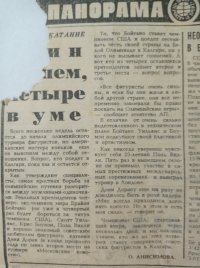
(the article published in russian 'Sovetskiy Sport' on January 8, 1988)
The Olympic cycle always brings new names, new styles. How has figure skating changed over the past four years? With this question, our correspondent turned to Honored Master of Sports Irina Rodnina.
— Irina Konstantinovna, in your opinion, why has the interest in figure skating, especially pairs skating, noticeably decreased in Europe? Could it be that you yourself are partly to blame for this? After all, for almost twelve years (!) on the world ice, first Rodnina and Ulanov, and then Rodnina and Zaitsev dominated, showcasing figure skating of the highest class, and defeating them was practically impossible. Yet, at the 1981 European Championship, just one year after you retired from the sport, representatives of only six countries competed.
— An interesting turn of phrase... But you know, I do not feel any guilt. After all, I didn't enter the elite of figure skating on a "green light"—I had to compete against strong, very strong rivals. Explaining the drop in popularity simply by the multi-year leadership of one or two athletes is just too simple and convenient.
— Then what is your explanation?
— Competition—that is the main, if not the decisive factor in the development of any sport. Today, there is no such fierce competition as there once was. Many national schools of figure skating are experiencing a decline—the French, British, Czechoslovak, and Polish schools. Yet, each of them used to be interesting and distinctive in its own way. Just fifteen years ago, an athlete's nationality could be determined without even looking at the competition protocol, simply by their style of skating.
Later, for a long time, the competition in pairs skating on the international arena came down to a rivalry between the figure skaters of two countries—the Soviet Union and the GDR. Now, pairs from Canada have joined this battle, and recently Americans activated as well. But representatives of the European school still remain in the shadows. And, as empty stands testify, this illness is outdated, a chronic one. Getting rid of it won’t be that simple.
— True, absolutely true. After all, you cannot force athletes to skate worse than they can just so that rivals can compete with them on a more or less equal footing, thereby increasing competition...
— You are ironizing in vain. The International Skating Union (ISU) makes repeated attempts to equalize the capabilities of athletes from different countries. But even this does not stop our leading pairs... We talked about competition inside the country...
For too long, the time belonged exclusively to coaches working under a single doctrine, where the absolute authority in this field was considered to be Stanislav Zhuk. He alone decided what was good and what was bad, dictating the fates of pairs skating. Other coaches, one after another, left our discipline. For instance, Tatiana Tarasova worked with pairs for only a short period of time before transitioning fully to ice dance. The last elite pair coached by Elena Chaikovskaya (Karelina — Proskurin) broke up back in 1973. True, during these years, Tamara Moskvina and Igor Moskvin "sat closely" in the quiet of their creative laboratories. It was they who were destined to bring pairs skating to a new level of development, to give it, so to speak, a new form, color, sound. If only they hadn't managed to preserve their own coaching and creative style, their own direction in figure skating, and their own vision... I don't know where we would have ended up then.
— Perhaps we shouldn't dramatize the situation so much. We have three wonderful, completely distinct pairs: Gordeeva and Grinkov, Valova and Vasiliev, Selezneva and Makarov. The eccentrics, the lyricals, and the athletes. And all three pairs are excellently prepared technically.
— With that listing, you have just answered all the questions yourself. Yes, three leading duets are fighting among themselves. But who is behind them? It turns out that as of today, there are only two "powerhouses" operating in the Soviet Union — the Moscow school and the Leningrad school. Moreover, the Moscow school has shouldered the bulk of the entire load in training athletes in all types of figure skating, while the Leningrad school is only pairs and singles. But our country is vast, and there are figure skating schools in many republics. Yet, there is practically no return from them.
— Well, why, in your opinion, do ice dances, where the main struggle is also between representatives of the USSR, still remain the most popular discipline in the world of figure skating?
— Ice dancing is a ball. Ice dancers generally look much more impressive than pairs, where a big disproportion in height, weight, and age is always noticeable. After all, right now in pairs skating, the complication of the technical level of programs happens largely due to this very difference. Ice dance coaches pay more attention to appearance: the athletes must match each other in height and harmonize with each other externally. Pairs coaches look primarily at the physical capabilities of the skaters. Of course, a leggy girl looks much more spectacular on the ice than a tiny, sturdy girl. But tell me: how will she land on her thin little leg after another mind-boggling throw? And besides, pairs skating is tightly constrained by technical complexity; athletes simply don't have time to use their choreographic inclinations and abilities. After all, when a triple twist is performed, it's not about embellishing the program, and not about musical accents.
But ice dancing seemingly highlights the athleticism of pairs and singles skaters, and makes people look for something new. Well, and then came a completely natural decline. And even for "ice dancers" today, the audience is not responding as eagerly as before. There is only one way out: a new search in technique, choreography, and entourage. Perhaps it is worth splitting one free program into two—three minutes each, without the right to repeat elements. Otherwise, it turns out that the spectator has become oversaturated with our sport, much like one can get sick of a sweet cake.
DOES THE JUDGE HAVE THE RIGHT TO "CALL THE TUNE"?
— Judging in figure skating is the most acute problem. The issues of objective and competent judging are increasingly worrying athletes, coaches, and the public alike...
— These questions are perhaps only so acute for ice dancers. That is truly where subjectivism reigns supreme and the principle of "you like it?, well I don't!" rules! But, as the saying goes, every house has its own troubles. Yet, there is one trouble common to all—the level of judging today is significantly inferior to the modern level of development in figure skating. Moreover—for example, in pairs skating, it becomes not a stimulus, but a brake on further progress.
— It is generally accepted that a judge's decision is, so to speak, the ultimate truth...
— The thing is, many national federations have stopped developing pairs skating. Perhaps it seems hopeless to them from the perspective of achieving high results. Be that as it may, Scandinavian countries and countries of Central Europe practically do not "supply" their athletes to the World and European Championships, or to international tournaments of various levels. Now answer me, which judge understands the nuances of figure skating better?
— Probably the one whose country has this discipline more developed.
— Absolutely right. The arithmetic regarding judging representation in pairs skating is simple: 9 judges, 4 of whom represent countries where pairs skating is in favor, while the remaining five... see pairs skating two or three times a year at best. Even if they meticulously study the athletes' training sessions before competitions, and regularly look through specialized magazines and books, gaps in their knowledge of the technical level of modern pairs—and therefore, gaps in judging technique—are inevitable.
— Let us clarify, what exactly does this "low level" of judging consist of?
— There is a single technical committee for pairs and singles skating—the exact same judges do the scoring. And since, as I already mentioned, pairs skating is not developed at all in some countries, the decisions regarding these athletes are made by singles judges. But pairs and singles skating, for all their outward similarities, are completely different disciplines.
— But the elements, with rare exceptions, are the same?
— It is a very common and crude mistake. For example, a jump in pairs skating is completely different from a jump by a singles skater.
There is another aspect. Singles skating specialists know perfectly well that a Lutz jump is harder to execute than, say, a Loop. However, many do not realize that a Loop lift is more difficult than a Lutz lift. Only a well-trained pairs-specialist judge can understand these nuances.
Flaws in the judging rules are also connected to a lack of knowledge regarding the core execution techniques of certain elements. For some reason, in recent years, the twist lift has begun to be classified under the general category of lifts. But this is incorrect—after all, a twist lift is much harder to perform. Yet, these elements are evaluated equally. And it seems to me that the ISU leadership should consider introducing a difficulty coefficient—say, like in artistic gymnastics. The more difficult and risky the element is, the higher the score should be.
Progress in figure skating is sometimes hindered by illiterate changes in the rules. A few years ago, the following decision was made: you cannot catch the female partner on your chest during a twist lift—only with a hand-to-body catch. In reality, catching a partner according to this rule requirement is only possible after a two-rotation twist.
— There has been a lot of talk in recent years about so-called balanced programs. What do you think about this?
— Because of these, to put it mildly, balanced programs, all compositions have become like identical twins—they look exactly the same, only the music is different. After all, every pair must perform a specific number of elements: at least two jumps, one or two jump combinations, three lifts (one of which can be a twist lift), a death spiral must absolutely be present, pairs parallel spins, combinations of spirals... There is simply no time to search for individuality of style or innovative solutions—one just hopes to manage to execute all the elements prescribed by the rules. In the junior ranks, this is especially noticeable. And how can one not understand that any pair should differ from another not only in their level of technical equipment, but also by the "uncommon expression of their face" [their unique identity]. Unfortunately, under the current judging rules, one can only dream about this.
THE ICE RINKS OF MY CHILDHOOD
— Irina Konstantinovna, many coaches nowadays complain that the influx of talented figure skaters into the national team is inexorably shrinking. Capable children are sought all over the country; people travel to the ends of the earth for them. What, has the Russian land grown poor in talent?
— No, it's just that talents have nowhere to skate. Probably, every person at some point begins to be haunted by a feeling of longing for something lost. For me, one of the facets of this nostalgia for the past is ice rinks. The rinks of my childhood. Brightly lit, festive, and noisy, where hot pies and tea were sold, where not only children but also quite respectable people came, and where the phrase "May I skate with you?" served as a password for getting to know someone.
Our ice rinks are melting. They are evaporating without a trace. There is no longer the massive ice area in Luzhniki around the Grand Sports Arena. The ice rink in Gorky Park practically ceased to function properly when it was moved from the center of the park to the windswept embankment. But that would only be half the trouble. Badly lit, equipped with practically no basic amenities, it became a haven not for figure skating enthusiasts, but for teenagers looking for wild fun. I am no retrogradist, but an adult is unlikely to come here anymore.
There is no longer open ice in Sokolniki, in Maryina Roshcha, at the Stadium of Young Pioneers. In Moscow, there are perhaps only two ice rinks left in the full sense of the word. Not just a space covered with ice, but something "humanized": with skate rentals, buffets, music, and good lighting. These are "Druzhba" [Friendship] and "Severnoye Siyaniye" [Northern Lights] in Luzhniki.
— And at the same time, huge, uninhabited spaces sit empty. How many ice rinks, for instance, could be set up at the VDNKh.
— And think about another fact: paradoxical as it is, both in the capital and in the country as a whole, the problem of employment for coaches is acute. There are few artificial ice rinks, and mostly venerable specialists work on them. Where should the young ones go if all the places under the sun are already taken? Well, alright, they might accept someone to coach the "younglings" at some sports school. But there, you face a quota plan. You need ranked athletes. And the coach, with the zeal of a gold digger, begins to search for talents... to fit into ranking standards. I, however, believe that before teaching an athlete how to jump, you need to instill a love for the sport, to teach them to use their imagination and create on the ice. But no, we immediately teach them to jump. If they learned it—great, if not—goodbye.
Moreover, even when talents are found, it is often disadvantageous for a young coach to work with them. Why, one might ask, waste extra effort on a promising student if you will eventually have to hand them over to a more experienced mentor anyway? But the real offense lies elsewhere—after all, hardly anyone will remember later who it was that first put the future champion on skates.
— It is hard to disagree with you. Does anyone know that the first coach of E. Vodorezova was L. Titova? That it wasn't T. Tarasova who first put N. Bestemianova and A. Bukin on skates, and it wasn't E. Chaikovskaya who taught V. Kotin how to move on ice, and it wasn't S. Zhuk and S. Volkov who witnessed the first steps of A. Fadeev. Let's be honest, we forget about the first coaches and do not reward their work properly. By doing so, we humiliate their professional pride and kill their interest in the work. As a result, almost no one wants to work with children. This, it seems to me, is the ultimate question: how do we raise the prestige of a children's coach's work?
— I think they need to be incentivized both financially and morally. Why not, for example, reward the first coach of a figure skater who has achieved notable success with a trip to an international competition? Or perhaps their salary should depend on the athlete's future successes? There could be various options. One thing is clear: this problem requires serious thought. How many times have I attended various seminars of the Figure Skating Federation. National team coaches and choreographers spoke there. But not once did I hear a speech by a children's coach. They are simply not invited there.
— Even to the naked eye, the rift between grassroots children's figure skating and training aimed exclusively at producing future champions is noticeable. Although, it would seem, the latter should naturally flow from the former. It used to be that way.
— When I came to the artificial ice at CSKA, I already had a solid track record of performances. Every year prior to that, I took part in the season's closing at the ice rink in Maryina Roshcha. Our coaches taught us to work independently. We bought vinyl records with the music we liked, made up the dance ourselves, "danced it out" on the floor first, and only then transferred it to the ice. I, for example, performed the dance of the dwarfs from "Snow White" and a waltz from the ballet "Raymonda." Thus, from an early age, figure skating was for us not just drilling and practicing certain elements, but above all, an immense pleasure.
And recently, I dropped by the choreography hall at CSKA. They were explaining to children how to hold their hand. They didn't understand. And no wonder! In ballet, as is well known, a child is placed at the barre only at the age of 9, when they are capable of comprehending choreographic techniques. Nowadays, however, in figure skating, in the pursuit of premature champions and fast results, coaches force the normal course of things. The result is right before our eyes: faceless figure skaters and programs, as alike as two drops of water.
There is also another side to the coin. Previously, people came to figure skating "for health." Now, parents send their child to the club, already calculating in advance what benefits this promises in the future—fame and everything that comes with it.
I remember once after a training session, the mother of one of my students came up to me and asked: "Irina Konstantinovna, will anything come of my boy, or are we wasting our time?". Since when has time given to a child—and, mind you, not someone else's, but one's own—been considered wasted?!..
...The ice rinks of my childhood are gone into the past. Longing for these rinks is not just nostalgia for childhood. It is also a regret for lost traditions, without which, I am sure, it is impossible to move forward.
The interview was conducted by O. POLONSKAYA.
View attachment 11900