Archive of newspaper articles | Page 40 | Golden Skate

Archive of newspaper articles

1987
NHK TROPHY

FIGURE SKATING

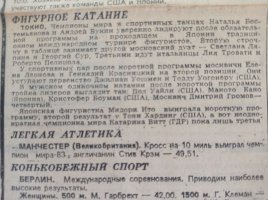
(the article published in russian 'Sovetskiy Sport' on November 28, 1987)

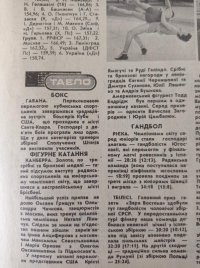
TOKYO. World champions in ice dance Natalia Bestemianova and Andrei Bukin are confidently leading after the compulsory program at the traditional international figure skating tournament currently taking place in Japan. The second spot in the standings is occupied by another Moscow duo — Svetlana Liapina and Georgiy Sur. In third place are Italians Lia Trovati and Roberto Pelizzola.
In pair skating, after the short program, Muscovites Elena Leonova and Gennadi Krasnitski are in second position. They trail Gillian Wachsman and Todd Waggoner (USA) for the lead.
In men's singles, after the short program, the top three leaders look like this: Paul Wylie (USA), Makoto Kano (Japan), Christopher Bowman (USA). Muscovite Dmitriy Gromov is fourth.
Japanese figure skater Midori Ito won the short program, the second best result went to Tonya Harding (USA), while multiple world champion Katarina Witt (GDR) is currently only third.
1786086503713.jpeg
 
1987
NHK TROPHY

FIGURE SKATING

(the article published in russian 'Sovetskiy Sport' on November 28, 1987)

TOKYO. World champions in ice dance Natalia Bestemianova and Andrei Bukin are confidently leading after the compulsory program at the traditional international figure skating tournament currently taking place in Japan. The second spot in the standings is occupied by another Moscow duo — Svetlana Liapina and Georgiy Sur. In third place are Italians Lia Trovati and Roberto Pelizzola.
In pair skating, after the short program, Muscovites Elena Leonova and Gennadi Krasnitski are in second position. They trail Gillian Wachsman and Todd Waggoner (USA) for the lead.
In men's singles, after the short program, the top three leaders look like this: Paul Wylie (USA), Makoto Kano (Japan), Christopher Bowman (USA). Muscovite Dmitriy Gromov is fourth.
Japanese figure skater Midori Ito won the short program, the second best result went to Tonya Harding (USA), while multiple world champion Katarina Witt (GDR) is currently only third.
View attachment 11868
I didn't realize Tonya Harding began competing internationally that early.
 
1987
NHK TROPHY

Before taking the ice in Calgary

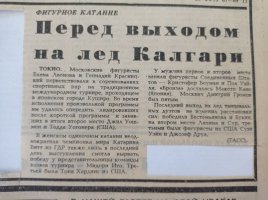
(the article published in russian 'Sovetskiy Sport' on December 1, 1987)

TOKYO. Moscow figure skaters Elena Leonova and Gennady Krasnitsky triumphed in the pairs competition at the traditional international tournament held in the Japanese city of Kushiro. During the performance of their free program, they managed to overtake the leaders after the short program, Gillian Wachsman and Todd Waggoner (USA), who finished in second place.
In the women's singles, multiple world champion Katarina Witt from the GDR was able to snatch victory from the representative of the host team, Midori Ito, only on the final day of the competition. Tonya Harding from the USA finished third.
In the men's event, first and second places were taken by skaters from the United States—Christopher Bowman and Paul Wylie. The "bronze" went to Makoto Kano (Japan). Muscovite Dmitry Gromov finished fifth.
The final performance on the ice by the ice dance duos did not change the standings: Bestemianova and Bukin won, Lyapina and Sur came in second, and third place went to skaters from the USA, Suzy Wynne and Joseph Druar.​
(TASS).​
1786115309189.jpeg
 
1924
From the archivist's notebook

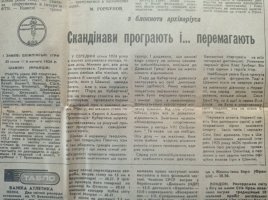
Scandinavians lose and... win

(an excerpt of the article published in Ukrainian 'Sportyvna Hazeta' on November 24, 1987)

I WINTER OLYMPIC GAMES
January 25 - February 4, 1924
CHAMONIX (FRANCE)


293 athletes from 16 countries took part: Austria, Belgium, Great Britain, Italy, Canada, Latvia, Norway, Poland, the USA, Hungary, Finland, France, Czechoslovakia, Switzerland, Sweden, Yugoslavia.

…The greatest attention was focused on the figure skaters' performances. Back then in Chamonix, no one paid attention to a little girl from Norway who finished last, in eighth place, among the women. Sonja Henie? So what? Yet, 5 or 6 years later, there wasn't a person in the sports world who didn't know that name.
1786297121106.jpeg
1932
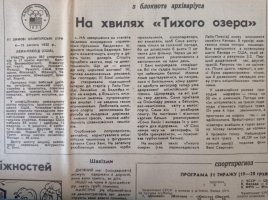
On the waves of "Lake Placid"

(an excerpt of the article published in Ukrainian 'Sportyvna Hazeta' on December 5, 1987)

III WINTER OLYMPIC GAMES
February 4–15, 1932,
LAKE PLACID (USA).

PARTICIPATION was taken by 307 athletes from 17 countries: Austria, Belgium, Great Britain, Germany, Italy, Poland, Canada, Norway, Romania, USA, Hungary, Finland, France, Czechoslovakia, Switzerland, Sweden, Japan.
...Norwegian figure skater Sonja Henie won her second gold medal.


...Olympic figure skating champion Sonja Henie was, of course, exceptionally popular. Crowds of fans, camera operators demanding that Sonja perform only under sunny conditions constantly hunted for everyone’s favorite, because this allowed them to capture her on film. Due to this, the women’s competitions began with a one-day delay.
And Henie justified expectations. All seven judges gave her the highest score! One can only guess how those fans felt who managed to get an autograph from the now two-time Olympic champion. However, not everyone knew this detail. Sonja arrived at the Olympics together with her father, a world ex-champion in cycling. He was the one who sorted through the mail. On postcards and business cards, the father would sign 'Sonja Henie' and place them into envelopes for delivery. 'Sonja has no time for autographs, she needs to train,' explained the caring father.
1786118850594.jpeg
 
Last edited:
1987
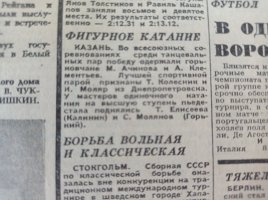
ALL-UNION COMPETITION 'IDEL'

FIGURE SKATING

(the article published in russian 'Sovetskiy Sport' on December 9, 1987)

KAZAN. In the all-union competitions among ice dance duos, victory was achieved by M. Achinova and A. Klementiev from Gorky. T. Kolesnik and I. Molyar from Dnipropetrovsk were recognized as the best pair. Among the singles masters, the highest step of the podium was taken by T. Eliseeva (Kalinin) and S. Molyanov (Gorky).
1786119714141.jpeg
 
Last edited:
1987
figure skating: interview

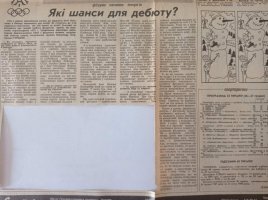
What are the chances for a debut?

(the article published in Ukrainian 'Sportyvna Hazeta' on December 12, 1987)

The Olympic flame is already on its way; only two months remain until the opening of the White Olympiad in Calgary. How are the Soviet athletes preparing for the games, and what are their chances for success? Today, we will talk about the main concerns of the country's figure skaters. Answering the questions of 'SG' correspondent I. Trofymenko is the head coach of the USSR State Committee for Sports in figure skating, Honored Master of Sports, Olympic champion Aleksandr Georgiyevich GORSHKOV.

— How is the preparation of candidates for the USSR national team progressing, and what can they count on in Calgary?

— The preparation period concluded with the traditional competitions for the prizes of the newspaper 'Moskovskiye Novosti'. Now the athletes are traveling to Yerevan, where a nationwide all-union tournament will take place from December 13 to 19, which will serve as the final selection for the national team. The venue was not chosen by chance. Yerevan and Calgary are located at approximately the same altitude above sea level.
Then, in January, at the European Championships in Prague, our masters must perform as an already established Olympic team. How is the situation today in world figure skating? There are some sensations, but the main balance of power remains unchanged.
Recently, our positions in pairs skating and ice dancing have been the strongest, where Soviet athletes won "gold" and "silver." The situation is more confusing in men's singles. In this discipline, the champions changed every season. In my opinion, the battle for Olympic titles will unfold between Brian Boitano of the USA, Brian Orser of Canada, and our Aleksandr Fadeev. The Canadian, naturally, will be supported by the spectators. Generally, besides the Americans, the hosts themselves will, in my opinion, turn out to be the main rivals of our skaters.
— What can you say about candidates for the Olympic national team from Ukraine?
— We don't have anyone to boast about in pairs skating. Things are better for representatives in ice dancing. Ilona Melnichenko and Gennady Kaskov became world junior champions last year. However, though they are candidates for the Olympic squad, realistically we can expect them to participate in the 1992 Olympics. The same could be said about Larisa Fedorinova and Yevgeny Platov. This is our prospective reserve.
In men's singles, Ukrainian athletes have already made a real name for themselves. Among them, first and foremost, is a pupil of Galina Yakovlevna Zmievskaya from Odesa—Viktor Petrenko. This gifted skater has gained significant authority abroad in recent seasons. At last year's World Championships, Viktor made it into the top six. He has excellent command of technique, which gives him a chance to become an Olympian in the current season.
Viktor's younger brother is currently among the substitutes. He experienced a slump in his performances, but I hope that now things will take a turn for the better.
Another strong Ukrainian figure skater is Kharkiv's Vitaliy Egorov, who is also among the candidates for the trip to Calgary. The season, however, started unsuccessfully for him; so far, Vitaliy has practically not taken the ice due to illness.
In women's singles, we have high hopes, looking ahead first and foremost to the '92 Olympics, for Natalia Gorbenko. She has a truly competitive character. Two years ago, Natalia became the world junior champion. Before her, only one Soviet figure skater had achieved such success. Neither among juniors nor among seniors had our female athletes ever been the strongest in the world. Last year, things did not go well for Gorbenko. However, her victory at a prestigious tournament in Austria at the end of October and her successful performance at the 'Moskovskiye Novosti' tournament have once again noticeably boosted the Kiev skater's standing.
— Are you satisfied with the pace of development of the sport in Ukraine?
— A strong center for figure skating has been established in the republic. We are talking about Odesa, where, admittedly, they mostly train singles skaters. A good creative team of trainers is working there, headed by G.Ya. Zmievskaya. Therefore, we look optimistically at the development of our winter sport in your southern city. But things are not entirely smooth here.
It would seem that during an Olympic season, the best possible conditions must be created to prepare candidates for the national team. However, things turned out differently in Odessa. Back in the spring, the Palace of Sports was closed for major renovations, and ahead of schedule at that. They failed to meet the timeline. The Palace opened only recently, which, understandably, did not aid the productive work of Odessa's figure skaters during the preparatory phase. Until November, they were forced to train far from home.
There is also, as we say, an 'ice shortage problem' in the republic's capital. Kyiv is far from fully utilizing its potential for the development of figure skating. Local skaters have to endure constant competition with hockey players. And due to the lack of 'their own' ice, the educational and training process suffers. While this does not affect Gorbenko's preparation that severely, it is a major hindrance to our other prospects.
However, on the whole, the republic has achieved remarkable progress in figure skating. The emergence of your compatriots on the main stage is no accident. Now it is important not to stop, but to strive for success among seniors as well. But why are the positions of Ukrainian figure skaters worse in pairs skating and ice dance? This is a superficial observation. Promising pairs have been appearing for a long time, for instance, in Dnipropetrovsk. But, first of all, the coaches still lack experience, and secondly, the Muscovites and Leningraders are exceptionally strong in these disciplines. After all, the best pairs in the world are trained in those cities. Yet, giving up on the intention to compete with them is out of the question, just as there was no desire to lag behind in singles skating in the past. And that is why there are now grounds to hope that, for the first time, a representative of your republic will go to the Olympics. So far, not a single Ukrainian figure skater has been granted such an honor.
1786128797283.jpeg
 
1987
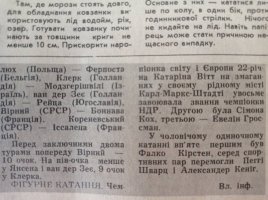
GDR CHAMPIONSHIPS

FIGURE SKATING

(the article published in Ukrainian 'Sportyvna Hazeta' on December 15, 1987)

At the competitions in her hometown of Karl-Marx-Stadt, 22-year-old World and European Champion Katarina Witt won the GDR champion title for the eighth time. Simone Koch finished second, and Evelyn Grossmann came in third.
In the men's singles, Falco Kirsten finished first for the fifth time, while Peggy Schwarz and Alexander König triumphed in the pairs skating event.​
Own info.
1786129277180.jpeg
 
1987
WORLD JUNIOR CHAMPIONSHIPS

FIGURE SKATING

(the article published in Ukrainian 'Sportyvna Hazeta' on December 15, 1987)

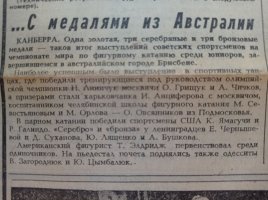
CANBERRA. Gold, along with three silver and three bronze medals—such was the result of Soviet athletes' performance at the World Junior Championships, which concluded in the Australian city of Brisbane.
The greatest success went to Oksana Grishuk and Aleksandr Chichkov, ice dancers from Moscow, who are coached by Olympic champion Natalia Linichuk. Following them onto the podium were Kharkiv native Irina Antsiferova with Muscovite Maksim Sevostyanov, and Mariya Orlova with Oleg Ovsyannikov from the Moscow region.
In pairs skating, victory went to USA representatives Kristi Yamaguchi and Rudi Galindo. Silver and bronze medals went to Leningrad pairs Evgenia Chernyshova and Dmitri Sukhanov, and Yuliya Lyashenko and Andrey Bushkov.
American skater Todd Eldredge was first in the men's singles. Among the prize winners were skaters from Odesa—Vyacheslav Zagororodniuk and Yuriy Tsymbalyuk.
1786130074722.jpeg

...With Medals from Australia

(the article published in russian 'Sovetskiy Sport' on December 15, 1987)

CANBERRA. One gold, three silver, and three bronze medals — such was the result of Soviet athletes' performance at the World Junior Figure Skating Championships, which concluded in the Australian city of Brisbane.
The most successful performance was in ice dance, where victory went to Muscovites O. Grishuk and A. Chichkov, who train under the guidance of Olympic champion N. Linichuk. Coming in as prize winners were Kharkiv native I. Antsiferova with Muscovite M. Sevostyanov (a product of the Chelyabinsk figure skating school), and M. Orlova with O. Ovsyannikov from the Moscow region.
In pairs skating, victory went to USA athletes K. Yamaguchi and R. Galindo. "Silver" and "bronze" went to Leningrad skaters E. Chernysheva and D. Sukhanov, and Yu. Lyashenko and A. Bushkov.
American figure skater T. Eldredge took first place among the singles skaters. Odesans V. Zagorodniuk and Yu. Tsymbalyuk also stepped onto the podium.
1786130100508.jpeg
FIGURE SKATING

(the technical results published in russian 'Sovetskiy Sport' on December 17, 1987)

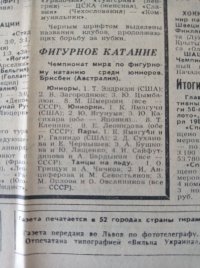
World Junior Figure Skating Championships. Brisbane (Australia).
Junior Men.
1. T. Eldredge (USA); 2. V. Zagorodniuk; 3. Yu. Tsymbalyuk... 8. M. Shmerkin (all — USSR).
Junior Women. 1. K. Yamaguchi (USA); 2. J. Yagunuma; 3. J. Kasihara (both — Japan)... 8. T. Klenina; 9. E. Leonidova (both — USSR).
Pairs. 1. K. Yamaguchi and R. Galindo (USA); 2. E. Chernysheva and D. Sukhanov; 3. Yu. Lyashenko and A. Bushkov; 4. I. Sayfutdinova and A. Bardykin (all — USSR).​
Ice Dance. 1. O. Grishuk and A. Chichkov; 2. I. Antsiferova and M. Sevostyanov; 3. M. Orlova and O. Ovsyannikov (all — USSR).
1786130688628.jpeg
 
Last edited:
1987
Match of the USSR's strongest figure skaters

FORGET ABOUT "ARMOR" OF CAUTION

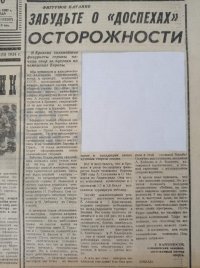
(the article published in russian 'Sovetskiy Sport' on December 16, 1987)

In Yerevan, the country's strongest figure skaters have begun the battle for tickets to the European Championship.

We are used to the classic competition calendar where, for example, the USSR Championship, usually held in January, decides the roster of our national team. But now everything looks different; the most important starts have been "shifted" forward by almost a month. And the tournament of the strongest figure skaters in Yerevan, opening just two months before the Olympic starts in Calgary, has marked the beginning of their difficult journey in this unusual season.
The route of our national Olympic squad can be read on the rink boards at the Yerevan Sports Palace: Yerevan — Prague — Calgary — Budapest. Those who demonstrate higher mastery on Yerevan ice will be able to perform at the European Championship in Prague. And only then will our Olympic team be finalized.
The intense working days of the match of the strongest skaters began early in the morning when female masters of singles skating took the ice to perform their "school" [compulsory figures]. Here came the first surprise—following the multiple champion of the country, K. Ivanova, a world junior champion, Kyiv resident N. Gorbenko, burst into the group of leaders. She managed to overtake experienced competitors—Muscovite A. Kondrashova and N. Lebedeva from Sverdlovsk.
And in the evening, the judges examined the masters of pairs skating performing their short program. Due to minor injuries, the reigning world champions E. Gordeeva and S. Grinkov, as well as Olympic champions E. Valova and O. Vasiliev, could not take the ice. Let the reader not break into a skeptical smile: we know what those 'injuries' are all about, the 'tactical maneuvering' has started again. But unfortunately, we are indeed talking about injuries, and we also have no right to forget about the health of our masters on the eve of the season's biggest starts.
And so it happened that in Yerevan, the role of undisputed favorites went to the 1987 European champions, L. Selezneva and O. Makarov from Leningrad. They clearly performed their composition and topped the standings with scores of 5.7 and 5.8 points.
Fiery rock and roll music plays: Muscovites E. Leonova and G. Krasnitsky, who recently confidently triumphed at the international tournament in Japan, take the stage. They really wanted to excel here as well, but a certain stiffness and fear of making a mistake were noticeable in their movements. Leningrad skaters E. Kvitchenko and R. Kadyrkaev immediately took advantage of this. In their 'Korobeyniki' program, they spread out their 'merchandise'—that is, the seven mandatory elements—very broadly and boldly. As a result, they took third place.
And who became the author of a small sensation? Who was second to them in this complex battle? It was the excellently performing Muscovites L. Koblova and A. Kalitin, who skated inspiredly, in complete harmony with the musical accompaniment.
On the whole, it must be recognized that we have decent reserves. But I would like to say to the young athletes: "Guys, do not hurry to put on 'armor' of caution. Everything is still ahead of you. And when competing at home, in an internal tournament, you need to try the maximum versions of your programs. Let there be a mistake, but captivate the audience with a whirlwind of combinations. Only then will you realize that you are capable of high results, only then will you manage to surprise and delight us like our Olympic champions. Raise your visors!"​
G. KARPONOSOV,
Olympic champion, Honored Master of Sports.
YEREVAN.
1786132256435.jpeg
 
1987
Match of the USSR's strongest figure skaters

Both "Stars" and "Little Stars"

(the article published in russian 'Sovetskiy Sport' on December 17, 1987)

On the second day of the match featuring the strongest figure skaters, the men entered the competition. After the compulsory exercises, the leaders are A. Fadeev, V. Kotin, and V. Petrenko.
We are accustomed to seeing the names of these masters in the final protocols of various competitions. The hierarchy was not disrupted at the Yerevan tournament either. This is precisely the order in which they stood on the European podium of honor in 1987.
However, competitions of this scale are great because, from behind the backs of powerful stars, "little stars" suddenly flash, later transforming into the big "stars" of figure skating. We should not, perhaps, get ahead of ourselves, as there are still two types of programs remaining, but even now many specialists are noting the progress in the mastery of D. Gromov. I. Pashkevich, who just a month ago competed in the junior ranks, also pleasantly surprised the judges during one of the compulsory figures. Gromov trains under ex-world champion V. Kovalev, and Pashkevich trains under the Honored Trainer of the USSR, V. Kudryavtsev.
In the evening, the women competed in the short program. Of course, it was pleasant to study the updated geography of our figure skating centers: seven participants represented six figure skating training centers. However, the gap in technical mastery between the leaders and the rest of the group of athletes remains very palpable.
A serious bid for success was made by 17-year-old N. Skrabnevskaya. She has significantly improved her mastery this season. The figure skater confidently performed her short program, and the scores overall were not bad: 5.3–5.4. Now it was time for the rest to take the ice. And suddenly, unexpectedly, "shot" L. Zamotina from Sverdlovsk. Unexpectedly, because after the "school" (compulsory figures) she was only in eighth place. Many thought this failure would completely knock her out of her rhythm. But everything turned out differently, and with her excellent performance, she upset the predictions of the specialists. We waited a long time for the scores. Finally, the scoreboard flashed with marks that, as it turned out later, were the highest of the day.
Kira Ivanova took the ice. This season, Ivanova has perhaps the best composition of all those she has ever performed. In it, it seems to me, the athlete has found herself, her own style. And immediately Kira was transformed on the ice. The figure skater opened up in a new way technically, too; in particular, she confidently executed a combination with a "triple toe loop". And suddenly, a frustrating mistake after jumping a "double axel", which, naturally, could not fail to affect the judges' marks.
Muscovite A. Kondrashova showed a true fighting character in this sharp situation. The fiery dance "Sirtaki" and its energetic performance made the arena chant. And if it weren't for a small mistake during the execution of a jump combination, the performance of the composition could have been called remarkable.
But the young Kyivite N. Gorbenko, who held second place after the "school", made a serious mistake and was noticeably nervous. Well, this kind of lesson will only benefit this talented figure skater.
As a result of the combined total of the compulsory and short programs, the leader is K. Ivanova. In second place is A. Kondrashova, and in third is N. Gorbenko.​
G. KARPONOSOV,
Olympic Champion.
YEREVAN.
1786164899019.jpeg
 
1987
Match of the USSR's strongest figure skaters

A Birthday Present

(the article published in russian 'Sovetskiy Sport' on December 18, 1987)

The first winners have been determined at the All-Union competition in Yerevan. Among the pairs, as expected, success was achieved by European champions L. Selezneva and O. Makarov.
While the fate of first place was never in doubt, the question of "silver" and "bronze" remained open until the very last competitors took the ice. When they announced, "In second place, E. Leonova and G. Krasnitsky," it seemed to me that the athletes themselves did not believe it at first. After all, following the short program, they were only in fifth place. The Muscovites skated beautifully on this day. They confidently executed a side-by-side triple toe loop and a triple split twist lift at a high speed. The skaters really wanted to please their coach, V. Zakharov, on the eve of his birthday. Well, I think the performance of these athletes was an excellent gift for their mentor.
E. Kvitchenko and R. Kadyrkaev stepped onto the third step of the podium.
The men have completed their short program. The compositions of our leaders deserve close attention. A. Fadeev performed the role of Nurali from Asafiev's ballet "The Fountain of Bakhchisarai". His flawless combination—a 3.5-revolution Axel (triple Axel) in a combination with a double loop—can be called unique in its own right.
V. Kotin presented an original interpretation of a melody from a work by Brahms in his composition. Connoisseurs also expected a lot from the performance of Odesa skater Viktor Petrenkо, who chose a fragment of music from the ballet "Flames of Paris" for his program. Viktor attempted to storm a combination with a triple Axel but made a mistake.
Thus, based on the combined total of the compulsory and short programs, Fadeev is in the lead, Kotin is in second place, and Petrenko is in third.​
G. KARPONOSOV,
Olympic Champion.
YEREVAN.
1786165590260.jpeg
 
1987
Match of the USSR's strongest figure skaters

The Main Events Lie Ahead

(the article published in Ukrainian 'Sportyvna Hazeta' on December 19, 1987)

At the All-Union competitions of the country's strongest figure skaters, taking place at the "Tsitsernakaberd" sports and concert complex in the capital of Armenia, the first award winners have been determined.
AS expected, in the pairs competition, Leningrad skaters Larisa Selezneva and Oleg Makarov, champions of Europe, were beyond competition. But the fight for the other two spots on the podium lasted until the very last moment between Muscovites Elena Leonova and Gennady Krasnitsky and Leningrad skaters Elena Kvitchenko and Rashid Kadyrkaev.
The capital's athletes, who were in fifth place after the short program, managed to surpass their main rivals by brilliantly performing a routine to Isaak Dunayevsky's music for films. We should add that the pupils of coach Vladimir Zakharov, two-time world junior champions, had already won a prestigious tournament in Japan this season. And here is a new success. Specialists hope that in the near future, this pair will become a worthy successor to the masters of the older generation.
In third place are Kvitchenko and Kadyrkaev. They are bright representatives of the Leningrad school of pair skating. The pupils of such a recognized authority as Igor Moskvin possess good technique and are sufficiently artistic. For now, they only lack consistency and confidence.
As we have already reported, after the compulsory and short programs, Muscovites Aleksandr Fadeev and Vladimir Kotin, and Odesa skater Viktor Petrenko are leading. A particularly interesting battle unfolded in the second discipline of the triathlon. Fadeev executed a unique combination—a "triple Axel" (3.5 revolutions) in a combination with a double "loop"—and was highly rewarded by the judges. Kotin presented an original interpretation of a melody from a work by Brahms. He skated his program inspirationally and without noticeable mistakes.
But our compatriot, who chose music from the ballet "Flames of Paris" for his program, made a mistake in a combination with a triple "Axel". This slip slightly worsened the chances of the pupil of Honored Coach of the Ukrainian SSR Galina Yakovlevna Zmievskaya for the top spot. But let us hope that during the execution of the free program, Petrenko will show true fighting qualities. In short, the most interesting events lie ahead.
1786166281160.jpeg
 
1987
Match of the USSR's strongest figure skaters

Courage Conquers All

(the article published in russian 'Sovetskiy Sport' on December 20, 1987)

Without enthusiasm and courage, it is difficult to count on success in modern figure skating. This truth was apparently forgotten by K. Ivanova, who failed to mobilize all her strength for her performance in the free program.
The situation was well utilized by Muscovite A. Kondrashova, who quite easily handled her jump combination with a triple toe loop. She finished her program on a major high note. As a result, A. Kondrashova took first place, K. Ivanova finished second, and N. Gorbenko came in third.
...V. Kotin was the first to skate in the group of the strongest men's singles competitors. He conquered the arena with his artistry. In the end, his first marks (for technical merit) were 5.7–5.8, and in the second marks (for presentation), he received two maximum scores of 6.0. But for the first time, this proved insufficient for victory. A. Fadeev started his routine. At the beginning of the program, he executed two ultra-complex combinations. And at the end, performing a triple Salchow to the daring whistling of a hopak dance, he moved into the lead. Now, everything depended on V. Petrenko. It was clear that the skater was ready for the fight. Although it was not without a few minor flaws, he confidently finished his composition.
The scores flashed on the scoreboard. A meticulous calculation began. Ultimately, A. Fadeev claimed first place. With a 5–4 judges' vote split in his favor, V. Petrenko edged out V. Kotin to take second place.
The ice dancers completed their performances in the original dance. Leading ahead of the free dance are N. Bestemyanova and A. Bukin, followed by N. Annenko and G. Sretenski, and S. Lyapina and G. Sur.​
G. KARPONOSOV,
Olympic Champion.
YEREVAN.
1786167433045.jpeg
 
1987
Match of the USSR's strongest figure skaters

Good Luck to You!

(the article published in Ukrainian 'Sportyvna Hazeta' on December 22, 1987)

THE competitions of the country's strongest figure skaters have concluded at the "Tsitsernakaberd" sports and concert complex in Yerevan. Based on their results, the coaching council must determine the roster of the USSR national team to be sent to the European Championships in Prague, the Olympic Games in Calgary, and the World Championships in Budapest.
MOSCOW’S Aleksandr Fadeev delivered such a performance of "Hopak" that even the most high-spirited Ukrainian lad would envy him. He swept across the ice like a whirlwind, dashingly tilting an imaginary astrakhan fur hat: "Hey, buddy, don't worry, turn this way and that...". Even two falls during the execution of his most difficult jumps did not spoil the overall impression of his performance. Ten out of 18 judges' marks were 5.9.
Viktor Petrenko, true to classic standards, presented a composition set to Leon Minkus's music from the ballet "Don Quixote" for this Olympic season. The 17-year-old Odesa native performed a combination featuring a triple Axel (3.5 revolutions) with enviable cleanliness, without forgetting another difficult set of jumps. His marks were 5.8–5.9. This allowed Viktor to surpass Muscovite Vladimir Kotin in the free program, although their total score in the triathlon turned out to be identical—5.0 points each.
Thus, the strongest—Fadeev, Petrenko, Kotin—secured their spots on the national team. In addition to them, several more athletes promise to mature into high-class figure skaters. Among them is Vladimir Petrenko—Viktor's brother—and Kyiv skater Viktor Baryshevtsev.
But for the women, it is an equation with three unknowns. The top places in the short and free programs were taken by Muscovite Anna Kondrashova, who ultimately won the overall event. Kira Ivanova was second, and Kyiv skater Natalya Gorbenko was third.
However, there is still no clarity on who will represent our country on the international arena. The performance of the female figure skaters on the Yerevan ice was, to put it mildly, far from perfect. Almost none of the athletes, including the medalists, avoided serious mistakes. Although the execution of the short program two days earlier promised interesting skating in the free program as well. In short, the coaching council, and later the presidium of the USSR Figure Skating Federation, have plenty to rack their brains over.
IN the ice dance competition, as expected, the pupils of Honored Trainer of the USSR T. A. Tarasova—our celebrated masters Natalya Bestemyanova and Andrei Bukin—won confidently. Second place was taken by Natalya Annenko and Genrikh Sretenski from the Moscow region, and third went to Muscovites Svetlana Lyapina and Georgi Sur.
The competitions are over. But the intense season is just beginning. Let us wish our masters successful performances on the international arena!
1786168234524.jpeg
 
1987
Match of the USSR's strongest figure skaters
COMMENTATOR'S OPINION

THE HALO OF THE BLUE PEAK

(the article published in russian 'Sovetskiy Sport' on December 22, 1987)

COACHES, gathering in the corridors of the Yerevan Sports Palace, quietly complained to each other: "Something is squeezing the chest, it’s almost time to see a doctor..."
Everyone expected that the battle for the podium places would be fierce. Their premonitions did not deceive them. In terms of intensity and, most importantly, the skill level of the participants, the tournament could easily be compared to a "Grand Prix" competition. In other words, it stood on par with the World and European Championships. The reigning world champions in ice dancing, Natalya Bestemyanova and Andrei Bukin, received 12 perfect 6.0 marks for their free dance. The European medalists, N. Annenko and G. Sretenski, earned six scores of 5.8 and three 5.9 for their artistry. The European silver medalist, V. Kotin, was also awarded two perfect 6.0 marks.
Yet, one cannot reproach the judges for being overly generous or caught up in the competitive hype. On the contrary, the referees in a number of cases demonstrated a highlighted strictness. Remember, for instance, what an enormous price the masters of pair skating paid for even average scores of 5.4–5.5.
The young Muscovites E. Leonova and G. Krasnitsky skated beautifully on the Yerevan ice. However, flaws in the staging of their free composition—a somewhat standardized alternation of elements—caught the judges' attention. As a result, they finished in a solid second place but lagged significantly behind the winners—European champions L. Selezneva and O. Makarov.
Flaws of roughly the same nature were noticeable in the performance of a very promising Kyiv figure skater, N. Gorbenko. Yes, she had some chances in the battle against much more experienced athletes—K. Ivanova and A. Kondrashova. However, at the finish line of the tournament, the Kyiv native noticeably faltered in the most critical phase of the competition—the free program.
According to specialists, the Yerevan match had two major highlights: one was the battle for the podium spots in the men's event, and the second was the performances of Bestemyanova and Bukin in the original and free dances.
Never before in our men's singles skating has there been a moment of such unique intrigue as today. Its distinctiveness is easily explained: three skaters simultaneously deserve the right to be called top leaders—European Champion Aleksandr Fadeev, European silver medalist V. Kotin, and European bronze medalist Viktor Petrenko. We compared the ranking table based on last season's results, but this table has now been seriously shaken. In Yerevan, both Kotin and Petrenko practically did not yield to Fadeev in the free skating segment (according to the rules, whoever wins the free program celebrates the overall victory).
In the ice dance discipline, we did not see a sharp rivalry, as European silver medalists M. Klimova and S. Ponomarenko, as well as M. Usova and A. Zhulin, were absent due to illness. Nevertheless, the spectacle of a magnificent festival with its rich palette of colors and costumes—along with its richest spectrum of varied rhythms—captured (and could not fail to capture) the attention of all spectators, both in the arena and on television. The main "culprits" of this celebration—Bestemyanova and Bukin—once again taught an excellent lesson in high artistic mastery. Artists sometimes use a very accurate phrase "the happiness of self-expression." So, for Natalya and Andrei, this happiness is always at its fullest, its most triumphant; and in their new discovery of the season — 'Polovtsian Dances' — they provide an example of how to 'sculpt' an artistic image through a whimsical program pattern, psychologically precise gestures, and piercing looks.
The match in Yerevan proved once again that many representatives of the youth tier have not yet fully managed to master the synthesis of high technical execution and artistry. Meanwhile, the established leaders confidently continued their path toward the artistic direction of development.​
A. SHELUKHIN.
1786174072447.jpeg
FIGURE SKATING

(the technical results published in russian 'Sovetskiy Sport' on December 25, 1987)

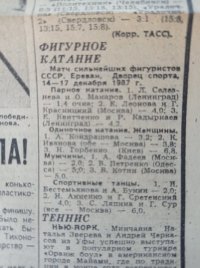
Match of the Strongest Figure Skaters of the USSR. Yerevan, Sports Palace, December 14–17, 1987.
Pair Skating.

1. L. Selezneva and O. Makarov (Leningrad) — 1.4 points; 2. E. Leonova and G. Krasnitsky (Moscow) — 4.0; 3. E. Kvitchenko and R. Kadyrkaev (Leningrad) — 4.2.
Women’s Singles. 1. A. Kondrashova — 3.2; 2. K. Ivanova (both from Moscow) — 3.8; 3. N. Gorbenko (Kyiv) — 6.8.
Men’s Singles. 1. A. Fadeev (Moscow) — 2.0; 2. V. Petrenko (Odesa) — 5.0; 3. V. Kotin (Moscow) — 5.0.
Ice Dancing. 1. N. Bestemyanova and A. Bukin — 2.0; 2. N. Annenko and G. Sretenski — 4.0; 3. S. Lyapina and G. Sur (all from Moscow) — 6.0.
1786168843891.jpeg
 
Last edited:
1948
From the Archivist’s Notebook

A New Balance of Power

(an excerpt of the article published in Ukrainian 'Sportyvna Hazeta' on December 26, 1987)

V WINTER OLYMPIC GAMES
January 30 – February 8, 1948,
ST. MORITZ (SWITZERLAND).

713 athletes from 28 countries took part. For the first time in the history of the White Olympics, representatives from Denmark, Iceland, Lebanon, Chile, and South Korea made their debut.
…The Norwegians also reminded everyone of their power on the ice track. However, a new balance of power was emerging here as well. This applied to figure skating as well. Only in the pairs competition did Europeans defend their leading positions. Micheline Lannoy and Pierre Baugniet brought Belgium its only gold medal in the history of the Winter Olympics.
In the final standings, the greatest number of points in the unofficial team standings of the V Winter Olympic Games was gathered by the national teams of Sweden, Switzerland, and the USA (the Americans, by the way, took the lead in figure skating). In this, a certain pattern can be traced: Sweden and Switzerland did not participate in the war. Meanwhile, Norway and representatives of other European countries suffered through occupation, and the development of sports there was generally halted.
1786169782818.jpeg
 
1988
EUROPEAN CHAMPIONSHIPS

From Prague to Calgary

(the article published in russian 'Sovetskiy Sport' on January 6, 1988)

"Everything is ready for the European Figure Skating Championships, which will take place in Prague from January 11 to 17," Petr Průša, chairman of the organizing committee, said at a meeting with journalists.Applications to participate in the championship, which will be held under the motto "Sport, Friendship, Peace," have been submitted by 21 countries. The tournament opens on January 11, and the draw will take place at the Prague Intercontinental Hotel.
The upcoming competitions are the last for Europe's strongest figure skaters before the Olympic Games in Calgary. Therefore, they attract great attention from the mass media. 300 journalists have already been accredited in Prague. The championship will be broadcast to almost all European countries.
1786297797622.jpeg
 
1988
From Everywhere

(the article published in Ukrainian 'Sportyvna Hazeta' on January 7, 1988)

Olympic and World figure skating champion Katarina Witt from the GDR intends to end her sports career after the Games in Calgary. In an interview with an ADN agency correspondent, she said: "I hope to dedicate myself to an interesting profession." Since 1986, the 22-year-old athlete has been studying at the theatrical institute in Berlin.
1786298798902.jpeg
 
1988
A Beautiful Fairy Entangled in Problems

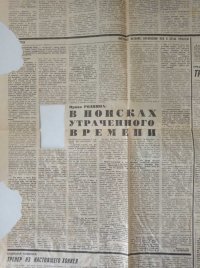
Irina Rodnina: In Search of Lost Time

(the article published in russian 'Sovetskiy Sport' on January 8, 1988)

The Olympic cycle always brings new names, new styles. How has figure skating changed over the past four years? With this question, our correspondent turned to Honored Master of Sports Irina Rodnina.

— Irina Konstantinovna, in your opinion, why has the interest in figure skating, especially pairs skating, noticeably decreased in Europe? Could it be that you yourself are partly to blame for this? After all, for almost twelve years (!) on the world ice, first Rodnina and Ulanov, and then Rodnina and Zaitsev dominated, showcasing figure skating of the highest class, and defeating them was practically impossible. Yet, at the 1981 European Championship, just one year after you retired from the sport, representatives of only six countries competed.
— An interesting turn of phrase... But you know, I do not feel any guilt. After all, I didn't enter the elite of figure skating on a "green light"—I had to compete against strong, very strong rivals. Explaining the drop in popularity simply by the multi-year leadership of one or two athletes is just too simple and convenient.
— Then what is your explanation?
— Competition—that is the main, if not the decisive factor in the development of any sport. Today, there is no such fierce competition as there once was. Many national schools of figure skating are experiencing a decline—the French, British, Czechoslovak, and Polish schools. Yet, each of them used to be interesting and distinctive in its own way. Just fifteen years ago, an athlete's nationality could be determined without even looking at the competition protocol, simply by their style of skating.
Later, for a long time, the competition in pairs skating on the international arena came down to a rivalry between the figure skaters of two countries—the Soviet Union and the GDR. Now, pairs from Canada have joined this battle, and recently Americans activated as well. But representatives of the European school still remain in the shadows. And, as empty stands testify, this illness is outdated, a chronic one. Getting rid of it won’t be that simple.
— True, absolutely true. After all, you cannot force athletes to skate worse than they can just so that rivals can compete with them on a more or less equal footing, thereby increasing competition...
— You are ironizing in vain. The International Skating Union (ISU) makes repeated attempts to equalize the capabilities of athletes from different countries. But even this does not stop our leading pairs... We talked about competition inside the country...
For too long, the time belonged exclusively to coaches working under a single doctrine, where the absolute authority in this field was considered to be Stanislav Zhuk. He alone decided what was good and what was bad, dictating the fates of pairs skating. Other coaches, one after another, left our discipline. For instance, Tatiana Tarasova worked with pairs for only a short period of time before transitioning fully to ice dance. The last elite pair coached by Elena Chaikovskaya (Karelina — Proskurin) broke up back in 1973. True, during these years, Tamara Moskvina and Igor Moskvin "sat closely" in the quiet of their creative laboratories. It was they who were destined to bring pairs skating to a new level of development, to give it, so to speak, a new form, color, sound. If only they hadn't managed to preserve their own coaching and creative style, their own direction in figure skating, and their own vision... I don't know where we would have ended up then.
— Perhaps we shouldn't dramatize the situation so much. We have three wonderful, completely distinct pairs: Gordeeva and Grinkov, Valova and Vasiliev, Selezneva and Makarov. The eccentrics, the lyricals, and the athletes. And all three pairs are excellently prepared technically.
— With that listing, you have just answered all the questions yourself. Yes, three leading duets are fighting among themselves. But who is behind them? It turns out that as of today, there are only two "powerhouses" operating in the Soviet Union — the Moscow school and the Leningrad school. Moreover, the Moscow school has shouldered the bulk of the entire load in training athletes in all types of figure skating, while the Leningrad school is only pairs and singles. But our country is vast, and there are figure skating schools in many republics. Yet, there is practically no return from them.
— Well, why, in your opinion, do ice dances, where the main struggle is also between representatives of the USSR, still remain the most popular discipline in the world of figure skating?
— Ice dancing is a ball. Ice dancers generally look much more impressive than pairs, where a big disproportion in height, weight, and age is always noticeable. After all, right now in pairs skating, the complication of the technical level of programs happens largely due to this very difference. Ice dance coaches pay more attention to appearance: the athletes must match each other in height and harmonize with each other externally. Pairs coaches look primarily at the physical capabilities of the skaters. Of course, a leggy girl looks much more spectacular on the ice than a tiny, sturdy girl. But tell me: how will she land on her thin little leg after another mind-boggling throw? And besides, pairs skating is tightly constrained by technical complexity; athletes simply don't have time to use their choreographic inclinations and abilities. After all, when a triple twist is performed, it's not about embellishing the program, and not about musical accents.
But ice dancing seemingly highlights the athleticism of pairs and singles skaters, and makes people look for something new. Well, and then came a completely natural decline. And even for "ice dancers" today, the audience is not responding as eagerly as before. There is only one way out: a new search in technique, choreography, and entourage. Perhaps it is worth splitting one free program into two—three minutes each, without the right to repeat elements. Otherwise, it turns out that the spectator has become oversaturated with our sport, much like one can get sick of a sweet cake.
DOES THE JUDGE HAVE THE RIGHT TO "CALL THE TUNE"?

— Judging in figure skating is the most acute problem. The issues of objective and competent judging are increasingly worrying athletes, coaches, and the public alike...
— These questions are perhaps only so acute for ice dancers. That is truly where subjectivism reigns supreme and the principle of "you like it?, well I don't!" rules! But, as the saying goes, every house has its own troubles. Yet, there is one trouble common to all—the level of judging today is significantly inferior to the modern level of development in figure skating. Moreover—for example, in pairs skating, it becomes not a stimulus, but a brake on further progress.
— It is generally accepted that a judge's decision is, so to speak, the ultimate truth...
— The thing is, many national federations have stopped developing pairs skating. Perhaps it seems hopeless to them from the perspective of achieving high results. Be that as it may, Scandinavian countries and countries of Central Europe practically do not "supply" their athletes to the World and European Championships, or to international tournaments of various levels. Now answer me, which judge understands the nuances of figure skating better?
— Probably the one whose country has this discipline more developed.
— Absolutely right. The arithmetic regarding judging representation in pairs skating is simple: 9 judges, 4 of whom represent countries where pairs skating is in favor, while the remaining five... see pairs skating two or three times a year at best. Even if they meticulously study the athletes' training sessions before competitions, and regularly look through specialized magazines and books, gaps in their knowledge of the technical level of modern pairs—and therefore, gaps in judging technique—are inevitable.
— Let us clarify, what exactly does this "low level" of judging consist of?
— There is a single technical committee for pairs and singles skating—the exact same judges do the scoring. And since, as I already mentioned, pairs skating is not developed at all in some countries, the decisions regarding these athletes are made by singles judges. But pairs and singles skating, for all their outward similarities, are completely different disciplines.
— But the elements, with rare exceptions, are the same?
— It is a very common and crude mistake. For example, a jump in pairs skating is completely different from a jump by a singles skater.
There is another aspect. Singles skating specialists know perfectly well that a Lutz jump is harder to execute than, say, a Loop. However, many do not realize that a Loop lift is more difficult than a Lutz lift. Only a well-trained pairs-specialist judge can understand these nuances.
Flaws in the judging rules are also connected to a lack of knowledge regarding the core execution techniques of certain elements. For some reason, in recent years, the twist lift has begun to be classified under the general category of lifts. But this is incorrect—after all, a twist lift is much harder to perform. Yet, these elements are evaluated equally. And it seems to me that the ISU leadership should consider introducing a difficulty coefficient—say, like in artistic gymnastics. The more difficult and risky the element is, the higher the score should be.
Progress in figure skating is sometimes hindered by illiterate changes in the rules. A few years ago, the following decision was made: you cannot catch the female partner on your chest during a twist lift—only with a hand-to-body catch. In reality, catching a partner according to this rule requirement is only possible after a two-rotation twist.
— There has been a lot of talk in recent years about so-called balanced programs. What do you think about this?
— Because of these, to put it mildly, balanced programs, all compositions have become like identical twins—they look exactly the same, only the music is different. After all, every pair must perform a specific number of elements: at least two jumps, one or two jump combinations, three lifts (one of which can be a twist lift), a death spiral must absolutely be present, pairs parallel spins, combinations of spirals... There is simply no time to search for individuality of style or innovative solutions—one just hopes to manage to execute all the elements prescribed by the rules. In the junior ranks, this is especially noticeable. And how can one not understand that any pair should differ from another not only in their level of technical equipment, but also by the "uncommon expression of their face" [their unique identity]. Unfortunately, under the current judging rules, one can only dream about this.
THE ICE RINKS OF MY CHILDHOOD

— Irina Konstantinovna, many coaches nowadays complain that the influx of talented figure skaters into the national team is inexorably shrinking. Capable children are sought all over the country; people travel to the ends of the earth for them. What, has the Russian land grown poor in talent?
— No, it's just that talents have nowhere to skate. Probably, every person at some point begins to be haunted by a feeling of longing for something lost. For me, one of the facets of this nostalgia for the past is ice rinks. The rinks of my childhood. Brightly lit, festive, and noisy, where hot pies and tea were sold, where not only children but also quite respectable people came, and where the phrase "May I skate with you?" served as a password for getting to know someone.
Our ice rinks are melting. They are evaporating without a trace. There is no longer the massive ice area in Luzhniki around the Grand Sports Arena. The ice rink in Gorky Park practically ceased to function properly when it was moved from the center of the park to the windswept embankment. But that would only be half the trouble. Badly lit, equipped with practically no basic amenities, it became a haven not for figure skating enthusiasts, but for teenagers looking for wild fun. I am no retrogradist, but an adult is unlikely to come here anymore.
There is no longer open ice in Sokolniki, in Maryina Roshcha, at the Stadium of Young Pioneers. In Moscow, there are perhaps only two ice rinks left in the full sense of the word. Not just a space covered with ice, but something "humanized": with skate rentals, buffets, music, and good lighting. These are "Druzhba" [Friendship] and "Severnoye Siyaniye" [Northern Lights] in Luzhniki.
— And at the same time, huge, uninhabited spaces sit empty. How many ice rinks, for instance, could be set up at the VDNKh.
— And think about another fact: paradoxical as it is, both in the capital and in the country as a whole, the problem of employment for coaches is acute. There are few artificial ice rinks, and mostly venerable specialists work on them. Where should the young ones go if all the places under the sun are already taken? Well, alright, they might accept someone to coach the "younglings" at some sports school. But there, you face a quota plan. You need ranked athletes. And the coach, with the zeal of a gold digger, begins to search for talents... to fit into ranking standards. I, however, believe that before teaching an athlete how to jump, you need to instill a love for the sport, to teach them to use their imagination and create on the ice. But no, we immediately teach them to jump. If they learned it—great, if not—goodbye.
Moreover, even when talents are found, it is often disadvantageous for a young coach to work with them. Why, one might ask, waste extra effort on a promising student if you will eventually have to hand them over to a more experienced mentor anyway? But the real offense lies elsewhere—after all, hardly anyone will remember later who it was that first put the future champion on skates.
— It is hard to disagree with you. Does anyone know that the first coach of E. Vodorezova was L. Titova? That it wasn't T. Tarasova who first put N. Bestemianova and A. Bukin on skates, and it wasn't E. Chaikovskaya who taught V. Kotin how to move on ice, and it wasn't S. Zhuk and S. Volkov who witnessed the first steps of A. Fadeev. Let's be honest, we forget about the first coaches and do not reward their work properly. By doing so, we humiliate their professional pride and kill their interest in the work. As a result, almost no one wants to work with children. This, it seems to me, is the ultimate question: how do we raise the prestige of a children's coach's work?
— I think they need to be incentivized both financially and morally. Why not, for example, reward the first coach of a figure skater who has achieved notable success with a trip to an international competition? Or perhaps their salary should depend on the athlete's future successes? There could be various options. One thing is clear: this problem requires serious thought. How many times have I attended various seminars of the Figure Skating Federation. National team coaches and choreographers spoke there. But not once did I hear a speech by a children's coach. They are simply not invited there.
— Even to the naked eye, the rift between grassroots children's figure skating and training aimed exclusively at producing future champions is noticeable. Although, it would seem, the latter should naturally flow from the former. It used to be that way.
— When I came to the artificial ice at CSKA, I already had a solid track record of performances. Every year prior to that, I took part in the season's closing at the ice rink in Maryina Roshcha. Our coaches taught us to work independently. We bought vinyl records with the music we liked, made up the dance ourselves, "danced it out" on the floor first, and only then transferred it to the ice. I, for example, performed the dance of the dwarfs from "Snow White" and a waltz from the ballet "Raymonda." Thus, from an early age, figure skating was for us not just drilling and practicing certain elements, but above all, an immense pleasure.
And recently, I dropped by the choreography hall at CSKA. They were explaining to children how to hold their hand. They didn't understand. And no wonder! In ballet, as is well known, a child is placed at the barre only at the age of 9, when they are capable of comprehending choreographic techniques. Nowadays, however, in figure skating, in the pursuit of premature champions and fast results, coaches force the normal course of things. The result is right before our eyes: faceless figure skaters and programs, as alike as two drops of water.
There is also another side to the coin. Previously, people came to figure skating "for health." Now, parents send their child to the club, already calculating in advance what benefits this promises in the future—fame and everything that comes with it.
I remember once after a training session, the mother of one of my students came up to me and asked: "Irina Konstantinovna, will anything come of my boy, or are we wasting our time?". Since when has time given to a child—and, mind you, not someone else's, but one's own—been considered wasted?!..
...The ice rinks of my childhood are gone into the past. Longing for these rinks is not just nostalgia for childhood. It is also a regret for lost traditions, without which, I am sure, it is impossible to move forward.​
The interview was conducted by O. POLONSKAYA.​
1786305257797.jpeg
 
1988
EUROPEAN CHAMPIONSHIPS

FIGURE SKATING

(the article published in russian 'Sovetskiy Sport' on January 8, 1988)

The roster of the national team has been determined for participation in the European Championships in the capital of Czechoslovakia (January 12–17).
In the men's category, Muscovites Alexander Fadeev and Vladimir Kotin, as well as Viktor Petrenkо from Odesa, will compete. Among the ladies' singles, alongside the well-known Muscovites Kira Ivanova and Anna Kondrashova, 17-year-old Natalia Gorbenko from Kyiv will make her debut. In pairs skating, Leningrad peers Natalia Mishkutenok and Artur Dmitriev have also been included in the main team alongside European champions Larisa Selezneva and Oleg Makarov, as well as the Moscow pair Ekaterina Gordeeva and Sergey Grinkov. Elena Valova and Oleg Vasiliev will also perform here.
Following a hiatus caused by the partner's illness, the ice dance duo of Marina Klimova and Sergey Ponomarenko returns to training and competition. Together with multiple World and European champions Natalia Bestemianova and Andrei Bukin, and Natalia Annenko with Genrikh Sretenski (Moscow Oblast), another capital couple—Maya Usova and Alexander Zhulin—will take to the ice of the Prague Sports Palace.
1786306129905.jpeg
 
Back
Top