Archive of newspaper articles | Page 14 | Golden Skate

Archive of newspaper articles

1983
MOSCOW NEWS PRIZE

ORIGINAL STYLE

(the article published in russian 'Sovetskiy Sport' on November 26, 1983)

At a press conference in the Luzhniki Palace of Sports following the conclusion of the pair skating competition, an emotional and jubilant coach, Igor Moskvin, stated that his return to the national arena as a specialist in pair skating was far from accidental. For many years, he had devoted himself to training singles skaters (notably, the Honored Coach of the USSR, Tamara Moskvina, began her career as a singles skater in Moskvin’s group). Over the last three seasons, all of the experienced mentor's efforts have been focused on developing a truly original style for the duo of Larisa Selezneva and Oleg Makarov.
"I wanted to create a composition where 'shadow skating' is replaced by a beautiful, diverse dialogue between the skaters," Igor Moskvin declared.
In essence, the coach's work represents a turn in the same direction chosen by Tamara Moskvina and Irina Rodnina, both of whom strive for a more spectacular and soulful style in pair skating. They are all driven by a desire to avoid well-trodden paths, and the Moscow International Tournament proves that their efforts have not been in vain!
For their free program, Selezneva and Makarov were awarded seven scores of 5.7, and yet they have far from exhausted their potential. The duo’s capabilities are immense: their arsenal includes a flawless triple toe loop, a double-and-a-half axel (2.5) in combination, a triple lutz twist, and a series of original lifts.
The novelty and freshness of the program were defined not only by the uniqueness of these "ultra-C" elements but also by its musical and plastic interpretation. The music by Timur Kogan (also from Leningrad) for the ballet The Mad Day, or The Marriage of Figaro is diverse in both rhythm and intonation; translating it into an ice miniature required great effort from choreographers Lyudmila Baskakova and Yuri Potemkin.
Baskakova chose a very interesting method for the psychological training of the skaters. She presented them with a whole series of ballet etudes with evocative titles: "Perspectives," "Zigzags," "Contours," "Cognition," "Sacrament," "Birth," and "Freedom." Combined with the classical music of Bach, Mozart, Rachmaninoff, and Scriabin, these etudes became a school of aesthetics.
Spectacle and a variety of intonations were also adopted in the compositions of Irina Rodnina’s pupils—Veronika Pershina and Marat Akbarov, and Lyudmila Koblova and Andrei Kalitin—who were medalists at the tournament. Both duos have improved in speed and the amplitude of their elements. Most importantly, as Rodnina noted, the female partners demonstrated their fighting spirit and, following autumn injuries, have finally regained their confidence and freedom of skating.
In technical terms, Pershina and Akbarov looked like more mature masters; they are ready to consistently perform a 2.5-revolution Axel in combination and a 2.5-revolution throw. And perhaps the most pleasing aspect of their "Spanish" composition is the new emotional colors in the lyrical fragments.
The best features of the Leningrad school were evident in the new program performed by Tamara Moskvina’s pupils, Elena Bechke and Valery Kornienko (who, incidentally, train alongside world champions Elena Valova and Oleg Vasiliev). Here are the results of excellent preparation side-by-side with champions: the duo received scores of 5.5 for technique. The issue of sparring partners is one of the most pressing in figure skating, and coaches must keep it in mind constantly.
A very interesting struggle continues in the women's competition. The performance of the short program decided a great deal in the overall standings, and the skaters' nerves significantly affected the quality of their compositions. A. Kondrashova and M. Serova failed to handle the difficult jump combination. In this situation, E. Vodorezova, A. Antonova, N. Lebedeva, and K. Ivanova showed their fighting character. Following the total of two program segments, Vodorezova maintained her lead.​

A. SHELUKHIN.
TECHNICAL RESULTS
International Figure Skating Tournament for the Moskovskiye Novosti Newspaper Prize. Moscow, Sports Palace, November 24.
Pair skating. All-around total.
1. L. Selezneva and O. Makarov - 1.4 points; 2. V. Pershina and M. Akbarov - 2.8; 3. L. Koblova and A. Kalitin - 5.2; 4. E. Bechke and V. Kornienko - 5.4; 5. I. Bekker and S. Likhansky - 6.6; 6. Bystrova and A. Tarasov (all - USSR) - 9.0.
Women. Sum of compulsory and short programs. 1. E. Vodorezova - 1.4; 2. K. Ivanova - 1.6; 3. A. Kondrashova - 3.8; 4. N. Lebedeva - 4.0; 5. A. Antonova - 4.8, b. C. Wong (Canada) - 5.8.

1767380668036.jpeg
 
1983
MOSCOW NEWS PRIZE

THIS INDEPENDENT STUBBORN MAN

(the article published in russian 'Sovetskiy Sport' on November 24, 1983)

MEET ONE OF THE PARTICIPANTS OF THE MOSCOW FIGURE SKATING TOURNAMENT — CANADIAN GARY BEACOM

As early as last year, 22-year-old Canadian Gary Beacom made people talk about him at the Moscow autumn tournament. His flawless spinning technique, beautiful organic transitions between elements, and cascades of complex jumps greatly appealed to the spectators at the Luzhniki Palace of Sports.
And now Gary is in Moscow again. Having confidently completed his "school" [compulsory figures], the cheerful, smiling, and handsome Canadian came backstage to have a cup of coffee. We took advantage of this pause.
— An interview? I'm ready to answer your questions. Biography? That's simple. I was born in Calgary on February 23, 1960. Later, my parents moved to Edmonton. At the age of eight, I was brought to the "Royal Club" to coach Eddie Collins.
Debuting at the Canadian Junior Championships, I took fourth place. I was thirteen then. Then I moved up step by step: in the junior category — third place, second, first. In 1977, at the senior championship, I started in seventh place. And now I have established myself in the second position behind Brian Orser. I trained at the Toronto Skating Club under the famous teacher Ellen Burka, who, by the way, also coached [Toller] Cranston. For the last few years, I have been preparing for performances on my own, without a choreographer and without a coach.
— Being on the same rink as Cranston, it must be difficult not to fall under his influence?
— Toller, in my opinion, is a unique figure in our sport. And being a "second Cranston" is pointless. I realized this long ago and decided to find my own path. It's not for me to judge to what extent I have succeeded.
— A few words about your creative laboratory...
— I always start only from the music. I feel an affinity for classics, jazz, and folk music alike. For instance, in one of my short programs, I decided to use Chinese folk melodies in a modern arrangement. A risk? Of course. But, I confess, I love untrodden paths and experimentation. Once the music is found, I work at the rink for weeks, agonizingly searching for the right pattern for the composition.
— Kovalev... Bobrin... Ovchinnikov... Kotin. Whose style is closer to yours?
— It’s hard to single anyone out. They are all world-class masters. And yet, Bobrin’s manner is closer to me. He is unlike anyone else, artistic, and always surprising. That is to my liking. I love stubborn, bold people. By the way, where is Bobrin now?.. Preparing a concert program? That’s understandable. And natural. It would be curious to see.
— How is your free time?
— Believe it or not, I have enough. I don't go in for twice-a-day practices. I train for two hours a day. My main passion is travel. I am grateful to sports for allowing me to see so much. This is my second time in Moscow. I confess that I asked the leaders of our federation to include me in the team for the trip to your amazing city. The unique scale and the special breadth in the people and the avenues amaze me.
— Your immediate goal?
— Both the immediate and, perhaps, the main one — to make the Canadian Olympic team. If that doesn't happen, I think I will leave the sport. This isn't bravado. It would mean I've stopped improving. In that case, one must put an end to it. Right now in Moscow, I will definitely try my best to finish in the top three.
— Good luck to you, Gary!
Interview conducted by
I. VANYAT.
View attachment 10549
Being a longtime friend of Gary Beacom can be exasperating, but it's always been fun. He's always interesting and now an inspiration to other adult skaters who also refuse to let their skills atrophy!
 
1983
MOSCOW NEWS PRIZE

COMMENTARY

AN INVITATION TO... THE DANCE

(the article published in russian 'Sovetskiy Sport' on November 26, 1983)

The performance of pair skaters is always at the center of expert attention. In this discipline, the battle for medals at tournaments of any rank is fought between Soviet masters and our friends from the GDR. At the competition in Luzhniki, the young duo from the GDR was seconded by the highly experienced skater Uwe Kagelmann, a bronze medalist at the European and World Championships and the Olympic Games. Now a coach at Dynamo Berlin, Uwe has managed to train the European bronze medalists Birgit Lorenz and Knut Schubert. Our conversation began with a question about the candidates for the national team.
"Former world champions Sabine Baeß and Tassilo Thierbach are training at full strength. Lorenz and Schubert hold the second position on the team. However, young athletes will have to fight for the third ticket to Sarajevo. Moscow spectators have already become acquainted with the program of 14-year-old Peggy Seidel and 18-year-old Ralf Seifert from Karl-Marx-Stadt. Another pair, pupils of coach Torsten Ohlow—Babette Preußler and Tobias Schröter from Berlin—are slightly older. They are preparing an interesting program for the GDR Championships in mid-December. It is this tournament that will be the primary event before the Olympic starts."
— Not long ago, the international sports press was debating a perceived decline in pair skating. In your opinion, what is the situation now?
— You see, our discipline is very complex and labor-intensive: it requires lightness and artistry, physical strength, and precision when executing virtuoso elements on the "second floor"—during lifts and twists. There are many requirements, yet the majority of pairs are rising to the challenge. This was confirmed by the performance of the top pairs here in Moscow.
I don’t see a decline in pair skating. What we need are top-class duos. After all, boys and girls adore idols. Here is a curious fact: when world champion Jan Hoffmann competed for us, hundreds of boys flocked to schools to "learn to be like Hoffmann." When Baeß and Thierbach competed—and now in the Berlin club Dynamo, where, incidentally, my partner Manuela Groß works with the boys—there is no shortage of those wishing to take up pair skating.
— In your opinion, where do the reserves and the prospects for the development of pair skating lie?
— I place spectacle and emotionality at the forefront: making the fan forget the difficulty of, say, a side-by-side triple jump. Achieving a sense of weightlessness. In this regard, it wouldn't hurt us to learn from our colleagues, the ice dancers. I make it a mandatory lesson for all my students to attend the training sessions of dance pairs. The synthesis of complexity, elegance, and, if you will, danceability—these components, in my view, represent the future of pair skating.​
Interview conducted by I. VANYAT.
A VIEW FROM THE STANDS

TWO HUNDRED PERCENT STABILITY

(the article published in russian 'Sovetskiy Sport' on November 26, 1983)

The European Champions Natalia Bestemyanova and Andrei Bukin were watched closely from the stands and at the rinkside by artists—masters of ballroom dancing, Irina and Stanislav Shklyar, laureates of many national competitions. The fact is that for the second season now, they have been giving a kind of ballroom dancing lessons in the group of the Honored Coach of the USSR, Tatyana Tarasova. We asked Irina and Stanislav to share their impressions of the creative laboratory of our leaders—European champions and World Championship silver medalists Bestemyanova and Bukin.
Irina Shklyar:
"The concerns of the athletes are close and understandable to me, as I myself was a Master of Sports in rhythmic gymnastics. My observations of Natasha and Andrei's training convinced me that their most valuable quality—one that not everyone knows about—is the desire to get to the truth in every specific case. They are not satisfied with approximate or average options. They are maximalists and therefore work in the hall and on the ice with enormous dedication, searching for and finding newer and newer intonations in each of their dances. In a technical sense, I am amazed by their work on a quality like flexibility. It is no coincidence that in their paso doble and free program, they have so many positions and fluid movements where the feeling of a static body completely disappears. This is not easy to achieve in dancing!"
Stanislav Shklyar:
- I'm particularly interested in the male part in the sport dance. Bukin is a very tactful partner; he doesn't try to highlight his own personality, but does everything he can to allow Natasha to express her talent and temperament freely and powerfully. This, in my opinion, is where the feeling of two hundred percent stability comes from, even in the most dizzying and risky parts of the dance.
We were thrilled to help Bestemianova and Bukin create original dances to the rhythm of rock 'n' roll and the paso doble. After all, our dance routines on the floor have much in common with those performed by figure skaters. We also strive to achieve a sense of camaraderie, a feeling of complete unity.
Irina:
- I can't help but mention Natasha and Andrey's personal charm—their human qualities are reflected in their dance, like in a mirror. Kindness, sincerity, and emotional drive—all of this is so appealing about Bestemianova! And she has a tactful, composed partner by her side.​
A. Antonov
1767384267679.jpeg
 
1983
MOSCOW NEWS PRIZE

A GRIPPING RIVALRY

(the article published in russian 'Sovetskiy Sport' on November 27, 1983)

Vladimir Kotin surpassed the master from Canada, demonstrating powerful and dynamic skating.
Former world champion Alain Calmat, stepping down from his duties as referee at the international figure skating tournament (he judged the men's competitions), gave a very interesting assessment of the current level of skill in single skating at a special press conference.
"In my opinion, skaters are increasingly broadly and boldly borrowing from and rethinking the experience of choreography and the art of ballet. Not only the technique of skating and the purity of lines are improving, but also the entire artistic form of the programs. We are approaching a point where the performances of first-class masters will be practically on the same level as the dances of masters of arts..."
It so happened that the fate of first place was decided in a duel between representatives of two bright and original schools of figure skating – the Soviet and Canadian. The difficult burden of the leader of our team was taken on by Vladimir Kotin (his teammate Alexander Fadeev fell ill), and he was opposed by 23-year-old Gary Beacom from Calgary.
Beacom had a clear path to victory, leading the standings in total points. Furthermore, the Canadian national federation had set a specific condition: only an exceptionally high result on the Moscow ice would guarantee him a spot on the Olympic team.
To put it plainly, Beacom did everything in his power to secure his trip to Sarajevo for February 1984. As he later admitted during a press conference, he chose his best musical composition for the free program—one he had composed four years earlier. Naturally, it had been modernized, specifically following the artistic direction Calmat had discussed.
Of course, whether this program surpassed the emotional performances of his compatriot Toller Cranston is a matter of taste. However, it is indisputable that Beacom delivered a performance worthy of his school of skating.
Receiving six scores of 5.7 and two scores of 5.8—the level of world championship medalists—gave Beacom a genuine chance at victory.
The announcer immediately called Kotin onto the ice by lot. Our singles skater faced a formidable challenge. Within the first minute, he executed two triple jumps, including a lutz, in brilliant style. In the next section, a lyrical one, Kotin revealed his artistic potential, displaying a smooth glide and a sense of line.
The third section proved to be one of the most beautiful, with an excellent step sequence and a three-element cascade. The energetic, upbeat finale, set to the music of "Tarantella," left no doubt: Kotin surpassed Beacom in the power and dynamics of his skating. Five of the seven judges gave Kotin even higher scores. Ultimately, the protégé of Honored Coach of the USSR Elena Tchaikovskaya achieved an important victory, a victory achieved through a synthesis of complexity and artistry.
Three other skaters demonstrated exceptional skill in their free skates: Vitaly Egorov and Leonid Kaznakov (students of coach Alexei Mishin), and East German athlete Rolf Lewandowski (a student of coach Inga Vishnevsky). Perhaps the closest to the modern standard of mastery was Kaznakov's composition, replete with a multitude of original sequences and steps.​
In the women's singles, the competition for the tournament's top prize was dominated by Soviet skaters. Kira Ivanova of Moscow had the best chance going into the free skate (considering that Elena Vodorezova hadn't planned her full program).
Indeed, K. Ivanova confidently performed her free skate and won the tournament. A. Kondrashova placed second, and N. Lebedeva third.
A. SHELUKHIN.
TECHNICAL RESULTS
International Figure Skating Tournament for the Moskovskiye Novosti Newspaper Prize. Moscow, November 25.
Men's Singles. All-Around Total.
1. V. Kotin (USSR) - 3.8 points; 2. G. Beacom (Canada) - 4.6; 3. V. Egorov - 8.2; 4. L. Kaznakov (both USSR) - 8.2; 5. D. Coy (Canada) - 13.0; 6. R. Lewandowski (GDR) -14.0.
Ice dancing. Sum of compulsory and original dances. 1. N. Bestemianova and A. Bukin - 1.0; 2. O. Volozhinskaya and A. Svinin - 2.0; 3. M. Klimova and S. Ponomarenko - 3.0; 4. N. Annenko and G. Sretensky - 4.4; 5. E. Batanova and A. Soloviev - 4.6; 6. M. Usova and A. Zhulin (all USSR) – 6.0.
1767444153123.jpeg
 
Last edited:
1983
MOSCOW NEWS PRIZE

THE ESSENCE OF DANCE

(the article published in russian 'Sovetskiy Sport' on November 27, 1983)

For ten years, they honorably represented the USSR national team, achieving numerous brilliant victories. However, they revealed the essence and meaning of dance not only in the heat of competition but in every single encounter with the audience. Even if Irina and Andrei had not held various prestigious titles, the images they created would remain long in the memory of many figure skating fans.
In Moiseeva and Minenkov's interpretation, dance is an unforgettable spectacle. Their emotional quality and inspired presence captivated the public. The finale of their last free dance program, "Sirtaki," is unforgettable. While the English pair Diane Towler and Bernard Ford once used this music to demonstrate high technique, in Moiseeva and Minenkov's performance, we see true Russian daring, while the folk spirit of the Greek dance is simultaneously preserved with great tact.
On the eve of their retirement from competitive sports, Irina and Andrei said:
"Figure skating, which at first only captivated our parents, very quickly became a commanding mentor for us. Regular training sessions, competitions, and constant travel taught us independence and made us more mature and purposeful. This evolution affected us both: since the age of seven, we trained in the same group, and at twelve, we became a dance duo. In 1976, fifteen years after meeting in the sports section at the Young Pioneers Stadium, we got married. By that time, we had managed to become World Champions for the first time."
"In 1975, in Colorado Springs, the illness of Aleksandr Gorshkov left our national team without its leaders in the ice dance category. What helped you defend the title in such a fierce struggle and strengthen the position of the Soviet school of ice dance?"
"We were aware that at least five pairs had an equal chance of winning, but this circumstance did not discourage us; on the contrary, it gave us strength. After all, the USSR team could not lose a gold medal just because of an absurd accident. And so, having set our minds accordingly, we won that competition of equals."
"In dance duets, it is often the case that one partner is the permanent leader. Was that the case with your pair?"
— "We always maintained complete equality. Although, of course, depending on the mood or the situation, one of us might occasionally become the leader, the captain of our little team. In such cases, itwas a matter of alternating leadership."
— "Over your fifteen years of performing in ice dance, you worked with several coaches, but in recent years with only one choreographer. What can you say about that?"
— "Our choreographer—Elena Matveeva, a soloist of the Bolshoi Ballet—brought a new, truly creative beginning to our sporting life. We had always enjoyed our work, but thanks to her, we felt that figure skating was connected to the world of great art. An artist with a wealth of unexpected and original ideas, Elena Matveeva spent seven years with us in creative exploration. It was incredibly interesting to work with her. We are extremely grateful to her both as a professional and as our ally. We hope to meet such people on our life's path in the future."
Well, it only remains for us to wish Irina and Andrei happiness and new creative discoveries!​
Y. DARAKHVELIDZE.
1767446032095.jpeg
 
1983
MOSCOW NEWS PRIZE

LIFE ON THE ICE AND LIFE LESSONS

(the article published in russian 'Sovetskiy Sport' on November 27, 1983)

The young Leningrad pair Larisa Selezneva and Oleg Makarov are far from newcomers to the international arena: they have twice won the World Junior Championships in pair skating. In 1981, they became the winners of the "Moscow News" prize competition. Last year, they took second place at this tournament. This time, on the ice of the Luzhniki Sports Palace, Selezneva and Makarov, who work with Honored Coach of the USSR I. Moskvin, once again drew the attention of specialists and spectators. And it is not just because they finished first again, as they did two years ago: their style on the ice and their interpretation of their competitive programs are what makes them interesting.
The conversation with Larisa and Oleg began by discussing how they got into figure skating and how their sporting career unfolded.
L. Selezneva: "I was seven and a half years old when my mother took me to the skating rink, to a tuition-based group. It was so that I would be active and... stop getting sick. After a while, the coaches took notice of me, and I joined 'Spartak' to train under Sergei Mikhailovich Loginov. Back then, I competed in singles. Then came another turn—I joined Tamara Nikolaevna Moskvina's group, training in pair skating under Andrei Alexandrovich Suraikin."
O. Makarov: "I also started in a tuition-based group at a rink near my house. For me, too, figure skating was initially a 'remedy' for illness. My first coach was Irina Vladimirovna Lapina. I met Larisa in Tamara Nikolaevna Moskvina's group, but I started competing in pair skating earlier than Larisa did."
— "Three years ago, you moved under the guidance of a new coach. It probably wasn't easy?"
L. Selezneva:
"I’ll be honest: at first, I regretted parting with my former coach. Gradually, that feeling passed as I realized how much Igor Borisovich Moskvin was giving me. Now, working in his group is very interesting."
O. Makarov: "Igor Borisovich embodies the Leningrad school of figure skating, which I believe is characterized by subtlety, fluidity, and musicality. We don’t just love training on the ice; we spend a lot of time on choreography. Our love for it was instilled by Lyudmila Fedotovna Baskakova, a soloist with the Leningrad Maly Theatre of Opera and Ballet. Of course, we don’t forget that we are students at the Leningrad Institute of Physical Education. Larisa is in her third year, and I am in my fourth."
The conversation with I. Moskvin continued on the interesting and complex theme of "coach and student."
I. Moskvin: "I am convinced that psychological compatibility is essential in pair skating. Larisa and Oleg did not have enough of it; in terms of character, life views, and attitudes towards others, they are different people.
My first task was to cement the pair, to establish creative contact. Moreover, one must not forget that Larisa and Oleg were World Junior Champions, and their authority in figure skating was quite high. They had their own opinions on creative matters as well as on technique and tactics. At first, they were rather reserved about everything new in my group. But a high goal captivated them.
We set the task of improving the skating culture and achieving an original program structure. Larisa and Oleg's results began to grow: they won a prestigious tournament in Holland, then the 'Moscow News' prize tournament. But it took a lot of effort for the youngsters to believe in themselves, in their return to the group of leaders. The difficult period is now behind them. Recently, Oleg became the Komsomol organizer for the pair skating group."
"This year, in collaboration with the choreographer Yuri Potemkin, with whom we have worked for a long time, since the early 70s, we have prepared a new short program and free program. Our sporting goal is to compete for medals at tournaments of any rank."

"— What is the essence of your creative search and views?"
"The key to success is a deep, organic combination of figure skating technique and artistic expression. The specific feature of our new programs lies in moving away from traditional forms of using choreography. I understand that this sounds rather cliché, but a coach's creative credo is proven in practice. I think that Larisa and Oleg's performance here, in Luzhniki, gives an idea of the direction of our search."
— "Igor Borisovich, as a coach, have you ever made mistakes?"
— "Unfortunately, yes. To this day, I regret that at the end of 1981, I was not firm enough and gave in during a rather delicate situation. The fact was that Larisa and Oleg had a legitimate claim to a spot on the USSR national team heading to the 1982 European Championships in Lyon. The pair Vorobieva-Lisovsky, world champions, were not ready to perform, and I could see that.
One could have assumed they would skip the European Championship and go straight to the Worlds. As it happened, Vorobieva and Lisovsky were included in the team, but they suffered a defeat in Lyon...
Life lessons must be constantly learned not only by athletes but by us coaches as well."​

The interview was conducted by
A. DOBROV.
1767448067466.jpeg
 
1983
MOSCOW NEWS PRIZE

COMMENT "SH"

WITH OLYMPIC FLAIR

(the article published in Ukrainian 'Sportyvna Hazeta' on November 29, 1983)

The international figure skating tournament for the prizes of the newspaper 'Moskovskiye Novosti' has concluded. As we already reported, the best in pair skating were the Leningraders Larisa Seleznyova and Oleg Makarov. In the remaining categories, the Muscovites became the holders of the 'Crystal Skate'. Among women, it was Kira Ivanova from the Moscow region, among men, Vladimir Kotin, and in ice dancing, Natalia Bestemyanova and Andrei Bukin.
The correspondent of "SH" asked the Honored Coach of the RSFSR Natalya Dubova to comment on the results of the competition, which was the first stage of selection for the country's Olympic team.

"- THE MAIN feature of the season is the early public appearance of our leading masters. Before the Moscow start, most of the Olympic candidates managed to perform the full program 3-4 times abroad and in our country. Moreover, exactly the new compositions were shown, those that the figure skaters prepared for the Games in Sarajevo.
In pair skating, Seleznyova and Makarov pleasantly surprised. Their athletic skating has become significantly enriched with complex elements, gained plasticity, and become more stable. Together with world champions Valova and Vasilyev, who limited themselves to an exhibition number due to a minor injury to the partner, Larisa and Oleg are the most likely contenders for Olympic berths.
The situation is more complicated among women, where there are only two vacancies, and the leader - Elena Vodorezova (performed only in the "school figures" and short program, where she was the best) does not have a reliable understudy. Ivanova started the current year excellently. However, she is unbalanced, and has also "earned" a reputation as an extra from foreign judges. And this is of great importance. I would choose from the group of young, technically well-equipped Lebedeva, Kondrashova, Antonova, but each of them still has many weak points, especially in the compulsory exercises.
The competition for the men's title was captivating. In the absence of Alexander Fadeev, who had fallen ill, Vladimir Kotin had to catch up with 23-year-old Canadian Gary Beacom, an emotional skater with excellent choreographic training. Kotin did not let anyone down. He skated virtuously, in a single breath, and with scores of 5.7–5.9, he surpassed the overseas guest. The third prize went to Vitaliy Egorov from Kharkiv—the only Ukrainian figure skater with a realistic chance of going to Sarajevo. He was noted for his smooth, expansive skating and his attempt to perform all existing triple jumps.
Naturally, I was particularly worried about the fate of the prizes in ice dancing, where my students Marina Klimova and Sergei Ponomarenko were competing. I believed that they were already capable of competing with the more experienced Volozhinskaya and Svinin for the second position in the national team (after Bestemyanova and Bukin). And practice confirmed this confidence. Marina and Sergei managed to beat Volozhinskaya and Svinin for the first time in their lives!
The farewell evening in Luzhniki was sad for all figure skating fans, as wonderful Soviet skaters Irina Moiseeva and Andrei Minenkov, Marina Pestova and Stanislav Leonovich were retiring. For me, the farewell was especially sad. After all, in recent years I helped Irina and Andrei with program preparation, tried to bring something of my own to their dance, and learned from them their dedication to the sport and enviable hard work. The best free compositions and exhibition numbers of the Honored Masters of Sports, two-time world champions Moiseeva and Minenkov are the golden fund of Soviet figure skating.​
Yu. YAROSLAVOV.
1767454980581.jpeg
 
1983
MOSCOW NEWS PRIZE

THE DASH OF RUSSIAN DANCE

(the article published in russian 'Sovetskiy Sport' on November 29, 1983)

New facets in the work of ice dancers Natalya Bestemyanova and Andrei Bukin

And so the 18th international figure skating tournament for the 'Moskovskiye Novosti' newspaper prize has finished. Under the curtain of this ice spectacular, more than 10 thousand spectators in Luzhniki witnessed the exhibition performances, which concluded with a solemn ceremony—the farewell from big-time sports of two-time world and European champions Irina Moiseeva and Andrei Minenkov, and world championship silver medalists in pair skating Marina Pestova and Stanislav Leonovich.

Yes, the 'stars' are leaving. But new ones are lighting up in figure skating. An example of this is the last final of the tournament, the final in the battle of ice dance duets. No one doubted the victory of the European champions Natalya Bestemyanova and Andrei Bukin. But not many of the spectators could have assumed that already in November the leaders would offer a composition to the judges at such a high artistic level and with such emotional intensity.

'The Fair'... This is what their mentor, Honored Coach of the USSR Tatyana Tarasova, calls the concept of the European champions' new free program. A fair with toys, a colorful show, the ringing of bells, and jesters. And all this the skaters were helped to reveal by astonishingly fervent Russian folk songs and dance melodies. Talking about this program, Tarasova noted:

The brilliant numbers of the ensemble under the leadership of People's Artist of the USSR Igor Moiseev served as a unique creative impulse for us. The ensemble's new program, ‘The Night Before Christmas,’ inspired admiration in me, Natasha, and Andrei, and we worked on our dance with enormous enthusiasm...”

“This is our favorite dance.” This is what the performers themselves say. And it was felt by everyone who saw the composition, which combined various facets of ice style—grotesque, humor, lyricism, and unrestrained daring. The skaters have such a command of the folklore material that they do not just dance, but act, depicting the world of the fair and transforming into its characters. Until now, only two duos were capable of solving such a task—Olympic champions Lyudmila Pakhomova and Alexander Gorshkov, and Irina Moiseeva and Andrei Minenkov. Nine scores of 5.9 points—such was the result for Bestemyanova and Bukin at the Moscow tournament.

Assessing the situation in our ice dancing generally, one must acknowledge that the leaders of the USSR national team have made a qualitative leap forward, as they say, already picked up Olympic pace, and noticeably surpass the other duos in skating class.

Five out of seven judges preferred the dancers Marina Klimova and Sergei Ponomarenko in the battle for second place, which came as a surprise to many specialists. The 17-year-old Klimova and 22-year-old Ponomarenko are progressing very rapidly: two years ago they debuted at a similar tournament and were sixth. Last season, two more young pairs started for the first time at the Moscow tournament—18-year-old Elena Batanova and Alexei Solovyov, and Natalya Annenko and Genrikh Sretensky. And now they hold honorable fourth and fifth places.

One cannot help but notice the clear inclination of the ice dancers toward programs with national flavor: Klimova and Ponomarenko captivated the audience with a csárdás, Batanova and Solovyov with a Mexican tap dance, and Annenko and Sretensky with a bravura Italian march. Replacing contrast-based programs, which merely featured classical tangos, rumbas, or waltzes, have come compositions with a unified concept and even a clearly structured plot, as seen in the dance of Batanova and Solovyov.

Discussions regarding new directions and new musical rhythms among dancers are only just heating up and will become even more heated—after all, the main competitions are still ahead. In particular, there is much debate about the performances of European Championship silver medalists Olga Volozhinskaya and Alexander Svinin, who are reaching their peak form more slowly than other pairs. They are experimenting a lot, using electronic music and 'rewind' melody techniques, like on a tape recorder. Coach Elena Tchaikovskaya emphasizes that only two-thirds of the discovered elements have been embodied in the dance patterns so far; therefore, the program should be judged based on the December tournament.
There are many novelties, they are yet to be fully grasped, and the definitive answer to all the questions of the season will be provided by the match of the strongest figure skaters in Leningrad.
A. SHELUKHIN.

TECHNICAL RESULTS
International figure skating tournament for the prize of the newspaper 'Moskovskiye Novosti'. Moscow, Palace of Sports, November 26.
Ice dancing. All-around total.
1. N. Bestemyanova and A. Bukin – 2.0; 2. M. Klimova and S. Ponomarenko – 5.0; 3. O. Volozhinskaya and A. Svinin – 5.0; 4. E. Batanova and A. Solovyov – 8.6; 5. N. Annenko and G. Sretensky – 9.4; 6. M. Usova and A. Zhulin (all – USSR) – 12.0.
Women. Single skating. All-around total. 1. K. Ivanova – 2.6; 2. A. Kondrashova – 5.8; 3. N. Lebedeva – 7.0; 4. A. Antonova (all – USSR) – 8.8; 5. C. Wong (Canada) – 11.8; 6. M. Serova (USSR) – 12.4.
1767458398924.jpeg
 
1983
MOSCOW NEWS PRIZE

Creative Search and 'Ultra-C' Elements

(the article published in russian 'Sovetskiy Sport' on November 29, 1983)

The six-day ice 'marathon' of figure skaters at the Luzhniki Palace of Sports has become an important milestone for many masters on the road to the Olympic starts in Sarajevo. We asked famous coaches and judges to share their impressions following the international Moscow tournament.

Olympic Champion Irina Rodnina:

“The timing of this important tournament was unusually early, which created additional difficulties for the athletes. It is even more pleasant to note that in most of the pair skating programs we saw quite a few of the most complex elements. The face of our avant-garde in this type of competition is defined by duos with interesting, original styles. As a coach, I was pleased with the young Lyudmila Koblova and Andrei Kalitin, who, in the best fragments of their program, showed that the true beauty of skating lies in the purity of lines...”

Czechoslovak National Team Coach Ivan Rezek:
“In ice dancing, undoubtedly, the brightest performance was by Bestemyanova and Bukin. Their program set to Russian melodies was the 'highlight' of the entire tournament. But the value of the dance is not only in the national flavor, but in the freedom, the generosity of emotions, and the joy with which Natalya and Andrei perform this dynamic composition.”

International Category Judge Mikhail Drei:
'In modern figure skating, the style and signature of the performers have acquired exceptionally important significance. For example, three or four of our duos now include the triple toe loop in their programs. They are reaching the same level in terms of technique. To gain an advantage, it is necessary to show a distinctive persona. In this regard, I am impressed by Elena Valova and Oleg Vasiliev, Larisa Selezneva and Oleg Makarov, and a number of young skaters from Moscow and Leningrad...'

International Category Judge Galina Gordon-Półtorak (Poland):
'I received true aesthetic pleasure working on the judging panel for the ice dance competitions. In the free compositions, the Soviet pairs (who took the first seven places) offered many novelties. Even Irina Zhuk and Oleg Petrov, who finished in seventh place, managed to receive a high score of 5.4 for a dance full of fire and joy. I want to point out that in the compulsory program, many performers need to be stricter and not overstep the boundaries of the rules...'"

Honored Coach of the USSR Elena Tchaikovskaya:
"I would like to highlight an important point in the new season—the energy and enthusiasm in the work of a large group of our specialists on the Olympic programs. The new dance of Bestemyanova and Bukin, created thanks to the great creative imagination of Tatyana Tarasova, deserves the most flattering words. Igor Moskvin is leading work in pair skating in an interesting direction. There is success for the young coach Vladimir Kovalev—his student Kira Ivanova was finally able to break through to the ranks of the leaders. More surprises are yet to come..."
1767460039821.jpeg
 
1983
MOSCOW NEWS PRIZE

SILHOUETTE-83
TREACHEROUS HEIGHT

(the article published in russian 'Sovetskiy Sport' on November 29, 1983)

Aside from the fans, another spectator was closely watching the performance of Leningrader Leonid Kaznakov. He stood by the rink gate, rhythmically tapping his fingers on the boards to the beat of the music. Canadian figure skater Gary Beacom (for it was he watching Leonid) smiled approvingly and said: 'I liked Kaznakov. He's brave. He fights for victory until the last second. A real man. And he will master the triple jumps...'
Currently in Moscow, the third-year student of the Lesgaft Institute of Physical Education found himself in fourth position. His highly characteristic free composition, unusual in its pattern, was liked by many."
... Grandma was very worried about her six-year-old grandson, Lenka. He was starting school soon, but the boy spent all winter dealing with constant colds. 'Why are you so frail? And you call yourself a hockey player,' Grandma would grumble. But Lenka, grabbing his puck and stick, would run back out to the yard. Grandma decided the situation needed to be brought under control and took the boy to a paid figure skating group in Izmailovsky Park. The newcomer didn't like it much at first: nobody scored goals, and he had to practice things he didn't understand. But two years later, as a top student, Leonid was transferred to the 'Trud' sports school. And 10-year-old Lenya was absolutely thrilled when, at his first competition for the 'Yubileyny' Sports Palace youth school championship, he brought home a diploma for third place. It’s still at his house today—in the most prominent spot. In conversation, you can tell that my interviewee is a person of pride and ambition.
Leonid says: "Yes, the composition's story is fascinating. Composer Murphy's dramatic poem 'Romeo and Juliet' is built on a ringing, intense note. And this was emphasized in the concept by coach Alexei Mishin and choreographer Nikolai Tagunov. Now, I believe, it's up to me. It is important to achieve psychological stability. In practice, everything goes well for me. But I go out onto the ice in a tournament and get off rhythm due to nervousness. It's a shame. But I'm not giving up. There are great words in Alexandra Pakhmutova's song: 'It is treacherous, the height. It doesn't like to be conquered!' My goal is to take that height. To take it for sure..."​

I. VANYAT.
1767461349645.jpeg
 
1983
BLUE SWORDS


FIGURE SKATING
A STEP ONTO THE PODIUM

(the article published in russian 'Sovetskiy Sport' on November 30, 1983)

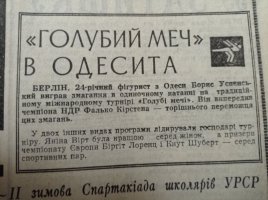
BERLIN. The 24-year-old figure skater from Odesa, Boris Uspensky, won the single skating competition at the traditional international "Blue Swords" tournament.
He managed to edge out the GDR champion Falko Kirsten, who was last year's winner of these competitions.
In the other two categories of the program, the tournament hosts took the lead. Janina Wirth was the strongest among the women, while European Championship medalists Birgit Lorenz and Knut Schubert triumphed among the pairs.
1767462024319.jpeg
"BLUE SWORD" FOR THE ODESAN

(the article published in Ukrainian 'Sportyvna Hazeta' on December 1, 1983)

BERLIN. The 24-year-old figure skater from Odesa, Borys Uspenskyi, won the single skating competition at the traditional international "Blue Swords" tournament. He surpassed the GDR champion Falko Kirsten, last year's winner of these competitions.
In the other two categories of the program, the tournament hosts took the lead. Janina Wirth was the best among the women, and European Championship medalists Birgit Lorenz and Knut Schubert were the best among the sport pairs.
1767462443972.jpeg
 
1983
OLYMPIC HOPES

COMMENTARY

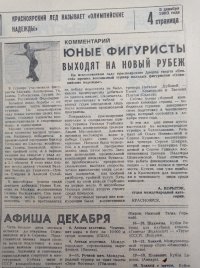
YOUNG FIGURE SKATERS REACH A NEW MILESTONE
(the article published in russian 'Sovetskiy Sport' on December 2, 1983)
The "Olympic Hopes" All-Union youth figure skating tournament was held on the artificial ice of the Yenisei Sports Palace in Krasnoyarsk.
Skaters from Moscow, Leningrad, Ukraine, Uzbekistan, Georgia, Estonia, and the Russian Federation participated in the competition.
The hallmark of this year’s tournament was the high intensity of the competition. On the Krasnoyarsk ice, both pairs and single skaters demonstrated new qualities in their programs and performed complex elements.
Many athletes performed elements of the highest difficulty. For example, the winner of the free skate, Viktor Petrenko from Odessa—a pupil of Galina Zmievskaya—executed a triple lutz. In pair skating, we saw triple throws and 2.5-revolution jumps from several duos. In this discipline, first place went to the students of Valery Tyukov from Tashkent: Irina Shishova and Aleksey Suleymanov.
In the ladies' all-around, success was achieved by Irina Klimova from Moscow, a pupil of Galina Vasilkovich. She took first place. However, it is worth noting that there was no shortage of contenders for the win, and no one managed to secure a clear advantage. The judges determined the final standings in the table of ranks only after the performance of the free programs.
Krasnoyarsk spectators and specialists also took a liking to tournament medalist Natalia Gorbenko from Kyiv, a pupil of coach Lidia Masliukova. The girl demonstrated true will to win. Judge for yourself: after the "school" (compulsory figures), Natalia was in fourth place, and in the short program, she placed only fifth. However, during the performance of her free composition, the Kyiv native was literally transformed: excellent gliding, high speed, and precise execution of such difficult elements as the triple loop and triple toe loop. Five out of seven judges placed Gorbenko in first. In the all-around, Natalia took second place among the medalists.
In ice dance, the pupils of coach Natalia Dubova—Elena Krykanova and Evgeni Platov (Odessa)—were beyond competition.
Currently, members of the country's junior national team—the tournament winners—are finalizing their preparation for the World Championship, which will take place this December.
During these same days, young duos competed at an international tournament in Czechoslovakia. These are Olga Neizvestnaya and Sergey Khudyakov, pupils of coach Sergey Shakhray, and the second pair, Ekaterina Gordeeva and Sergey Grinkov, pupils of coach Nadezhda Shevalovskaya. It should be noted that the youngsters finished successfully—they secured first and third places. Incidentally, they have already arrived in Krasnoyarsk to prepare for the Junior World Championship.​
A. KORYTEK,
International Category Judge.
KRASNOYARSK.
1767524576830.jpeg
 
1983
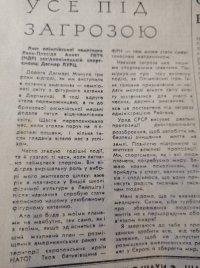
EVERYTHING UNDER THREAT

(the article published in Ukrainian 'Sportyvna Hazeta' on December 8, 1983)

Letter from the Olympic champion of Lake Placid, Annette Pötzsch (GDR), to the West German athlete Dagmar Lurz.

Dear Dagmar,
Three years have passed since we competed in our last competition—the World Figure Skating Championships in Dortmund. I became the winner for the second time then, and you added the title of World Vice-Champion to your Olympic bronze medal. We were filled with happiness standing next to each other on the podium, and several thousand spectators congratulated us on our success.
I often remember those events, and indeed all those times when I was actively involved in sports. It played a decisive role in choosing my life's path: I have been studying for a year at the Higher School of Physical Culture in Leipzig and after graduation, I will try to be useful to our beloved sport of figure skating.
But what will become of my plans for the future, as well as yours, if another terrible plan is realized—the deployment of American missiles on the territory of European NATO countries? Your homeland—the FRG—could also become a lethal launching pad.
A threat looms over our sporting ideals. Just think of such a significant event as the Olympic Games. Their primary purpose is to provide the youth of the whole world with the opportunity to meet for participation in fair, friendly competitions. And all of this is being put at risk by the Reagan administration.
The USSR government is putting forward realistic proposals for bilateral disarmament to prevent the danger of the destruction of life on Earth. I fully support these vital proposals. We athletes, like all people on the planet, need peace. I wish the new generations coming into sports great success and hope they will bring joy to thousands upon thousands of people.
I am aware that you are studying medicine. Tell me, is not the care for preserving human lives the primary duty of a doctor?
I appeal to you with a request to do everything in your power to prevent the deployment of American missiles in Europe and to preserve peace.
1767526804410.jpeg
 
1983
RELAY

ABOUT WHAT WAS, IS, AND WILL BE

(the article published in russian 'Sovetskiy Sport' on December 8, 1983)

Today, the guest of the "Olympic Courier" is Vladimir Kotin, a student of Honored Coach of the USSR Elena Anatolyevna Chaikovskaya. This figure skater, a candidate for the Olympic team, recently became the recipient of the "Crystal Skate" award, a prize from the newspaper "Moskovskiye Novosti".
- What does one of the candidates for the Olympic team feel two months before the start of the Games?

Above all, an increased responsibility for my performances this season. A responsibility I didn't know before. Participating in the Olympics is any athlete's dream. But achieving that right is not enough. At the Olympic tournament, it's important to show the maximum of what you can do. That's what I'm tuning myself for.
"Which famous athlete was your benchmark for mastery?"
"I can't give a definitive answer to that question. I've never really thought about which of the world's leading figure skaters I'd like to emulate. I don't like similarities, because then an athlete loses their identity, their individuality. A sign of class in figure skating isn't just mastering a set of highly challenging technical elements. True class is being yourself, connecting a composition into a pattern that no one else can achieve.
I admired a variety of skaters. In their performances, I tried to find the traits that distinguished the individuality of these great masters. But I memorized them not to replicate them in my own programs, but to serve as a starting point in my search for something new, to develop and continue what was close to me, to my style...
"What can you say about the masters of the previous generation?"
"Canadian figure skater Toller Cranston once inspired a completely new way of thinking about figure skating choreography. His programs inspired a new understanding of the music I skate to. It was this choice of musical accompaniment that became the foundation of my programs."
I loved the performances of Yuri Ovchinnikov and Igor Bobrin. Their imagery and ability to use music to create a cohesive composition, conveying character and mood. And world champion Vladimir Kovalev, in his prime, set an example of how to prepare for a competitive sport. Іncidentally, he, like me, is a graduate of the Moscow Dynamo School.
Now let's bridge the gap between the present and the recent past and ask Honored Master of Sports, two-time Olympic participant, and 1975 World Champion Sergei Volkov to comment on the situation in men's singles skating.
- Sergey, how do you rate the recent performances of our two leaders, national champion Alexander Fadeev and Vladimir Kotin, in the international tournament "Moscow News"?
"In my opinion, both athletes are worthy candidates for the Olympic team. Both are strong all-around athletes. I'd like to highlight Fadeev's qualities, such as his clear and consistent "schooling" and excellent skating skills. Kotin's main asset is the artistry of his routines. He also excels in jumps, spins, and other techniques."
- In your opinion, how significant is the overall progress in world single skating over the past decade?

- For comparison, I'll give a few examples. When I competed at the 1968 Winter Olympics in Grenoble, many experts considered a program to be technically advanced if it included two triple jumps. In 1976, all five types of triple jumps had already been mastered in Innsbruck. Now, the conversation is about the most difficult elements – the triple axel and quadruple toe loop. And we might see all of this on the Olympic ice in Sarajevo.
- What are your wishes for our current Olympians?
- In a challenging tournament like the Olympics, where all the "stars" compete, a special degree of psychological fortitude and self-confidence is needed. And this is possible only under one condition: very consistent execution of your routines during training. Therefore, first of all, I wish our young candidates for the national team one hundred percent consistency in all difficult elements, in all sections of the all-around.
1767531487251.jpeg1767531505324.jpeg
 
1983
WORLD JUNIOR CHAMPIONSHIPS

FIGURE SKATING
(the article published in russian 'Sovetskiy Sport' on December 9, 1983)
TOKYO. Viktor Petrenko, a 14-year-old figure skater from Odesa, won the junior world champion title (under 16) in the Japanese city of Sapporo.
Having perfectly executed his free program, he moved up from third place to first, ahead of American Tom Cherniak and Canadian Mark Ferland. Viktor was the only participant in the tournament to perform a triple Lutz.
Another representative of Odesa competed in the same event – the new champion's 12-year-old brother, Vladimir Petrenko, who took fifth place. Coach Galina Zmievskaya led the young athletes to this success.
Muscovites Olga Neizvestnaya and Sergey Khudyakov took third place in the pairs competition.
1767532502281.jpeg
 
1983
WORLD JUNIOR CHAMPIONSHIPS

LEAP ONTO THE PEDESTAL

(the article published in Ukrainian 'Sportyvna Hazeta' on December 10, 1983)

Odesan Viktor Petrenko - junior world champion!
PLEASANT news came from the Japanese city of Sapporo. At the Junior World Championships, 14-year-old figure skater from Odesa Viktor Petrenko won in the singles event. In pairs skating, Kyiv native Olga Neizvestnaya and Odesan Sergey Khudyakov became bronze medalists. The winners were M. Landgraf and I. Steuer from the GDR.
CONSIDERING that in every event at the World Championships, the USSR national team featured our fellow countrymen, one can conclude that the republic has learned to train young masters of the winged skates. This primarily applies to the Odesa school "Avangard," which produced Viktor Petrenko, Sergey Khudyakov, and Petrenko's younger brother, 12-year-old Vladimir, who also competed in Sapporo and took an honorable fifth place there.
It is characteristic that the brothers, trained by Galina Zmievskaya, debuted at the World Junior Championships the year before last and took, respectively, 10th and 11th places. The next season, they approached the podium. And now the older one - Viktor has jumped to the highest step. According to TASS, the Odesan performed his free program excellently, beating American Tom Cherniak and Canadian Mark Ferland. The Soviet figure skater was the only participant to perform a triple lutz.
Olga Neizvestnaya, a student of the Kyiv "Dynamo" school, has been training for over a year with Odesan Sergey Khudyakov in the group of Olympic champion Irina Rodnina. After the short program, our athletes were leading, but then the partner's recent injury took its toll.
After the compulsory dances, Odesans Elena Krykanova and Evgeny Platov are sixth. Our girls are performing worse so far. Muscovite Irina Klimova finished the "school" in tenth place, and Kyiv native Natalia Gorbenko in twentieth.
1767534316660.jpeg
 
1983
WORLD JUNIOR CHAMPIONSHIPS

FIGURE SKATING

(the article published in russian 'Sovetskiy Sport' on December 11, 1983)

TOKYO. Following the success of the new junior figure skating champion in singles, Viktor Petrenko of Odesa, his fellow Odesans Elena Krykanova and Evgeny Platov climbed to the highest step of the world championship podium in the Japanese city of Sapporo, having won among ice dance duos.
1767535105923.jpeg
 
1983
BRITISH NATIONAL CHAMPIONSHIPS

RISKY DANCE

(the article published in Ukrainian 'Sportyvna Hazeta' on December 10, 1983)

Three-time world champions in ice dance Jayne Torvill and Christopher Dean will not appear before spectators until the Olympic starts in Sarajevo. After performing their new program at the British Championships, they secluded themselves in the training hall and are not allowing anyone in except their coaches.
Nevertheless, enterprising reporters still managed to get the public's idols to comment:
"The theme from Ravel's 'Bolero' that accompanies our free dance is interpreted boldly, even provocatively," says Dean. "We even call the final part of the composition the 'dance of death'..."
"Of course, we are taking a risk," adds Jayne. "But at home, our experiment was enthusiastically received by both specialists and spectators."
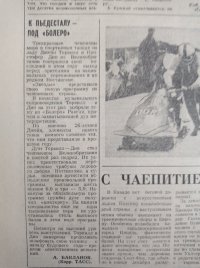
The Torvill-Dean duo won the British Championship for the sixth time. Assessing the artistry of the free program performance, the judges gave six scores of 6.0. The success is convincing. But Karen Barber and Nicky Slater, silver medalists of the 1983 European Championship, did not participate in the national championship - the partner is recovering from an injury...
1767536879629.jpeg
TO THE PEDESTAL UNDER "BOLERO"

(the article published in russian 'Sovetskiy Sport' on December 14, 1983)

Three-time world champions in ice dancing Jayne Torvill and Christopher Dean from Great Britain made their final appearance of the year before spectators at the national competitions in their native Nottingham.
The "stars" presented their new program at the country's championship.
As musical accompaniment, Torvill and Dean this time chose a theme from Ravel's "Bolero", in a breathtaking interpretation.
According to 26-year-old Jayne, the elements of the new dance are much more complex than those they presented last year.
The Torvill-Dean duo became champions of Great Britain for the sixth consecutive time. Their success was greeted by a packed house at the Nottingham ice palace, and the judges, evaluating the artistry of the free program performance, awarded six scores of 6.0 and three of 5.9. The day before, for the compulsory program (rumba), the duo received a "six". Specialists cannot recall any other ice dance pair ever being awarded such a high score in this type of program.
Despite the high level of performance, Torvill and Dean intend to continue polishing their technique by the beginning of next year - a time of responsible trials.
A. BAKLANOV
(TASS Correspondent).
1767614307045.jpeg
 
Last edited:
1983
WORLD JUNIOR CHAMPIONSHIPS

GOLDEN DANCE

(the article published in Ukrainian 'Sportyvna Hazeta' on December 13, 1983)

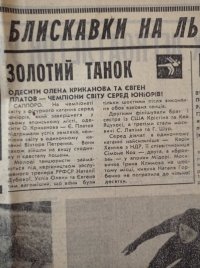
ODESANS ELENA KRYKANOVA AND EVGENY PLATOV - JUNIOR WORLD CHAMPIONS!
SAPPORO. At the World Junior Figure Skating Championships, which concluded in this Japanese city, Odesans Е. Krykanova and E. Platov supported the success of their fellow countryman, World Champion in singles skating Viktor Petrenko. They also climbed to the highest step of the podium.
The young dancers train under the guidance of Honored Coach of the RSFSR Natalia Dubova. The success of Elena and Evgeny is even more significant because they were only sixth after performing the compulsory dances.
Second place went to the brother and sister from the USA, Christina and Keith Yatsuhashi, and third place went to Muscovites S. Lyapina and G. Sur.
Among the girls in singles skating, the strongest is Karin Hendschke from the GDR, her compatriot Simone Koch is second, and the "bronze" goes to the Japanese Midori Ito. Muscovite Irina Klimova is in sixth place, and Kyiv native Natalia Gorbenko did not make it into the top ten.
1767538262194.jpeg
 
1983
WORLD JUNIOR CHAMPIONSHIPS

LAST MEDALS AWARDED

(the article published in russian 'Sovetskiy Sport' on December 14, 1983)

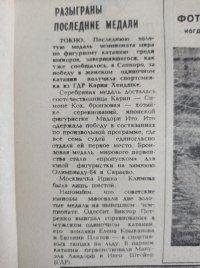
TOKYO. The last gold medal of the World Junior Figure Skating Championships, which concluded in Sapporo as previously reported, was won in the women's single skating event by the athlete from the GDR, Karin Hendschke.
The silver medal went to Karin's compatriot, Simone Koch, and the bronze to the host of the competition, Japanese skater Midori Ito. Ito claimed victory in the free skate program, where all seven judges unanimously awarded her first place. The bronze medal at the world championships became a "ticket" for the young skater to the 1984 Winter Olympics in Sarajevo.
Muscovite Irina Klimova was only sixth.
As a reminder, Soviet juniors won two gold medals at the current championships. Viktor Petrenko from Odessa won the men's single skating competition, and his fellow Odessans Elena Krykanova and Evgeni Platov triumphed in ice dance. In pair skating, Manuela Landgraf and Ingo Steuer (GDR) took first place.
1767640916990.jpeg
 
Last edited:
Back
Top