1988
WINTER OLYMPIC GAMES
PRE-START REVIEW: WHO IS WHO
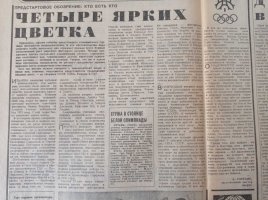
FOUR BRIGHT FLOWERS
(the article published in russian 'Sovetskiy Sport' on February 4, 1988)
I must admit, many events of the upcoming Olympic figure skating tournament are unpredictable, and this circumstance should be noted especially, since it reflects above all the rapid qualitative growth of world figure skating. Four beautiful flowers make up the Olympic "bouquet": pairs skating, ice dance, and men’s and women’s singles. I am sure that in none of these disciplines will experts risk "handing out" podium spots ahead of time.
On the other hand, we can confidently talk about the trendsetters. Among them, representatives of traditionally strong schools stand out—national teams from the USSR, USA, Canada, and the GDR.
SINCE ANCIENT TIMES, the sympathies of the audience belonged to those masters who conducted a dialogue on ice, filled with internal passion, and knew how to express the beauty of pairs skating. The Olympic ice sparkled with new colors when Soviet figure skaters Irina Rodnina and Alexei Ulanov, the winners of the 1972 Games, swiftly flew into the arena. Since that time, many victories have been achieved.
Recently, the perfection of styles in pairs skating has followed two directions: athletic and artistic, but with a constant search for the 'golden middle.' In 1986, the programs of the new world champions Ekaterina Gordeeva and Sergei Grinkov captivated everyone. They captivated, first of all, with harmony, a combination of athleticism and choreography. Even now, they confidently won the European Championship.
Experienced duets are in a fighting mood—Larisa Selezneva and Oleg Makarov, as well as representatives from GDR—Peggy Schwarz and Alexander König. Let me remind you that the first pair took bronze at the '84 Games in Sarajevo, and the second took bronze at the European Championship. And, the 1984 Olympic champions Elena Valova and Oleg Vasiliev have not yet said their word this season (they missed the European start in Prague).
Across the ocean, the Americans Jill Watson and Peter Oppegard, and Canadians Denise Benning and Lyndon Johnston, Christine Hough and Doug Ladret, are training hard.
The Americans, considering the specific nature of Olympic season, held their national championship during the dates of the European Championship—in mid-January.
THE PROGRESS of world figure skating is especially noticeable when watching modern ice dance. There are so many original ideas! Some skaters, seeing videotapes with recordings of old programs, would smile condescendingly: "Is this really the Stone Age?" But very much is learned by comparison. The main thing is that we have come a long way forward. Today it is more clearly seen how fundamental the first Olympic victory of Soviet duet Lyudmila Pakhomova and Aleksandr Gorshkov in 1976 was.
Twelve years later, our ice dance school woke up and gave life to many interesting styles and distinctive handwritings. They were brought to life in the dances of current world champions Natalia Bestemianova and Andrei Bukin, second-prize winners of the European and World Championships Marina Klimova and Sergei Ponomarenko, and silver medalists of the 1988 European Championship Natalia Annenko and Genrikh Sretenski.
The Olympic ball for ice dancers in Sarajevo left a bright mark on figure skating. The "Bolero" of Jayne Torvill and Christopher Dean showed everyone how vast the possibilities of ice dance are. It is no accident that in recent years, programs have appeared where the refinement and fantasy of the skaters are uniquely reflected in the music of Bizet, Shchedrin, Rachmaninoff, Liszt, Strauss, Gershwin, and Shostakovich.
In Calgary, three Soviet duets will play the main roles. Their competitors will be figure skaters from Canada, the USA, and France. But it seems that the battle for the highest awards is within the reach of only two Soviet duets—Bestemianova-Bukin and Klimova-Ponomarenko. And here, Canadians Tracy Wilson and Robert McCall, Americans Suzanne Semanick and Scott Gregory, as well as the French Isabelle Duchesnay and Paul Duchesnay, who are now helped by Englishman Christopher Dean will strive for bronze medals. However, these duet still need to "settle scores" with our ice dancers Annenko and Sretenski, who over the last two years have achieved impressive progress.
AN EXCITING intrigue awaits us in the men's event. Three unique masters with strong characters will clash in an ice battle. I am talking about the world championship winners: Brian Orser (Canada), Brian Boitano (USA), and Alexander Fadeev (USSR). The intrigue is not just about how they share the medals, but whether someone else can interfere in this battle. After all, the Olympic debutants must also show a fighting character!
What trump cards do the leaders hold? The top skaters from Canada, USA, and the USSR practically have no flaws in their multi-discipline training: they are focused on first place in the "school" (compulsory figures), short program, and free skate. All three favorites have a combination with a reliable 'triple axel' jump in their arsenal. True, Orser has an undeniable advantage—the support of thousands of compatriots. Canadians passionately know how to cheer for 'their own,' no wonder a whole fan club for Orser has been created in the country. And yet...
Yet five-six skaters are ready to claim their right to a medal: our Vladimir Kotin, Viktor Petrenko, Americans Paul Wylie, Christopher Bowman, and Canadian Kurt Browning.
It seems to me that a lot can be decided by even a single mistake made in the heat of battle. After all, under the new rules, a fall after a jump is penalized very harshly.
THE RELIABILITY of their programs needs to be taken care of by our skaters Kira Ivanova and Anna Kondrashova. Let me remind you that at the Olympic tournament in Sarajevo, Ivanova won a bronze medal. Both skaters have repeatedly reached the podium of European and World Championships. However, in 1987, failed to cope with their free program and ended up in 5th and 9th place in Europe. From these positions, they will have to start a new attack on the Olympic podium. This will not be easy, considering that their competitors include Olympic champion Katarina Witt (GDR), three American skaters—Debi Thomas, Caryn Kadavy, Jill Trenary, Canadian champion Elizabeth Manley, Japanese Midori Ito.
Among those who will take the start in Calgary, there are figure skaters capable of receiving the highest scores — 6.0 in practically each of the four program segments. This alone already characterizes the sports level of the tournament as a high-class event. The sporting world is waiting for an ice fireworks display, the likes of which have never been seen before.
A. GORELIK,
Honored Master of Sports.