


- Joined
- Nov 14, 2007
Daisuke talks about his new ice show '滑走屋 (Kassouya)'  https://www.youtube.com/watch?v=45ysKztqulo
https://www.youtube.com/watch?v=45ysKztqulo
Follow along with the video below to see how to install our site as a web app on your home screen.
Note: This feature may not be available in some browsers.
https://www.youtube.com/watch?v=45ysKztqulo
 www.youtube.com
www.youtube.com
www.youtube.com

Some video clips on the upcoming Prince Ice World show where Dai will skate 'Tango de Roxanne' with Prince members
- YouTube
Enjoy the videos and music you love, upload original content, and share it all with friends, family, and the world on YouTube.- YouTube
Enjoy the videos and music you love, upload original content, and share it all with friends, family, and the world on YouTube.
 Dai also successfully landed a 2 Axel and attempted a 3 Lutz! It's wonderful to see him jump again - I just hope his knee is ok.
www.youtube.com
www.youtube.com
www.youtube.com
Dai also successfully landed a 2 Axel and attempted a 3 Lutz! It's wonderful to see him jump again - I just hope his knee is ok.
www.youtube.com
www.youtube.com
www.youtube.com
Here's my favorite Dai costume!
www.youtube.com


 :
: ): https://drive.google.com/file/d/1FqQj2afbcNyaAZ98Nt9uKHEKoi5CGmcS/view?usp=drive_link
 Thank you, deedee, for keeping us in the loop on some news!
  :
:Source: https://www.ntv.co.jp/oshareclip/articles/2617qd17dum1lky5n9h7.htmlGuest: Daisuke Takahashi, three-time Olympian, figure skater and ice dancer.
He is friends with MC Ikuzaburo Yamazaki. As soon as they appeared on stage, they tried their hand at shooting a short video together. The talk also covers everything from his addiction to men's nails to his stoic skincare regime, as well as candid confessions about his new life in Tokyo. And then there's his ice-dance partner Kana Muramoto, and the secret stories from his friends from university. The message from his mother, who has continued to support him, was very moving. We caught up with Takahashi-san's emotions as he continues to evolve to a new stage in his life after retiring as an athlete.
 drive.google.com
):
drive.google.com
drive.google.com
):
drive.google.com


 www.instagram.com

Thank you synes, much appreciated and your are the best Dai fan!!!!
I was reading through some of the first few pages a few days ago and realised (again) that you've both been cheering for Dai and lovingly contributing to his fanfest since the beginning of this thread (and I'm guessing you've been following his career since way before).

Yuzu to perform in the third instalment of 'Hyoen' starring Daisuke Takahashi and directed by Amon Miyamoto. Ice show based on the motif of 'Night on the Galactic Railroad'.
On 29 January, it was announced that artist Yuzu will appear as a special guest artist in the ice show “Hyoen 2024- The Kiss of the Crossed Stars”.
“Hyoen" expresses the desire to create a glamorous stage that conveys Japanese culture in a way that has never been seen before, through the beautiful and supple performances and emotional expression that only figure skating can offer. The sound 'en' in Hyo-en also expresses the will to challenge to 'perform' beyond the common sense of figure skating and the wish that various 'connections' will be made through the project. The ice show will be a story-based ice show that combines sports and Japanese culture, and will showcase the charms of Japan to the domestic and global audience.
The first show, "Hyoen 2017 - Basara", was a collaboration with Kabuki, one of Japan's most popular cultural arts. With Matsumoto Koshiro (then Ichikawa Somegoro) as the director, it attracted around 40,000 spectators. The second production, Hyoen 2019 – Like the Moonlight / the Tale of Genji, said to be the world's oldest full-length novel, was directed by Amon Miyamoto, and attracted around 42,000 spectators with genre-crossing performers including Takahiro Matsumoto, Reon Yuzuki, Ayaka Hirahara and Tokuma Nishioka.
For this third production, Yuzu has written the theme song and will appear in all performances as a special guest artist (appearing and singing in some of the performances). The entire story will be coloured by Yuzu songs sung by the cast. The collaboration is a new challenge for both the cast and Yuzu.
The story is based on Kenji Miyazawa's masterpiece “Night on the Galactic Railroad”. The production will be directed by Miyamoto following the show in 2019, and the script will be written by Riko Sakaguchi, who is active in various genres including TV drama, film, animation and theatre. Various elements, mainly figure skating, but also music and theatre, will be fused together to create a magnificent and heroic dream picture scroll-like world.
Takahashi is enthusiastic: "I will do my best to make everyone's life richer by bringing to the audience's attention the miracle that we have created together with these great artists.”
Yujin Kitagawa of Yuzu says: "After receiving the offer, I met with Amon-san, where I received an incredible amount of passionate power from him, and the next day the prototype for the song was ready. It's the first time for Yuzu to be involved in ice skating, so there are some unknowns about what the stage will be like, but I'm looking forward to seeing Yuzu's music resonate in a new way on the ice rink and reach the audience.
The show will run for a total of four performances at Yokohama Arena from 8 to 11 June. In addition to Takahashi and Yuzu, the cast includes Ryunosuke Onoda, Shizuka Arakawa, Ehara Masahiro, Kana Muramoto, Marie and Eliana.
 :
: www.youtube.com
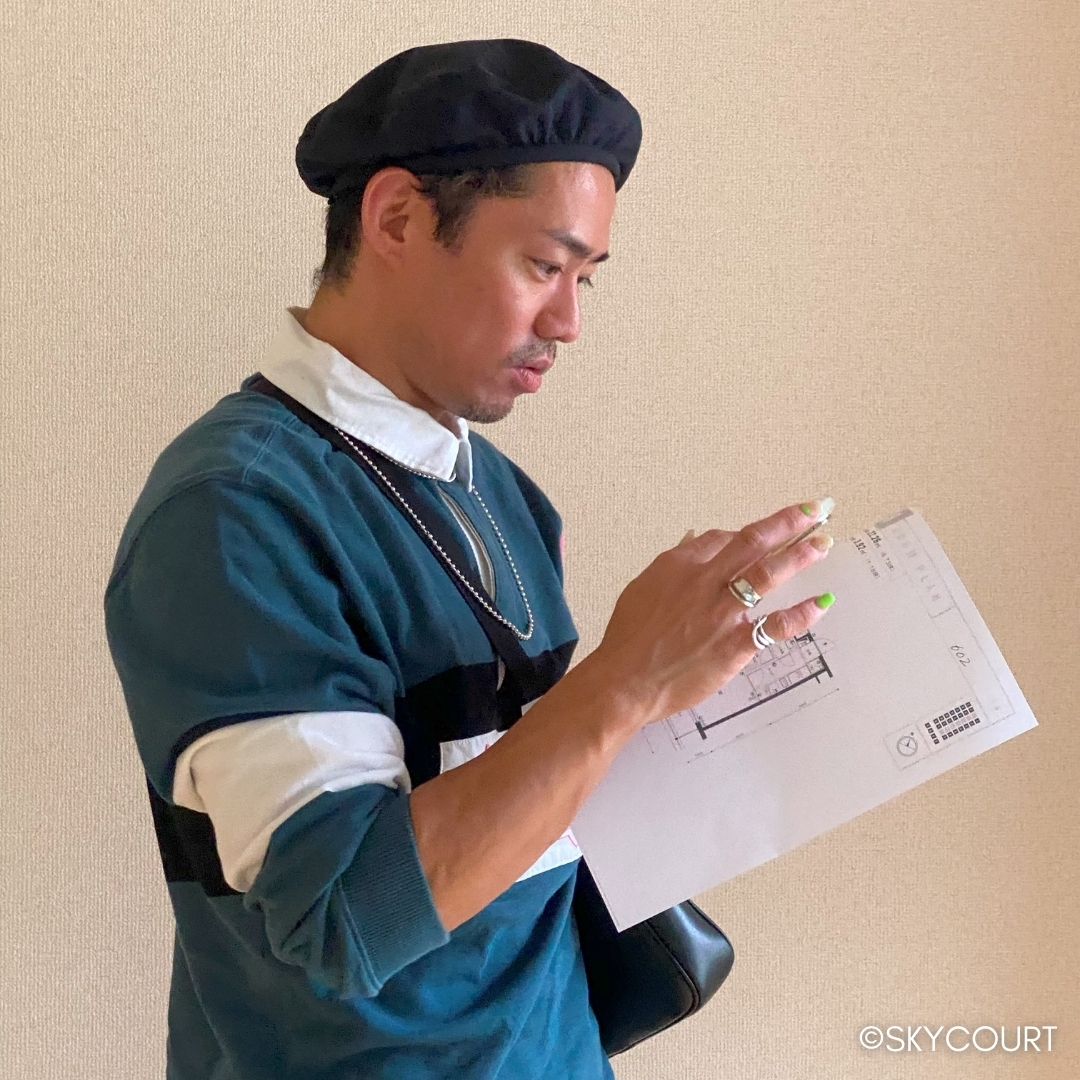
 www.d-color.tokyo
:
www.d-color.tokyo
:Employing young people, low price, short time, ”Kassouya'' produced by Daisuke Takahashi. Public practice.
An open practice session for the ice show "Kassouya", produced by professional figure skater Daisuke Takahashi (37), was held on 5 February, with enthusiastic preparations for the show to be held at the Ovision Ice Arena Fukuoka from 10 to 12 February.
'I can't even think about my solo number.' His eyes widened and he smiled wryly. At the performance, he will unveil his first new solo number in four years, but his mind is now occupied with the production of the show itself. Since his retirement as an ice dancer last May, he has been struggling to put into this show all the inspiration he had felt until then.
“I thought, ``I have to decide this too.'' There were also discoveries that made me realize, ``Oh, there are so many different things.'' There are parts that are really fun, but it's hard work. I feel it's interesting to see things taking shape and becoming more and more visible."
On this, the third day of general practice, they spent about two hours checking a part of the 14-minute opening sequence over and over again. Surrounding him were skaters younger than himself. Active skaters scouted by Takahashi himself are lined up, ranging from high school to university students to working adults.
I wanted to put on a show with only Japanese skaters.
Regardless of his fame, he went to the competitions himself and called up athletes who could skate with speed and power, one of the themes of the show.The name “Kassouya” isn't a performance group, but I thought it would be good to have a name that would be taken to mean something like that."
The intention of gathering young skaters was also to bring out their appeal so that they could continue skating as professionals even after they had finished their career as active skaters. The show is also a way of expressing the hope that, as a group of professionals, this show will be a platform for the future.
In fact, the show is different from conventional shows, and we are planning to deliver a new experience to the audience, and at the same time, raise awareness among young people. The choreography is by Yuma Suzuki, a former member of the Shiki Theatre Company and the head of Tokyo Panorama Theatre, who is renowned for her original stage direction, and who, having worked together on the 2019 ice show “Hyoen”, wanted to create a stage that was not bound by conventional frameworks.
The composition of the piece you've seen today is something you don't see very often. The movements are also very detailed.
Takahashi himself takes on the task of translating the choreography he has conceived on the floor onto the ice, trying to embody an unknown charm beyond its complexity. I hope that learning these movements will help current athletes in their competitive careers and beyond. He makes use of his experience as an ice dancer as well as a singles skater.
In producing the show, he also focuses on ease of viewing. Tickets cost between 6,000 and 12,000 yen. The price was set lower than for other shows.
"It can't be helped that it's more expensive because we have to put ice on it. But this time we didn't invite any international skaters, so we could keep costs down. We thought about where we could lower the cost to the max.”
We want to lower the hurdles and reach out to a segment of the audience other than the traditional fans. Based on this, the time has been shortened to 75 minutes, with three performances a day.
“We thought two hours would be too long for non-fans. If we increase the time slots, we think we can attract a wider range of visitors, and they can also do other things during the day. We thought about making it easier to come."
Advantages for the audience and the performers. Taking into account both sides, he takes the lead role in the production.
::Contents:
2:08 When did I start to take up Figured Skating?
7:26 When I started to take figure skating seriously
19:00 Dealing with slumps
32:10 Injuries
36:40 The LOWest of all
58:33 How the couple got together
1:06:04 Struggles
1:13:05 Thoughts on training
1:18:56 Where things have changed in my body
1:19:39 Muscles you want to build
1:19:54 Training I'm addicted to
1:20:05 Have your leg muscles changed since changing to ice dancing?
1:21:20 The training I'm not good at
1:22:06 Give me some blackmail (?)
1:22:48 Has your training changed since returning from Florida?
1:23:29 Advice when injured
1:25:01 Essential training
1:27:26 Is Kana Muramoto your rival?
1:30:05 Do you get nervous?
1:36:11 Announcements
 )
)Now that he has finished all his competitions for the season, he is practising every day in preparation for his appearance in Daisuke Takahashi's ice show “Kassouya”, which will open on 10 February in Fukuoka City. When information about the show was first released, his mother contacted him and said, "They are looking for skaters to perform in the show, why don't you apply?" However, Kadowaki himself thought that it was too presumptuous for him to apply, so he passed on the idea.
However, after the East Japan Games in November last year, he received a direct offer from Mr Takahashi and decided to perform as an ensemble skater, saying, "If you have chosen me, I will perform......". I'm happy that he watched me in competition," he says, "but I'm determined to do my best in the role I've been given so that I can live up to his expectations."
Many of the ensemble skaters who will perform are athletes who train in the Chugoku, Shikoku and Kyushu blocks. In particular, the only rink in the Chugoku-Shikoku region that is open during the off-season is in Okayama Prefecture, where the skaters are old acquaintances who see each other often. He said, with a twinkle in his eye, "I'm looking forward to working together with the skaters I know so well."

 :
:According to Mr Takahashi, one of the aims of this show is to nurture the next generation of skaters. Usually, ice shows are mainly for skaters who have won world titles, and skaters who have not yet achieved international success do not have the opportunity to participate. This time, Takahashi personally visited domestic competitions and selected young, unknown but talented skaters as ensemble skaters.
[…]
The performance will be limited to domestic skaters and the main skaters will be narrowed down, but the ensemble skaters were selected from a large number of students to give it more power. At the same time, this will also lead to the aforementioned development of younger skaters who will be responsible for the future of the skating world. As well as growth through practice and performance experience, Takahashi's big goal is to create a place for talented skaters to skate after they retire. If “Kassouya” is successful it can be developed in many places / locations in the future.
[…]
The aforementioned staff member said that Takahashi's determination and behaviour are extraordinary. “I think it's very significant that he knows both when skating was not yet popular and when it was at its best. After the Corona disaster, the situation in the entertainment industry changed while the number of ice shows increased, but he is not afraid to try something new and is trying to reform the industry, thinking about the future of skaters and creating shows that can survive after this. This time, as he is also the general director, he was aware of the reality of budgets and costs, and he was worried about how to make tickets cheaper, so he took a rough look at what we could cut back on.
For example, stage lighting and other aspects related to the content and quality of the show can never be cut. However, the ensemble skaters shared a room, and the main skaters had a room large enough to hold all their boots. The food has also been rethought and simplified to rice, vegetables, meat and fish to cut down on the cost of catering. Above all, the skater himself [Daisuke] asked for a substantial reduction in his own fee. I strongly felt his extraordinary passion for the skating world and for “Kassouya”.
I've never seen Daisuke Takahashi like this! First time to produce a full ice show... 'Preparedness' shown in practice.
Report on the open practice session at "Kassouya".
by Akiko Tanaka
Writer Akiko Tanaka, who interviewed Daisuke Takahashi in November 2023, attended an open practice and press conference on 5 February. She attended the press conference and reports on the heated scene just before the event.
When I entered the rink side, male skaters dressed in hoodies with the black “Kassouya” logo were in the middle of practising as an ensemble on the ice. A fast-moving formation, with the two groups dancing individually, intersecting and then breaking off. It looks quite difficult, but the black group looks somewhat like ninjas as they tackle the unique and cool choreography.
One thing that stands out is Daisuke Takahashi's movements, who divided the group into two groups, one led by Daisuke Takahashi and the other by Kazuki Tomono, who taught the skaters detailed movements as the practice progressed. The overall choreography is created by Yuma Suzuki, a former member of the Shiki Theatre Company and a close friend since Hyoen, who now runs the Tokyo Panorama Theatre. She instructs everyone with a microphone at the rink side while striking large poses herself, which Takahashi models on the ice.
The women's team joined the formation halfway through, with Kana Muramoto and Kanako Murakami leading the ensemble skaters in danceable moves. These were part of the opening program, which lasted a whopping five songs and 14 minutes.
What surprised me, in addition to the coolness of the choreography, was the closeness of the members and the density of their rehearsals. You can watch former world champion and legend Daisuke Takahashi, who skates the ensemble moves many times, up close for long periods of time and get to watch his moves almost on a one-to-one basis. This is a tremendous asset for young ensemble skaters.
According to Mr Takahashi, one of the aims of this show is to nurture the next generation of skaters. Usually, ice shows are mainly for skaters who have won world titles, and skaters who have not yet achieved international success do not have the opportunity to participate. This time, Takahashi personally visited domestic competitions and selected young, unknown but talented skaters as ensemble skaters. The show will feature many ensemble scenes, which is not possible in a normal show, and the individual performances of the main skaters will be connected in a flowing, fast-moving and varied way.
At the press conference, Takahashi said:
“At first, we wanted to make a fast and powerful show, so we chose skaters with a sense of speed, but Yuma Suzuki's choreography is so interesting that it has become more danceable than at first, and everyone is struggling with it (laughs). It's only been about a week since the whole group got together to practise, so it's a race against time to get it all together, but it's gradually coming together, so if we can complete what we have in mind and get the whole thing snapped together, I think we can show something wonderful and you can feel the power of everyone. It's tough now that I'm a full time producer, but it's still interesting to make new discoveries and see the things I've been thinking about taking shape."
While stressing the difficulties, he seems to be having a lot of fun.
Since 3 February, all members of the team, except for Sota Yamamoto, who was competing in the Four Continents Championships, have gathered for a general practice session. On 5 February, the third day of the gathering, some of them were still struggling with their unique choreographies, but the motivated atmosphere of everyone seemed to be having a lot of fun. The young ensemble skaters were also actively engaged without fear. This must also be the atmosphere created by the conductor.
A staff member on the organising side said:
“I can sense that Takahashi himself is taking on the challenge with a determination that has never been seen before: "If we don't make this year's Kassouya in Fukuoka an absolute success, it won't lead to the next one. I can see it in his face, in his eyes and in everything he does."
Ticket prices and number of performances to make it easier for audiences to come.
Daisuke Takahashi is not only taking on the role of general conductor for the first time for Kassouya, he is also taking on a variety of new challenges: the first is overall direction; the second is the selection of the ensemble music, which will be performed by the skaters. All 15 pieces of music used in the ensemble were selected by himself. He creates his own vision of the world, paying close attention to the details of the posters and programme content. He asked Yuma Suzuki, who is active on the floor, rather than an ice specialist, to choreograph the embodiment of this world-view.
The choreographer, Yuma Suzuki (third from the right in the photo), is a close friend with whom a relationship of trust has been established through Hyoen starring Takahashi.
To offer cheaper ice show tickets for audiences.
Ice shows are conventionally expensive due to the costs involved in putting up ice. However, this time, in order to allow as many people as possible to see Takahashi's challenging and fresh ice show, the ticket prices were lowered to 6,000 yen for the lowest and up to 12,000 yen for the highest, which is a significant reduction for an ice show. To make it easier for first-time visitors to come, the number of 75-minute performances, which can be seen all at once, has been increased to three per day, and efforts are also being made to keep revenues down.
“The price and time slots were designed to make it easier for people who have never been to an ice show to come, not to mention those who have been to ice shows before," he says. “If they like what they see and want to go again, it will lead to new developments and we will be very happy.”
The performance will be limited to domestic skaters and the main skaters will be narrowed down, but the ensemble skaters were selected from a large number of students to give it more power. At the same time, this will also lead to the aforementioned development of younger skaters who will be responsible for the future of the skating world. As well as growth through practice and performance experience, Takahashi's big goal is to create a place for talented skaters to skate after they retire. If “Kassouya” is successful it can be developed in many places / locations in the future.
He also asked for a significant reduction in his own fee...
The aforementioned staff member said that Takahashi's determination and behaviour are extraordinary. “I think it's very significant that he knows both when skating was not yet popular and when it was at its best. After the Corona disaster, the situation in the entertainment industry changed while the number of ice shows increased, but he is not afraid to try something new and is trying to reform the industry, thinking about the future of skaters and creating shows that can survive after this. This time, as he is also the general director, he was aware of the reality of budgets and costs, and he was worried about how to make tickets cheaper, so he took a rough look at what we could cut back on.
For example, stage lighting and other aspects related to the content and quality of the show can never be cut. However, the ensemble skaters shared a room, and the main skaters had a room large enough to hold all their boots. The food has also been rethought and simplified to rice, vegetables, meat and fish to cut down on the cost of catering. Above all, the skater himself asked for a substantial reduction in his own fee. I strongly felt his extraordinary passion for the skating world and for “Kassouya”.
In addition, the selected ensemble skaters are said to be extremely enthusiastic and conscious. The ensemble choreographies were sent to the skaters via video before the practice on 3 February, but they all practised on their own before the day of the assembly, making sure they had the choreographies in their bodies before taking part. After practice, they returned to the hotel and gathered voluntarily, without being told by anyone, to watch the video and check the choreography together.
At the press conference on the 5th, four of the ensemble skaters, including Kosho Oshima, Yuto Kishina, Sakaki Miyake and Yurina Okuno, all expressed their joy at being chosen as “Kassouyas”. The opportunity to see Daisuke Takahashi's performances, movements and attitude towards training up close and personal. They were also able to receive almost one-on-one coaching from him. It was impressive that each of them said in their own words that they wanted to make the most of this in their competitive life and in their future lives.
The staff member mentioned above also had the following to say about Takahashi's thoughts on the ensemble skaters.
Yuma Suzuki's astonishing choreography was arranged so that it could be realised on the ice, and Takahashi and Kana Muramoto worked hard from early morning till late at night, which itself took about a month. While respecting each other's opinions, they searched for a place where creativity on land and ice could coexist and gradually create a chemical reaction.
In order to teach this to the ensemble skaters, Takahashi and his assistant Muramoto both put all the choreography for the parts they do not perform into their bodies before going through the whole rehearsal. He is not the type of leader who says 'I am the leader', but he is the type of leader who shows it through his attitude and actions, so that those around him see his back and naturally follow him.
We also asked Kana Muramoto, who is a member of an ice dance couple [with Daisuke Takahashi] and also plays a supporting role in this show, about Takahashi's overall direction this time.
“This time, Dai-chan is really enthusiastic, and I'm very happy to be involved in the process of creating a show from scratch for the first time, and it's going to be a novel show like nothing I've ever seen before. We have been doing ice dance competitions together for three years and have exchanged many different opinions, but this time Dai-chan is in a completely different mood from that again. It's not that I'm scared, but when Dai-chan speaks in front of everyone, the atmosphere becomes tense in a friendly way, and I myself feel a sense of tension. It's a new and different image of Dai-chan that I've never seen before, and as a producer, I feel that he has something wonderful to offer."
Daisuke Takahashi is so determined and passionate about "Kassouya".
So, how is the actual content and choreography going to be? On the 5th, there was a press conference with Yuma Suzuki, who is in charge of the overall choreography, and we heard some interesting stories. The second part of the interview with Takahashi and Muramoto about the content will be published on the 9th.
Daisuke Takahashi's "power of persistence" is amazing... Testimonies from the "Kassouya" partners.
Report on the open training session of "Kassouya", Part 2
by Akiko Tanaka
Daisuke Takahashi will lead the ice show "Kassouya" at the Ovision Ice Arena Fukuoka from 10 February. An open practice session was held just before the show on 5 February, where Daisuke Takahashi and Yuma Suzuki, who is in charge of the overall choreography, also held a press conference. What kind of world are they creating together?
In the first part, we reported on the unexpected "inner world" of Daisuke Takahashi, who gives the impression of a lovable character, with a focus on the story of Yuma Suzuki, who is in charge of the overall choreography. In the second part, we get closer to what's inside, including comments from Daisuke Takahashi and Kana Muramoto.
Kanadai's Kana Muramoto talks about Daisuke Takahashi and choreography.
As a behind-the-scenes helpmate, Kana Muramoto assists in various tasks, saying: "I really enjoy working together to create things. During our three years of ice dancing together, we discussed and experimented with various choreographies with Dai-chan and (coach) Marina, and that process is still alive today. I also feel the joy of seeing what we have done so far take shape. I also want to be a choreographer, so I'm learning a lot about how to move many skaters in a group number, and how to turn the formations around, and I'm very impressed, so I want to support what I can.
Dai-chan is also good at understanding shapes, and immediately understood the overall concept that Yuma-san had created, with its unique shapes. “I didn't understand it at all until I actually saw it (laughs). When you transfer choreography from land to ice, there are problems and some things are impossible, so it's always difficult to adjust. But I think the great thing about Dai-chan is that he wants to be as close to Yuma's image as possible. We worked out in detail how far to go and how far to compromise, and it was a really creative time."
”Daisuke has an amazing ability to pursue things."
Yuma Suzuki similarly felt that Daisuke Takahashi's "persevering power" is amazing.
“I thought that Daisuke was someone who had always been fighting against the world," she said. It's really hard work to transfer dance choreography from land to ice, and it's not easy to make it equal. Daisuke is always trying to bring out the best of the dances. My dance is very detailed, and it's really difficult to make use of the counts and nuances on the ice. If I have a count of 10, a normal person would be able to do 2. It feels like it's OK if you put it all together, but Daisuke not only matches 10 counts with 10 counts, but also adds the goodness of skating to it, increasing the number of counts to about 13. Working together, I was happy that we could have such a close communication and I could feel Daisuke's love for “Kassouya”.
I've been involved in various musicals and stage productions, including the Shiki Theatre Company, but I'm really excited to be working on skating, as I've never worked in such a creative environment with such a different genre before.
The opening of this year's show is an unprecedented 14 minutes comprised of five songs, although the format is purely performance-based and flows without the traditional introduction of the skaters and the applause that accompanies it. The composition of five songs is beyond the concept of an opening, as for most shows it is usually around five minutes long, although it depends on the show.
Daisuke told me at the beginning that he wanted to use these five songs for the opening and that he wanted to create a consistent flow with a sense of speed, so I connected the five songs to form one opening song, and before I knew it, it was 14 minutes long. There is a lot of movement, so I heard the skaters say 'my legs are cramping', and I think it's really hard work. I think the audience will be absorbed in the rich, breathless opening 14 minutes, where every single movement and pose is something they've never seen before, and you can see that this kind of expression is possible with skating."
'What I experienced in ice dance is alive now.'
As a producer, Takahashi is committed to conveying Yuma Suzuki's choreography to the skaters.
“Yuma's choreography is very detailed, and the slightest difference in the curves changes the shapes. If the shapes shift, the next move won't match, so it's difficult to communicate that to everyone. But I think that my experience of ice dancing and communicating with Kana on a daily basis is now coming alive for me. If I had only had singles experience, I think I would have been even worse at communicating than I am now.
“In the ensemble choreography, couples' movements are also included,” Takahashi continues.
“During the rehearsals as a whole, we all have a lot of trouble with lifts and so on in the paired numbers. But it seems interesting when they try it, and I am impressed when they can do it. Active skaters don't often have the opportunity to practise as a couple, so this could be a valuable experience for them."
According to the organising staff, Kana Muramoto also teaches couples' skills such as lifting to everyone. “Teamwork is becoming more cohesive with every practice session, and Kazuki Tomono is playing a part in this. As an elder brother, he teaches the younger skaters greetings, manners and how to behave in an ice show. I remember that during an open practice session, on the rink, Mr Takahashi called out to Kazuki, "Kazuki, hey! and there were quite a few scenes of Mr Takahashi calling out to Mr Tomono and relying on him.”
Unfortunately, ensemble skater Kazuki Hasegawa has to miss the show this time due to illness, but his understudy, Juki Nakanishi, has been helped by him in practice and in many other ways for the past month. Haruna Watanabe, Yuma Suzuki's choreography assistant, has also been assisting Yuma in the cold at the rink side for the past month.
”I tried something I wanted to try anyway.”
We asked Ms Muramoto about the highlights of the show.
“Being able to experience the process of a show that Dai-chan creates from scratch together is not something you get to experience very often. I'm excited to finally see the whole ensemble when the whole thing comes together. The ensemble skaters are dressed all in black. I am glad that the younger skaters are working hard, but they are so enthusiastic that I am worried that they need a little break. There seems to be a sense of happiness and responsibility that Dai-chan himself went to see the competition and chose them, and the younger skaters are all very eager to make this show a success.
What I feel with the tag-team of Dai-chan and Yuma is that their worldviews are a great match. The show has formations and speed that I have never seen before, and the show develops so fast, I urge you to watch it as if you were riding in a sports car, buckled up and speeding through. There are so many different developments that you won't be able to blink, and you may have to watch it several times to get the full picture. This time, there's no one side facing the front, so I hope you'll enjoy seeing it from all angles."
Lastly, I asked Daisuke Takahashi how many appearances he would have in addition to the opening, solo, and finale.
“Even in the ensemble, I have a few turns, like everyone else. Even when I go into solo parts, they flow in such a way that it's hard to tell, so you might not be able to tell at first. I tried a lot of things I wanted to do with “Kassouya”. It's pretty much put together, so I'm looking forward to seeing the audience's reaction to the skating performed by a group of professional Kassouyas.''
“Kassouya”, which is filled with Daisuke Takahashi's grand thoughts and dreams, will forge the future of the skating world.
Daisuke Takahashi talks about his new ice show "Kassouya" as a skater and producer.
The ice show “Kassouya”, produced by professional figure skater Daisuke Takahashi (37) will open on February 10th at the Ovision Ice Arena. On the 6th, the practice in Tokyo was made public, and Kengo Abe, who has covered Takahashi since he was an active skater, was there. This is his first ambitious project, from the planning stage to the selection of people and the choice of music. The low-cost, short-time style is also innovative, but it was also a time that made you feel the reason why young skaters were chosen and the thoughts behind it.
2024.02.06 14:25
Kengo Abe
Intensive confirmation work
The “Kassouya”-skaters wearing matching hoodies with colorful kanji characters on their backs lined up vertically, facing each other at a close distance. When the music starts, the skaters begin swinging, facing each other, passing through the narrow space between them. Rather than just gliding through, it involves complex movements. After a few checks, some skaters crossed paths and fell over.
The top skaters in Japan, all of whom have the level to compete in the All-Japan Championships. Despite falling and getting the back of their hoodies completely white with ice, they looked like they were having fun and repeating unfamiliar moves.
“That sucks!' Sorry!" It was Takahashi who laughed and apologised, as two rows of skaters intersected and seemed to unleash themselves further into the rink, when he too fell over.
The hoodies are the same colour, black, but one of them has a different design, perhaps to make it easier to see where he is in the show itself. His back was also completely white, but like the youngsters a year older than him, he looked apologetic, frowning, but somehow happy.
“Are you alright?' There were times when he politely called out to each person like that.
Suzuki, who is in charge of choreography, demonstrated the movements from the rink side, and Takahashi re-enacted them, and everyone repeated them. Such scenes were frequent.
Looking at the side of the rink, we see Kana Muramoto and Kanako Murakami working together on some detailed hip-hop-style moves.
This scene, which was shown to the press, was part of the 14-minute opening sequence. After confirming the group dance of each team, the one with Takahashi and the one with Muramoto, the two teams were fused together at the end of about two hours of practice. However, the song is still only a few minutes long.
The show lasts for 75 minutes, non-stop. What kind of perfection can be seen ahead of brushing up at this density? Expectations are high here too.
The hardships and joys of being a producer.
The hard work has made him lose a bit of weight.
While overhearing these stories, I waited for the interview after practice, thinking that Takahashi's fall likely had a lot to do with his physical condition, and imagining how difficult it must be to produce.
“Sorry to keep you waiting!” Wearing stubble and sometimes almost leaning against the wall behind him, and when responding with a smile, there were times when he pondered for a while. Although he was feeling tired, his eyes were shining from beginning to end, and he responded for about 20 minutes, giving the impression of being full of energy.
--You said that you took September off completely after announcing your retirement in May last year.
Takahashi: Actually, I had no intention of doing this at the time. I was thinking of doing "Ice Explosion" again, but due to the season and other competitions, I wasn't able to invite the skaters I wanted to. I was thinking of not doing it this year, but then a venue became available, and there are not many ice shows in Fukuoka, so I had a chance to do "Ice Explosion" in May last time, and the venue became available, so I thought maybe we could do something. So we thought, "What can we do? We thought about what we could do in the short time we had. Instead of inviting overseas skaters, I thought that if we could get only Japanese skaters, for example skaters who don't compete in international competitions, even though there are international competitions at the same time of year, to participate, we could do it in February. Then, I wanted to do a show with only Japanese skaters, including those in the current All-Japan Championships class and university students. But we only started working on it in November, so we were really on the edge, and it was very difficult at times. We wanted to try something new with the choreography and asked a non-skater choreographer to choreograph the numbers other than the main skaters’. We had a lot of discussions and finally came to this stage.
--You also work as a producer, which must be both fun and difficult at the same time?
Takahashi: No, it's fun, but it was quite difficult to do it in such a short period of time. Since the year-end and New Year holidays were in between, there were times when I couldn't move, so there were many parts that didn't go smoothly. Also, I hadn't been involved in that kind of thing before, so there were discoveries like "I have to make decisions here too" and "Oh, there's so much to do". There are parts that are really fun, but it's also hard work, but I also learn new things, and I can see them gradually taking shape. It's interesting when you can see it taking shape.
--I heard that you were very particular about the design of the pamphlet.
Takahashi: First of all, since the name (Kassouya) is only used by Japanese people, so I thought it would be okay if it wasn't written in English. The name itself is more about showing the atmosphere of the show, and although we're not a performance group, I thought it would be nice to have a name that would be taken with that meaning. I thought it would be great if it became something like ”XX of the Kassouya''. I wanted the flyers to go in the direction of, ``It's a skating show, but is it skating?'' and “what are they going to do” kind of vibe, so that's why the flyers were made like that. For brochures, skating brochures often have pictures of people skating, but I tried to summarize them as a whole instead of skating. I tried a few different things. It's like I wish something like this existed, I want to see something like this, etc., and I was wondering what kind of reaction I would get, so I started giving form to what I wanted to do. . So there were some parts where I had to make other people do things that were a bit troublesome, like skating (smiles), but everyone was still very cooperative. But I think it turned out to be something wonderful.
--For example, you mentioned troublesome things.
Takahashi: For example, taking the trouble to have the photographs taken for the brochure. Also, normally it takes three days to finish a show, but we have a lot of choreography done on land, so there is time to put it on the ice. Since we couldn't get together because of the competitions, I would send them videos and ask them to prepare for the show. The Tokyo kids who are able to participate in the practice sessions are invited to attend. We used a large number of skaters this time, so I think the burden was quite heavy on them, having them act as substitutes and so on.
--I think you saw everyone, including the ensemble skaters, in person and talked to them. Did you have a clear image of who you wanted to skate with and chose the ones who fit your needs?
Takahashi: This time I wanted the skaters to have a sense of speed. I picked skaters who could skate powerfully and strongly. In the planning process, the dance became quite danceable, and the dance was difficult. But there were also a lot of kids I hadn't had much contact with, so I think it was difficult, but when I picked them, I didn't yet know how this show was going to turn out. But I chose the skaters with the greatest emphasis on strength/power.
[…]
 :
:Civil servant skater Seiya Tsuboi, who admired Daisuke Takahashi, was scouted for ice show appearance for his 'appealing/sexy standing posture'.
[16:27, 8 February 2024]
Seiya Tsuboi (23), a public servant figure skater who works for the Tomakomai City Office in Hokkaido, will appear as an ensemble skater in the ice show "Kassouya" (10-12 February, Ovision Ice Arena Fukuoka) produced by Daisuke Takahashi (37), a professional skater. He will perform with Takahashi, who he admires and who inspired him to start competing.
Tsuboi, who continues to compete while working as an employee of the Tomakomai City Hall Secretarial and Public Relations Department, has been appointed as an ensemble skater for the ice show "Kassouya" produced by Takahashi. Due to the Local Public Service Act's prohibition on side jobs, he cannot receive any compensation for his appearance, but he co-stars with the skater who inspired him to start competing. "There aren't many opportunities like this. I want to steal all the good things and put them to good use in competition," he said enthusiastically.
In November last year, Takahashi's agency contacted him with a request to appear in the production. He was scouted because he (Takahashi) "felt his (Tsuboi’s) standing posture was sexy". On that day, the city's website was down and restoration work was in progress. Looking back, he said, ”I was half overjoyed'' at the good news despite my busy schedule. Once the work was done, I finally felt it. I'm glad I continued skating without giving up."
After watching the 2010 Vancouver Olympics on TV, where Takahashi won the bronze medal, he was captivated by Takahashi's rich expressiveness and switched from ice hockey. ”There is no one who can match Daisuke Takahashi in terms of sex appeal,'' he admires. He arrived in Tokyo on the 4th to join the general practice for the performance, and on the 7th moved to Fukuoka for a series of last-minute rehearsals. Upon meeting his idol, he expressed his surprise at his undiminished expressiveness, saying, ``His skating is even better than what I've seen on video.''
During the general practice, he enthusiastically said, ”There are still some things I can't keep up with, but I want to do my best to have everything in order and give my best by the time of the actual performance.'' As an ensemble skater, he dances unified choreography with multiple performers. “I want to give a performance that catches the audience's attention while valuing the atmosphere.'' He radiates sex appeal that rivals Takahashi and captivates the audience.
Born 19 June 2000 in Tomakomai City. In his third year at Tomakomai Hokko Elementary School, he admired Daisuke Takahashi's skating and switched from ice hockey to figure skating, joining Shiratori FSC to begin competing. He graduated from Komadai Tomakomaki High School and Hokuyo University, where he placed 10th at the 23rd East Japan Championships with 150.06 points. Family: mother and grandmother; 167 cm, 60 kg.
:
Can I just say, I'm just in awe of Daisuke's vision and hard work - this show is such an interesting and innovative way of promoting skaters and skating.
I'm also amazed by his leadership skills, because everyone involved in this project is clearly passionate about it. I'm especially grateful to Daisuke for the trust and responsibility he seems to have placed onto Kazuki, as you know things haven't been easy since Nats, but for him to have this experience and even help Daisuke, it is something truly invaluable.
...as you know things haven't been easy since Nats...
That reminds me, during the National Winter Sports victory ceremony, a fan who was there in person saw that Kazuki and Sena took to the side to take pictures together. The fan wondered if they were spending a lot of time together because of the Kassouya rehearsals, and wrote: 'Dai-chan, the team you formed is also here'. I thought that was super cute, and it says a lot that the Kassouya cast is being seen as a 'team' even before the show starts.
 :
: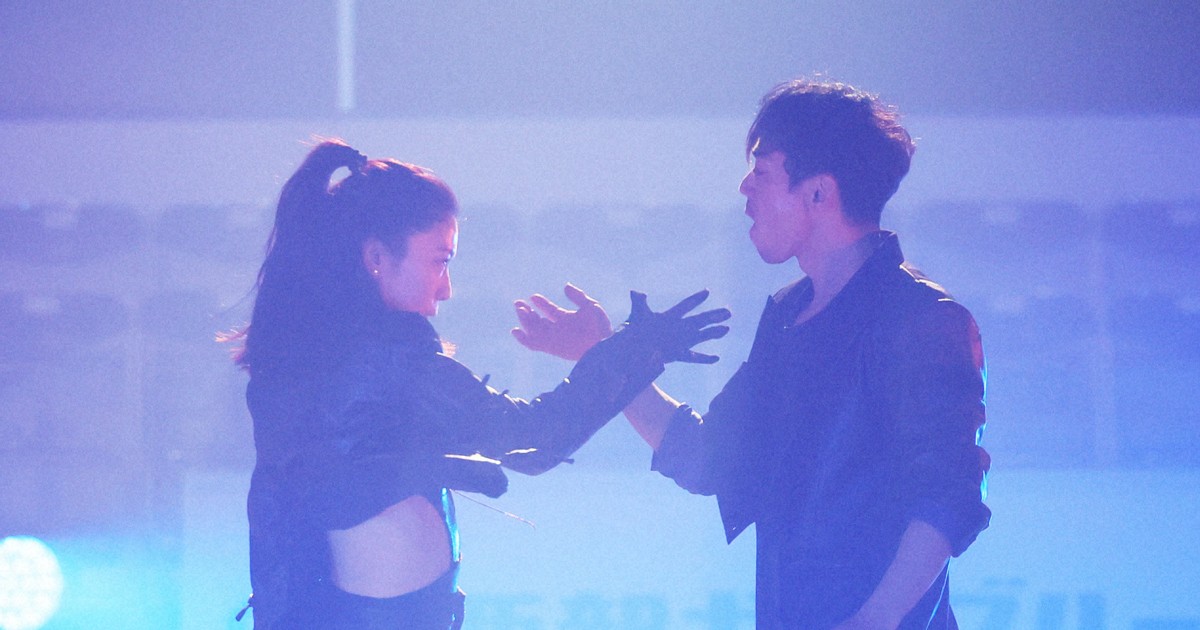
 mainichi.jp
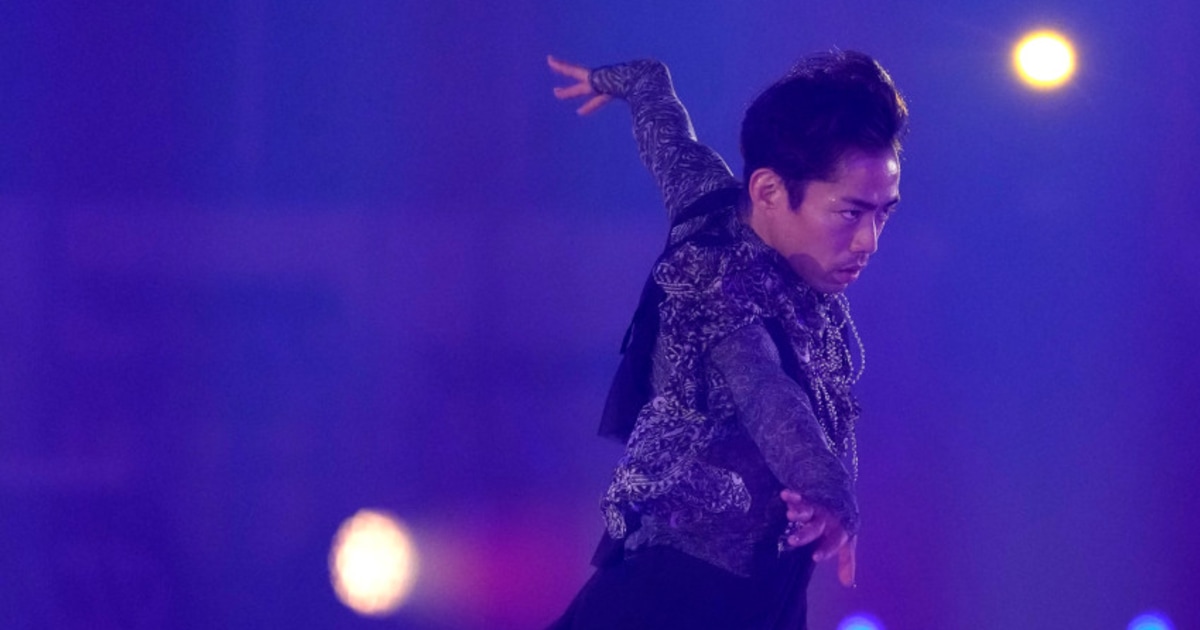
 gendai.media
(I guess Nagamitsu-sensei will be very happy about this.) From the article:
gendai.media
(I guess Nagamitsu-sensei will be very happy about this.) From the article:And Daisuke Takahashi's first solo program in five years is a flamenco choreographed by Pasquale Camerlengo. Today, he performed no jumps, but he skated so eloquently that even a single swing of his arms had a meaning. After ice dancing, the singles skater Daisuke Takahashi was back with even more power. He laughed at the press conference, saying "I don't know why I had such a hard program choreographed, and why I decided to perform it at such a difficult time."
 I wish him a speedy recovery!) - I love that it's not your obvious music choice (apart from the Habanera intro).

 www.instagram.com
Just wanted to share here something I said on Twitter. For me, Kassouya is undoubtably making figure skating feel great again.
 (Now I kinda wanna see him skate to the original version of “Flame to the moth” : https://www.youtube.com/watch?v=Gl9bjw1-O-I).
 ): https://twitter.com/ajapon1/status/1756627629070069813:
Bringing this here because it's really down to Daisuke's genius. I thought the whole use of media/social media for this show was incredibly smart - the teasers, the cool visuals, the extensive open practice reports, and then allowing fan-made pictures/clips was really the cherry on the cake.It's not about camerawork and more about the licensing rights. If they "sell" their video rights to the TV stations, the fans won't be allowed to take videos and photos. And honestly with the cast being mostly skaters with no international titles, the broadcast by the TV station will likely be limited/region-blocked and also paid.
The purpose of this show is to introduce ice shows as entertainment options to people who have never watched ice shows before especially in Fukuoka, and seeing how it's full every single show (3 shows a day), the fan videos and photos did their work in spreading the word about this ice show. But this isn't something that can be done with just one set of shows, I hope they made back enough to continue this series. It's a great platform for Japanese skaters who we don't usually see in ice shows to express themselves together like this.
In my observation, there are many people in Japan who don't watch TV every day but are active in social media, so allowing fancams and photos is a good trial run to attract new and local audience who can immediately purchase tickets (and additional tickets) when their interest is piqued.


