Eating Disorders: public or silent enemy? | Page 12 | Golden Skate

Eating Disorders: public or silent enemy?

Seriously, though, if an ice dancer is "muscular," is running laps going to produce the desired loss of muscle mass? Is it in fact desirable that athletes work on debilitating their musculature? (According to her on-line biographies, Anissina comes from a family of hockey players.)
Of course! Since these girls are somehow too strong in this sport, we'll just make them run more laps to gain strength and muscle and expect them to automatically drop 10kg because of this!

🙄🙄🙄
 
Last edited:

- post from Jimmy Morgan, former pair skater

"I am so sick of hearing people say, oh, that's not a skating body. There literally is no such thing. I've heard that line said out loud almost my entire skating career. Sometimes whispered, but sometimes said really loudly. Like there's this one specific body type that is the right way to do it and everything else is wrong. But skating isn't built on a body type. It's built by movement and awareness and creativity and a lot of time.

Your body is a skating body because it's the one that's learning and adapting and pushing and showing up every day. And it absolutely kills me
to see so many skaters start literally and figuratively shrinking themselves to fit what they think a skater should look like. Skating is supposed to be empowering, not lead you toward self erasure. So let's be clear, there is no such thing as a skating body. There are only bodies that skate, and all of them deserve to take up space on the ice.

Because our goal shouldn't be to look like a skater. It's to be one."


Debate about this issue has its own Thread on the Forum, started by @moonvine:
 
"I've been an athlete for most of my life.

I grew up in a world where being "perfect" was the goal, perfect performance, perfect body, perfect smile. And for a long time, I thought that was strength. But what people didn't see was the pressure from all around. The comments about my body, the constant weighing, the fear of not being "enough"..."


⛸️ Natalie Taschlerová opened up about her fight with Eating Disorders previous season.

Now she decided to share a part of her journey and struggles. The beginning of her post is above, the whole post and video is on her Instagram. It was difficult to read, even more difficult to listen.

She describes her troubles and illnesses which are consequences of Eating Disorders. Suffering from anorexia since 2019, she went through period loss, digestion troubles, immune dysregulation, finally RED-S syndrome (Relative Energy Deficiency in Sport).

She writes and talks about body shaming comments and comments directly recommending her to lose weight, which only triggered the situation and her lack of self-confidence.

Mentioning that many girls around her share the some struggles, not being good enough = skinny enough.

Natali also wants to support people having similar struggles.

"...To anyone who's ever felt broken, pressured, or ashamed, I see you.

You are not weak. You are not alone. You deserve to heal. You deserve to feel safe in your body again..."


Natali's post was supported by many people from figure skating world.
There are really nice words and encouragement public comments below Natali's post. For example from Gabriella Papadakis, Madison Chock and Piper Gilles, Mark Hanretty, photographer Danielle Earl and Wilma Alberti, Holly Harris, Kaitlyn Weaver, Lilah Fear, Mae-Berenice Meite and others. It worth reading. Going through those messages one realises that health both physical and mental is above all, and people writing there knows that.

Natali is one of those who fell into troubles thanks to "ideal = the skinniest body" approach in figure skating.

Not accepting skaters body type, not accepting natural maturity process...is not only about losing talented skaters, but even more importantly about creating health troubles and even life-threatening situations, which those skaters will fight for the rest of their lives.

I would wish to see more reaction from ISU. Figure skating is sport where unrealistic demands on athlete's look is helping to grow mental and physical struggles which having for longer leads to serious health damage. It is not only Gracie Gold. There are thousands of skaters dealing with this.

While I do support positive look of any page. I would like ISU to post more about these issues. More content about eating troubles, mental troubles, injuries, their prevention and cure would be appreciated. To warn others, to educate them, to share positive examples of people fighting with it, to give read flags navigation.

Body shaming comments are over the top in past few years in figure skating world (and other communities as well). Both Natali now and Olivia Smart in past mentioned that skaters are reading social medias A LOT. And shaming comments hurt them. I would appreciate ISU educational videos how skaters should handle negative comments on social nets. Because we cannot stop bad people posting shaming comments, but we can learn skaters how to handle it and NOT be mentally burned thanks to it.

Many skaters Natali including shared their stories to help others and protect them to avoid journey they had to went through. Having sport organisation behind their back would definitely help to create more safe space in figure skating.

ISU pages at Instagram and Facebook has over 430 thousands followers. Which means that their information coverage is much bigger comparing to single athletes sharing their story.

 
New year slowly comes to the end.
I wish all people to have a nice evening with many positive memories from this year.

Let next year to be full of beautiful unexpected moment, full of joy and happiness.

Let next year to bring courage and power to make our lives more healthy and happy.

⛸️
 
I was reading about how Sakamoto has been on half the daily average calorie for an average female (and she's a high level athlete), and it was causing problems for her with injury, sickness, etc.

I wouldn't have guessed it with Sakakmoto she's quite strong, so you can only imagine the lengths some (or many) skaters are going to.
 
I was reading about how Sakamoto has been on half the daily average calorie for an average female (and she's a high level athlete), and it was causing problems for her with injury, sickness, etc.

I wouldn't have guessed it with Sakakmoto she's quite strong, so you can only imagine the lengths some (or many) skaters are going to.

Yes, too low calories intake or lack of fluids are increasing the risk of injuries and diseases mental troubles including.
Do you have link on some article where Kaori mentions this?
 

Thank you for the link.
I used google translator, so please, if I made some mistakes or misunderstanding in translation, feel free to correct me.

The article mentions that Kaori Sakamoto was fighting eating troubles with keeping her body in good condition.

- Until the end of last season Kaori was keeping herself on diets, some days eating less than 1000 kcal.
- Thanks to health troubles she was not able to train for around 40 days per year.
- She started to cooperate with Ajinomoto Co., Inc company (nutrition company), company's worker Mr. Takashiba Rui was surprised she can move (skate) like this having such low calories intake.
- Mr. Takashiba explained that thanks to low calories intake Kaori's body was in energy restriction state, which led to worse immune functions and loss of concentration.
- Today Kaori is consuming around 2300 kcal per day - 3 main meals and snacks (Mr. Tahashiba suggests she could even eat more).

The informations coming from article are great. It sums up the known facts that low calories intake leads to health both physical and mental troubles. Calories intake of 2300kcal is absolutely OK for top athlete.

Once I finished translation I found out that https://fs-gossips.com/15137/ has the full translation of the article - take a look on it.
 
Since childhood skaters are hearing that bigger weight is enemy. It looks to be that there is full ignoration of the fact that child - adult evolution is about growing height and GROWING WEIGHT. Or ignoration of the fact that bigger muscles and bigger strength mean BIGGER WEIGHT.

It looks that skaters are led to hate each single kilogram they gain. To feel guilty about that.

When new season began in our local club in 2000's you could hear comments like: "Oh my lord, you grew up 1 meter." "Look, how big buttocks she has now."
Was it called puberty? No.
Was it called natural process? No.
In skating manners the second case - it was straightly because girl did nothing = laziness. In reality both girls were entering puberty only.

Are skaters led to welcome puberty like challenging BUT natural thing nowadays?

Are coaches, parents, federation patient, giving enough time to skaters to adapt to new body and mental state?
To get back to this, Laura Lepistö described something similar in her memoirs: once (while still a teenager) she overheard two coaches talking about unnamed former prodigy along the lines "oh, she was so good before she got t*** and a**."

As Laura was quite petite, she didn't have to worry as much about her eating as some of her training mates, but it was still an issue. When she retired, she kept her strict regime simply because she didn't know anything else, and when she tried to get pregnant, she couldn't. She had to teach herself to eat more, to get her body to return to more natural state.

From another sport, comes to mind biathlete Gabriela Soukalova. She had perfectly normal bodybuild (not 'heavy' by any skiing standard), but some of her competitors were very slender. So her junior era coach decided that her weight was a problem, and recipe for winning was to thin down. Apparently her coach put her in front of a mirror and told her "Look at how terrible you look". This led to eating disorder, which came to light when an x-ray revealed she had swallowed a spoon.
 
It's a shame that Kamila Valieva's international career was short-circuited. When she burst on the scene at 14 she was a slim girl (on a ball), but by the time of the 2022 Olympics she was not a stick figure that made us think, "give that poor little waif a hamburger right quick."

It would have been -- and still may be -- healthy advertising for the sport to see her dominate the "skinnier the better" crowd.
 
To get back to this, Laura Lepistö described something similar in her memoirs: once (while still a teenager) she overheard two coaches talking about unnamed former prodigy along the lines "oh, she was so good before she got t*** and a**."

As Laura was quite petite, she didn't have to worry as much about her eating as some of her training mates, but it was still an issue. When she retired, she kept her strict regime simply because she didn't know anything else, and when she tried to get pregnant, she couldn't. She had to teach herself to eat more, to get her body to return to more natural state.

From another sport, comes to mind biathlete Gabriela Soukalova. She had perfectly normal bodybuild (not 'heavy' by any skiing standard), but some of her competitors were very slender. So her junior era coach decided that her weight was a problem, and recipe for winning was to thin down. Apparently her coach put her in front of a mirror and told her "Look at how terrible you look". This led to eating disorder, which came to light when an x-ray revealed she had swallowed a spoon.

Thanks for mention. I hope Laura's book will be translated into English one day.

Recently I read Kiira Korpi's book. Kiira mentions she and Laura were good friends. She also mentions Laura used to bring candy at competitions in early years. But later (Worlds 2008) Kiira mentioned that Laura's behaviour towards eating changed in a wrong way too.

Kiira herself was fighting eating troubles.

The reminder about young girls with prepubertal or early pubertal body who are jumping with ease is something which I hope will dissapear in future. Senior cathegory shouldn't be about girls with child body. And skaters shouldn't be attacked for not having child's body.

I really like interview with Karine Arribert, who trains for example Loicia Demougeot & Theo Le Mercier and Celina Fradji & Jean-Hans Fourneaux.

https://anythinggoe.com/karine-arribert/
- article from December 2025

"Arribert’s passion for her work also comes through when she speaks about mental health and the role of coach in supporting athletes with all body types. She brought up Natalie Taschlerova’s post on Instagram about her struggles with eating disorder and the impact of judgemental comments about her body.

“It hurts me so much,” Arribert shared. She has seen how comments on the internet have impacted her skaters, and believes the problem of body shaming goes deep into the culture of the sport. She remembers seeing a fan at Skate America in 2022 call Kaitlin Hawayak over to her to say horrible things about her appearance, and she praised Kaitlyn for speaking out.

Arribert has also evolved her views on the topic. In the past, Arribert used to sometimes tell her female skaters that they needed to lose weight. However, she was told by a medical director that those comments would hurt her skaters. “You can’t talk about this with skaters, because after, they believe that you just see that. We are six hours a day with them, and if we talk about this, it becomes a problem. So now I [tell my skaters], ‘You are exactly as you are. My job is, you have to do your lift, your spin, and have your levels be good…and I’m going to train you exactly as you are.’”

She believes the burden is on the coach to find a way to work with different body types, even though it can be challenging with some elements.

For example, Loïcia and Théo don’t have a big difference in size. “She said to me, ‘Oh, la, la, I have to lose weight,’
and I said, in the summer, ‘Loïcia, you are exactly as you are. I have to be a better coach, to find a solution, with you as you are.’ So we have to find solutions with each body…we chose to do the same lift for two years because this is a beautiful lift, and they are comfortable.”

“Coaches, we are between judges and the Federation and the athletes…Everyone in ice skating has to change. Because a lot of judges said to us, she has to lose weight, a lot of people from the federation said it. [I said], “No, I don’t want to listen to this, just stop. We can talk about… the program, the skating, but I don’t want to understand that you have to lose weight. I disagree.’ But it’s a fight with the judges. I need to fight with the federation.”

She also sees how the demand for perfection impacts skaters mentally.

“When training a child for skating, they can be not-perfect. They can have mistakes. They just have to want to work, and improve, and be athletes, by themselves. They have to choose: ‘I want to be an athlete,’ by themselves. But at the high level, it’s really difficult. They have to be good every time. And after, when they come back to real life, that is why I think it is difficult for them. To not be under the lights, to be a normal person, to have no goal. My daughter skated…and when she stopped she said to me, ‘it’s so difficult [because] each day we have a goal, to be better and better and better…and in real life, we have no goal. We have to find our own goal.’”

She emphasizes the importance of having other things in life beyond skating.

“It is obligatory. If you don’t have this, you can’t come to skate in my school. They have to have something, when the training is not good, they have to come back to the house, and then to have something to get out the bad [mindset]. 
It’s really a problem. There are a lot of young people that are not with the family. I am a mother, and when my son and my daughter come home after school, we can talk, okay? But when they are alone, if they have no other project, they stay in the black ideas….We are really close to Grenoble, there is a university, and all the high level skaters go to school.”

-------


This is great interview. I appreciate Karine Arribert's approach and understanding for the situation.
 
It's a shame that Kamila Valieva's international career was short-circuited. When she burst on the scene at 14 she was a slim girl (on a ball), but by the time of the 2022 Olympics she was not a stick figure that made us think, "give that poor little waif a hamburger right quick."

It would have been -- and still may be -- healthy advertising for the sport to see her dominate the "skinnier the better" crowd.

On this Saturday and Sunday both Kamila and Sasha Trusova will participate at Russian National Jumping Championships. They both plan to come back to competitions again. This competition has specific rules and they are not training seriously for long, but if you want to see them, you can.

 
Thanks for mention. I hope Laura's book will be translated into English one day.
Laura's book is more introversive than Kiira's, she spends plenty of pages in self-reflection. Also obviously her career on the top was shorter, so she has less juicy stories to tell. Still interesting, covering same period from slightly different perspective: she also talks about downfall of her training mate Jenni Vähämaa, who was hailed as next big thing, but burned out just as she was breaking into senior level.
 
2 months back Czech ice dancer Natalie Taschlerova was a guest in Marketa Gajdosova's podcast.

Marketa Gajdosova is Clinical Nutritive therapist from Czech Republic, who studied Nutrition / Clinical nutrition program at both Universities in Boston and Miami. She won Nutritional Therapist of the year 2025 award.

The podcast is available at YouTube Channel, Mrs. Gajdosova was so kind and confirmed that English subtitles setting is active.

Natalie is speaking about her eating health troubles especially since 40 minute.


Here are few things Natalie mentioned:
(For translation I used Google translator combined with my not ideal English knowledge, English subtitles on YouTube could be a little bit different).

To why did Natalie publish the video describing her troubles:
"....The main idea was to finally relax / unwind myself and stop pretending something that wasn't really happening and closing my eyes to it and also to help a lot of the girls around me and actually just those who watch me...in figure skating, 90% of the girls have a problem with this and anorexia, bulimia, then extreme overeating...I didn't want to be quiet anymore and I wanted to hit back a little at those insulting comments that were already unbearable. a
And I didn't want to be quiet anymore because I know what I'm dealing with every day now. And every day is a small victory for me to get from morning to night..."


To how Natalie's eating troubles started:
"...It all started when I was 16.... So the coach came up with the idea that I should start losing weight, just to be prepared for the senior career that was coming and that I actually looked good, but if I could lose a little weight, it would be better. That's when I actually went to a nutritionist for the first time.... And that's when the control of eating started, thinking about what I should eat and what I shouldn't eat.

...And then being 17, when we moved to America, actually at the age of 17 I started to mature, because I have to add that I was quite a late child in terms of development and menstruation... So it was like there started to be a weight problem that was highlighted very often and because there were older girls around me already dealing with such weight problems, I thought that this was normal here...

...And then when my dad died, I actually lost a lot of weight in a week and then of course I started overeating to deal with my unhappiness, so the weight came up and then actually in the winter of 2019 I had severe anorexia for the first time. It was probably connected to the depression, the cold, being lost, not knowing what to do with life, but also the fact that I knew that this was like a path to skating, that I would fit in... No one noticed, everyone was happy that I had lost weight and it was OK.

...I wanted to be the perfect one, so perfect, beautiful, skinny and good at everything, so from then on it started to escalate a lot..."


To wrong diet regime:
"...We also had a weekly weigh-in, so we actually developed different theories and tried different things with the girls, that on Sunday, Monday, Tuesday we didn't eat almost at all, Wednesday morning was the weigh-in, so we didn't eat until Wednesday morning and then of course the rest of Wednesday, Thursday, Friday, Saturday we ate and of course more, because we were really hungry...so the body was already suffering there..."

To when the break point was and Naty realised that something is wrong:
"...Probably when I found out that I had an autoimmune thyroid disease, before that there was an approach that it was normal, that it was just skating, everyone around me had it that way and it seemed normal to me that no one was solving it any way..."

To whether Naty heard some advices from skating community which she now sees were wrong:
"...for those five years, I had a lot of different nutritional "assistants", that's what I would call it, not nutritional professionals. And I actually tried a lot of diets - protein diet... apple diet... egg diet... and keto diet...powder diet... And of course no sacharides...as to milk products - only sometimes and fat-free to have the lowest possible calories intake...And I think the worst thing is when you start eliminating all those foods that the body ultimately needs..."
 
Thank you for the link.
I used google translator, so please, if I made some mistakes or misunderstanding in translation, feel free to correct me.

The article mentions that Kaori Sakamoto was fighting eating troubles with keeping her body in good condition.

- Until the end of last season Kaori was keeping herself on diets, some days eating less than 1000 kcal.
- Thanks to health troubles she was not able to train for around 40 days per year.
- She started to cooperate with Ajinomoto Co., Inc company (nutrition company), company's worker Mr. Takashiba Rui was surprised she can move (skate) like this having such low calories intake.
- Mr. Takashiba explained that thanks to low calories intake Kaori's body was in energy restriction state, which led to worse immune functions and loss of concentration.
- Today Kaori is consuming around 2300 kcal per day - 3 main meals and snacks (Mr. Tahashiba suggests she could even eat more).

The informations coming from article are great. It sums up the known facts that low calories intake leads to health both physical and mental troubles. Calories intake of 2300kcal is absolutely OK for top athlete.

Once I finished translation I found out that https://fs-gossips.com/15137/ has the full translation of the article - take a look on it.
Thank you for a very interesting story. When I first saw Kaori this season I remarked to my wife that she really wants to do well as I havent seen her this thin in awhile. Standing next to her in an elevator, it is evident to me that the camera adds weight, but the diff between this season and the last is quite evident. The physics are beyond despute. Take off 5 lbs and extreame skating becomes easier. Kaori doesnt have an eating disorder IMHO. She had a desire to win big this season. But the health issues are real of low caloric/not so nutricious food intake. My wife is an athletee and eats way more than I do but her metabolic rate is so high that she burns it off. A good team nutricianist is important. IMHO. They can measure your metabolic rate. Everyone is an individual. I think Mr. Tahashiba is correct. (I just got off a cruise ship for 11 days. I put on 5 lbs. I walk the deck alot but eat too much of rich, caloric food. I came home at 169 Saturday..I am now at 166. I will be back at 164 by next Sunday as I am eating right and walking 6-10 miles a day working on my ranch. My flight log from college says I was 160 in 1969 but I had a bit more muscle.
I hope Kaori keeps up her activity for her own health. Many Japanese skaters like Fumie Suguri look and feel great over the years.
You wanna see eating disorders? Go on a cruise ....I will spare you the pics.
My Spare tire growing...now disappearing

Kaori a few years ago in great shape for the woman she was back then. Time changes shape
 
Last edited:
Thank you for a very interesting story. When I first saw Kaori this season I remarked to my wife that she really wants to do well as I havent seen her this thin in awhile. Standing next to her in an elevator, it is evident to me that the camera adds weight, but the diff between this season and the last is quite evident. The physics are beyond despute. Take off 5 lbs and extreame skating becomes easier. Kaori doesnt have an eating disorder IMHO. She had a desire to win big this season. But the health issues are real of low caloric/not so nutricious food intake. My wife is an athletee and eats way more than I do but her metabolic rate is so high that she burns it off. A good team nutricianist is important. IMHO. They can measure your metabolic rate. Everyone is an individual. I think Mr. Tahashiba is correct. (I just got off a cruise ship for 11 days. I put on 5 lbs. I walk the deck alot but eat too much of rich, caloric food. I came home at 169 Saturday..I am now at 166. I will be back at 164 by next Sunday as I am eating right and walking 6-10 miles a day working on my ranch. My flight log from college says I was 160 in 1969 but I had a bit more muscle.
I hope Kaori keeps up her activity for her own health. Many Japanese skaters like Fumie Suguri look and feel great over the years.
You wanna see eating disorders? Go on a cruise ....I will spare you the pics.
BTW, Some Cruise ship employees have access to the gym. Piano player is not Zack Donahue)
 
Thank you for a very interesting story. ...

Interesting notes @CoyoteChris . Thank you.

Kaori had negative attitude towards food in past in my opinion. As it looks to me she had typical skating approach - food is an enemy. But she changed this, most probably thanks to her cooperation with nutritionist.

There is few months old article where Kaori Sakamoto and nutritionist Rui Takashiba (not sure with the translation - she is the director of Ajinomoto Co., Inc.) describe a lot about Kaori's attitude towards food - in past and today.
https://story.ajinomoto.co.jp/report/199.html
(using online translator)
Those two first met in March 2025.

- Kaori: "Yes, I was quite concerned about it (food). During high school and in the early college years, "weight loss" meant "not eating" for me. I would reduce or skip meals to lose weight..."

- Kaori: "Perhaps because of that, my immunity has decreased... I got colds, fevers, flu, COVID-19, and gastroenteritis... I also got gastroenteritis during the Pyeongchang 2018 Winter Olympics and the Beijing 2022 Olympics."

- Kaori: "For about three years now, I've been consistently unwell. When I collapsed physically, my muscle strength and stamina declined, and I had to start training again from scratch, getting my body back to its normal state. This process of going from negative to zero was a waste of time, and it's been challenging for me for the past few years."

- Mr. Takashiba: "...I had the impression that her body was extremely "energy-saving" (= "starvation mode"). My initial impression after speaking with her was that she was so focused on how to do as much as possible with minimal energy that she was constantly experiencing poor health and fatigue."

- Mr. Takashiba: "Sakamoto wasn't consuming enough energy, almost like a high school girl on a diet. So, first I told her to eat, and if she loves white rice, then eat plenty of it. Another challenge was figuring out how to easily incorporate vegetables and warm food into her diet."

- Kaori: " Yes. After practice, I was often so tired that I would go to sleep without eating dinner."

- Mr. Takashiba: "There were two stages to our approach. First, we had to figure out how to change Sakamoto's negative thinking about energy intake. The goal was to give her the reassurance that it was okay to eat. Then, as the next step, we were figuring out how to incorporate a diet that builds muscles..."

- Kaori: " I was very convinced. Up until now, I thought "weight loss" meant "not eating," so I couldn't understand at all at first the idea of "eating and burning (losing weight)." But as I listened to Mr. Takashiba's explanation, it clicked for me: "Ah, you need fuel to make it easier to burn..."

--------------------------

There are things I would like to mention.
1. Kaori had to switch completely her mental approach towards food - to learn that food is not enemy, but friend who can help towards strong performances. Getting from "less food = smaller weight" way of thinking to "eating ideal amount of ideal food = having ideal weight".

2. Body keeping "energy-saving" = "starvation mode".
https://www.morelandobgyn.com/blog/i-eat-healthy-why-am-i-gaining-weight
- "You Might Be Eating Too Little ...This phenomenon is called “starvation mode,” and while your body isn’t actually starving, it will naturally hold onto whatever calories it receives in an effort to help you maintain your energy balance. Eating too little can also cause you to get so hungry that you stray from your planned, healthy meals and snacks, or eat foods that aren’t ideal for weight loss..."

This "starvation mode" is not healthy and is no way leading to maintaining ideal weight (which is individual for every skater). Many skaters in puberty describe eating almost nothing, but not being able to lose or keep weight...the answer is not only in puberty and growing and maturing body with hormonal changes... but also thanks to starving their body goes to "energy saving = starvation mode".
This explains why Kaori was thinner when you met her, @Cyote - before this season she started to eat well and despite bigger calories intake, she got her body into better shape and feeling much better both mentally and physically.

3. Regular eating. Kaori mentions that she sometimes missed food thanks to tiredness.
To persuade body that "starvation mode" doesn't need to be activated, person needs to eat regularly.

---------------------------

I am glad Kaori was successful with changes in her nutrition, I am persuaded it played big role in her this season's success. It also helped her to feel better both on and off the ice, that is always nice to hear.
I also hope that she will continue with this healthy approach in her post-retirement life as a coach. And also...that she will teach this healthy approach her students!
 
Interesting notes @CoyoteChris . Thank you.

Kaori had negative attitude towards food in past in my opinion. As it looks to me she had typical skating approach - food is an enemy. But she changed this, most probably thanks to her cooperation with nutritionist.

There is few months old article where Kaori Sakamoto and nutritionist Rui Takashiba (not sure with the translation - she is the director of Ajinomoto Co., Inc.) describe a lot about Kaori's attitude towards food - in past and today.
https://story.ajinomoto.co.jp/report/199.html
(using online translator)
Those two first met in March 2025.

- Kaori: "Yes, I was quite concerned about it (food). During high school and in the early college years, "weight loss" meant "not eating" for me. I would reduce or skip meals to lose weight..."

- Kaori: "Perhaps because of that, my immunity has decreased... I got colds, fevers, flu, COVID-19, and gastroenteritis... I also got gastroenteritis during the Pyeongchang 2018 Winter Olympics and the Beijing 2022 Olympics."

- Kaori: "For about three years now, I've been consistently unwell. When I collapsed physically, my muscle strength and stamina declined, and I had to start training again from scratch, getting my body back to its normal state. This process of going from negative to zero was a waste of time, and it's been challenging for me for the past few years."

- Mr. Takashiba: "...I had the impression that her body was extremely "energy-saving" (= "starvation mode"). My initial impression after speaking with her was that she was so focused on how to do as much as possible with minimal energy that she was constantly experiencing poor health and fatigue."

- Mr. Takashiba: "Sakamoto wasn't consuming enough energy, almost like a high school girl on a diet. So, first I told her to eat, and if she loves white rice, then eat plenty of it. Another challenge was figuring out how to easily incorporate vegetables and warm food into her diet."

- Kaori: " Yes. After practice, I was often so tired that I would go to sleep without eating dinner."

- Mr. Takashiba: "There were two stages to our approach. First, we had to figure out how to change Sakamoto's negative thinking about energy intake. The goal was to give her the reassurance that it was okay to eat. Then, as the next step, we were figuring out how to incorporate a diet that builds muscles..."

- Kaori: " I was very convinced. Up until now, I thought "weight loss" meant "not eating," so I couldn't understand at all at first the idea of "eating and burning (losing weight)." But as I listened to Mr. Takashiba's explanation, it clicked for me: "Ah, you need fuel to make it easier to burn..."

--------------------------

There are things I would like to mention.
1. Kaori had to switch completely her mental approach towards food - to learn that food is not enemy, but friend who can help towards strong performances. Getting from "less food = smaller weight" way of thinking to "eating ideal amount of ideal food = having ideal weight".

2. Body keeping "energy-saving" = "starvation mode".
https://www.morelandobgyn.com/blog/i-eat-healthy-why-am-i-gaining-weight
- "You Might Be Eating Too Little ...This phenomenon is called “starvation mode,” and while your body isn’t actually starving, it will naturally hold onto whatever calories it receives in an effort to help you maintain your energy balance. Eating too little can also cause you to get so hungry that you stray from your planned, healthy meals and snacks, or eat foods that aren’t ideal for weight loss..."

This "starvation mode" is not healthy and is no way leading to maintaining ideal weight (which is individual for every skater). Many skaters in puberty describe eating almost nothing, but not being able to lose or keep weight...the answer is not only in puberty and growing and maturing body with hormonal changes... but also thanks to starving their body goes to "energy saving = starvation mode".
This explains why Kaori was thinner when you met her, @Cyote - before this season she started to eat well and despite bigger calories intake, she got her body into better shape and feeling much better both mentally and physically.

3. Regular eating. Kaori mentions that she sometimes missed food thanks to tiredness.
To persuade body that "starvation mode" doesn't need to be activated, person needs to eat regularly.

---------------------------

I am glad Kaori was successful with changes in her nutrition, I am persuaded it played big role in her this season's success. It also helped her to feel better both on and off the ice, that is always nice to hear.
I also hope that she will continue with this healthy approach in her post-retirement life as a coach. And also...that she will teach this healthy approach her students!
Thank you for the insite. Very interesting. Much truth there. She is not alone and I have to, in the US, blame our society for its effects here. We were never taught
the truth about nutrician in our schools. Indeed, there is still much to learn.
1. Food is not the enemy. In fact, skipping lunch makes the metabolic rate slow down for the rest of the day. I am guilty of this myself due to time constraints.
2. Good dieticians/nutricianists are hard to find and my wife's insurance company wont even pay for them. Foods effect a whole lot of our body's chemistry and health and this has been accepted by many forward thinking organizations for decades but not by mainstream organizations, unfortunately.
3. You still see trendy diets like the paleo or mediteranian diet...these are designed to make money, not healthy people. Not saying there are not good things in them...but they are not the whole truth. We are taught that the "secret" to being healthy is a new pill...gag vomit.
4. When I stood next to Kaori years ago in the elevator in Vegas, cruel people were calling Japanese skaters "chunky". I still think the camera adds five lbs but there was nothing wrong in my eyes with her way back then.
I am so happy she is learning the truth...it is a sign of intellegence. Any country that starves its skaters and keeps them out of puberty is not my friend.
So Happy for skaters that have been taught the truth....the education should be required. Way to go, Fumie.
 

- article from April 23, 2026
You will like it, @CoyoteChris . :)

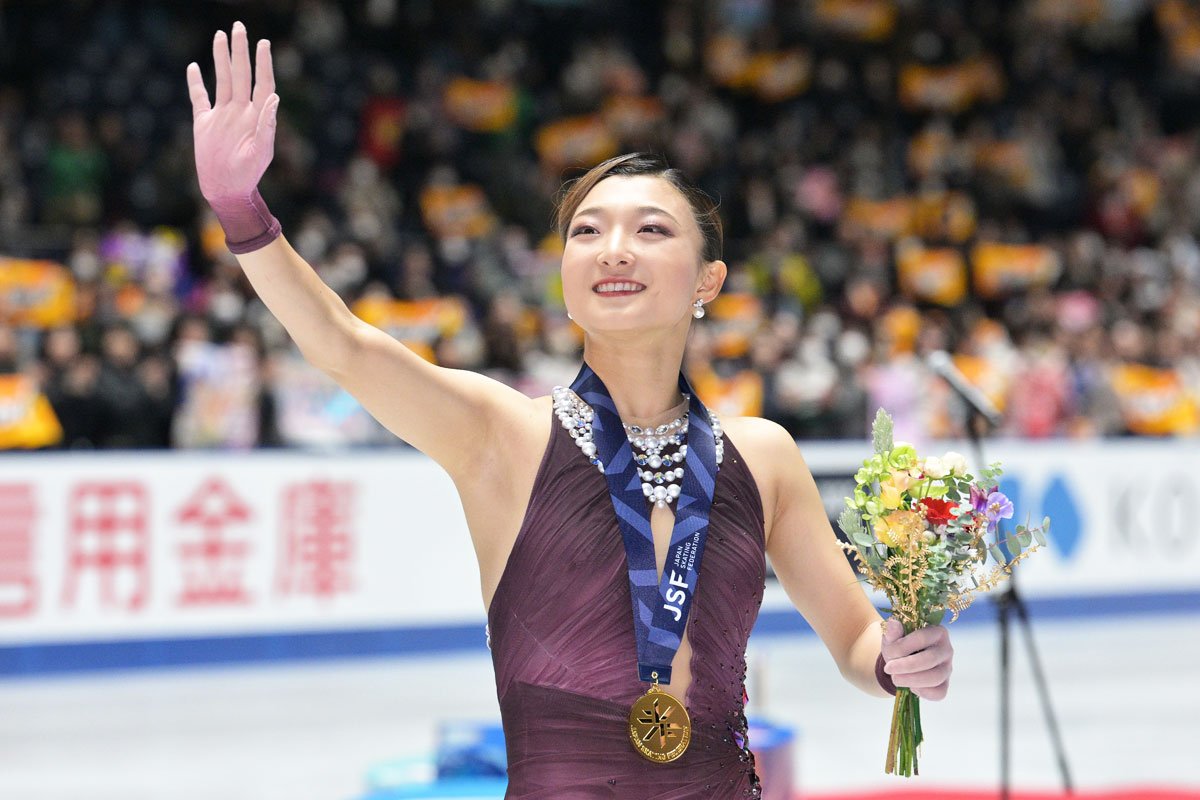
Kaori Sakamoto mentions that right nutrition is improving her conditions - so she is less ill, have more energy - which translates into more efficient practise. It is also more protective for skaters, as poor nutrition lowers immune systeme, so athletes are more prone to any kind of infection.


- "...Last season, I had 40 days of poor health, but this season I only got sick once. I was able to work hard every day with energy. This change in diet has saved me."

- She mentioned that she had been taken to the hospital by ambulance due to gastroenteritis during the previous two Olympics, but for this tournament (Olympics 2026) she made sure to avoid nutritional deficiencies by eating plenty of vegetables in hot pot dishes.

- Many female skaters find weight restrictions difficult in the figure skating world, but she intends to pass on her experience from her final year as a skater to her students. "Eating is not bad at all. By eating properly, building strength, and practicing diligently, your metabolism will improve, and the efficiency of your training will increase dramatically. I hope to use my experience to pass it on to the younger generation," she said..."
 
Here's an article from Japan Forward talking to RikuRyu and their long-time nutritionists revealing how you feed a pair to grab so many golds, including an individual Olympic gold. Very interesting and inspiring, especially that - how they note - each of a pair team member's role on the ice is very different - one does the lifting,the other one is being lifted - so also their diets must be different and focused on different aspects.
Anyway, they stress the need of 3 full meals a day and some supplementary snacks of dairy and fruit in between.

A similar advice came famously from Yuzuru's nutritionist working for the same company as the one of Kaori,

It seems they all used similar methods to analyse and advise, all working for specialized Japanese food companies with special atllete-support divisions, all analysing lots of daily data from training, and differentiating between daily and competition nutritional routines.

All athletes - Yuzuru, Kaori and RikuRyu - admitted to have benefited greatly from specialized nutritional support.

Having quite a few of their Olympic and World gold medallists cared for and catered to by nutrition specialists on the long-term and regular basis - does it make Japan a leader in the field of healthy eating FS champions? :clap:

Here's the article and some photos - in English!!!


https://japan-forward.com/what-fueled-rikuryu-to-olympic-gold-a-sports-nutritionist-explains/
 
Last edited:
Back
Top