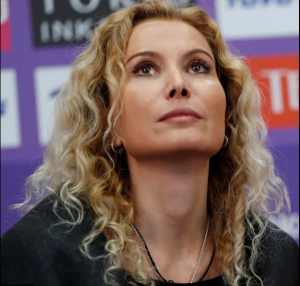
A short interview with Eteri:
translation:
What was the most important thing from all what your parents teached you?
Probably, it was the understanding that everything valuable requires hard work - that's why it is valued.
Rate your hardness as a coach on a scale of 1 to 10.
I do not consider our team or our methods to be hard, much less cruel. Therefore, I will probably rate it 3 out of 10. Because our system is more of a recommendation. The experience we have accumulated allows us to see what tasks need to be given and what plans need to be made. Any athlete has the right either once or systematically to refuse to complete the task. Well, the result - fortunately or unfortunately - is clearly visible to everyone.
10 - this is probably the case when the coach insists on completing his tasks. We do not insist. We come, give tasks - and then the athlete decides for himself. We have seven athletes on the ice at the same time. Of these, three are doing tasks, and four are just skate around in circles - simply because they don't feel in the right mood. And if an athlete does this in one training session, then there is nothing wrong with that. But if it becomes a system, then it won't work.
Do you have friendly relations with students?
No. No. I always keep my distance. If a student wants to talk to me, tell me about some of his secrets, then I will be happy to meet halfway, but I will still remain at a certain distance.
What do you think about at the end of the working day?
I'm thinking about how I can remember to take both of my dogs with me. I also think about how I can get home as soon as possible.
What superpower would you like to have?
Healing. That would be great. I mean the restoration of people's physical health. I thought about that. To get rid a people of diseases. To save lifes.
How has life in a patriarchal Caucasian family influenced your character?
My parents were very hardworking and patient. And I think that I got about 30% of their ability to work and patience from them. But I'm not nearly as productive as my dad or my mom. It seems to me that they never slept at all, they did everything for us.
What do you think your father would say if he saw what his daughter had achieved?
I think he would cry. They would be tears of joy and proudness, but perhaps also tears of pain. Pain caused by injustice to us. Well, it seems to us that the public is not always fair to us. We work, we work, but as a result there is so much criticism!
Is such a feeling as pride [hubris] dangerous for an athlete?
If we are talking about “star disease”, about testing with copper pipes, then I think that this has a devastating effect. Not only for athletes, but also for coaches, because because of this, a person stops developing, stops looking for flaws in himself. Self-esteem is something else. I probably have that feeling too. But if pride is in sports... What is pride in sports, pride in an athlete? Reluctance to socialize with peers? I think it shouldn't be. You can't think of yourself as the best. You just need to go out and perform, show what the athlete has worked on, and if this brings him to the highest step of the podium, that's great.
If an athlete has worked hard, then he is confident in himself. The feeling of confidence comes because he knows that he has already performed this program many times, and all that is now necessary is ... [perform one more time]. Good preparation gives a sense of self-confidence, and that's good, but it's not pride. An athlete needs to have confidence in himself, and this feeling is usually developed through the training process.
But it not hubris. Yuzuru Hanyu, when he was one of the best athletes, never had hubris. He communicated with everyone on an equal footing and respectfully bowed to any athlete if he liked how any element was performed during training. This is not hubris, this is sport, everyone is equal here.
What advice would you like to give to the current young generation?
I would advise them to learn how to set themselves both "micro" goals and "macro" goals. Let it be a goal for today, or a goal for a year ahead, or a goal for ten years ahead. And also I [would like to advise them] to value their own time, so that later they don’t feel pain for the senseless lived years.
The “micro” goal is the goal for today's training. I have to do the best that I can today. For example, to perform sequentially all those elements that I am capable of. Let's say the coach gave the task to skate a short program, which means that I need to do it, albeit with errors. You need to put in it all your strength. Even if today something does not work out, then these efforts will bear fruit tomorrow. And if you didn’t finish today, didn’t finish tomorrow, if there are no goals, if you come to training aimlessly - this is very bad.
And, unfortunately, representatives of the younger generation very often live without any goal. Sometimes I ask them: “What do you want to achieve”, and they cannot answer this question. They look down and say, "I want to be a great figure skater." What is it, how is it? What is a “great skater” and what does the little child standing in front of me have to do with it?
If you could live a day in your life a second time, which day would you choose?
Definitely, it would be one of those days that I spent together with my daughter and with my parents, with dad and mom, so that we could be together again all day. I would just like to live such a day, hold their hands, see their eyes, sit next to them. I don't need anything else, just this. It's just that feeling when everyone is at home.
I really scold myself for the fact that there were such moments: the training day was ending, I was very tired, and I still need strength to just get home - and Diana says to me: “Mom, let's go to grandfather” - and I understand that after I get there, stay there, return to my place, I will not have any strength at all. And so I put it off until tomorrow or the day after tomorrow, but then the day comes when there is no tomorrow.
If you, with your current experience, could give advice to your past self, what would you say to yourself?
I would advise myself to pay more attention to my parents, pamper them. Really pamper, fulfill all their desires. I would say: "You yourself will need this in the future." And as an athlete, I would advise myself to stay in sports until the last day, while there is still strength and opportunity. There is no need to finish, because the feeling of unfulfillment then remains for life. I would just suggest to myself the various technical aspects that I came to understand. It took me decades. In any case, each path takes time. I don't believe in fast becoming.
How would you describe yourself?
I think I'm completely anti-social. I don't like society. I don't like to be in a crowd, it consumes a lot of my energy and I get very tired.
Talent or hard work - which is more important to you?
Talent only gives a person a certain head start, an advantage over other athletes, or over ordinary people in a certain field of activity. Diligence develops talent, and any talent perishes without work. Talent without hard work is nothing.
What advice would you give to very small, young athletes who are starting their journey in figure skating?
They must understand that everything they do, they do for themselves. And if they didn’t complete something today, or evaded the task, then perhaps tomorrow same thing this will need for them.
Where do you draw inspiration from difficult times in life?
At work. So you come to work and here again you need to remember about “micro” goals. Here your athlete has learned something, you see the fruits of your labor - this is the motivation for work. Let these be small goals, but today they are small, and then they will become big.
What character traits, in your opinion, are important for a skater?
Demanding to oneself, respect for others and love for one's work.
What inspires you to create new programs?
Life. Some life situations, the path traveled. You see every day how something happens and you want to share your feelings through the program, through the choreography, through the music. It's great that sometimes we get it.