Archive of newspaper articles | Page 9 | Golden Skate

Archive of newspaper articles

Figure Skating

(the article published in russian 'Sovetskiy Sport' on January 15, 1983)
1983
GDR NATIONAL CHAMPIONSHIPS


BERLIN. The 17-year-old schoolgirl from Karl-Marx-Stadt, Katarina Witt, has won the title of the strongest skater again (for the third time in a row) at the GDR Figure Skating Championships that ended here. The winner of silver medals at the European and World Championships was the best in all three events and is apparently ready to fight for the top spot at the main competitions of the current season. Second place went to Janina Wirth, third to Karin Hendschke.
In the pairs competition, the best were, "according to tradition", last year's European and world champions Sabine Baess and Tassilo Thierbach. However, this time they faced serious competition from Birgit Lorenz and Knut Schubert, who took second place. Bronze medals went to the participants of the tournament for the prizes of the newspaper "Moscow News"-82, Babette Preussler and Torsten Olow.
As expected, Falko Kirsten won the men's competition, with Nils Koepp and Alexander Koenig in second and third place, respectively.​

1983
FRG NATIONAL CHAMPIONSHIPS


BONN. European champion and world singles silver medalist Norbert Schramm, who many figure skating experts consider the main favorite he current international season, was unable, however, to win the FRG championship in Oberstdorf.
Schramm had three falls in the free skate, including a triple loop and a triple toe loop. He ended up second, with Heiko Fischer winning. Rudy Cerne came in third.
Claudia Leistner, the strongest figure skater in Germany according to the results of last season (fourth place at the world championship), also came in second at the national championship. She lost to Manuela Ruben.
The ice dance duo Petra Born and Rainer Schönborn demonstrated an increased level of skill, receiving five 5.9 points for the free dance.
The German championships were the final test of strength for the hosts of the European Championships, which will be held in Dortmund from January 31 to February 5.
1755848423795.jpeg
 
1983
EUROPEAN CHAMPIONSHIPS
FIGURE SKATING


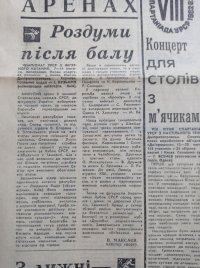
ON ICE BALL

(the article published in Ukrainian 'Sportyvna Hazeta' on January 29, 1983)

ON JANUARY 26, the Soviet figure skaters' team left for the European Championships in Dortmund (Germany). On January 31, the men's competition will begin in the morning, and the pairs' competition will begin in the evening. By decision of the coaching council, the honor of competing at the European Championships was given to Alexander Fadeev and Vladimir Kotin (men's single skating), in pair skating - to experienced national champions Marina Pestova and Stanislav Leonovich, silver medalists Veronica Pershina and Marat Akbarov, and debutants, bronze medalists of the national championship Marina Avstriyskaya - Yuri Kvashnin.
On February 1, the leader of our women's single skating, the bronze medalist of last year's European Championship, Elena Vodorezova, as well as two Annas - Kondrashova and Antonova, will take to the ice of the Westfalenhalle Sports Palace. Kondrashova will be performing at such representative competitions for the first time.
On February 2, representatives of ice dance will join the competition. Here, along with silver medalists of the European and world championships Natalia Bestemianova and Andriy Bukin, as well as Olga Volozhinskaya and Alexander Svinin, debutants Marina Klimova and Sergey Ponomarenko will start, whom the coaches selected among other talented ice dance couples.
The European champions will be announced: among pairs - February 2, men - February 3, ladies - February 4, and among ice dance couples - February 5.
1755924638659.jpeg
 
1983
EUROPEAN CHAMPIONSHIPS

Our special correspondent Anatoly SHELUKHIN reports from Germany

THERE ARE NO EXTRAS IN THE STAR FESTIVAL

(the article published in russian 'Sovetskiy Sport' on February 1, 1983)

On the day before the opening of the European Figure Skating Championships, a real thunderstorm rumbled over Dortmund: pouring rain, thunder rumbled, and in the evening wet snow began to fall in flakes. Miracles, and nothing more – what sudden changes in one day!
And for those who came to Dortmund for the Ice Stars Festival, news poured out like a horn of plenty. The first surprises came from the USSR team. When our athletes got off the plane at Dusseldorf airport, the organizers were completely amazed, not understanding who they were meeting... Seven unfamiliar masters got off the plane at once. The fact is that the 1983 team did not include former European champion I. Bobrin, nor former world champions Irina Moiseyeva and Andrei Minenkov, nor the silver pair from last year's world championship, Marina Pestova and Stanislav Leonovich. All of them are absent for various reasons: Bobrin is not in the best athletic shape, ice dancers Moiseyeva - Minenkov (they are called "Mo" and "Mi" abroad) did not compete anywhere this year due to illness. Finally, national champions Pestova and Leonovich planned to peak their form for the world championship, since they started learning new programs later than usual.
Before leaving, I spoke with choreographer Nina Domanovskaya, and she said directly: “Pestova and Leonovich will go to Helsinki and, I hope, will skate at full strength, but they still need to work at home, in a calm environment ...”.
The second surprise was presented by the England team, which arrived in Dortmund without the world and European champions in ice dancing D. Torvill and Ch. Dean. 10 days ago, the female partner suffered an arm injury, and as a result, the skaters stayed home.
Finally, we found another blank in the lineup of the leaders - the fifth in a row. Last year's European champion C. Christofics-Binder, who is already performing in the American ballet "Holiday on Ice", left the Austrian team.
Of course, such serious changes in the composition of the participants could not but give rise to new situations in the European tournament. In the press center, right at the entrance, there is a huge box of the Adidas company. The company conducts secret votes among journalists - to name all the champions of the four disciplines before the start. Representatives of the company stated that they are already naming eight figure skaters among the men and six athletes among the ladies.
Let's not make predictions, especially since the men began to sort things out in the compulsory exercises on the morning of January 31.
Let's try to clarify the picture in the most prestigious discipline for us - pair skating. I managed to attend training sessions in two shifts. In the first, GDR pairs skated, and in the second - USSR pairs. The appearance of world champions S. Baess and T. Thierbach said one thing: the partner did everything to acquire the appearance of an air fairy, and clearly succeeded in this (her weight is only 38 kg). Agree that for a 22-year-old girl the weight is very modest. The 27-year-old partner, on the contrary, has expanded in the shoulders (he weighs 71 kg). It is easy to imagine how high Sabina Bess can fly during twists! Champions skate easily and powerfully.
Olympic champion Irina Rodnina told me the same thing when we met at the Westfalenhalle Sports Palace:
- Keep in mind that Baess and Thierbach won bronze medals at the World Championships back in 1979. They have a lot of experience. And here in Dortmund, their main rivals will be, in fact, juniors from our team - Veronika Pershina is only 17 years old, and Marina Avstriyskaya is 16. In my opinion, they need another season to be recognized on the international arena. The fight for medals will be difficult. True, a pair from Leningrad has just joined our team - Elena Valova and Oleg Vasiliev. They successfully master complex elements. But complexity does not give decisive trumps today, because at the meeting of ISU specialists it was noted that first of all we need beauty of skating, aesthetics and spectacle. And on this path we must seek our advantage ...
We will return to this important remark in other reports, but for now I will emphasize that the opinion of the new USSR champion in single skating, Alexander Fadeev, echoes it. I asked him:
- Have you seen the FRG team? How do you rate the chances of European champion Norbert Schramm? After all, he just lost the national championship to his comrade Heiko Fischer...
- It seems to me that Schramm surpasses Fischer in the beauty of his skating, - said Fadeev. Apparently, the judging in Dortmund will be different, more multifaceted. I am sure that Schramm will remain the leader...
There is a lot of debate here about the aesthetics of figure skating. And it is no coincidence that ISU President Olaf Poulsen called on the 110 participants of the championships to skating on ice in a beautiful way. It seems that we are in for a very spectacular and at the same time courageous spectacle throughout the week. All our skaters are optimistic and it is possible that the team will finally regain the gold medal in one of the events.
But, as usual, the celebration was preceded by morning routine. As you might guess, we are talking about the performance of three compulsory figures for men. Our Fadeev started last, 21st, by lot.
After school, the leader was J. Simond (France), second place - J. Sabovcik (Czechoslovakia), third place - H. Fischer (FRG). In sixth place - V. Kotin, in ninth - A. Fadeev.
DORTMUND,
January 31.
1755930475188.jpeg
 
1983
EUROPEAN CHAMPIONSHIPS
Our special correspondent Anatoly SHELUKHIN reports from Germany

A CHAIN OF AMAZING EVENTS LEADS TO A MINOR KEY

(the article published in russian 'Sovetskiy Sport' on February 2, 1983)

The European Championships have entered into a working rhythm, providing the ice arena for 12 of the continent's best pairs. The 8,000 spectators who filled the stands of the Westfalenhalle Sports Palace were, in fact, getting to know most of the duets for the first time, since many teams decided to fire on their youngsters in the pre-Olympic season. By the way, the two leading pair skating teams, the GDR and the USSR, did the same.
The day before, the press center bulletin jokingly reported that the chef of the kitchen where the skaters' food is prepared had included witty new items on the menu - like "Jutta Müller salad", "Norbert Schramm-style pastry". Now, apparently, they should offer another original dish on the menu - "Irena Salzmann's roast".
Irena Salzmann, a slender woman with expressive black eyes, a coach who has worked with the GDR national team for over 20 years, received warm congratulations yesterday after the start of her students, world champions S. Baess and T. Thierbach. Salzmann composes her "signature dish" - a short composition - magnificently, very subtly taking into account the individuality of her female partner - her almost childlike spontaneity, impulsiveness. Eight years ago, Salzmann invited Sabine, then 14, to move from Dresden to Karl-Marx-Stadt to the famous figure skating school. All these years, the future world champion's style was being formed. Sabina herself says this about her coach: "She became my second mother."
Indeed, the coach's extraordinary personality left its mark on Baess and Thierbach's program. Salzmann added spice to the composition, combining great dynamics and a soft style of movement. However, Sabine was very nervous before the start (she has complex problems with the flip jump due to an injury) and this anxiety was transmitted to her partner. Of the seven required elements, the world champions performed five flawlessly, but the judges noticed some stiffness in the flip and death spiral. That is why they gave very restrained marks for technique – 5.5 – 5.6 and higher marks for artistry – 5.6-5.7.
By lot, Baess and Tierbach started first, and our pair V. Pershina and M. Akbarov - second. It turned out to be a clear comparison of skill. Looking ahead, I will say that these were the most beautiful minutes of the entire evening. The students of the Olympic champion Irina Rodnina wanted to emphasize both the virtuosity of the technique and the special mood. They managed to do this, especially in such elements as graceful lift, twist, death spiral and flip. In technique, they were not inferior to the world champions: most of the marks were 5.5. But in artistry, they lost (perhaps the slow sequence of steps in a circle played a role).
Again, looking ahead, I will note that further on the execution of the step sequence played a decisive role in the second mark. The sequence of our debutants M. Avstriyskaya and Yu. Kvashnin was impressive. And it is no coincidence that many judges without hesitation gave the debutants a high mark for artistry - 5.5 -5.6. And this despite the female partner's fall during the execution of the camel spin!
As Stanislav Zhuk, who led the pair to the start, told us, our junior world champions had many admirers in Dortmund. In their composition, the music of A. Khachaturian "Dance with Sabres" sounded unusually loud and major. As for the camel spin, Marina found herself on the most cut-up section of the ice and skated into a deep track. The skate literally dug into the hollow, and the athlete fell on the first rotation. It was very sad! Marina then cried with grief, and even the wonderful flowers from the spectators did not console her.
Yes, rules are rules. Because of Marina's fall, the judges put our duet fifth in the protocol.
The experienced second duet of the GDR - B. Lorenz (20 years old) and K. Schubert (25 years old) skillfully used the situation that had arisen, skated the program with fire and, with the judges' votes counting 5:4 in their favor, managed to get past Pershina and Akbarov.
Personally, I am convinced that Avstriyskaya's fall in the camel spin played a special role in the struggle of the leaders, since our young duet had a chance to push Lorenz and Schubert to fourth place. Alas, the first day, despite the fighting spirit of our duets, turned out to be an unsuccessful day. Unfortunately, debutants E. Valova and O. Vasiliev have not yet been able to become allies in the fight for a prize place. True, they took fourth place, but this is little consolation. The style of performance itself with the chosen music (it was too stereotypical, not modern in arrangement) did not evoke a response from the audience. Five ratings - 5.4 for artistry deprived the couple of the opportunity to intervene in the dispute of the leaders.
This evening we keenly felt the absence of our team leaders M. Pestova and S. Leonovich. Their grace and elegant style could have presented our team in a completely different light. Now - a difficult fight for second place lies ahead. By the way, let me remind you that according to the new rules, the free program is performed with a break of one day, in other words - on February 2.
Before the men took to the ice to perform the "school", everyone was discussing the upcoming duel between the two leaders of the FRG team - European Champion N. Schramm and H. Fischer. Who would be able to create a springboard for success in the triathlon? The dispute ended in a draw - Fischer came in third, and Schramm - fourth. But the initiative was seized by two other virtuosos - the champion of France J.-K. Simond and the champion of Czechoslovakia J. Sabovcik.
The most confusing situation arose in the group of skaters who took places from 4th to 6th.
The result of the first day for men was assessed by coach E. Tchaikovskaya as follows:
- The thing is that none of them had a decisive advantage. Vladimir Kotin could easily have ended up fourth, in Schramm's place. He was only two votes short of the judges. But sixth place also leaves hope for success in the triathlon. Unfortunately, the first appearance on the ice of the USSR champion A. Fadeev ended in a small defeat, as he took ninth place out of 21. He made a gross mistake on the very first figure. But let's hope that it will not cost him too much in the long struggle of nerves, characters, styles.
So, the balance of power is as follows: the FRG team is in third and fourth place, and this gives the initiative to its leaders. The USSR team is in sixth and ninth. A very difficult climb up the mountain lies ahead. Will our guys cope with this climb? I think the draw gives this opportunity - in the short program Fadeev is performing 14th, the last in his group, and Kotin is 18th, after Schramm and Sabovchik.
DORTMUND, February 1.​

TECHNICAL RESULTS
European Figure Skating Championships. Dortmund. Westfalenhalle Sports Palace. January 31.
Pair skating. Short program.
1. S. Bаess and T. Thierbach - 0.4 points: 2. B. Lorenz and K. Schubert (all - GDR) - 0.8; 3. V. Pershina and M. Akbarov - 1.2; 4. E. Valova and O. Vasiliev - 1.6; 5. M. Avstriyskaya and Yu. Kvashnin (all - USSR) - 2.0; 6. C. Massari and L. Azzola (FRG) - 2.4.
Men. Compulsory figures. 1. J.C. Simond (France) - 0.6; 2. J. Sabovcik (Czechoslovakia) - 1.2; 3. H. Fischer (FRG) - 1.8; 4. N. Schramm (FRG) - 2.4; 5. G. Filipowski (Poland) - 3.0; 6. V. Kotin (USSR) - 3.6; 7. R. Cerne (FRG) - 4.2; 8. F. Fedronic (France) - 4.8; 9. A. Fadeev (USSR) - 5.4; 10. L. Depouilly (France) - 6.0.
1756024828609.jpeg
 
1983
EUROPEAN CHAMPIONSHIPS

Elena Vodorezova wins small gold medal

(the article published in russian 'Sovetskiy Sport' on February 2, 1983)

Yesterday, ladies entered the competition at the European Figure Skating Championships, performing three compulsory figures. The small gold medal in the compulsory program was won by the USSR champion E. Vodorezova. Two other of our athletes, A. Antonova and A. Kondrashova, took 11th and 12th places among 25 participants.​
1756025371780.jpeg
 
1983
EUROPEAN CHAMPIONSHIPS
Our special correspondent Anatoly SHELUKHIN reports from Germany


THE ROAD TO THE PEDESTAL IS CLOSE AT THE EUROPEAN FIGURE SKATING TOURNAMENT

(the article published in russian 'Sovetskiy Sport' on February 3, 1983)

First, a brief excursion into history. In 1964, at the Winter Olympics in Innsbruck, the figure skater from West Germany, Manfred Schnelldorfer, won. And then it took 17 long years for the leaders of the West German team to make a name for themselves again on the international arena. The new ascent is associated with the name of 22-year-old Norbert Schramm, the 1982 European Champion, a master who always brings something of his own personal touch to the design of each program.
So, the Schramm phenomenon... Where did it come from? In an interview with journalists, Schramm spoke very warmly of the Soviet school of figure skating. It turns out that this athlete had been studying our Igor Bobrin's programs for a number of years, and earlier - the compositions of Yuri Ovchinnikov, and found in them a stimulus for inspiration, for composing original drawings on the ice.
On the eve of the men's short program competition, I had the chance to meet with Sepp Sönmetzler, a research fellow at the Cologne Sports Institute. He showed me a book that was published in 1979 in Frankfurt am Main. It turned out that it was a translation of a book by the Soviet coach, PhD in pedagogical sciences Alexei Mishin, published in Moscow under the title "Jumps in Figure Skating". So, Sepp used the principles of jumps proposed by Mishin, and later this work became a reference book for many coaches in the FRG.
I will note that mature masters from countries such as Spain, Sweden, Denmark, Yugoslavia, where new figure skating schools have recently emerged, have now arrived in Dortmund. In short, everything is moving towards the fact that the path to the podium is becoming more and more crowded. And it was no coincidence that the following peculiarity of the men's tournament in Dortmund caught the eye: none of the top ten skaters allowed a single fall. Moreover, all the leaders showed an extraordinary artistic temperament.
Yes, energy and artistry were palpable in every jump of those who wanted to win the short program today. And we are pleased that the first successful attempt was made by 19-year-old USSR champion Alexander Fadeev.
There's no denying that this tough guy gave his all to the fight, confirming his reputation as a virtuoso, acquired in recent tournaments in Tokyo, Moscow, and Chelyabinsk.
Fadeev took the risk of using rock and roll music with its frantic rhythm for his composition. And risk is a noble thing, even the judges like it. Fadeev had a cascade, perhaps the most difficult one - with a triple lutz, but nevertheless Alexander performed it with a smile. The step sequence looked good. And here is the result - eight marks of 5.6, three marks of 5.7 and one - 5.8 points. As it turned out later, this was the third result of the European Championship.
Right after Fadeev, European Champion Schramm was called onto the ice. A tall, athletic athlete with cat-like flexibility and explosive jumps - this is how we remembered Schramm after the 1982 season. And in the new composition, he revealed himself as an original master. True, the triple lutz combination looked worse than Fadeev's, but Schramm executed the other elements flawlessly. He received scores in the range of 5.7-5.9. This brought him a spectacular victory in the short program.
In a classical manner, although somewhat dryly, Josef Sabovcik (Czechoslovakia) presented the miniature. And again a great success - 5.7-5.8. A bid for second place.
It is easy to understand how much effort it took for our Vladimir Kotin to pull himself together and get ready for the fight after these three excellent performances. He was inferior in complexity, since he chose a triple salchow for his combination. But this does not mean that he gave up the initiative. In his spins, in his step sequence and especially in the connection between the elements, Kotin was precise, swift, and this impulse was emphasized by the beautiful music of Vivaldi. Five 5.5 and two 5.6 ratings gave Kotin a chance to establish himself in the group of leaders.
But here it became clear that the FRG team, in addition to Schramm, had two more first-class skaters. This time, Heiko Fischer and Rudi Cerne received very high scores at 5.5-5.8 and took fourth and fifth places in the participants' table. With such an abundance of high scores, confusion began among the judges' votes. As a result, we saw Kotin's name in 8th place.
So, two athletes headed this championship: Sabovcik (he has the first place in the "school" and the second in the short) and Norbert Schramm (the fourth in the "school" and the first in the short). Fadeev has moved to the seventh place for now, but has a good prospect to rise higher.
The ladies’ tournament marathon, where the compulsory program was performed, lasted six hours. When Elena Vodorezova left the ice, she admitted: "I can barely stand on my feet. It's not easy to spend so many hours in such great tension...". Fortunately, the efforts were not in vain. Vodorezova, as already reported, won a small gold medal and became the leader of the championship.
Finally, on the third day, the ice dance tournament started, where 17 duets were declared. All the experts were especially interested in the ice dancers. And they all agree that the USSR team, always rich in ice dance talents, presented another strong duet in the persons of Natalia Bestemyanova and Andrey Bukin. They set the tone in the compulsory dances.
DORTMUND, February 2.
TECHNICAL RESULTS
European Figure Skating Championships. Dortmund. Westfalenhalle. 1 February.
Singles skating. Men. Sum of compulsory and short programs.
1. J. Sabovcik (Czechoslovakia) - 2.0; 2. N. Schramm (FRG) - 2.8; 3. J. Simond (France) - 3.0; 4. H. Fischer (FRG) - 3.4; 5. G. Filipowski (Poland) - 5.8; 6. R. Cerne (FRG) - 6.2; 7. A. Fadeev (USSR) - 6.6; 8. V. Kotin (USSR) - 6.8; 9. F. Fedronic (France) - 10.4; 10. L. Depouilly (France) - 11.2.
Ladies. Compulsory program. 1. E. Vodorezova (USSR) - 0.6; 2. K. Witt (GDR) - 1.2; 3. S. Cariboni (Switzerland) - 1.8; 4. S. Stanek (Austria) - 2.4; 5. K. Wegelius (Finland) - 3.0: 6. M. Ruben (FRG) - 3.6; 7. S. Dubravcic (Yugoslavia) - 4.2; 8. P. Sarafidis (Austria) - 4.8; 9. K. Leistner (FRG) - 5.4; 10. J. Wirth (GDR) - 6.0; 11. A. Antonova - 6.6; 12. A. Kondrashova (both - USSR) - 7.2.
1756031000765.jpeg
 
1983
EUROPEAN CHAMPIONSHIPS

FIGURE SKATING

(the article published in Ukrainian 'Sportyvna Hazeta' on February 3, 1983)

DORTMUND. The European Championships are being held in this West German city. It started badly for the Soviet skaters. In the men's event, in the absence of the experienced Igor Bobrin, the coaches were counting on Alexander Fadeev to win a medal. However, he dashed all hopes already in the "school": he made a gross mistake while performing the first compulsory figure and eventually took ninth place among 21 participants.
Vladimir Kotin started better, but not as expected. After the "school" he became sixth. And the list of contenders for the awards was headed by Simond (France), Sabovčik (Czechoslovakia), Fischer and Schramm (both – West Germany).
The situation did not change after the short program. The best performance was by the European champion-82 Schramm, who moved from fourth to second place. And the leadership passed to the 19-year-old Sabovčik. Kotin dropped from sixth to eighth place. Fadeev rose from ninth to seventh.
The pairs were also not pleased. This year's national champions Marina Pestova and Stanislav Leonovich were not included in the team. The role of leaders was entrusted to Veronika Pershina and Marat Akbarov. They performed the short composition technically (most of the marks were 5.5); but in artistry they noticeably lost to two couples from the GDR and stopped only third. Our debutants Marina Austriiska and Yuri Kvashnin, on the contrary, received high marks for artistry - 5.5 - 5.6, but their female partner fell and this led to an overall fifth place. Leningraders Elena Valova and Oleg Vasiliev danced without mistakes, but also without inspiration. Fourth place after the short program today is probably the best possible result for them. Experts believe that last year's world champions Baess and Thierbach from the GDR are brilliantly prepared and will not give up their lead. Our pairs will have to compete only for the "silver".
Muscovite Elena Vodorezova brought optimistic notes to the performance of the Soviet figure skaters. She won the compulsory program and received a small gold medal. Two Annas - Antonova and Kondrashova - occupy eleventh and twelfth places, respectively.
1756032637422.jpeg
 
1983
OLYMPIC HOPES OF FOREIGN COUNTRIES

BET ON ACROBATICS

(the article published in Ukrainian 'Sportyvna Hazeta' on February 3, 1983)

BRONZE medalists of the world championship in pair skating Caitlin and Peter Carruthers (USA) have high hopes for this winter season: they dream of exchanging the "bronze" for a more precious metal with the help of ... acrobatics.
Neither brother nor sister can remember who first suggested they perform as a pair. But be that as it may, before the beginning of 1973, the Carruthers made their debut. Soon, their parents enrolled them in the Billerica Skating Club in Boston. The classes in Boston lasted four years, and then the father sent his son and daughter to a winter sports training center in Wilmington (Delaware).
Ron Ludington took charge of our training there, - says Caitlin. - At one time he himself competed with his sister Nancy, and at the 1960 Winter Olympics in Squaw Valley they were third. He led us to the bronze medal at the world championship. And now he claims that we are capable of more ...
The Carruthers dream of success at Games-84 in Sarajevo. And for now, at the World Championships-83 in Helsinki, they want to show a complicated free program with interesting acrobatic elements. Similar elements adorned their composition last season. And now the Carruthers are once again betting on acrobatics.​
Y. SALOMAKHIN.
1756035117559.jpeg
 
1983
EUROPEAN CHAMPIONSHIPS
Our special correspondent Anatoly SHELUKHIN reports from Germany

A CHAIN OF AMAZING EVENTS LEADS TO A MINOR KEY

(the article published in russian 'Sovetskiy Sport' on February 2, 1983)

The European Championships have entered into a working rhythm, providing the ice arena for 12 of the continent's best pairs. The 8,000 spectators who filled the stands of the Westfalenhalle Sports Palace were, in fact, getting to know most of the duets for the first time, since many teams decided to fire on their youngsters in the pre-Olympic season. By the way, the two leading pair skating teams, the GDR and the USSR, did the same.
The day before, the press center bulletin jokingly reported that the chef of the kitchen where the skaters' food is prepared had included witty new items on the menu - like "Jutta Müller salad", "Norbert Schramm-style pastry". Now, apparently, they should offer another original dish on the menu - "Irena Salzmann's roast".
Irena Salzmann, a slender woman with expressive black eyes, a coach who has worked with the GDR national team for over 20 years, received warm congratulations yesterday after the start of her students, world champions S. Baess and T. Thierbach. Salzmann composes her "signature dish" - a short composition - magnificently, very subtly taking into account the individuality of her female partner - her almost childlike spontaneity, impulsiveness. Eight years ago, Salzmann invited Sabine, then 14, to move from Dresden to Karl-Marx-Stadt to the famous figure skating school. All these years, the future world champion's style was being formed. Sabina herself says this about her coach: "She became my second mother."
Indeed, the coach's extraordinary personality left its mark on Baess and Thierbach's program. Salzmann added spice to the composition, combining great dynamics and a soft style of movement. However, Sabine was very nervous before the start (she has complex problems with the flip jump due to an injury) and this anxiety was transmitted to her partner. Of the seven required elements, the world champions performed five flawlessly, but the judges noticed some stiffness in the flip and death spiral. That is why they gave very restrained marks for technique – 5.5 – 5.6 and higher marks for artistry – 5.6-5.7.
By lot, Baess and Tierbach started first, and our pair V. Pershina and M. Akbarov - second. It turned out to be a clear comparison of skill. Looking ahead, I will say that these were the most beautiful minutes of the entire evening. The students of the Olympic champion Irina Rodnina wanted to emphasize both the virtuosity of the technique and the special mood. They managed to do this, especially in such elements as graceful lift, twist, death spiral and flip. In technique, they were not inferior to the world champions: most of the marks were 5.5. But in artistry, they lost (perhaps the slow sequence of steps in a circle played a role).
Again, looking ahead, I will note that further on the execution of the step sequence played a decisive role in the second mark. The sequence of our debutants M. Avstriyskaya and Yu. Kvashnin was impressive. And it is no coincidence that many judges without hesitation gave the debutants a high mark for artistry - 5.5 -5.6. And this despite the female partner's fall during the execution of the camel spin!
As Stanislav Zhuk, who led the pair to the start, told us, our junior world champions had many admirers in Dortmund. In their composition, the music of A. Khachaturian "Dance with Sabres" sounded unusually loud and major. As for the camel spin, Marina found herself on the most cut-up section of the ice and skated into a deep track. The skate literally dug into the hollow, and the athlete fell on the first rotation. It was very sad! Marina then cried with grief, and even the wonderful flowers from the spectators did not console her.
Yes, rules are rules. Because of Marina's fall, the judges put our duet fifth in the protocol.
The experienced second duet of the GDR - B. Lorenz (20 years old) and K. Schubert (25 years old) skillfully used the situation that had arisen, skated the program with fire and, with the judges' votes counting 5:4 in their favor, managed to get past Pershina and Akbarov.
Personally, I am convinced that Avstriyskaya's fall in the camel spin played a special role in the struggle of the leaders, since our young duet had a chance to push Lorenz and Schubert to fourth place. Alas, the first day, despite the fighting spirit of our duets, turned out to be an unsuccessful day. Unfortunately, debutants E. Valova and O. Vasiliev have not yet been able to become allies in the fight for a prize place. True, they took fourth place, but this is little consolation. The style of performance itself with the chosen music (it was too stereotypical, not modern in arrangement) did not evoke a response from the audience. Five ratings - 5.4 for artistry deprived the couple of the opportunity to intervene in the dispute of the leaders.
This evening we keenly felt the absence of our team leaders M. Pestova and S. Leonovich. Their grace and elegant style could have presented our team in a completely different light. Now - a difficult fight for second place lies ahead. By the way, let me remind you that according to the new rules, the free program is performed with a break of one day, in other words - on February 2.
Before the men took to the ice to perform the "school", everyone was discussing the upcoming duel between the two leaders of the FRG team - European Champion N. Schramm and H. Fischer. Who would be able to create a springboard for success in the triathlon? The dispute ended in a draw - Fischer came in third, and Schramm - fourth. But the initiative was seized by two other virtuosos - the champion of France J.-K. Simond and the champion of Czechoslovakia J. Sabovcik.
The most confusing situation arose in the group of skaters who took places from 4th to 6th.
The result of the first day for men was assessed by coach E. Tchaikovskaya as follows:
- The thing is that none of them had a decisive advantage. Vladimir Kotin could easily have ended up fourth, in Schramm's place. He was only two votes short of the judges. But sixth place also leaves hope for success in the triathlon. Unfortunately, the first appearance on the ice of the USSR champion A. Fadeev ended in a small defeat, as he took ninth place out of 21. He made a gross mistake on the very first figure. But let's hope that it will not cost him too much in the long struggle of nerves, characters, styles.
So, the balance of power is as follows: the FRG team is in third and fourth place, and this gives the initiative to its leaders. The USSR team is in sixth and ninth. A very difficult climb up the mountain lies ahead. Will our guys cope with this climb? I think the draw gives this opportunity - in the short program Fadeev is performing 14th, the last in his group, and Kotin is 18th, after Schramm and Sabovchik.
DORTMUND, February 1.​

TECHNICAL RESULTS
European Figure Skating Championships. Dortmund. Westfalenhalle Sports Palace. January 31.
Pair skating. Short program.
1. S. Bаess and T. Thierbach - 0.4 points: 2. B. Lorenz and K. Schubert (all - GDR) - 0.8; 3. V. Pershina and M. Akbarov - 1.2; 4. E. Valova and O. Vasiliev - 1.6; 5. M. Avstriyskaya and Yu. Kvashnin (all - USSR) - 2.0; 6. C. Massari and L. Azzola (FRG) - 2.4.
Men. Compulsory figures. 1. J.C. Simond (France) - 0.6; 2. J. Sabovcik (Czechoslovakia) - 1.2; 3. H. Fischer (FRG) - 1.8; 4. N. Schramm (FRG) - 2.4; 5. G. Filipowski (Poland) - 3.0; 6. V. Kotin (USSR) - 3.6; 7. R. Cerne (FRG) - 4.2; 8. F. Fedronic (France) - 4.8; 9. A. Fadeev (USSR) - 5.4; 10. L. Depouilly (France) - 6.0.
View attachment 9679
I sympathize with the pairs girl who fell on that camel spin. When you don't weigh much, it's easy to be "re-directed" by someone else's deep groove on rough ice!
 
1983
EUROPEAN CHAMPIONSHIPS
Our special correspondent Anatoly SHELUKHIN reports from Germany


A JUMP OUT OF THE UNKNOWN

(the article published in russian 'Sovetskiy Sport' on February 4, 1983)

Figure skating is going through a period when one situation or trend is replaced by another as often as the seasons. In the fall, for example, you hear about one program being considered unpromising, but in the winter it is already called harmonious. And perhaps these paradoxes are also the manifestation of an energetic offensive of new talents.
An illustration of the rapid progress of figure skating is, perhaps, the performance of the Leningrad duet Valova and Vasiliev. The duet was formed by coach Tamara Moskvina and choreographer V. Vigant in 1979 from two strong single skaters. Their debut took place in Moscow at the open championship, and at that time the new duet found very few allies. They were simply not believed in. And then it took them three years to establish their authority among the best in the country. But even the victory in October 1982 at the tournament in Lake Placid, USA, was only a touchstone.
This is what was typical for the athletes themselves. Already in Dortmund, Valova and Vasiliev admitted that while preparing for the 1983 starts, they did not lose hope until the last day. And their debut turned out to be an excellent jump from obscurity straight to the "silver" step of the podium.
The reason for the success was the free, relaxed manner of performing the free composition. Let me remind you that on the first day of the competition in the short program, Valova and Vasiliev did not leave a very bright impression, as if they decided to remain in the shadows, in fourth place. In this composition with unsuccessful music, the individuality of the partners was little revealed - the mischief and expression of 20-year-old Elena and the softness of 23-year-old Oleg.
But the worries of the first day are forgotten. And a long chain of surprises begins in the free composition. In the final group, the 1982 world champions S. Baess and T. Thierbach (GDR) were called to the ice first by lot. A year ago, experts said that this duo's main trump card was the complexity of twists, lifts, and great athleticism.
They have been continuously increasing their speed for the first two minutes, with spectacular throws and lifts following one after another without the slightest pause.
Later, their coach I. Salzmann noted that the skaters went to Dortmund with great concerns about the fate of their title. The female partner's injury in the fall put the duo in serious trouble, and only the will to win helped them pass the European exam.
In our team, the main hopes were placed on V. Pershina and M. Akbarov, who were starting for the third time at the European Championship. The burden of responsibility (and at the last moment they had to take the role of leaders on themselves instead of M. Pestova and S. Leonovich) seemed to bind this pair.
At first we thought it was nervousness. But, alas, after a superb lyrical waltz the skaters made mistakes again. The female partner's jumps were clearly not going well. And although the duet distinguished itself in its choice of music and lyrical notes of performance, the overall impression was spoiled. The judges' scores of 5.4 -5.7 put the duet in fourth place overall.
This is where all the composure of Leningrad's Valova and Vasiliev was needed. The first minute - a precise triple toe loop jump, a one-handed lift and a powerful throw with a double axel. Perhaps one set of complex elements would not have been enough, but a lot was decided by the variety of intonations in the manner of execution, a cheerful, energetic pressure and contact with the audience.
The score of 5.9 given for artistry by the French judge, former world champion Alain Calmat, was an eloquent argument in favor of the debutants.
Our third duet – M. Avstriyskaya and Yu. Kvashnin – remained in fifth place. The guys lacked the spirit of dance that permeated the performance of Valova and Vasiliev. But in fairness, I will note that it is difficult to blame these skaters, since at the beginning of the 1983 season they managed to win the junior world championship, and then immediately moved up to the senior echelon.
Express commentary by multiple world champion in pair skating Hans-Jurgen Baeumler (FRG):
-
First of all, I would like to emphasize that Valovaya and Vasiliev deserved their success and the sympathy of the entire audience. They challenged previous canons with their program. It is now, when there are heated debates about new trends, about the need for harmony and beautiful gliding, that Valova and Vasiliev have added new arguments in favor of an elegant dialogue on the ice, in favor of aesthetics. I think that shortening the free program from 5 minutes to 4 minutes 30 seconds does not contribute to the progress of pair skating. All the duets felt that they were cramped within these limits. All attention was focused only on the standard set of elements. The skaters began to fantasize less, to search in the field of music. I think we need to urgently return to the previous 5-minute composition to give space for creativity.
I will immediately cite another important express comment from the multiple champion of the FRG, silver medalist of the 1980 World and European Championships, Dagmar Lurz:
- I am convinced that the best short composition in the men's tournament was performed by Soviet figure skater Alexander Fadeev. He was the only one who held the maximum tempo to the end, and was impeccable in the combination with a triple lutz, in a double axel jump. He showed an example of harmony between sports and aesthetics.
As if continuing the introduction made by Fadeev, our girls also fought aggressively. In the short composition E. Vodorezova was third, A. Kondrashova – fifth, A. Antonova – seventh among 25 participants.
Stravinsky's complex music from the ballet "The Firebird" was interpreted for the first time so vividly and convincingly as it was done in the program of S. Zhuk's student Elena Vodorezova. It is no coincidence that she received 5.6 - 5.8 points for artistry. According to the sum of the two days of competition, two athletes are in the lead - the GDR champion K. Witt (she was awarded first place in the short program) and E. Vodorezova.
On the third day of the championship, our team's position clearly strengthened. Our dance duet N. Bestemyanova and A. Bukin played a role here, being the undisputed best in all three compulsory dances. Our team's debutants M. Klimova and S. Ponomarenko, who took third place, also rose high in this section. Ahead is the original dance contest, which will determine the final standings.
DORTMUND, February 3.​
TECHNICAL RESULTS
European Figure Skating Championships. Dortmund. Westfalenhalle Sports Palace, 3 February. Pair skating. Total combined. 1. S. Baess and T. Thierbach (GDR) – 1.4; 2. E. Valova and O. Vasiliev (USSR) – 3.6; 3. B. Lorenz and K. Schubert (GDR) – 3.8; 4. V. Pershina and M. Akbarov – 5.2; 5. M. Avstriyskaya and Yu. Kvashnin (all USSR) – 7.0; 6. B. Preußler – T. Olov (GDR) – 9.2; 7. C. Massari and L. Azzola (FRG) – 9.4; 8. S. Garland and J. Jenkins (England) – 10.8; 9. J. Havluva and R. Novotny (Czechoslovakia) – 12.6; 10. H. Tortel and K. Douillard (France) – 14.8.
Ladies. Sum of the compulsory and short programs. 1. K. Witt (GDR) – 1.6; 2. E. Vodorezova (USSR) – 1.8; 3. M. Ruben (FRG) – 6.); 4. K. Leistner (FRG) – 6.2; 5. K. Wegelius (Finland) – 6.2; 6. S. Stanek (Austria) – 6.8; 7. J. Wirth (GDR) – 7.6; 8. A. Kondrashova (USSR) – 9.2; 9-11. S. Cariboni (Switzerland), A. Antonova (USSR) and S. Dubravcic (Yugoslavia) – 9.4 points each.
Ice dancing. Compulsory program. 1. N. Bestemyanova and A. Bukin (USSR) – 0.6; 2. K. Barber and N. Slater (England) – 1.2; 3. M. Klimova and S. Ponomarenko (USSR) – 1.8; 4. O. Volozhinskaya and A. Svinin (USSR) – 2.4; 5. N. Herve and P. Bechu (France) – 3.0; 6. P. Born and R. Schönborn (Germany) – 3.6; 7. W. Sessions – S. Williams (England) – 4.2; 8. I. Micheli and R. Pelizzola (Italy) – 4.8; 9. J. Peterfy and C. Balint (Hungary) – 5.4; 10. I. Hola and K. Foltan (Czechoslovakia) – 6.0.
1756154536243.jpeg
 
1983
EUROPEAN CHAMPIONSHIPS
Our special correspondent Anatoly SHELUKHIN reports from West Germany

TULIPS FOR THOSE WHO TAKE RISKS

(the article published in russian 'Sovetskiy Sport' on February 5, 1983)

Until now, we had some idea of how active German sports fans are in supporting their football clubs. But since yesterday evening, we have learned what figure skating fans are like. More than ten thousand spectators filled the stands of the Westfalenhalle sports palace to welcome their favorites – Norbert Schramm, Heiko Fischer, Rudi Cerne. As soon as the announcer announced that the strongest group (which included all three figure skaters from the FRG team) would take to the ice, the stands began chanting: "Rudi, Rudi, Rudi!"
It was Rudi Cerne who opened the performance of the European stars. I will note that on the eve of the men's free program, a whole group of television cameramen arrived from the USA, headed by a commentator - a famous figure skater of the US national team of past years, M. Pitkevich. They had heard that in the 1983 season, the European leaders would be able to give a serious fight for the world crown on the ice of Helsinki.
On the morning before the competition, I met the USSR champion Alexander Fadeev in the park, where he was walking with his teammate Yuri Kvashnin.
- It must be a shame, Sasha, that you were so unlucky on the first day, during the performance of the "school"? - I asked Fadeev. Not so much a shame, as annoyed. But I felt more angry at myself. There was an interesting phrase in one local newspaper: it is impossible for Fadeev to break into the prize-winners from ninth place. So my coach Stanislav Zhuk hung the newspaper in my room so that I could look at this phrase every day. You can understand how I want to get on the ice as soon as possible, - said Fadeev.
Yes, our 19-year-old athlete lived all three days under the impression of his failure at the "school" and waited for the decisive dispute with great impatience. He was unlucky with the draw again: he got into the third group of participants, not the last one. And he opened it.
Ten seconds into the program, Fadeev soars into the air and neatly completes an axel in three and five tenths of a turn, and in a combination with a double toe loop. The audience explodes with applause. Another ten seconds pass, and again a combination with two triple jumps. And again an ovation. By the third minute, the audience began to rhythmically applaud to the music, egging Fadeev on. The skater, feeling the contact with the audience, literally soars in the air. And here is the finale - spectacular "butterfly" jumps.
Tulips fly onto the ice as a reward for the daredevil. Yes, he took a risk, but he won, and this success is rightfully shared by his mentor Stanislav Zhuk, who aimed the athlete at maximum difficulty and maximum speed.
An intriguing start to this challenging evening! The judges' scores were 5.7 - 5.8 for technique and 5.6 - 5.9 for artistry. On the monitors, Fadeyev's name appears at the top of the list of participants - he has become the leader in the triathlon.
The third group was completed by Vladimir Kotin. He also had to endure a very difficult test earlier - with a magnificent performance of the short program, he came under the pressure of the judges' mistrust. In our opinion, some judges unfairly gave him a low score - 5.4 - 5.5. Now, however, there was a lot at stake: it was necessary to finally break the chill of prejudice.
And Kotin managed to win the sympathy of the audience from the very first minute, when his program included an unforgettable melody from the ballet "Swan Lake". Vladimir has long had a passion for classics in a modern arrangement; he literally lives in the world of these melodies. Now the skater's perfect plasticity was combined with a sudden explosion of energy on the ice; by the fourth minute he had already performed seven triple jumps. And finally, the finale - the tarantella - made the audience respond with warm applause. Even such a picky judge as the ex-world champion Alain Calmat (France) showed an eloquent score on the scoreboard - 5.8. The scores of the other judges were 5.6 - 5.7. The direction towards maximum expressiveness and perfect choreography, chosen by coach Elena Tchaikovskaya, brought the long-awaited result.
It was nice to see the monitor screen again: two of ours - Fadeev and Kotin - were already at the top of the list.
The plot of this performance was approaching its final phase. 20-year-old Rudi Cerne, a native of Dortmund, came out onto the ice. In his costume, he imitated the 1976 Olympic champion John Curry – the same white shirt without a single decoration. And, of course, the same style. Complete identity with ballet positions, turns.
Grey-eyed Cerne is handsome, graceful and precise in his jumps. The audience groans with delight. However, the judges have a different opinion - they give 5.4 - 5.6 for technique. It is quite obvious that skating at the level of 1976 is no longer satisfactory.
And finally, the climax of the evening - Norbert Schramm, last year's European champion, rides out in a dazzling red and silver suit. The 60-year-old coach of the West German national team, Eric Zeller, is outwardly unperturbed. But he sees how Schramm nervously shrugs his shoulders and gestures to him: shake off the excitement!
It is impossible not to note that Schramm's manner on the ice is inimitable. He composes his own plasticity, based on personal emotions. And Schramm conducts the entire program as a variety show, it is not for nothing that he performs rock and roll in the final. Schramm's triple jumps and spins are both the power of an athlete and the precise calculation of a tactician who knows how to place a difficult element in the most convenient point on the ice.
This is where the fans of the West German team gave free rein to their emotions. Schramm spent more than two minutes collecting bouquets of flowers. With 5.8 for technique and 5.9 for artistry, he was practically untouchable. The 22-year-old figure skater from Oberstdorf won the European Championship for the second year in a row.
Later, only one skater, Czechoslovakia champion Josef Sabovcik, managed to come close to the results of the three strongest - Schramm, Fadeev and Kotin. Of course, the excellent triple axel played a special role in this success. Sabovcik's reward was a silver medal.
And our Fadeev eventually won a small silver medal in free skating and a large bronze medal in the all-around. His offensive impulse was supported by Kotin, who was third in the free program and fifth in the total of three events.
On the same day, ice dance duets performed an original dance - rock and roll. The situation in this tournament is such that all three Soviet couples are fighting for medals. Moreover, the champions of the country Natalia Bestemyanova and Andrey Bukin are ahead by a large margin. They demonstrated amazing speed and a huge amplitude of combinations in the original dance. Their scores are 5.5 - 5.7 for technique and 5.6 - 5.8 for artistry. The audience warmly welcomed the dance of Olga Volozhinskaya and Alexander Svinin. It is curious that the English judge P. Davis gave our duet 5.8 for artistry. Olga and Alexander have the second result of the day. The dance of Marina Klimova and Sergei Ponomarenko was also highly praised, achieving the third result, ahead of the strong English duo K. Barber and N. Slater.
DORTMUND, 4 February.​
TECHNICAL RESULTS
European Figure Skating Championships. Dortmund. Westfalenhalle. February 3.
Men. Singles skating. Total score of the triathlon.
1. N. Schramm (FRG) – 3.8; 2. J. Sabovcik (Czechoslovakia) – 7.0; 3. A. Fadeev (USSR) - 8.6; 4. H. Fischer (FRG) – 9.4; 5. V. Kotin (USSR) – 9.8; 6. J.-C. Simond (France) - 10.0; 7. R. Cerne (FRG) – 10.2; 8. G. Filipowski (Poland) – 13.8: 9. L. Depouilly – 20.2; 10. F. Fedronic (both France) – 21.4.
Ice dancing. Sum of compulsory and original dances. 1. N. Bestemianova and A. Bukin (USSR) - 1.0; 2. K. Barber and N. Slater (England) – 2.8; 3. M. Klimova and S. Ponomarenko (USSR) - 3.0; 4. O. Volozhinskaya and A. Svinin (USSR) – 3.2; 5. N. Herve and P. Bechu (France) - 5.4; 6. P. Born and R. Schonborn (FRG) - 5.6; 7. W. Sessions and S. Williams (England) – 7.0; 8. I. Micheli and R. Pelizzola (Italy) - 8.0; 9. I. Hola and K. Foltan (Czechoslovakia) - 9.0; 10. J. Peterfy and C. Balint (Hungary) - 10.0.​
1756227894562.jpeg
 
1983
EUROPEAN CHAMPIONSHIPS

WITH OPTIMISTIC NOTES

(the article published in Ukrainian 'Sportyvna Hazeta' on February 5, 1983)

EUROPEAN FIGURE SKATING CHAMPIONSHIPS

AFTER the free, pairs and singles programs, the mood of the Soviet coaches improved somewhat: in both disciplines, our masters managed to climb the podium.
Meanwhile, the previous starts did not bode well. It was noticeable how worried our leaders in pair skating Pershina - Akbarov were, how unsuccessfully their female partner jumped. It seemed that there was little chance to correct the situation after the short composition for the Leningraders Elena Valova - Oleg Vasiliev, too, but they were the ones who presented a pleasant surprise.
The team of the Honored Coach of the USSR Tamara Moskvina was the bronze medalist of the USSR Championship last year, but did not compete at the current All-Union Championship in Chelyabinsk due to a partner's injury. When it became clear that the champions of 1983 Pestova and Leonovich would not go to Dortmund, the coaching council remembered the Leningrad team, who managed to win the prestigious tournament in Lake Placid (USA) in the fall. As we wrote, the debutants did not succeed in the short program. But in the free skate, Elena and Oleg surpassed themselves. Brilliant choreographic preparation, no mistakes in the performance of technical elements, ease, and spontaneity - all this conquered the audience. The judges were simply confused. Some of them did not know how to evaluate this enchanting performance of little-known athletes. Nevertheless, objectivity prevailed, and Valova and Vasiliev found themselves on the pedestal, on its "silver" step.
Pershina and Akbarov remained fourth, Avstriyskaya and Kvashnin - fifth. Figure skaters from the GDR Sabine Baess and Tassilo Thierbach became European champions for the second time in a row.
Norbert Schramm from Germany also confirmed his title as the strongest. Josef Sabovcyk from Czechoslovakia became the vice-champion of Europe. For our singles skaters Alexander Fadeev and Vladimir Kotin, the tournament was dramatic. But after a failure in the "school", they coped with the task in the short program and performed well in the free program. This allowed Fedeev to become a bronze medalist, and Kotin to take fifth place.
Among the ice dancers, after performing the compulsory program and rock and roll, Natalia Bestemyanova and Andrey Bukin are in the lead. In the next places are the English Barber and Slater, our couples Marina Klimova - Sergey Ponomarenko, Olga Volozhinskaya - Alexander Svinin.
After the women's short program, Katarina Witt from the GDR took the lead. Elena Vodorezova was second, Anna Kondrashova moved up to eighth place, and Anna Antonova tied for ninth-eleventh.​
1756228276698.jpeg
 
1983
EUROPEAN CHAMPIONSHIPS
Our special correspondent Anatoly SHELUKHIN reports from West Germany


"SNOWDROPS" FROM KARL-MARX-STADT

(the article published in russian 'Sovetskiy Sport' on February 6, 1983)

"There is no limit to beauty" - these words were once the motto of the famous figure of Russian ballet Marius Petipa, who trained several generations of artists. We heard the same words from the famous figure skating coach Jutta Müller after 18-year-old Katarina Witt climbed to the top step of the podium, another pupil of the famous school in Karl-Marx-Stadt.
In her time, Jutta Müller led Gabi Seifert, Jan Hoffman, Annette Pötzsch to victories at the European Championships. And here again are the joyful moments of triumph. Jutta Müller, with her 20 years of coaching experience, had reason to repeat the words "There is no limit to beauty", because everything that her student showed on the ice of Dortmund met strict aesthetic criteria, the principles of a beautiful, balanced style. And most importantly, it did not repeat the previous programs of Seifert or Pötzsch in any way.
Katarina Witt debuted at the 1979 European Championships at the age of 14, finishing only 14th. Three years later, she was second in the rankings, and over the years, her style has evolved towards artistry. Now her programs are as fresh as the first snowdrops after a long winter.
In general, at the Dortmund championship, attention to the artistic side of the composition increased sharply, which was noticeable both in the performances of men and in the ladies’ competitions. Former world champion Emmerich Danzer, now a commentator for Austrian television, said about this:
- It is significant that the men's tournament was won by skaters who in their skills took different paths to artistry. Norbert Schramm, Alexander Fadeev, Josef Sabovcik and Vladimir Kotin were all exponents of the most progressive trend in figure skating...
And everything that happened in the final of the ladies’ tournament confirmed this opinion. Our national champion Elena Vodorezova, by lot, knocked out before her main rival - Witt. In terms of plasticity, grace, softness of style of movements, her program, built on the melodies of the modern composer Frank Pursel, was a kind of pinnacle in her athletic career. The silver medal won in Dortmund confirms the high class of the figure skater. Perhaps Elena would have achieved even greater success if the program had been strengthened by triple jumps. But today she has not yet reached the peak of her form in the area of jumps. But even with only a powerful 2.5-turn axel, she managed to get artistry scores of 5.3-5.6 points. We have long known the protégé of coach Stanislav Zhuk and choreographer Nina Domanovskaya as an excellent triathlete, and her qualities largely determined the course of the struggle in the current tournament.
The progress of Katarina Witt is obvious. As soon as she included a triple toe loop combination and two more triple jumps in her composition to the music of composer Edward Clayderman, this immediately gave her a decisive advantage and brought her scores of 5.7-5.8.
In her understanding of the aesthetics of skating, another of our figure skaters, 17-year-old Muscovite Anna Kondrashova, turned out to be the closest to the leaders. She managed to show the fourth result in free skating and rise from 12th place straight to the overall fifth in the all-around. Anna skated with a rare sense of proportion and taste, in each of her pirouettes, a high choreographic culture was felt. Kondrashova's marks - 5.3-5.5 - are far from the limit, and her coach Eduard Pliner understands this well.
In this regard, it is interesting to listen to Pliner's reasoning about the results of the European championship in single skating. Here is his express commentary:
- I believe that the Dortmund starts confirmed the increased strength of European masters and, first of all, figure skaters from the GDR, USSR and FRG. In men, we saw a whole constellation in the persons of Norbert Schramm, Alexander Fadeev, Vladimir Kotin, Josef Sabovcik, Rudi Cerne, Heiko Fischer. Moreover, excellent masters appeared who were not included in the main six. For example, the Austrian T. Hlavik (13th place) performed a triple axel and a triple lutz, the Polish athlete G. Filipowski (8th place) mastered the entire arsenal of triple jumps, and the young Swede R. Akesson looked like a mature master in all respects.
There has now been a qualitative shift in the technique of the "ultra-c" elements. Previously, the main task was a successful landing after a difficult jump, but now the goal of figure skaters is to achieve the feeling of flight. And many already have it. By the way, Norbert Schramm himself said that in Dortmund he performed the best program in his life.
For the first time, Vladimir Kotin's original program has evoked a warm response. It is complex in terms of the set of elements and the design. But at the same time, it attracts with its reliability. Kotin performed without a single mistake, with inspiration, and it is gratifying that now, among new trends, both of our leaders, Fadeev and Kotin, demonstrate a special freshness of choreographic solutions.
The main conclusion is this: the best European masters made a leap forward in the pre-Olympic season, they approached a level where only 100% stability guarantees success. And, conversely, the slightest misfire crosses out almost all hopes. Remember that as soon as the FRG champion Heiko Fischer faltered in a sharp battle of nerves, he immediately found himself outside the top three. At the same time, I would like to emphasize that in the 1983 season, the entire FRG team in single skating took a new step forward. The magnificent center in Oberstdorf, where, by the way, Schramm lives, has already given a significant influx of reserves to the national team.
So, the era of balanced programs in figure skating that has arrived means that among the strongest there is no longer a division into pure "artists" and "grasshoppers" who only jump. There is a close fusion of the two principles. True, this mainly applies to men's skating. Among women, this trend is currently embodied by three or four athletes.
Yes, the process of accumulating "ultra-c" elements in women's skating is not yet complete, it is in full swing. And here Katarina Witt has outpaced everyone in terms of growth rates. But it seems that our figure skaters Vodorezova, Kondrashova, and 17-year-old Leningrader Anna Antonova can also accomplish this task. Antonova's seventh place is far from the limit.
So, another page of the European Championships has been turned. The USSR team continues to increase its pace, with two silver and a bronze medal to its credit. And this is not its last word.
DORTMUND, February 5.​
TECHNICAL RESULTS
European Figure Skating Championships. Dortmund. Westfalenhalle. February 4.
Singles. Women. Total score.
1. K. Witt (GDR) – 2.6; 2. E. Vodorezova (USSR) – 6.8; 3. K. Leistner – 8.2; 4. M. Ruben (both – FRG) – 9.0; 5. A. Kondrashova (USSR) – 13.2; 6. K. Wegelius (Finland) – 13.2; 7. A. Antonova (USSR) – 13.4; 8. J. Wirth (GDR) - 15.6; 9. S. Stanek (Austria) – 16.8; 10. S. Dubravcic (Yugoslavia) – 20.4.
1756237346204.jpeg
1756237605334.jpeg
 
1983
EUROPEAN CHAMPIONSHIPS
Our special correspondent Anatoly SHELUKHIN reports from West Germany

EXCELLENT STUDENTS IN ICE DANCE CLASS

(the article published in russian 'Sovetskiy Sport' on February 8, 1983)

On the last day of the competition, right under the roof of the Westfalenhalle Sports Palace, the participants of the European Championships met in the hall for ceremonies. To the sounds of Mozart's serenade, four duets literally floated into the hall. These were not figure skaters, but masters of sport dance on the parquet. The tango, samba, charleston, and then the figure skaters, the new European champions Natalia Bestemyanova and Andrei Bukin, began to whirl in the rhythm of a waltz. They were enthusiastically greeted by all the athletes, paying tribute to the mastery of the Soviet duo. The appearance of the silver medalists Olga Volozhinskaya and Alexander Svinin was greeted just as warmly.
Here is the original continuation of the brilliant performance of the Soviet duets on the ice of Dortmund, I thought at that moment. And again the four minutes for which Natalia and Andrei had worked, fantasized, and searched with such selflessness for four years came to mind. They first performed at the Moscow Open Championships in the fall of 1978, and then many experts wittily called their program a dance "on the second floor". A sparkling series of spins, jumps, half-lifts left an amazing feeling of flight.
Now the talent of Bestemianova and Bukin has received a golden cut, it seems to have flared up under the rays of the kind and strict guidance of their mentor - Tatyana Tarasova.
At the press conference Tarasova was asked:
- Tell me, did you consciously strive for such a high-speed program? Your students fly over the ice, and we barely have time to follow their combinations ...
- Our goal was a program at the highest level of complexity," she answered. "And the fact that Natasha and Andrey mastered such a dance speaks of their technical capabilities, of their rich arsenal of complex elements.
The conversation about the problems of the art of ice dance was first raised by the 1972 European champions Angelika Buck and Erich Buck (FRG). They gave a special interview to journalists. Angelika noted that the art of dance has made a new leap forward thanks to the current generation of masters. Eric found many interesting ideas in the program of Bestemianova and Bukin, that their compositions are heavily influenced by ballet.
Progress in ice dancing in Europe is obvious and everyone admits that the main credit for this goes to the students of Soviet coaches Tatyana Tarasova, Elena Tchaikovskaya, Natalia Dubova, and Lyudmila Pakhomova.
Duets from Germany, France and Hungary showed themselves excellently in Dortmund. Moreover, the effectiveness and originality of the programs were combined with dynamics and plastic expressiveness. A very characteristic point of view was expressed by the chairman of the technical committee for ISU ice dance sport, multiple world champion Lawrence Demmy (England):
- I have been following the work of Bestemianova and Bukin for a long time. The audacity of the Soviet duo has always attracted the attention of specialists. And this season, in my opinion, the skaters have progressed especially brightly in all three sections of the competition. If the Soviet team has problems in this discipline, then the problems are mostly good, I would say, joyful. In ice dance we saw a first-class reserve in the persons of Klimova and Ponomarenko. In addition, I watched with particular pleasure at the tournaments in London and Tokyo the young duet of Elena Batanova and Alexey Solovyov and I will say that with such dancers any team can feel confident.
By lot, Bestemyanova and Bukin "opened" the group of the strongest. With shining eyes, Natasha threw up her fiery red bangs and, together with Andrey, seemed to rush towards the furious rhythm. Her spins, the so-called pinwheels, were performed in one breath. Seven 5.8 marks for technique and five 5.9 marks for artistry secured their leading position.
Twenty-year-old Olga Volozhinskaya and twenty-four-year-old Alexander Svinin also experienced moments of triumph, since their dance in its expression and precision of gestures was almost in no way inferior to the dance of the leaders. The partners' gliding on long, steep arcs was especially impressive. Eleven 5.7 and four 5.8 scores allowed them to win silver for the first time. The new prize winners grew up in the same school where our Olympic champions L. Pakhomova and A. Gorshkov, N. Linichuk and G. Karponosov were formed.
- Your current duet continues the traditions of its predecessors or establishes its own direction? - I asked E. Tchaikovskaya.
- In my students’ programs, as I think, two directions are combined - on the one hand, the art of emotional dance, embodied by Pakhomova and Gorshkov, and on the other hand, the art of maximum coherence and synchronicity, which is associated with the names of Linichuk and Karponosov.
These words contain the key to how Volozhinskaya and Svinin, occupying fourth place, managed to get ahead of the most experienced duo from England - Barber and Slater.
Our third duo - Marina Klimova and Sergey Ponomarenko - made a successful debut. They revealed the subtleties of the artistic concept of their mentors N. Dubova and choreographer E. Kholina.
So, the USSR team has five medals - gold, three silver and one bronze. I will add that compared to 1982, the team has been sharply renewed. Seven skaters tested their strength, and their achievements are as follows - second, fourth and two fifth places. But the point is not even in the number of medals. The main results are determined for us by the contribution that our figure skating school made in ice dancing and single skating, where Alexander Fadeev, Vladimir Kotin, and Elena Vodorezova shone.
However, let's not beat the kettledrums, let's also be self-critical in assessing the events in Dortmund. Although L. Demmy called the problems of the USSR team good and joyful, we must clearly see the dark sides that exist primarily in pair skating, where not a single Soviet pair has yet reached the peak of their athletic form. And it's about time! Much needs to be done to ensure that our duets add speed, dynamics of compositions and, of course, stability in the execution of “ultra-c” elements.
In Helsinki at the World Championships our team will face immeasurably tougher competition from figure skaters from the USA, Canada, Japan. And, of course, in ice dancing - from duets from England (apparently, world champions D. Torvill and C. Dean will be able to take part in the tournament after their female partner's injury).
DORTMUND.​
TECHNICAL RESULTS
European Figure Skating Championships. Dortmund. Westfalenhalle Sports Palace. February 5.
Ice Dance. Triple Event Total.
1. N. Bestemianova and A. Bukin – 2.0; 2. O. Volozhinskaya and A. Svinin (all – USSR) – 5.2; 3. K. Barber and N. Slater (England) – 5.8; 4. M. Klimova and S. Ponomarenko (USSR) – 7.0; 5. N. Herve and P. Bechu (France) – 10.4; 6. P. Born and R. Schonborn (FRG) – 11.6; 7. W. Sessions and S. Williams (England) – 14.0; 8. I. Micheli and R. Pelizzola (Italy) – 16.0; 9. I. Hola and K. Foltan (Czechoslovakia) – 18.0; 10. J. Peterfy and C. Balint (Hungary) - 20.0.
1756282156276.jpeg
1756282185276.jpeg
 
1983
EUROPEAN CHAMPIONSHIPS

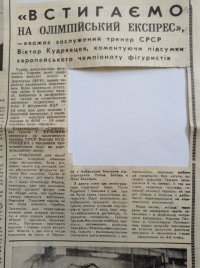
"LET'S CATCH UP FOR THE OLYMPIC EXPRESS,"

(the article published in Ukrainian 'Sportyvna Hazeta' on February 8, 1983)

says Honored Coach of the USSR Viktor Kudryavtsev, commenting on the results of the European Figure Skating Championships
The tournament of the strongest skaters of Europe, which ended last Sunday in Dortmund (Germany), brought victory to the Soviet athletes. They won a gold, three silver and a bronze medal, gaining 36 points in the unofficial standings according to the Olympic scoring system. The skaters of the GDR - 19 points with two gold and a bronze medal, the hosts - winged skaters from Germany - have 18 points: "gold" plus "bronze".
The correspondent of "Sportyvna Hazeta" G. KUZMIN turned to the honored coach of the USSR Viktor KUDRYAVTSEV with a request to comment on the events on the Dortmund ice.

- A WORRYING start for our boldly renewed team was alarming. Of course, it is difficult to expect from young, little-shot skaters to skate without mistakes. However, there were too many of them in the first days. And what a lot! Alexander Fadeev, for example, already when performing the first school figure, stood on both feet, which is especially severely punished by the judges. Veronika Pershina fell almost after every jump. You can understand these athletes: they were the leaders of the Soviet team for the first time and, of course, were nervous ... Gradually, passions subsided, and things went more cheerfully. Fadeev jumped from ninth place to third. And Pershina and Akbarov were brilliantly supported by Elena Valova and Oleg Vasiliev.
I have known this Leningrad pair for a long time. After Rodnina and Zaitsev, we have not had such harmonious skaters. Some were carried away by acrobatics, mercilessly exploiting the large difference in partners' height and weight, others got too "close" to dancing, ignoring the complexity. Coach Tamara Moskvina seems to have found the optimal solution. Of course, without the athletes themselves, their ability to organically combine high technique and artistry, and to do it naturally, without effort, all of Tamara's creative ideas would have remained on paper. And so we witnessed the triumph, the main sensation of the tournament: in three days, Olena and Oleg turned from debutants into vice-champions of the continent!
To be honest, a month ago they weren't even considered reserves and got to Dortmund by accident. Marina Pestova and Stanislav Leonovich didn't have time to learn the free program due to their female partner's illness and focused only on the world championship in March. And Valova and Vasiliev were ignored by our judges for some reason. Perhaps because they did not meet any of the accepted standards, and only a resounding victory at the international tournament in Lake Placid (USA) opened the door to the national team for the Leningraders. I hope for a long time. And for us, members of the coaching council, this is an instructive lesson. We need to use the wealth we have more effectively, and trust determined newcomers more boldly. After all, in single skating, in ice dancing, this allowed us to almost painlessly transfer the change of generations.
I believe that the complete transition after the Olympic Lake Placid to the system of training skaters in large centers, the emphasis on technical equipment, was fully justified. In Dortmund, we saw the first, but already significant fruits of methodological reorientation. Until recently, I thought that we were a little behind, about a year, in forming a team where all the participants were worthy of the Olympic podium in 1984. Now I have changed my mind: the new team will be able to win prizes in every discipline in Sarajevo.
Let's take the men. Both Fadeev and Kotin have a full set of triple jumps. They perform them expressively, organically weaving them into the fabric of the composition, constantly looking for new methods of presenting programs, which is very important in today's ruthless competition. I am often asked why Bobrin, the silver medalist of the All-Union Championships, did not start in Dortmund. Back in the fall, the coaching council warned Igor that his free composition was inferior to modern technical standards - it had too few complex elements. The Leningrader did not have time to correct the situation, and we did not include him in the team, the selection for which was more meticulous than ever. This was justified. Of all our participants, only Anna Antonova did not earn any points, taking seventh place.
But think about it: our third figure skater is the seventh in Europe! A few years ago, we couldn't even dream of something like this - domestic ladies’ skating lagged so far behind international standards. And now the gap has almost been eliminated. The credit for this goes primarily to Elena Vodorezova, who, having overcome chronic colds, remained in the big sport and led the young ones with her. Even today, the courageous girl is unable to train the free program in large fragments, to do jumps in the fourth minute, which she jokingly dealt with in her pioneer years. But thorough preparation in the "school" and clarity in the short program allow her to compensate for her weak endurance.
It is there where Vodorezova is impeccable that our other singles skaters (both boys and girls) falter. There was a period when there were persistent talks about the archaic nature of school exercises, about the need to remove them from the program. Perhaps then our coaches were somewhat superficial about school science, and now it is making itself felt. Meanwhile, compulsory figures are the basis of technique. And even if they were not in the competition program, during the classes you cannot do without them. For some reason, an important change in the regulations also passed by our specialists. Previously, the draw for free compositions was carried out based on the result of only the short program. Now - based on the total indicator of the compulsory and short program. I will explain why this is important using the example of Fadeev. Under the old rules (third place in the short program), he would have started in the group of the best and would have received scores at least 0.1 points higher than those he received when competing in Dortmund in the group of "averages", since he had only seventh place before the last triathlon event. The same applies to Kotin and Kondrashova, who came fifth, and, especially, the talented Antonova, whose school achievements are still very mediocre.
I was pleased with the double success of the ice dancers. Although, in my opinion, the overall level of skill has decreased. Apart from our couples and the Englishmen Barber - Slater, there is no one to look at. We will not overestimate the victory of Natalia Bestemyanova - Andrey Bukin. Let them win against world champions Torvill - Dean (England), who did not come to Dortmund due to their female partner's injury, but are preparing to perform in Helsinki. It is then, after another round of the dispute between Europeans and overseas skaters, that it will be possible to clarify the balance of power before Sarajevo.
1756286914345.jpeg
1756286934090.jpeg
1756286955721.jpeg
 
1983
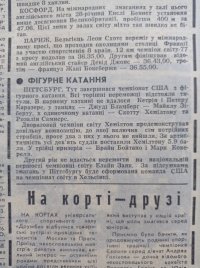
US NATIONAL CHAMPIONSHIPS

FIGURE SKATING

(the article published both in Ukrainian 'Sportyvna Hazeta' on February 10, 1983 and russian ‘Sovetskiy Sport’ on February 9, 1983)

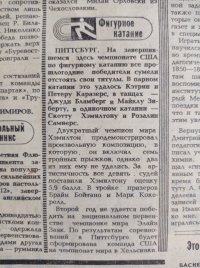
PITTSBURGH. The U.S. Figure Skating Championships have concluded here. All of last year's winners defended their titles. In pairs skating, Caitlin and Peter Carruthers succeeded, in dancing - Judy Blumberg - Michael Siebert, in singles skating - Scott Hamilton and Rosalynn Sumners.
Two-time world champion Hamilton performed a free skate that included seven triple jumps, but missed two of them. All nine judges gave Hamilton 5.9 points for artistry. The three medalists were Brian Boitano and Mark Cockerell.
World champion Elaine Zayak has failed to win a national championship for the second year in a row. The Pittsburgh competition will determine the U.S. team for the world championships in Helsinki.
1756316109151.jpeg
1756316131319.jpeg
 
1983
NEWSPAPER PAGE RELAY


"EQUIPE"

(the article published in russian ‘Sovetskiy Sport’ on February 11, 1983)

Until recently, many famous Western figure skaters, after finishing their amateur careers, usually signed a contract with the famous North American ice revue "Holiday on Ice".
In 1981, several enterprising businessmen from Toronto and New York decided to found a new company - "Pro-skate". Its goal is to hold figure skating competitions among professionals, where the winners receive not medals and prizes, but large sums of money as a reward.
The first such tour took place in early 1982 in Canada. It was attended by many famous athletes, such as Robin Cousins, Toller Cranston, Janet Lynn, Peggy Flemming, Dorothy Hamill and others.
"Pro-skate" is a purely sporting spectacle, - writes the French sports newspaper "Equipe", - everything here resembles ordinary amateur competitions. However, this is where the main danger lies. Young skaters no longer dream of world or Olympic medals, but want to "profit" their talents, to extract as much benefit from them as possible."
Well, the sports businessmen don't care about the fate of figure skating, and Pro-Skate continues to lure the best skaters with profits. The general manager of the newly-minted but successful company, Elva Clermount, is already dreaming of the day when her enterprise will expand beyond America and Pro-Skate will triumph in the ice arenas of Europe. “So,” concludes “Equipe,” “figure skating risks facing an unpleasant choice in some countries in the near future: to remain an amateur sport or to accept the rules of the “professional” game.”
1756318356819.jpeg
 
1983
UKRAINIAN SSR YOUTH COMPETITION,
USSR YOUTH CHAMPIONSHIPS

WHO IS BEHIND THE SOLOISTS?

(the article published in Ukrainian 'Sportyvna Hazeta' on February 10, 1983)

THOUGHTS IN THE HEAT OF THE SEASON

While the best skaters of the republic were making their way to the first USSR national team (unfortunately, they again failed, although Kharkiv resident V. Egorov and ice dancers from Dnipropetrovsk N. Karamysheva - R. Sinitsyn became bronze medalists of the All-Union Championships), the young people demonstrated how they were progressing. The arena for the competition of potential Olympians of the 1988 model was the Zaporizhzhia Palace of Sports.
First, the best skaters of the republic born in 1970-1973 from Odesa, Kyiv, Kharkiv, Dnipropetrovsk and Severodonetsk were invited to the ice. The general impression: there were no "tourists" at the competition. Everyone, even a nine-year-old, had at least one triple jump in their arsenal. But, of course, the participants did not perform them consistently.
The tone was set by the students of trade union societies, primarily Odesans. Thus, brothers Volodymyr and Vasyl Yeremenko won in both age groups among boys, Natalia Lomakina was second among girls born in 1970, and another Odesan, Hanna Lozovyk, was third in the younger age group. The winners here were Ruslana Shcherbakova from Kharkiv and Tamara Zabolotna, a representative of the Dnipropetrovsk sports club "Meteor", respectively.
For several years now, show dance competitions have been held among young people. This allows athletes to reveal their artistry and forces coaches to pay more attention to the choreographic preparation of their wards. The best performers of show dances in Zaporizhia were Dmytro Dmytrenko from Kyiv (choreographer I. Kryuchkov) and Natalya Lyolina from Odesa (choreographer T. N. Verzhkovska).
Following the tournament, a reserve team was formed. I talked to experts. They agree that young skaters of this age are not only technically but also psychologically ready to storm the heights of mastery.
Then the kids were replaced by older comrades. The USSR Youth Championships were held in the same Zaporizhzhia. Our republic was represented by 19 athletes.
The gold medal account was opened by the pair Olga Neizvestna - Sergey Khudyakov. The Kyiv native and the Odesa native are currently training in Moscow with Honored Master of Sports Irina Rodnina, and this is already bearing the first fruits. Olga and Sergey's victory was quite convincing. The pleasantries did not end there. The second and third places were also won by our compatriots - Iryna Myronenko - Dmytro Shkidchenko from Dnipropetrovsk and Olena Prozorovska - Borys Khristenko from Dynamo Kyiv.
The avant-garde figure skater from Odesa, Viktor Petrenko (coach G. Zmiyevska), was pleased. He beat 19 skaters, including the best representatives of the famous Moscow and Leningrad figure skating schools. The performance in the short and free programs of the temperamental Mikhail Shmerkin from Odesa was very expressive. Unfortunately, he is still lagging behind in school exercises, which ultimately brought him only seventh place. Viktor Baryshevtsev from Dynamo Kyiv became fourth, but his free composition does not yet meet modern requirements.
Our ice dancers demonstrated good physical training and skillful skating skills. Svitlana Serkeli and Alexei Kyslitsyn performed the most consistently. They became winners, ahead of the world junior vice-champions from Moscow, Elena Novikova and Oleg Blyakhman.
The best among the girls was Muscovite Irina Klimova. And although Kyiv resident Kateryna Denysenko took fourth place, it should be admitted that in this discipline we cannot overcome the lag in the all-Union arena. Ahead of the best young skaters of the republic - the USSR Cup in Tallinn and the international competition for the "Friendship Cup" in Hungary.​
L. MYKHAYLOVSKA,
international referee.

1756620942185.jpeg
 
1983
UKRAINIAN SSR CHAMPIONSHIPS

REFLECTIONS AFTER THE BALL

(the article published in Ukrainian 'Sportyvna Hazeta' on February 17, 1983)

UKRAINIAN SSR FIGURE SKATING CHAMPIONSHIPS. February 7-11. Zaporizhzhia. Palace of Sports. 44 participants from Kyiv, Odesa, Dnipropetrovsk, Kharkiv. Chief judge - I. KUZMIN (international category, Kyiv).
THE LAST season of the V Winter Spartakiad of the Peoples of the USSR, where Ukrainian skaters fought for the main prizes, surpassed the current one in terms of the intensity of the competition.
The republican championships showed that there was a certain decline. Among men, in the absence of leaders V. Egorov and B. Uspensky, Kyiv Dynamo skater Oleksandr Lunin performed equally at all stages. However, two triple jumps do not guarantee success at the USSR Cup competitions, which will be held in Tashkent. There is still time to include more triple jumps in the program and overcome the psychological barrier when performing compulsory exercises.
The undisputed leader of women's single skating in the republic is Lyudmila Yashchuk ("Burevisnik", Kyiv). She has always been distinguished by a good "school", which she has now confirmed with a fairly stable performance in the short program. It is only necessary to complicate the free composition with various elements of "ultra-c". But, unfortunately, a sharp fight for the championship title among women did not work out. Dynamo's Viktoriya Karatsai, who took second place, having fulfilled the master's standard, fell far behind the leader.
If the Kyiv team dominated in single skating, then the Dnipropetrovsk team confidently won in pairs and ice dances, respectively, L. Zaporozhets - V. Panfilov and N. Karamysheva - R. Sinitsyn.
Our leading ice dance couple, having started in Switzerland, has now slightly reduced their training load and performed in Zaporizhzhia easily and freely. According to many experts, Karamysheva and class=y2iqfc> class=y2iqfc>Sinitsynclass=y2iqfc> style='font-size:11.0pt;font-family:"Calibri",sans-serif;mso-ascii-theme-font:
minor-latin;mso-hansi-theme-font:minor-latin;mso-bidi-theme-font:minor-latin;
color:#1F1F1F;mso-ansi-language:EN'>performed the program much more confidently than a month ago in Chelyabinsk. The second and third places went to Odesa's O. Moskalska - V. Drumov and Kyiv's S. Yaromova - L. Ryzhenko. By the way, Leonid, a student at the KIBІ (Kyiv State Technical University of Construction and Architecture) successfully passed not only the exam session, but also, together with his partner, fulfilled the master's standard.
Now the figure skaters of Ukraine are waiting for the USSR Cup among boys, girls and seniors (Tallinn, Tashkent). The best members of the national team will perform at the World Universiade in Bulgaria and in the competition for the “Friendship” Cup of socialist countries. The season will end in mid-April with the traditional “Kyiv Chestnut” competitions.​
V. MAKSAYEV,
Master of Sports.
1756624478234.jpeg
 
1983
WINTER UNIVERSIADE
Our special correspondent Lev NIKOLOV reports from Bulgaria


UNDER THE FLAG OF "ACADEMICIAN"

(an excerpt of the article published in russian 'Sovetskiy Sport' on February 22, 1983)

...The competitions of hockey players and figure skaters have begun at the Winter Stadium. ...Soviet athletes are also leading in three disciplines of figure skating: in men's singles - student of the Kharkiv Institute of Physical Education Vitaliy Egorov, among ice dance couples - students of the Moscow Physical Education Institute Natalia Annenko and Genrikh Sretensky, in the competition of pairs - Sverdlovsk residents Anna Malgina (Pedagogical Institute) and Sergey Korovin (Mining Institute).
SOFIA, February 21.​
TECHNICAL RESULTS
Figure skating. Sofia. Winter Stadium.
Men. Singles. Compulsory program.
1. V. Egorov (USSR) – 0.6; 2. T. Mura (Japan) – 1.2; 3. R. Yuario (USA) - 1.8; 4. S. Mkhitaryan (USSR) – 2.4. Pairs. Short program. 1. A. Malgina - S. Korovin (USSR) - 0.4; 2. N. Chervotkina - V. Teslya (USSR) - 0.8; 3. Luan Bo - Yao Bing (China) – 1.2. Ice dancing. 1. N. Annenko – G. Sretensky (USSR) - 0.6; 2. I. Hola – K. Foltan (Czechoslovakia) - 1.2: 3. I. Michele – R. Pelizzola (Italy) – 1.8; 4. Yu. Romanova – Yu. Gaichenkov (USSR) – 2.4.
1756626868889.jpeg
 
Back
Top