Archive of newspaper articles | Page 25 | Golden Skate

Archive of newspaper articles

1985
EUROPEAN CHAMPIONSHIPS

THE MYSTERY OF "SCHOOL"

(the article published in russian 'Sovetskiy Sport' on February 6, 1985)

Our special correspondents report from Sweden
The huge hall is almost empty. Silence. It even rings in the ears. Only the crunch of skates is heard, and the occasional low-voiced whisper of coaches keeping their counts.
On the ice, a kind of mystery is taking place. On the mirror-like surface, female figure skaters trace whimsical patterns, like children drawing on asphalt. They are tightly surrounded by nine judges with impassive faces. Talking with the judges is forbidden. All of this is very much like an exam in a high school. The same tense and solemn atmosphere, the same ultra-strict discipline—no extra noise, no extra rustle.
However, on Monday morning, It really felt as if we had stepped into a school—but a special kind, from the world of figure skating. Twenty-six athletes, participants in the European Championships, were performing their compulsory figures that day, known as "school."
As is well known, this part of the program isn't popular with spectators. After all, this isn't free skating—there is no room here for improvisation or creative liberties. For six long hours, the women traced three compulsory figures. And the names themselves are complete mysteries: "rocker," "forward eight with brackets," and "backward eight with loops." In short, it’s prose. It’s no wonder there was a time (not so long ago) when "school" was proposed to be excluded from the program altogether.
But is "school" really that boring? And is it true that it’s devoid of emotion and feeling? Let’s sit closer to the boards and watch.
Florence Copp from France was called up. She darted onto the ice somewhat timidly, sideways—thin, with a haircut that was too short and round glasses on her nose. She looked exactly like a schoolgirl who had got into trouble! The head judge, B. Wright—wearing a Tyrolean hat and an English-cut coat, though he himself was American—approached Copp with importance and made some remark with a cold smile. Even under her makeup, Copp flushed red and involuntarily performed a curtsy. After that, her tracing was nervous; her blade was unsteady and hesitant. The axis of the drawing was shifted, the circles uneven, as if made with a broken compass. She collapsed against the shoulder of her coach, Jean Simon, by the boards, a fountain of tears springing from under her glasses. At 17, it’s forgivable.
Then it was the leaders' turn. Here, nerves were stretched like piano strings. Our own Kira Ivanova was the first to be surrounded by the judges. She traced firmly, evenly, and calmly. Her figures turned out the same way. Ivanova left the ice, but the judges circled for a long time like a swarm over the marks left by her blade. Finally, at Wright's command, they lined up and raised their placards. The numbers 3.8–4.0 were displayed there.Until now, there hadn't been scores this high. The gauntlet has been thrown down. Who will pick it up?
At that moment, there was a tenth judge on the rink—an unofficial one, of course. Katarina Witt, the Olympic champion from the GDR, was warming up off to the side, stealthily noting everything: Ivanova’s mood, her tracing, and the judges' reactions. Then she glided over to her coach, Jutta Müller. They whispered about something by the boards. Witt was called, but Müller kept talking and talking after her. She gripped the boards with her hands, her eyes fixed on the ice.
Witt’s movements are sharp. You can feel her self-confidence. You can feel her class. The "eights" laid down one on top of the other, as if through carbon paper. Five judges to Ivanova's four gave the preference to Witt, and she became the leader. She skated over to Müller. Only now could you see that she was whiter than chalk, her lips pressed tight. Müller gently strokes her hand: "Calm down! Everything is fine!"
No one had to calm down Claudia Leistner from West Germany. She indifferently left her tracing for the judges and moved decisively toward the locker room. But at the very curtain, hidden from prying eyes, she lurked to hear her scores. The judges were favorable to her, and she silently clapped for herself with her fingertips. Then she stepped cheerfully behind the scenes. She had reason to be happy. Leistner had crept right up behind Ivanova and Witt. And immediately after Leistner, the Swiss skater Sandra Cariboni performed successfully. Same emotions. But she didn't hide her joy: she did a cheerful upright spin in the corner of the rink. The judges looked on sternly, but indulgently...
Anna Kondrashova was the last of the leaders to trace the first figure. When the final stroke was made, Wright placed markers on the axis of the drawing (to check for symmetry), while his assistant took a brush and, in a businesslike manner as if in a kitchen, swept the ice shavings away. The judge from France, Monique Petit—a petite, nearsighted lady—first knelt and then nearly lay flat on the ice, her glasses pressed against the pattern. We don’t know what she discovered there, but she gave a lower score than the others.
"Kondrashova lost to Kondrashova," said one of our coaches, Alexander Vedenin. He explained his point: the national champion knows how to skate "school" better and more confidently, and has proven it many times.
Perhaps that was true. But even in losing to herself, Kondrashova surpassed Cariboni and Leistner to move into third place.
The conclusion of the "school" segment felt somewhat like a mass-start bicycle race. Witt, having broken away, hurried alone toward the finish of the grueling six-hour marathon. In pursuit, taking turns, rushed Ivanova, Kondrashova, Leistner, and Cariboni. It seemed the pursuers were just about to catch the runaway. But the second figure ended, then the third, and Witt remained unreachable. The rivals finished in the same order: first Ivanova and Kondrashova, followed by Leistner and Cariboni. Then the rest of the "caravan" arrived, led by Patricia Neske from West Germany.
So, is "school" really that boring? Isn’t its outward dryness and stiffness deceptive? It depends on how you look at it. If seen through the eyes of the skaters themselves, you won't find a more nerve-wracking or emotional internal duel. At least, that is what all the leaders believe.
Late in the evening, after the official opening ceremony of the championships, the pairs skating competitors began their battle. They performed their short program, which is roughly the equivalent of "school" for the singles skaters. Within 2 minutes and 15 seconds (no more and, ideally, no less), the skaters must demonstrate seven compulsory elements.
Olympic champions Elena Valova and Oleg Vasiliev performed these better than anyone else at the "Scandinavium." Their skating was filled with beauty and depth, and the judges, without hesitation, awarded them the highest scores. Following them is our other pair, Larisa Selezneva and Oleg Makarov, with Birgit Lorenz and Knut Schubert from the GDR a bit further behind. Veronika Pershina and Marat Akbarov are currently in fourth place.
Today, the European champions in pairs skating will be decided, the men will begin their "school" figures, and the women will start their short program. In short, it is a tense, event-filled, and difficult day.​
V. KUCHMIY,
V. STRELTSOV.
GOTHENBURG, February 5.
TECHNICAL RESULTS
European Figure Skating Championships. Gothenburg, February 4.
Women. Compulsory program. "Frölundaborg" Sports Palace. 1. K. Witt (GDR) — 0.6; 2. K. Ivanova (USSR) — 1.2; 3. A. Kondrashova (USSR) — 1.8; 4. C. Leistner (FRG) — 2.4;5. S. Cariboni (Swizerland) – 3.0; 6. P. Neske (FRG) – 3.6 ...11. N. Lebedeva (USSR) — 6.6.
Pairs Skating. Short Program. "Scandinavium" Sports Palace. 1. E. Valova – O. Vasiliev – 0.4; 2. L. Selezneva – O. Makarov (both pairs – USSR) – 0.8; 3. B. Lorenz – K. Schubert (GDR) – 1.2; 4. V. Pershina – M. Akbarov (USSR) – 1.6; 5. C. Massari – D. Caprano (FRG) – 2.0; 6. M. Landgraf – I. Steuer (GDR) – 2.4.​
View attachment 11215
A journalist with x number of words to fill about the school figures event, looking for an angle to make it more interesting :biggrin:
 
1985
EUROPEAN CHAMPIONSHIPS

SOVIET EVENING IN GOTHENBURG

(the article published in russian 'Sovetskiy Sport' on February 7, 1985)

From our special correspondents in Sweden
First, the fanfarists appeared. In elegant blue suits, they held nearly two-meter-long golden trumpets. This was intended to give the ceremony a more solemn and festive character. Following the fanfarists to the podium, set in the middle of the "Scandinavium" arena, came all the Soviet pairs—Elena Valova and Oleg Vasiliev, Larisa Selezneva and Oleg Makarov, Veronika Pershina and Marat Akbarov.
It was a complete, unconditional success. And so, at the European Championships, three pairs representing one country ascended the podium. A Norwegian TV commentator sitting next to us, breathless with delight, repeated the winners' names three times and then exclaimed: "You are attending a gala evening in honor of the Soviet school of figure skating." And indeed, it turned out to be our own Soviet evening!
...What a wonderful winter day that was in Novogorsk! Beyond the steamy windows of the training base lay impassable snowdrifts, and somewhere in the forest, a blizzard was howling. But at the rink, it was warm and cozy. Tamara Moskvina was sitting nearby—a small, charming woman with ironic eyes. She spoke quickly, "off the cuff" as they say—either she was in a great hurry or afraid she might leave something unsaid.
"Remember, before the national championships, Oleg had an injury? We thought about whether or not to compete. And not to compete meant not qualifying for the European Championships. I imagined how people would look at us later. Imagine, I didn't sleep for nights. And then suddenly I fell asleep. And I had a dream that Oleg and Elena were doing an Axel. I burst into their hotel room and shouted: 'We will compete!' I saw that they were happy, that they had been thinking of nothing else. And even though they later took second place in Dnipropetrovsk, their spirits rose. And then I told them: 'Well, in Gothenburg, guys, you need to try even harder.'"
And they did try! Only twice did Elena Valova and Oleg Vasiliev take to the ice of the "Scandinavium". In the short program, then in the free program. Two minutes and 15 seconds are allocated for one, and 4 minutes and 30 seconds for the other. But in those minutes, the Leningrad duo captivated the audience, judges, and journalists alike. When on Monday late in the evening they performed "Flight of the Bumblebee," the spectators sat as if bewitched, enchanted. Two people "translated" music into the language of movement so precisely and expressively.
A journalist from the Swedish newspaper Dagens Nyheter, sitting nearby, even dropped her cup of coffee. "Agree," she said to us, "this is true art! The Bolshoi Theatre!" She pronounced "Bolshoi Theatre" in Russian, of which she was very proud. We clarified that the composition was staged by Tamara Moskvina and Leningrad choreographer Valentina Wigant. But our colleague stood her ground: "Let it not be the 'Bolshoi,' but it is great nonetheless..."
She was happy that she found a suitable synonym: after all, she had studied Russian at Stockholm University.
And when on Tuesday Valova and Vasiliev performed their free program to melodies from the ballet "Shurale," the applause followed like a trail, trailing after them along the rink. Their performance was confident, flawless, and full of restrained power. Just restrained. And the judges rightfully appreciated their program: for artistry, the scores were 5.8–5.9.
After their performance Valova and Vasiliev rushed to Moskvina. All four minutes she stood at the boards and did not betray her feelings, emotions with a single gesture or movement. But now she was touched, clearly proud of her students. Looking at them, one couldn't help but think of the winners: "Three with one dream." Exactly three: nothing to take away, nothing to add. Two who create art on ice, and the third who inspires them to this art.
Larisa Selezneva and Oleg Makarov’s path to their medals was not so smooth, not so certain. At first, they didn't have luck; the short program to contemporary French symphony music in the style of a symphonic jazz didn't work out. The scores weren't too high. There were 5.3 and 5.4. And then they were closely followed by Birgit Lorenz and Knut Schubert from the GDR. This meant the free program for Selezneva and Makarov had to be skated cleanly, without mistakes. Which they did.
All four minutes of their program literally stirred those present in the hall, and even in the music it was felt how synchronously the hearts of athletes Selezneva and Makarov beat, leaving no chance for rivals from other teams. They have a solid second place.
Lorenz and Schubert from the GDR, remember, were third after the short program. Based on the mood of the crowd and the judges, they should have remained in third place. Besides, their performance was overly diligent, much like children carefully writing a difficult spelling test at school.
But here, by contrast, Pershina and Akbarov shone. They were like two poles. She is harmonious and plastic, tentative and unconstrained. He is manly serious and gathered. In the end, the judges did not stand before their charm. They gave preference to Pershina and Akbarov, and they rightfully took the third, "bronze" place.
And then behind the scenes, we saw tears of joy in the eyes of the mentor of this duo—the three-time Olympic champion Irina Rodnina. An unforgettable, generous, and involuntary smile. The smile of a person who knows how to pass on her faith in her own strength and optimism to others.
The struggle continues in the singles skating for women. After the short program, our Kira Ivanova came out on top. Her skating was free of glitches and mistakes. But Katarina Witt from the GDR followed a simplified version of the cascade. It appeared she was constrained, nervous, as if feeling the breath of Ivanova behind her. As a result, our figure skater topped the tournament table before the free program. Witt is currently in second, Anna Kondrashova is fourth, and Natalia Lebedeva has moved up from 11th to ninth. But there's a reason we said 'currently.' Nothing is set in stone yet, and only the long program will truly give everyone their due.
The men have joined the struggle. After two figures, our Vladimir Kotin confidently led. But in the third figure, his business didn't go well; he committed several gross mistakes and eventually ended up in fourth place. Сurrently ahead is a Frenchman Fernand Fédronic. And once again, we say 'currently' — everything could still change in the men's competition.​

V. KUCHMIY,
V. STRELTSOV.
GOTHENBURG, February 6.

TECHNICAL RESULTS
European Figure Skating Championships. Gothenburg. "Scandinavium" Sports Palace. February 5.
Pairs. Final rankings. Total scores. 1. E. Valova — O. Vasiliev 1.4; 2. L. Selezneva — O. Makarov 2.8; 3. B. Pershina — M. Akbarov (all USSR) — 4.6; 4. B. Lorenz — K. Schubert 5.2; 5. M. Landgraf — T. Steuer (both GDR) 7.4; 6. C. Massari — D. Kaprano (FRG) — 8.0.
Women. Singles skating. Total amount of compulsory and short program. 1. K. Ivanova (USSR) — 1.6; 2. K. Witt (GDR) — 2.2; 3. C. Leistner (FRG) — 3.2; 4. A. Kondrashova (USSR) — 4.6; 5. S. Koch (GDR) — 6.6; 6. C. Villiger (Switzerland) — 7.4 ... 9. N. Lebedeva (USSR) — 9.0.
Men. Compulsory program. 1. F. Fédronic (France) — 0.6; 2. J. Sabovčík (Czechoslovakia) — 1.2; 3. H. Fischer (FRG) — 1.8; 4. V. Kotin (USSR) — 2.4; 5. G. Filipowski (Poland) — 3.0; 6. L. Akesson (Sweden) — 3.6.
1776071295415.jpeg
1776071315563.jpeg
 
1985
EUROPEAN CHAMPIONSHIPS

A Day Full of Surprises

(the article published in russian 'Sovetskiy Sport' on February 8, 1985)

From our special correspondents in Sweden
It just so happened that in the program of the European Championships, this day turned out to be the most outwardly calm day. Medals were not being contested this time, and passions in the "Scandinavium" did not seem to be raging. But the calm was deceptive. Each appearance of the skaters on the ice hid a surprise, behind each performance a surprise was hidden.
Let’s start with the singles. We have already talked about how dramatically and intriguingly the struggle unfolded among the women. After the performance of the three compulsory figures "at school," the most diligent student turned out to be Katarina Witt, the Olympic champion from the GDR. She was leading confidently. And suddenly—a slip-up. In the short program, Witt made a mistake in the execution of a jump and after that, she was unrecognizable. She skated nervously, constrained. As a result, Witt lost to her teammate Simone Koch, Claudia Leistner from the FRG, and our Kira Ivanova.
Ivanova’s performance, which won the short program, deserves the most flattering words. She conveyed the passion of Gypsy melodies so ardently, so accurately, that, truly, her performance was like in a theater, it was worth repeating "encore." Her skates were able to both "sting" the ice and stroke it, like a cat with its paw, they were able to spin and throw themselves like a wolf. And her face during the performance was at once bright, sorrowful, and joyful—as it is with everyone who is capable of a strong feeling.
The situation for the women before the free program is as follows: Ivanova is in the lead, followed by Witt, Leistner, and our Anna Kondrashova.
The men also performed their short program. After the three compulsory figures, as we have already reported, leadership unexpectedly for everyone was seized by the Frenchman Fernand Fedronic. Here, too, it was not without disruptions. First, the bronze medalist of the 1984 Olympics, Jozef Sabovčík from Czechoslovakia, made a mistake, then—Heiko Fischer from the FRG, and then Vladimir Kotin. When the results were posted, all three figure skaters stood following Fedronic. The Frenchman, already changed into an elegant suit, beamed with joy and clapped his palms on his knees.
But his joy was premature. In the lead, he remained for only one day. The short program put everyone in their places. The favorites this time did not allow themselves any major mistakes; they performed confidently, consistently, as if trying to make up for what they lost the day before. The short program by Kotin left a particularly strong impression. Music—a classic melody from Glinka’s opera "Ruslan and Lyudmila." And he performed classically, in a high-class manner. As a result, Kotin moved from fourth place to second, and Sabovčík took the lead. Fedronic moved down to third place. Our 15-year-old skater V. Petrenko also performed excellently (breaking into the top six).
Ice dance duels began. They performed the compulsory program. The leaders were determined after the second dance—the Polka. Clearly stronger than their rivals were our Natalya Bestemianova–Andrei Bukin and Marina Klimova–Sergei Ponomarenko. Their superiority was noticeable not only to the strict judges but even to the uninitiated fan. Now everyone is worried, in essence, by one question: which of these two duos will be luckier? When the protocols were handed out, it turned out that Bestemianova and Bukin were in first place, and Klimova and Ponomarenko were in second. Currently in fifth (undoubtedly a success for debutants) is our third pair — Natalia Annenko and Genrikh Sretenski. But the main dispute for the ice dance duos is still ahead.
And now let's return to the event which made a lasting impression here in Gothenburg. We are talking about the brilliant success of our pairs Elena Valova and Oleg Vasiliev, Larisa Selezneva and Oleg Makarov, Veronika Pershina and Marat Akbarov, who won all the medals of the European Championship. The Swedish press is full of enthusiastic words about the performances of the Soviet skaters. The newspaper "Göteborgs Handels-och Sjöfartstidning" writes: "The Soviet pair Elena Valova and Oleg Vasiliev demonstrated their total superiority over their rivals. In their skating, deep lyricism and positivity were combined with excellent choreography and high skating technique."
One of the largest Swedish newspapers "Svenska Dagbladet" notes that the coach of the European champions Tamara Moskvina found an original interpretation for her students' program. Work of this coach, other papers write, is distinguished by a constant creative search, high professional mastery.​

V. KUCHMY,
V. STRELTSOV.
GOTHENBURG, February 6.
TECHNICAL RESULTS
European Figure Skating Championships. Gothenburg. "Scandinavium" Sports Palace. February 5.
Ice Dance.
Compulsory program. 1. N. Bestemianova and A. Bukin — 0.6; 2. M. Klimova and S. Ponomarenko — 1.2; 3. K. Barber and N. Slater (Great Britain); 4. P. Born and R. Schönborn (FRG) – 2.4; 5. N. Annenko and G. Sretenski (USSR) — 3.0; 6. I. Micheli and R. Pelizzola (Italy) — 3.6.
Men. Sum of compulsory figures and short program. 1. J. Sabovčík (Czechoslovakia) — 1.6; 2. V. Kotin (USSR) — 3.2; 3. F. Fedronic (France) — 3.4; 4. G. Filipowski (Poland) — 4.6; 5. H. Fischer (FRG) — 5.0; 6. V. Petrenko (USSR) — 6.0.
1776077467326.jpeg
 
1985
EUROPEAN CHAMPIONSHIPS

Grace and Inspiration

(the article published in russian 'Sovetskiy Sport' on February 9, 1985)

From our special correspondents in Sweden
The battle in figure skating is not as tangible, obvious, as say in boxing or football. But it is no less dramatic and tense. Though emotions here are hidden behind radiant smiles, bows, and conversations in the lobby. The struggle is felt in every entry onto the ice, in every gesture of the skater, in every movement.
Rarely has the performance of the women in the free program been as dramatic. Before the final entry onto the ice, Kira Ivanova was ahead followed by the Olympic champion Katarina Witt, Claudia Leistner from the FRG, our Anna Kondrashova and Simone Koch from the GDR. Their clash on the ice was like a kind of art: it was a dispute at the highest level. Every performance of the leaders was like a small play; in their compositions, everything was connected: music and high technique of performance.
And now, about it all in order. In the group of the strongest, the first to appear on the ice was Leistner in a golden costume, and she herself was golden, white-haired, sparkling. But the program turned out slightly stiff, probably because before the start, Leistner had been too nervous. For technique, she received from 5.4 to 5.6, for artistry — from 5.5 to 5.7.
We are waiting for Witt. The final word is hers. Her name alone in Gothenburg makes a magical impression on both the judges and the audience. And this is understandable: the Olympic champion, World and European champion. However, the figure skater was performing far from her full potential this time. Her technique is certainly at a high level, but it wasn't without mistakes and inaccuracies. Even Jutta Müller, usually hiding her emotions, disapprovingly shook her head when her student finished the performance. Ratings for technique from 5.4 to 5.8, for artistry — from 5.7 to 5.8.
Then performed Kondrashova. Chopin's music was chosen with taste, and the program had many finds, but our champion skated with mistakes. As a result, the judges placed her overall in only fifth place.
Following Kondrashova, her skating was demonstrated by Simone Koch, small, in a light blue costume. Perhaps our impression is deceptive, but Koch on the ice did not improvise, did not create, but worked. And the decision of the judges, who gave her preference in the battle for fourth place, looks quite controversial. But the judges, as they say, see better.
Last onto the ice of the "Scandinavium" that evening was the leader Ivanova, elegant, with a high black hairstyle, in a light blue costume. It seemed as if she wasn't performing a well-known routine rehearsed hundreds of times, but was improvising her way across the ice. It felt as though the audience's delight was carrying her along and spinning her around. Her marks were high, they were quite enough to beat Leistner. In the end, Ivanova had the silver medal. In this success, there is a great merit of coach Vladimir Kovalev and choreographer Alla Kapranova.
We note the success in the tournament of Natalia Lebedeva, a debutante at the European Championships, a student of the famous coach from Sverdlovsk, Igor Ksenofontov. Lebedeva in the “school” felt herself not very confident, then from the program to the program it was noticeable that she is gathering, gaining momentum. And after the wonderful free program, she took sixth place overall.
Continuing the battle are the ice dance couples. Ahead after three compulsory and original dances are still our couples - Natalia Bestemianova and Andrei Bukin, Marina Klimova and Sergei Ponomarenko. Their advantage is indisputable. The third pair from the USSR, Natalia Annenko and Genrikh Sretenski, are currently in fifth place.
… Fifth day under the arches of the magnificent Sports Palace "Scandinavium" sounds wonderful music. In Gothenburg, they know the value of good music, which can fight, inspire. At Götaplatsen, not far from the "Scandinavium," on the building of the concert hall, there is a memorial plaque. Here in 1943 the beautiful music of Dmitry Shostakovich’s 7th Symphony was playing. A terrible war was still raging. Heroic Leningrad was standing firm in its defense, yet the music of the 7th Symphony was already sounding in the West.
Music, as you see, can also fight, inspire, create.​
V. KUCHMY,
V. STRELTSOV.
GOTHENBURG, February 8.
Technical Results
European Figure Skating Championships. Gothenburg (Sweden). February 7.
Women. Final standings (Sum of compulsory figures, short program, and free skate): 1. K. Witt (GDR) — 3.2; 2. K. Ivanova (USSR) — 3.6; 3. C. Leistner (FRG) — 6.2; 4. S. Koch (GDR) — 10.6; 5. A. Kondrashova (USSR) — 10.6; 6. N. Lebedeva (USSR) — 14.0
Ice Dance. Sum of compulsory and original dances: 1. N. Bestemianova and A. Bukin (USSR) — 1.0; 2. M. Klimova and S. Ponomarenko (USSR) — 2.0; 3. K. Barber and N. Slater (Great Britain) — 3.4; 4. P. Born and R. Schönborn (FRG) — 3.6; 5. N. Annenko and G. Sretenski (USSR) — 5.0; 6. I. Micheli and R. Pelizzola (Italy) — 6.4
1776094718963.jpeg
 
1985
EUROPEAN CHAMPIONSHIPS

SOVIET EVENING IN GOTHENBURG

(the article published in russian 'Sovetskiy Sport' on February 7, 1985)

From our special correspondents in Sweden
First, the fanfarists appeared. In elegant blue suits, they held nearly two-meter-long golden trumpets. This was intended to give the ceremony a more solemn and festive character. Following the fanfarists to the podium, set in the middle of the "Scandinavium" arena, came all the Soviet pairs—Elena Valova and Oleg Vasiliev, Larisa Selezneva and Oleg Makarov, Veronika Pershina and Marat Akbarov.
It was a complete, unconditional success. And so, at the European Championships, three pairs representing one country ascended the podium. A Norwegian TV commentator sitting next to us, breathless with delight, repeated the winners' names three times and then exclaimed: "You are attending a gala evening in honor of the Soviet school of figure skating." And indeed, it turned out to be our own Soviet evening!
...What a wonderful winter day that was in Novogorsk! Beyond the steamy windows of the training base lay impassable snowdrifts, and somewhere in the forest, a blizzard was howling. But at the rink, it was warm and cozy. Tamara Moskvina was sitting nearby—a small, charming woman with ironic eyes. She spoke quickly, "off the cuff" as they say—either she was in a great hurry or afraid she might leave something unsaid.
"Remember, before the national championships, Oleg had an injury? We thought about whether or not to compete. And not to compete meant not qualifying for the European Championships. I imagined how people would look at us later. Imagine, I didn't sleep for nights. And then suddenly I fell asleep. And I had a dream that Oleg and Elena were doing an Axel. I burst into their hotel room and shouted: 'We will compete!' I saw that they were happy, that they had been thinking of nothing else. And even though they later took second place in Dnipropetrovsk, their spirits rose. And then I told them: 'Well, in Gothenburg, guys, you need to try even harder.'"
And they did try! Only twice did Elena Valova and Oleg Vasiliev take to the ice of the "Scandinavium". In the short program, then in the free program. Two minutes and 15 seconds are allocated for one, and 4 minutes and 30 seconds for the other. But in those minutes, the Leningrad duo captivated the audience, judges, and journalists alike. When on Monday late in the evening they performed "Flight of the Bumblebee," the spectators sat as if bewitched, enchanted. Two people "translated" music into the language of movement so precisely and expressively.
A journalist from the Swedish newspaper Dagens Nyheter, sitting nearby, even dropped her cup of coffee. "Agree," she said to us, "this is true art! The Bolshoi Theatre!" She pronounced "Bolshoi Theatre" in Russian, of which she was very proud. We clarified that the composition was staged by Tamara Moskvina and Leningrad choreographer Valentina Wigant. But our colleague stood her ground: "Let it not be the 'Bolshoi,' but it is great nonetheless..."
She was happy that she found a suitable synonym: after all, she had studied Russian at Stockholm University.
And when on Tuesday Valova and Vasiliev performed their free program to melodies from the ballet "Shurale," the applause followed like a trail, trailing after them along the rink. Their performance was confident, flawless, and full of restrained power. Just restrained. And the judges rightfully appreciated their program: for artistry, the scores were 5.8–5.9.
After their performance Valova and Vasiliev rushed to Moskvina. All four minutes she stood at the boards and did not betray her feelings, emotions with a single gesture or movement. But now she was touched, clearly proud of her students. Looking at them, one couldn't help but think of the winners: "Three with one dream." Exactly three: nothing to take away, nothing to add. Two who create art on ice, and the third who inspires them to this art.
Larisa Selezneva and Oleg Makarov’s path to their medals was not so smooth, not so certain. At first, they didn't have luck; the short program to contemporary French symphony music in the style of a symphonic jazz didn't work out. The scores weren't too high. There were 5.3 and 5.4. And then they were closely followed by Birgit Lorenz and Knut Schubert from the GDR. This meant the free program for Selezneva and Makarov had to be skated cleanly, without mistakes. Which they did.
All four minutes of their program literally stirred those present in the hall, and even in the music it was felt how synchronously the hearts of athletes Selezneva and Makarov beat, leaving no chance for rivals from other teams. They have a solid second place.
Lorenz and Schubert from the GDR, remember, were third after the short program. Based on the mood of the crowd and the judges, they should have remained in third place. Besides, their performance was overly diligent, much like children carefully writing a difficult spelling test at school.
But here, by contrast, Pershina and Akbarov shone. They were like two poles. She is harmonious and plastic, tentative and unconstrained. He is manly serious and gathered. In the end, the judges did not stand before their charm. They gave preference to Pershina and Akbarov, and they rightfully took the third, "bronze" place.
And then behind the scenes, we saw tears of joy in the eyes of the mentor of this duo—the three-time Olympic champion Irina Rodnina. An unforgettable, generous, and involuntary smile. The smile of a person who knows how to pass on her faith in her own strength and optimism to others.
The struggle continues in the singles skating for women. After the short program, our Kira Ivanova came out on top. Her skating was free of glitches and mistakes. But Katarina Witt from the GDR followed a simplified version of the cascade. It appeared she was constrained, nervous, as if feeling the breath of Ivanova behind her. As a result, our figure skater topped the tournament table before the free program. Witt is currently in second, Anna Kondrashova is fourth, and Natalia Lebedeva has moved up from 11th to ninth. But there's a reason we said 'currently.' Nothing is set in stone yet, and only the long program will truly give everyone their due.
The men have joined the struggle. After two figures, our Vladimir Kotin confidently led. But in the third figure, his business didn't go well; he committed several gross mistakes and eventually ended up in fourth place. Сurrently ahead is a Frenchman Fernand Fédronic. And once again, we say 'currently' — everything could still change in the men's competition.​

V. KUCHMIY,
V. STRELTSOV.
GOTHENBURG, February 6.

TECHNICAL RESULTS
European Figure Skating Championships. Gothenburg. "Scandinavium" Sports Palace. February 5.
Pairs. Final rankings. Total scores. 1. E. Valova — O. Vasiliev 1.4; 2. L. Selezneva — O. Makarov 2.8; 3. B. Pershina — M. Akbarov (all USSR) — 4.6; 4. B. Lorenz — K. Schubert 5.2; 5. M. Landgraf — T. Steuer (both GDR) 7.4; 6. C. Massari — D. Kaprano (FRG) — 8.0.
Women. Singles skating. Total amount of compulsory and short program. 1. K. Ivanova (USSR) — 1.6; 2. K. Witt (GDR) — 2.2; 3. C. Leistner (FRG) — 3.2; 4. A. Kondrashova (USSR) — 4.6; 5. S. Koch (GDR) — 6.6; 6. C. Villiger (Switzerland) — 7.4 ... 9. N. Lebedeva (USSR) — 9.0.
Men. Compulsory program. 1. F. Fédronic (France) — 0.6; 2. J. Sabovčík (Czechoslovakia) — 1.2; 3. H. Fischer (FRG) — 1.8; 4. V. Kotin (USSR) — 2.4; 5. G. Filipowski (Poland) — 3.0; 6. L. Akesson (Sweden) — 3.6.
View attachment 11216
View attachment 11217
I get a kick out of this journalist's style -- a frustrated poet or novelist :).
 
1985
EUROPEAN CHAMPIONSHIPS

PERFORMANCES FILLED WITH THOUGHT AND FEELING

(the article published in russian 'Sovetskiy Sport' on February 10, 1985)

Our special correspondents report from Sweden
How frustrating! How disappointing that just two days ago, 22-year-old Muscovite Vladimir Kotin made that absurd mistake in the "compulsory figures"—the last of the three. It is possible that this very error cost him the European Championship title.
We can say this with confidence because on Friday night, during the free skate, Kotin was stronger than the blond leader Jozef Sabovčík from Czechoslovakia, the elegant Grzegorz Filipowski from Poland, and everyone else who took to the ice that evening. He skated with inspiration, jumping lightly and confidently; his entire performance had a certain "spark"—an indescribable interplay of feeling and passion.
He managed to seamlessly fuse his jumps, spins, and every element of the program into a single artistic composition. His movements flowed as if they were improvised. And right there on the ice with him lived the inspiring music of Saint-Saëns and the fiery Italian "Tarantella." Even Kotin’s costume was the most exquisite and beautiful—sleek, black, and accented with gold sequins. In all of this—his creativity on the ice, his improvisation, and his sophistication—one could feel the refined taste and directorial mastery of his coach, Elena Tchaikovskaia.
Kotin received the highest marks for his skating that evening: for technique — three 5.7 and six 5.8, for artistry — two 5.8 and seven 5.9. These scores brought our athlete a small gold medal in the free program. But alas, this was not enough for him to overtake Sabovčík in the overall standing — the gap was too large.
And Sabovčík, realizing that his main task was to avoid gross errors, skated cautiously, without risk. He was the first to perform in the group of the strongest and demonstrated a harmonious composition, but was precise in the elements, fast in execution. He succeeded in everything. However, his performance lacked a flight of imagination. Apparently, this was felt by the judges too. In any case, they were not very generous to Sabovčík. The scores were in the range of 5.6—5.8. But, we repeat, such a situation completely suited the leader. His main goal was achieved.
In contrast, the performance of 18-year-old Filipowski left a pleasant impression on both the judges and the audience. Remarkably fluid and radiating a kind of boyish joy, the Pole did everything on the ice with ease, as if it were child's play. The judges truly appreciated the young skater's program. As a result, he secured third place for the first time.
For the first time, 20-year-old Sabovčík climbed to the top step of the podium, returning the championship title to Czechoslovakia 13 years after the victory of the famous Ondrej Nepela. Kotin also stepped onto the podium for the first time; prior to this, his best achievement had been fourth place at last year's World Championships. Our skater’s success is remarkable. As you know, our leader—the 1984 European Champion Alexander Fadeev—was unable to come to Gothenburg due to an injury. In his absence, Kotin did not falter; he boldly stepped into the leadership role and managed to uphold the high prestige of our school of men’s singles skating.
Another member of the Soviet team, Viktor Petrenko, did the same. The performance of this championship debutant here in Gothenburg sparked great interest. Petrenko is only 15 years old and trains under the Odesa coach Galina Zmievskaya. There is a lot of vigor in his skating.
In every program, the debutant looked fresh yet masculine and mature. And although he fell twice during his free skate, his composition to the music of Tchaikovsky was performed with overall virtuosity, in a single breath. As a result, Petrenko overtook the Frenchman Fernand Fédronic—the very same skater who led after the compulsory figures and moved up to sixth place.
'The emergence of a new constellation of talented youth in men's figure skating will grant us many more beautiful, thrilling battles like the ones we saw at the Scandinavium,' said Berger Rosén, President of the Swedish Figure Skating Association, in a conversation with us. 'Today, we are captivated by the skill of Sabovčík, Kotin, Filipowski, Heiko Fischer from West Germany, Falko Kirsten from East Germany, our own Lars Åkesson, and Petrenko. They have given all television viewers and all Swedes programs filled with beauty and grace.'
On the ice of the Scandinavium, only the last set of medals remains to be contested. But even now, one can rightfully note the great success of the Soviet school of figure skating at this championship. This opinion is shared by the majority of newspaper columnists, TV commentators, coaches, and officials. In three disciplines, our skaters have already won one gold, three silver, and one bronze medal.
Ahead of the free dance, Soviet couples Natalya Bestemianova and Andrei Bukin, and Marina Klimova and Sergei Ponomarenko, lead with a significant advantage. The third duo, Natalya Annenko and Genrikh Sretenski, also has good prospects.
The programs of the Soviet skaters are like miniature plays, full of passion and thought, inspiration and harmony; they are distinguished by choreographic taste and high performance mastery.
'Russian figure skating is akin to the world-renowned Russian ballet,' writes one local newspaper. 'It is just as virtuosic and just as lyrical.'
Well said. There is nothing to add and nothing to take away.​
V. KUCHMIY,
V. STRELTSOV.

GOTHENBURG, February 9.
TECHNICAL RESULTS
European Figure Skating Championships. Gothenburg. "Scandinavium" Sports Palace. February 8.
Men. Overall sum of points.
1. J. Sabovčík (Czechoslovakia) — 3.6; 2. V. Kotin (USSR) — 4.2; 3. G. Filipowski (Poland) — 7.6; 4. H. Fischer (FRG) — 9.0; 5. F. Kirsten (GDR) — 12.4; 6. V. Petrenko (USSR) — 14.0.
1776152640638.jpeg
 
1985
EUROPEAN CHAMPIONSHIPS

THE READER ASKS FOR AN ANSWER

DECISIVE FACTOR

(the article published in russian 'Sovetskiy Sport' on February 10, 1985)

These days, letters from figure skating fans are arriving at the editorial office and the USSR Sports Committee. E. Ochertsova, Z. Sakalauskas, A. Gusev from Leningrad, and others ask why the couple N. Annenko and G. Sretenski was included in the USSR national team competing at the European Championships, rather than O. Volozhinskaya and A. Svinin.
As reported to us by the chairman of the USSR Figure Skating Federation, Silchev, the question regarding the composition of the national team was considered at a meeting of the federation's presidium. After a detailed discussion of the results of all previous competitions, preference was given to Annenko and Sretenski.Candidates for the national team Volozhinskaya and Svinin have participated in the European and World Championships since 1981. They took second place at the 1983 European Championship, but unfortunately, a trend toward declining sports results subsequently emerged: fifth place at the 1984 European Championship and seventh place at the Winter Olympics in Sarajevo. The federation took into account that the start of the new Olympic cycle was marked by the growth of young promising duos possessing high skill and capable of fighting for leading positions in the international arena. Among them are Annenko and Sretenski. In September 1984, at a tournament in England, they won the compulsory dances against the Canadian couple T. Wilson and R. McCall, who held sixth place at the 1984 World Championship. Only a failure in the original dance prevented the Muscovites from taking first place.
At the international "Moscow News" competitions in December 1984, Volozhinskaya and Svinin won against Annenko and Sretenski with an advantage of one judge's vote, but at the USSR Championship in Dnipropetrovsk, the majority of judges gave preference to Annenko and Sretenski. The results of this championship were the decisive factor in determining the composition of the national team. The majority of the federation's presidium members voted for Annenko and Sretenski.
1776155891879.jpeg
 
1985
EUROPEAN CHAMPIONSHIPS

TO THE SOUNDS OF A FAREWELL WALTZ

(the article published in russian 'Sovetskiy Sport' on February 12, 1985)

Our special correspondents report from Sweden
That is all. The smoky ice of the "Scandinavium" has somehow suddenly become orphaned. The 12,000 orange chairs in the stands are empty. Only the rink attendants behind the scenes are clearing away the fallen multicolored tulip petals. But before the eyes, bouquets of flowers again arise, flying from the stands to the feet of the European Championship participants.
The most bouquets during the seven days of the championship went to the Soviet figure skaters. Their advantage in Gothenburg was complete and unconditional. For the first time in the history of European tournaments, representatives of one country, one school, collected a collection of seven medals of various denominations in four program events: two gold, four silver, and one bronze.
This great success is shared with the skaters by their coaches, their choreographers, and everyone who prepared the team for the championship. To finish with the figures, let us name one more: without exception, all our skaters finished in the top six in their events and, according to Olympic calculations, brought the national team 44 points—also an unprecedented case. And, therefore, a very encouraging one.
The crown of the championship, the farewell ball at the "Scandinavium," was the performance of the ice dance couples. It was an evening filled with exquisite colors, stormy passions, and generous improvisations. The dances of all sixteen couples were original in their own way, unique in their own way, just as the very nature of ice dancing is original and unique. But even here, the art of the Soviet couples knew no equal.
We are not referring to the outcome of the sporting struggle for medals—it was predetermined even after the compulsory and original dances, when it became obvious that no one at the championship would be able to withstand our leaders Natalya Bestemianova and Andrei Bukin, Marina Klimova and Sergei Ponomarenko. When speaking of art, we implied something else: the ability to transform in a dance, naturally and precisely to convey to the audience both the music and one's mood, and one's feelings, even subtle shades of feelings. Such art is mastered by few.
For example, the most important feature of the art of Bestemianova and Bukin lies in the ability to give a spontaneous, improvisational character to a precisely calculated logical progression of the dance plot. And it seems to the spectators that before them is not a rehearsed number, suffered through hundreds of times, but a dance just spontaneously born, as if during a merry carnival. There was such a feeling that Bestemianova is capable of making hearts tremble with a single bend of her arm, conducting the feelings of the spectators.
Seven judges gave the leaders a 6.0, two a 5.9. Everyone who was at the "Scandinavium" that day—even the rink employees, ticket collectors, buffet workers, and police—ran out to the boards to see the little spectacle to the music of "Carmen Suite" performed by Bestemianova and Bukin.
Afterward, in the corridors, the President of the ISU Technical Committee for Ice Dance, Lawrence Demmy, a strict and elegant English gentleman, said:
— What just happened on the ice is a standard for ice dance, its future.
And Tatyana Tarasova, the champions' coach, recalled that Demmy, a person highly authoritative in their world, noticed the innovation and refined taste of the then-young couple back in 1979 at the World Championships in Vienna.
— The judges did not welcome our debut very warmly, — said Tarasova. — But Demmy, imagine, even insisted that the kids be allowed to perform in the exhibition gala. It was an unprecedented decision, as our couple was only tenth then...
In Gothenburg, as early as Wednesday, a letter arrived for Bestemianova and Bukin from England—from Olympic champions Jayne Torvill and Christopher Dean, who left the ice after Sarajevo-84. The famous ice dancers expressed their admiration for the Soviet duo's program and wished them success on the ice of the "Scandinavium." It turns out Torvill and Dean saw their "Carmen Suite" on Eurovision during the national championship in Dnipropetrovsk, and it made an indelible impression on the English couple.
Recall that in Dnipropetrovsk, Klimova and Ponomarenko also shone, becoming national champions. Students of Natalya Dubova, a restless and searching trainer, they revealed their talent back last year in Sarajevo, winning bronze medals there. And already in the first starts of the new season, it became clear that the young duo continued to seek their style, their face, and undoubtedly achieved progress.
Unusual is their new composition, staged by choreographer Elena Kholina. It is a kind of dance-history, a dance-memory of the most prominent moments in the development of this beautiful discipline of figure skating. Into it, the unforgettable "La Cumparsita" of Lyudmila Pakhomova and Aleksandr Gorshkov, the rumba of Torvill and Dean, and their own, Klimova and Ponomarenko's, samba are woven vividly and surprisingly naturally. However, the couple's own style was felt throughout the program. This is a confident style, worthy of great athletes, just as their predecessors were. In many ways, this is helped by the creative, original character of the talent of 18-year-old Klimova, who, like every female partner, is the face of the duo. Hence her joy, gaiety in the dance - the joy of an artist, all-powerful in her art.
Yes, in Gothenburg, the Soviet ice dancers were beyond competition. Although even before the championship, many thought that the English couple Karen Barber and Nicky Slater, successors to Torvill and Dean, could challenge them. And the English, indeed, tried to copy their compatriots as diligently as possible, repeating in many ways both their style and their gestures. But, as is known, even a good copy is always worse than the original. Therefore, neither the spectators nor the judges perceived the intricate free program performed by Barber and Slater, and in the end, they found themselves in fourth place. Bronze medals were received by the couple from West Germany, Petra Born and Rainer Schönborn.
We note the success of our third couple, Natalya Annenko and Genrikh Sretenski. The championship debutants—students of Lyudmila Pakhomova—lost only to the leaders, taking fifth place.
— On the whole, the performance of the national team left a good impression, — said the team's head coach Aleksandr Gorshkov. — At the same time, we, the coaches, still have complaints about the programs of both the leaders and the debutants. Therefore, the main thing now is not to stop at what has been achieved, to continue working, to improve the compositions. Ahead is a new test—the World Championships in Tokyo.
...The last petals of flowers are rustling behind the scenes of the "Scandinavium." But new flowers are already growing for those who will come out in early March to conquer the hearts of spectators on the ice in Tokyo.​
V. KUCHMY,
V. STRELTSOV.
GOTHENBURG, February 11.
TECHNICAL RESULTS
European Figure Skating Championships. Gothenburg. "Scandinavium" Sports Palace. February 11.
Ice Dance. Combined Total. 1. N. Bestemianova — A. Bukin — 2.0; 2. M. Klimova — S. Ponomarenko (both couples — USSR) — 4.0; 3. P. Born — R. Schönborn (FRG) — 6.6; 4. K. Barber — N. Slater (England) — 7.4; 5. N. Annenko — G. Sretenski (USSR) — 10.0; 6. K. Beck — C. Beck (Austria) — 12.6.
1776158275742.jpeg
1776158294937.jpeg
 
Last edited:
1985
WHERE DO THE CHAMPIONS GO

OPENING A NEW WORLD

(the article published in russian 'Sovetskiy Sport' on February 15, 1985)

Artistic persona of ex-world champion Marina Cherkasova
It is not easy at eighteen years to say to sport: "Farewell". Marina for a long time did not believe in this, did not want to believe. Her fate in sport turned out rarely successfully — at 15 years she was a medalist of the world championship, at 16 years she was a prize-winner of the Winter Olympics. To Marina Cherkasova it seemed, that main victories were ahead.
But after winning the title of world champions in 1980 for the pair Cherkasova — Shakhrai followed a difficult period. At the European Championship of 1981 they were third, and at the world championship they completely did not get into the top three prize-winners. And yet they were leaders of our national team after the departure of Rodnina and Zaitsev.
In the autumn of 1982 Sergei Shakhrai declared, that he decided to leave the icy arena. Then Marina was forced to leave the school of CSKA.
Cherkasova lived an interesting life in sport. And now began another, completely yet undefined. Marina entered the GZOLIFK (State Central Institute of Physical Culture). What is hidden behind this step of Cherkasova? She herself answers thus:
— It seems to me, I will be able to teach children to love figure skating. I feel, that I can.
But right now to speak about this is early, my debut in the coaching field will take place not soon…
Marina became a student, with joy plunged into studies. But once in the evening a call rang out: followed an invitation to “Ballet on Ice”. Marina slightly got confused, did not find what to answer, but her heart joyfully pounded. And soon the management of the Moscow Ballet on Ice after an official viewing enrolled her into the troupe.
Soloist of the Moscow Ballet on Ice, honored master of sports S. Chetverukhin tells:
— From myself I know, how difficult it is to "transform" into an artist. This only seems, that figure skaters simply can perform in ballet on ice. Yes, our kind of sport is unthinkable without artistry, but artistry in ballet — is of another kind. To play here is necessary differently.
Marina — the youngest in our troupe, and, of course, she needs help, support. She has quite good acting abilities, and, if Marina will diligently work, successes on the new field, I am sure, will be no less significant, than in sport…
In Kiev, where she was destined to debut in the role of soloist, she experienced unusual excitement. Now it is not necessary to think about scores. But the spectator… He always was for her the main arbiter. How will he perceive the new Cherkasova? After the performance she could not say exactly, if she was liked by the audience or not. Applause, flowers — all this was, but contact with the spectator she yet had not felt.
After the third concert, when her and the other artists of the troupe the public received enthusiastically, Marina already did not doubt herself. She was happy. And on the next day again she caught the spectator’s chill.
Why so? Perhaps, because the spectator every time is different? And truly different. In one city — welcoming and kind, in another — a bit more reserved, as if not wishing at once to express his emotions. The Ballet on Ice toured in Argentina, and everywhere — in Rosario, Cordoba, Buenos Aires and other cities — the public organized for the soloists ovations. Probably, to achieve such a reaction from Muscovites, it is necessary yet very much to work…
In 1984 the collective of the capital ballet celebrated its anniversary: 25 years from the day of foundation. In the anniversary program, which was staged by People's Artist of the USSR Mikhail Godenko, there are many beautiful numbers. But the miniature "Dream," only recently created by Marina Cherkasova and Vasily Blagov (remember, there was such a pair Chernyaeva - Blagov, in 1972 having become champion of the country), simply conquers. We see here real masters of pair skating and artists of ballet.​
S. DADYGIN.
1776258087665.jpeg
 
Last edited:
1985
Who Is Who


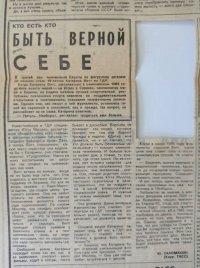
TO BE TRUE TO ONESELF

(the article published in russian 'Sovetskiy Sport' on February 21, 1985)

For the third time, the European figure skating champion is 19-year-old Katarina Witt from the GDR.
When Katarina Witt, after finishing the 1984 Olympic season, won "everything in the world"—at the Games in Sarajevo, the World and European Championships—at home she was named the best athlete of the republic. Fans flooded her with congratulatory postcards and telegrams, and journalists besieged her with phone calls. However, as they write about her now, she remained just as modest and calm as before. To the question of whether her fame relaxes her, Katarina replied:
— No. On the contrary, it makes me work even harder.

The most famous figure skating coach in the GDR, who raised Gabriele Seyfert and Annett Pötzsch, and now Witt, is Jutta Müller. When asked what character trait she would highlight in Katarina, she answered briefly: "Hardworking. None of my students have worked as hard on the ice as she has. "
Witt started skating when she wasn't even five years old. She was born in the town of Staaken, not far from Berlin, but her whole life is connected with Karl-Marx-Stadt, where the figure skating center was established. She doesn't like to leave her favorite city (exceptions are made only for competitions). According to Müller, she often exempts her best student from training camps, knowing that she is perfectly capable of training independently and seriously. Witt spends so much time at the ballet barre, in the gym, and on the ice rink that sometimes she simply has to be asked to finish her workout.
Katarina spends her free time just like her peers: she watches movies, goes to the theater, visits guests, and goes to the disco. Though, she does not understand those people who say they are there three times a week. 'I like the disco, but I don't think it should be an excessive obsession,' says the Olympic champion. And she loves her home more than anything, or rather, the room where her books are. For her, there is no better way to relax after intense training than an interesting book. Her parents, and a coach Jutta Müller, say that Katarina is so conscious and purposeful that she does not need "psychological-social" care. She carries out her regime herself, consciously.
She is businesslike. When giving interviews to journalists (which, according to reporters from the GDR, happens quite rarely), she never flirts and does not act arrogantly.
Katarina calls work the foundation of life. 'In our country, in the GDR, everyone works,' she says. 'Why should I be an exception?'
'I am sure that Katarina will be an excellent physical education teacher or coach,' says Müller. 'She already loves meeting with children.'"
When, on the eve of 1985, journalists asked Witt what goals she was setting for herself in the post-Olympic season, she replied:
— To defend the titles of world and European champion, to bring the new long program to peak condition. To improve my mastery.
And now one of the points of her program has already been completed in Gothenburg.
Her opinion on women’s figure skating in the year 2000 is curious. Perhaps, says the 1985 European champion, by then all athletes will be performing quadruple jumps. 'In 1982, I tried doing them with the help of a harness, but so far, alas, without success. I remember there was also talk that four different triple jumps would be needed to win the '84 Olympics. For me, two were enough. Perhaps, after all, our sport will develop more harmoniously'​
Yu. SALOMAKHIN,
(Corr. TASS).
1776429012206.jpeg
 
1985
WINTER UNIVERSIADE

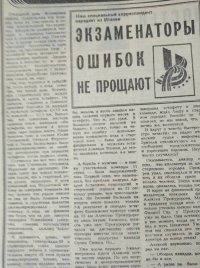
EXAMINERS DO NOT FORGIVE MISTAKES

(excerpts of the article published in russian 'Sovetskiy Sport' on February 22, 1985)

Our special correspondent reports from Italy
The next day of the World Winter Student Games gifted all participants and guests a wonderful masquerade ball: figure skaters competed for medals in the ice dance and pairs tournaments. Moreover, both groups performed their free programs on the same evening, compelling the packed stands of the Belluno Sports Palace to repeatedly explode with applause for five and a half hours, while sharing the magic of beautiful ice fairy tales with the performers.
...The applause of grateful fans, captivated by the skill of the Universiade-85 participants, almost never ceases in the arenas. But there had not yet been such a thunderous roar as the one with which the enthusiastic 'tifosi' greeted the free dance of Maya Usova and Alexander Zhulin. It was as if some unknown force, along with the final musical chord of the gypsy dance—alternating between burningly temperamental and languidly lyrical—lifted the spectators to their feet, and the announcement of the judges' scores was drowned out by the ovation. No one had any doubt: the students of Honored Coach of the RSFSR N. Dubova, having first won the original dance (according to the competition regulations, ice dancers perform only the original and free dances, while singles masters perform only the short and free programs) and now the free dance, became the Universiade champions. They left virtually no hope for victory to their experienced rivals, participants in world and European championships: the Czechoslovak duo Hola–Foltan (silver medals) and the brother and sister Beck from Austria, who took third place. Our second ice dance couple—Irina Zhuk and Oleg Petrov—is in fifth place in the final standings.
In the pairs competition, in an exceptionally sharp rivalry with our masters, the 'gold' was won by American students S. Hartyubis and K. Maurizi. The second-highest score went to Yulia Bystrova and Alexander Tarasov, and the third to Svetlana Frantsuzova and Oleg Gorshkov.​
A. ELISEYKIN.
BELLUNO, February 21.
1776430764873.jpeg
1776430783588.jpeg
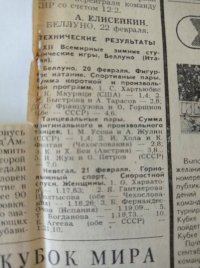
TECHNICAL RESULTS
(published in russian 'Sovetskiy Sport' on February 23, 1985)
XII World Winter Student Games. Belluno (Italy).
Belluno. February 20. Figure skating. Pairs. Sum of short and free programs. 1. S. Hurtubise and C. Maurizi (USA) – 1.4; 2. Yu. Bystrova and A. Tarasov – 2.8; 3. S. Frantsuzova and O. Gorshkov (both – USSR).
Ice dance. Sum of original and free dances. 1. M. Usova and A. Zhulin (USSR) – 1.4; 2. J. Holá and K. Foltán (Czechoslovakia) – 2.8; 3. K. and С. Beck (Austria) – 3.8 ... 5. I. Zhuk and O. Petrov (USSR) – 7.0.​
1776432695882.jpeg
TECHNICAL RESULTS
(published in russian 'Sovetskiy Sport' on February 26, 1985)
XII World Winter Student Games. Belluno (Italy). February 24.
Belluno. Figure skating. Men.
1. Yan Shibin (CHN) – 1.4; 2. R. Rosenbluth – 3.2; 3. D. Jamison (both – USA) – 6.0.
1776433574621.jpeg
 
Last edited:
1985
BETWEEN US, COACHES

LET'S TALK ABOUT FEMALE FIGURE SKATERS

(the article published in russian 'Sovetskiy Sport' on February 27, 1985)

Jutta Müller (GDR) and Vladimir Kovalev (USSR) answer questions from the sports editors of TASS and ADN.
— In your opinion, what are the distinguishing features of women's singles skating today?

MÜLLER: Unfortunately, in women's figure skating today, uncertainty in performing difficult jumps still prevails. While technical elements of the highest difficulty should be prioritized, I advocate for more harmony, expressive, artistic performance in programs. I also support giving greater weight to artistic marks.
KOVALEV: First and foremost, women's singles skating at present is becoming a sport of athletics. This means a figure skater must possess a diverse technical arsenal: performing jumps, spins, and footwork.
All this must be combined with softness, lyricism, the ability to hear and understand music, and the means of figure skating to express ideas and emotions, and convey them to the audience. A very large role is played by the athlete's charisma. Remember the figure skaters of past years—Peggy Fleming, Gabriele Seyfert, Dorothy Hamill. Is there anyone who, besides specialists, remembers what elements they included in their programs? They are remembered because they were feminine and charming on the ice.
And finally, a necessary condition is an original, well-choreographed free program, the music of which is close in spirit and style to that particular athlete.
— What are the prospects for the development of this discipline of figure skating?
MÜLLER:
At the European Championships in Gothenburg, we already saw certain progressive shifts. If until now numerous falls spoiled the overall picture, now the leading female figure skaters are starting to skate more confidently. I think that complex triple jumps should be included in the free program only after mastering them. I believe that athletes should include three or four different triple jumps in their programs, organically included in the general choreographic structure of the composition.
KOVALEV: In my view, the prospects are in complicating the technical side of the program, and overall—in achieving the greatest harmony between the athletic and choreographic sides of compositions.
— Do you think that female singles skaters should strive to master jumps with three and a half or more rotations?
MÜLLER:
Theoretically, the mastery of triples by women, for example, the triple Axel, is quite possible. However, this is for individual skaters only. With favorable physical data and the ability to develop high speed, this jump could be trained even at a young age, but then the risk of injury would be quite high. I am inclined to think that triple jumps should be shown in combinations.
KOVALEV: From my point of view, complicating jumps will go up to a certain limit. Undoubtedly, it is necessary to master all types of triple jumps. As for "masculine difficulty," with jumps of three and a half and four rotations, girls can easily do without them. The drive for super-difficulty will inevitably lead to a loss in artistry and the loss of the feminine charm of skating.
— Whom do you consider the most promising female figure skaters in the current season—the main contenders for medals at the World Championships?
MÜLLER:
In the post-Olympic year, young athletes who did not hold high places last season can suddenly emerge. It is difficult to name specific names. But the serious contenders for top awards are Tiffany Chin from the USA and my student Katarina Witt.
KOVALEV: Of the foreign athletes, first of all, Katarina Witt, Tiffany Chin, and Midori Ito from Japan. Of the Soviets—Kira Ivanova and Anna Kondrashova.
— Who, in your opinion, will claim the medals of the '88 White Olympics?
MÜLLER:
We still need to wait for many young female athletes, who began competing on the world stage this year, to achieve recognition.
KOVALEV: Almost all of the above names. And besides them, new figure skaters will definitely appear, who are 16–17 years old today.
1776439845172.jpeg
 
1985
A FOUR-REVOLUTION JUMP?

(the article published in russian 'Sovetskiy Sport' on March 1, 1985)

PRAGUE. (TASS). Preparing for the World Championships in Tokyo, the new European figure skating champion, Czechoslovak athlete Jozef Sabovčík, has included a four-revolution loop jump in his training sessions. He performed this extraordinary jump during an exhibition performance after the European Championships in Gothenburg but did not land it quite successfully.
"I feel enormous joy knowing that the gold medal is mine. I could hardly believe that I had won, and only now am I beginning to truly realize it," Sabovčík told journalists upon returning from Sweden. He noted the intense level of competition in the men's event in Gothenburg, which caused him excessive nervousness. The champion himself considers his performance in the free skate to be not very successful.
Regarding the upcoming World Championships, Sabovčík emphasized that he will primarily work on perfecting his compulsory figures. In response to the question of whether he will include the four-revolution jump in his free skate composition when competing in Tokyo, the figure skater said that everything will depend on the course of the competition.
1776441402384.jpeg
 
1985
WORLD CHAMPIONSHIPS

And May It Continue This Way...

(the article published in russian 'Sovetskiy Sport' on March 5, 1985)

Our special correspondent reports from Japan

Soviet figure skater Alexander Fadeev—winner of the small gold medal of the world championship in figure skating.

In the program published in Tokyo specifically for the world championship, many beautiful photographs—an entire gallery of "stars" of figure skating from 24 countries of the world. Among them are photographs of the 14 best figure skaters of the Soviet Union. Today we can say with certainty that all of them are part of the group of contenders for medals of the world championship-85. These are pairs E. Valova and O. Vasiliev, L. Selezneva and O. Makarov, V. Pershina and M. Akbarov, ice dance duets N. Bestemianova and A. Bukin, M. Klimova and S. Ponomarenko, masters of single skating A. Fadeev, V. Kotin, A. Kondrashova, K. Ivanova.
This season is special opening a new Olympic cycle. Therefore, we see a complete transformation of the creative face of our national team—in 1985 the efforts of our coaches and choreographers created original programs for our leaders. I will name the brightest of them: "Shurale" — Valova and Vasiliev, "Carmen" — Bestemianova and Bukin, "White Night," or "The Marriage of Figaro" — Selezneva and Makarov, «With love for the champions» - Klimova and Ponomarenko, the "Spartak" — Pershina and Akbarov, compositions from Russian folk melodies — Fadeev, and compositions from works of Saint-Saëns, Tchaikovsky - Kotin. The uniqueness of these innovations is that the concept of a balanced and harmonious program in them is expressed through to the end.
A feature of the season also consists of the fact that in national teams new leaders have emerged: the Americans — B. Boitano, theJapanese — 15-year-old M. Ito, the Canadians — two pairs, the French — F. Fedronic.
The first press conference for 200 journalists accredited at the world championship was led by ISU council member Josef Dědič (Czechoslovakia). He again confirmed the position of the ISU in the field of figure skating — to adhere to a firm course toward balanced programs, toward a combination of artistry, spectacle, and modern complexity. Dědič emphasized that the repetition of one and the same triple jumps will not bring high marks. Both for the judges and for the spectators, variety in everything is much more valuable — both in music, and in jumps, and in choreographic means.
During training at the "Yoyogi" Sports Palace, I met with the Honoured Coach of the USSR Tamara Moskvina. She was conducting the final warm-up of her students — Valova and Vasiliev.
“An interesting spectacle awaits us, — she said. — I have watched attentively the practices of foreign pairs and find that there is progress in the mastery of our longtime rivals — figure skaters of Canada, USA. In the first place I will name the Canadians Katherina Matousek and Lloyd Eisler (fifth place at the world championship-84), Cynthia Coull and Mark Rowsom (seventh place last year), and also the new American pair Jill Watson and Peter Oppegard. But our pairs are ready for the struggle for medals.”
And here is the first workday: at 6:30 AM, three Soviet athletes — A. Fadeev, V. Kotin, and V. Petrenko — went to the ice for performance of "School" (Figures). At 8:00 AM, the panel of judges, headed by B. Wright, invited the 27 participants.
In the first figure, the best result was shown by the new champion of Europe, J. Sabovčík (Czechoslovakia). Second was Fadeev. However, the next two exercises brought an indisputable advantage to Fadeev. This figure skater for four years has performed on the international arena, but for the first time with such brilliance he won "School" and won the small gold medal, leaving behind Sabovčík, Fedronic, and the Canadian B. Orser. Finishing the struggle in sixth was the silver medalist of the European championship Kotin. And the debutant of the world championship Petrenko finished 12th.
On March 5, the figure skaters have the most intense day: in the morning, competitions in the compulsory ice dances will take place; in the afternoon — the short program for men; and in the evening, pairs will perform their short program.​
A. SHELUKHIN.​
TOKYO, March 4.
TECHNICAL RESULTS
World Figure Skating Championships. "Yoyogi" Palace of Sports. March 4.
Men. Compulsory program. 1. A. Fadeev (USSR) – 0.6; 2. J. Sabovčík (Czechoslovakia) – 1.2; 3. F. Fedronic (France) – 1,8; 4. B. Orser (Canada) – 2.4; 5. B. Boitano (USA) – 3.0; 6. V. Kotin (USSR) – 3.6; 7. G. Filipowski (Poland) – 4.2; 8. H. Fischer (FRG) – 4.8… 12. V. Petrenko (USSR) – 7.2.
1776505802177.jpeg
 
1985
WORLD CHAMPIONSHIPS

RUSH HOUR ON THE ICE OF "YOYOGI"

(the article published in russian 'Sovetskiy Sport' on March 6, 1985)

Our special correspondent reports from Japan
The training rink "Shinahava." 9:00 AM. In the narrow corridor first appears a girl with perpetually smiling eyes and the stern, youthful look of a dzhigit (horseman). These are Veronika Pershina and Marat Akbarov. And here, as if running a 100-meter sprint, through the corridor pass the fair-haired Larisa Selezneva and the tall, athletic Oleg Makarov. And finally, in snow-white costumes, the Olympic champions Oleg Vasiliev and Elena Valova march into the arena.
Vasiliev casually says "Bonjour" to the French coach Robert Dureville, shakes the hand of the French champion Fernand Fédronic, and just as casually begins his ballet warm-up. At the training sessions of our pairs, there are many coaches and judges. And they know that this spectacle is rare in its impressiveness and effectiveness. Now all realize that Soviet pairs are the trendsetters in Europe. And it is thought that they will prove this class also in the world arena. This is what the coach of the French national team Dureville says.
The class of Soviet duets is so high that many masters of figure skating should learn from them. In the first order, they should learn original thinking, the art of artistry. In this direction, the bst masters gain everything — both love of the spectator, and the recognition of the judges.
The confirmation of these words was the competitions of the second day of the championship in Tokyo.
The tone was set by the masters of ice dance. Today, on a creative surge are the champions of Europe Natalia Bestemianova and Andrei Bukin. For them, technical difficulties have ceased to exist, their skating is soft and noiseless. Already in the Viennese Waltz, they conquered all the judges with their breadth and freedom of movement. Scores of 5.8–5.9. In three compulsory dances, the Viennese Waltz, American Polka and Blues— Bestemianova and Bukin — took first place.
No problems with complex technique in the compulsory positions were seen from our second duet — Marina Klimova and Sergei Ponomarenko. With each dance, they more firmly established themselves in second position, pushing back the champions of the USA Judy Blumberg and Michael Seibert.
The question about the American duet unexpectedly acquired sharpness in connection with the fact that they are stubbornly pursued by the champions of Canada, Tracy Wilson and Robert McCall, students of the multiple-time world champion Bernard Ford.
On the eve of the starts, Ford said:
— We do not hide our intentions. Our task is, as a minimum, to be the "third".
A pleasant surprise of the championship appeared to be the successful start of the third Soviet duet — Natalia Annenko and Genrikh Sretenski (they moved up to 7th place).
The culmination of the second day was the performances of men in the short program. The group of the strongest was opened by the champion of Canada, Brian Orser. In the composition was a spectacular rhythm, but it was so monotonous that it could not but affect the quality of the skating. But Orser executed very complex jumps, and this allowed him to receive for technique scores of 5.7–5.8. Thus, the Canadian presented a difficult task for his rivals.
The champion of France, Fédronic, could not withstand the intensity of the struggle and, having failed a jump combination, dropped out from the list of contenders for medals.
However, all other favorites were at their peak. The champion of Europe, current leader Jozef Sabovčík (Czechoslovakia), was flawless in his jump combination and triple Lutz. His coach Agnessa Vlahova kissed Sabovčík for such a successful start. Our judge Vedenin gave Sabovčík a 5.9 for technique. And overall, it was fair. The other judges gave 5.7–5.8. In the end, this brought Sabovčík third place. The fact is that after him performed last year's champion of Europe, Aleksandr Fadeev. Let us recall that he missed the European championship in Gothenburg due to illness. But upon arriving in Tokyo, he first won the 'school' (compulsory figures), and now he has amazed everyone with his short program set to Russian folk melodies. Fadeev started the performance from a complex triple Lutz jump combo and finished with a swift footwork sequence. On the scoreboard appeared two scores of 5.9 for technique, and for artistry — four 5.9s. This, undoubtedly, is first place.
Excellently performed on this day also Vladimir Kotin. With scores of 5.6–5.7–5.8, he took fifth place in the short program.
Misfortune befell only one of our athletes. The 15-year-old debutant Viktor Petrenko failed to land his jump cascade and ultimately finished in 13th place.
Late in the evening, pairs entered the battle.​
A. SHELUKHIN.
TOKYO, March 5.
TECHNICAL RESULTS
World Figure Skating Championships. Tokyo. Palace of Sports "Yoyogi." March 5.
Ice Dancing. (After 3 compulsory dances).
1. N. Bestemianova and A. Bukin (USSR) – 0.6; 2. M. Klimova and S. Ponomarenko (USSR) – 1.2; 3. J. Blumberg and M. Seibert (USA) – 1.8; 4. T. Wilson and R. McCall (Canada) – 2.4; 5. P. Born and R. Schönborn (FRG) — 3.0; 6. K. Barber — N. Slater (England) — 3.6; 7. N. Annenko — G. Sretenski (USSR) — 4.2; 8. I. Micheli and R. Pelizzola (Italy) – 4.8; 9. K. Beck — C. Beck (Austria) – 5,4; 10. K. Garossino and R. Garossino (Canada) – 6.0.
Men. (Total sum after the short program). 1. A. Fadeev (USSR) – 1.0; 2. J. Sabovčík (Czechoslovakia) – 2.4; 3. B. Orser (Canada) – 3.2; 4. B. Boitano (USA) – 4.6; 5.V.Kotin (USSR) – 5.6; 6. G. Filipowski (Poland) – 6.6.
1776511227889.jpeg
 
1985
WORLD CHAMPIONSHIPS

A COLORFUL DIALOGUE ON ICE

(the article published in russian 'Sovetskiy Sport' on March 8, 1985)

Our special correspondent reports from Japan
The highlight of the third evening of the World Championships was the free program for pairs. Elena Valova had been waiting for these moments with trepidation. Later, she said:
"No one even realizes how upset I was by my mistake on the double Lutz in the short program. I probably blamed myself more than anyone else and couldn't sleep. But, as sometimes happens, my sense of responsibility sharpened to the limit the next day..."
Let's return to the first round of the pairs competition. Thirteen pairs competed in the championship. Naturally, the athletes from the USSR, Canada, and the USA were the center of attention.
By draw, Olympic champions Elena Valova and Oleg Vasiliev were among the first to start, performing a miniature in their short program to the popular melody "Flight of the Bumblebee." Our figure skaters handled the twist and lift superbly, and earned applause for their death spiral, but they made an error in the Lutz jump. As a result, they received 5.2–5.3 for technique and 5.7–5.8 for artistry.
Such an unexpected start to the competition somewhat fueled the excitement of all participants: both the Canadians and the Americans realized there was an opportunity to fight for the lead. However, evidently, the desire for quick success played a treacherous role. The new leaders of the American team, Jill Watson and Peter Oppegard, could not handle the double Lutz. Their scores for technique ranged from 4.6 to 5.4, and for artistry — from 4.9 to 5.7.
Then, experienced masters launched their attacks on the Olympic champions' results. First and foremost were the Canadian champions, 20-year-old Katherina Matousek and 22-year-old Lloyd Eisler. Their program, set to the striking music of composer R. Rodgers, was performed with confidence. I should note that the coach of this pair, Kerry Leitch, had traveled to Moscow twice for the "Moscow News" international tournament and had quite thoroughly studied the experience of our specialists. This apparently helped the Canadians find several interesting solutions for their combinations. And here are the scores: for technique — 5.3 to 5.8, for artistry — from 5.2 to 5.6. As you can see, they were still unable to surpass Valova and Vasiliev in the second mark.
Undoubtedly, the highlight of this intense evening was the performance of the silver medalists of the last European Championship and USSR champions Larisa Selezneva and Oleg Makarov, who performed their composition in a modern choreography style. It should be noted that it was in this duo that a powerful creative charge was most palpable. There was not a single standard movement in the approaches to the elements, and because of this, everything was perceived freshly, with an unexpected effect. The Lutz jump and the step sequence made a special impression on the judges. Japanese TV camera operators later replayed the slow-motion footage of Selezneva and Makarov's program twice. Our figure skaters took the lead, receiving scores of 5.7–5.8.
Thus, the "reconnaissance by fire" brought success to the Leningraders Selezneva and Makarov, and Valova and Vasiliev, who took first and second place respectively. The Canadians Matousek and Eisler moved into third place. Everything was now to be decided by the free program.
Yes, we witnessed a small miracle: Elena was transformed, and immediately the dialogue of two great masters sparkled with all its colors on the ice. I would call it a dialogue of soaring birds—this is exactly how the Olympic champions Valova and Vasiliev interpret the music from the ballet "Shurale."
By draw, they started earlier than their main rivals. Oh, how many spears have been broken in arguments about which draw is more favorable! But practice convinces us of one thing—if the athletes are strong, the draw does not matter to them. The brilliant skating of Valova and Vasiliev captivated the entire arena!
The audience greeted every score with a standing ovation. The score of 5.8 was announced ten times, and 5.9 five times. In essence, the battle for the "gold" was a foregone conclusion.
The Canadians Matousek and Eisler clearly "burnt out" from nervousness and in their Spanish program did not reveal all their possibilities. They were not able to receive a single score of 5.7. To a certain extent, what helped them was that they were liked by the judges after the short composition. And the authority of the champions of Canada helped them to maintain the third position. I shall remind you that last year the World Championship was won by the Canadians B. Underhill and P. Martini.
In Tokyo, silver medals, as in Gothenburg, were deservedly won by Soviet pair skaters Larisa Selezneva and Oleg Makarov. The combination with a double Axel, a dashing lift with a flip of the partner — how all this decorated their composition. And it is thought, only a mistake in the triple toe loop did not allow them to receive marks higher than 5.7–5.8.
It must be admitted that the mentor of the world champions Tamara Moskvina possesses an extraordinary talent — she knows how to bring her pupils to the main start of the season in excellent form. In an interview she emphasized:
— Our success is an achievement of the entire Soviet school of pair skating. The creation of new programs in the '85 season I regard as a creative feat of Valova and Vasiliev. They did not want to be content with old baggage, boldly went on a search and performed in Tokyo in a fighter-like manner...
On the same day into the piggy bank of the USSR national team one more gold medal — a small one — was brought by Kira Ivanova. Now in special esteem is the beautiful style of execution of the school, which the coach Vladimir Kovalev helped her to form. Our second figure skater Anna Kondrashova occupied fourth place (and for a long time was even third). The Sverdlovsk-resident Natalia Lebedeva is also progressing — she has 8th place among 26 female athletes.
The original dance quickstep changed nothing in the alignment of forces. Natalia Bestemianova and Andrei Bukin lead the group of the strongest duets.
In the corridors of the Palace of Sports "Yoyogi" lively discussions go around the competitions of men. The sensational performance of Alexander Fadeev, who won both the "school" and the short program, was so commented by the Olympic champion American Scott Hamilton:
— I from my own experience know how difficult it is to skate when you already have first place by "school." As a rule, in these situations great nervousness and constraint appear. All the more in this regard I was amazed by Fadeev — in the most difficult situation he proved himself a real virtuoso. Full freedom, relaxedness of movements and even a smile after the most difficult cascade.​

A. SHELUKHIN.

TOKYO, March 7.
TECHNICAL RESULTS
World Figure Skating Championships. Tokyo. Palace of Sports "Yoyogi." March 5.
Pair skating. Short program. 1. L. Selezneva and O. Makarov – 0.4; 2 E. Valova and O. Vasiliev (all – USSR) – 0.8; 3. K. Matousek and L. Eisler – 1.2; 4. C. Coull and M. Rowsom (all - Canada) - 1.6; 5. V. Pershina and M. Akbarov (USSR) - 2.0; 6. J. Watson and P. Oppegard (USA) - 2.4; 7. M. Kunhegyi and L. Johnston (Canada) – 2.8; 8. M. Landgraf and I. Steuer (GDR) - 3.2; 9. N. Seybold and W. Seybold (USA) - 3.6; 10. C. Massari and D. Caprano (FRG) – 4.0.
March 6. Sum of combined event. 1. E. Valova and O. Vasiliev - 1.8 points; 2. L. Selezneva and O. Makarov (both – USSR) – 2.4; 3. K. Matousek and L. Eisler (Canada) - 4.2; 4. J. Watson and P. Oppegard (USA) – 6.4; 5. M. Kunhegyi and L. Johnston (Canada) – 7.8; 6. V. Pershina and M. Akbarov (USSR) - 8.0; 7. C. Coull and M. Rowsom (Canada) – 8.6; 8. M. Landgraf and I. Steuer (GDR) - 11.2; 9. N. Seybold and W. Seybold (USA) - 12.6; 10. C. Massari and D. Caprano (FRG) – 14.0.
Women. Compulsory program. 1. K. Ivanova (USSR) – 0.6; 2 T. Chin (USA) - 1.2; 3. K. Witt (GDR) – 1.8; 4. A. Kondrashova (USSR) - 2.4; 5. C. Leistner (FRG) - 3.0; 6. S. Cariboni (Switzerland) - 3.6; 7. D. Thomas (USA) – 4.2; 8. N. Lebedeva (USSR) – 4.8; 9. A. Gosselin (France) – 5.4; 10. E. Manley (Canada) – 6.0.
Men. Single skating. 1. A. Fadeev (USSR) - 2.0; 2. B. Orser (Canada) - 5.2; 3. B. Boitano (USA) – 7.6; 4. J. Sabovcik (Czechoslovakia) – 8.4; 5. V. Kotin (USSR) – 9.6; 6. H. Fischer (FRG) – 13.0; …9. V. Petrenko (USSR) - 21.4.
1777024333910.jpeg
 
1985
WORLD CHAMPIONSHIPS

MAJOR SYMPHONY ON TOKYO ICE

(the article published in russian 'Sovetskiy Sport' on March 10, 1985)

Our special correspondent reports from Japan

In Tokyo, the World Figure Skating Championships have concluded. Three gold and three silver medals — such is the result of our athletes' performances.

On the very first day of the world championship in Tokyo, all journalists were handed packets with information about the participants. There was also a photograph with the caption "1985 World Champions." It depicted E. Valova and O. Vasiliev, N. Bestemianova and A. Bukin, K. Witt (GDR), and the Canadian B. Orser. Apparently, the championship organizers had no doubt that Orser would be beyond competition. But sport is beautiful for its unpredictable drama.
Let’s listen to Alexander Fadeev, the new world champion:
- A year ago in Ottawa, I was very close to beating the American Scott Hamilton, the Olympic champion. But then I didn't manage it and stayed third. I regarded that bronze as a failure and began to prepare for this season in a new way. Already in November, I started at an international tournament in Tokyo and won against Orser. Likely, the Canadian coaches considered this an accident, as we met only in the free program. But now, in the compulsory figures, I overtook not only Orser but also Brian Boitano of the USA and Jozef Sabovčík of Czechoslovakia. This was the turning point.
And yet, much in this battle depended on the free program. Already during the warm-up of the strongest, the arena exploded several times with standing ovations: Orser, Boitano, Fadeev, and Filipowski are flying on winged skates. And all of them are performing the triple Axel. Three times Sabovčík attempted this jump, and on the third attempt, he jubilantly throws his hands up: the Axel is landed! Yes, all the skaters were coming out for this evening having such a trump card as the triple Axel.
However, Fadeev, who had to open the performances in the group of leaders, was ready for more. The first 60 seconds, like flashes of lightning, saw two unique Fadeev cascades: a triple Lutz and a triple toe loop, then a triple Axel and a double toe loop. Such complexity was unattainable for his rivals. The final segment of the composition highlighted a dramatic comeback by Fadeev, who, despite apparent exhaustion, squared his shoulders again and again went on the attack with difficult jumps, easily and playfully. Six judges immediately awarded a 5.9 for technical merit, and three — 5.8. For artistry, the scores were six 5.8s and three 5.9s. Brilliant victory for the Soviet figure skater, a pupil of coach Stanislav Zhuk and the CSKA school!
Sitting next to us, a commentator for Austrian television and former European champion, Ingrid Wendl, commented on the progress:
— We have known for a long time about the high class and courage of Fadeev. But what he showed in Tokyo is fantastic and goes beyond the limits of previous ideas. In the Soviet team, we saw a magnificent ensemble of three masters: following Fadeev come the most artistic skaters of this season — V. Kotin and V. Petrenko.
Indeed, the refined and unconstrained Kotin opened up as a multifaceted artist, a universal performer of classical compositions. Scores of 5.7–5.8 for artistry speak volumes. As a result, he took fourth place in the free program and fifth overall. The young Petrenko also managed to rise, entering the top ten.
As for our rivals, the medalists — Orser and Boitano — also managed in this season to a significant degree to restructure their style, to vary the pace and mood in the program more flexibly and diversely. Practically, they follow the same path as Soviet masters with the help of choreographers. It is characteristic that Boitano's coach, Linda Leaver, said: 'Now everyone is learning from the Russians how to combine sophisticated complexity and emotionality.'
On the eve of the final evening of ice dancing, a conversation took place with Olympic champion, six-time world champion L. Pakhomova. When I asked her to evaluate the situation this season, she replied:
— For the first time I see a world championship where there are no problems for our two leading duos — Bestemianova and Bukin, Klimova and Ponomarenko. They have gone so far ahead of their pursuers — ice dancers from the USA, Canada, FRG, that it creates the impression: the rivals even before the start were psychologically broken, they lost faith in themselves and in success...
Imagine, such things happen in sports too. For several training sessions, I observed the American couple J. Blumberg and M. Seibert and felt that they dance without joy. And what is a dance without feeling? Work.
But on the other hand, you should have seen how the new world and European champions Bestemianova and Bukin are gliding, listening to the growing waves of music from "Carmen," and then fly to meet the mysterious elements of Spanish rhythm. Natalia and Andrei came to a new interpretation of the dance and at the same time enriched their technique of skating. This identity of style was worthily appreciated in Tokyo: 13 marks of 5.9 and two marks of 6.0!
Thus, after the victory of Valova — Vasiliev and Fadeev, the piggy bank of the USSR national team added another gold medal — the third. In the last fifteen years, not a single other team in the world has known such a triumph!
Honored Coach of the USSR Tatiana Tarasova said:
— What can I say, we are boundlessly happy. A very beautiful victory for Natalia and Andrei — one more recognition of our direction in ice dances. I cannot but say the most kind words addressed to our friends, selfless helpers — choreographer Natalia Ulyanova, music editor Mikhail Belousov, and second coach Svetlana Alexeeva.
As was expected, with extraordinary lightness and confidence passed through the entire tournament the pupils of coach Natalia Dubova — M. Klimova and S. Ponomarenko. They deservedly became the silver-medal couple of the world, delighting with virtuosic technique, plasticity, great cohesion and soulful inspiration. It is curious that for artistry this duo received four marks of 5.9 and three marks of 5.8.
Their success once again emphasized that the Soviet school of ice dancing is extraordinarily versatile. Their coach emphasized that the two Soviet pairs started the new Olympic cycle extraordinarily confidently.
Practically at the world championship there were seven excellent couples, and it is especially pleasant for us that the Soviet duet N. Annenko and G. Sretenky— pupils of L. Pakhomova entered this top seven. They received marks of 5.5 for their dance.
The competitions of women single skaters have concluded. Olympic champion K. Witt (GDR) excellently performed her free composition and with marks of 5.8–5.9 became the owner of the gold medal. For the first time, a silver medal of the world championship was won by our K. Ivanova. In fourth place — A. Kondrashova.
A. SHELUKHIN.
TOKYO, March 9.
TECHNICAL RESULTS
World Figure Skating Championships. Tokyo. "Yoyogi" Palace of Sports. March 8-9.
Ice Dancing. Sum of combined event.
1. N. Bestemianova and A. Bukin — 2.0; 2. M. Klimova and S. Ponomarenko (all USSR) — 4.0; 3. J. Blumberg and M. Seibert (USA) — 6.0; 4. T. Wilson and P. McCall (Canada) — 8.0; 5. P. Born and R. Schönborn (FRG) — 10.0; 6. K. Barber and N. Slater (England) — 12.0; 7. M. Annenko and G. Sretensky (USSR) — 14.0; 8. I. Micheli and R. Pelizzola (Italy) — 16.4; 9. K. Beck and C. Beck (Austria) — 17.6; 10. K. Garrosino and P. Garrosino (Canada) — 20.0.
Women. Sum of combined event. 1. K. Witt (GDR) — 3.2; 2. K. Ivanova (USSR) — 3.8; 3. T. Chin (USA) — 5.0; 4. A. Kondrashova (USSR) — 9.0; 5. D. Thomas (USA) — 10.2; 6. C. Leistner (FRG) — 13.4; 7. N. Lebedeva (USSR) — 15.6; 8. A. Gosselin (France) — 20.6; 9. E. Manley (Canada) — 22.0; 10. C. Coull (Canada) — 23.0.
1777031121245.jpeg
1777031139473.jpeg
 
1985
WORLD CHAMPIONSHIPS
ECHO OF NEWSPAPER PAGES


TRIUMPH OF THE SOVIET SCHOOL

(the article published in russian 'Sovetskiy Sport' on March 13, 1985)

TOKYO. (Spec. corr. TASS A. Anichkin, A. Novikov). Three gold and three silver medals were brought to our athletes by the World Figure Skating Championships held in Tokyo. "Complete dominance of Soviet figure skaters and the school of figure skating of the USSR" — this is the commentary with which the sports columnist of the newspaper "Asahi" concludes the coverage of the tournament. In three finals out of four, the Russians proved invincible, writes the newspaper; moreover, it notes, in pair skating and ice dancing, both top steps of the podium were occupied by Soviet duos. A brilliant, confident victory was won in the men's singles by Alexander Fadeev, and Kira Ivanova, who received the "silver" in the women's category, was only slightly inferior in a close struggle to the World and Olympic champion Katarina Witt. But even in this single event where the USSR yielded the "gold," Soviet figure skaters have firmly established themselves among the world leaders, notes "Sankei Shimbun."
Japanese sports observers unanimously call the free dance of Natalia Bestemianova and Andrei Bukin, "Carmen," the culminating event of the championship. The stunning drama on the ice mesmerized everyone present in the hall of the "Yoyogi" Sports Palace, writes the sports commentator of the "Mainichi" newspaper. As soon as the final chords of the music by Bizet-Shchedrin died down and Carmen — Bestemianova froze on the knees of Jose — Bukin, a powerful wave of applause rolled under the arches of the Sports Palace, growing into an unabating storm of ovations after the judges' scores were announced. Two of them — for artistry — were the highest — 6.0, and all others were 5.9, emphasizes "Mainichi."
The victory in ice dancing particularly vividly demonstrated the superiority of the Soviet Union in this sport, which stands on the border with art, writes the columnist of the "Asahi" newspaper. The flourishing of Soviet figure skating, which brought Russians the gold medals of world champions in this type of skating for the first time after a six-year break, is solid and aimed at the future. It is no coincidence that second place also went to Soviet figure skaters — Marina Klimova and Sergei Ponomarenko, who demonstrated their own, vividly individual style of skating, a kind of creative opposite to the fiery dance of Bestemianova and Bukin. Their free dance was filled with subtle lyricism, points out "Asahi."
The sports columns of the Japanese press are filled with enthusiastic reviews about the performances of other Soviet champions — Alexander Fadeev, Elena Valova, and Oleg Vasiliev.
Fadeev left his rivals no chance of victory, writes "Mainichi." Even despite the fact that this was his first performance at an international tournament after a serious injury, he proved to be the undisputed leader in all three types of the competition program — in "school" (compulsory figures), in the short, and in the free programs. Having concluded his performance with a truly brilliant free program to the motifs of Russian melodies, the Soviet athlete, apparently, is opening the "Fadeev era" in men's singles, replacing the world leader Scott Hamilton of America, who has turned professional, emphasizes "Mainichi."
Valova and Vasiliev, who brought the Soviet team its first gold medal at the tournament in Tokyo, confirmed the traditional leadership of the USSR in this discipline of figure skating, according to the sports column of the "Tokyo Shimbun" newspaper. This pair showed, continues the newspaper, personal sporting courage as well, making up the gap after the short program from their rivals — another Soviet duo, Larisa Selezneva and Oleg Makarov. But even such a dispute speaks to the fact that the USSR will continue to lead the world elite of pair skating in the future.
On Sunday, exhibition performances of the world's strongest figure skaters — championship participants — took place at the "Yoyogi" Sports Palace. Filled to capacity, the Ice Palace applauded the outstanding figure skaters and champions. This bright ball of figure skating, said a commentator for the Japanese television company "TBS," turned into a demonstration of the superiority of the Soviet school of figure skating, which owns half of the medals contested in Tokyo, including three out of four golds.
1777032478596.jpeg
 
1985
INTERNATIONAL JUNIOR COMPETITION "FRIENDSHIP"
FACT-ASSESSMENT


JUNIORS ARE CATCHING UP WITH SENIORS

(the article published in russian 'Sovetskiy Sport' on March 21, 1985)

In the capital of the GDR — Berlin — the traditional "Friendship" international figure skating competitions with the participation of athletes from socialist countries have concluded. Once again, representatives of the USSR junior national team achieved great success: they have 3 gold, 4 silver, and 1 bronze medal. Here is an assessment of the results of this tournament by the Honored Coach of the USSR, Viktor Kudryavtsev.
Many still remember the results of the performance of the senior USSR national team at the World Championships in Tokyo. There, our masters won three gold and three silver medals, leaving far behind such strong teams as the USA, Canada. And now, following them, in Berlin, our juniors tried to repeat the achievement of the senior team. Again, in the team's piggy bank there are 3 gold medals. They were won by Odessa resident Vladimir Petrenko in men's singles, Muscovites Elena Leonova and Gennady Krasnitsky in pair skating, and Svetlana Serkeli and Andrey Zharkov in ice dancing.
Perhaps the most intense struggle unfolded among the men. It is curious that in the "six" of the strongest, three of our skaters and three representatives of Czechoslovakia were present. And they all pleased with their unordinary technique of complex jumps in three rotations. All the specialists liked the Odesa athlete Yuri Tsymbalyuk, who performed the short program elegantly, softly, and with a large amplitude of movements. However, in the free program, the scales tipped in favor of Vladimir Petrenko, who performed his program brilliantly, with high jumps in three rotations. In the combined total, Petrenko took first place, Tsymbalyuk — second, and Roman Kudryavtsev from Moscow — third. This is a great success for the coaches of the USSR national team — Galina Zmievskaya (Odesa), Irina Lyulyakova (Moscow).
The victory of the Kyiv girl Natalya Gorbenko in the girls' junior tournament of the championship was close. However, in the combined total, she lost slightly to the representative of the GDR, Simone Lang, who took second place in "school" and in the free composition. The highest result in the free skating was shown by Muscovite Elena Taranenko, her arsenal had all five types of the triple jumps. In "school" though, Elena was only tenth in results, and therefore, in the final standings, she ended up in sixth place. The third of our athletes — Natalya Skrabnevskaya (Moscow region) — could well have taken a prize. She was the leader in the "school," and second in the short program, but did not maintain her leading positions due to errors in the free composition. Total — 4th place.
As for the competition in pair skating and ice dancing, here the USSR's advantage was quite obvious. In pairs, representatives of the CSKA [Central Sports Club of the Army] — Leonova and Krasnitsky (coach V. Zakharov) stood out. Serkeli and Zharkov (coach G. Akkerman) became the winners in ice dancing. Moreover, the winners in pair skating demonstrated such unique elements as a double Axel in a combination and a 4-rotation twist. The Dnipropetrovsk pair I. Mironenko and D. Shkidchenko energetically supported their teammates and won the 'silver,' while Muscovites O. Grishuk and A. Chichkov deservedly became silver medalists in ice dance.
1777112962042.jpeg
 
Back
Top