1985
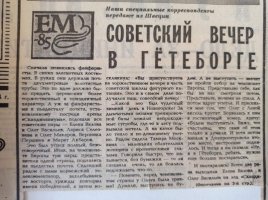
EUROPEAN CHAMPIONSHIPS
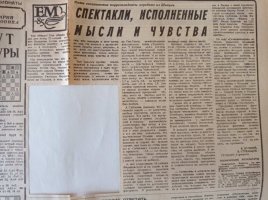
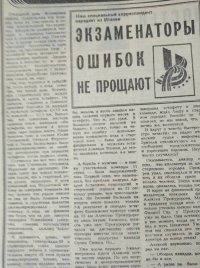
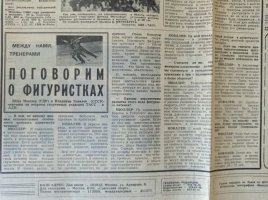
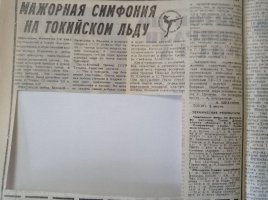
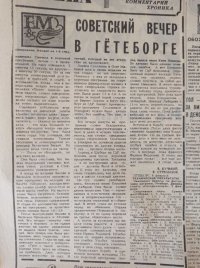
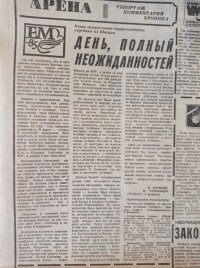
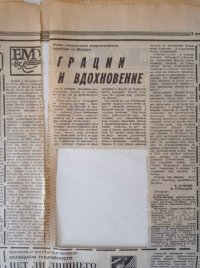
THE MYSTERY OF "SCHOOL"
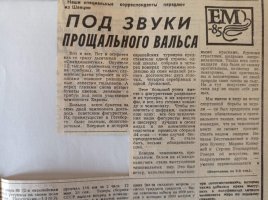
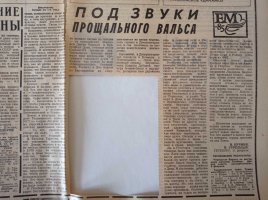
(the article published in russian 'Sovetskiy Sport' on February 6, 1985)
Our special correspondents report from Sweden
The huge hall is almost empty. Silence. It even rings in the ears. Only the crunch of skates is heard, and the occasional low-voiced whisper of coaches keeping their counts.
On the ice, a kind of mystery is taking place. On the mirror-like surface, female figure skaters trace whimsical patterns, like children drawing on asphalt. They are tightly surrounded by nine judges with impassive faces. Talking with the judges is forbidden. All of this is very much like an exam in a high school. The same tense and solemn atmosphere, the same ultra-strict discipline—no extra noise, no extra rustle.
However, on Monday morning, It really felt as if we had stepped into a school—but a special kind, from the world of figure skating. Twenty-six athletes, participants in the European Championships, were performing their compulsory figures that day, known as "school."
As is well known, this part of the program isn't popular with spectators. After all, this isn't free skating—there is no room here for improvisation or creative liberties. For six long hours, the women traced three compulsory figures. And the names themselves are complete mysteries: "rocker," "forward eight with brackets," and "backward eight with loops." In short, it’s prose. It’s no wonder there was a time (not so long ago) when "school" was proposed to be excluded from the program altogether.
But is "school" really that boring? And is it true that it’s devoid of emotion and feeling? Let’s sit closer to the boards and watch.
Florence Copp from France was called up. She darted onto the ice somewhat timidly, sideways—thin, with a haircut that was too short and round glasses on her nose. She looked exactly like a schoolgirl who had got into trouble! The head judge, B. Wright—wearing a Tyrolean hat and an English-cut coat, though he himself was American—approached Copp with importance and made some remark with a cold smile. Even under her makeup, Copp flushed red and involuntarily performed a curtsy. After that, her tracing was nervous; her blade was unsteady and hesitant. The axis of the drawing was shifted, the circles uneven, as if made with a broken compass. She collapsed against the shoulder of her coach, Jean Simon, by the boards, a fountain of tears springing from under her glasses. At 17, it’s forgivable.
Then it was the leaders' turn. Here, nerves were stretched like piano strings. Our own Kira Ivanova was the first to be surrounded by the judges. She traced firmly, evenly, and calmly. Her figures turned out the same way. Ivanova left the ice, but the judges circled for a long time like a swarm over the marks left by her blade. Finally, at Wright's command, they lined up and raised their placards. The numbers 3.8–4.0 were displayed there.Until now, there hadn't been scores this high. The gauntlet has been thrown down. Who will pick it up?
At that moment, there was a tenth judge on the rink—an unofficial one, of course. Katarina Witt, the Olympic champion from the GDR, was warming up off to the side, stealthily noting everything: Ivanova’s mood, her tracing, and the judges' reactions. Then she glided over to her coach, Jutta Müller. They whispered about something by the boards. Witt was called, but Müller kept talking and talking after her. She gripped the boards with her hands, her eyes fixed on the ice.
Witt’s movements are sharp. You can feel her self-confidence. You can feel her class. The "eights" laid down one on top of the other, as if through carbon paper. Five judges to Ivanova's four gave the preference to Witt, and she became the leader. She skated over to Müller. Only now could you see that she was whiter than chalk, her lips pressed tight. Müller gently strokes her hand: "Calm down! Everything is fine!"
No one had to calm down Claudia Leistner from West Germany. She indifferently left her tracing for the judges and moved decisively toward the locker room. But at the very curtain, hidden from prying eyes, she lurked to hear her scores. The judges were favorable to her, and she silently clapped for herself with her fingertips. Then she stepped cheerfully behind the scenes. She had reason to be happy. Leistner had crept right up behind Ivanova and Witt. And immediately after Leistner, the Swiss skater Sandra Cariboni performed successfully. Same emotions. But she didn't hide her joy: she did a cheerful upright spin in the corner of the rink. The judges looked on sternly, but indulgently...
Anna Kondrashova was the last of the leaders to trace the first figure. When the final stroke was made, Wright placed markers on the axis of the drawing (to check for symmetry), while his assistant took a brush and, in a businesslike manner as if in a kitchen, swept the ice shavings away. The judge from France, Monique Petit—a petite, nearsighted lady—first knelt and then nearly lay flat on the ice, her glasses pressed against the pattern. We don’t know what she discovered there, but she gave a lower score than the others.
"Kondrashova lost to Kondrashova," said one of our coaches, Alexander Vedenin. He explained his point: the national champion knows how to skate "school" better and more confidently, and has proven it many times.
Perhaps that was true. But even in losing to herself, Kondrashova surpassed Cariboni and Leistner to move into third place.
The conclusion of the "school" segment felt somewhat like a mass-start bicycle race. Witt, having broken away, hurried alone toward the finish of the grueling six-hour marathon. In pursuit, taking turns, rushed Ivanova, Kondrashova, Leistner, and Cariboni. It seemed the pursuers were just about to catch the runaway. But the second figure ended, then the third, and Witt remained unreachable. The rivals finished in the same order: first Ivanova and Kondrashova, followed by Leistner and Cariboni. Then the rest of the "caravan" arrived, led by Patricia Neske from West Germany.
So, is "school" really that boring? Isn’t its outward dryness and stiffness deceptive? It depends on how you look at it. If seen through the eyes of the skaters themselves, you won't find a more nerve-wracking or emotional internal duel. At least, that is what all the leaders believe.
Late in the evening, after the official opening ceremony of the championships, the pairs skating competitors began their battle. They performed their short program, which is roughly the equivalent of "school" for the singles skaters. Within 2 minutes and 15 seconds (no more and, ideally, no less), the skaters must demonstrate seven compulsory elements.
Olympic champions Elena Valova and Oleg Vasiliev performed these better than anyone else at the "Scandinavium." Their skating was filled with beauty and depth, and the judges, without hesitation, awarded them the highest scores. Following them is our other pair, Larisa Selezneva and Oleg Makarov, with Birgit Lorenz and Knut Schubert from the GDR a bit further behind. Veronika Pershina and Marat Akbarov are currently in fourth place.
Today, the European champions in pairs skating will be decided, the men will begin their "school" figures, and the women will start their short program. In short, it is a tense, event-filled, and difficult day.
V. KUCHMIY,
V. STRELTSOV.
GOTHENBURG, February 5.
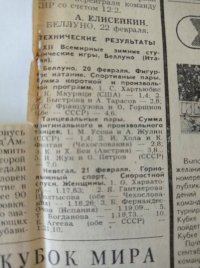
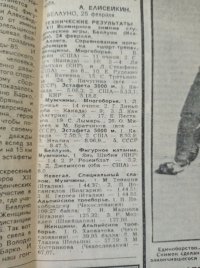
TECHNICAL RESULTS
European Figure Skating Championships. Gothenburg, February 4.
Women. Compulsory program. "Frölundaborg" Sports Palace. 1. K. Witt (GDR) — 0.6; 2. K. Ivanova (USSR) — 1.2; 3. A. Kondrashova (USSR) — 1.8; 4. C. Leistner (FRG) — 2.4;5. S. Cariboni (Swizerland) – 3.0; 6. P. Neske (FRG) – 3.6 ...11. N. Lebedeva (USSR) — 6.6.
Pairs Skating. Short Program. "Scandinavium" Sports Palace. 1. E. Valova – O. Vasiliev – 0.4; 2. L. Selezneva – O. Makarov (both pairs – USSR) – 0.8; 3. B. Lorenz – K. Schubert (GDR) – 1.2; 4. V. Pershina – M. Akbarov (USSR) – 1.6; 5. C. Massari – D. Caprano (FRG) – 2.0; 6. M. Landgraf – I. Steuer (GDR) – 2.4.
View attachment 11215



 .
.