Archive of newspaper articles | Page 38 | Golden Skate

Archive of newspaper articles

1987
WHAT YOU DON'T KNOW ABOUT YET

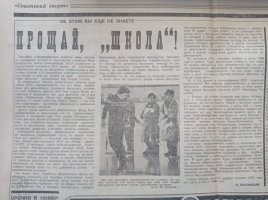
FAREWELL, "SCHOOL"!

(the article published in russian 'Sovetskiy Sport' on July 24, 1987)

Teletypes of world news agencies have sent out a report: "The Council and technical committees of the International Skating Union (ISU) have submitted for consideration to the ISU Congress the question of eliminating compulsory figures from the program of single skating competitions and reducing the number of compulsory dances from three to one at all championships among seniors held under the auspices of the union."
In a special letter sent to all members of the ISU Council, it is emphasized that these measures are necessary for the further progress of figure skating, that they are designed to make this sport more interesting and spectacular both for spectators and for the athletes themselves. "If this proposal is accepted," writes Agence France-Presse, "we will witness a real revolution in the small world of figure skating."
For a long time, the performance of compulsory figures was decisive in the ranking of forces at competitions. However, in recent years, this section of figure skating has lost its authority. The athletes themselves believe that practicing the "school" requiring diligence and perseverance, contributes little to increasing mastery, developing athleticism, and the beauty of skating.
"The intention to eliminate compulsory exercises from the competition program, even if at first only for seniors, is a big step forward," believes the first vice-president of the ISU, Dr. Josef Dědič (Czechoslovakia). In an interview with the newspaper Czechoslovak Sport, he stated: "Professional coaches from the USA, Canada, and other Western countries have long been against any restrictions on the 'compulsory program' since its removal requires duplicate hours, meaning it provides coaches with work and salary. And yet, one should not dismiss the fact that champions become primarily those who achieve success in the free program."
But perhaps it is necessary to preserve the practice of compulsory figures for young athletes and juniors? The generally accepted point of view stands: who does not possess the skills of the "school," that person cannot be considered a figure skater. But, for example, specialists unanimously recognize English ice dancer Christopher Dean as the most technical figure skater of modern times, although he never engaged in the "school" and never performed compulsory exercises. He acquired all the necessary technique during regular training sessions on the ice and in the hall for choreography.
"Despite the fact that the score for the 'school' is only 30 percent of the total score for the performance of an athlete, its role is immeasurably higher,» continues J. Dědič. «It influences the short programme, too: if a figure skater has a poor performance in the "school," they fall into a weaker group. And even with a good performance of the program, they are unlikely to receive the scores that they would be awarded in the group of the strongest. It would be more correct to build the sequence of performances based on the results of the last World or European Championship, taking into account the indicators of other significant competitions.»
At the ISU Congress, which will be held in June 1988 in Davos, a question will also be considered to ensure that the 10 best figure skaters or ice dance couples (based on the results of the previous championship) do not participate in the draw. It is expected that they will start in the last two groups according to the positions occupied up to that year.
And what do Soviet specialists think about the ISU innovations? Here is the opinion of the famous figure skater of the past, medalist of the World Championship, and now director of the figure skating school of the CSKA Army Club, Aleksandr Gorelik.
— The question of eliminating the "school" has already been discussed in sports circles for a long time. However, getting rid of it turned out to be not so simple. The roots of the "school" are deep. Its history goes back into the past, to the end of the XIX — beginning of the XX century, when athletes were obliged to trace complex flourishes, rosettes, and figures on the ice. The undisputed master of the "school" in Russia, and indeed in the whole world, was the first Russian Olympic champion Nikolai Panin-Kolomenkin. But now, it seems to me, the "compulsory program" is becoming less relevant from year to year. Even children in figure skating schools begin to practice compulsory figures from the age of 9–10, when they have sufficiently strong leg muscles. That is, at the level of mastery, the "school" has a very indirect influence...
According to the proposals of the Council and technical committees of the ISU, the short program for single skaters should be replaced by an original one, lasting 2.5 minutes and containing mandatory elements and two footwork sequences. The ice dance competitions will also become more spectacular. In one day, it will be possible to hold competitions for one compulsory and original dance. The compulsory dance will be determined by a draw right before the competition from three designated ones for the season. Competitions for pairs will remain unchanged.
The new rules, if approved by the ISU Congress, may come into force starting from 1988.​

O. POLONSKAYA.
1785587093023.jpeg

This is how competitions in the "school" take place. But it may happen that in just two years this section of figure skating will become a historical artifact.
Photo by Yu. Tkachev.
 
1987
Shorten the program?

(the article published in Ukrainian 'Sportyvna Hazeta' on August 6, 1987)

To eliminate compulsory figures from single skating competitions and to reduce the number of compulsory dances from three to one at all championships held under the auspices of the ISU—such are the proposals of the Council and technical committees of the International Skating Union that will be submitted for consideration to the ISU Congress in 1988. The new rules, if the congress approves them, "could cause a real revolution in figure skating," states an article published in the June issue of the ISU bulletin.
IN A LETTER sent to all ISU members, it is emphasized that the adoption of these proposals is necessary for the further progress of figure skating. The innovations will make the competitions more dynamic and interesting both for the athletes and for the spectators.
The current level of figure skating requires increasingly longer training sessions, and a massive amount of valuable time is spent on mastering compulsory figures, which do not contribute to the development of free skating, its grace, artistry, and athleticism. If compulsory figures are eliminated from the programs of World and European Championships and the Olympic Games, figure skaters will be able to concentrate on developing their artistic abilities, improving their skating style, and perfecting their technique. Furthermore, they will be able to dedicate more time to choreography and modern dance, meaning off-ice training that precedes the work on the ice.
The rejection of compulsory figures and two dances will allow for a reduction in the number of days spent on competitions, as the championships' program will automatically be shortened, which will undoubtedly ease the organization of these events.
According to the new proposals, instead of the current short program, an "original" program should be introduced, lasting 2.5 minutes, as well as two footwork sequences, the placement of which can be arbitrarily chosen by the athlete. Judging of the original program will be almost the same as the current short program, but perhaps a bit less strict. Due to the rejection of two compulsory dances, it will be possible to hold competitions for one compulsory and one original dance on the same day, which, in the opinion of the tech committee, will increase interest in these disciplines among both spectators and television viewers. The one compulsory dance will be determined by a draw from three previously announced dances for the season.
The proposed coefficients for single and pair skating are as follows: 0.4 — original program and 1.0 — free program; for ice dance: compulsory — 0.4, original — 0.6, free — 1.0.
It has also been proposed that the top ten figure skaters or pairs based on the results of the previous championship should not participate in the draw. It is expected that they will start in the last two warm-up groups of the competition according to the places they achieved the previous year (from 10th to 1st). This way, the champions of the previous year will always skate last.
1785588322292.jpeg
 
1987
ON THE HORIZON — CALGARY


MAGIC MOSAIC

(the article published in russian 'Sovetskiy Sport' on August 28, 1987)

For two weeks, two-time world figure skating champions Ekaterina Gordeeva and Sergei Grinkov were guests of the skaters from the French city of Briançon. The athletes took part in a sports festival organized by the French Communist Party. Our athletes (the delegation also included Anna Kondrashova, Natalia Annenko, and Genrikh Sretenski) were warmly welcomed by thousands of figure skating fans who gathered at the Briançon Sports Palace. The stands were not empty even during morning practices. The audience watched the athletes' work closely, only occasionally whispering: "Look, look closely. A unique element! In Russian, this is called a 'podkrutka' [twist lift]."
Once, the mayor of the city of Albertville—the future capital of the 1992 Winter Olympics—Henri Dujol, came to a training session. The mayor admitted that he was amazed by the complexity of the combinations performed by Gordeeva and Grinkov.
"— I always imagined figure skating as something elegant, soaring... But today I saw firsthand that this is a sport of courageous people, I would even say, a heroic sport."
The two weeks spent by our figure skaters on French soil were packed to capacity with meetings, conversations, and new acquaintances. Katya and Seryozha gladly told their French friends about how they are preparing for the upcoming season, for the main event—the Olympic Games in Calgary. There were many questions. This short interview came out of them.
— Is there any special secret to the Soviet school of pair skating, which brings forward world-class masters in every four-year cycle?
Gordeeva:
— A special secret? Everything that Sergei and I have achieved in sports, we owe first and foremost to our CSKA school on Leningradsky Prospekt. Such masters grew up in this school as Tatyana Zhuk, Aleksandr Gorelik, Irina Rodnina, Aleksey Ulanov, Aleksandr Zaitsev, Marina Cherkasova, Sergei Shakhrai, Marina Pestova, Stanislav Leonovich... Perhaps the secret lies in traditions?..
Grinkov: — Choreographer Marina Zueva has been working with us for five seasons now. She is a product of the CSKA school and was a member of the national ice dance team. In Zueva's classes, we discovered a completely new world—the world of music and movement solutions. Marina raises us to be versatile dancers, so that we can master both the complexity of Mussorgsky and Tchaikovsky, and at the same time, the energy of sirtaki or the charleston. After all, pair skating is not just ultra-complex jumps and twist lifts. It is also a soul.
— With what mood, with what feelings are you starting the new Olympic season?
Gordeeva:
— For now, we are just gathering and accumulating impressions, thinking on the ice, improvising a bit, assembling a new program from fragments of certain images—like a mosaic. In this sense, the trip to France is extremely useful for us due to a mass of new impressions. I think the new composition will differ from the previous ones not so much even in the external pattern of the dance, but in its inner mood, its spirit.
Grinkov: — We only started skating in mid-July, but we are gradually getting into shape. In Briançon, we successfully landed a double Axel—not bad for summer. In the new Olympic program, a new dialogue will resonate on the ice. Katya and I have serious ideas. We really want everything to work out.
— They say that a champion's crown is heavy. How do you handle the "burdens" of your title?
Gordeeva:
— The happiest moment for me is when I am standing on the podium of honor, and the flag of our Motherland rises high. But right after that, thoughts start rushing in about training, the future program, and competitors. The championship title is not a burden to Sergei and me. We are friends, tolerant of each other, and rarely argue. If Sergei suddenly forgets something, I will always help out. After all, we are a small team.
Grinkov: — The status, as they say, obliges us. If we are champions, it means we must approach every new start with ultimate attention. We simply do not know how to perform half-heartedly. If you step onto the ice, it means you must fight to the end.
— What are your impressions of the trip to France?
Gordeeva:
— It was wonderful. People recognized us on the street, and strangers greeted us. I got the impression that we were swimming in a sea of smiles. On the street in Albertville, a chance meeting occurred with the mayor of the city, and he immediately invited us to visit the town hall. He talked with us for a long time, asked about our plans, about our preparation for the Olympic season, and introduced us to the designs for the Olympic venues in Albertville.
Grinkov: — Briançon is located in the French Alps. The beauty of the mountains and their majesty have always moved me. Furthermore, Briançon sits at an altitude of 1400 meters above sea level, making it close in its climatic conditions to Calgary. So we can consider that we already breathed in the Olympic air.
Gordeeva: — I would also like to add that the organizers of the sports festival treated us with the utmost attention and care. For example, learning about my hobby (I love to embroider), they gave me a special album for embroidery and accessories for it. I was deeply touched by this kind attention.
— Just the other day, by decision of the USSR State Committee for Sports, you were awarded the title of Merited Masters of Sports...
Gordeeva:
— This is a major and very important event in our lives. We are glad that every four-year cycle, the Soviet squad of pair skaters grows in its caliber—now there are six merited masters of sports skating in our national team. By the way, returning to the question about the secret of the Soviet figure skating school's success on the international stage, I will note one more point. Most likely, our victories are explained by the fact that beautiful conditions for training have been created in our country.
Grinkov: — Chatting with French figure skaters and coaches, we heard the phrase more than once: "We envy you! You have so many artificial rinks, and you don't have to pay crazy money for ice rental like we do..." We saw with our own eyes how difficult it is for an athlete in a capitalist country to fight for the necessary conditions to train. At every step, an insurmountable obstacle arises—money. Figure skating is an expensive sport. It is simply unaffordable for many.
— What are your immediate plans? When will you make your first start in the current season?
Gordeeva:
— Spectators will see us on the ice for the first time this autumn at the traditional "Moscow News" tournament.​
V. RYZHKIN,
Merited Coach of the RSFSR.
BRIANÇON — MOSCOW.
1785647053634.jpeg
 
1987
NEBELHORN TROPHY

FIGURE SKATING

(the article published in russian 'Sovetskiy Sport' on September 8, 1987)

OBERSTDORF. At the international figure skating tournament held in this West German city, victory in ice dance went to world junior champions Ilona Melnichenko and Gennady Kaskov from Moscow.
1785735791876.jpeg
 
1987
LESSONS OF COMPANIONSHIP

TEN DAYS IN SOKOLNIKI

(the article published in russian 'Sovetskiy Sport' on September 26, 1987)

Sokolniki was still bathed in greenery, barely touched by the first autumn yellowing, but winter was already fully in charge inside the Sports Palace on the Sokolniki rampart. The ice was creaking merrily under the skates, and the trainers were wrapped in warm jackets. The beginning of autumn is the most critical period in the work of figure skaters.
For days on end, the ice dancers Marina Klimova and Sergei Ponomarenko—students of the Honored Trainer of the USSR, Natalia Dubova—have been "working their magic" over a new Olympic program. Together with them, the Czechoslovak figure skaters Vera Rehakova and Ivan Havranek, who came to the Soviet Union for a training internship, are mastering the secrets of ice dancing.
The skaters spent only ten days together. For Vera, this time dragged on painfully—after all, at home she left her two-year-old son and missed him terribly. Ivan, on the other hand, did not want to leave Moscow at all—there was so much to learn from Marina, Sergei, and their teammates, who willingly shared their professional secrets.
"Our main task was to polish the compulsory elements," the Czechoslovak athletes' coach, František Blaťák, told me. "In this regard, Natalia Dubova is an unsurpassed master. Her students are famous for the absolute clarity of their tracking and their ability to perform the most complex elements naturally. As a coach, it was extremely useful for me to observe her training sessions and delve into her methods. These short ten days completely turned around my ideas about training figure skaters/dancers. It is not for nothing that it is so difficult to get into the Soviet Union for consultations with your trainers—there are too many who wish to do so from various countries."
The concept of "sharing experience" implies reciprocity. Therefore, Vera and Ivan were glad that they, too, proved to be helpful in some way to their Soviet friends.
"Such meetings are, in my view, useful for both sides," said Natalia Dubova. "They force our athletes to intensify their work, to manifest better human qualities—a sense of companionship, sincerity, and kindness. For me, it opens up another opportunity to test my methodology. If it works both for 'our own' and for 'outsiders,' it means it is fundamentally correct. I want to express only one wish. The traditional exchange of experience with representatives of other national teams happens exactly when we need to be left alone to work on future programs. Everyone wants to prepare surprises for the competitions. And right then, foreign athletes arrive. One must have a lot of courage to reveal professional secrets long before the start of the season. But my students agree to this, which pleases me greatly as an educator."​
N. KALUGINA.
1785736936208.jpeg
 
1987
ST IVEL INTERNATIONAL

FIGURE SKATING

(the article published in russian 'Sovetskiy Sport' on October 9, 1987)

LONDON. Following the original dance, the Moscow ice dance duo of M. Usova and A. Zhulin continues to lead at the traditional international figure skating tournament taking place here.
The first winners of the competition have also been determined. In the pairs tournament, Canadians D. Benning and L. Johnston took first place. Muscovites L. Koblova and A. Kalitin finished fourth.
In the ladies' event, World Championship bronze medalist C. Kadavy (USA) triumphed. Tournament debutante and World Junior Champion T. Andreeva from Leningrad took ninth place.
1785737423155.jpeg
 
1987
LIUDMILA PAKHOMOVA PRIZE

FIGURE SKATING

(the article published in russian 'Sovetskiy Sport' on October 13, 1987)

CHELYABINSK. The winners of the first All-Union ice dance tournament competing for the prize of Olympic champion Lyudmila Pakhomova are 20-year-old students of the Moscow Institute of Physical Culture, S. Lyapina and G. Sur.​
On the ice of the Chelyabinsk Sports Palace "Yunost," 18 duos from Moscow, Leningrad, Tashkent, Riga, and Kharkiv performed.
(TASS).
1785739519093.jpeg
 
1987
UKRAINIAN SOUVENIR JUNIOR INTERNATIONAL

One - Jump, Two - Jump...

(the article published in Ukrainian 'Sportyvna Hazeta' on October 20, 1987)

at the tournament for the prize of the "Ukraina" magazine

Everyone has probably seen figure skating competitions at least once. Their atmosphere is miraculous, isn't it? The participants and spectators are so solemn, well-dressed, and smiling! The music, the colors! Every performance is a true miniature, a unique little show. It is not without reason that figure skating tournaments are often called an ice ball.
But what happens on the ice on the eve of the competitions? On Sunday, young participants of the "Ukrainian Souvenir" international tournament for the prize of the Ukraina magazine went out for their last training session. The Kyiv Palace of Sports had a different, working appearance; the athletes were different too. No pageantry at all—focused, thoughtful faces, short phrases from coaches. And work, work, work... How many triple jumps will we see them perform tomorrow in the program? Two, three, four? And how many times do they need to practice them at rehearsal—eight, ten? It feels like I've lost count...
And finally, another group of athletes left the ice, and I managed to talk with the Honored Trainer of the Ukrainian SSR, Lidia Ivanivna Masliukova:
"This tournament is the test of strength for us, and a great hope for the future. For the Kyiv boys I train, achieving a podium spot is well within their reach, but serious competitors for them will be the Odesa skaters. By the way, last year in Odesa at an international tournament, one of my students, Dmytro Dmytrenko, finished fourth. He will be starting today as well."
After a short break, the draw began. With excitement, the participants approached the table to pull a token. Who will open the competition? And then everyone saw number one in the hands of Alina Pisarenko. The very first score of the tournament will be received by the 16-year-old Leningrad athlete.
Yesterday, the best in the "school" [compulsory figures] turned out to be: among girls—A. Pisarenko, and among boys—P. Fuchs (FRG). In pair skating, O. Chernyshova and D. Sukhanov (Leningrad) are leading after the short program. Late in the evening, the first performances of the ice dancers concluded.​
O. DMYTRYCHEVA,
student of the Faculty of Journalism at KDU [Kyiv State University]
1785740790598.jpeg
 
1987
UKRAINIAN SOUVENIR JUNIOR INTERNATIONAL

...Plus Artistic Impression

(the article published in Ukrainian 'Sportyvna Hazeta' on October 22, 1987)

at the tournament for the prize of the "Ukraina" magazine

The stands of the Kyiv Palace of Sports are becoming more crowded, there are fewer and fewer empty spaces on the information boards listing performance results, and the names of the leaders are being identified with increasing certainty—the youth competition is in full swing.
The attention given to the international junior figure skating tournament for the prize of the Ukraina magazine is no accident. Because such major showcases of athletes of this age are quite rare, they are rightfully considered a serious test of strength for both the figure skaters and their coaches.
Naturally, not everyone is equally lucky—the judges are very demanding. Here, the Austrian figure skaters Belinda Leiter and Eva Sonnenleitner watch the scoreboard with visibly somber expressions. Their marks are very low – 3-3.5.
"The competition has gathered well-prepared athletes," they say. "The Soviet, GDR, and Czechoslovak figure skaters have become strong rivals for us. We are not aiming for the podium positions, but we are glad for the opportunity to go through such a serious school, which this tournament is considered to be."
The technical level of the performances is quite high. This is the assessment of the five-time European Champion, three-time World Champion, and Olympic Champion Ondrej Nepela. His student from West Germany (FRG), Peter Fuchs, took first place after completing the compulsory figures. However, after the short program, the athlete from West Germany had to yield the leader's spot to Kharkiv skater Mikhail Shmerkin. The Soviet figure skater managed to pull ahead of his opponent thanks to higher marks for artistic impression.
Yesterday, the winners of the female singles event and the representatives of pair skating were determined: 1. A. Pisarenko, 2. T. Klenina (both from Leningrad), 3. Ye. Leonidova (Kharkiv);​
Pairs: 1. Ye. Chernyshova — D. Sukhanov (Leningrad), 2. O. Starcheva — V. Tkachenko (Dnipropetrovsk), 3. M. Hannebauer — M. Kreft (GDR).
O. DMYTRYCHEVA,
student of the Faculty of Journalism at KDU [Kyiv State University].
1785741772700.jpeg
 
1987
UKRAINIAN SOUVENIR JUNIOR INTERNATIONAL

When Passions Subsided

(the article published in Ukrainian 'Sportyvna Hazeta' on October 24, 1987)

at the tournament for the prize of the "Ukraina" magazine

The young, feisty rooster that became the emblem of the competition spread his wings and proudly raised his head, crowned with a pink comb, daring for the first time to crow "like a grown-up." It is hard to take the first steps. The voice sometimes cracks, letting its owner down. But later, the young rooster will become a real rooster and climb all the steps of a singing career, gaining even greater mastery in his art with each step. Each of the 90 participants in the international junior figure skating tournament for the prize of the Ukraina magazine also had to test their voice on the hospitable ice of the Kyiv Palace of Sports.
Alina Pisarenko and Vyacheslav Zagorodniuk in singles skating, ice dancers Iryna Sheremet and Oleksandr Stanislavov, and the pairs team of Evgenia Chernyshova and Dmitry Sukhanov were lucky. They became the winners. The medal ceremonies and the solemn closing moments of the tournament have passed, the passions subsided, and the competition ended. What did it mean for the athletes and their coaches, and what impressions did they take away? We spoke with representatives of the GDR (East Germany) delegation.
Fourteen-year-old East German figure skater Kathleen Fenske looks a bit embarrassed. It is the first time she is giving an interview:
"Kathleen, are you satisfied with your performance?"
"In the short program, as my coach also thinks, I wasn't at my best. Despite the second-best result in the free skate, that early mistake kept me from making the podium."
"What will you tell people about first when you get home?"
"Kyiv charmed me. It is a city of amazing beauty. I was especially impressed by the golden domes. And I also met my old friends here and made new ones."
The head of the GDR delegation, two-time Olympic, World, and European bronze medalist Uwe Kagelmann (who formerly competed in pairs with Manuela Groß), is now the head coach of the Berlin club "Dynamo," where Kathleen trains. For this tournament, Uwe brought two more of his pupils—Mandy Hannebauer and Marno Kreft, who took fourth place. Uwe kindly agreed to answer a few questions:
"Could you highlight anyone among the hosts of the competition, particularly among the pairs?"
"It is difficult to name specific names because quite a few have good prospects. Any predictions and conclusions are further complicated by the fact that the age of the participants varies."
"In just two weeks, the traditional international youth competition for the 'Blue Swords' prize will begin in the GDR capital. Don't you think the young athletes might get tired? Especially with the World Junior Championships ahead..."
"You see, none of these trials can be redundant for juniors. It is very important for beginner figure skaters to get the hang of it: to get used to performing in front of an audience, stabilize their results, and feel the spirit of competition. Without this, a true athlete cannot exist."
"From specialists at this competition, one could hear different opinions regarding the balance between technique and artistry in youth performances. What are your thoughts?"
"I think that precisely at this age, attention should be paid primarily to the technique of executing complex elements, because artistry comes with time. But even now, one can see that the best skaters demonstrate remarkable artistic abilities alongside masterful blade control. For example, Mikhail Shmerkin, Vyacheslav Zagorodniuk, Alina Pisarenko, Tatyana Klenina, and the pair Evgenia Chernyshova and Dmitry Sukhanov have not only mastered complex technique but have also developed their own original style."​
V. VYSHNEVSKA, O. DMYTRYCHEVA,
students of the Faculty of Journalism at KDU [Kyiv State University].
1785745400582.jpeg
 
1987
UKRAINIAN SOUVENIR JUNIOR INTERNATIONAL

When Passions Subsided

(the article published in Ukrainian 'Sportyvna Hazeta' on October 24, 1987)

at the tournament for the prize of the "Ukraina" magazine

The young, feisty rooster that became the emblem of the competition spread his wings and proudly raised his head, crowned with a pink comb, daring for the first time to crow "like a grown-up." It is hard to take the first steps. The voice sometimes cracks, letting its owner down. But later, the young rooster will become a real rooster and climb all the steps of a singing career, gaining even greater mastery in his art with each step. Each of the 90 participants in the international junior figure skating tournament for the prize of the Ukraina magazine also had to test their voice on the hospitable ice of the Kyiv Palace of Sports.
Alina Pisarenko and Vyacheslav Zagorodniuk in singles skating, ice dancers Iryna Sheremet and Oleksandr Stanislavov, and the pairs team of Evgenia Chernyshova and Dmitry Sukhanov were lucky. They became the winners. The medal ceremonies and the solemn closing moments of the tournament have passed, the passions subsided, and the competition ended. What did it mean for the athletes and their coaches, and what impressions did they take away? We spoke with representatives of the GDR (East Germany) delegation.
Fourteen-year-old East German figure skater Kathleen Fenske looks a bit embarrassed. It is the first time she is giving an interview:
"Kathleen, are you satisfied with your performance?"
"In the short program, as my coach also thinks, I wasn't at my best. Despite the second-best result in the free skate, that early mistake kept me from making the podium."
"What will you tell people about first when you get home?"
"Kyiv charmed me. It is a city of amazing beauty. I was especially impressed by the golden domes. And I also met my old friends here and made new ones."
The head of the GDR delegation, two-time Olympic, World, and European bronze medalist Uwe Kagelmann (who formerly competed in pairs with Manuela Groß), is now the head coach of the Berlin club "Dynamo," where Kathleen trains. For this tournament, Uwe brought two more of his pupils—Mandy Hannebauer and Marno Kreft, who took fourth place. Uwe kindly agreed to answer a few questions:
"Could you highlight anyone among the hosts of the competition, particularly among the pairs?"
"It is difficult to name specific names because quite a few have good prospects. Any predictions and conclusions are further complicated by the fact that the age of the participants varies."
"In just two weeks, the traditional international youth competition for the 'Blue Swords' prize will begin in the GDR capital. Don't you think the young athletes might get tired? Especially with the World Junior Championships ahead..."
"You see, none of these trials can be redundant for juniors. It is very important for beginner figure skaters to get the hang of it: to get used to performing in front of an audience, stabilize their results, and feel the spirit of competition. Without this, a true athlete cannot exist."
"From specialists at this competition, one could hear different opinions regarding the balance between technique and artistry in youth performances. What are your thoughts?"
"I think that precisely at this age, attention should be paid primarily to the technique of executing complex elements, because artistry comes with time. But even now, one can see that the best skaters demonstrate remarkable artistic abilities alongside masterful blade control. For example, Mikhail Shmerkin, Vyacheslav Zagorodniuk, Alina Pisarenko, Tatyana Klenina, and the pair Evgenia Chernyshova and Dmitry Sukhanov have not only mastered complex technique but have also developed their own original style."​
V. VYSHNEVSKA, O. DMYTRYCHEVA,
students of the Faculty of Journalism at KDU [Kyiv State University].
View attachment 11828
Nothing to do with skating, but having concentrated on onomastics, the study of names, when I was doing a PhD in linguistics, now I'm sidetracked by wondering how/why an East German child born in c1973 was given the Irish name Kathleen!
 
1987
UKRAINIAN SOUVENIR JUNIOR INTERNATIONAL

FIGURE SKATING

(the article published in russian 'Sovetskiy Sport' on October 25, 1987)

KYIV. The strongest young figure skaters from 10 countries competed in the "Ukrainian Souvenir" tournament for prizes from the weekly publication "Ukraine".
The winners were A. Pisarenko from Leningrad, V. Zagorodniuk from Odesa, the pairs team of E. Chernyshova and D. Sukhanov from Leningrad, and the ice dance duo of I. Sheremet and A. Stanislavov from Dnipropetrovsk. Among the foreign guests, only M. Hannebauer and M. Kreft from the GDR managed to take third place in the pairs skating event.​
D. PONAMARCHUK.
1785903374760.jpeg
 
1987
"All Stars" — For Children

(the article published in russian 'Sovetskiy Sport' on October 27, 1987)

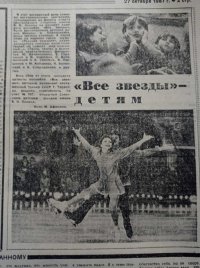
On this Sunday, the most enthusiastic spectators who came to the Central Stadium's Palace of Sports named after V.I. Lenin for the concert of the ice ensemble "All Stars" were children from orphanages in Moscow and the Moscow region, as well as young residents of the capital. Before them on the ice stage, the "Russian Fair" bustled, and episodes of mini-performances unfolded: "And the Saved World Remembers," "Tango, Tango" performed by wonderful figure skaters Yu. Ovchinnikov, E. Garanina and I. Zavozin, O. Volozhinskaya and A. Svinin, V. Pershina and M. Akbarov, I. Volynskaya and V. Spiridonov, and others.
The artists of the "All Stars" ensemble, directed by Honored Coach of the USSR T. Tarasova, decided to transfer all proceeds from this concert to account No. 707, opened by the Soviet Children's Fund named after V.I. Lenin.​
Photo by M. Afonina.
1785903862240.jpeg
 
1987
MENTANA JUNIOR INTERNATIONAL

FIGURE SKATING

(the article published in russian 'Sovetskiy Sport' on October 29, 1987)

ROME. The international junior ice dancing tournament held in the town of Mentana, near the Italian capital, concluded with a victory for Muscovites Irina Antsiferova and Maksim Sevastyanov (coach — N. Dubova).
1785904255796.jpeg
 
1987
OLYMPIC COURIER
LEADERS IN CLOSE-UP
TO FEEL THE "SOUL OF THE DANCE"

(the article published in russian 'Sovetskiy Sport' on October 29, 1987)

"Thank you, tonight you have done a wonderful job," — Tatiana Anatolyevna Tarasova laconically concluded another training session, seeing Natalia Bestemianova and Andrei Bukin off the ice rink. A minute later, the three-time world champions and four-time European champions, having changed into everyday sports jackets, came out into the rink's lobby for a conversation with a reporter.
— Do you like the new dance?
Bestemianova:
The word, "like" does not express what we feel. Personally, I have a feeling that the music of the "Polovtsian Dances" was written just for me. This is my element, my world. Sometimes, the music overflows and overshadows the skater's movement.
Bukin: To get into the world of musical images that make up the whole beauty of the piece — we always strive toward this ultimate goal. But this, as you understand, takes time. Some programs enter your heart easily and naturally, while others require a lot of spiritual strength and psychological tension.
— And how did your "relationships" with previous dances develop?
Bestemianova:
The hardest "nut to crack" was last year's program "Cabaret". Only at the November tournament in Tokyo did we reach that understanding of every gesture, every look, which was so crucial for us.
Bukin: But "Russian Fair", which we performed with at the Olympic Games in Sarajevo, with all its irony, humor, and grotesqueness, turned out to be very close to us. Ideas were born at every training session; we prepared happily and with a sense of mischief.
— Do you have any special secret in "interpreting" new dances?
Bestemianova:
Not to repeat ourselves — that is our motto, our credo over the past ten seasons. They say that we have our own style, that we know how to steer away from clichés. But perhaps that is precisely the special trait of those masters who win on the ice.
Bukin: I must admit, with more than just an ordinary passion and excitement, we immersed ourselves into the mysterious world of the "Carmen" dance. Our hard work paid off a hundredfold; we read Mérimée, studied Spanish painting, argued a lot, but we never copied anyone. And it was pleasant to see that we found our own key.
— Your creative alliance with Tatiana Anatolyevna Tarasova has been continuing for a whole decade. What kind of experience did you gain thanks to this alliance?
Bestemianova:
We are like-minded people! That is the main thing. And the value of our alliance is also in the fact that the coach helped us feel like individuals, like co-authors. They say there is a "dictat" of the coach's will. Maybe so, but the "dictat" of Tatiana Anatolyevna somehow resembles the warmth of a parental home. The destiny of a student is precious to her, and she fights for this destiny with all her passion. For her, we are "tarasyata" (Tarasova's kids), and our programs are her pain and happiness...
1785907270600.jpeg

 
Last edited:
1987
VETERANS REMEMBER...

A MEDAL WITH AN ALPINE RESIDENCE

(the article published in russian 'Sovetskiy Sport' on October 29, 1987)

In the medal collection of Honored Master of Sports Aleksandr Zaitsev, there is a gold medal with an "Alpine residence." It was won at the Olympic Games-76 in Innsbruck, where Aleksandr competed in the pairs event alongside Irina Rodnina.
— For my first Olympic tournament in Innsbruck, — recalls Aleksandr Zaitsev, — I arrived already holding the titles of three-time World champion and three-time European champion. It seemed like it would be difficult to surprise or scare me with anything. However, in Innsbruck, I found myself in a complicated psychological atmosphere. No matter where we turned, we constantly heard: "Rodnina and Zaitsev are within five minutes of becoming champions!" And yet, as an athlete, I knew how brilliantly prepared our main rivals, the GDR champions and European Championship silver medalists Romy Kermer and Rolf Österreich, were.
Our intuition did not fail us: Kermer and Österreich skated flawlessly. To win, Irina and I had to turn on "super-sonic speed"; we gave our absolute all, leaving nothing behind. When the final chord struck, I went over to the boards and suddenly realized that I could not even take a step. Right then, I literally collapsed onto the ledge and just stayed there sitting, waiting for the marks. Yes, we won! But Irina and I knew that our titles had no magical effect on the judges; we were running like sprinters toward the finish line with only one thought: to break the record!
That was long ago, back in 1976. Now, new generations of skaters are on the ice arena. I am also training the next generation: eight pairs are being raised at once in our Dynamo school. I lead my kids out to the start, and every time I quietly say: 'Don't cut yourself any slack! Skate as if it were the very last time in your life!'​
1987
ST IVEL INTERNATIONAL
AN INVITATION TO A DIALOGUE

THE "GRANDS" HAVE SHARPENED THEIR SKATES

(the article published in russian 'Sovetskiy Sport' on October 29, 1987)

The famous London fogs swirled around the ice arena this autumn as well, when the best figure skaters from the USA, Canada, the GDR, the FRG, and the USSR gathered here for another tournament to showcase their new programs. Some competed in the events, while others shone in the exhibition performances. One way or another, the fog over the athletic predictions has begun to clear: we saw firsthand the immense desire to fight and win with which the 'stars' of figure skating are preparing for the Olympic tournament in Calgary.
A happy smile lit up the face of Caryn Kadavy after her victory in London. The bronze medalist of the World Championship has wasted no time: by October, she is already in top shape. Talk about pace! Her coach, Carlo Fassi, stated: 'The dress rehearsal before Calgary was successful for us. Five difficult jumps are a powerful trump card for Kadavy.'
Kurt Browning from Canada caused quite a stir when, during practice in London, he confidently landed a four-revolution jump—the quadruple toe loop. Many expected him to attempt it in the competition as well. However, the Canadian preferred to execute only triple jumps and successfully avoided any mistakes.
Why are our opponents paying such close attention to the issue of stability? Their tactics have changed remarkably under the influence of the new rules approved by the International Skating Union. Now, for every fall during a jump, a skater faces a deduction of 0.1–0.2 points from each judge. And what if there are two or three falls? Practically, the factor of reliability has moved to the forefront of planning.
The situation has also changed due to the fact that the level of opponents regarding difficult elements has visibly evened out. Previously, the advantage was determined by the number of "ultra-C" jumps; now, it is determined by the aesthetics of movements and the polished completeness of every combination in the routine.
Once upon a time, we used to argue whether any of the pairs could execute an Axel in 2.5 revolutions. But even this difficulty barrier was overcome. Triple jumps have also appeared in the pairs' arsenal.
At the tournament in London, I had the opportunity to judge the pairs events and get acquainted with contemporary trends. The lyrical Canadians D. Benning and L. Johnston, the Americans G. Wachsman and T. Waggoner, and the aggressive GDR athletes P. Schwarz and A. König rightfully earned plenty of applause from the crowd and proved to be roughly equal in their class ('A clear leader was not found,' as American referee B. Wright later put it). But here is what caught the eye — the Canadians were still slightly ahead, and primarily due to their reliability in executing all elements. A balanced and beautiful composition tipped the scales in their favor.
"Polovtsian Dances" to the music of Borodin — this is the theme of the future Olympic program for three-time World ice dancing champions N. Bestemianova and A. Bukin. It is a dance of great emotional power, natural and unforced.
Progress in ice dancing is moving forward in leaps and bounds, and it is crucial that Soviet couples are setting this pace. World and European Championship silver medalists Marina Klimova and Sergei Ponomarenko are making their own contribution to this progress (let me remind you that in Sarajevo in 1984, they took the "bronze"), as well as our couple Natalya Annenko and Genrikh Sretenski (bronze medalists of the European Championship).
In the exhibition performances in London, we also had the chance to see World champion in the men's singles event Brian Orser. He skated in his own style, elegantly, lightly, and looked confident in complex elements. However, in this discipline of the program, it is best to refrain from forecasts and conclusions. It is possible that it is precisely on the Olympic arena that the names of three Soviet figure skaters—Aleksandr Fadeev, Vladimir Kotin, and Viktor Petrenko—will resound in full force. No, this is not from the realm of dreams. Our team has real prerequisites—the personality of each of the three leaders is unique in its own way.​
A. GORELIK,
Honored Master of Sports.
LONDON — MOSCOW.
1785911892042.jpeg
 
1987

"ALL STARS" VISITING

(the article published in russian 'Sovetskiy Sport' on October 31, 1987)

"This celebration will serve as a creative report by figure skating representatives to the country on the eve of the jubilee," Natalia DUBOVA, head coach of the USSR national team, told our correspondent. "Among the exhibition performances, we always particularly emphasize those dedicated to major events in the life of the country. On the eve of the jubilee of the Great October and on the threshold of the 15th Winter Olympic Games season, their new creative achievements will be showcased by ice dance couples Natalia Bestemianova and Andrei Bukin, Marina Klimova and Sergei Ponomarenko, Maya Usova and Alexander Zhulin. High honors have been bestowed upon young ice dancers Larisa Fedorinova and Evgeni Platov, as well as future participants in the World Junior Championships Irina Antsiferova and Maksim Sevastyanov, who will also demonstrate their artistry on the ice of the Minor Sports Arena. I am certain that unforgettable moments will be gifted to the spectators by our pair — Katya Gordeeva and Serezha Grinkov, returning after an injury to the national team Aleksandr Fadeev. In a word, the ice ball should be a glorious success!"​
Minor Sports Arena in Luzhniki
November 3 at 19:00
— an ice celebration featuring the country's strongest figure skaters, as well as the AZLK children's ice ballet group.
1785904886898.jpeg
 
1987
FIGURE SKATING

(the article published in russian 'Sovetskiy Sport' on November 1, 1987)

SKATE CANADA
Calgary. The Canadian city is hosting Pre-Olympic Week, featuring the world's top figure skaters.
Leningrad skaters E. Kvitchenko and R. Kadyrkaev lead the pairs event after delivering the best short program.
In the men's singles event World champion B. Orser (Canada) leads after the compulsory figures ("school") and short program. American B. Boitano is in second, and Soviet skater Viktor Petrenko is in third.
In the women's singles event Soviet athlete N. Skrabnevskaya is currently in tenth place.
In ice dance Canadians T. Wilson and R. McCall, world championship bronze medalists, hold first place.​

PANIN MEMORIAL
Leningrad. Muscovites M. Usova and A. Zhulin won the ice dance event at the traditional tournament dedicated to the memory of N. Panin, the first Russian Olympic champion.
1785929579953.jpeg
 
Last edited:
1987

FIGURE SKATERS COMPETE FOR PRIZES

"Skate Canada"

(the article published in russian 'Sovetskiy Sport' on November 3, 1987)

Ottawa. Only one of the four main prizes at the "Skate Canada" international figure skating tournament, which concluded in the 1988 Winter Olympics capital, Calgary, went to a visiting skater.
It was claimed by 1986 World Champion Debi Thomas (USA) who won the women's singles event. The best in compulsory figures ("school"), Elizabeth Manley (Canada), lost to Thomas in the short and free programs and finished second. Joanne Conway (Great Britain) took third place. Soviet athlete Natalya Skrabnevskaya from the Moscow region finished sixth overall.
The hosts - Canadian skaters - won all other events.
In the men's event World Champion Brian Orser was first. Brian Boitano (USA) took second. Viktor Petrenko from Odesa was third in compulsory figures and the short program. He placed fourth in the free skate, losing to Canada's Kurt Browning, but held onto third place overall.
In the pairs event Leningrad skaters Elena Kvitchenko and Rashid Kadyrkaev, who led after the short program, placed second in the free skate. The victory went to Ch. Hough / D. Ladret (Canada). In third place were K. Keeley and J. Mero (USA).
In the ice dance event, which did not feature Soviet skaters, Tracy Wilson and Rob McCall won. They were followed by Kathrin and Christoff Beck (Austria).​

PANIN MEMORIAL
IN MEMORY OF N. PANIN

(the article published in russian 'Sovetskiy Sport' on November 3, 1987)

Leningrad. Skaters from Bulgaria, Hungary, East Germany (GDR), Italy, Poland, Romania, West Germany (FRG), Czechoslovakia, and the Soviet Union competed at the Yubileyny Sports Palace in the traditional international USSR trade union tournament. The event was held in memory of the first Russian Olympic champion, Nikolai Panin-Kolomenkin.
Moscow's M. Tveritinova won the women's single’s event. Her fellow Muscovite A. Torosyan stood out in the men's event. Muscovites Maya Usova and Alexander Zhulin became the champions in ice dance.
In the pairs event skaters from the GDR, M. Wötzel and A. Rauschenbach, defeated Leningrad's E. Bechke and D. Petrov.
G. Popov.
(Our Correspondent).
1785932582557.jpeg
 
1987
PRAGUE SKATE

FIGURE SKATING

(the article published in russian 'Sovetskiy Sport' on November 7, 1987)

PRAGUE. Yesterday's juniors—the pairs team from Leningrad, Natalia Mishkutenok and Artur Dmitriev—successfully began their first senior appearance. They won the short program competition at the traditional "Prague Skate" figure skating tournament. Their compatriots Evgenia Shishkova and Vadim Naumov hold third place. In second place are Mandy Wötzel and Axel Rauschenbach from the GDR.
Among the men, Heiko Fischer (FRG) leads after the compulsory figures. Among the women, Joelle Tustin (Canada) leads. In the ice dance competition, Renee Roca and James Yorke (USA) are ahead after the compulsory dances.
1785934081443.jpeg
 
Back
Top