Archive of newspaper articles | Page 12 | Golden Skate

Archive of newspaper articles

1983
ALPINE CUP

Our figure skaters win the Alpine Cup

(the article published in russian Sovetskiy Sport' on August 27, 1983)

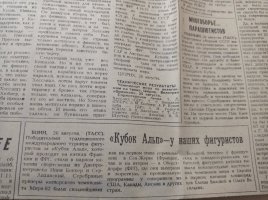
BONN, August 26 (TASS). Inna Becker and Sergey Likhansky, athletes from Dnipropetrovsk, won the pairs skating competition at the traditional international Alpine Cup figure skating tournament, which takes place on rinks in France and West Germany. The silver medalists of the 1982 World Junior Championships were the strongest in both the first stage of the competition in Saint-Gervais (France) and the second stage in Oberstdorf (Germany), where they won both the short and free programs against competitors from the USA, Canada, England and other countries.​
The exhibition performances of Leningrad's Elena Valova and Oleg Vasiliev, world and European champions in pairs skating, generated great interest among French and West German figure skating fans.
1766930021221.jpeg
P.S. There is a mistake in this article because Elena Valova and Oleg Vasiliev were not European champions at that time. They were only world champions and European silver medalists of 1983.
 
Last edited:
1983
ALPINE CUP

FIRST TEST OF STRENGTH

(the article published in russian 'Sovetskiy Sport' on August 24, 1983)

PARIS. The first test of strength on the international arena of the new season for Soviet figure skaters was the traditional Alpine Cup competition, held in two stages at rinks in France and West Germany.
Our athletes successfully competed in the first tournament in Saint-Gervais, France. Moscow's Marina Klimova and Sergey Ponomarenko won the ice dance competition, while Inna Bekker and Sergey Likhansky from Dnipropetrovsk were the strongest in the pairs competition. Muscovite Gurgen Vardanyan took second place in the singles competition behind French figure skater Philippe Pollet.​
(TASS).​
View attachment 10499
I still miss the Alpine Cup. My partner and I were supposed to go to St. Gervais/Oberstdorf in 1982, and then he broke his nose playing rugby. He was having trouble breathing while it healed, and too much risk I might smack him in the nose with my elbow in a twist lift (something that happens to all pairs boys at least once), so Canada sent another pair instead. And then we decided to retire and never had another chance 😢
 
1983
ICE HOUSE INTERIOR

(the article published in russian 'Sovetskiy Sport' on September 1, 1983)

Dear Editors! The season of numerous figure skating competitions is approaching. As you know, many important international tournaments are held in the fall, including the Alpine Cup, Prague Skate, Blue Swords, Skate Canada, Moskovskiye Novosti, and others. Are Soviet figure skaters expected to participate? What are their plans for preparing for the new season?
V. MARYNOV

PENZA REGION
Readers' letters are a kind of barometer predicting the competitive weather in figure skating. The first news has already arrived from the Alpine Cup: our athletes I. Becker and S. Likhansky won the pairs skating competition.
The figure skating season has arrived, a special Olympic season at that. And naturally, as coaches finalize their students' programs, they're trying to anticipate what will be highly prized in the virtuosos' performances on the Olympic stage in Sarajevo, Yugoslavia.
We, for our part, also decided to try to draw the future interior of the Olympic "ice house" and asked several well-known experts in our figure skating to answer one question: what, in your opinion, will be the main criteria for determining the best Olympic programs in the winter of 1984?
Honored Coach of the USSR Igor Moskvin (Leningrad):

"The main criterion, in my opinion, is the harmonious combination of impeccable technique, highly developed choreographic culture, and musicality in the program's execution. I consider it absolutely essential to include the triple jump, twist, and triple throw in pairs skating programs. And, most importantly, future Olympians must demonstrate not only a cultured movement but also a choreographic understanding of the concept and music of the composition.
In my opinion, the best example is the new, balanced programs of our world pairs champions, Elena Valova and Oleg Vasiliev. On the one hand, they feature striking technical achievements, including a triple parallel jump, while on the other, they offer an artistic vision capable of captivating spectators and judges…​
Honored Coach of the RSFSR Eduard PLINER (Moscow):
I believe the decisive criterion is consistency and flawless execution of all the complex elements of the Olympic program. A skater's ability to combine complexity, musicality, and artistry will also be highly valued in the new season. Finally, an equally important criterion is the purity of the glide. This is precisely what captivates us in the performances of our national champion and European Championship medalist Alexander Fadeev. His versatility and superb glide put him on par with American world champion Scott Hamilton.
Alexander Vlasov (Leningrad), Master of Sports of International Class and 1977 World Championship silver medalist in pair skating:
In my opinion, the main criterion is that the program meets modern standards of difficulty. What does this mean in pair skating? The presence of a triple jump and a double axel, a double jump combination, and a set of elements that will be played out are emphasized in the musical design. Plus, the athletes' personalities have a special charm. That charm that became one of the advantages of world champions—my fellow countrymen Valova and Vasiliev…
The three points of view expressed are the best confirmation that our experienced and thoughtful coaches are searching for their key to success.
World and European Championship participant A. Kondrashova is preparing for the season in E. Pliner's group. In the coaching room, Pliner watches videos of programs by many of the world's leading figure skaters almost daily. He noted that Anna Kondrashova remained true to the principle of a balanced program, and that this principle also formed the basis for the new compositions of the 1984 edition, created in collaboration with choreographer Elena Matveeva. Yes, Kondrashova's programs are almost ready; she plans to present them in October at the USSR Trade Union Prize tournament. And the first on her list of new moves is a jump—a triple lutz.​
Coach I. Moskvin's group includes the winners of the international tournament "Moscow News" in pair skating, L. Selezneva and O. Makarov, as well as the new duo - S. Frantsuzova and O. Gorshkov, and the young single skater I. Krundysheva.
Igor Borisovich Moskvin speaks with satisfaction about the final training sessions of his main pair, Selezneva and Makarov. By August, the skaters had already completed two new programs ("at the highest level of difficulty," Moskvin notes). This time, Yuri Potemkin, an artist from the Leningrad Kirov Opera and Ballet Theatre, was actively assisting the coach.
For Selezneva and Makarov's short program, Negro blues was chosen, and the skaters had to solve the most difficult task of finding not only a distinctive movement pattern, but also to express the mood, to convey the spirit of this music," says Potemkin. "I think the duo is now close to achieving their goal. You'll see the results of our work in November."
Coach A. Vlasov also arrived on the ice at the Novogorsk training center with the new pair. Renowned Leningrad figure skater N. Chervotkina is now paired with A. Zelensky from Dnepropetrovsk. Their main goal is a successful debut at the 1984 national championships.
I can't help but praise the new training center for the USSR figure skating team in Novogorsk. It boasts a spacious, well-heated skating rink, a sparkling clean choreography hall, and a gym for general physical training. And nearby is a stadium and the picturesque Moscow forests with trails for cross-country running. And once the new radio station is installed, the Novogorsk complex will rightfully become a first-class center, which should help our figure skaters achieve tangible progress in their skills...
Twenty diverse tournaments lie ahead, where we'll see all the key players of the USSR national team. It's going to be a hot season!​
A. SHELUKHIN.
(Our special correspondent).

NOVOGORSK.​
Here is the calendar of the main figure skating competitions: the USSR Trade Union Prize Tournament - Tallinn (October 18-23); the Moscow Open Championship - October 14-16; the Olympic Hopes Tournament - Krasnoyarsk (November 15-20); the Moscow News International Tournament - Moscow (November 22-27); match of the strongest figure skaters of the USSR - Leningrad (December 13-18); World Junior Championships - Sapporo (December 5-10); European Championships - Budapest (January 9-14); USSR Cup - Rostov-on-Don (January 17-22); Olympic tournament - Sarajevo (February 8-19); World Championships - Ottawa (March 19-24); USSR Championships - Tashkent (April 3-8, 1984).
1767018816559.jpeg
 
1983
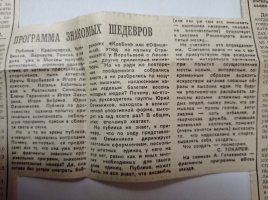
A PROGRAM OF FAMILIAR MASTERPIECES

(the article published in russian 'Sovetskiy Sport' on September 14, 1983)

Audiences in Krasnoyarsk, Chelyabinsk, Barnaul, Tomsk, and recently even Moscow, naturally enjoyed the skating of the now-famous artists Irina Vorobyova and Igor Lisovsky, Natalia Karamysheva and Rostislav Sinitsyn, Elena Garanina and Igor Zavozin, Igor Bobrin and Yuri Ovchinnikov. The audience appreciated the original attempt to compose a short program and the exploration of light and sound.
But at the same time, the audience clearly had some questions. Why, first of all, are they offered everything they’ve already seen: fragments of familiar free programs, familiar exhibition numbers? Yes, they’re ready to tirelessly watch Bobrin's "Cowboy" or "Waiter," Vorobyova and Lisovsky's etude to Stravinsky, and other delightful miniatures. But surely eight young people didn't gather together just to repeat what they'd learned, instead of scattering across our powerful, lush, and well-oiled ice ballets? Secondly, why does the group's leader, Yuri Ovchinnikov, despite being in excellent athletic shape, only take to the ice once? There are plenty of these "whys."
But the audience doesn’t know, for example, that during the performance Ovchinnikov is conducting the lighting design, since he doesn’t have the staff for this, just as he doesn’t have many other units necessary for such a task.
Don't consider these excuses. Think of it this way: we are witnessing the birth of a new and exciting endeavor, an attempt to realize a dream by expressing complex images and lofty ideas through the art of skating in a new, exciting, and modern way. Without being authorized to reveal the plans of these eight courageous young people, I will only say that their minds are full of ideas, their enthusiasm is rife, and the creative friendship that has united this small group will help (I really hope) them express what remains unsaid in sport, express themselves, and create...
We'll see what to create.​
S. TOKAREV.​
1767021715182.jpeg
 
1983
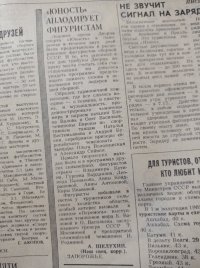
"YUNOST" APPLAUSES THE FIGURE SKATERS

(the article published in russian 'Sovetskiy Sport' on September 22, 1983)

The ice arena of the "Yunost" Sports Palace in Zaporizhzhia was made available to the USSR national figure skaters for two days. Those who filled the Palace's stands during these days could rightfully consider themselves lucky: they had the chance to see the upcoming winter season's programs performed by all the leaders of our team.
An example of a harmonious composition, where everything merged together - technique, plasticity, and musicality - was demonstrated by world champions in pair skating Elena Valova and Oleg Vasiliev, European champions in ice dancing Natalia Bestemyanova and Andrey Bukin, silver medalists of the European championship ice dancers Olga Volozhinskaya and Alexander Svinin.
The programs of other top figure skaters of the country—Vladimir Kotin, Gurgen Vardanyan, Leonid Kaznakov, Anna Kondrashova, Anna Antonova, and Kira Ivanova—also featured many creative breakthroughs.
The figure skaters visited the region's agricultural workers, who were particularly interested in the performances of world champions E. Valova and O. Vasiliev, Honored Coach of the USSR T. Moskvina, and three-time Olympic champion I. Rodnina at the Peremoga state farm.​
A. SHELUKHIN.
(Our special correspondent).
ZAPORIZHZHIA.
1767023352005.jpeg
 
1983
AMBER SKATE

FIGURE SKATING

(the article published in russian 'Sovetskiy Sport' on October 14, 1983)

RIGA. Young figure skating masters took over the Sports Palace's ice arena these days. They compete for the "Amber Skate" – the challenge prizes of the Riga City Executive Committee.
Figure skating competitions have long been a favorite among Riga residents. This year marks the 22nd time they've been held. Renowned athletes I. Rodnina, L. Pakhomova, G. Karponosov, A. Gorshkov, and A. Ulanov have won honorary prizes over the years.
In recent years, popular competitions have been dedicated to juniors. Spectators now have the opportunity to meet talented young people and glimpse the future of the country’s figure skating.
As is traditional, the pairs skating masters will compete for the awards first. They have already performed their short program. Dynamo Moscow's O. Neizvestnaya and S. Khudyakov are in the lead. All five judges gave them the undisputed top spot.
Following the pairs, the ice dance couples took to the ice. Here, after three compulsory dances, E. Krykanova and E. Platov (Spartak, Moscow) are in the lead, significantly ahead of their closest rivals.
Among the boys, after the compulsory program, V. Petrenko from Odesa is in the lead.​
V. KARPUSHKIN.
1767091237484.jpeg
 
1983
AMBER SKATE

FIGURE SKATING

(the article published in russian 'Sovetskiy Sport' on October 15, 1983)

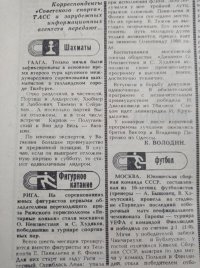
RIGA. At the young figure skating competition, Muscovites O. Neizvestnaya and S. Khudyakov became the first winners of the Riga City Executive Committee's "Amber Skates" challenge prize, winning the pairs tournament.
Tashkent figure skaters E. Pavileva and V. Fomin have been training together for only six months. This was their first competition on the ice of Riga. Lena made a mistake: she fell while performing a flip. However, she landed a triple lutz, a difficult jump. Pavileva and Fomin finished last. But their coach, V. Tyukov, didn't seem upset. It's understandable: the young duo's journey is just beginning, with their sights set on the 1988 Winter Olympics.
Dynamo Moscow alumni O. Neizvestnaya and S. Khudyakov performed their free program at a high tempo and with considerable technical skill.
The women's singles entered the competition. N. Dvalishvili from Tbilisi won the compulsory program by a narrow margin. Leningrad's I. Krundysheva followed.
After the short program, brothers Viktor and Vladimir Petrenko from Odesa emerged as the best juniors.​
K. Volodin.
1767093509230.jpeg
 
1983
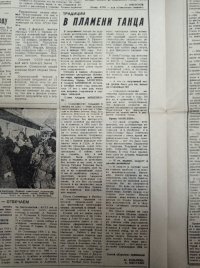
TRADITIONS

IN THE FLAME OF DANCE

(the article published in russian 'Sovetskiy Sport' on October 15, 1983)

In ice dancing, the greatest achievements of our figure skaters are associated with the brilliant performances of L. Pakhomova and A. Gorshkov, N. Linichuk and G. Karponosov, and I. Moiseeva and A. Minenkov. Interestingly, in January 1976, literally on the eve of the Winter Olympics in Innsbruck, all three Soviet duos took the podium at the European Championships in Geneva, and the local press called this success a “triple charm.”
Today, our "Kurier" features two-time world champions and two-time Winter Olympic medalists Irina Moiseeva and Andrei Minenkov. Incidentally, this October marks 15 years since they first competed in the ice dancing competition.
Andrei Minenkov speaks:

"Olympic traditions in ice dancing are a passionate, multifaceted topic, and for Irina and me, a deeply personal one. After all, we had the opportunity to compete for medals both on the ice of Innsbruck and on the rink of Lake Placid. You're wondering what music we performed to, for example, in 1976? But is the essence really in the specific melody?" I'd put the question more broadly: success is determined by the direction of your search. For example, a year before the Innsbruck Olympics, Irina and I won the World Championships in the USA, and most of the coaches and judges noted that our program was very spectacular. And now we can say that it had a good balance of both technique and artistry. That's why both we and our coach, Tatyana Tarasova, were in favor of keeping this dance for the Olympic season. And we were right: along with the "golden" dance by Lyudmila Pakhomova and Alexander Gorshkov (a true breakthrough in their artistic career), our program received recognition and earned us silver medals.
After the Innsbruck Olympics, a tradition of the Soviet dance school emerged: the highest choreographic culture and a new qualitative leap in technique.
Incidentally, these same characteristics of our school were evident at the Lake Placid Olympics. During the new four-year cycle, Irina and I developed our own style, and our choreographer, Elena Matveeva, played a huge role in this. Working with her on many dances helped us immerse ourselves in the spirit of the Bolshoi Ballet School. Our exploration of plastique became more conscious and profound, and it's no coincidence that during these years, our best dances—Romeo and Juliet and Carmen—were staged on ice. Each season, we also changed our athletic program. I want to emphasize: the annual change of compositions and dances is one of our school's best traditions, a testament to the skaters' creative growth.
In Lake Placid, we performed a program we created with Lyudmila Pakhomova. Everything was new to us—the music, the modern athletic style, the costumes, and we ourselves were different. This also helped us in our fight for medals…​
"What was new for you from a sporting perspective at the 1980 Olympics?"
"I think improvement in skill occurs gradually, year after year. But compared to 1976, we clearly felt an increase in speed, intensity, and program richness. Almost all the skaters reached a new level of technical development."
Irina MOISEEVA:
- For my part, I'd like to point out that the defining characteristic of our Olympic figure skating team, both in Innsbruck and Lake Placid, was the combination of athletes with very distinct personalities. A stamp of originality—that's what characterized the performances of Pakhomova and Gorshkov, Rodnina and Zaitsev, Kovalev, Ovchinnikov, and Bobrin. This, too, reflected one of the finest traditions of our school...
— And it seems that this should be further developed?
"That's one of the main problems—finding individuality. For example, some coaches would have kicked out a seemingly fragile athlete like Scott Hamilton long ago. But he skates. He's won three world championships. So, you still have to identify that talent. In other words, we need to look for not only hard-working performers in our schools, but also creatively active athletes and creators!"
We've dedicated 15 years of our lives to ice dancing. We've poured every ounce of our creative energy into it, and that's why we consider ourselves fortunate. After all, we've lost and then we've gotten back up. We've burned in the flames of dance, but we haven't, and for that alone, we're grateful to the sport. Never lose your head, always remember the ultimate goal (without it, you can't win!) – these are our wishes to the 1984 Olympians.​
Kurier's guests were received by
M. KOZYREVA,
A. SHELUKHIN
1767097833932.jpeg
 
1983
AMBER SKATE

FIGURE SKATING

(the article published in russian 'Sovetskiy Sport' on October 16, 1983)

RIGA. Viktor Petrenko, a 14-year-old Odesa schoolboy and a student of coach G. Zmievskaya, won the Amber Skates figure skating tournament.
The battle for the lead was between brothers Viktor and Vladimir Petrenko from Odessa and Andrey Torosyan from Tbilisi. Viktor Petrenko performed his free skate confidently, including a triple jump. This predetermined his success.
After two days of competition, Leningrad's I. Krundysheva, currently trained by Honored Coach of the USSR I. Moskvin, emerged as the leader in the girls' competition.​
V. KARPUSHKIN.
1767098629011.jpeg
 
1983
AMBER SKATE

FIGURE SKATING

(the article published in russian 'Sovetskiy Sport' on October 18, 1983)

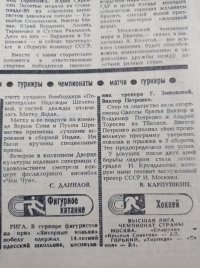
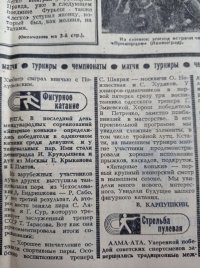
RIGA. On the final day of the international "Amber Skate" competition, the winners in the women's singles and ice dancing events were determined. The winners were Leningrad's I. Krundysheva and the Moscow duo E. Krykanova and E. Platov.
Among the foreign participants, the Czechoslovakian ice dancing couple D. Jendrišková and R. Szabo performed best, finishing third. Second place went to S. Lyapina and G. Sur, coached by Honored Coach of the USSR T. Tarasova. Here's how she commented on the competition results:
“The pairs left a good impression, especially those trained by coach S. Shakhrai—Moscow's O. Neizvestnaya and S. Khudyakov. Among the junior singles, three of them, trained by Odessa coach G. Zmievskaya, were in the top five. The winner, V. Petrenko, was also a good performer, having noticeably improved his skills. His free skate featured complex elements, including a triple lutz. Incidentally, many competitors at this year's competition demonstrated excellent execution of jumps, combinations, and twists."
"Amber Skate" is the first major junior competition of the season. We saw a lot of new and interesting things. We saw the future of our figure skating.​
V. KARPUSHKIN.
1767100065202.jpeg
 
1983
AMBER SKATE

FIGURE SKATING

(the article published in russian 'Sovetskiy Sport' on October 14, 1983)

RIGA. Young figure skating masters took over the Sports Palace's ice arena these days. They compete for the "Amber Skate" – the challenge prizes of the Riga City Executive Committee.
Figure skating competitions have long been a favorite among Riga residents. This year marks the 22nd time they've been held. Renowned athletes I. Rodnina, L. Pakhomova, G. Karponosov, A. Gorshkov, and A. Ulanov have won honorary prizes over the years.
In recent years, popular competitions have been dedicated to juniors. Spectators now have the opportunity to meet talented young people and glimpse the future of the country’s figure skating.
As is traditional, the pairs skating masters will compete for the awards first. They have already performed their short program. Dynamo Moscow's O. Neizvestnaya and S. Khudyakov are in the lead. All five judges gave them the undisputed top spot.
Following the pairs, the ice dance couples took to the ice. Here, after three compulsory dances, E. Krykanova and E. Platov (Spartak, Moscow) are in the lead, significantly ahead of their closest rivals.
Among the boys, after the compulsory program, V. Petrenko from Odesa is in the lead.​
V. KARPUSHKIN.
View attachment 10507
The "tradition" of pairs competing first was intended to sell more tickets to the early days of a competition. No one but parents watched the school figures or, usually, the compulsory dances, so having a pairs event gave an audience something interesting to come and watch. (And the pairs skaters liked it because we got our work out of the way and then could hang around and watch our friends in singles and dance -- unless our parents made us leave and get home to go back to high school :).)
 
1983
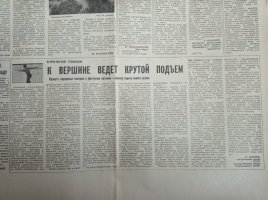
SEARCH STRATEGY


A STEEP CLIMB LEADS TO THE TOP

Regaining the leading position in figure skating is a key goal for the new season.

(the article published in russian 'Sovetskiy Sport' on October 20, 1983)

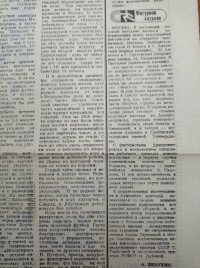
The current season marks the end of a four-year cycle between two Winter Olympics. During this time, Soviet figure skaters had their share of victories and setbacks. While they won two gold medals at the 1980 Olympics, they won none at the 1982 World Championships. We are not satisfied with our position in ice dancing. The last time the European men's singles champion was in 1981.
It's worth noting that over the past few years, our national team has undergone a nearly ninety percent renewal. Of the team's current leaders, only one ice dancing couple—N. Bestemianova and A. Bukin—has competed in Lake Placid.
The example set last winter by the national team debutants E. Valova and O. Vasiliev, who boldly challenged the renowned masters and became world champions in pair skating, shows that with systematic, targeted work and a creative approach to the educational and training process you can achieve the greatest success on the international stage. Now, under the guidance of their coach, T. Moskvina, the Leningrad team continues to persistently hone their skills, preparing new short and free programs incorporating elements of the highest complexity including triple jumps, unique lifts, and their combinations.
Valova and Vasiliev's performances in the fall in France and Germany made a strong impression on spectators, international judges, and ISU members. The world champions' new programs are distinguished by their vibrant choreography, dynamics, high performance skills.
In pairs skating, renowned figure skaters V. Pershina and M. Akbarov (coach I. Rodnina), L. Selezneva and O. Makarov (coach I. Moskvin), as well as world junior champions M. Avstriyskaya and Y. Kvashnin (coach S. Zhuk), are vying for spots on the national team. Unfortunately, renowned pair skaters M. Pestova and S. Leonovich have retired. In S. Zhuk's group, a number of other candidates for the national team are preparing - USSR champions A. Fadeev and E. Vodorezova.
Incidentally, I'd like to point out that this coach was fairly criticized in April 1983, citing violations of moral and ethical standards and a decline in the level of athletes in his group. S. Zhuk draws the right conclusions from the criticism, and we hope that the new season will demonstrate his true professional qualities of this experienced specialist.
The challenges of singles skating deserve special attention. There will be many contenders for the top spots in the men's competition at the upcoming Olympics. Fadeev has loudly declared his ambition for an Olympic medal. At the European Championships in Dortmund, he finished second in the free skating. His short program, with its extremely difficult 3,5-turn and triple jumps in the combination, made a strong impression. Alexander adheres to his principles when preparing his Olympic routines. Renowned pop dancer and Honored Artist of the RSFSR Yury Zamyatin is involved in choreographing his routines. It's important to emphasize that Fadeev is making significant progress in the compulsory exercises as well.
The conditions have also been created for significant growth in the skill of another of our singles skaters, V. Kotin (coach E. Tchaikovskaya). Kotin has always stood out for his artistic talent. And now he's significantly increased the power and amplitude of his most difficult elements. I'm noting that in his short program, Kotin confidently executed a jump combination with a triple lutz. We expect the skater to make significant progress in his "school" routine as well. Provided that the necessary adjustments are made to the free program (we are talking about mastering the 3,5-turn jump), Kotin will have a real chance of placing high in Sarajevo and at the World and European Championships. At the same time, the first autumn trials, held at rinks in Zaporizhzhia and Kharkiv, revealed a number of serious shortcomings in our singles skating. The pool of candidates for the national team is too narrow. We cannot tolerate a situation where there are only two athletes – Fadeyev and Kotin – capable of competing in all-around at the international level. Young singles skaters from Leningrad, Kharkiv, Kyiv, Minsk, Tbilisi, and Yerevan are gradually losing ground. The development of reserve teams in Moscow is far from perfect either.
I believe there are two reasons for this. The first is the weak oversight of central, republican, and regional councils of societies over the use of ice rinks at the local level. After all, why is there talk about the ineffective and irrational use of ice rinks? Because many sports schools try to cultivate equal opportunities for pairs skating, ice dancing, and singles skating. This leads to serious imbalances: ice dancers often have twice as much ice as singles skaters, when it should be the other way around! "School" training is kept to a minimum, and skaters fail to develop high-quality skating technique.
The second reason is that most coaches underestimate the benefits of modern team-based methods, where each specialist can learn and continually grow creatively. Having received a university degree, coaches believe they've mastered everything theoretically. But this is clearly a misconception. The real learning begins within the walls of the youth sports school...
The national team needs full-fledged reserves, and today we must, from a new position, present an account to the specialists in single skating, in particular, the Leningrad coaches - A. Mishin, E. Beilina, V. Kuksinsky, A. Kopylov, N. Monakhova, A. Pyatova, coaches from other cities - V. Kaprov (Kharkiv), S. Loginov, T. Loginova (Kyiv), V. Serebrovsky (Gorky), A. Adeev (Chelyabinsk). Moscow coaches V. Kudryavtsev, N. Zhuk, G. Titova, V. Kovalev, S. Volkov, G. Gorbunova, Z. Podgornova, E. Shcheglova, and others should also be more active in their talent search.
Let me cite one specific example. Recently, a commission from the All-Union Federation inspected the work of the specialized youth sports school of the "Trud" society at the capital's Young Pioneers Stadium. It was discovered that over the past three years, the conditions for training figure skaters had been significantly improved: strength training and acrobatics halls had been commissioned, the ice rink's heating, ventilation, and lighting systems have been modernized, and dance studios have been made available for training. But what about the performance of a team with 13 coaches and three choreographers? In six years of work, not a single international master of sport has been produced in single skating, and only two masters of sport have been awarded.
The school, its administration, and the leadership of the Trud society face serious challenges. We cannot tolerate the inefficient use of the ice rink, the lack of a clear methodological plan for the coaching staff, and the weak implementation of team methods in singles skating.
Following the 1980 Olympic season, an all-Union coaching conference was held to outline the main areas of work for the new Olympic cycle. Most experts noted that we must be prepared for increased competition from foreign athletes.
The national team's coaches have currently conducted a thorough analysis of trends in figure skating. The goal is to regain lost ground and consolidate achievements where progress has been made.
To prepare for the season's main competitions, the national team's athletes are provided with the necessary conditions, with significant assistance from choreographers, musicologists, psychologists, and professional artists. The figure skaters have been provided with magnificent new sports facilities, including training rinks in Novogorsk (Moscow Region), Dnipropetrovsk, Kharkiv, Tallinn, and other cities across the country. We have every right to hope that the leaders of the USSR national team will live up to the expectations of fans of this wonderful sport.​
V. Piseyev,
Honored Coach of the USSR,
State Coach of the USSR Sports Committee.


1767126578229.jpeg
 
1983
SEARCH STRATEGY


A STEEP CLIMB LEADS TO THE TOP

Regaining the leading position in figure skating is a key goal for the new season.

(the article published in russian 'Sovetskiy Sport' on October 20, 1983)

The current season marks the end of a four-year cycle between two Winter Olympics. During this time, Soviet figure skaters had their share of victories and setbacks. While they won two gold medals at the 1980 Olympics, they won none at the 1982 World Championships. We are not satisfied with our position in ice dancing. The last time the European men's singles champion was in 1981.
It's worth noting that over the past few years, our national team has undergone a nearly ninety percent renewal. Of the team's current leaders, only one ice dancing couple—N. Bestemianova and A. Bukin—has competed in Lake Placid.
The example set last winter by the national team debutants E. Valova and O. Vasiliev, who boldly challenged the renowned masters and became world champions in pair skating, shows that with systematic, targeted work and a creative approach to the educational and training process you can achieve the greatest success on the international stage. Now, under the guidance of their coach, T. Moskvina, the Leningrad team continues to persistently hone their skills, preparing new short and free programs incorporating elements of the highest complexity including triple jumps, unique lifts, and their combinations.
Valova and Vasiliev's performances in the fall in France and Germany made a strong impression on spectators, international judges, and ISU members. The world champions' new programs are distinguished by their vibrant choreography, dynamics, high performance skills.
In pairs skating, renowned figure skaters V. Pershina and M. Akbarov (coach I. Rodnina), L. Selezneva and O. Makarov (coach I. Moskvin), as well as world junior champions M. Avstriyskaya and Y. Kvashnin (coach S. Zhuk), are vying for spots on the national team. Unfortunately, renowned pair skaters M. Pestova and S. Leonovich have retired. In S. Zhuk's group, a number of other candidates for the national team are preparing - USSR champions A. Fadeev and E. Vodorezova.
Incidentally, I'd like to point out that this coach was fairly criticized in April 1983, citing violations of moral and ethical standards and a decline in the level of athletes in his group. S. Zhuk draws the right conclusions from the criticism, and we hope that the new season will demonstrate his true professional qualities of this experienced specialist.
The challenges of singles skating deserve special attention. There will be many contenders for the top spots in the men's competition at the upcoming Olympics. Fadeev has loudly declared his ambition for an Olympic medal. At the European Championships in Dortmund, he finished second in the free skating. His short program, with its extremely difficult 3,5-turn and triple jumps in the combination, made a strong impression. Alexander adheres to his principles when preparing his Olympic routines. Renowned pop dancer and Honored Artist of the RSFSR Yury Zamyatin is involved in choreographing his routines. It's important to emphasize that Fadeev is making significant progress in the compulsory exercises as well.
The conditions have also been created for significant growth in the skill of another of our singles skaters, V. Kotin (coach E. Tchaikovskaya). Kotin has always stood out for his artistic talent. And now he's significantly increased the power and amplitude of his most difficult elements. I'm noting that in his short program, Kotin confidently executed a jump combination with a triple lutz. We expect the skater to make significant progress in his "school" routine as well. Provided that the necessary adjustments are made to the free program (we are talking about mastering the 3,5-turn jump), Kotin will have a real chance of placing high in Sarajevo and at the World and European Championships. At the same time, the first autumn trials, held at rinks in Zaporizhzhia and Kharkiv, revealed a number of serious shortcomings in our singles skating. The pool of candidates for the national team is too narrow. We cannot tolerate a situation where there are only two athletes – Fadeyev and Kotin – capable of competing in all-around at the international level. Young singles skaters from Leningrad, Kharkiv, Kyiv, Minsk, Tbilisi, and Yerevan are gradually losing ground. The development of reserve teams in Moscow is far from perfect either.
I believe there are two reasons for this. The first is the weak oversight of central, republican, and regional councils of societies over the use of ice rinks at the local level. After all, why is there talk about the ineffective and irrational use of ice rinks? Because many sports schools try to cultivate equal opportunities for pairs skating, ice dancing, and singles skating. This leads to serious imbalances: ice dancers often have twice as much ice as singles skaters, when it should be the other way around! "School" training is kept to a minimum, and skaters fail to develop high-quality skating technique.
The second reason is that most coaches underestimate the benefits of modern team-based methods, where each specialist can learn and continually grow creatively. Having received a university degree, coaches believe they've mastered everything theoretically. But this is clearly a misconception. The real learning begins within the walls of the youth sports school...
The national team needs full-fledged reserves, and today we must, from a new position, present an account to the specialists in single skating, in particular, the Leningrad coaches - A. Mishin, E. Beilina, V. Kuksinsky, A. Kopylov, N. Monakhova, A. Pyatova, coaches from other cities - V. Kaprov (Kharkiv), S. Loginov, T. Loginova (Kyiv), V. Serebrovsky (Gorky), A. Adeev (Chelyabinsk). Moscow coaches V. Kudryavtsev, N. Zhuk, G. Titova, V. Kovalev, S. Volkov, G. Gorbunova, Z. Podgornova, E. Shcheglova, and others should also be more active in their talent search.
Let me cite one specific example. Recently, a commission from the All-Union Federation inspected the work of the specialized youth sports school of the "Trud" society at the capital's Young Pioneers Stadium. It was discovered that over the past three years, the conditions for training figure skaters had been significantly improved: strength training and acrobatics halls had been commissioned, the ice rink's heating, ventilation, and lighting systems have been modernized, and dance studios have been made available for training. But what about the performance of a team with 13 coaches and three choreographers? In six years of work, not a single international master of sport has been produced in single skating, and only two masters of sport have been awarded.
The school, its administration, and the leadership of the Trud society face serious challenges. We cannot tolerate the inefficient use of the ice rink, the lack of a clear methodological plan for the coaching staff, and the weak implementation of team methods in singles skating.
Following the 1980 Olympic season, an all-Union coaching conference was held to outline the main areas of work for the new Olympic cycle. Most experts noted that we must be prepared for increased competition from foreign athletes.
The national team's coaches have currently conducted a thorough analysis of trends in figure skating. The goal is to regain lost ground and consolidate achievements where progress has been made.
To prepare for the season's main competitions, the national team's athletes are provided with the necessary conditions, with significant assistance from choreographers, musicologists, psychologists, and professional artists. The figure skaters have been provided with magnificent new sports facilities, including training rinks in Novogorsk (Moscow Region), Dnipropetrovsk, Kharkiv, Tallinn, and other cities across the country. We have every right to hope that the leaders of the USSR national team will live up to the expectations of fans of this wonderful sport.​
V. Piseyev,
Honored Coach of the USSR,
State Coach of the USSR Sports Committee.


View attachment 10513
"The more things change, the more they stay the same" :) (And you see the same complaints in the competitive ballroom dance world when one country that has been on top for a few years goes into a winless slump for the next few years.)
 
1983
Moscow Open Championships

FIGURE SKATING

(the article published in russian 'Sovetskiy Sport' on October 25, 1983)

MOSCOW. The final evening of figure skating at the Moscow Open Championships turned into a veritable celebration on ice. The winners were I. Bekker and S. Likhansky (pairs skating), N. Annenko and G. Sretensky (ice dancing), and M. Tveritinova and V. Oralnov (singles skating).
Six or seven years ago, none of the candidates for the national figure skating team would have risked competing in October full-time—it was considered too early. And it's all the more gratifying that today's list of winners includes those who have already represented the national team on the international stage. In pairs skating, the most rave reviews went to the Dnipropetrovsk masters, medalists of the Junior World Championships, Bekker and Likhansky, and in ice dancing, to the Muscovites Annenko and Sretensky, champions of the Winter Universiade.
The Dnipropetrovsk figure skaters and Moscow ice dancers are working with new-generation coaches—Olympic champion I. Rodnina in the former, and Olympic champion L. Pakhomova in the latter. And this continuity in the development of traditions is perhaps the most interesting feature of the current season.
Almost all of our team's leaders presented their new routines to the audience during their exhibition performances at Luzhniki Stadium. The evening concluded with a ceremony marking the retirement of Elena Garanina and Igor Zavozin, winners of numerous international ice dance tournaments, trainees of our renowned specialists – Honored Coach of the USSR T. Tarasova and Honored Coach of the RSFSR N. Dubova.​
A. SHELUKHIN.
1767165854050.jpeg
 
1983
USSR Trade Union Prize Tournament

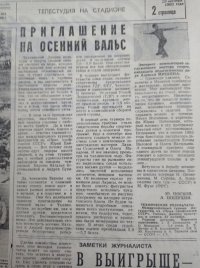
INVITATION TO AN AUTUMN WALTZ

(the article published in russian 'Sovetskiy Sport' on October 29, 1983)

The Tallinn Palace of Culture and Sports overlooks the sea, which on these autumn days resembles a frozen green skating rink. Descend the stairs into the palace's depths, and you find yourself in a veritable kingdom of ice. The uniqueness of this structure lies not only in the fact that it combines a concert hall and an artificial skating rink into a single complex, but also in the fact that it offers an almost family-like atmosphere.
"This hall has excellent acoustics; even the slightest nuances of sound can be heard from any seat in the stands. And the spectators themselves sit very close to the arena," noted Yuri Zimmerman, head judge of the international figure skating tournament for the USSR Trade Union Prize. - That's why the leaders of our team are so eager to come here, and at this tournament we are especially pleased to watch the dances of European champions Natalia Bestemianova and Andrey Bukin...
Yes, the European champions are actively preparing for the Olympic season, exploring a wide range of areas—music, movement, and technique. They accepted the invitation to the autumn waltz in Tallinn without hesitation. Incidentally, they, like the other duets, were drawn to perform the Westminster Waltz. It was truly a sight to behold: Natalia and Andrey demonstrated flawless edge placement on wide arcs and earned scores of 5.8-5.9. They easily won all three compulsory dances and took the lead.
Figure skaters from seven countries are competing in the tournament, with strong athletes representing the East German, West German, and Czechoslovakian singles teams. For example, 19-year-old Rolf Lewandowski (East Germany) boasts a triple axel jump. He is a contender for a spot on his country's Olympic team.
On the first day of the tournament, the packed stands witnessed the pairs' battle in the short program. Back in September, we heard many compliments about the composition of Leningrad masters Larisa Selezneva and Oleg Makarov. And now, finally, the premiere is taking place on the Tallinn ice. Even during the warm-up, the skaters clearly stood out among the other eight duets—their purity of execution and powerful skating. Larisa's face flushed with excitement, understandable: the skaters were about to perform a difficult, uniquely choreographed program to the tune of black blues. Without going into a detailed description of the entire performance, it's worth noting that the twist, death spiral, loop jump, and spins were technically outstanding. Ultimately, the judges' scores were generally between 5.4 and 5.7.
Express commentary from Honored Master of Sports and Candidate of Pedagogical Sciences Alexey MISHIN:
"The premiere was a success. Selezneva and Makarov have improved their skills, especially their female partner. I admire the originality of their style, powerful and unstoppable. Despite the complexity and multifaceted nature of the composition, the performers successfully mastered the challenge. Congratulations go to both coach Igor Moskvin and choreographer Yuri Potemkin, who brought his extensive experience as a choreographer to this program. Let's recall that the 1983 season saw the brilliant emergence of Leningraders Elena Valova and Oleg Vasiliev. And the obvious progress of another duo from that city speaks to the strength of the Leningrad school as a whole..."
Women's singles skating has entered the fray. After compulsory figures, N. Ovchinnikova, M. Serova, A. Kondrashova (all three from the USSR), and M. Fuchs (West Germany) are in the lead.
Yu. Noskov,
A. Shelukhin.
Technical Results
International Figure Skating Tournament for the USSR Trade Union Prize. Tallinn. Palace of Culture and Sports. October 27.
Pair Skating. Short Program.
1. L. Selezneva and O. Makarov - 0.4 points; 2. E. Bechke and V. Kornienko - 0.8; 3. Yu. Bystrova and A. Tarasov (all from the USSR) - 1.2 points.
1767169160636.jpeg
 
FIGURE SKATING

(the article published in russian 'Sovetskiy Sport' on November 1, 1983)
1983
SKATE CANADA
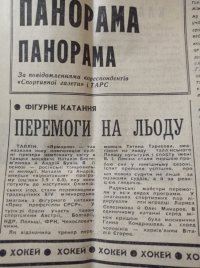
HALIFAX, Canada. The two events of the traditional figure skating tournament Skate Canada have concluded.

As expected, K. Witt of the GDR won the women's competition. She comfortably outscored Canada's K. Thomson, who led after the short program, and T. Chin of the USA. N. Lebedeva of the USSR finished fourth.
For the first time in the tournament's 10-year history, the hosts, Canada's T. Wilson and R. McCall, won the ice dance competition. W. Sessions and S. Williams (Great Britain) and our N. Annenko and G. Sretensky followed.​
1983
USSR Trade Union Prize Tournament

TALLINN. N. Bestemianova and A. Bukin, who won the USSR Trade Union Prize International Figure Skating Tournament, received a perfect score of 6.0 for their new free dance. L. Selezneva and O. Makarov (pairs skating), and A. Kondrashova and V. Egorov (singles skating) also took top honors.
"I think Bestemianova and Bukin's new free program will be much talked about during the winter season," remarked the dancers' mentor, Honored Coach of the USSR T. Tarasova. "It embodies both the rich experience of folk dance and the skaters' own creative exploration."
A number of original innovations also graced the distinctive free skate routine of the Leningrad pair L. Selezneva and O. Makarov (coach I. Moskvin). This bold and dynamic duo won with scores of 5.5-5.6.
The men's singles competition was a very competitive one. Coach A. Mishin's student, V. Egorov from Kharkiv, showed significant growth and development. He was the strongest in both the short and free programs, consistently executing five different triple jumps. The 19-year-old figure skater from Volgograd, A. Efremov (coach M. Makoveev, choreographer E. Sergeeva), also performed complex elements dynamically and with great amplitude. He was neck and neck with the experienced figure skater from Odessa, B. Uspensky, for second place. Ultimately, Efremov took third place and left a lasting impression on the experts.
The top three women's skaters were A. Kondrashova (Moscow), M. Serova (Leningrad), and M. Tveritinova (Moscow). It's worth noting that their free skates now feature complex jump combinations. The coaches and choreographers also emphasized the aesthetics and visual appeal of their routines. Suffice it to say that Kondrashova and Serova received 5.4-5.5 points for artistry, even though this was essentially their first competition of the season. The rise in skill of the young figure skater from Sverdlovsk, N. Ovchinnikova, who demonstrated high technique in the "school," is also noteworthy.​
Y. NOSKOV,
A. SHELUKHIN.
Technical Results
International Figure Skating Tournament for the USSR Trade Union Prize. Tallinn, Palace of Culture and Sports. October 29-30.
Pairs Skating.
1. L. Selezneva and O. Makarov - 1.4 points; 2. Yu. Bystrova and A. Tarasov - 3.2 points; 3. A. Malgina and S. Korovin (all from the USSR) - 4.6 points. Ice Dancing. 1. N. Bestemianova and A. Bukin - 2.0; 2. M. Usova and A. Zhulin - 4.0; 3. E. Vasyukova and D. Blyakhman (all - USSR) - 6.0. Singles Skating. Women. 1. A. Kondrashova - 3.6; 2. M. Serova - 4.8; 3. M. Tveritinova (all - USSR) -6.0. Men. 1. V. Egorov - 2.0; 2. B. Uspensky - 4.0; 3. A. Efremov (all - USSR) - 8.2.
1767172836307.jpeg
 
1983
USSR Trade Union Prize Tournament

VICTORIES ON ICE

(the article published in Ukrainian 'Sportyvna Hazeta' on November 3, 1983)

TALLINN. "Fair" - this is the name of the new composition of the silver medalists of the World Ice Dance Championship, Muscovites Natalia Bestemyanova and Andrey Bukin. It is based on Russian dance melodies. Natalia and Andrey, having "skated" the program for the first time (scores 5.9 and 6.0), which they are preparing for the next Olympic Games, class=y2iqfc>became the winners of the traditional XIV international figure skating competition "Prize of the USSR Trade Unions". Athletes from Austria, Bulgaria, the GDR, Poland, West Germany, and Czechoslovakia also participated in the tournament.
As the winners' coach, Tatyana Tarasova, noted, the competition on the ice at the V. I. Lenin Palace of Culture and Sports in Tallinn was the first test of strength this season. The test was successful, which can be judged not only by the judges' assessments, but also by the skaters' reaction.
Soviet masters won in all disciplines. In the pairs competition, Leningrad's Larisa Selezneva and Oleg Makarov were in the lead. In single skating, the best among women was Muscovite Anna Kondrashova, and among men, Kharkiv's Vitaly Yegorov.
1767194761488.jpeg
 
1983
"TORVILLE AND DEAN"

(the article published in Ukrainian 'Sportyvna Hazeta' on November 5, 1983)

LONDON. The book "Torville and Dean" about the winners of the last three world ice dancing championships, Jayne Torville and Christopher Dean, has been published here. It tells the story of the sports and life path of the popular athletes from Nottingham.
Now the dancing couple is finishing the preparation of a new program, which, as the skaters hope, will lead them to Olympic "gold" in Sarajevo-84. This program has not yet been seen by many people. It will be demonstrated for the first time to the residents of Hottingham on November 18.
To all the questions of journalists and those just curious before this event, Dean and Torvill answer: "No." It is only known that they trained for quite a long time in Germany.​
(TASS).
1767195775355.jpeg
 
Last edited:
1983
Prague Skate

FIGURE SKATING

(the article published in russian 'Sovetskiy Sport' on November 10, 1983)

Young Soviet figure skaters Inna Bekker and Sergei Likhansky won the traditional international "Prague Skate" pairs skating competition.
A surprise at this year's tournament, which featured mostly young athletes, was the strong performance of the Japanese representatives. Fourteen-year-old Midori Ito won the women's singles title, while Takashi Mura emerged victorious among the men. Interestingly, Mura also competed in the pairs competition, where he and Toshimo Ito finished third.
Another young Soviet duo, Maya Usova and Alexander Zhulin, came in second in the ice dancing competition, losing to the experienced Czechoslovakian figure skaters Indra Hola and Karol Foltán.
1767196632056.jpeg
 
1983
SILHOUETTE-83

A BEAUTIFUL DIALOGUE OF MOVEMENT AND MELODY

(the article published in russian 'Sovetskiy Sport' on November 10, 1983)

Irina Rodnina stood by the edge of the ice, peering at the two gliding across the mica-like surface of the ice. She occasionally nodded her head in approval, and occasionally her eyes sparkled with the embers of her eyes ("Is it even conceivable—another mistake in the same place!").
At the Moscow Open Championship, Dnipropetrovsk Dynamo skaters Inna Bekker and Sergey Likhansky, students of the three-time Olympic champion, won a resounding victory.
Rodnina admits she chose this pair for one simple reason: "Inna resembled me in appearance." But it seems that beyond her looks, Irina Konstantinovna saw something special in the dark-eyed Inna Bekker, capturing her temperament, energy, and thirst for combat in any situation.
Before forming a duo, Becker and Likhansky spent several years navigating the arduous process of mastering singles skating. Inna skated in Temirtau and Sergey skated in Dnipropetrovsk. Inna joined the rink at the insistence of her parents to improve her health (she was four years old at the time), Sergei was fascinated by the exotic nature of the training, which required using a compass, just like in a drawing lesson.
Subsequently, Seryozha changed his attitude toward figure drawing, and his interest in "school" cooled, but he understood that without it he wouldn't get very far. In fact, he has a character trait—thoroughness. Intense training in Rodnina's group, studies at the metallurgical institute in Dnipropetrovsk—all this is a test of the skater's character.
"Which of the young pairs do I like among my competitors?" says Inna Bekker. "First and foremost, Marina Avstriyskaya and Yuri Kvashnin." Perhaps that's precisely because Sergei and Inna lost to them at the 1981 World Junior Championships. "Their skill makes you want to step up your game," asserts Sergei.
The young duo's progress was rapid: in 1981, they won first place in the trade union tournament in Dnipropetrovsk, second place in the Junior Spartakiad, and second place in the World Junior Championships.
Elena Cherkasskaya, a ballerina and choreographer who now works with Rodnina, believes the pair is rapidly improving their technique and movement. "It's no longer skating to music, but self-expression through it."
The core of the duo, the leader and cheerleader, is, of course, sixteen-year-old Inna.
Inna admitted that she'd love to perform a program featuring Tchaikovsky's music: "Classical music is a source of inspiration; it gives you the opportunity to create an artistic image and showcase a uniquely challenging combination of elements." And Inna and Sergey love taking risks, performing challenging lifts and twists.
Flying over the mirror of ice—it's all about speed and scope. And there's also the feeling of being at one with the music. The dialogue between movement and melody is beautiful—it evokes a warm smile from the audience and applause from the stands. It gives us a sense of celebration.​
O. KHROMOVA
1767199463249.jpeg
 
Back
Top