1983
SEARCH STRATEGY
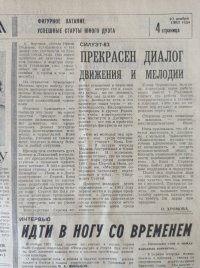
A STEEP CLIMB LEADS TO THE TOP
Regaining the leading position in figure skating is a key goal for the new season.
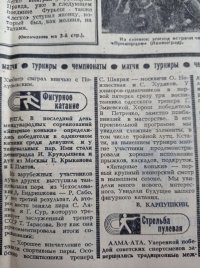
(the article published in russian 'Sovetskiy Sport' on October 20, 1983)
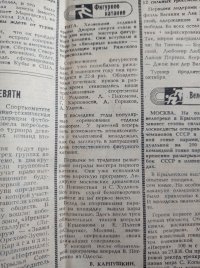
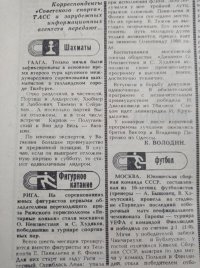
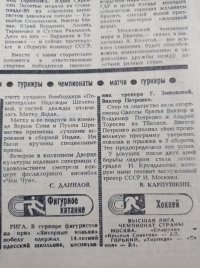
The current season marks the end of a four-year cycle between two Winter Olympics. During this time, Soviet figure skaters had their share of victories and setbacks. While they won two gold medals at the 1980 Olympics, they won none at the 1982 World Championships. We are not satisfied with our position in ice dancing. The last time the European men's singles champion was in 1981.
It's worth noting that over the past few years, our national team has undergone a nearly ninety percent renewal. Of the team's current leaders, only one ice dancing couple—N. Bestemianova and A. Bukin—has competed in Lake Placid.
The example set last winter by the national team debutants E. Valova and O. Vasiliev, who boldly challenged the renowned masters and became world champions in pair skating, shows that with systematic, targeted work and a creative approach to the educational and training process you can achieve the greatest success on the international stage. Now, under the guidance of their coach, T. Moskvina, the Leningrad team continues to persistently hone their skills, preparing new short and free programs incorporating elements of the highest complexity including triple jumps, unique lifts, and their combinations.
Valova and Vasiliev's performances in the fall in France and Germany made a strong impression on spectators, international judges, and ISU members. The world champions' new programs are distinguished by their vibrant choreography, dynamics, high performance skills.
In pairs skating, renowned figure skaters V. Pershina and M. Akbarov (coach I. Rodnina), L. Selezneva and O. Makarov (coach I. Moskvin), as well as world junior champions M. Avstriyskaya and Y. Kvashnin (coach S. Zhuk), are vying for spots on the national team. Unfortunately, renowned pair skaters M. Pestova and S. Leonovich have retired. In S. Zhuk's group, a number of other candidates for the national team are preparing - USSR champions A. Fadeev and E. Vodorezova.
Incidentally, I'd like to point out that this coach was fairly criticized in April 1983, citing violations of moral and ethical standards and a decline in the level of athletes in his group. S. Zhuk draws the right conclusions from the criticism, and we hope that the new season will demonstrate his true professional qualities of this experienced specialist.
The challenges of singles skating deserve special attention. There will be many contenders for the top spots in the men's competition at the upcoming Olympics. Fadeev has loudly declared his ambition for an Olympic medal. At the European Championships in Dortmund, he finished second in the free skating. His short program, with its extremely difficult 3,5-turn and triple jumps in the combination, made a strong impression. Alexander adheres to his principles when preparing his Olympic routines. Renowned pop dancer and Honored Artist of the RSFSR Yury Zamyatin is involved in choreographing his routines. It's important to emphasize that Fadeev is making significant progress in the compulsory exercises as well.
The conditions have also been created for significant growth in the skill of another of our singles skaters, V. Kotin (coach E. Tchaikovskaya). Kotin has always stood out for his artistic talent. And now he's significantly increased the power and amplitude of his most difficult elements. I'm noting that in his short program, Kotin confidently executed a jump combination with a triple lutz. We expect the skater to make significant progress in his "school" routine as well. Provided that the necessary adjustments are made to the free program (we are talking about mastering the 3,5-turn jump), Kotin will have a real chance of placing high in Sarajevo and at the World and European Championships. At the same time, the first autumn trials, held at rinks in Zaporizhzhia and Kharkiv, revealed a number of serious shortcomings in our singles skating. The pool of candidates for the national team is too narrow. We cannot tolerate a situation where there are only two athletes – Fadeyev and Kotin – capable of competing in all-around at the international level. Young singles skaters from Leningrad, Kharkiv, Kyiv, Minsk, Tbilisi, and Yerevan are gradually losing ground. The development of reserve teams in Moscow is far from perfect either.
I believe there are two reasons for this. The first is the weak oversight of central, republican, and regional councils of societies over the use of ice rinks at the local level. After all, why is there talk about the ineffective and irrational use of ice rinks? Because many sports schools try to cultivate equal opportunities for pairs skating, ice dancing, and singles skating. This leads to serious imbalances: ice dancers often have twice as much ice as singles skaters, when it should be the other way around! "School" training is kept to a minimum, and skaters fail to develop high-quality skating technique.
The second reason is that most coaches underestimate the benefits of modern team-based methods, where each specialist can learn and continually grow creatively. Having received a university degree, coaches believe they've mastered everything theoretically. But this is clearly a misconception. The real learning begins within the walls of the youth sports school...
The national team needs full-fledged reserves, and today we must, from a new position, present an account to the specialists in single skating, in particular, the Leningrad coaches - A. Mishin, E. Beilina, V. Kuksinsky, A. Kopylov, N. Monakhova, A. Pyatova, coaches from other cities - V. Kaprov (Kharkiv), S. Loginov, T. Loginova (Kyiv), V. Serebrovsky (Gorky), A. Adeev (Chelyabinsk). Moscow coaches V. Kudryavtsev, N. Zhuk, G. Titova, V. Kovalev, S. Volkov, G. Gorbunova, Z. Podgornova, E. Shcheglova, and others should also be more active in their talent search.
Let me cite one specific example. Recently, a commission from the All-Union Federation inspected the work of the specialized youth sports school of the "Trud" society at the capital's Young Pioneers Stadium. It was discovered that over the past three years, the conditions for training figure skaters had been significantly improved: strength training and acrobatics halls had been commissioned, the ice rink's heating, ventilation, and lighting systems have been modernized, and dance studios have been made available for training. But what about the performance of a team with 13 coaches and three choreographers? In six years of work, not a single international master of sport has been produced in single skating, and only two masters of sport have been awarded.
The school, its administration, and the leadership of the Trud society face serious challenges. We cannot tolerate the inefficient use of the ice rink, the lack of a clear methodological plan for the coaching staff, and the weak implementation of team methods in singles skating.
Following the 1980 Olympic season, an all-Union coaching conference was held to outline the main areas of work for the new Olympic cycle. Most experts noted that we must be prepared for increased competition from foreign athletes.
The national team's coaches have currently conducted a thorough analysis of trends in figure skating. The goal is to regain lost ground and consolidate achievements where progress has been made.
To prepare for the season's main competitions, the national team's athletes are provided with the necessary conditions, with significant assistance from choreographers, musicologists, psychologists, and professional artists. The figure skaters have been provided with magnificent new sports facilities, including training rinks in Novogorsk (Moscow Region), Dnipropetrovsk, Kharkiv, Tallinn, and other cities across the country. We have every right to hope that the leaders of the USSR national team will live up to the expectations of fans of this wonderful sport.







 .)
.)