Archive of newspaper articles | Page 13 | Golden Skate

Archive of newspaper articles

1983
ENNIA CUP

FOR THE ENNIA CUP PRIZES

(the article published in Ukrainian 'Sportyvna Hazeta' on November 15, 1983)

THE HAGUE. Figure skaters from European countries, as well as Canada, the USA and Japan, performed at the traditional international competitions "Ennia Cup". Experts consider this tournament as one of the stages of preparation for the main official starts of the season - the Olympic Games, World and European Championships.
Soviet ice dancers performed successfully. First place was taken by Muscovites Marina Klimova and Sergey Ponomarenko (coach N. Dubova), second place was taken by also Moscow skaters Elena Batanova and Alexey Solovyov (coach L. Pakhomova). Third place was taken by Canadians - winners of the recent Skate Canada tournament Tracy Wilson and Robert McCall.
Among women, the European champion Katarina Witt (GDR) took the lead. The top three medalists were also Japanese - the winner of the Prague Skates Midori Ito and Sasi Yuki. Muscovite Anna Kondrashova showed the fourth result.
World Championship bronze medalist Brian Orser of Canada left Takashi Mura (Japan) and Rudy Cerne (West Germany) in second and third place. Moscow's Gurgen Vardanyan performed below expectations - ninth place.​
(TASS).
1767207578527.jpeg
 
1983
ENNIA CUP

FIGURE SKATING
(the article published in russian 'Sovetskiy Sport' on November 15, 1983)
THE HAGUE. Figure skaters from many European countries, as well as Canada, the United States, and Japan, gathered for the traditional international Ennia Cup competition, which experts consider one of the stages of preparation for the main official competitions of the season – the Olympic Games, World Championships, and European Championships.
The Soviet ice dance duos performed successfully. First place went to Muscovites Marina Klimova and Sergei Ponomarenko (coach N. Dubova), and second place went to figure skaters Elena Batanova and Alexei Soloviev (coach L. Pakhomova), also from Moscow. Third place went to Canadians Tracy Wilson and Robert McCall, winners of the Skate Canada tournament.
European champion Katarina Witt (East Germany) won the women's competition. Two Japanese athletes, Prague Skate champion Midori Ito and Sashi Yuki, made it to the top three. Moscow's Anna Kondrashova finished fourth.
World Championship bronze medalist Brian Orser of Canada left Takashi Mura (Japan) and Rudi Cerne (West Germany) in second and third place. Muscovite Gurgen Vardanyan performed below his abilities, finishing in ninth place.
1767209118543.jpeg
 
1983
THE TRAINER IS SEARCHING

THE MODERN WOMAN'S STYLE

(the article published in russian 'Sovetskiy Sport' on November 16, 1983)

On the sidelines of the Sports Palace, you often hear discussions about the merits of certain figure skaters. One says, "I think this duo is very technical." Another remarks, "And I think the skaters are noticeably better at artistry." From the entire complex of qualities, they usually single out one and begin to build plans and program concepts around it.
Leningrad coach Tamara N. Moskvina has a completely different approach to the individuality of athletes. She looks for a unique character trait in partners, a "seed" of originality, and strives to ensure that this "seed" produces new shoots.
"Just as modern fashion is constantly innovating, so too in sports, one wave of change is constantly replacing another," says Moskvina herself. "And my job as a coach is to anticipate what set of qualities my students will need tomorrow, and the day after."
In the spring of 1983, Elena Valova and Oleg Vasiliev won the World Championships in Helsinki, disproving all the skeptics' arguments. This triumph was Moskvina's achievement: after all, having relied on the temperament and individual flexibility of her students, she had remained true to her course for all four previous seasons.
Reflections of world champion Elena Valova:
"Moskvina taught me to be persistent and goal-oriented, even though I started figure skating very early. From the age of five, I was already skating to music near my house. My father, Alexander Dmitrievich, a foreman of electrical fitters and metro builders by profession, even tried to coach me personally. After work, he would come home, put a homemade speaker on the windowsill, turn on the music and give me the command: “Skate!”
My home training sessions were well known at school. Our school principal, Alexandra Nikolaevna Matz, came to class one day, called me over, and said, "Lenochka, grab your skates and quickly go to Plekhanov Street. Tamara Nikolaevna Moskvina is overseeing the selection of new skaters at the rink there."
I went and was accepted into the figure skating school at the very first audition. Tamara Nikolaevna undoubtedly has an intuition that allows her to spot individual traits in a young athlete. After all, she once discovered Irina Vorobyova, a figure skater with an extraordinary temperament.
I studied with many coaches. But in the end, I came back to Moskvina. It was she who taught me the fundamental understanding of beauty in sport, and the very first program we did with Oleg Vasiliev was like an eye-opener: I heard the melody of the lines, the melody of the jump, the melody of the gesture…
Tamara Nikolaevna Moskvina herself formulates the five main theses of the coaching plan: the spectacular nature of pair skating, innovations in the technical arsenal, the class of the duet's skating, confidence and champion charm, and a variety of psychological and musical intonations in the program.
toward the realization of this program...
Many people think that figure skaters mechanically transfer the best achievements of ballet to the ice. Nothing of the sort! Moskvina convinced her students that only the process of mutual penetration of sport into art, and art into sport, is effective. Elena and Oleg attempted to perform purely ballet lifts on the ice, but these versions were far from the ideal. So they shifted their focus to the character, psychology, and facial expressions of ballet dancers. When Valova watched television ballets featuring People's Artist of the USSR Ekaterina Maximova, she realized: here it is, a living character, expressed in plasticity, in facial expressions!
Moskvina's vision for her championship-winning free skate presented Valova with a specific challenge: finding the perfect image of a young woman—bold, brave, mischievous, and yet charming. Moskvina also modeled her students on the performances Igor Boorin demonstrated in his programs…
Reflections of World Champion Oleg Vasiliev:
"In Moskvina's group, we skated alongside the 1981 World Champions Irina Vorobyeva and Igor Lisovsky, and Tamara Nikolaevna would often say to us in her special, quiet voice, 'Look, remember what the real Leningrad school is—pure, soft. You're destined to achieve this.' We never forgot this goal!
Tamara Nikolaevna and I released three free programs. The first of them was surprisingly fresh and original in terms of music ("Pictures at an Exhibition" by Mysorgsky), but we lacked the skill to convey its full charm to the audience. The second (set to Rimsky-Korsakov's "Scheherazade") was very beautiful and graceful, but not quite in our style. But the third—energetic, youthful in style—was like an arrow aimed precisely at its target. It took us a long time to develop our technical arsenal, but the ultra-C elements became our greatest advantage."
"We draw back the bowstring for a long time," Tamara Nikolaevna joked, "but after the shot we fly beyond the record line..."
This is truly a special trait of our coach—the ability to stoically endure the most unexpected turns in athletic life. Sometimes we noticed Moskvina arriving on the ice sad and worried. But then she'd gently shake her head and casually say, "Okay, all forgotten. Let's move on!" And immediately get back into the swing of things...
Watching Moskvina during training is instructive. She's usually calm and friendly ("I work on positive emotions"). But Moskvina can also be very angry: "Everything we've done is very bad. A terrible standard! We'll throw it out without a word!"
There is no point in arguing with her here; she wages a merciless war against cliches, affected hand gestures, saccharine language, and artificial smiles.
One day, Elena and Oleg came up with a new and interesting skating routine and pose. Moskvina included it in her program. A month later, seeing three other ice dancing couples using the same pose, she immediately abandoned it, even though ice dancing doesn't compete in pairs skating competitions. Tamara Nikolaevna's diaries contain notes on routines and elements from the past 15 years. However, she is convinced that these are merely food for thought, not for copying. The routine that brought her gold at the World Championships didn't include a single old, tired element. And now, preparing for the 1984 Olympic tournament, the world champions have replaced all the old techniques and approaches with elements.
Not to mention that Valova and Vasiliev's new short composition to the music of "Kalinka" is highly original and in no way replicates what Rodnina and Zaitsev showed on the ice...
Tamara Nikolaevna Moskvina embodies the best qualities of a modern woman, a mentor who works with complete dedication and passion, and who can teach her students to do the same. She is an Honored Master of Sports, multiple national champion, PhD in pedagogy, and the author of two books on pair skating (Moskvina worked on them in collaboration with her husband, Honored Coach of the USSR Igor Moskvin), an active teacher at the Leningrad Institute of Physical Culture, a mother of two daughters - how many different facets there are in the life of this seemingly fragile woman!
And at the same time, firmness and the ability to stand up for one’s views, the ability to make an extremely bold decision (for example, to change the short program one week before the start of the World Championships, as happened last winter).
Her group has developed its own unwritten rules: once a week, the guys hold an "April Fool's Day," and it's not easy to beat Moskvina in this unusual competition. Figure skaters, including world champions, enthusiastically participate in the group's creative workshop, discussing new techniques and the latest theatrical premieres. Who knows, maybe a few more original elements will be included in future Olympic compositions after such discussions.
"Forecasting is the most difficult and most interesting thing in coaching," Tamara Nikolaevna once remarked. "And how wonderful it is when you see a 5.9 on the scoreboard, the living embodiment of your ideas!"​
A. SHELUKHIN
Necessary afterword:
By decision of the USSR Sports Committee, Honored Coach of the USSR T. N. Moskvina was awarded a medal for high athletic achievements in 1983.​
1767260307285.jpeg
 
1983
All-Union Society "Dynamo" championships

THE CURTAIN IS RAISED

(the article published in Ukrainian 'Sportyvna Hazeta' on November 17, 1983)

A CONSTELLATION of the names of our leading athletes of the recent past and present marked the championships of the All-Union Society "Dynamo" in Kuibyshev. Olympic champion Alexander Zaitsev is the deputy chief judge, and Irina Rodnina, Vladimir Kovalev, and Elena Chaykovskaya took their students to the ice.
These competitions became a rehearsal for the Dynamo team for the Olympic season. The leaders confirmed their high class. The champions of the society were: Kira Ivanova (Moscow region), Vladimir Kotin, Veronika Pershina - Marat Akbarov, Olga Volozhinskaya - Alexander Svinin (all - Moscow).​
Dynamo has strengthened its ranks not only qualitatively - in addition to the aforementioned coaches, Honored Coach of the USSR V. M. Kudryavtsev and Honored Master of Sports N. Lynychuk work here, but also quantitatively: figure skating centers have been opened in Kharkiv, Kuibyshev, and the Kyiv region...
However, so far, the Muscovites have only been competing with Kyivans: Inna Shostak (third place in single skating), Svitlana Yaromova - Leonid Ryzhenko (third place in sports dancing) and Leningraders O. Karasova - O. Zhigulsky (third place in pair skating).
V. MAKSAYEV,
judge of the all-Union category.
1767261700802.jpeg
 
1983
SARAJEVO ON THE HORIZON
French Skating Concerns

(the article published in russian 'Sovetskiy Sport' on November 18, 1983)

"Now, it seems, everything is back to normal. Simond is training at full capacity," Michel Lafont, technical director of the French Skating Federation, recently told reporters with relief.
We're talking about Jean-Christophe Simond, the country's number one figure skater. He's decided to retire from competitive skating next year, but, in his words, "beautifuly": at least he'll be among the top five skaters competing in the White Olympics in Sarajevo. However, in May of this year, the athlete was forced to undergo surgery, and his plans were jeopardized. The surgery was followed by a long recovery period for Simond. He repeatedly returned to the ice, only to have to interrupt training again due to persistent pain in his right leg. Only a month ago did the pain finally subside...
The French champion is currently training in Champigny under his coach, Didier Gailhaguet. What's special about the Olympic program Jean-Christophe plans to perform? For now, it's a "little secret" between the athlete and coach. However, elements of it will be demonstrated and tested on the ice at the national championship on December 9-11 and the European Championship, which will take place in Budapest from January 9-14 next year. J.-C. Simon and his coach consider these tournaments extremely important stages on the road to Sarajevo.
Two athletes will represent France's singles at the White Olympics. Simond is the first, but who will be the second? Experts believe the upcoming national and international competitions will allow a final decision to be made between three young, but already established, figure skaters. These are Fernand Fedronic, Laurent Depouilly, and Philippe Poulet.
Of the French female singles skaters, according to the national federation, Agnes Gosselin has the best chance of competing in Sarajevo; in pairs, Nathalie Tortel and Xavier Douillard; and in ice dancing, Nathalie Hervé and Pierre Bechu.​
Yu. Mitin.
1767263889932.jpeg
 
1983
MOSCOW NEWS PRIZE

"Star Week" at Luzhniki

(the article published in russian 'Sovetskiy Sport' on November 18, 1983)

From November 22 to 27, the Luzhniki Sports Palace is hosting the 18th annual Moskovskiye Novosti International Figure Skating Tournament. Yesterday, at a meeting between journalists and the tournament's organizing committee, some interesting figures were revealed: athletes from 17 countries are expected to compete, including many Olympic team candidates. More than 250 press representatives will be accredited for the competition.
"The USSR national team is led by recognized leaders," said Valentin Piseyev, state coach of the USSR Sports Committee. "Among them are world champions in pairs skating Elena Valova and Oleg Vasiliev, and European champions in ice dancing Natalia Bestemyanova and Andrei Bukin, silver medalists of the European Championship Olga Volozhinskaya and Alexander Svinin, bronze medalist of the World Championship Elena Vodorezova, bronze medalist of the European Championship Alexander Fadeev, participants of the World and European Championships Vladimir Kotin, Anna Kondrashova, Veronika Pershina and Marat Akbarov, the winners of the recent international tournament in Holland, Marina Klimova and Sergey Ponomarenko, Elena Batanova and Alexey Soloviev, and the winners of the international tournament in Tallinn, Larisa Selezneva and Oleg Makarov."
I'd like to emphasize that all of our figure skaters prepared for the season's main competitions with great creativity and enthusiasm. It's no coincidence that they've added a multitude of interesting new pieces to their arsenal, and that their programs feature expressive melodies, including music with a vibrant national flavor.
Reputable specialists have been invited to act as referees on the judging panels - for example, in the men's competitions the panel of judges will be led by multiple French champion and 1965 world champion Alain Calmat, in the women's tournament - by Pamela Davis (England), and in the ice dancers' tournament - by Chia Bordoni (Italy). A total of 17 foreign judges will sit at the judging panels, making the scores awarded to the competitors particularly interesting.
The Figure Skating "Stars" Week in Luzhniki is the first dress rehearsal for the "White Olympics" in Sarajevo.
The second stage will be a match of the USSR's strongest figure skaters in Leningrad on December 13-18.​
A. SHELUKHIN.
1767266003490.jpeg
 
1983
SKATE CANADA

EXPERT OPINION​

ORSER, WITT, AND OTHERS

(the article published in russian 'Sovetskiy Sport' on November 19, 1983)

Recently, as a judge, I attended the traditional international figure skating tournament, "Skate Canada," which this time took place in Halifax. The Sports Palace, designed for over ten thousand spectators, was filled with figure skating enthusiasts throughout the entire event. And this is understandable – after all, almost all of the leading figures on Team Canada participated, as well as athletes from the United States, Japan, and many European countries.
Perhaps the most outstanding skater of this tournament was Brian Orser, the bronze medalist at the World Championships. Born in 1961 in Ontario, he has been involved in the sport since the age of six. He is coached by Doug Leigh. Orser has already won the national championship three times, and many of his admirers, not without reason, consider him a worthy successor to the renowned Canadian master, Toller Cranston.
Frankly, Orser is living up to the expectations of his fellow countrymen. In his free skate, he demonstrated a striking, emotional style, with beautiful and original transitions between elements. Within the first minute, Brian executed the most difficult element, the triple axel, with precision.
Comparing Orser's program with the compositions of our best singles skaters, Alexander Fadeev and Vladimir Kotin, it should be emphasized that, in technical terms, our leaders now possess just as powerful potential, and in terms of artistry, they even surpass the Canadian champion. And it seems that such trump cards as musicality, expressive movement, and a sense of rhythm could prove very powerful in the competition at the Olympic tournament...
The women's tournament in Halifax was won by European champion Katarina Witt, a prominent leader of the GDR team and a student of coach Jutta Müller. Witt was in good shape for the fall competitions, and her free skate included three triple jumps.
Katarina Witt's only competition came from 20-year-old Canadian champion Kay Thomson, a very persistent and determined skater (incidentally, she won the Moscow News Prize tournament in 1981.) Thomson managed to win the "school" championship against Witt, but was noticeably inferior to the European champion in performing difficult jumps.
In the ice dance competition, the host Canadian champions, Tracy Wilson and Robert McCall, also won. However, their routines failed to leave a strong impression – they lacked dynamics and emotion. Incidentally, just two weeks later, at a tournament in Holland, two Soviet duos - Marina Klimova and Sergey Ponomarenko, Elena Batanova and Alexey Soloviev, representatives of the new wave in our ice dancing - managed to beat the Canadian couple. This success is crucial, as it opens up new prospects for our young masters.
Now, strong singles skaters from Canada are set to compete in the Moskovskiye Novosti newspaper prize tournament, and we will be able to gain an even more complete understanding of the uniqueness of the Canadian school.
Among the other skaters, 19-year-old Masari Ogawa of Japan, who took third place in the men's competition, deserves a mention. He executed five different triple jumps in his routine with excellent style and speed.
True, his "school" technique was weak, and this prevented him from beating Polish champion Grzegorz Filipowski. But in a year or two, we'll likely see Ogawa leading the Japanese national team.
We already felt the spirit of the White Olympics at the "Skate Canada," and I think the skill level of many skaters in Sarajevo will be higher than ever.​
V. SOLOVIEV,
International Judge
1767269200614.jpeg
 
1983
MOSCOW NEWS PRIZE

"Crystal Skates" Again

(the article published in Ukrainian 'Sportyvna Hazeta' on November 19, 1983)

A PRE-OLYMPIC trial of strength — this is how any competition of winter sports masters is viewed today. To some extent, this also applies to the international figure skating tournament for the "Moscow News" newspaper prize, which opens on November 22 in Moscow. All the strongest Soviet athletes, as well as guests from 16 countries, will take part in it.
By tradition, winners in each discipline will receive six original prizes — "Crystal Skates" — crafted by masters of the Dyatkovo Crystal Factory in the Bryansk region.
The Moscow tournament has long held a place of honor in the international figure skating calendar. It concludes a series of competitions held in various countries where athletes present their new compositions — this time, Olympic ones — to the judgment of referees and spectators, said Valentin Piseev, state figure skating coach of the USSR Sports Committee, during a meeting with journalists at the "Moscow News" editorial office.
For those vying for a trip to the capital of the White Olympics, Sarajevo — where the USSR national team will be represented by three duos each in pair skating and ice dance, and in singles by three men and two women — the tournament at Luzhniki will be the first qualifying test. The selection process will then continue at the "Match of the Strongest" in Leningrad on December 13–18. Roughly a month before the Olympics, from January 9–14, the European Championships will take place in Budapest.
Leading Soviet figure skaters, Piseev noted, have prepared interesting programs, and numerous fans of the sport can look forward to an exciting new encounter with renowned masters and talented youth.
1767286586900.jpeg
 
1983
MOSCOW NEWS PRIZE

REPORTAGE
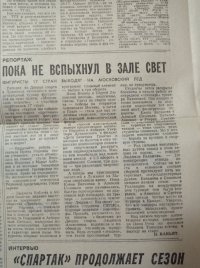
BEFORE THE HOUSE LIGHTS GO UP
(the article published in russian 'Sovetskiy Sport' on November 22, 1983)
FIGURE SKATERS FROM 17 COUNTRIES TAKE TO THE MOSCOW ICE
Today, the international figure skating tournament for the Moscow News prize begins at the Luzhniki Palace of Sports, featuring athletes from 17 countries.
Before the start, we attended the final "run-throughs" of our skaters' programs. Everyone is anxious: how will the audience receive the new routines, and how will the judges score them? Coaches and choreographers look critically at every gesture and pose with one thought in mind: does everything suit their students, and is it all elegant and fashionable?
"Take a rest, guys," Irina Rodnina said to her students, leaning back wearily in her chair. Veronika Pershina, Marat Akbarov, and their young teammates earned a breather after a grueling practice. At the Moscow tournament, Olympic champion Rodnina’s group is represented by three pairs.
"- Lyudmila Koblova and Andrey Kalitin, recently competing in our 'Dynamo' society championship," says Rodnina, "- showed quite mature programs and took second place, following Pershina and Akbarov. The bright, major-key music by composer Khrennikov very accurately matches the character of the young pair. For the first time, the skaters included a complex element in their program: a three-revolution throw.
Inna Bekker and Sergey Likhansky are young, energetic, and bold. Their success at the start of the season — victories at the open Moscow Championship and then in Prague — became an excellent stimulus for them and served as a good psychological backdrop.
Pershina and Akbarov prefer to skate in a strict, classical manner. Dunayevsky's overture to the film 'Children of Captain Grant' and melodies from ballets and operas by Spanish composers help the athletes reveal their individuality. They worked hard on mastering the 2.5-revolution axel in a combination. In short, three duos, three different creative identities...
And now we invite readers to the Small Sports Arena in Luzhniki. While Elena Batanova and Aleksey Solovyov were dashingly warming up, quickly crossing the entire rink diagonally, their coach — Olympic champion Lyudmila Pakhomova — was surrounded by GITIS students, future pedagogues and choreographers. The request, of course, was one: help with tickets to the Palace of Sports. Lyudmila Alekseevna sighed and promised to figure something out. After all, you couldn't imagine a better 'lecture' than such a prestigious tournament."
The students then opened their notebooks and began working on another "seminar" with coach Pakhomova. She gracefully and precisely demonstrated various gestures and delicate turns to her students on the ice. Elena Batanova and Alexei Soloviev, Natalia Annenko and Genrikh Sretensky—participants in the Moscow Ice Dance Tournament - are also, in a sense, seminar students. But their tasks are immeasurably more difficult – competing for spots on the national team.
"A number of strong dance duos have left the stage this season," says Lyudmila Pakhomova. "But the competition is far from diminishing. Currently, five interesting, distinctive duos are vying for spots on the main team. Batanova and Soloviev had a strong start to the season – they placed second at an international tournament in Holland, while Annenko and Sretensky took third at a tournament in Canada. I'm sure all the dancers will try to impress with innovative and original compositions."
Nino Rota's captivating melody from Fellini's films echoes over the rink. The dancers are ready to take the starting line.​
I. VANYATH.
1767289395720.jpeg
 
1983
GOLDEN SPIN


FIGURE SKATING
"GOLDEN SPIN"

(the article published in russian 'Sovetskiy Sport' on November 22, 1983)

The main surprise of the traditional "Golden Spin" international figure skating tournament, which concluded in the Yugoslav city of Zagreb, was the defeat of the world champion Rosalynn Sumners from the United States. She conceded first place to her peer, the nineteen-year-old Yugoslav athlete Sanda Dubravčić.
The American figure skater was far from her best form, made a number of mistakes, and managed to win only the compulsory figures, while in the short program and free skate, Dubravčić surpassed her rival.
Natalya Ovchinnikova from Sverdlovsk was among the top three leaders before the free skate, but ultimately ended up in fifth place.
At the Zagreb tournament, the spotlight was on the rivalry between world champion Scott Hamilton (USA) and European champion Norbert Schramm (FRG). The American skater was first in all three segments of the all-around competition.
The performance of the third-place finisher, the seventeen-year-old Japanese athlete Makato Kano, made a great impression on specialists; his repertoire included an impressive jump combination – a triple axel and a double loop.
In the ice dancing competition, the West German duo Petra Born and Rainer Schönborn prevailed. Muscovites Tatyana Gladkova and Igor Shpilband achieved the second-best result.​
(TASS).
1767290281509.jpeg
 
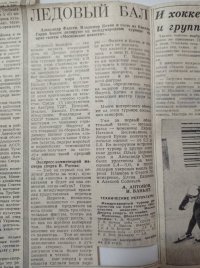
1983
MOSCOW NEWS PRIZE

ICE BALL

(the article published in russian 'Sovetskiy Sport' on November 23, 1983)
Alexander Fadeev, Vladimir Kotin, and guest from Canada Gary Beacom are leading at the international tournament for the "Moscow News" prize.
An "Ice Marathon" is what yesterday could be called at the Sports Palace in Luzhniki during the international figure skating tournament: the men started at 8 AM, and the ice dance duos finished their first "ball" only around midnight.
Former world champion Alain Calmat (France), who heads the judging panel for the men's competition, immediately oriented the judging towards being very strict and rigorous. Among 15 athletes from Austria, East Germany, Hungary, Italy, Canada, Romania, Yugoslavia, Finland, and the USSR, only two of our masters – national champion Alexander Fadeev and his national team colleague Vladimir Kotin – managed to "earn" scores above 4 points (incidentally, the leaders of world and European championships usually receive exactly this average score for the "compulsory figures").
Express commentary by Master of Sport V. Rogov:
"Debates have been ongoing for several years now on whether compulsory figures are needed in single skating and if they will ever be abolished? However, there are no significant changes in the international rules. A novelty has appeared, though – previously, single skaters were offered only three compulsory figures for the entire season; now, they are offered six immediately, from which three are chosen by lot. At first glance, the change is not global in nature. Nonetheless, it has influenced the overall class of execution of the figures for the better. The geometry of the patterns has become more perfect and precise. Our leaders – Fadeev and Kotin – have undoubtedly made a step forward in this area, which is gratifying.
As for the second tier, represented by V. Egorov, L. Kaznakov, and G. Vardanyan, they still have much to improve in the technique of microelements, in the technique of the finest turns that also influence the geometry of the entire figure."
So, the top three leaders among the men have been determined: Fadeev, Kotin, and the well-known Canadian master Gary Beacom.
The ice dance competitions promise many interesting moments at this tournament.
For their first compulsory dance – the Starlight Waltz – European champions Natalia Bestemyanova and Andrei Bukin already received excellent scores, ranging from 5.5 to 5.8. Other Soviet duos also met this tournament fully prepared: Olga Volozhinskaya and Alexander Svinin were awarded scores of 5.4-5.6 for the waltz, and Marina Klimova and Sergei Ponomarenko, as well as Elena Batanova and Alexei Solovyov, confidently entered the group of leaders.​

A. ANTONOV,
I. VANYAT.
TECHNICAL RESULTS
International Figure Skating Tournament for the Moskovskiye Novosti Prize. Moscow. Sports Palace. November 22.
Men's Compulsory Program.
1. A. Fadeev - 0.6; 2. V. Kotin (both from USSR) - 1.2; 3. G. Beacom (Canada) - 1.8; 4. V. Egorov - 2.4; 5. L. Kaznakov (both from USSR) - 3.0; 6. D. Coy (Canada) - 3.6.
1767292242145.jpeg
 
1983
GOLDEN SPIN


FIGURE SKATING
"GOLDEN SPIN"

(the article published in russian 'Sovetskiy Sport' on November 22, 1983)

The main surprise of the traditional "Golden Spin" international figure skating tournament, which concluded in the Yugoslav city of Zagreb, was the defeat of the world champion Rosalynn Sumners from the United States. She conceded first place to her peer, the nineteen-year-old Yugoslav athlete Sanda Dubravčić.
The American figure skater was far from her best form, made a number of mistakes, and managed to win only the compulsory figures, while in the short program and free skate, Dubravčić surpassed her rival.
Natalya Ovchinnikova from Sverdlovsk was among the top three leaders before the free skate, but ultimately ended up in fifth place.
At the Zagreb tournament, the spotlight was on the rivalry between world champion Scott Hamilton (USA) and European champion Norbert Schramm (FRG). The American skater was first in all three segments of the all-around competition.
The performance of the third-place finisher, the seventeen-year-old Japanese athlete Makato Kano, made a great impression on specialists; his repertoire included an impressive jump combination – a triple axel and a double loop.
In the ice dancing competition, the West German duo Petra Born and Rainer Schönborn prevailed. Muscovites Tatyana Gladkova and Igor Shpilband achieved the second-best result.​
(TASS).
View attachment 10543
Looks like you spent a busy New Year's Day preparing all these for posting! I'm enjoying them because we retired in the summer of 1983, so the 83/84 season was the first where I paid more attention to skating around the world and didn't focus as much on what other rival Canadian pairs were doing.
 
1983
MOSCOW NEWS PRIZE

STROKES TO A FAMILIAR PORTRAIT
Saint-Saëns and Personal Charm

(the article published in russian 'Sovetskiy Sport' on November 23, 1983)

At 19, Vladimir Kotin won the international figure skating tournament for the Moskovskiye Novosti newspaper prize. At the time, many experts noted the extraordinary nature of his ice skating style, especially his extraordinary emotional generosity and romantic grace. Two years later, at the 1983 European Championships, Kotin not only placed among the top five in singles but also achieved one of the best results in the free skate. Now a student at the Moscow Institute of Physical Education, Kotin is 21 years old, having dedicated 14 of those years to figure skating.
- Vladimir, what has helped you develop such a distinctive, emotional style in recent years?
"I've long been unable to imagine myself without music and ice. And the last three seasons in coach Elena Anatolyevna Tchaikovskaya's group—a group where the spirit of creative learning reigns—have noticeably changed my perception of both figure skating and music.
I try to understand every step, every movement, and in my programs I strive to express my understanding of the standard of technique and the art of composition. In this process, I owe a great deal to my mentor..."
A question for Honored Coach of the USSR E. Tchaikovskaya:
- Elena Anatolyevna, what do you think about this?
- I think all the previous World and European Championships where Kotin competed were merely steps in his development as a master and as a person. He not only gained experience but also learned to think broadly and outside the box on the ice, and embraced art in all its diversity. It's no coincidence that classical music plays so naturally in his programs. The melodies of Beethoven and Rossini are close to his heart. And now the new composition features a fragment set to music by Saint-Saens—for Kotin, it became one of the most striking, most significant moments. In my observations, the skater has achieved a new quality of sculpting: laconic, rigorous, and at the same time extremely expressive...
- Some people see figure skating as a sport of constant celebration. Vladimir, what does this world of skating look like to you?
“I don't love this sport for its charm. Above all, it demands tremendous daily work and strengthens one's will. I used to have a hard time getting used to the fact that my day started at six in the morning. But I got used to it. It was even harder to get into the rhythm of working on the ice during the "school" routine. I haven't gotten into the rhythm yet, but you understand that every muscle has to "play and sing," to feel every nuance of gliding. And it came with time!
They say the nights are very long in winter. But I think we figure skaters have short nights. But the day seems endless...”
“Vladimir, you had to constantly train with Dynamo dancers, first with Natalia Linichuk and Gennady Karponosov, then with Olga Volozhinskaya and Alexander Svinin. Did this affect your style?”

"You bet! While perfecting my skating skills, I also took up the compulsory dances on my coach's advice. They say I've caught up with my dancer friends in some ways. Sasha Svinin is a close friend of mine, a great advisor on creative matters. And I must admit, he's never let me down..."
"What are your hobbies outside the rink?"
"Music and more music. I hear it either in the theater, or in the auditorium, or at home."
Again, a question for the coach.
"Elena Anatolyevna, what new techniques have Kotin added to his arsenal this Olympic season?"
"First of all, I must say that Volodya's execution of all elements of the free skate—jumps, spins, and step sequences—has improved the purity and range of motion. Kotin is confident in his jump combinations, including a triple lutz combination and a triple flip-toe loop combination. Finally, he worked extensively on a unique element – a triple axel".
When preparing new compositions, we thought not only about the Olympic season but also about our goals for future seasons, and about the strengths we absolutely must bring to the next Olympic cycle.
"And also, creativity for the sake of the audience," Vladimir noted. "Performing in front of thousands of people is a celebration of the soul and heart. Then you forget all the difficulties!"​
Interview conducted by
A. SHELUKHIN.
1767297297783.jpeg
 
1983
MOSCOW NEWS PRIZE

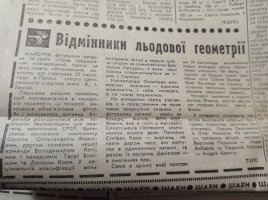
Masters of Ice Geometry

(the article published in Ukrainian 'Sportyvna Hazeta' on November 24, 1983)

The traditional international tournament for the "Moskovskie Novosti" newspaper prize, which started on November 22 at the Sports Palace of the V.I. Lenin Central Stadium, gathered figure skating masters from 16 countries.
The men were the first to compete in "ice geometry" - the precision of executing compulsory figures. As expected, the main competition unfolded between last year's winner of these competitions, USSR champion, European Championship bronze medalist Alexander Fadeev, the second number of our team Vladimir Kotin, and Canadians Gary Beacom and Denis Coy. In the national classification, they occupy places in the top three behind the famous Brian Orser, with whom our leaders will compete at the Games in Sarajevo.
On the eve of the Olympics, the Moscow competitions are an excellent opportunity to show oneself and look at others.
It is no coincidence that participants include representatives not only from countries traditionally strong in figure skating, such as Canada, England, FRG, GDR, Japan, but also guests from Australia. There are only two athletes from the "Green Continent". Moreover, Stephen Carr decided not to waste time in vain: he competes in singles skating and, together with his sister Danielle, in pairs competitions.
It is in this type of program that the first winners of the "Crystal Skates" prize will be determined on November 24. Unfortunately, world champions Elena Valova and Oleg Vasiliev are not participating in the tournament (the female partner suffered a minor injury in one of the recent training sessions)...
Fadeev won the men's competition in the "school" (compulsory figures), Kotin showed the second result, and Beacom the third.
In the dispute of sports pairs after the short program, the Leningrad pair Larisa Selezneva and Oleg Makarov took the lead. In second and third places were Muscovites Veronika Pershina - Marat Akbarov and Lyudmila Koblova - Andrey Kalitin.​
TASS.
1767336924782.jpeg
 
1983
MOSCOW NEWS PRIZE

FEELING OF FLIGHT

(the article published in russian 'Sovetskiy Sport' on November 24, 1983)

Leningraders L. Selezneva and O. Makarov lead in pair skating at the Moscow International Tournament.

Perhaps this was one of those happy evenings when no figure skating fan experienced disappointment. The stands of the Sports Palace in Luzhniki repeatedly responded with applause to the compositions presented by 13 pairs to the attention of the strict judges (headed by the Englishwoman Pamela Davis).
Truly, world champions Elena Valova and Oleg Vasiliev – who were forced to stay in the stands that day due to a cold – very much wanted to compete on the ice surrounded by all the candidates for our national team. And they have something to show: recently in Tallinn, they brilliantly performed a new free program. But we will hope that the Muscovites will still see the strongest pair on Sunday at the exhibition performances.
Here is what Elena Valova said immediately after the end of the short program competition:
"In my opinion, never before have our pairs skated at such speeds; they literally flew across the rink. Oleg and I cheered for our young compatriots Lyuda Kostenich and Igor Bich. The guys outdid themselves. And yet they did not even make it into the top eight. That is the level of competition now."
"Another interesting fact: Muscovites Marina Avstriyskaya and Yuri Kvashnin, who have a fifth place finish at the European Championship to their name, now found themselves in seventh place after the short program. Just one mistake - in the double loop, and immediately a loss of 0.6 points in each judge's score.
The lion's share of the applause went to the duo who had already won the "Moskovskie Novosti" tournament in 1981. We are talking about the pupils of the Honored Coach of the USSR Igor Moskvin, the Leningraders Larisa Selezneva and Oleg Makarov, skaters who cause the most heated debates because of their constant desire for unexpected, sometimes paradoxical versions of sports programs.
No, this is not a departure from the competition rules, but a search for new technical and plastic techniques that transform the pattern of the elements. The exit of skaters after a 'lasso' lift takes a split second for most pairs. But Selezneva and Makarov know how to make a remarkably long and steep arc, and this, in turn, leads to an unexpected transition to the next element. The result is a dense "pattern" of designs.
Negro blues is music mainly designed for dancers with an impeccable sense of rhythm. Selezneva and Makarov proved that they are also capable of solving purely dance tasks.
Dynamic skating with clear accents and the cleanliness of execution of all elements earned this duo technical scores of 5.5-5.8, and artistry scores of 5.6-5.8."
The three subsequent places were taken by duos training in the group of Olympic champion Irina Rodnina. This first and quite logical success for the young coach is explained by the fact that a unique creative identity and role were found for each of these pairs: romantic for Veronika Pershina and Marat Akbarov, lyrical for Lyudmila Koblova and Andrey Kalitin, and spirited and cheerful for Inna Bekker and Sergei Likhansky. Rodnina’s athletic 'echelon,' among other things, was distinguished by excellent technique in the execution of lifts and jumps.
Olympic medalist Uwe Kagelmann, now a coach for the GDR national team, brought his students from Karl-Marx-Stadt to Moscow. Peggy Seidel is only 14 years old, and Rolf Seifert is 18. Nevertheless, the world junior championship medalists displayed a completely mature style. They skated at a high tempo and received scores above 5.0, which is honorable for a tournament of such high caliber. Reliable reserves are growing within the GDR team.
The ice dance tournament in Luzhniki is still far from its climax, but it can already be said that in all compulsory dances, our leaders Natalia Bestemianova and Andrei Bukin displayed a most valuable quality—they form a single whole in all step sequences and positions. Hence the scores (for example, 5.7–5.8 points for the Kilian). The original dance—the Paso Doble—will clarify much regarding the ranking of the top six duos.
The women's compulsory program competition was won by E. Vodorezova. The men performed their short program. A. Fadeev was the best in this event.​

A. SHELUKHIN.
TECHNICAL RESULTS
International Figure Skating Tournament for the Moskovskiye Novosti Newspaper Prize. Moscow. Sports Palace, November 22.
Pair Skating. Short Program.
1. L. Selezneva and O. Makarov – 0.4 points; 2. V. Pershina and M. Akbarov – 0.8; 3. L. Koblova and A. Kalitin – 1.2; 4. I. Bekker and S. Likhansky – 1.6; 5. Yu. Bystrova and A. Tapasov – 2.0; 6. E. Bechke and V. Kornienko (all - USSR) – 2.4.
1767341293069.jpeg
 
1983
MOSCOW NEWS PRIZE

THIS INDEPENDENT STUBBORN MAN

(the article published in russian 'Sovetskiy Sport' on November 24, 1983)

MEET ONE OF THE PARTICIPANTS OF THE MOSCOW FIGURE SKATING TOURNAMENT — CANADIAN GARY BEACOM

As early as last year, 22-year-old Canadian Gary Beacom made people talk about him at the Moscow autumn tournament. His flawless spinning technique, beautiful organic transitions between elements, and cascades of complex jumps greatly appealed to the spectators at the Luzhniki Palace of Sports.
And now Gary is in Moscow again. Having confidently completed his "school" [compulsory figures], the cheerful, smiling, and handsome Canadian came backstage to have a cup of coffee. We took advantage of this pause.
— An interview? I'm ready to answer your questions. Biography? That's simple. I was born in Calgary on February 23, 1960. Later, my parents moved to Edmonton. At the age of eight, I was brought to the "Royal Club" to coach Eddie Collins.
Debuting at the Canadian Junior Championships, I took fourth place. I was thirteen then. Then I moved up step by step: in the junior category — third place, second, first. In 1977, at the senior championship, I started in seventh place. And now I have established myself in the second position behind Brian Orser. I trained at the Toronto Skating Club under the famous teacher Ellen Burka, who, by the way, also coached [Toller] Cranston. For the last few years, I have been preparing for performances on my own, without a choreographer and without a coach.
— Being on the same rink as Cranston, it must be difficult not to fall under his influence?
— Toller, in my opinion, is a unique figure in our sport. And being a "second Cranston" is pointless. I realized this long ago and decided to find my own path. It's not for me to judge to what extent I have succeeded.
— A few words about your creative laboratory...
— I always start only from the music. I feel an affinity for classics, jazz, and folk music alike. For instance, in one of my short programs, I decided to use Chinese folk melodies in a modern arrangement. A risk? Of course. But, I confess, I love untrodden paths and experimentation. Once the music is found, I work at the rink for weeks, agonizingly searching for the right pattern for the composition.
— Kovalev... Bobrin... Ovchinnikov... Kotin. Whose style is closer to yours?
— It’s hard to single anyone out. They are all world-class masters. And yet, Bobrin’s manner is closer to me. He is unlike anyone else, artistic, and always surprising. That is to my liking. I love stubborn, bold people. By the way, where is Bobrin now?.. Preparing a concert program? That’s understandable. And natural. It would be curious to see.
— How is your free time?
— Believe it or not, I have enough. I don't go in for twice-a-day practices. I train for two hours a day. My main passion is travel. I am grateful to sports for allowing me to see so much. This is my second time in Moscow. I confess that I asked the leaders of our federation to include me in the team for the trip to your amazing city. The unique scale and the special breadth in the people and the avenues amaze me.
— Your immediate goal?
— Both the immediate and, perhaps, the main one — to make the Canadian Olympic team. If that doesn't happen, I think I will leave the sport. This isn't bravado. It would mean I've stopped improving. In that case, one must put an end to it. Right now in Moscow, I will definitely try my best to finish in the top three.
— Good luck to you, Gary!
Interview conducted by
I. VANYAT.
1767343853688.jpeg
 
1983
EXPRESS INFORMATION

(the article published in russian 'Sovetskiy Sport' on November 24, 1983)

· Renowned English journalist J. Hennessy's book "Torvill and Dean" has gone on sale in London. It's dedicated to the renowned figure skaters and world champion ice dancers Jayne Torvill and Christopher Dean. The book chronicles the athletes' careers and their training principles. The final chapter covers the skaters' preparations for the Games in Sarajevo, where they hope to win gold medals.
1767344551767.jpeg
 
1983
MOSCOW NEWS PRIZE

A Play Called 'Corrida'

(the article published in russian 'Sovetskiy Sport' on November 25, 1983)

The dance range of European champions Natalia Bestemyanova and Andrey Bukin

Much has been written about the performance of the original dance to the paso doble rhythm in ice dance competitions. This topic was particularly hot during the 1978 season, when that year's world champions, Natalia Linichuk and Gennady Karponosov, masters of inimitable coherence, precision, and synchronicity, amazed all the experts with their paso doble. Five years have passed. And now, the draw has once again forced all the strongest couples to turn to this same rhythm of martial, passionate Spanish dance.
At the international tournament for the 'Moskovskie Novosti' newspaper prize, Natalia Bestemianova and Andrei Bukin had already won twice. And it seems that the main prize awaits them for the third time now, as with each new start they increase their advantage. For their Paso Doble, the European champions received three scores of 5.9 and nine scores of 5.8 points.
What is the charm of their dance? What is the allure of the best compositions at the Moscow tournament in general? Reflecting on this topic, choreographer Elena Matveeva, co-author of many wonderful dances by Irina Moiseeva and Andrei Minenkov, formulates her thought as follows:
— The word 'duet' in figure skating, just as in ballet, has a deep subtext. It is not just two skaters gliding alongside each other on the ice, but performers who form a single entity due to a subtle psychological connection. They conduct a dialogue with both gestures and eyes, and hidden behind all this is a tremendous amount of work on plasticity, on the pattern of the dance...
Yes, it is precisely this—the months of polishing every single step—that remains hidden from the spectator. The public sees something else: lightness and delicacy.
For instance, regarding our young duos following in the footsteps of the European champions—Marina Klimova and Sergei Ponomarenko, Elena Batanova and Alexei Soloviev, Natalia Annenko and Genrikh Sretenski—one could say this: the Paso Doble in their performance is characterized by airiness, elegance, and the refinement of movement. They do not "tear passion to tatters," but rather perform a bright, cheerful play called "Corrida." And they do so in the traditions of our brilliant Soviet ballet—effortlessly and emotionally.
It is pleasant to note another detail: the aforementioned group of skaters includes four former World Junior Champions (Ponomarenko, Batanova, Soloviev, and Annenko), and their transition to the senior ranks has happened smoothly—essentially at a new level of quality. This is undoubtedly a great credit to their mentors: N. Dubova and E. Kholina, L. Pakhomova and L. Pavlova.
Olympic champion Lyudmila Pakhomova once said: "Victories are not born in tranquility. Constant burning and complete self-dedication are needed!" This principle defines all the searches in the field of dance by Bestemianova and Bukin; that is why their dance range covers any and all directions—lyrical, dramatic, and grotesque. They decided to perform their Paso Doble in a dramatic key. There were many debates regarding the finale of this dance, where the partner fell onto the ice as if struck down by the "toreador." The new ending, performed at Luzhniki, leaves a strong impression; it symbolizes a new level for all our dances, which are increasingly becoming plot-driven.
A very high result—seven scores of 5.7 points—was the outcome of the performance by the European silver medalists Olga Volozhinskaya and Alexander Svinin. And yet, this is not the limit for these skaters, who are exceptionally technical with a sharp sense of rhythm. This very thought was emphasized by their mentor E. Tchaikovskaya when speaking about the new version of the Paso Doble, as all our best duos are still only halfway to the peak of their form.
The single skating leaders continue their path to the podium at the Moscow tournament. Their battle in the short program left no one in the hall indifferent. And once again, the entire drama of the situation was defined by the question of who could handle the unique jump combination, including a triple lutz.
USSR Champion Alexander Fadeev started first; he was also the first to overcome the difficult hurdle in his composition set to the rhythm of the Charleston. A month ago at the Moscow championship, he received all 5.9 scores. Now the judges were stricter: five scores of 5.7 and three of 5.8. Nevertheless, it should be noted that the quality of execution of most elements, and especially the step sequence, was higher. Only the roughness of the combination affected the result. The performances of Canadian Gary Beacom and the Leningrad skater Leonid Kaznakov were excellent.
The winners in pair skating were the Leningrad pair Larisa Selezneva and Oleg Makarov.​
A. SHELUKHIN.
TECHNICAL RESULTS
International Figure Skating Tournament for the Moskovskiye Novosti Newspaper Prize. Moscow. Sports Palace, November 23.
Men. Sum of compulsory and short programs.
1. A. Fadeev (USSR) - 1.0; 2. G. Beacom (Canada) – 2.6; 3 B. Kotin – 2.8; 4. L. Kaznakov – 4.2; 5. V. Egorov (all-USSR) – 5.2; 6. D. Coy (Canada) – 6.0.
Women. Compulsory program. 1. E. Vodorezova - 0.6; 2. K. Ivanova - 1.2; 3. A. Kondrashova - 1.8; 4. N. Lebedeva (all - USSR) - 2.4; 5. C. Wong (Canada) - 3.0; 6. A. Antonova (USSR) - 3.6.
1767348461621.jpeg
 
1983
MOSCOW NEWS PRIZE

STROKES TO A FAMILIAR PORTRAIT
"FIGHTING FOR HUMAN HEALTH"

(the article published in russian 'Sovetskiy Sport' on November 25, 1983)

A slender, fit man stands by the rink's edge, watching the pair skating masters with interest. He is captivated by the spectacle, and his reactions reveal him to be a true connoisseur of the craft. After the scores are announced, I ask him: "Monsieur Calmat, did you truly enjoy it, or have you simply missed the tournaments?"
In the now-distant 1960s, Muscovites became acquainted with the famous French figure skater Alain Calmat, a three-time European champion and World Championship winner. But beyond his titles, Calmat managed to win immense popularity with the general public. He was loved for his risk-taking and bravery. In those days, short programs were unheard of, and the weight of "compulsory figures" was significant. Calmat usually trailed his opponents after the "school" figures, and therefore, in the free skate, he performed miracles for the sake of victory, taking risks to the very end. At the 1965 European Championships in Moscow, Calmat remained true to himself and, seemingly with the frantic support of a jubilant audience, overtook Emmerich Danzer at the finish line—but the judges ruled otherwise: Danzer won by a minimal margin. However, Alain had the last word: at the 1965 World Championships in Colorado Springs, he secured an unconditional victory and retired from the sport.
In 1968, at the White Olympics in Grenoble, Calmat, as one of the most outstanding masters, lit the Olympic flame. Later, we followed his success in the medical field: the young surgeon began specializing in heart surgery. Yet, he could not stay away from figure skating entirely: he became a judge. Incidentally, at the tournament for the "Moskovskie Novosti" newspaper prize, Calmat is heading the judging panel for the men's singles event...
Hearing my first question, Alain smiles and replies with conviction:
"I like the performances of the Soviet pairs very much. For several decades now, I have been closely following the development of the Soviet school of figure skating and am glad to note the progress. Your achievements in ice dance are also impressive. Just think: in 1965 in Moscow, Soviet dancers took their first steps among the best European duos, and five years later, representatives of the USSR became the strongest in the world. Coaches are growing alongside the athletes.
As for the Moscow public, they have understood the nuances for a long time and, in my subjective view, appear no less knowledgeable than some of the judges."
— And how does Monsieur Calmat feel in the role of a referee today?
"I try to be tough and strict; I don’t give away extra points to anyone. For me, the most important thing is to rank the athletes correctly and honestly. True, no one is immune to mistakes—I clearly realize that now. But in my opinion, only non-essential errors are excusable. In cases where champions and medalists are being determined, judges must never lack competence, focus, and conscience. After all, justice and sometimes even the very path of figure skating's development depend on the quality of the judging panel's work."
— Considering that at these competitions the referee Calmat leads the judges, rather than setting scores himself, I ask you to characterize our leaders in men's singles skating...
— Fadeev and Kotin are athletes of a high international class. The former, I believe, is exceptionally technical, the latter artistic, but both are approaching a harmonious ideal and are capable of achieving much in this extremely important season. The fact that, despite their high skill, they are completely different and do not copy each other is valuable for the USSR national team. I feel that both skaters can appeal to more than just the spectators.
— Monsieur Calmat, what is new in your main job?
— I work as the chief surgeon in a hospital in the suburbs of Paris. I currently specialize in abdominal surgery.
— Does Calmat the skater help Calmat the doctor?
— Absolutely. Just as on the ice, I fight, only now for something much greater than medals—for a person's life and health. And I want to say frankly: I am completely satisfied with the seventeen years that have flown by rapidly since I left the ice. I will be happy if the next eighteen years are just as fruitful!​

Interview conducted by
Yu. DARAKHVELIDZE.
1767350614712.jpeg
 
1983
MOSCOW NEWS PRIZE

A Pleasant Repeat

(the article published in Ukrainian 'Sportyvna Hazeta' on November 26, 1983)

The first winners of the "Crystal Skate"—the "Moskovskie Novosti" newspaper prize—for victory in pair skating were the Leningrad pair Larisa Selezneva and Oleg Makarov. This is their second victory in the Moscow International Figure Skating Tournament (the first was in 1981).
Among the women's singles after the short program, Muscovite Elena Vodorezova is in the lead.
Late last night, the winner of the "Crystal Skate" in men's singles skating was determined. After the compulsory figures and the short program, the Muscovite Alexander Fadeev was ahead. Following him was the Canadian G. Beacom, and the fifth place was held by V. Yegorov from Kharkiv.
1767351295936.jpeg
 
Back
Top