1983
THE TRAINER IS SEARCHING
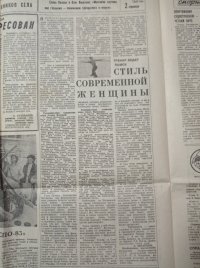
THE MODERN WOMAN'S STYLE
(the article published in russian 'Sovetskiy Sport' on November 16, 1983)
On the sidelines of the Sports Palace, you often hear discussions about the merits of certain figure skaters. One says, "I think this duo is very technical." Another remarks, "And I think the skaters are noticeably better at artistry." From the entire complex of qualities, they usually single out one and begin to build plans and program concepts around it.
Leningrad coach Tamara N. Moskvina has a completely different approach to the individuality of athletes. She looks for a unique character trait in partners, a "seed" of originality, and strives to ensure that this "seed" produces new shoots.
"Just as modern fashion is constantly innovating, so too in sports, one wave of change is constantly replacing another," says Moskvina herself. "And my job as a coach is to anticipate what set of qualities my students will need tomorrow, and the day after."
In the spring of 1983, Elena Valova and Oleg Vasiliev won the World Championships in Helsinki, disproving all the skeptics' arguments. This triumph was Moskvina's achievement: after all, having relied on the temperament and individual flexibility of her students, she had remained true to her course for all four previous seasons.
Reflections of world champion Elena Valova:
"Moskvina taught me to be persistent and goal-oriented, even though I started figure skating very early. From the age of five, I was already skating to music near my house. My father, Alexander Dmitrievich, a foreman of electrical fitters and metro builders by profession, even tried to coach me personally. After work, he would come home, put a homemade speaker on the windowsill, turn on the music and give me the command: “Skate!”
My home training sessions were well known at school. Our school principal, Alexandra Nikolaevna Matz, came to class one day, called me over, and said, "Lenochka, grab your skates and quickly go to Plekhanov Street. Tamara Nikolaevna Moskvina is overseeing the selection of new skaters at the rink there."
I went and was accepted into the figure skating school at the very first audition. Tamara Nikolaevna undoubtedly has an intuition that allows her to spot individual traits in a young athlete. After all, she once discovered Irina Vorobyova, a figure skater with an extraordinary temperament.
I studied with many coaches. But in the end, I came back to Moskvina. It was she who taught me the fundamental understanding of beauty in sport, and the very first program we did with Oleg Vasiliev was like an eye-opener: I heard the melody of the lines, the melody of the jump, the melody of the gesture…
Tamara Nikolaevna Moskvina herself formulates the five main theses of the coaching plan: the spectacular nature of pair skating, innovations in the technical arsenal, the class of the duet's skating, confidence and champion charm, and a variety of psychological and musical intonations in the program.
toward the realization of this program...
Many people think that figure skaters mechanically transfer the best achievements of ballet to the ice. Nothing of the sort! Moskvina convinced her students that only the process of mutual penetration of sport into art, and art into sport, is effective. Elena and Oleg attempted to perform purely ballet lifts on the ice, but these versions were far from the ideal. So they shifted their focus to the character, psychology, and facial expressions of ballet dancers. When Valova watched television ballets featuring People's Artist of the USSR Ekaterina Maximova, she realized: here it is, a living character, expressed in plasticity, in facial expressions!
Moskvina's vision for her championship-winning free skate presented Valova with a specific challenge: finding the perfect image of a young woman—bold, brave, mischievous, and yet charming. Moskvina also modeled her students on the performances Igor Boorin demonstrated in his programs…
Reflections of World Champion Oleg Vasiliev:
"In Moskvina's group, we skated alongside the 1981 World Champions Irina Vorobyeva and Igor Lisovsky, and Tamara Nikolaevna would often say to us in her special, quiet voice, 'Look, remember what the real Leningrad school is—pure, soft. You're destined to achieve this.' We never forgot this goal!
Tamara Nikolaevna and I released three free programs. The first of them was surprisingly fresh and original in terms of music ("Pictures at an Exhibition" by Mysorgsky), but we lacked the skill to convey its full charm to the audience. The second (set to Rimsky-Korsakov's "Scheherazade") was very beautiful and graceful, but not quite in our style. But the third—energetic, youthful in style—was like an arrow aimed precisely at its target. It took us a long time to develop our technical arsenal, but the ultra-C elements became our greatest advantage."
"We draw back the bowstring for a long time," Tamara Nikolaevna joked, "but after the shot we fly beyond the record line..."
This is truly a special trait of our coach—the ability to stoically endure the most unexpected turns in athletic life. Sometimes we noticed Moskvina arriving on the ice sad and worried. But then she'd gently shake her head and casually say, "Okay, all forgotten. Let's move on!" And immediately get back into the swing of things...
Watching Moskvina during training is instructive. She's usually calm and friendly ("I work on positive emotions"). But Moskvina can also be very angry: "Everything we've done is very bad. A terrible standard! We'll throw it out without a word!"
There is no point in arguing with her here; she wages a merciless war against cliches, affected hand gestures, saccharine language, and artificial smiles.
One day, Elena and Oleg came up with a new and interesting skating routine and pose. Moskvina included it in her program. A month later, seeing three other ice dancing couples using the same pose, she immediately abandoned it, even though ice dancing doesn't compete in pairs skating competitions. Tamara Nikolaevna's diaries contain notes on routines and elements from the past 15 years. However, she is convinced that these are merely food for thought, not for copying. The routine that brought her gold at the World Championships didn't include a single old, tired element. And now, preparing for the 1984 Olympic tournament, the world champions have replaced all the old techniques and approaches with elements.
Not to mention that Valova and Vasiliev's new short composition to the music of "Kalinka" is highly original and in no way replicates what Rodnina and Zaitsev showed on the ice...
Tamara Nikolaevna Moskvina embodies the best qualities of a modern woman, a mentor who works with complete dedication and passion, and who can teach her students to do the same. She is an Honored Master of Sports, multiple national champion, PhD in pedagogy, and the author of two books on pair skating (Moskvina worked on them in collaboration with her husband, Honored Coach of the USSR Igor Moskvin), an active teacher at the Leningrad Institute of Physical Culture, a mother of two daughters - how many different facets there are in the life of this seemingly fragile woman!
And at the same time, firmness and the ability to stand up for one’s views, the ability to make an extremely bold decision (for example, to change the short program one week before the start of the World Championships, as happened last winter).
Her group has developed its own unwritten rules: once a week, the guys hold an "April Fool's Day," and it's not easy to beat Moskvina in this unusual competition. Figure skaters, including world champions, enthusiastically participate in the group's creative workshop, discussing new techniques and the latest theatrical premieres. Who knows, maybe a few more original elements will be included in future Olympic compositions after such discussions.
"Forecasting is the most difficult and most interesting thing in coaching," Tamara Nikolaevna once remarked. "And how wonderful it is when you see a 5.9 on the scoreboard, the living embodiment of your ideas!"
A. SHELUKHIN
Necessary afterword:
By decision of the USSR Sports Committee, Honored Coach of the USSR T. N. Moskvina was awarded a medal for high athletic achievements in 1983.