Archive of newspaper articles | Page 18 | Golden Skate

Archive of newspaper articles

1984
WINTER OLYMPIC GAMES

PERFECT TECHNIQUE

(the article published in Ukrainian 'Sportyvna Hazeta' on February 15, 1984)

The world press, commenting on the results of the pair competitions, unanimously emphasizes that the Soviet athletes Elena Valova and Oleg Vasiliev had no equals on the ice in Sarajevo. The Belgrade newspaper "Vecernje Novine" writes that the champions performed their program in a style worthy of their high title. Former figure skating 'star' and now TV commentator Ingrid Wendl from Austria notes the perfect technique of Valova and Vasiliev; she is delighted with the grace and artistry of this pair.
The free program of the Leningrad pair captivated even the strict judges. For artistry, Elena and Oleg received six scores of 5.9; for technique, seven scores of 5.8. The champions' mentor, Honoured Coach of the USSR Tamara Moskvina, considers the main advantage of her students to be the balance of their program and the ability to combine the most complex elements into a single composition.
Other debutants and fellow Leningraders Larisa Selezneva and Oleg Makarov also deserved high marks. Their 'bronze' is of the highest quality, as it was earned with scores of 5.6 - 5.8 for technique and artistry, leaving all the GDR pairs behind, including the former world and European champions Bess and Tirbach. Second place went to the Americans Caitlin and Peter Carruthers. Although they did not demonstrate 'ultra-C' elements, they won people over with their synchronicity and expressiveness."
In the ice dancers' competition on the eve of the final day (medals were contested late yesterday evening), the British couple Jayne Torvill and Christopher Dean maintained the best chances for victory; their innovative programs are popular with the judges. Their original dance earned the world champions four scores of 6.0. Our Natalia Bestemyanova and Andrei Bukin confidently held second place. Marina Klimova and Sergei Ponomarenko, and the Americans Judy Blumberg and Michael Seibert, had almost equal chances for the 'bronze'. The strong point for our pair is perfect choreography, while the Americans possess speed and originality in their dance moves.
Last Monday, the men began their path to the Olympic podium. On the 'Zetra' rink, school figures were performed by 23 skaters from 15 countries. Representing the USSR are Alexander Fadeev and Vladimir Kotin. European champion Fadeev is currently in fifth position, and Kotin is eleventh. Naturally, both have a chance to move higher after the short and free programs. For example, Fadeev can well count on one of the medals, as the famous Norbert Schramm did not make it into the top six, and now he needs to take risks to break into the leaders. This season, Schramm had a falling out with coach Erich Zeller and prepared for the Games under the guidance of Carlo Fassi. Perhaps this was evident during the compulsory figures competition, where accuracy, calmness, and stability are key.
Leading the field is the three-time world champion American Scott Hamilton, whom all nine judges unanimously placed first after the 'school' (figures). It can be said that the fate of the 'gold' medal here is practically decided. Besides Fadeev, Josef Sabovčík from Czechoslovakia and three skaters from West Germany are also contending for other awards. One should not forget about the Canadians either, who, admittedly, performed poorly in the 'school'.
1769713067631.jpeg
 
1984
WINTER OLYMPIC GAMES

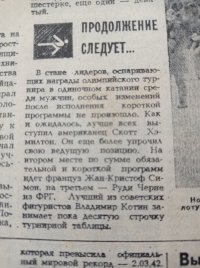
TO BE CONTINUED...

(the article published in russian 'Sovetskiy Sport' on February 15, 1984)

There were no major changes among the leaders vying for medals in the men's Olympic singles tournament after the short program. As expected, the American Scott Hamilton delivered the best performance, further solidifying his leading position. In the combined standings of the compulsory figures and the short program, Jean-Christophe Simond of France is in second place, with Rudi Cerne of West Germany in third. The top-ranked Soviet skater, Vladimir Kotin, currently holds the tenth spot in the standings.
1769714436381.jpeg
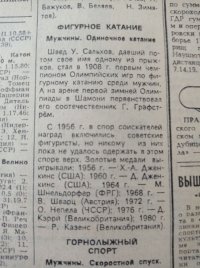
FIGURE SKATING

(the article published in russian 'Sovetskiy Sport' on February 15, 1984)
Men's Singles
Swede U. Salchow, who later gave his name to one of the jumps, became the first Olympic Games champion in men's figure skating in 1908. At the arena of the first Winter Olympics in Chamonix, his compatriot G. Grafström took first place.
Soviet figure skaters joined the competition for awards in 1956, but none of them have managed to win so far. Gold medals were won by: 1956 - H.-A. Jenkins (USA); 1960 - D. Jenkins (USA); 1964 - M. Schnelldorfer (West Germany); 1968 - W. Schwarz (Austria); 1972 - O. Nepela (Czechoslovakia); 1976 - J. Curry (Great Britain); 1980 - R. Cousins (Great Britain).
1769715191537.jpeg
 
1984
WINTER OLYMPIC GAMES

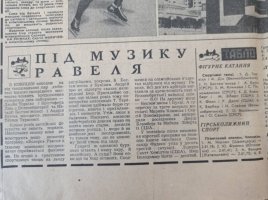
TO THE MUSIC OF RAVEL

(the article published in Ukrainian 'Sportyvna Hazeta' on February 16, 1984)

With each appearance of the ice dance couples, fans of their unique art await the continuation of the rivalry between the two best: Jayne Torvill and Christopher Dean from Great Britain, and Natalia Bestemyanova and Andrei Bukin, Muscovites coached by Tatiana Tarasova.
For several years, the British skaters have been undefeated. This season, they are demonstrating a somewhat unusual program. Their performance of Ravel's 'Bolero' is perceived ambiguously by specialists. Bestemyanova and Bukin, in particular, disagree with the British interpretation of ice dance. Andrei spoke about this frankly on the eve of the Games. Let us recall, however, that a few years ago, the innovation of Tatiana Tarasova's students also stirred a storm of debate, having both supporters and opponents. Yet, this was only in words. The Muscovites proved the right of their style to exist through high mastery and achieved great success, and if they have not found followers yet, it is simply because their style is not within everyone's capabilities.
The spectators greet both our couple and the British pair with equal enthusiasm. And the judges? For now, they are on the side of the latter. The ascent to the Olympic podium took place to the music of Ravel. All nine judges awarded the pair from Great Britain the highest possible marks for artistry — 6.0! In second place are Bestemyanova and Bukin. The battle for third was won by Muscovites Marina Klimova and Sergei Ponomarenko, who overtook the experienced Judy Blumberg and Michael Seibert from the USA.
In the men's event, Alexander Fadeev dropped down one position after the short program: he fell in a rather simple situation. Scott Hamilton (USA) remains in the lead. Our Vladimir Kotin is tenth.​
FIGURE SKATING
Ice Dance. 1. J. Torvill and C. Dean (Great Britain); 2. N. Bestemyanova and A. Bukin (USSR); 3. M. Klimova and S. Ponomarenko (USSR); 4. J. Blumberg and M. Seibert (USA); 5. K. Fox and R. Dalley (USA); 6. K. Barber and N. Slater (Great Britain); 7. O. Volozhinskaya and A. Svinin (USSR).
1769718587455.jpeg
 
1984
WINTER OLYMPIC GAMES

CHAMPIONS​

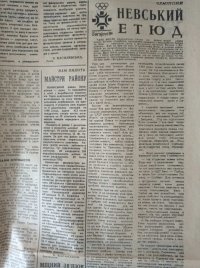
NEVA ETUDE

(the article published in Ukrainian 'Sportyvna Hazeta' on February 16, 1984)

IT FELT LIKE something one could only dream of by the seashore: tanning and carefree, Elena Valova and Oleg Vasiliev—world champions in figure skating—were running, jumping, and frolicking among the waves. But it was no dream. In September Yalta, at the height of preparations for the Olympic season, Elena and Oleg arrived for only a few hours. Naturally, they rushed to the sea to say goodbye to summer. Their path then led to Sevastopol for an Olympic athletes' gathering. While the bus sped through Crimea, these Leningrad students, still unaccustomed to fame and popularity, gave interviews, sharing stories about themselves and figure skating.
People began talking about them a year ago. Back then, the pupils of Tamara Moskvina unexpectedly found themselves at the European Championships. To the surprise of others, they took second place, impressing judges and the public with a style of skating that had begun to be forgotten since Irina Rodnina and Alexander Zaitsev: soft, plastic, yet simultaneously whirlwind and ultra-complex. Combining these traits is as difficult as holding two apples in one hand.
Their performance on the European ice was a surprise for Valova and Vasiliev themselves because they had missed the USSR Championship and hadn't initially made the national team. A serious injury to Oleg—a double jaw fracture—had stood in their way. The slightest strain or wrong move caused excruciating pain. Plans and hopes were crumbling, yet the skaters never stopped practicing. They trained in the gym, and on the ice, they performed "mock-ups"—running through the program without elements, merely imitating them. At first, they practiced individually, then together. Oleg lost seven kilograms and gasped for breath after only five minutes of skating, yet he refused to back down. Elena was terrified of the "twist" lifts, fearing she might strike her partner during the jump. When they finally managed to complete their full long program in early January, their coach’s applause echoed loudly in the empty Chelyabinsk Sports Palace, making it feel as though the stands were packed to capacity.
Vasiliev couldn't even eat on his own yet, but he was already spending his usual 5–6 hours a day on skates. They felt they had finally gained that confidence without which you cannot show everything you're capable of. Moreover, their program successfully synthesized the spectacle of pair skating, elite gliding class, and the technical versatility of both skaters, along with their high musical culture. The only problem was that there was no one to show it to. In a few days, the national team was leaving for Dortmund for the European Championships; for Valova and Vasiliev, the pre-Olympic season had practically ended before it even began...
Suddenly, they were invited to perform their program for the experts. Once again, empty stands (this time at the Luzhniki Palace of Sports), and once again, applause followed the final chord. Applause that served as recognition—a ticket to Dortmund. The previously selected participants had fallen ill, and by the next morning, Elena and Oleg were setting off toward fame.
Even though the partner competed with a fractured jaw and they had absolutely no experience in such major events, they weren't nervous: they danced joyfully, with total abandon. Silver medals there, followed a month later by World Championship Gold in Helsinki, overturned all pre-Olympic predictions. The surprise was explained by the fact that we have so many excellent pairs that it is sometimes harder to establish oneself on the national stage than on the international one. Yet, no one called their rise a fluke. How could it be an accident when Valova and Vasiliev were bright representatives of the Leningrad school of figure skating, continuing the traditions of world champions Irina Vorobieva and Igor Lisovsky, who were also trained by Moskvina?
... Different paths led our heroes to the ice. Little "Whirligig" Elena had dreamed of skates, dancing to music, and grand victories since childhood. Her first coach was her father—an electrical foreman who rigged up a sound system for a mini-rink in their yard. Later, her grandmother enrolled her in a real sports club. This happened shortly before the triumph of Rodnina and Ulanov in Sapporo. Oleg, meanwhile, grew up weak and sickly. Doctors recommended physical education and fresh air. He liked the prescription, and that is how Vasiliev befriended the skates.
Both competed in singles for a long time without much success until Moskvina spotted them and united them as a pair. Since each had their own opinion and their own understanding of figure skating, their joint sessions began with... settling scores. Their debut took place on the eve of 1980 in Leningrad at a match of the USSR's strongest skaters. Elena and Oleg started immediately after Rodnina and Zaitsev and were terribly nervous. They don’t remember the scores—only their ninth-place finish. And now, Leningrad again, again the eve of an Olympic year (1984), and again a match of the strongest. Valova and Vasiliev are called to the ice. To the rest of the world, they are Champions and Honored Masters of Sports, but to Leningraders, they are still those same likable debutants. After all, others hold the title of the best in the city on the Neva, and Elena and Oleg have never actually won a nationwide competition. Yet only through this victory does the road to Sarajevo lie...
In the short program, they dared to dance to "Kalinka," which we vividly remember being performed by Rodnina and Zaitsev. During preparation, there were doubts. Nevertheless, their creative search, high standards, and desire to reveal something new and previously unseen in a dance to such a popular melody prevailed. Leningrad received "Kalinka" with an encore... The long program confirmed the leadership of Moskvina's pupils.
— Who are your main rivals in Sarajevo? What are their strengths and weaknesses?
— Any of the Soviet pairs could step onto the podium. As for foreign competitors, the former world champions from the GDR, Baess and Thierbach, stand out, as do their compatriots Lorenz and Schubert. For the latter, there are no secrets in figure skating, but they are very vulnerable and react painfully to intense competition. Baess and Thierbach are not as versatile, but they are very stable and cold-blooded. When the female partner fell once, it was a sensation because we had never seen them fall, even in training.
— What is the most difficult period of the season or during the competitions themselves? What is the most treacherous element?
— We don’t like the summer stage. Although we perfectly understand that one cannot get by without learning new, record-breakingly complex elements and general physical conditioning. On the other hand, when we are choreographing a new dance, it’s hard to get us off the ice...
According to the new rules, there is a day off between the short and long programs. Surviving that day without relaxing too much or burning out (in Sarajevo, it falls on Saturday, February 11) is the most difficult task. As for the most treacherous element, it’s always the one you have the least mastery over. For a long time, the triple twist at the end of the program let us down—we simply ran out of strength.
— Does the reaction of the crowd affect you? Some athletes claim not to notice it…
— We always feel the audience's attitude, and we perform with the same competitive spirit whether the spectators are friendly or skeptical. We strive to thank the former for their trust and to win the latter over to our side. Purely emotionally, everyone liked our performance in Dortmund more than at the World Championships in Helsinki. However, it was in Finland that we landed the double axel, which we couldn't boast of before, and the judges, of course, took note of that. Meanwhile, we hesitated until the very last minute before the start: to risk it or not. Everything was decided by the rallying cry of "Shaybu!" (Score!) from our teammate Vladimir Kotin, who was sitting in the stands and rooting for us intensely...
— How do you see Tamara Nikolaevna Moskvina, your coach?
— Hardworking.
Erudite. A Candidate of Pedagogical Sciences, an associate professor, she speaks fluent English...
Witty. During the national team’s traditional "April Fools' Days," few people manage to outplay Tamara Moskvina.
Brave. She dared to completely change our short program just a week before the World Championships...
Precise. She knows perfectly how to bring us to peak form at the exact right moment. Sometimes, a week before a competition, Elena falls on every element. We are in despair, but Tamara Nikolaevna just laughs: "Children, stay calm! Everything is normal! Chin up!"
— Did you promise your coach to bring back a medal from Sarajevo? And what are your plans for the future?
They look at each other, blush, and lower their eyes... Everything is understood without words.​
G. KUZMIN
P.S. The Leningraders kept their word. Last Sunday, they became Olympic champions. The winning traditions of our nation's pair skating continue.
1769781434861.jpeg
1769781462898.jpeg
 
1984
WINTER OLYMPIC GAMES

IN CREATIVE SEARCH

(the article published in russian 'Sovetskiy Sport' on February 16, 1984)

On the Olympic ice of Sarajevo, the gold medal was won by the three-time world champions, British figure skaters Jane Torvill and Christopher Dean. From their very first dance, they seized the lead and did not relinquish it until the end of the competition.
The British couple skated last in the packed Zetra Olympic Hall and performed their free dance to Ravel’s "Bolero." The ice dancers staged a true theatrical masterpiece. The new Olympic champions possess confident edge work, and the lines of their dance are harmonious. Not a single movement was taken from their previous programs. The British duo matched the record of Soviet masters Lyudmila Pakhomova and Aleksandr Gorshkov, receiving twelve scores of 6.0 for their free dance.
The battle for places on the Olympic podium unfolded in the final group, featuring Judy Blumberg and Michael Seibert (USA), followed by Marina Klimova and Sergei Ponomarenko (USSR), Natalia Bestemianova and Andrei Bukin (USSR), and Karen Barber and Nicky Slater (Great Britain).
Competition debutants M. Klimova and S. Ponomarenko performed excellently throughout the entire ice dance marathon. They took to the ice full of determination to fight for medals. The light, clean gliding, the clear structural concept of their free composition (as European bronze medalists), and the soulful quality of their performance earned the students of Honored Coach of the RSFSR Natalia Dubova the bronze medals.
And then Russian melodies rang out and spread across the rink. Natalia Bestemianova and Andrei Bukin displayed a whirlwind, high tempo, refined mastery, and beautiful movement patterns in their dance. The students of Honored Coach of the USSR Tatyana Tarasova received thirteen scores of 5.8 and three scores of 5.9. In the end, they earned Olympic silver.
What about the Americans Blumberg and Seibert? They presented a traditional program in terms of technique and dropped a step lower to fourth place.
Our duo, Olga Volozhinskaya and Aleksandr Svinin, took seventh place. It should be noted that the duos outside the top six are engaged in interesting creative searches. The Canadian couple Tracy Wilson and Robert McCall, as well as American ice dancers Elisa Spitz and Scott Gregory, stood out. In ice dancing, there is a clear desire to create images filled with high meaning and beauty.
The men's event still had the free skate program remaining. We asked Honored Coach of the RSFSR Eduard Pliner to comment on the skaters' battle after the short program:
— Undoubtedly, the standard of men's singles skating has noticeably improved. Only Scott Hamilton (USA) is far ahead of the pack. Those currently in second through fifth places—Jean-Christophe Simond (France), Rudi Cerne (West Germany), Jozef Sabovčík (Czechoslovakia), and Brian Orser (Canada)—have not guaranteed themselves secure positions; they are being chased by a large group of masters.
The leader, Scott Hamilton, was extremely focused and diligent but did not avoid minor errors. He was second in the short program.
The Canadian Brian Orser skated with scope and breadth. The athlete took a certain risk by performing a complex combination jump and ultimately won the short program segment. The American athlete Brian Boitano took third place in the short program and moved up to sixth place overall after the two segments. Norbert Schramm (West Germany) fell during his short program (7th place).
Our Vladimir Kotin showed he was a fighter, performing all elements without mistakes or blemishes. We saw a worthy skate. However, Kotin started in the second group, long before the leaders took the ice, and the judges did not fully objectively evaluate his performance.
The European Champion, Aleksandr Fadeev, started his program excellently, with good tempo and power. He executed a complex cascade. But he failed his flip jump. As a result, he moved down to 7th place overall.
Ahead lies the free program. That will truly put everyone in their final places.
Twenty-four skaters have entered the competition in the women's singles event. USSR champion Elena Vodorezova showed the best result in the execution of the first compulsory figure. She is followed by World champion Rosalynn Sumners (USA), European champion Katarina Witt (GDR), Sandra Cariboni (Switzerland), and two Soviet skaters—Kira Ivanova and Anna Kondrashova.

Figure Skating. "Zetra" Sports Palace. Ice Dance. Overall Standings.
1. Jane Torvill / Christopher Dean (Great Britain) — 2.0; 2. Natalia Bestemianova / Andrei Bukin (USSR) — 4.0; 3. Marina Klimova / Sergei Ponomarenko (USSR) — 7.0; 4. Judy Blumberg / Michael Seibert (USA) — 7.0; 5. Carol Fox / Richard Dalley (USA) — 10.6; 6. Karen Barber / Nicky Slater (Great Britain) — 11.4; 7. Olga Volozhinskaya / Aleksandr Svinin (USSR) — 14.6; 8. Tracy Wilson / Robert McCall (Canada) — 15.4; 9. Petra Born / Rainer Schönborn (FRG) — 18.0; 10. Elisa Spitz / Scott Gregory (USA) — 20.0; 11. Wendy Sessions / Stephen Williams (Great Britain) — 22.6; 12. Kelly Johnson / John Thomas (Canada) — 23.8
1769790733114.jpeg
1769790756535.jpeg
 
Last edited:
1984
WINTER OLYMPIC GAMES

New facets of dance art

(the article published in russian 'Sovetskiy Sport' on February 16, 1984)

So, another figure skater tournament has concluded in Sarajevo – in ice dancing. As many specialists had assumed, the gold medals went to the well-known British duo J. Torvill and Ch. Dean.
Their path to the Olympic peak is, in my opinion, quite instructive. In recent years, the British have been persistent in their search in the field of composition, expression, plastics, and demonstrated new possibilities in expanding the technical and creative arsenal of ice dancing.
It is generally said that champions dictate fashion. Such a phrasing is not entirely correct in relation to Torvill and Dean. They brought their original creativity to the public's judgment. I think this is probably connected with the preparation of their future dances in professional ice ballet.
All specialists recognize that the Soviet school of figure skating made a great contribution to the development of ice dancing. The direction chosen by the Soviet school opens up new perspectives in the creative plan. During the Olympic season, coaches T. Tarasova, N. Dubova worked especially fruitfully. The Soviet team has excellent reserves; there are talented masters among those who stayed home.
I specifically note the progress of the silver pair N. Bestemyanova and A. Bukin; they clearly added in all sections of dancing.
Now our duos have started to pay more attention to technical skill, perfectly understanding that a highly artistic composition can be created only on the basis of filigree technique. The leading athletes of our team manifest themselves as real actors on the ice, but not for a moment do they forget that the basis of acting skill is skating technique.
The creative growth of the Olympic silver medalists N. Bestemyanova and A. Bukin is obvious. Honored coach of the USSR T. Tarasova always listened to the opinion of specialists. Working with Bestemyanova and Bukin, she widely used the rich technical arsenal that her students possess. Dances of any genre, any rhythmic pattern are within Bestemyanova and Bukin's power. It is pleasant to note their inclination towards folk melodies.
The debutants M. Klimova and S. Ponomarenko faced a difficult task at the Olympic Games. And under the guidance of Honored Coach of the RSFSR N. Dubova and choreographers E. Kholina, E. Matveeva, they successfully solved it. The couple, which became the bronze medalist of the '84 Games, attracted all connoisseurs with the purity of lines, freshness, and charm of youth.
Ice dancing awaits new talents. And we have them. We only need to learn lessons from mistakes in time, dare, be more persistent in creative search.​
V. RYZHKIN, Honored Coach of the RSFSR.
SARAJEVO
1769795041318.jpeg
 
1984
WINTER OLYMPIC GAMES

CHANCES REMAIN

(the article published in russian 'Sovetskiy Sport' on February 17, 1984)

The Soviet figure skater K. Ivanova is in third place after the ladies' single skaters performed the short program, where she was also third, losing in this discipline to the European champion K. Witt (GDR) and T. Chin (USA).
Witt, justifying her role as the favorite in most forecasts, is leading the tournament; the world champion R. Summers (USA) is in second place. E. Vodorezova and A. Kondrashova are in fourth and fifth positions.
In the short program, failure struck the leader of our team, Vodorezova, who made a mistake when performing the double loop. The highest scores (up to 5.9 points) were received by Witt.​
1769796038089.jpeg
FIGURE SKATING

(the article published in russian 'Sovetskiy Sport' on February 17, 1984)

Women. Singles skating
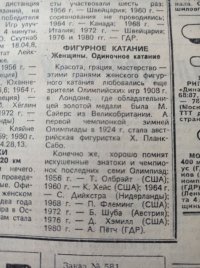
Beauty, grace, mastery — these facets of women's figure skating were admired back by spectators of the 1908 Olympic Games in London, where the owner of the gold medal was M. Sayers from Great Britain. And the first champion of the Winter Olympics in 1924 was the Austrian figure skater H. Plank-Sabо.
Of course, sophisticated connoisseurs also well remember the champions of the last seven Olympics:​

1956 — T. Albright (USA);

1960 — C. Heiss (USA);

1964 — S. Dijkstra (Netherlands);

1968 — P. Fleming (USA);

1972 — B. Schuba (Austria);

1976 — D. Hamill (USA);

1980 — A. Pötzsch (GDR).
1769796084274.jpeg
 
1984
WINTER OLYMPIC GAMES

SOLOISTS AND EXTRAS

(the article published in Ukrainian 'Sportyvna Hazeta' on February 18, 1984)

Once upon a time, the compulsory figures competition determined the fate of single skaters long before the finale. The relative weight of the "school" (compulsory figures) in the overall standings was too great, which diminished interest in the figure skating tournament as a whole. The situation changed with the introduction of the short program.
Now, to become a medalist, an athlete must be a much more well-rounded master of the "winged skates." At the same time, a "failing grade" in the figures doesn't completely destroy one's hopes, provided the participant is a fearless jumper and possesses the art of dance—allowing them to excel in the other two sections of the program.
The most striking example is the Canadian, Brian Orser. After failing to break into the top six following the compulsory figures, he won the short program and delivered a breathtaking free skate composition, filled with "flight-like" jumps, original spins, and many purely choreographical innovations. All of this allowed Orser, in the final stretches of the three-day marathon, to overtake his main competitors and become the Olympic silver medalist. The champion, however—25-year-old American Scott Hamilton—was beyond competition.
The bronze medal went to Jozef Sabovčík of Czechoslovakia, a skilled skater well known to our spectators. He often competed alongside Soviet skaters, and both Alexander Fadeev and Vladimir Kotin regularly proved their convincing superiority over him. However, in the decisive tournament of the Olympic cycle, both let their nerves get the better of them, showing an inability to tune in for the struggle. Fadeev was particularly disappointing. The European Champion didn't even make it into the top six—a group that was rounded out by the Frenchman Jean-Christophe Simond, an excellent "school" specialist (compulsory figures).
Among the women, all our participants—Kira Ivanova, Elena Vodorezova, and Anna Kondrashova—successfully cleared the "checkpoint" that is the short program. Before the final performance, they trail only Katarina Witt from the GDR and the American Rosalynn Sumners. The positions of these leaders are perhaps only threatened by another US representative, Tiffany Chin, who placed second in the short program and holds seventh place overall. However, no matter how the struggle ends, one can already speak of the great progress made by Soviet female athletes.​

FIGURE SKATING
Men's Singles
1. S. Hamilton (USA); 2. B. Orser (Canada); 3. J. Sabovčík (Czechoslovakia); 4. R. Cerne (West Germany); 5. B. Boitano (USA); 6. J.-C. Simond (France); 7. A. Fadeev (USSR); 8. V. Kotin (USSR)
1769801138674.jpeg
1769801167680.jpeg
 
1984
WINTER OLYMPIC GAMES

FIGURE SKATERS​

(the article published in Ukrainian 'Sportyvna Hazeta' on February 18, 1984)
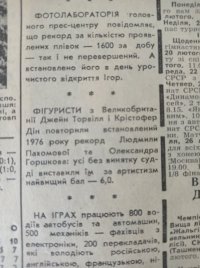
Jayne Torvill and Christopher Dean of Great Britain repeated the record set in 1976 by Lyudmila Pakhomova and Alexander Gorshkov: every single judge, without exception, awarded them the highest score—6.0—for artistic impression.
1769801700079.jpeg
 
1984
WINTER OLYMPIC GAMES

FIGURE SKATERS​

(the article published in Ukrainian 'Sportyvna Hazeta' on February 18, 1984)
Jayne Torvill and Christopher Dean of Great Britain repeated the record set in 1976 by Lyudmila Pakhomova and Alexander Gorshkov: every single judge, without exception, awarded them the highest score—6.0—for artistic impression.
View attachment 10823
A linguistics question: Looking at the original newspaper article, why does it look as if the same Cyrillic symbol has been used for the J in Jayne and the D in Dean? I can't quickly locate my Russian/English dictionary that has that alphabet, but I like to at least pick out people's names in the original.
 
A linguistics question: Looking at the original newspaper article, why does it look as if the same Cyrillic symbol has been used for the J in Jayne and the D in Dean? I can't quickly locate my Russian/English dictionary that has that alphabet, but I like to at least pick out people's names in the original.
The names in Ukrainian look as follows: Джейн Торвілл - Крістофер Дін.
 
The names in Ukrainian look as follows: Джейн Торвілл - Крістофер Дін
:thank:Finally overcame laziness and went to my collection of linguistics textbooks left over from grad school. I see the Ukrainian alphabet doesn't have a letter J so they use the combination of two letters representing the sound, D+soft G. Roughly speaking. And for his surname, they just needed the D equivalent by itself. My sub-field in linguistics was personal names, so when I see something like that, not seeming to make sense at first glance, the old academic curiosity stirs :unsure:🔍
 
Transliteration in another alphabet allows to follow the approximate pronunciation instead of the spelling. In a way, it makes sense, because it's efficient.
 
1984
WINTER OLYMPIC GAMES

SAFETY MARGIN MEANS A LOT

(the article published in russian 'Sovetskiy Sport' on February 18, 1984)

The figure skating masters' competitions have finished at the Zetra Sports Palace. The 12 strongest figure skaters fought an uncompromising battle at a high level of skill. But even those athletes who did not make it into the leading group also demonstrated interesting, original skating. For example, F. Kirsten from the GDR, who was 16th after the sum of the "school" and short program, performed a triple axel perfectly. Japanese figure skater M. Ogawa, who started from 15th position, showed an original free composition rich in original elements.
But, of course, everything was decided in the performances of the two strongest groups.
When the first six came out for warm-up, they included N. Schramm (FRG), A. Fadeev and V. Kotin (both USSR), G. Filipowski (Poland), H. Fischer (FRG), G. Beacom (Canada), they immediately showed that they were all tuned for high results.
But the tension was great, and not everyone managed to cope with their nerves.
On the ice was the silver medalist of last year's World Championship N. Schramm. And here is the first misstep. His skating was uneven, with mistakes. He messed up the lutz and practically dropped out of the fight for a place in the top six.
Alexander Fadeev followed him on the ice. Everyone remembers that Alexander had a unique program in complexity. But if at the European Championship in Budapest Fadeev coped magnificently with a cascade, triple lutz, and triple toe loop, here he fell after an axel in 3.5 turns. He also failed the triple Salchow.
In the end, A. Fadeev took 7th place overall. V. Kotin's program was saturated with difficult jumps and original spins, but the inaccuracies made in the middle of the composition did not allow him to fully reveal his mastery. He is eighth overall.
G. Beacom, J.-C. Simond (France), H. Fischer showed very close results. And the troublemaker was B. Orser (Canada). As you remember, after performing the compulsory figures he was seventh. The Canadian performed the short program perfectly. Orser won the free program as well. He skated freely, widely, performed an axel in 3.5 turns. The figure skater is artistic, he has excellent gliding, soft lines. Orser received 11 marks of 5.9. This brought him the silver medal of the Olympic Games. Immediately after him started the American figure skater B. Boitano. There were many difficult jumps in the program. Taking 5th place in the free program, he remained in fifth position.
And now it was the turn of the world champion S. Hamilton (USA). He had a significant safety margin, so why risk it? And it was felt. In his program, a flip was messed up. The athlete mostly succeeded in jumps in 2.5 turns. The marks were from 5.6 to 5.9. In the free program Hamilton was second. But, we repeat, the safety margin played its role, and the US figure skater became the champion of the Winter Olympic Games.
And now the final chord of the figure skaters' performances. The champion of Czechoslovakia J. Sabovcik put the last point. At the beginning of the season, the athlete had a knee operation, he took a long time to gain sporting form, but now he skated with amazing ease, ideally performed a jump in 3.5 turns. For execution technique he received all marks 5.8. For artistry, the marks were slightly lower, but they still brought him the bronze medal.​
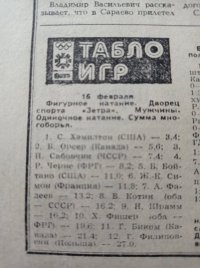
SCOREBOARD GAMES
16 February
Figure skating. Zetra Sports Palace. Men. Singles skating. All-around total.
1. S. Hamilton (USA) - 3.4; 2. B. Orser (Canada) - 5.6; 3. J. Sabovcik (CSSR) - 7.4; 4. R. Cerne (FRG) - 8.2; 5. B. Boitano (USA) - 11.0; 6. J.-C. Simond (France) - 11.8; 7. A. Fadeev - 13.2; 8. V. Kotin (both USSR) - 16.2; 9. N. Schramm - 16.2; 10. H. Fischer (both FRG) - 19.6; 11. G. Beacom (Canada) - 21.4; 12. G. Filipowski (Poland) - 27.0.
1770037844878.jpeg
1770037864371.jpeg
 
1984
WINTER OLYMPIC GAMES

BRONZE PROGNOSIS

(the article published in Ukrainian 'Sportyvna Hazeta' on February 21, 1984)

DURING the Olympic qualifying competitions for Soviet figure skaters in Leningrad last December, Honored Coach of the RSFSR Eduard Pliner, commenting on the women's performances, said:
"We didn't even notice how our figure skaters joined the ranks of the best in the world. We have Elena Vodorezova to thank for that. For many seasons, she fought her way onto the podiums alone, while simultaneously clearing the path for others. Using Vodorezova as an example, we taught her younger teammates, focusing on the refinement of compulsory figures, mastering complex elements, and skating technique. I believe my Anna Kondrashova will perform worthily in Sarajevo. If her chronic colds let up, Vodorezova will also have her say. But the best chances lie with Kira Ivanova. Under the guidance of Vladimir Kovalev, she has progressed so much in two years that she has no equal in the world today in terms of technical preparation. If this experienced athlete can master her nerves, she will be on the podium."
It was as if the specialist were looking into the mirror of the ice at the "Zetra" Olympic Hall, where the Olympic figure skating tournament took place. For the first time in the history of domestic figure skating, Kira Ivanova won a medal in the women's event. She was awarded the bronze. The champion's laurels went to Katarina Witt from the GDR, while the silver medal went to Rosalynn Sumners from the USA.
Journalists had been critical of coach Pliner's Leningrad forecast. After all, Ivanova had been competing on the international stage for a long time and represented our team in Lake Placid, yet her achievements had been very modest. Recently, she hadn't even always made the national team and was rarely seen by judges or spectators.
Kira did not melt the ice of judicial mistrust immediately. After the "school" (compulsory figures) — which, it should be noted, she always skates cleanly — the judges "held Ivanova back" somewhat. The turning point was her performance in the short program, where the Dynamo athlete from the Moscow region posted the third-best result. She danced with inspiration and without noticeable errors on the final day as well, which brought her the long-awaited award.
The Olympic debut of Anna Kondrashova must be recognized as superb. Our most promising figure skater secured fifth place among 24 participants.
Despite the upbeat finale, our athletes trailed behind the Americans in the unofficial team standings. The men’s performance was a letdown, as they unexpectedly failed to earn any points. In the other three disciplines, Soviet skaters amassed 26 points (one gold, one silver, and three bronze medals). This is only one point less than in Lake Placid; however, the consistent performance of the overseas "masters of the winged skate," who took home medals in all four disciplines, earned them 29 points. The GDR skaters, who were not represented in ice dance and failed to score in the men’s event, finished with 12 points.​
FIGURE SKATING
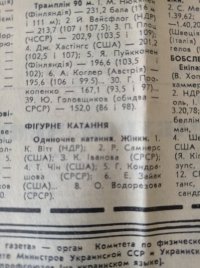
Women’s Singles. 1. K. Witt (GDR); 2. R. Sumners (USA); 3. K. Ivanova (USSR); 4. T. Chin (USA); 5. A. Kondrashova (USSR); 6. E. Zayak (USA) ... 8. E. Vodorezova (USSR).
1770043809224.jpeg
1770043829531.jpeg
 
1984
WINTER OLYMPIC GAMES

CHARACTER DECIDED MUCH

(the article published in russian 'Sovetskiy Sport' on February 21, 1984)


(The beginning of this article is missing)

K. Witt (GDR) with her coach Jutta Müller remained at the boards to watch Rosalin Sumners perform. Incidentally, Witt herself had very high scores: five times 5.9, ten times 5.8.
Then Jutta Müller will say: "At the Sarajevo Olympics, my student showed real character. She performed consistently in all components of the all-around."
...The figure skater from the USA also deserved applause from the hall. She had excellent scores for artistry, even one six. But in the end, she remained the silver medalist of the '84 Games. And this season the title of champion was won by Witt.
Our Ivanova achieved success. In the current season, as they say, she couldn't find herself for a long time: there was no stability in jumps, Kira skated unevenly, although she possesses a solid technical arsenal. But Ivanova showed fighting qualities now and deservedly won the bronze medal.
After the "school," she was in fifth place, the short program brought her the third result, and in the free skate, she was fourth. In the end, she climbed onto the podium of the Olympic Games.
Anna Kondrashova, a student of Honored Coach Eduard Pliner, deserves kind words, too. The European Championship bronze medalist made a good impression with her elegant style of skating, musicality, and ease of execution of complex jumps.
In the all-around, A. Kondrashova showed the fifth result, letting the talented figure skater from the USA, T. Chin, get ahead.
A curious twist: T. Chin looked unremarkable in the "school" (12th place). But she was second in the short program and third in the free skate.
Unfortunately, Elena Vodorezova did not live up to expectations. She looked good only in the compulsory figures, she was second. But 8th place in the short program, 11th result in the free skate threw Vodorezova back to eighth place overall.
So, the figure skating competitions have concluded. The USSR team won 5 medals in this tournament: one gold, one silver, and three bronze medals. Our leaders in pair skating and ice dance gave their all in the fight. It was the real fighting character that determined the success of such bright masters as Elena Valova and Oleg Vasiliev, Natalia Bestemyanova and Andrei Bukin.​

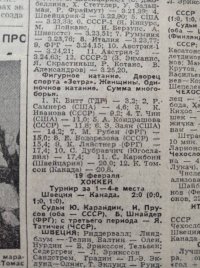
Figure Skating. Zetra Sports Palace. Women. Singles Skating. All-around Total.
1. K. Witt (GDR) — 3.2; 2. R. Sumners (USA) — 4.6; 3. K. Ivanova (USSR) — 9.2; 4. T. Chin (USA) — 11.0; 5. A. Kondrashova (USSR) — 11.8; 6. E. Zayak (USA) — 14.2; 7. M. Ruben (FRG) — 15.0; 8. E. Vodorezova (USSR) — 15.4; 9. K. Leistner (FRG) — 17.4; 10. S. Dubravcic (Yugoslavia) — 17.4; 11. S. Cariboni (Switzerland) — 20.0; 12. K. Thomson (Canada) — 20.8.
1770049471666.jpeg
1770049497195.jpeg
 
1984
WINTER OLYMPIC GAMES

A Line in the Olympic Chronicle

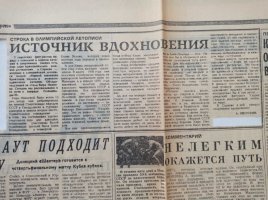
A Source of Inspiration

(the article published in russian 'Sovetskiy Sport' on February 22, 1984)

For Soviet figure skaters, alongside success in pair skating and ice dancing, there was another fundamentally important achievement in Sarajevo: for the first time in our team's Olympic history, a bronze medal was won in women's singles skating. Kira Ivanova became the medalist. Today we tell the story of her path to the award.
Kira Ivanova was only 15 years old when she debuted at the Winter Spartakiad of the peoples of the USSR in Sverdlovsk in the junior tournament and took second place. A surprising coincidence: two other girls, current participants of the White Olympics, also started successfully in the same competition: Anna Kondrashova was third, and Elena Valova, who switched to pair skating a year and a half later, was fourth.
For Kira, the Sverdlovsk success became a very important stepping stone. In March 1978, she won a silver medal at the World Junior Championships in France, and in January 1979 she won the gold medal at the senior USSR Championships in Zaporizhzhia. All experts recognized the 16-year-old figure skater's achievement as sensational and at that time already acknowledged her mentor, Honored Coach of the USSR Viktor Nikolaevich Kudryavtsev. It was he who set his student on the right path, from the very beginning aiming Kira at mastering the technique of triple jumps. This is how the multiple national champion Tatyana Danilenko (Likhareva) commented on Kira's victory then:
"Kira is unusually devoted to figure skating, she does not despair after failure, she does not flinch before authorities. And I also note the merits of her free skate: Mozart's music helped to emphasize the lyricism of the program, her beautiful gliding."
Yes, this is how it often happens in sports: the first steps in the all-Union arena brought the young figure skater recognition and opened up wonderful prospects. However, the path to the international arena was not so happy for Ivanova: her debut at the World Championships brought her only 18th place, and her debut at the White Olympics in Lake Placid only 16th. Her further athletic career could have ended there. For the next two seasons, the athlete performed inconsistently, even finding herself in a secondary role on the national team. Now she had to think about how to catch up with her competitors who had picked up the pace, like Elena Vodorezova and Anna Kondrashova.
The "pursuit" lasted a long time, right up to the start in Sarajevo, for which the athlete was trained by V. Kovalev. I remember that at the European Championships in Budapest, Ivanova, although she took fourth place, still lagged behind her teammates. As the USSR national team coach Alexander Vedenin later emphasized, it was hardest for Kira Ivanova to win back authority and recognition from the judges, but she coped with this task primarily because she was fully aware of the responsibility of her Olympic performance and mobilized herself maximally in each type of competition.
In the first minute of the free program, Kira missed the triple loop. These were critical moments. Kira did not flinch in the difficult situation and performed the rest of the program excellently, showing a fine sense of music and rhythm. In the finale, a flawless triple salchow followed, and the author himself, Swedish figure skater Ulrich Salchow, multiple world champion, would surely have applauded this beautiful jump.
In Sarajevo, she found her sporting inspiration!​

A. SHELUKHIN.
1770152145522.jpeg
 
1984
WINTER OLYMPIC GAMES

A Line in the Olympic Chronicle

A Source of Inspiration

(the article published in russian 'Sovetskiy Sport' on February 22, 1984)

For Soviet figure skaters, alongside success in pair skating and ice dancing, there was another fundamentally important achievement in Sarajevo: for the first time in our team's Olympic history, a bronze medal was won in women's singles skating. Kira Ivanova became the medalist. Today we tell the story of her path to the award.
Kira Ivanova was only 15 years old when she debuted at the Winter Spartakiad of the peoples of the USSR in Sverdlovsk in the junior tournament and took second place. A surprising coincidence: two other girls, current participants of the White Olympics, also started successfully in the same competition: Anna Kondrashova was third, and Elena Valova, who switched to pair skating a year and a half later, was fourth.
For Kira, the Sverdlovsk success became a very important stepping stone. In March 1978, she won a silver medal at the World Junior Championships in France, and in January 1979 she won the gold medal at the senior USSR Championships in Zaporizhzhia. All experts recognized the 16-year-old figure skater's achievement as sensational and at that time already acknowledged her mentor, Honored Coach of the USSR Viktor Nikolaevich Kudryavtsev. It was he who set his student on the right path, from the very beginning aiming Kira at mastering the technique of triple jumps. This is how the multiple national champion Tatyana Danilenko (Likhareva) commented on Kira's victory then:
"Kira is unusually devoted to figure skating, she does not despair after failure, she does not flinch before authorities. And I also note the merits of her free skate: Mozart's music helped to emphasize the lyricism of the program, her beautiful gliding."
Yes, this is how it often happens in sports: the first steps in the all-Union arena brought the young figure skater recognition and opened up wonderful prospects. However, the path to the international arena was not so happy for Ivanova: her debut at the World Championships brought her only 18th place, and her debut at the White Olympics in Lake Placid only 16th. Her further athletic career could have ended there. For the next two seasons, the athlete performed inconsistently, even finding herself in a secondary role on the national team. Now she had to think about how to catch up with her competitors who had picked up the pace, like Elena Vodorezova and Anna Kondrashova.
The "pursuit" lasted a long time, right up to the start in Sarajevo, for which the athlete was trained by V. Kovalev. I remember that at the European Championships in Budapest, Ivanova, although she took fourth place, still lagged behind her teammates. As the USSR national team coach Alexander Vedenin later emphasized, it was hardest for Kira Ivanova to win back authority and recognition from the judges, but she coped with this task primarily because she was fully aware of the responsibility of her Olympic performance and mobilized herself maximally in each type of competition.
In the first minute of the free program, Kira missed the triple loop. These were critical moments. Kira did not flinch in the difficult situation and performed the rest of the program excellently, showing a fine sense of music and rhythm. In the finale, a flawless triple salchow followed, and the author himself, Swedish figure skater Ulrich Salchow, multiple world champion, would surely have applauded this beautiful jump.
In Sarajevo, she found her sporting inspiration!​

A. SHELUKHIN.
View attachment 10847
Poor Kira. I only met her very briefly once, really just an exchange of hellos in the hall one year when she did Skate Canada, but she looked so beautiful and so strained with nerves. Somebody told me she wore gloves all the time because she bit her nails right down to the quick.
 
1984
What do you know about it?

EVERYTHING STARTED WITH MUSIC

(the article published in russian 'Sovetskiy Sport' on February 24, 1984)


(INTRODUCING NO. 32 FIGURE SKATING)​

Figure skating—one of the most spectacular and attractive sports for thousands of people—traces its official history from a very modest, but remarkable event: on January 16, 1866, in Vienna, there was a performance by Jackson Haines, who had previously worked as a ballet master in the USA. It was he who first came up with the idea of performing popular dances to music on figure skates. Haines' first demonstrations at home did not find recognition or approval, and so Haines went to one of the most musical cities in Europe. Austrian sports enthusiasts greeted Haines' ice concert with enthusiasm, and he immediately found students. Four years later, the first official figure skating competitions were held in Vienna. At the same time, the Viennese couple Frei demonstrated the first pair skating program.
In the first World and European Championships (1891-1906), only one winner was determined in singles skating, as both men and women competed together. There was a case where the Englishwoman Madge Syers took second place among male skaters, losing only to the famous Swedish world champion Ulrich Salchow (incidentally, one of the most beautiful jumps on the ice is named in his honor). From 1906, women were granted the right to compete in separate tournaments, and from 1908, the title of world champion in pair skating was contested.
The number of participants in the first tournaments was small. For example, at the 1908 Olympic Games, spectators only saw three pairs, five women, and ten men's singles skaters.
The fundamental principles of the Soviet figure skating school were laid down by the outstanding teacher Nikolai Alexandrovich Panin-Kolomenkin, who taught for many years at the Leningrad Institute of Physical Culture and wrote several textbooks. He also left unusually interesting memoirs about his sports journey. The fact is that Panin was an outstanding figure skater in the world at the beginning of the century and won the first gold medal at the 1908 Olympic Games in London, for the execution of special figures on ice (the designs of which were developed by Panin himself).
Today, watching the virtuoso performances of modern masters, one involuntarily recalls many of Panin’s precepts—they were creatively adopted and interpreted by Soviet coaches, especially those who underwent the rigorous school of figure skating in Leningrad.
A new flourishing of figure skating began in many countries during the 1950s, when indoor artificial rinks—convenient, spacious, and featuring massive grandstands—appeared in dozens of cities. Coaches increasingly drew upon the achievements and traditions of ballet and theater, as well as the expertise of musicians, directors, and choreographers. The 1950s marked the rise of two national schools in Europe: the Austrian and the French. A whole galaxy of Viennese skaters triumphed at European championships—Eva Pawlik, Hanna Eigel, Ingrid Wendl, Hanna Walter, and Regina Heitzer. Among the men, Emmerich Danzer and Wolfgang Schwarz later shone. Meanwhile, the French school produced original masters such as Alain Giletti, Alain Calmat, and Patrick Péra. In Czechoslovakia, the sparkling talent of ice dancers Eva Romanová and Pavel Roman, as well as famous singles skaters Karol Divín, Hana Mašková, and Ondrej Nepela, brought great joy...
This winter former world champion Alain Calmat (France) visited Moscow in the role of a referee at an international tournament. He fondly recalled his performance on the ice at the 1965 European Championships in Moscow. Calmat is credited with the famous aphorism: “A true master must demonstrate the beauty of figure skating in the fragments between jumps.” Indeed, his call to focus on high aesthetic criteria was embraced by athletes from many countries. This is evidenced by the exceptionally spectacular programs of Olympic champions John Curry (Great Britain), Peggy Fleming (USA), Canadian champion Toller Cranston, and many others. It is interesting to note that specialists consider Canadian skater Gary Beacom to be Cranston’s successor; in 1983, at the Moscow tournament in Luzhniki, Beacom won a silver medal and received the special "Sportloto" prize. This prize, a decorative wooden vase, was established by the Main Administration of Sports Lotteries for the foreign skater with the best result, and was painted in the Russian national style by folk craftsmen from Lipetsk.
The 1980 Olympics became another important stepping stone in the development of singles skating. The new Olympic champion, Robin Cousins (Great Britain), proved with his victory that a modern skater's strength lies in jumps and athletic qualities. The entire last four-year period has been marked by a sharp increase in program difficulty and the mastery of "ultra-c" elements.
The greatest achievements of the Soviet school of figure skating are associated with winning performances in pair skating and ice dancing.
The debut of the young Muscovites Irina Rodnina and Alexei Ulanov at the World Championships in Colorado Springs immediately brought them gold medals. Rodnina holds a unique record: she has three Olympic victories to her credit (in 1972 with Alexei Ulanov, and in 1976 and 1980 with Alexander Zaitsev), as well as ten gold medals from World Championships (1969–1978). This winning streak was continued by new duos—Marina Cherkasova and Sergei Shakhrai, Irina Vorobieva and Igor Lisovsky, and Elena Valova and Oleg Vasiliev.
Soviet masters Lyudmila Pakhomova and Alexander Gorshkov, six-time World and European champions, made a significant contribution to the development of ice dancing. Through their programs, they helped facilitate the inclusion of ice dancing in the Winter Olympics program and were the first to secure victory at the Olympic tournament in 1976. It is worth noting that in that same year, 1976, Soviet duos swept the entire podium at the European Championships: Pakhomova and Gorshkov, Irina Moiseeva and Andrei Minenkov, and Natalia Linichuk and Gennadi Karponosov.
The World Championship was won by Moiseeva and Minenkov. 1978. The World Championship brought success to Linichuk and Karponosov. 1980 Olympics. First place was taken by Linichuk and Karponosov, while third place went to Moiseeva and Minenkov. All of this is evidence of the rapid progress of our ice dancing school.
Today, its traditions are being developed in an original direction by the 1983 European champions Natalia Bestemianova and Andrei Bukin, along with a whole range of other dance duos.
Soviet singles skaters have also written an interesting page in the annals of figure skating with their victories—World champions Sergei Volkov and Vladimir Kovalev, and European champions Igor Bobrin and Alexander Fadeev. The list of victories continued in Sarajevo, where Elena Valova and Oleg Vasiliev became Olympic champions.​

A. SHELUKHIN.
1770226228502.jpeg
 
1984
WINTER OLYMPIC GAMES

A LINE IN THE OLYMPIC ANNALS

WITH YOUTHFUL ZEST

(the article published in russian 'Sovetskiy Sport' on February 25, 1984)

Two medals—a gold and a bronze—were brought into the piggy bank of the USSR national team at the Sarajevo Winter Olympics by Soviet pair skating masters Elena Valova and Oleg Vasiliev, and Larissa Selezneva and Oleg Makarov. Both duos, who achieved success on Olympic ice, are from Leningrad. Perhaps the most unexpected result—third place in the highly complex tournament—was achieved by Larissa Selezneva and Oleg Makarov. This pair became a "mystery" to many competitors in the '84 season. We present them to our readers.
The Selezneva and Makarov mystery is a psychological one. Four years ago, they won the world championship among juniors in pair skating. But then they remained in the shadows for four years, as if not daring to throw down the gauntlet to the leaders of our pair skating—Marina Cherkasova and Sergei Shakhrai, Marina Pestova and Stanislav Leonovich.
Larissa and Oleg have been skating together for just over six years. Their first mentor was a very meticulous, thorough coach, a former medalist of the 1972 Winter Olympics, Andrei Suraykin, who always asked his students for one thing: "skate softer, more beautiful!"
It goes without saying how important lessons in aesthetics are for figure skaters. Suraykin's lessons were not in vain for Oleg and Larissa. The skaters still had to gain competitive experience and willpower. Their first start at the senior national championships in 1982 seemed to offer no special hope—fifth place among the strongest duos. But many specialists believed in the future of Larissa and Oleg, primarily the head of the new specialized pair skating group, Honored Coach Igor Borisovich Moskvin, and the group's choreographer, Lyudmila Baskakova.
"Our sessions in the hall were unusually exciting," Baskakova told us. "There were choreographic sketches where they had to transform themselves, drastically change their mood and emotions. Empathizing with the music—that was the ultimate goal for our kids."
Is revealing individuality and noticing the buds of originality in time not the main concern of a coach and their assistants?! This is exactly how Igor Moskvin finally understood his goal when he conceived new programs for Selezneva and Makarov on the eve of the Olympic season.
Everything was going smoothly, but fate intervened: in September 1983, Larissa suffered a hand injury, and for a month and a half, doctors forbade her from performing lifts and death spirals—elements rightly called key in pair skating. Larissa trained alone and anxiously awaited the hour when the doctors would remove the cast. Only at the end of October were Selezneva and Makarov able to show their new compositions. The premiere took place in Tallinn at the international "USSR Trade Unions Prize" tournament. Everyone was nervous—Moskvin, the choreographer of the new programs Yuri Potemkin, the athletes themselves, and of course, Larissa. The premiere was extremely tense and nervous. Yet it was a success because, as Oleg Makarov said, they "truly fell in love with their programs, lived this music, and looked forward to the start, like a holiday." The duo skated boldly and assertively, and Larissa fearlessly went for the triple toe loop and triple twists. They won the Tallinn tournament. And almost a month later, they achieved victory in the international "Moscow News Prize" tournament in Luzhniki. This is how the Olympic ticket to Sarajevo was won!
The free program to the music from the ballet by composer R. Kogan, The Mad Day, or The Marriage of Figaro, already aroused keen interest and debate: compositions with a single storyline and such a set of original lifts and transitions between elements are rare. At the European Championships in Budapest, Selezneva and Makarov's innovations were noticed by the judges. The duo was close to a podium finish. Oleg was overly nervous and fell on the most difficult element, the triple toe loop. The pair took fourth place.
In Sarajevo, everything that was conceived came to fruition in the execution of both the short and free compositions. Larissa and Oleg skated with youthful zest, cleverly, and originally.
"In your team at the Olympics, all the pairs were different in style, mood, and approach. And that's wonderful!" said Igor Moskvin. "That is the strength of our masters—their individuality."​

A. SHELUKHIN.
1770227210532.jpeg
 
Back
Top