Archive of newspaper articles | Page 24 | Golden Skate

Archive of newspaper articles

1985
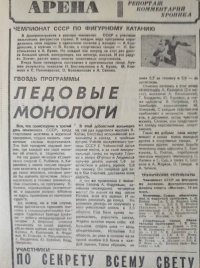
USSR CHAMPIONSHIPS

January Patterns on Ice

(the article published in russian 'Sovetskiy Sport' on January 9, 1985)
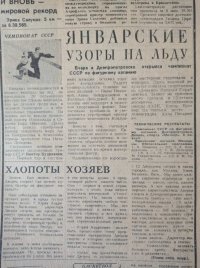
Yesterday in Dnipropetrovsk, the USSR Figure Skating Championships opened.
No surprises occurred during the first outings on the ice. Twenty of the country’s strongest female figure skaters were determining who among them is the best in compulsory figures (school figures). Sarajevo Olympic bronze medalist Kira Ivanova took first place. Following her were world championship silver medalist Anna Kondrashova and last year's USSR champion Natalya Lebedeva.
Honoured Coach of the USSR, Viktor Kudryavtsev, comments on the women's competition:
"The first round of the competition left a good impression. The technical versatility of our leaders—Kira Ivanova, Anna Kondrashova, and Natalya Lebedeva—is pleasing. By the peak of the season, they are reaching excellent athletic form. Anna Kondrashova, the world silver medalist, has significantly gained in confidence. At the same time, considering the upcoming European Championships, some adjustments and additions are necessary: special attention must be paid to the aesthetics of movement during the tracing of figures."
Simultaneously with the seniors, the juniors began their starts. Here, a high result was shown by "Dynamo" athlete Natalya Skrabnevskaya. Second place was taken by 13-year-old Muscovite Elena Kushnir from the AZLK school. In third place is Alla Pisarenko from Leningrad.​
Technical Results
USSR Figure Skating Championships, Dnipropetrovsk, "Meteor" Sports Palace, January 8.
Women's Singles: Compulsory Figures. 1. Kira Ivanova — 0.6; 2. Anna Kondrashova — 1.2; 3. Natalya Lebedeva — 1.8; 4-5. N. Ovchinnikova and M. Tveretinova — 2.4; 6. M. Serova — 3.6​


Troubles of the Hosts

(the article published in russian 'Sovetskiy Sport' on January 9, 1985)

A phone ring. Another ring. "Is this the Sports Palace? Where can I buy tickets for the figure skating?"
Our interlocutor reluctantly lets go of a lock of thick black hair. Yuri Andreyevich Vasilenko, the director of the Sports Palace, has no more than thirty minutes for our conversation. During this time, he picked up the telephone receiver many times, and in a changing voice, said:
"You understand, a hopeless situation..."
"In my life, I have a constant rule: to start every day with physical exercise. Well, first of all, a run through the streets. But even in these minutes, I thought about the upcoming work on our scoreboard. It is the first in a new series, which the Hungarian complex 'Elektroimpex' begins to produce this year. On such a board, you can draw any text 'picture.' We assembled it for the start of the country's championship, and I thought: how will it withstand the intense competitive rhythm?"
"Yuri Andreyevich, perhaps you could continue the topic of presenting this magnificent Palace of Sports, in which the country's strongest figure skaters are contesting championship medals?"
"When we were designing our Palace, we familiarized ourselves with 12 sports palaces in cities such as Moscow, Kiev, Vilnius, Riga... We even selected each brick for the facade—what color, what size. And here are some of the engineering characteristics of the Palace of Sports in Dnipropetrovsk: capacity — 5406 seats, refrigeration machines — 7, air conditioning units — 3, technical staff — 300 people. In preparation for the championship, both communications specialists and masters of children's toys also participated (they made a huge rabbit on skates!), as did artists of theaters and poets."
Again, a telephone ring. The director listened to the caller and said:
"Immediately... flood the main arena. The skaters are already in the locker room..."​
(From our special correspondents)
1774291842396.jpeg
 
1985
USSR CHAMPIONSHIPS

FAMILIAR RHYTHMS — FAMILIAR STYLE

(the article published in russian 'Sovetskiy Sport' on January 10, 1985)

The USSR Figure Skating Championships continue in Dnipropetrovsk. Yesterday, the men entered the ice—the masters of single skating, performing the compulsory program. European champion Alexander Fadeev seized the lead. In second place is Vladimir Kotin. In third—Vitaly Egorov.
The competition for women is nearing its climax. This time they competed in the short program. Here, Anna Kondrashova took first place.
In the evening, the fate of the gold medals in pair skating was decided.


Remember the famous finale of the Olympic program of Lyudmila Pakhomova and Alexander Gorshkov? That fiery, soul-stirring "Dance of the Clogs" became a classic of its kind. Nine years have passed since then. And now we have once again heard that familiar melody. This time on the ice of the Dnipropetrovsk "Meteor" Sports Palace, it was performed by Leningraders Elena Bechke and Valery Kornienko.
By the draw, they were the ones who had to conclude the pairs' short program competition. Let's be honest, the skaters took on an incredibly difficult task: to expand the strict framework of a short program to include what was once only possible for brilliant ice dancers.
We must give credit to Bechke and Kornienko—they skated excellently, with temperament and soul. It seemed like the podium was within reach. But then happened what coaches fear most: the psychological burden of responsibility (Bechke and Kornienko have been leading the race for a spot on the national team for six months) took its toll in a decisive moment. The partner could not stay on her feet after a double Lutz jump, and her fall immediately lowered the scores by 0.5 points of 9 judges. In the conditions of the sharpest competition, where nine pairs vied for a spot in the top six, such a mistake cost them dearly. The Leningraders found themselves in seventh place.
However, fans from Leningrad are unlikely to stay upset for long, as their school of pair skating once again proved to be at the top, thanks to the mastery of Olympic champions Elena Valova and Oleg Vasiliev and Sarajevo Olympic bronze medalists Larisa Selezneva and Oleg Makarov.
Both pairs, pupils of Honored Coaches of the USSR Tamara Moskvina and Igor Moskvin, received 5.8 scores for performance technique. This is a unique case in our figure skating. Until now, we were witnesses to the undeniable advantage of one pair—recall the six undefeated seasons of Irina Rodnina and Alexander Zaitsev. Now the picture is different: there are two magnificent duos, and both evoke admiration with their dedication and total self-giving.
"Flight of the Bumblebee" performed by Valova and Vasiliev is an unusually complex miniature, where the synchronized rhythms create a special sense of exoticism and inner tension. Selezneva and Makarov's program to modern French jazz music in a symphonic style captivates with a bubbling overflow of energy and is performed with great feeling of confidence in their own strength. This noble competitive impulse was felt by everyone who was in the stands this time.
Yes, these two pairs skated at the highest level of mastery, while maintaining their distinctive style. Only in artistic expression did the judges give preference to Olympic champions Valova and Vasiliev, which put them in first place.
The fate of the remaining spots was decided by the champions of the 1981 national championship, Muscovites Veronika Pershina and Marat Akbarov, and Inna Bekker and Sergei Likhansky (both pairs from Irina Rodnina’s group), as well as the rapidly progressing program of Sverdlovsk pair Yulia Bystrova and Alexander Tarasov (coach A. Rennik) and junior world champions Ekaterina Gordeeva and Sergei Grinkov (coach Stanislav Leonovich).
Pershina and Akbarov’s short program was an effective version: Chopin’s Etude was subtly interpreted by Irina Rodnina. As a result, Pershina and Marat received scores of 5.6–5.7 and took third place. The other three pairs mentioned skated harmoniously, clearly, and with ease in the most effective elements—the double lutz, the twist, and the lift.​
TECHNICAL RESULTS
USSR Figure Skating Championships, Dnipropetrovsk. "Meteor" Sports Palace. January 8.
Pairs: Short Program. 1. E. Valova and O. Vasiliev — 0.4 points; 2. L. Selezneva and O. Makarov — 0.8 points (Leningrad); 3. V. Pershina and M. Akbarov — 1.2 points (Moscow); 4. I. Bekker and S. Likhansky — 1.6 points (Dnepropetrovsk); 5. Yu. Bystrova and A. Tarasov — 2.0 points (Sverdlovsk); 6. E. Gordeeva and S. Grinkov — 2.4 points (Moscow).
1774294161531.jpeg
 
1985
USSR CHAMPIONSHIPS
PARTICIPANTS


JANUARY "FLIGHT OF THE BUMBLEBEE"

(the article published in russian 'Sovetskiy Sport' on January 10, 1985)

A candid conversation with Olympic champions Elena Valova and Oleg Vasiliev, who have not yet won at the country's championships.
In the list of brilliant victories for the Leningrad duo Valova and Vasiliev, there are first-place finishes earned at the European and World Championships and the Winter Olympics in Sarajevo. But fate decreed that in the '84 season, Elena and Oleg were unable to start at the USSR championship, where Larisa Selezneva and Oleg Makarov became the winners. In Dnipropetrovsk, Valova and Vasiliev, having all the highest titles, began the battle for the title of country champions for the first time.
We turned to Oleg Vasiliev with a request to comment on the duo's new short program.
"The essence of a modern short program in figure skating, as I define it, is first and foremost a 'mini-performance,' extremely saturated with polished elements, original findings in technique, in plasticity, and in music."
"Elena and I are already working on our fifth short program. Together with our coach Tamara Nikolaevna Moskvina, we chose Rimsky-Korsakov's eternal melody 'Flight of the Bumblebee.' The range of search for us is expanding with each season. Especially if you consider that in the free program, we also have new music—from the ballet 'Shurale,' composed by the Soviet composer F. Yarullin."
"In our short program, there are three key elements: a lutz lift, a parallel jump double lutz, and a sequence of spirals in the form of a swallow. At first glance, they are not very complex, but in each element lies a ‘spark’ that creates the effect of spectacle. Compared to the previous season, our duo has a more noticeable sense of reliability and strength. Lena is in good form."
"Is there a difference in your emotional state between the short and free programs?"
"No. In both cases, we have one goal: to give all our strength for victory, to perform with maximum power."
Question to Elena Valova:
"What did you remember most recently from theatrical premieres? You are known to be big fans of theatrical art."
"We enjoyed watching the new ballet 'Tsar Boris' back home in Leningrad. But we still watch every performance as if through the prism of figure skating. We learn, we learn, we learn...."​


FROM DIFFERENT POINTS OF VIEW

THESE DISSIMILAR PAIRS

(the article published in russian 'Sovetskiy Sport' on January 10, 1985)

G. Orlova and V. Kaprov, well-known past masters of pair skating and now coaches, reflect on the merits and shortcomings of the short program.
G. ORLOVA:
When there is no undisputed leader, it's already interesting and intriguing. And in the short program, three duos immediately fought for first place. And what is remarkable—they are not like each other.
V. KAPROV: True, every pair has its own identity, its own charm. Not only we, the coaches, but also the spectators immediately noticed this.
G. ORLOVA: Still, I would give preference to Selezneva and Makarov. Bold, daring, combative. They were set for a good result from the very beginning.
V. KAPROV: But ahead are the Olympic champions...
G. ORLOVA: Yes, ahead. But by the way, there is something unfinished in their skating. I attribute this to their first start. Hence a slight constraint, fear of making a mistake. And it is felt that the guys are searching.
V. KAPROV: And what do you think of the pair Pershina – Akbarov? Aren’t they very lyrical, musical, and charming?
G. ORLOVA: Moreover, they are competing on equal terms with the leaders.
V. KAPROV: I will continue the thought about Valova and Vasiliev. They lacked just a tiny bit. I agree that it is connected with the feeling of the first start. They skated to very fast music, which, as you know, requires truly heroic strength... And Selezneva—Makarov are good. Their short program is independent, powerful, and effectively uses brilliant gliding. As for Pershina—Akbarov, in their program, one feels a scientific approach to the work by Irina Rodnina and choreographer Elena Cherkasskaya.
G. ORLOVA: I think we should mark a search of the young.
V. KAPROV: Out of them, world junior champions Ekaterina Gordeeva and Sergei Grinkov are remembered most. Having stepped onto the senior ice for the first time, they did not falter. The Dnipropetrovsk pair Sorokina and Guenko are worthy of praise, having joined the group of the strongest in such a short period.​
"Soviet Sport" Brigade:
V. Krivopaltsev, V. Kuchmiy, A. Shelukhin
Dnipropetrovsk
1774297141239.jpeg
 
1985
USSR CHAMPIONSHIPS

VIRTUOSOS ARE AIMED AT NEW FRONTIERS

(the article published in russian 'Sovetskiy Sport' on January 8, 1985)

THE STRONGEST FIGURE SKATERS ENTER THE STRUGGLE FOR MEDALS OF THE USSR CHAMPIONSHIPS IN DNIPROPETROVSK

January is one of the peak months of the winter season for figure skating masters. And the current January is special in many respects. Soviet figure skaters are conducting intensive preparation not only for the upcoming European and World Championships, but also for the future Winter Olympics of 1988 in the Canadian city of Calgary.
As is known, in 1984 at the Sarajevo Olympics, the USSR team won 5 medals, including a gold one — in pair skating. Our juniors also performed successfully: following the World Championships in Colorado Springs, they had three gold medals in their collection (in pairs, in women's singles, and in ice dancing).
Today, it is important to clarify the modern trends in the development of world figure skating. The first of these is a broad change of generations in national teams. Such famous masters of figure skating as the English pair J. Torvill and C. Dean, Americans S. Hamilton, E. Zayak, R. Sumners, brother and sister Carruthers (USA), Canadians B. Underhill – P. Martini as well as R. Cerne, N. Schramm (FRG) have left competitive sports and turned professional. In their place come new waves of talented masters. Their new leaders, without doubt, will have even more complex programs. If at the Lake Placid Olympics the leaders in single skating performed several triple jumps, then in Sarajevo we saw both quadruple jumps and 3.5-turn jumps in combinations for men, and the triple lutz and flip for women. If earlier in pair skating it was sufficient for the strongest pairs to perform a parallel jump in 2.5 rotations, then now it is necessary to include in the program one or two triple jumps, complex twists, and lifts.
However, to achieve success in Calgary, it is necessary to surpass previous levels of mastery. All-around at the highest level — this is the key to success in modern single skating. Current leaders of our national team should perfectly do compulsory exercises, have in their arsenal the most complex combinations of jumps and virtuoso spins in the short program, include four-rotation jumps and combinations with triple axels.
The judges and spectators expect from the skaters new programs that would meet high artistic criteria. Music, choreography must be organically combined with technical skill. It is precisely on the basis of elements of the highest complexity that the best figure skaters create a kind of micro-performance with an original concept, reflecting the individuality of the athletes.
In ice dance, there is a clear trend toward narrative-driven compositions using cohesive musical works. Coaches are focusing heavily on personalizing performance styles and offering original interpretations of musical themes.
Olympic, World, and European silver medalists Natalia Bestemyanova and Andrei Bukin, under the guidance of coach Tatiana Tarasova, created a new free dance set to Georges Bizet’s "Carmen" (specifically the Rodion Shchedrin transcription for ballet). This dance highlights the duo's emotional, dynamic style and showcases their high level of choreographic movement.
Olympic and European bronze medalists Marina Klimova and Sergei Ponomarenko (coached by Natalya Dubova) prepared a compelling free program as well. Their dance, unified by Latin American rhythms, is elegant and distinguished by a unique directorial vision and impressive skating technique.
The 1985 season also features vibrant new dances from Olympians Olga Volozhinskaya and Alexander Svinin (coach Elena Tchaikovskaya), medalists of international competition in England Natalia Annenko and Genrikh Sretenski (coach Lyudmila Pakhomova), and the young pair Maya Usova and Alexander Zhulin (coach Natalya Dubova).
In pair skating, the top duos continue to push technical boundaries, incorporating side-by-side double Axel and triple jumps, double and triple twist lifts, and triple throw jumps into their programs.
Olympic pair skating champions Elena Valova and Oleg Vasiliev (coached by Tamara Moskvina) have prepared a new free program set to Fiyar Yarullin's music for the ballet "Shurale" (choreographed by Alexander Matveev). This program is a bold attempt to create a unique athletic-choreographic miniature. Its segments are tightly woven into a cohesive narrative while strictly maintaining a balance between technical elements and aesthetic quality.
Sarajevo Olympic medalists Larisa Selezneva and Oleg Makarov (coached by Igor Moskvin) are also successfully preparing for the upcoming season. Their short program features an original concept with engaging rhythm changes, impulsive execution, and unique plasticity. Their free program, set to music from the ballet "The Marriage of Figaro," is packed with side-by-side 2.5 and 3-rotation jumps, triple twists, and highly complex combinations of lifts and spins.
Contenders for the USSR national team in this discipline include students of Irina Rodnina: Veronika Pershina and Marat Akbarov, and Irina Bekker and Sergei Likhansky. They are joined by coach Tamara Moskvina’s students, Elena Bechke and Valery Kornienko, winners of the international "Coupe des Alpes" competition.
In men's singles, European champion Alexander Fadeev is showcasing a new short program set to Russian melodies, featuring a unique triple Axel combination. In his free skate, performed to modern pop tunes, he reveals his vast technical range, fully demonstrating his performance artistry and expressive plasticity.
Experienced skater Vladimir Kotin, who made a strong impression with his free program at the last World Championships, along with Junior World Champion Viktor Petrenko, are determined to fight for top spots at the European and World Championships. Their plans for the new season include mastering 3.5 and 4-rotation jumps.
In women’s singles, Soviet skaters Kira Ivanova (coach Vladimir Kovalev) and Anna Kondrashova (now training under Stanislav Zhuk) made history in 1984 by winning their first podium spots at the most prestigious international events—the Olympics and the World Championships. Now, their task is to solidify those positions and mount a serious challenge for leadership against world-renowned skaters like Olympic champion Katarina Witt (GDR), Tiffany Chin (USA), and Midori Ito (Japan).
Sverdlovsk native and USSR champion Natalia Lebedeva (coach Igor Ksenofontov) has also closed in on the lead group. By taking second place at the international "Moscow News" tournament, she proved she possesses undeniable strengths in the all-around competition.
Today, the USSR Figure Skating Championships open in Dnipropetrovsk, featuring all candidates for the national team. This tournament will allow us to fully assess not only the caliber of our leaders but also the strength of our reserves, as the best juniors—including winners and participants from the recent World Junior Championships in Colorado Springs—have been cleared to compete in every discipline. As a result, these competitions promise to be incredibly exciting across the board.​
V. Piseev,
Honored Coach of the USSR.
View attachment 11086
Quite a good summary of the shift during the 80s from the all-important technical emphasis earlier to the growing importance of artistic programs heading to the 90s.
 
1985
USSR CHAMPIONSHIPS

Features of Future Compositions

(the article published in russian 'Sovetskiy Sport' on January 11, 1985)

The competition for pairs has concluded. Gold medals for the USSR champions for the second time were won by Larisa Selezneva and Oleg Makarov, silver by Elena Valova and Oleg Vasiliev, and bronze by Veronika Pershina and Marat Akbarov.
These specific duos were a fortunate exception at the tournament, as they performed practically without errors. The music for the three ballets by Mozart, Minkus, and Rossini—"Marriage of Figaro," "Don Quixote," and "The Barber of Seville"—sounded in the three best compositions, and in all cases, we witnessed how subtly, and with great insight into choreographic images, the coaching visions of Igor Moskvin, Tamara Moskvina, and Irina Rodnina were brought to life on the ice.
It is noteworthy that the champions, Selezneva and Makarov, for the first time were able to achieve very high marks for technical merit – 5.8 and artistic impression – 5.8 and 5.9. Even compared to the recent December 'Moscow News' tournament, a clear step forward was made in the quality of execution of jumps — an Axel in 2.5 rotations, a complex throw in 2.5 rotations, and original lifts.
Their first start of the season for Olympic champions Valova and Vasiliev left a good impression. They are true to their principle — to maintain an original style. This duo has always gravitated toward a complex dialogue, an intricate weave of combinations, and here again, the skaters' plasticity was revealed to the full extent. For their artistry, they received four marks of 5.9.
A strong impression was made by the dynamic and technically intense composition of Pershina and Akbarov. Their sense of lyricism was expressed even more fully. This duo deservedly won the bronze prize.
Our junior echelon is also widely represented in Dnipropetrovsk—duos from Moscow, Leningrad, Tashkent, and the tournament hosts. Here is how Boris ANOKHIN, the head judge of the USSR Championship, assessed the level of their preparation:
'We are often asked: how do you see the pair skating of the future? Well, this national championship provides the answer. And not just through the performances of the leaders. In my opinion, interesting trends can be traced in the compositions of the young duos. We were delighted by three pairs from the CSKA school—World Junior Champions E. Gordeeva and S. Grinkov, E. Leonova and G. Krasnitskiy, and E. Murugova and A. Torgashov. What makes them so appealing? Their unique triple-and-a-half and even quadruple twists, new lifts, and great amplitude of movement.
Our coaches have demonstrated high artistry in program composition; they present their vision and interpretation of the images in a striking form. In this regard, the young pairs were once again notable—the lyrical Gordeeva and Grinkov from Moscow, and G. Sorokina with I. Guenko from Dnipropetrovsk.”​
TECHNICAL RESULTS
USSR Championship in Figure Skating. Dnipropetrovsk. Sports Palace "Meteor." January 9th.
Pairs Skating. Combined Score.
1. L. Selezneva and O. Makarov (Leningrad) — 1.8; 2. E. Valova and O. Vasiliev (both pairs — Leningrad) — 2.4; 3. V. Pershina and M. Akbarov (Moscow) — 4.2; 4. E. Bechke and V. Kornienko (Leningrad) — 6.8; 5. Yu. Bystrova and A. Tarasov (Sverdlovsk) — 7.0; 6. E. Gordeeva and S. Grinkov (Moscow) — 8.4
Women. Short Program. 1. A. Kondrashova (Moscow) — 0.4; 2. N. Lebedeva (Sverdlovsk) — 0.8; 3. K. Ivanova (Moscow region) — 1.2; 4. M. Serova (Leningrad) — 1.6; 5. A. Antonova (Leningrad) — 2.0; 6. M. Tveretinova (Moscow) — 2.4.​

Unexpected Perspective
Always Learning

(the article published in russian 'Sovetskiy Sport' on January 11, 1985)

A monologue by 1985 USSR Pairs Champion Oleg Makarov
If Larisa Selezneva and I have come to skate well, it is, of course, thanks to our Leningrad mentors—coaches and choreographers. My first lessons in ice technique were taught by coach I. Lapina (who led a group of 8-9-year-old beginners); from the age of 13, I took up pair skating under the guidance of Olympic silver medalist A. Suraikin. And in the summer of 1980, after becoming a World Junior Champion, I met the man who would be my mentor for many years—Honored Coach of the USSR Igor Borisovich Moskvin.
In his lessons, for instance, Larisa and I are still amazed that no two training sessions are ever the same. In the morning, we learn one step sequence, in the evening another, and the next day Moskvin proposes yet another version.
Our coach knows not only how to argue but also how to always listen to his interlocutor. He will agree with an opponent’s evidence if it is sufficiently well-reasoned. And this is despite Igor Borisovich having nearly 30 years of coaching experience. For example, he often debates with his permanent choreographer, Yuri Potemkin. But they always find common ground to improve the program's pattern or to include a new lift or twist.
Much of Moskvin’s work is explained by his ability to understand a student’s character and sense his pupils' mood. Larisa and I have developed a habit: before the start, we always look at Igor Borisovich. In that moment, with an encouraging, slightly mischievous gaze, he seems to say to us: 'Don't worry, everything is going according to plan.'
I also want to emphasize that Igor Borisovich’s original talent manifests itself primarily in his programs. Under his guidance, we have staged four short and three free compositions. Over the years of working with him, we realized that bringing a coach’s vision to life requires not only our willpower and focus but also extensive knowledge of figure skating.
Larisa and I received many useful lessons in aesthetics through our interactions with our choreographers—Yuri Potemkin, Lyudmila Baskakova, and, in the most recent season, Eleonora Usupova. Watching ballet premieres expanded our horizons and taught us how to listen to music. That is why it became easier for us to embody Moskvin’s vision and create on the ice what his imagination suggests.
Our performance at this championship has proven once again that turning to the classical music of Rossini has enriched our style. In my opinion, we are at the beginning of a very interesting journey. And I am certain that our mentor’s subtle direction will manifest itself many more times in our new programs."​
(By our special correspondents).
1775149706339.jpeg
 
EXPRESS INFORMATION

(the article published in russian 'Sovetskiy Sport' on January 11, 1985)

A record number of participants—145 athletes from 23 countries—will compete at the World Figure Skating Championships, which kicks off on March 4 in Tokyo. The tournament organizers have calculated that the championships will feature 29 men's singles skaters, 32 ladies' singles skaters, 20 pairs, and 22 ice dance duos.
1775150104707.jpeg
 
1985
USSR CHAMPIONSHIPS

The USSR Championship is in full swing in Dnipropetrovsk, featuring the country's strongest skaters. In each discipline, leaders have emerged: in ladies' singles — A. Kondrashova, in men's — V. Kotin, in ice dance — N. Bestemianova and A. Bukin. But every step forward in this race comes at a high price; the competition, like never before, is high. And that is gratifying. It means the class of many talented athletes is growing.
Yesterday, the original dance competitions were held. The best results were shown by: N. Bestemianova and A. Bukin, M. Klimova and S. Ponomarenko, O. Volozhinskaya and A. Svinin.


HIGHLIGHT OF THE PROGRAM

ICE MONOLOGUES

(the article published in russian 'Sovetskiy Sport' on January 12, 1985)

Everything that happened on the third day of the USSR Championship, when the men started their short program, is difficult to call by the usual word "competition." It was a festival of ice poetry, where everyone conducted their own monologue about courage, about creativity.
Not long ago, readers of Sovietsky Sport, S. Rybakov and A. Kirillina, suggested in their letter that a judging panel of such experts be included, who could evaluate artistry regardless of technical elements. They referred to the program of V. Kotin, which strikes with its expressiveness, and asked the question: "Can we expect recognition from today's judges?"
Yes, we can, but only in the case when a harmony of plastics and dizzying leaps is achieved. The judging panel (referee — international category judge A. Shirshov) did an excellent job, objectively evaluating the mastery of V. Kotin, L. Kaznakov, A. Fadeev, E. Egorov, A. Vaskovsky, G. Vardanyan, Yu. Bureiko, Vlad. Petrenko.
In this valiant group of eight, Muscovite V. Kotin stood out this time, brilliantly performing all elements and a combination with a triple lutz. The pupil of Honored Coach of the USSR E. Tchaikovskaya took first place, and for his emotional dance to the music of Glinka's opera Ruslan and Lyudmila, he received nine marks of 5.9 for artistry and nine marks of 5.8 for technique. He danced for the audience and was happy, bringing joy to everyone.
And what happened to European champion A. Fadeev, who unexpectedly took fourth place? He took the ice after Kotin, knowing his marks. And he decided to take a risk to the end. In the warm-up, he failed twice at the unique 3.5-turn Axel. There was still time to reconsider, to simplify the combination. Fadeev remained true to himself: "In high-level sports, risk is an obligatory thing." Having performed 3.5 turns, he fell and lost 0.6 points in each mark due to one mistake. Thus, he had 5.2 for technique and 5.9 for artistry.
Leningrad’s A. Kaznakov (2nd place), Muscovites A. Vaskovsky, G. Vardanyan, Yu. Bureiko, as well as Odessans V. Petrenko, Yu. Tsymbalyuk, and Kharkov's M. Shmerkin skated excellently that evening. With each start, they add power to their jumps, dynamics, and feel the music sharply. In short, they represent a whole galaxy of promising athletes.
Such kind words also belong to a new wave of youth duos in ice dance. The junior world champions E. Krykanova and E. Platov, silver medalists of the World Junior Championship S. Lyapina and G. Sur, as well as S. Serkeli and A. Zharkov, O. Grishchuk and A. Chichkov started the tournament successfully.​


TECHNICAL RESULTS

USSR Figure Skating Championship. Dnipropetrovsk, Meteor Sports Palace, January 10.
Men.
Sum of compulsory and short programs. 1. V. Kotin — 1.6; 2. A. Fadeev (both Moscow) — 2.2; 3. V. Egorov (Kharkiv) — 3.0; 4. L. Kaznakov (Leningrad) — 3.8; 5. G. Vardanyan — 6.0; 6. A. Vaskovsky (both Moscow) — 6.2.
Ice Dance. Compulsory program. 1. N. Bestemianova — A. Bukin — 0.6; 2. M. Klimova — S. Ponomarenko — 1.2; 3. N. Annenko — G. Sretensky — 1.8; 4. O. Volozhinskaya — A. Svinin — 2.4; 5. M. Usova — A. Zhulin — 3.0; 6. I. Zhuk — O. Petrov (all Moscow) — 3.6.
1775151977889.jpeg
 
1985
USSR CHAMPIONSHIPS
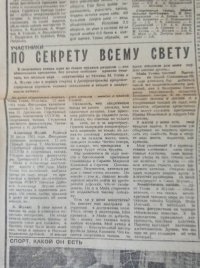
PARTICIPANTS


BY SECRET TO THE WHOLE WORLD

(the article published in russian 'Sovetskiy Sport' on January 12, 1985)

In ice dance, one of the most difficult segments is the compulsory program. That is why it is particularly pleasant to note that the young couple—Spartak members from Moscow, M. Usova and A. Zhulin—demonstrated good skating technique in their first starts in Dnipropetrovsk and are among the leading group.
From the "Sovetsky Sport" Dossier.
Maya Usova.
Born May 22, 1964. Has been figure skating for 12 years. First coach—I. Druzhkova. Silver medalist of the 1984 USSR Championship in ice dance. Student at the Institute of Physical Culture. Trains under N. Dubova.
Alexander Zhulin. Born July 20, 1963. Has been figure skating for 15 years. First coach—T. Moskovskaya. Silver medalist of the 1984 USSR Championship in ice dance. Student at the Institute of Physical Culture. Trains under N. Dubova.
Maya and Alexander have performed together since 1980. Maya Usova chose ice dance without hesitation when she was invited to the group of Honored Coach of the RSFSR Natalya Dubova. Alexander Zhulin competed a lot in singles. He loved jumping and never even thought about anything else, but...
A. Zhulin: At one time, I treated ice dance somewhat lightheartedly. But when injuries began to haunt me and it became increasingly difficult to jump, quitting sports was beyond my strength; that’s when I came to Natalya Ilyinichna Dubova. And soon I was already skating together with Maya Usova.
It turned out that ice dance is no less complex than singles skating. We had to work until we were "sweating blood." I realized that I am responsible not only for myself but also for my partner. Moreover, I am forced to concentrate my attention not only on some difficult combinations but on every gesture, step, and turn of the head. To be honest, I didn't expect that training in ice dance would be so grueling.
We practice on the ice alongside the bronze medalists of the Sarajevo Olympics, Marina Klimova and Sergei Ponomarenko. Of course, skating next to them is very beneficial. But at the same time... it’s dangerous: involuntarily, you might follow a trodden path, copy something. But Maya and I try not to give in to such a temptation.
Do I have any shortcomings? I lack enough patience in achieving goals. I am learning this from my partner. What I like about Maya is her kindness. In my opinion, that is the main trait for any person. My idol in sports is the brilliant master of football, David Kipiani. As for ice dance, here the standard for me are many duos...
Maya Usova: A Dream? To perform at the 1988 White Olympics. And I would also like to achieve the same expressiveness of movements as the ballerina Ekaterina Maximova, a soloist of the Bolshoi Theatre. She has so much poetry and grace. And in ice dance, for me, the programs of Irina Moiseeva and Andrei Minenkov can serve as a model of artistic style.
In life, I have my own difficult task. I am too touchy, but I hope to overcome this weakness. After all, in sports, you need a character like flint.
My hobbies? I enjoy "composing" my own sports costumes, coming up with patterns on them. I really love to fuss around the stove—this is my second passion after figure skating. I'll open one more "secret of our duo": in the art of culinary, Sasha Zhulin competes with me...
Expert opinion. — Usova and Zhulin are a charming couple—said multiple world champion in ice dance Bernard Ford (England). — I watched these skaters at the "Moscow News" tournament. Their performance attracts with elegance and beautiful plasticity. The partner looks like a true gentleman. I think we will hear about these ice dancers many more times.
1775153356371.jpeg
 
Last edited:
1985
USSR CHAMPIONSHIPS
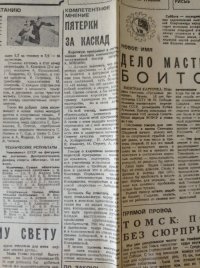
EXPERT OPINION


FIVES FOR THE COMBINATION

(the article published in russian 'Sovetskiy Sport' on January 12, 1985)

Honored Master of Sports A. MISHIN comments on the ladies' short program:
— I must note that the short program is, generally speaking, a newcomer to figure skating (it was introduced into the competition rules only about 15 years ago). But it is by no means a timid newcomer, but rather a bold, daring one. In a word, I would call today's short program a criterion not only of craftsmanship but also of the athlete's willpower.
In my view, the execution of the compulsory elements is the main task of this program. In this regard, the question arises: did the female skaters cope with it? Yes, they clearly demonstrated who is who in singles skating. I would single out the top five: A. Kondrashova, N. Lebedeva, K. Ivanova, M. Serova, A. Antonova.
Speaking about the key element of the short program—the jump combination—I will emphasize that all the participants performed it necessarily with a triple jump and, on the whole, did so brilliantly. I was pleased by the clean, polished technique of Kondrashova, the power and high speed of Lebedeva and Serova.
I would also like to note one more important feature: today, in ladies' singles skating, we do not see imitation or copying; no one follows a well-trodden path. Each performance is a manifestation of originality and self-reliance. We see this in the "Gypsy Dance" by Ivanova, in the classical style of Lebedeva’s program, and in the compositions set to modern rhythms by Kondrashova.
Overall, the level of performance of the top five leading female athletes meets high world standards.
1775153967141.jpeg
 
1985
USSR CHAMPIONSHIPS
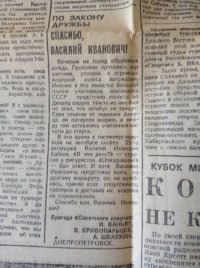
BY THE LAW OF FRIENDSHIP


THANK YOU, VASILY IVANOVICH!

(the article published in russian 'Sovetskiy Sport' on January 12, 1985)

In the evening, a heavy rain collapsed upon the city. Passers-by hid under umbrellas; the wheels of cars were drowning in huge "lakes." It was exactly during this foul weather that a large group of USSR championship participants was supposed to get to the Palace of Sports. None of them knew yet that the bus would not arrive. Barely having pulled away from the Ice Palace, it had been in an accident, and meanwhile, only minutes remained until the start.
At this time, a driver from the 29th motor depot, Vasily Ivanovich Babkov, pulled up to the hotel in a bus. "What’s the matter?" he asked the figure skaters. "We're late!" was the reply. And although Vasily Ivanovich was supposed to drive along a different route, he, without hesitating, took all the athletes and coaches and delivered them to the competition on time.
Thank you, Vasily Ivanovich!
"Sovetsky Sport" Team:
I. VANYAT, V. KRIVOPALTSEV, A. SHELUKHIN.

DNIPROPETROVSK.
1775154429748.jpeg
 
1985
USSR CHAMPIONSHIPS


The USSR Figure Skating Championship is nearing its conclusion. In the ladies' singles, the gold medal was won by Muscovite Anna Kondrashova, the silver by Kira Ivanova (Moscow region), and the bronze by Natalia Lebedeva (Sverdlovsk). Medals for ice dance and men remain to be contested.
HER STYLE CONQUERS HEARTS

(the article published in russian 'Sovetskiy Sport' on January 13, 1985)

The logical success of Muscovite Anna Kondrashova
In childhood, Anya spent five years learning to play the piano, and her mother, Marina Sergeyevna, a music teacher, believed that her daughter would follow in her footsteps. But Anya showed character early on and said firmly: "I will not play. I like sports more. I must train at the CSKA school."
Of course, the music lessons were not in vain. Anya fell in love with classics—works by Beethoven, Chopin, Tchaikovsky. In her sporting destiny, a ballet artist from the Bolshoi Theater, Elena Matveeva, played an important role—a person who does not accept templates or a craft-like approach to art. She taught Anna to understand the beauty of movement, and she revealed the main secret in Kondrashova's talent.
"This girl has a talent for hard work," says Matveeva. "Anya doesn't need to be persuaded to train for an extra hour. She often stays after the session on the ice and continues painstaking work on her program." And her attraction to romantic music allowed for the creation of the original composition 'Symphony of the Future' from the works of composer Lefebvre.
Perhaps the decisive moment in Anya's fate was the year 1982, when the 17-year-old girl won the Winter Spartakiad of the Peoples of the USSR. And now, a new big success at the Dnipropetrovsk rink —a victory over the whole country—was achieved under the guidance of coach S. Zhuk and choreographer E. Matveeva. Let us also give due credit to Anya's other mentor — Honored Coach of the RSFSR E. Pliner, who prepared the athlete during the three previous seasons. It seems that the style that Anna now shows to the judges and spectators most fully corresponds to the standard of spectacular, beautiful skating.
The gold medal was not easy to get. Until the last seconds, two other skaters competed with her: Kira Ivanova and Natalia Lebedeva. But Ivanova, performing in the final, was primarily concerned with triple jumps, and this pursuit of difficulty shackled the athlete. Later, Ivanova's coach, former world champion Kovalev, said:"Kira was ready to fight for the gold medal, showed stable technique, but at the decisive minute she burnt out."
Lebedeva, having beautifully started her program with a triple loop, suddenly got a "pop" [missed jump]. Then she suddenly sustained a minor injury. Pushing through the pain, she continued to skate with her usual energy and was rewarded with a bronze medal.
Express commentary by the referee of the international category, Viktor Solovyov:
Our female figure skaters faced a difficult challenge. Any of the three athletes could have won. Success ultimately went to Kondrashova: she twice confidently performed a double Axel (2.5 rotations) and a triple toe loop combination, impressing with her high-level spinning technique. Of course, the potential of these three skaters has not yet been fully realized. They still have to master a maximum-difficulty program that will include three triple jumps and modern combinations.
Another notable feature of the women’s tournament is the vigorous push toward 'ultra-с' elements by young skaters—N. Skrabnevskaya, E. Taranenko, and E. Kushnir—pupils of three renowned Moscow schools: Dynamo, CSKA, and Trud. At just 13–14 years old, these athletes already possess all the modern technical tools and, by tomorrow, will be ready to master complex, artistic compositions on par with senior masters.​

TECHNICAL RESULTS
USSR Figure Skating Championship. Dnіpropetrovsk, Meteor Sports Palace, January 11.
Ladies. Sum of three events. 1. A. Kondrashova (Moscow) — 2.6; 2. K. Ivanova (Moscow region) — 3.8; 3. N. Lebedeva (Sverdlovsk) — 5.6; 4. M. Tveretinova (Moscow) — 8.8; 5. M. Serova (Leningrad) — 10.2; 6. N. Ovchinnikova (Sverdlovsk) — 13.2.​


PARTICIPANT

BY NATURE SHE IS A CHALLENGER

(the article published in russian 'Sovetskiy Sport' on January 13, 1985)

From the "Sovietsky Sport" Dossier: Natalia Lebedeva. Born December 16, 1964 in Zaporizhzhia. Has been figure skating for 15 years. First coach B. Rogatskin. Student at the Sverdlovsk Pedagogical Institute. Master of Sports International Class. Trains under Igor Ksenofontov (Sverdlovsk).
Now Natalia performs triple jumps—toe loop and salchow, as if she’s cracking nuts. Her skating is powerful, with a real sense of speed. But so many tears were shed by Natalia Lebedeva as a first-grader when she first joined coach B. Rogatskin’s group, where she was among the underdogs for a long time.
At just eight years old, she had to make the first serious, independent decision of her life. It so happened that her coach decided to move to Sverdlovsk. At a family meeting, her mother hugged Natasha and said: 'I won't stand in your way, daughter. If you want to be a figure skater, go to Sverdlovsk.' And so, eight-year-old Natasha made her choice: "I'm going!" Since then, she lives in Sverdlovsk.
Her journey in sports was not smooth. At the age of fifteen, many female athletes struggle with their technique; their coordination changes, and, naturally, their results decline. During that time, Natasha also thought: 'I’ll pass my eighth-grade exams and go back home to Zaporizhzhia.' And it might have very well happened that way. But fortunately, Natasha was noticed by the Sverdlovsk coach Igor Borisovich Ksenofontov. He told her: 'Natasha, you can always go home. That is your right. But I’m offering you a different path. Come to our school in Pervouralsk. Train in my group. If you like it, you stay...'
Ksenofontov turned out to be right. Lebedeva didn't go anywhere. However, this doesn't mean she always follows her coach's lead. By nature, she is a debater and has her own point of view on many things. And perhaps, it is exactly this quality that allows her to steadfastly endure the difficult period of establishing a new style.
Lebedeva dreams of mastering quadruple jumps and learning to win in an environment of the fiercest competition. In short, she is a girl with a true 'Urals character.
1775209682496.jpeg
 
1985
USSR CHAMPIONSHIPS

UNEXPECTED PERSPECTIVE

ONCE WE STARTED FROM SCRATCH

(the article published in russian 'Sovetskiy Sport' on January 13, 1985)

Monologue by the Director of the Dnipropetrovsk Specialized Figure Skating School, Merited Coach of Ukraine Valery DOLGOV.
Four pairs from Dnipropetrovsk performed in the pairs competition, which in itself attracted the attention of specialists. This is no accident. After all, pair skating is the main direction of the Dnipropetrovsk school.
In March of this year, the school marks its 5th anniversary. When we held the first competitive selection, Ira Mironenko was studying in the first grade. Two years later, she won her first prize in singles skating. Among the boys, a similar prize was awarded to Dima Shkidchenko. And two years later, Ira and Dima became silver medalists of the World Junior Championships.
Time moves relentlessly forward. Our pupils I. Bekker and S. Likhansky have become experienced masters, participating in the national championship for the first time—Tropina and Shumakov, Sorokina and Guenko.
They were very nervous. After all, it was the first time in such company: they are skating alongside Makarov and Selezneva, Valova and Vasiliev. Naturally, they felt timid and nervous. These kids have a remarkably strong sense of responsibility, which is evident in training, in studies, and in competitions. Gueiko successfully copes with the curriculum at the Institute of Chemical Technology; Shumakov is in medical school. Shkidchenko and Mironenko are straight-A students in school.
And this, too, I attribute to the work of the coaching brigade, whom I am not afraid to call people fanatically devoted to their craft. They are amazing educators and talented mentors. I am talking about A. Artyshchenko, V. Luzan, and choreographer Yu. Gorbachev. They have families, children, and personal lives, but first and foremost, there is their school, their second home.
It was difficult for them. They started from scratch with six-year-old children. They selected about 80 people, but only those who knew how to work as hard as they do themselves remained in the school.
Our ice palace is, first and foremost, the most important health base intended for the workers of the city. Step into the palace during the hours when mass skating is held here. With what pleasure the workers run on skates! And their children study at our specialized school.​
"Soviet Sport" Brigade:
I. Vanyat,
V. Krivopaltsev,
A. Shelukhin.

DNIPROPETROVSK.
1775211784587.jpeg
 
1985
USSR CHAMPIONSHIPS

A CASKET FULL OF SURPRISES

(the article published in russian 'Sovetskiy Sport' on January 15, 1985)

The winners in ice dance were Marina Klimova and Sergei Ponomarenko.
Like a multi-colored rain, bouquets of flowers fell onto the ice. The hall collectively applauded the "stars" honored with the awards of the USSR-85 Championship. The figure skaters gifted the spectators with happy smiles, elegant bows, and in the moments of the tournament's closing, it seemed that the events on the Dnipropetrovsk ice were a kind of idyll.
But this idyll was preceded by hours and days of heated struggle, incredible tension, where every warm-up turned into a test of characters. In essence, the championship resembled a magic "casket," full of surprises in practically all events of the program. In pair skating, L. Selezneva and O. Makarov shone; in men's singles — V. Kotin; in women's singles skating — A. Kondrashova. And as for ice dance, the plot unfolded according to all the laws of drama, with wild twists, a climax, and an unexpected finale. In the history of ice dance, there had never been a case where the two top duos finished with the exact same score—3.0—and where six marks of 6.0 did not guarantee a decisive advantage.
Here are a few highlights of this dramatic duel between Olympic silver medalists N. Bestemyanova and A. Bukin, and Olympic bronze medalists M. Klimova and S. Ponomarenko. Two compulsory dances—the Quickstep and the Argentine Tango—brought the best marks to Natalya and Andrei, the third—the Ravensburger Waltz—gave the advantage to Marina and Sergey... The spring of competition tightened with new force in the original dance—Klimova made a mistake in one of the spins, but the judges rated the excellent execution of the composition as a whole highly: 5.7–5.9 points. Bestemyanova and Bukin, having significantly improved their version of the original dance, achieved an advantage: they received 5.8 for technical merit and eight 5.9s for artistry.
Finally, the tournament final—the free program. By draw, O. Volozhinskaya and A. Svinin opened the competition of the strongest duos. Just a month ago, everyone remembered their composition to Tchaikovsky's 'Capriccio Italien'—then in Moscow, it received the third-highest scores of the international tournament. In this new performance, the thoughtfulness and maximum precision of every gesture and sequence of steps were particularly impressive (qualities the duo also showcased in their original composition as well (receiving 11 marks of 5.7 and two marks of 5.8). The audience warmly applauds the students of the Honored Coach of the USSR, E. Chaikovskaya—they truly gave their all in this decisive surge forward. This time, the scoreboard shows sixteen 5.7s and one 5.8.
Everything now depends on the performances of three more duos: Bestemyanova and Bukin, Klimova and Ponomarenko, as well as the Muscovites N. Annenko and G. Sretensky, who performed the compulsory dances with great inspiration and moved into third place after four segments of the program.
Now on the ice—Klimova and Ponomarenko. This talented duo has gained many fans this season, and one of the secrets of their success lies in the farsighted tactics of their mentor, Honored Coach of the RSFSR N. Dubova, who never rests on her laurels and constantly searches for new reserves of mastery. Their light, airy style, clearly established in their Olympic program to Kalman’s music, has been enriched with new colors—the variety of intonations, expression, and inner passion in the new dance are captivating. The climax was a technically virtuoso performance of the tango 'La Cumparsita.' Here are the full scores for this program: for technical merit — 5.8, 5.8, 5.9, 5.9, 5.9, 5.8, 5.9, 5.8, 5.9; and for artistic impression — 5.8, 5.9, 5.9, 5.9, 5.9, 5.9, 5.9, 5.8, 5.9.
Readers will find it interesting to compare these marks with the results of the next duo to see how the five judicial votes necessary for victory are determined. Looking ahead, we can say that everything was decided by a single judge’s vote: five judges favored Klimova and Ponomarenko, while four favored Bestemianova and Bukin.
As for the performance by the students of Honored Coach of the USSR T. Tarasova—it was an explosion of imagination, emotion, and acting skill. A dance like 'Carmen,' interpreted by Bestemianova and Bukin, rises to the level of true art. Here is how it was scored: in technique—5.7, 5.9, 5.8, 5.8, 5.8, 5.9, 5.8, 5.9, 5.8; and in artistry—6.0, 6.0, 5.9, 5.9, 6.0, 6.0, 5.9, 6.0, 6.0. The ice dancers, having polished their program over several months, brought the plastic patterns to perfection, and the dance, as they say, has 'ripened.'
The tournament offered one more surprise at the very end: performing last, Annenko and Sretensky — a duo created by coach L. Pakhomova just three years ago — performed a dance to Gershwin's music that was enchanting in its mood and perfection of lines. With scores of 5.6–5.8, they secured third place.​
TECHNICAL RESULTS

USSR Figure Skating Championship. Dnipropetrovsk. "Meteor" Palace of Sports. January 13.
Ice Dance. Total place points. 1. M. Klimova—S. Ponomarenko (Moscow) — 3.0; 2. N. Bestemianova—A. Bukin (Moscow) — 3.0; 3. N. Annenko—G. Sretensky (Moscow) — 6.4; 4. O. Volozhinskaya—A. Svinin (Moscow) — 7.6; 5. M. Usova—A. Zhulin (Moscow) — 10.0; 6. I. Zhuk—O. Petrov (Moscow) — 12.0.
Men. Total place points. 1. V. Kotin (Moscow) — 2.6; 2. V. Egorov (Kharkov) — 5.0; 3. L. Kaznakov (Leningrad) — 6.8; 4. G. Vardanyan (Moscow) — 10.0; 5. D. Gromov (Leningrad) — 14.4; 6. S. Mkhitaryan (Moscow) — 15.2.​


COMPETENT OPINION

A SPRINGBOARD FOR TAKEOFF

(the article published in russian 'Sovetskiy Sport' on January 15, 1985)

"Golden" pirouette by Vladimir Kotin.
The multi-day struggle of the men's singles skating has concluded. A confident victory was secured by Muscovite Vladimir Kotin, a student of coach Elena Chaikovskaya. Joining him on the podium were Vitaly Egorov from Kharkiv and Leningrad’s Leonid Kaznakov. We asked Marina Valentinovna GRISHINA, Candidate of Pedagogical Sciences and head of the complex scientific research group for figure skating, to comment on the results of the men's competition.
'Even though the European champion Aleksandr Fadeev did not participate in the final due to injury,' she said, 'the overall level of preparation among the leaders is encouraging. The set of triple jumps, the technique of spins, and the step sequences—all of this meets today’s requirements. For example, the program of the new national champion, Kotin, included 28 elements. He performed his key jumps not only in the first minute, as was trendy not so long ago, but throughout almost all parts of the composition. Specifically, the 22nd element in his arsenal was a triple salchow, and the 27th was a triple toe loop. I want to note that the composition, set to classical music, is very precisely balanced in mood and tempo. The powerful jumps — triple lutz and triple loop — left a strong impression.
Both Egorov and Kaznakov, as well as the junior tournament winner Vladimir Petrеnkо, are also striving for maximum program density. For instance, Kaznakov had 30 elements performed dynamically and with great energy. However, he lacks stability in his triple jumps. Nevertheless, let's not forget that the peak of athletic form has not yet been reached.
Who was the breakthrough of the championship? First of all, in the senior tournament, it was Muscovite Yury Bureyko (he has a very expressive, beautiful composition), and in the junior competitions, it was the Odessa natives Petrеnkо and Yury Tsymbalyuk, and Muscovite Alexander Vaskovsky. This is undoubtedly a credit to their mentors — E. Pliner, G. Zmievskaya, and V. Kudryavtsev. The reserve [of talent] left everyone with a sense of reliability, and that is the most pleasant result of the championship.'​


PARTICIPANT

PETRENKO—BROTHER OF PETRENKO

(the article published in russian 'Sovetskiy Sport' on January 15, 1985)

FROM THE SOVIET SPORT DOSSIER. Vladimir PETRENKO, the younger brother of World Junior Champion Viktor Petrenko. Born February 2, 1971. He has been figure skating for 9 years. Winner of the USSR Youth Cup in men's singles. He trains under Galina Zmievskaya ("Trud" club, Odessa).
In room 1004 of the "Dnepropetrovsk" Hotel lived two figure skaters, both with the same last name and identical initials. We are talking about brothers Viktor and Vladimir Petrenko. The elder, Viktor, became a medalist at an international senior tournament in Moscow in December 1984, despite being only 15 years old. In Dnipropetrovsk, he fell ill. However, his brother Vladimir once again upheld the reputation of Odessa's figure skating school and secured a victory in the junior competition at this championship.
— Vladimir, who is 'to blame' for your passion for figure skating?
— "Well, of course, my older brother. When I was a little kid, my grandmother would take me to the rink to watch Vitya train. I loved everything that happened on the ice. It felt so festive: Vitya jumped great, the music was beautiful, and watching the VCR screen was so interesting. So, soon enough, I showed up with my own skates. Now Vitya is my main 'second' at all competitions. But of course, for me, the coach is the ultimate authority..."
— "And how are you doing in middle school?"
— "Vitya helps me here, too. But he doesn't have to worry about me in this regard. I’m doing fine in the eighth grade. Though my class teacher sometimes says: 'You perform well on the ice, Volodya. But if you knew chemistry as well as you know ice geometry, you’d have straight A's.'
My hobbies? I love dancing at the disco. I collect sports pins. In sports, my idol was World Champion Jan Hoffmann from the GDR—he was a remarkable hard worker. I’d like to become just as patient and persistent. If I can master the triple loop, then I’ll consider that I'm truly making progress…"​
Brigade of "Soviet Sport":
I. VANYAT, V. KRIVOPALTSEV, A. SHELUKHIN.

DNIPROPETROVSK.
1775243702410.jpeg
 
1985
FROM A YUGOSLAV NOTEBOOK


Sanda Dubravčić:
I AM NOT PARTING WITH THE ICE YET

(the article published in russian 'Sovetskiy Sport' on January 16, 1985)

Earlier or later, for every athlete, the moment comes when they step onto the track, playing field, or ice rink for the last time. This happened with the famous Yugoslav figure skater Sanda Dubravčić. This past year became a milestone in her life. At the beginning of it, Sanda was granted a great honor—to light the flame of the Olympic Games in Sarajevo. In the summer, she celebrated her jubilee—her twentieth birthday. And at the end of November, during the international tournament "Golden Spin of Zagreb," fans of figure skating witnessed the ceremony of bidding farewell to the big sport for Dubravčić...
When Antun Škrtić, one of the veterans of sports journalism in Yugoslavia, found out that I wanted to meet with Sanda Dubravčić, he immediately took out his well-used notebook, found the necessary number, called, and said:
— There is nothing simpler. In the evening, she has a practice with a group of guys from the "Medveščak" club at the Dom Sportova. Go there and talk...
It should be noted that Škrtić is not only a journalist but also a great expert on figure skating, an international category judge. On the way to the Zagreb Dom Sportova, he shared his impressions of a trip to Colorado Springs, where he participated in judging the world junior championship. Škrtić spoke highly of the mastery of Soviet figure skaters, particularly Tanya Andreyeva, and complained that there are no worthy successors to Dubravčić among Yugoslav athletes yet.
— Certain hopes are associated with Nevenka Lisak and completely young Željka Čižmešija. By the way, you will see them today on the ice. Both are trainees of coaches from Zagreb. Generally, our city sets the tone for all figure skating in the country. For several years now, Zagreb masters have known no equals at the championships of Yugoslavia. It’s sufficient to mention Miljan Begović—an eight-time winner of these tournaments. And as for Sanda’s authority, it goes without saying...
In Zagreb, as I learned, there are three rinks with artificial ice. For such a relatively small city, that’s not bad. But they are all scheduled literally by the minute—from early morning until late at night. I believe there ia no need for a better proof of how popular figure skating is here. Zagreb has also hosted major international competitions. Specifically, it was under the roof of the Dom Sportova, where we were heading, that the medals for the 1974 and 1979 European Championships were contested.
...Music echoed beneath the arches of the Dom Sportova as athletes—mostly children—whirled across the ice. From the stands, the most attentive of spectators, seemingly mothers and grandmothers, looked on. A scene typical of our own Sports Palaces, I thought.
A pleasant-looking young woman in a warm jacket and a knit hat approached the boards. This was Sanda Dubravčić.
She was focused and stern, as a true coach should be. Only occasionally, when one of her pupils landed awkwardly on the ice, did a smile flicker across her face.
It was clearly in this same way that she once began learning the basics of figure skating herself. Sanda first stepped onto the "big ice" at age 12. Admittedly, her debut at the 1977 European Championships was far from a triumph—she finished only 16th. However, just two years later in her native Zagreb, she took 7th place, catching the eye of the experts. Those who predicted a great future for the young Dubravčić were not mistaken. At the 1981 Continental Championships in Innsbruck, the 16-year-old Yugoslav athlete caused a sensation. After placing only fifth in the "school" (compulsory figures), Sanda dazzled with her expressive, polished technique in the most difficult elements of the free program, earning the silver medal and trailing only the famous Denise Biellmann of Switzerland. Before the Games in Sarajevo, there were no more titled athletes in the Yugoslav team, that is why she was entrusted with the distinct honor of lighting the Olympic cauldron at the Koševo Stadium.
— When and why did you decide to leave the big sport?
— At the very start of the Olympic season, I knew firmly: it would be the last. Before that, I entered the medical institute. From the very beginning, my studies completely took over. I realized that balancing them with sports was impossible. I had to choose, and I chose medicine.
— Why did you choose medicine as your future profession?
— Oh, that is my hereditary trait. My mother is an ambulance doctor and my father is a surgeon, so since childhood, I never even thought about anything other than medicine. I am currently in my second year, so it is too early to talk about a specific specialization. Perhaps I will become a sports doctor and stay involved in sports that way. But again, that is for the future.
— And your coaching work? How does it mesh with medicine?
— This, if you will, is my hobby. Among other things, it helps me soften the bitterness of parting with sports. You can't just instantly cut all the ties that bind you to it.
— Have you been to our country?
— Unfortunately, not even once. My mother has visited the USSR several times and shared many interesting stories. I have many friends among Soviet figure skaters—Kira Ivanova, Anna Kondrashova, and Alexander Fadeev. I would love to send them my greetings through Sovetsky Sport. I hope that one day I will visit Moscow myself and meet them all again.​
E. MALKOV
(Our special correspondent)
ZAGREB—MOSCOW
1775320359217.jpeg
 
1985
FROM A YUGOSLAV NOTEBOOK


Sanda Dubravčić:
I AM NOT PARTING WITH THE ICE YET

(the article published in russian 'Sovetskiy Sport' on January 16, 1985)

Earlier or later, for every athlete, the moment comes when they step onto the track, playing field, or ice rink for the last time. This happened with the famous Yugoslav figure skater Sanda Dubravčić. This past year became a milestone in her life. At the beginning of it, Sanda was granted a great honor—to light the flame of the Olympic Games in Sarajevo. In the summer, she celebrated her jubilee—her twentieth birthday. And at the end of November, during the international tournament "Golden Spin of Zagreb," fans of figure skating witnessed the ceremony of bidding farewell to the big sport for Dubravčić...
When Antun Škrtić, one of the veterans of sports journalism in Yugoslavia, found out that I wanted to meet with Sanda Dubravčić, he immediately took out his well-used notebook, found the necessary number, called, and said:
— There is nothing simpler. In the evening, she has a practice with a group of guys from the "Medveščak" club at the Dom Sportova. Go there and talk...
It should be noted that Škrtić is not only a journalist but also a great expert on figure skating, an international category judge. On the way to the Zagreb Dom Sportova, he shared his impressions of a trip to Colorado Springs, where he participated in judging the world junior championship. Škrtić spoke highly of the mastery of Soviet figure skaters, particularly Tanya Andreyeva, and complained that there are no worthy successors to Dubravčić among Yugoslav athletes yet.
— Certain hopes are associated with Nevenka Lisak and completely young Željka Čižmešija. By the way, you will see them today on the ice. Both are trainees of coaches from Zagreb. Generally, our city sets the tone for all figure skating in the country. For several years now, Zagreb masters have known no equals at the championships of Yugoslavia. It’s sufficient to mention Miljan Begović—an eight-time winner of these tournaments. And as for Sanda’s authority, it goes without saying...
In Zagreb, as I learned, there are three rinks with artificial ice. For such a relatively small city, that’s not bad. But they are all scheduled literally by the minute—from early morning until late at night. I believe there ia no need for a better proof of how popular figure skating is here. Zagreb has also hosted major international competitions. Specifically, it was under the roof of the Dom Sportova, where we were heading, that the medals for the 1974 and 1979 European Championships were contested.
...Music echoed beneath the arches of the Dom Sportova as athletes—mostly children—whirled across the ice. From the stands, the most attentive of spectators, seemingly mothers and grandmothers, looked on. A scene typical of our own Sports Palaces, I thought.
A pleasant-looking young woman in a warm jacket and a knit hat approached the boards. This was Sanda Dubravčić.
She was focused and stern, as a true coach should be. Only occasionally, when one of her pupils landed awkwardly on the ice, did a smile flicker across her face.
It was clearly in this same way that she once began learning the basics of figure skating herself. Sanda first stepped onto the "big ice" at age 12. Admittedly, her debut at the 1977 European Championships was far from a triumph—she finished only 16th. However, just two years later in her native Zagreb, she took 7th place, catching the eye of the experts. Those who predicted a great future for the young Dubravčić were not mistaken. At the 1981 Continental Championships in Innsbruck, the 16-year-old Yugoslav athlete caused a sensation. After placing only fifth in the "school" (compulsory figures), Sanda dazzled with her expressive, polished technique in the most difficult elements of the free program, earning the silver medal and trailing only the famous Denise Biellmann of Switzerland. Before the Games in Sarajevo, there were no more titled athletes in the Yugoslav team, that is why she was entrusted with the distinct honor of lighting the Olympic cauldron at the Koševo Stadium.
— When and why did you decide to leave the big sport?
— At the very start of the Olympic season, I knew firmly: it would be the last. Before that, I entered the medical institute. From the very beginning, my studies completely took over. I realized that balancing them with sports was impossible. I had to choose, and I chose medicine.
— Why did you choose medicine as your future profession?
— Oh, that is my hereditary trait. My mother is an ambulance doctor and my father is a surgeon, so since childhood, I never even thought about anything other than medicine. I am currently in my second year, so it is too early to talk about a specific specialization. Perhaps I will become a sports doctor and stay involved in sports that way. But again, that is for the future.
— And your coaching work? How does it mesh with medicine?
— This, if you will, is my hobby. Among other things, it helps me soften the bitterness of parting with sports. You can't just instantly cut all the ties that bind you to it.
— Have you been to our country?
— Unfortunately, not even once. My mother has visited the USSR several times and shared many interesting stories. I have many friends among Soviet figure skaters—Kira Ivanova, Anna Kondrashova, and Alexander Fadeev. I would love to send them my greetings through Sovetsky Sport. I hope that one day I will visit Moscow myself and meet them all again.​
E. MALKOV
(Our special correspondent)
ZAGREB—MOSCOW
View attachment 11143
I remember Sanda, from my generation. North American journalists were always misspelling her first name as Sandra :palmf:. I never actually met her -- I think the only time she competed in Canada was at Worlds in Ottawa in 1984, the year after my partner and I retired. She retired quite young herself; like my partner she was entering medical school and like him chose to put her studies first. Years later, my partner met her mother at a conference in Europe, he having become a trauma surgeon like Mrs Dubravcic (or whatever name she would have used in, by then, Croatia) and both of them lost track of the conference agenda while reminiscing about skating competitions in the early 80s.
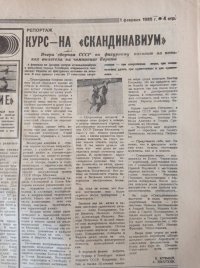
 
1985
EUROPEAN CHAMPIONSHIPS

REPORTAGE

COURSE TO "SCANDINAVIUM"

(the article published in russian 'Sovetskiy Sport' on February 1, 1985)

Yesterday the USSR national figure skating team flew to the European Championships

On February 4, in the "Scandinavium" sports palace in the Swedish city of Gothenburg, the European Figure Skating Championships opens. 17 Soviet athletes will take part in it — three pairs, three dance duos, three female singles skaters, and two male singles skaters.
The pristine whiteness of snow-covered fields surrounds the building of glass and concrete. A silent forest literally stands like a wall fifty meters from the rink of the training center in Novogorsk. In this kingdom of the Russian winter, a melody sounding in the ice hall penetrates the soul especially deeply. We heard these melodies many times in the last hours before the departure of the Soviet national team to the European Championships.
"Larisa, please, perform this 'dream' pirouette once more!" — says choreographer Yuri Potemkin, addressing Larisa Selezneva.
A blonde girl in a strict black bodysuit effortlessly, with a smile, makes a short run and rapidly spins, for some moments turning into a "spindle."
"And now, Larisa and Oleg, let’s try a lyrical part of the free program!" — asks honored coach of the USSR Igor Moskvin.
For the Olympic bronze medalists Larisa Selezneva and Oleg Makarov, every mention of the word "lyrical" is a kind of push to complex associations, to intense creative work. A lot of energy was given to this part of the composition, but now it has sparkled, played, shone like a polished diamond.
"Most of all, I am satisfied with the current preparation of Selezneva and Makarov — a clear and precise line on individual style," says Igor Moskvin. "Today, this pair is easily recognizable in every element. Looking at it you can see the breadth, the grace, and the power..."
In a new way, high, airy lifts of Olympic champions in pair skating Elena Valova and Oleg Vasiliev are perceived. The last stage of preparation for Gothenburg for them was especially active.
"Athletes entered their best form in January, on the eve of the European Championships," says honored coach of the USSR Tamara Moskvina. "We had many hesitations — which variant of the program to go to the start with, what tasks to set for ourselves. I thought so much about it that even in a dream I saw new elements of the program. And, imagine, suddenly one morning an unexpected decision came. We immediately rushed to the rink, tried a variant of combinations, jumps. It worked! That is why Valova and Vasiliev skated with such high spirits and competitive drive at the national championship..."
Yes, judging by everything, this good mood further strengthened after training in Novogorsk.
We found on the ice the masters of single skating — Anna Kondrashova, Kira Ivanova, Natalia Lebedeva, Alexander Fadeev, Viktor Petrenko. In full silence, they traced ideal circles in the form of an eight. Then they carefully studied the traces on the ice. Kondrashova, Lebedeva, and Fadeev even lay down on the ice to examine the filigree precision of the executed 'bracket'.
In good shape meets the tournament in Gothenburg the new USSR champion Vladimir Kotin, as well as the 15-year-old champion of the world among juniors Viktor Petrenko. But they will have to lead the fight for European prizes together, because after an injury in Dnipropetrovsk, the winner of last year's European title Alexander Fadeev, unfortunately, cannot defend it.
Besides Petrenko, the USSR team has three more debutants — these are Sverdlovsk's Natalia Lebedeva, ice dancers Natalia Annenko and Genrikh Sretenski from Moscow.
"Is your protege worried?" — we asked Galina Zmievskaya, Petrenko's coach.
"Imagine, no. He realized that in figure skating there are also real men, just as in ice hockey."
"Completely right," says choreographer Elena Cherkasskaya, who works together with Olympic champion Irina Rodnina with pairs. "In our eyes, Veronika Pershina, performing with Marat Akbarov, has matured. After long searches, the confidence of the pair of figure skaters has grown, mutual understanding and stability have come to them..."
On the ice of "Scandinavium" our masters of ice dancing will perform— already experienced Natalya Bestemianova and Andrei Bukin, Marina Klimova and Sergei Ponomarenko, and also the young duo Natalia Annenko and Genrikh Sretenski. They are expected to compete with ice dancers from England, FRG, Italy, France, Czechoslovakia.
Yesterday morning, from the Sheremetyevo international airport, an Aeroflot plane with Soviet figure skaters on board took a course to Sweden. Bon voyage, easy ice!​
V. KUCHMIY,
A. SHELUKHIN.
1775581395526.jpeg
 
1985
EUROPEAN CHAMPIONSHIPS

REPORTAGE

COURSE TO "SCANDINAVIUM"

(the article published in russian 'Sovetskiy Sport' on February 1, 1985)

Yesterday the USSR national figure skating team flew to the European Championships

On February 4, in the "Scandinavium" sports palace in the Swedish city of Gothenburg, the European Figure Skating Championships opens. 17 Soviet athletes will take part in it — three pairs, three dance duos, three female singles skaters, and two male singles skaters.
The pristine whiteness of snow-covered fields surrounds the building of glass and concrete. A silent forest literally stands like a wall fifty meters from the rink of the training center in Novogorsk. In this kingdom of the Russian winter, a melody sounding in the ice hall penetrates the soul especially deeply. We heard these melodies many times in the last hours before the departure of the Soviet national team to the European Championships.
"Larisa, please, perform this 'dream' pirouette once more!" — says choreographer Yuri Potemkin, addressing Larisa Selezneva.
A blonde girl in a strict black bodysuit effortlessly, with a smile, makes a short run and rapidly spins, for some moments turning into a "spindle."
"And now, Larisa and Oleg, let’s try a lyrical part of the free program!" — asks honored coach of the USSR Igor Moskvin.
For the Olympic bronze medalists Larisa Selezneva and Oleg Makarov, every mention of the word "lyrical" is a kind of push to complex associations, to intense creative work. A lot of energy was given to this part of the composition, but now it has sparkled, played, shone like a polished diamond.
"Most of all, I am satisfied with the current preparation of Selezneva and Makarov — a clear and precise line on individual style," says Igor Moskvin. "Today, this pair is easily recognizable in every element. Looking at it you can see the breadth, the grace, and the power..."
In a new way, high, airy lifts of Olympic champions in pair skating Elena Valova and Oleg Vasiliev are perceived. The last stage of preparation for Gothenburg for them was especially active.
"Athletes entered their best form in January, on the eve of the European Championships," says honored coach of the USSR Tamara Moskvina. "We had many hesitations — which variant of the program to go to the start with, what tasks to set for ourselves. I thought so much about it that even in a dream I saw new elements of the program. And, imagine, suddenly one morning an unexpected decision came. We immediately rushed to the rink, tried a variant of combinations, jumps. It worked! That is why Valova and Vasiliev skated with such high spirits and competitive drive at the national championship..."
Yes, judging by everything, this good mood further strengthened after training in Novogorsk.
We found on the ice the masters of single skating — Anna Kondrashova, Kira Ivanova, Natalia Lebedeva, Alexander Fadeev, Viktor Petrenko. In full silence, they traced ideal circles in the form of an eight. Then they carefully studied the traces on the ice. Kondrashova, Lebedeva, and Fadeev even lay down on the ice to examine the filigree precision of the executed 'bracket'.
In good shape meets the tournament in Gothenburg the new USSR champion Vladimir Kotin, as well as the 15-year-old champion of the world among juniors Viktor Petrenko. But they will have to lead the fight for European prizes together, because after an injury in Dnipropetrovsk, the winner of last year's European title Alexander Fadeev, unfortunately, cannot defend it.
Besides Petrenko, the USSR team has three more debutants — these are Sverdlovsk's Natalia Lebedeva, ice dancers Natalia Annenko and Genrikh Sretenski from Moscow.
"Is your protege worried?" — we asked Galina Zmievskaya, Petrenko's coach.
"Imagine, no. He realized that in figure skating there are also real men, just as in ice hockey."
"Completely right," says choreographer Elena Cherkasskaya, who works together with Olympic champion Irina Rodnina with pairs. "In our eyes, Veronika Pershina, performing with Marat Akbarov, has matured. After long searches, the confidence of the pair of figure skaters has grown, mutual understanding and stability have come to them..."
On the ice of "Scandinavium" our masters of ice dancing will perform— already experienced Natalya Bestemianova and Andrei Bukin, Marina Klimova and Sergei Ponomarenko, and also the young duo Natalia Annenko and Genrikh Sretenski. They are expected to compete with ice dancers from England, FRG, Italy, France, Czechoslovakia.
Yesterday morning, from the Sheremetyevo international airport, an Aeroflot plane with Soviet figure skaters on board took a course to Sweden. Bon voyage, easy ice!​
V. KUCHMIY,
A. SHELUKHIN.
View attachment 11149
At least that time Moskvina visualized her pupils' program in a dream. She used to be well-known for getting into frequent fender-benders, getting choreographic ideas while driving her car :)
 
1985
EUROPEAN CHAMPIONSHIPS

BEFORE THE START

Meeting Place—"Scandinavium"

(the article published in russian 'Sovetskiy Sport' on February 2, 1985)

STOCKHOLM. (TASS corr. N. Vukolov). The Gothenburg Palace of Sports "Scandinavium" celebrates its anniversary this year: ten years ago this building was built, distinguished by its lightness and originality of construction. "Scandinavium" has hosted many representative international competitions, including continental and world championships. When at the end of last year the Davis Cup tennis final was played here with the participation of the national teams of Sweden and the USA, the palace specialists prepared a court with a clay surface here in a very short time. Now "Scandinavium" has invited the best figure skaters of Europe.
— In the championship, which will take place from February 4 to 9, 105 athletes from 19 countries will take part, — said the chairman of the organizing committee of the competition, Berger Rosen. — The most representative is the USSR team. On the Gothenburg ice will perform many famous masters — champions of the world, Europe, Olympic Games. Therefore, we expect that the stands of the Palace, capable of accommodating 12 thousand people, will be filled. Ticket sales, in any case, are going well.
According to the chairman of the organizing committee, interest in the championship is very high. This is evidenced by the fact that applications for accreditation have already been received from 150 journalists from newspapers and information agencies of various countries. 20 television commentators will conduct reports on the progress of the championship. For representatives of the press, a press center is equipped, from where it is possible to quickly transmit reports via telex and telephone communication. About 200 people are involved in the preparation for the championship and its service.
The tournament will begin with the performance of women in the compulsory program, and on the evening of the same day the solemn opening ceremony will take place.
In Sweden, they hope that the championship will contribute to the popularization of figure skating. Now about 10 thousand people involved in this sport are registered in the country, said B. Rosen, who at the same time is the chairman of the Swedish Figure Skating Association. Representatives of Sweden will perform in three disciplines. Lotta Falkenback — in women's single skating, Lars Akesson — in men's. For the first time, the country will be represented at the European championship by a dance duo — Asa Agblad and Christer Thornell. Their task is to enter the number of the top ten in each discipline. This will give the right to field a larger number of participants in the next championship.
1775662800620.jpeg
 
1985
EUROPEAN CHAMPIONSHIPS

NIGHT LIGHTS OF "SCANDINAVIUM"

(the article published in russian 'Sovetskiy Sport' on February 5, 1985)

Our special correspondents report from Sweden
IN GOTHENBURG a blizzard is howling. The wind hums, with a whistle. We walk in the early morning, hiding our faces in the collars of our coats, and involuntarily hunching our shoulders—the cobblestone street is narrow and crooked. But as soon as we turn the brick corner, right before our eyes, where the road descends, lies a whimsically curved roof—as if dropped by a chance passerby, a wide-brimmed hat.
Every city has its symbols. Paris has the Eiffel Tower, London has Big Ben, Prague has the Charles Bridge. The symbol of Gothenburg is the "Scandinavium" sports palace with its hat-like roof pulled low over its head.
Since "Scandinavium" appeared on the map in 1971, it has gained great authority in the sporting world; it has hosted many major events. Twice on its artificial ice, world championships in ice hockey have been held; under its roof, the strongest track and field athletes and gymnasts of Europe have competed. It witnessed the tennis final matches for the Davis Cup. But more than others, "Scandinavium" has taken a liking to, perhaps, figure skaters. In 1972 and 1980 they played out European championships here, and in 1976—the world one. And so today on the ice of "Scandinavium" opens the next regular holiday of figure skating—the European championship.
...Enchanting music seems to have seeped into the hall through invisible cracks and softly, envelopingly spreads over the smoky ice. First, even before dawn, the pairs arrived at the Palace. Here are the pairs rehearsing: Veronika Pershina and Marat Akbarov are practising a lift—and then their gaze goes beyond the barrier, to the coach. And there Irina Rodnina—tiny against the background of her pupils, only her eyes shine from behind the high barrier. She claps her hands, shouting piercingly:
— Shake it off, shake it off! After all, you're sleeping on the move. Let's repeat one more time, livelier and more precise!
Nearby, the Olympic champions Elena Valova and Oleg Vasiliev, the country's champions Larisa Selezneva and Oleg Makarov are training their programs. Swedish newspapers are unanimous in the opinion that it is these three Soviet pairs who will set the tone at the championship.
By noon, the singles skaters ran out onto the ice. Here, Katarina Witt glides past us in a black, strict suit. However, her many titles (champion of Europe, the world, and the '84 Olympics) do not seem to weigh down the 19-year-old figure skater from the GDR. All her movements are light and graceful, and her smile is natural and even simple-hearted. But Jutta Müller, the famous coach from the GDR, seems to be dissatisfied with something.
— Hands bound!
— Hands!—Witt is surprised and looks at her palms as if seeing them for the first time.
— Yes, yes! Work with your hands more fluidly, softer.
By the way, the GDR team will appear before the spectators in a renewed form. Besides Witt, only the pair Birgit Lorenz and Knut Schubert participated, and not without success, in European tournaments. The others are debutants.
Behind the barrier, Anna Kondrashova is warming up on the way. Looking down, she tries to concentrate—even knits her brows on the bridge of her nose. But even through them she glances sideways at the ice: how is Witt there? At the '84 world championship Kondrashova lost only to her. What will happen this time?
The English skaters Karen Barber and Nicky Slater have just left the ice rink. On the whole, this couple, after the departure of the famous champions Jayne Torvill and Christopher Dean, is full of determination to maintain the priority of the English ice dance school. Their authority, as you know, is extremely high.
But three of our couples appear on the ice: Marina Klimova and Sergei Ponomarenko, Natalia Bestemianova and Andrei Bukin, Natalia Annenko and Genrikh Sretenski. In the deep silence of the hall, only the clear sound of blades cutting the ice is heard. Someone from the stands applauded—timidly, alone. He was supported by one of the coaches. Then, unable to contain themselves, the judges burst into applause.
Official assessments from the referees will be given later, in the course of the championship, but this involuntary delight is for the artist and the compliment to those who create it.
— We have the most pleasant memories of Gothenburg,—says the honorary chairman of the Soviet Figure Skating Federation Anna Sinilkina.— On its ice shone Irina Rodnina, Lyudmila Pakhomova, Alexander Zaitsev, Alexander Gorshkov. We hope that the new generation of figure skaters will continue the glorious traditions of their predecessors. All 17 participants of our team feel well and are ready for the intense duels...
The championship evokes huge interest. All of Gothenburg is covered with posters calling to come to "Scandinavium." However, there is no special need for advertising: tickets for the final competitions were sold out long ago. Spectators are impatiently waiting for the ice debut of more than 100 best figure skaters from 19 European countries. As the head of the championship press center, Turid Berg, reported, there will be about 150 journalists. The competition will be seen by television viewers in 30 countries of Europe, as well as the USA and Canada.
The last to finish their training today were the men's singles. It was about midnight on the clock. It's also time for us to go. Before turning into the narrow side street leading to our hotel, we looked back. Behind us, the Palace with its hat-like roof was drowning in the night with neon lights. It will not have to sleep for long. Early in the morning, the women will enter the struggle performing compulsory figures, and then the pairs' skating will replace them.​
B. KUCHMIY,
V. STRELTSOV.
GOTHENBURG,
February 4.
1775664937584.jpeg
 
1985
EUROPEAN CHAMPIONSHIPS

THE MYSTERY OF "SCHOOL"

(the article published in russian 'Sovetskiy Sport' on February 6, 1985)

Our special correspondents report from Sweden
The huge hall is almost empty. Silence. It even rings in the ears. Only the crunch of skates is heard, and the occasional low-voiced whisper of coaches keeping their counts.
On the ice, a kind of mystery is taking place. On the mirror-like surface, female figure skaters trace whimsical patterns, like children drawing on asphalt. They are tightly surrounded by nine judges with impassive faces. Talking with the judges is forbidden. All of this is very much like an exam in a high school. The same tense and solemn atmosphere, the same ultra-strict discipline—no extra noise, no extra rustle.
However, on Monday morning, It really felt as if we had stepped into a school—but a special kind, from the world of figure skating. Twenty-six athletes, participants in the European Championships, were performing their compulsory figures that day, known as "school."
As is well known, this part of the program isn't popular with spectators. After all, this isn't free skating—there is no room here for improvisation or creative liberties. For six long hours, the women traced three compulsory figures. And the names themselves are complete mysteries: "rocker," "forward eight with brackets," and "backward eight with loops." In short, it’s prose. It’s no wonder there was a time (not so long ago) when "school" was proposed to be excluded from the program altogether.
But is "school" really that boring? And is it true that it’s devoid of emotion and feeling? Let’s sit closer to the boards and watch.
Florence Copp from France was called up. She darted onto the ice somewhat timidly, sideways—thin, with a haircut that was too short and round glasses on her nose. She looked exactly like a schoolgirl who had got into trouble! The head judge, B. Wright—wearing a Tyrolean hat and an English-cut coat, though he himself was American—approached Copp with importance and made some remark with a cold smile. Even under her makeup, Copp flushed red and involuntarily performed a curtsy. After that, her tracing was nervous; her blade was unsteady and hesitant. The axis of the drawing was shifted, the circles uneven, as if made with a broken compass. She collapsed against the shoulder of her coach, Jean Simon, by the boards, a fountain of tears springing from under her glasses. At 17, it’s forgivable.
Then it was the leaders' turn. Here, nerves were stretched like piano strings. Our own Kira Ivanova was the first to be surrounded by the judges. She traced firmly, evenly, and calmly. Her figures turned out the same way. Ivanova left the ice, but the judges circled for a long time like a swarm over the marks left by her blade. Finally, at Wright's command, they lined up and raised their placards. The numbers 3.8–4.0 were displayed there.Until now, there hadn't been scores this high. The gauntlet has been thrown down. Who will pick it up?
At that moment, there was a tenth judge on the rink—an unofficial one, of course. Katarina Witt, the Olympic champion from the GDR, was warming up off to the side, stealthily noting everything: Ivanova’s mood, her tracing, and the judges' reactions. Then she glided over to her coach, Jutta Müller. They whispered about something by the boards. Witt was called, but Müller kept talking and talking after her. She gripped the boards with her hands, her eyes fixed on the ice.
Witt’s movements are sharp. You can feel her self-confidence. You can feel her class. The "eights" laid down one on top of the other, as if through carbon paper. Five judges to Ivanova's four gave the preference to Witt, and she became the leader. She skated over to Müller. Only now could you see that she was whiter than chalk, her lips pressed tight. Müller gently strokes her hand: "Calm down! Everything is fine!"
No one had to calm down Claudia Leistner from West Germany. She indifferently left her tracing for the judges and moved decisively toward the locker room. But at the very curtain, hidden from prying eyes, she lurked to hear her scores. The judges were favorable to her, and she silently clapped for herself with her fingertips. Then she stepped cheerfully behind the scenes. She had reason to be happy. Leistner had crept right up behind Ivanova and Witt. And immediately after Leistner, the Swiss skater Sandra Cariboni performed successfully. Same emotions. But she didn't hide her joy: she did a cheerful upright spin in the corner of the rink. The judges looked on sternly, but indulgently...
Anna Kondrashova was the last of the leaders to trace the first figure. When the final stroke was made, Wright placed markers on the axis of the drawing (to check for symmetry), while his assistant took a brush and, in a businesslike manner as if in a kitchen, swept the ice shavings away. The judge from France, Monique Petit—a petite, nearsighted lady—first knelt and then nearly lay flat on the ice, her glasses pressed against the pattern. We don’t know what she discovered there, but she gave a lower score than the others.
"Kondrashova lost to Kondrashova," said one of our coaches, Alexander Vedenin. He explained his point: the national champion knows how to skate "school" better and more confidently, and has proven it many times.
Perhaps that was true. But even in losing to herself, Kondrashova surpassed Cariboni and Leistner to move into third place.
The conclusion of the "school" segment felt somewhat like a mass-start bicycle race. Witt, having broken away, hurried alone toward the finish of the grueling six-hour marathon. In pursuit, taking turns, rushed Ivanova, Kondrashova, Leistner, and Cariboni. It seemed the pursuers were just about to catch the runaway. But the second figure ended, then the third, and Witt remained unreachable. The rivals finished in the same order: first Ivanova and Kondrashova, followed by Leistner and Cariboni. Then the rest of the "caravan" arrived, led by Patricia Neske from West Germany.
So, is "school" really that boring? Isn’t its outward dryness and stiffness deceptive? It depends on how you look at it. If seen through the eyes of the skaters themselves, you won't find a more nerve-wracking or emotional internal duel. At least, that is what all the leaders believe.
Late in the evening, after the official opening ceremony of the championships, the pairs skating competitors began their battle. They performed their short program, which is roughly the equivalent of "school" for the singles skaters. Within 2 minutes and 15 seconds (no more and, ideally, no less), the skaters must demonstrate seven compulsory elements.
Olympic champions Elena Valova and Oleg Vasiliev performed these better than anyone else at the "Scandinavium." Their skating was filled with beauty and depth, and the judges, without hesitation, awarded them the highest scores. Following them is our other pair, Larisa Selezneva and Oleg Makarov, with Birgit Lorenz and Knut Schubert from the GDR a bit further behind. Veronika Pershina and Marat Akbarov are currently in fourth place.
Today, the European champions in pairs skating will be decided, the men will begin their "school" figures, and the women will start their short program. In short, it is a tense, event-filled, and difficult day.​
V. KUCHMIY,
V. STRELTSOV.
GOTHENBURG, February 5.
TECHNICAL RESULTS
European Figure Skating Championships. Gothenburg, February 4.
Women. Compulsory program. "Frölundaborg" Sports Palace. 1. K. Witt (GDR) — 0.6; 2. K. Ivanova (USSR) — 1.2; 3. A. Kondrashova (USSR) — 1.8; 4. C. Leistner (FRG) — 2.4;5. S. Cariboni (Swizerland) – 3.0; 6. P. Neske (FRG) – 3.6 ...11. N. Lebedeva (USSR) — 6.6.
Pairs Skating. Short Program. "Scandinavium" Sports Palace. 1. E. Valova – O. Vasiliev – 0.4; 2. L. Selezneva – O. Makarov (both pairs – USSR) – 0.8; 3. B. Lorenz – K. Schubert (GDR) – 1.2; 4. V. Pershina – M. Akbarov (USSR) – 1.6; 5. C. Massari – D. Caprano (FRG) – 2.0; 6. M. Landgraf – I. Steuer (GDR) – 2.4.​
1776000030365.jpeg
 
Back
Top