1986
DETAILS OF INTEREST
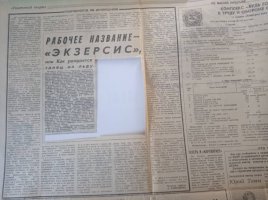
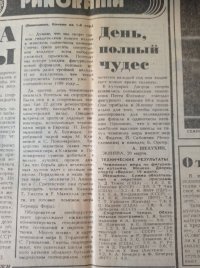
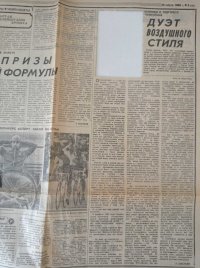
WORKING TITLE — "EXERCISE", or How a Dance on Ice is Born
(the article published in russian 'Sovetskiy Sport' on April 6, 1986)
When I first saw this "ballet-style" exhibition dance performed by Marina Klimova and Sergei Ponomarenko, and still did not know whose ideas and talent it owed its existence to, I first of all thought of the choreography of Elena Matveeva. Remember, it was she who staged such brilliant premieres as "Carmen", "Romeo and Juliet" performed by Irina Moiseeva and Andrei Minenkov, the unforgettable Chaplin-themed program of Natalia Bestemianova and Andrei Bukin, and the seemingly air-woven free program of Klimova and Ponomarenko to the music of Kálmán... I have named only a small fraction of her works in figure skating, one of the latest among which turned out to be "Dedication to the Ballet", or, as this number is briefly called, "Exercise" — named after its first part, the exercises at the ballet barre.
"Dedication to the Ballet" is not just an original exhibition number performed by figure skaters whose skating technique was polished to a shine by trainer Natalia Dubova, and in which a deep understanding of choreography was instilled by Elena Kholina. It is now, when the dance exists, when it is alive, that you understand: Matveeva didn't just dare to do an experiment — she didn't just think something up out of nowhere. No, this was deeply felt and endured. The dance is like an exposed nerve. In purely visual terms, the art of a soloist from the Bolshoi Theater has expressed itself in a sport with which she has been "on a first-name basis" for ten years now. "Farewell to the Ballet" — this is her bow, her "thank you" to the artists, teachers, rehearsal directors, and ballet masters, thanks to whom such an unusual exhibition number could be born.
Well, and now, we give the floor to the Honored Coach of the RSFSR, Elena MATVEEVA, whose latest work still stirs the minds and hearts of figure skating fans.
— The main interest for me always lies in one thing—inventing something new. If during the creation of competitive programs I, as a choreographer, am tied like no one else to the sporting laws of figure skating, then in exhibition routines I step outside the boundaries of this obedience. I am overcome by complete freedom and an enduring sense of wonder—after all, I am the owner of a gigantic stage area that, for example, a ballet director can only dream of.
I look at the ice through the eyes of an athlete. There are no judges, no nerve-wracking scores and placements, no fear of making a mistake, which means no fear of losing.
Instead, I just sit in the stands like a regular spectator and know that I have come to a celebration where it is customary to give gifts.
Everything is very vital: if there is no experimentation in exhibition routines, then figure skating will stagnate. Its past will become its present and bleed into the future.
It is quite easy for the coach, the performers, and me to "work up" a routine for bouquets of flowers. You stage a "Gypsy Dance"—and there you go, applause. But I am for a thinking audience and for the cultivation of thought. Believe me, it was even pleasing to me that during the first run-throughs of "Dedication to the Ballet," the audience did not applaud right away. Although those seconds of silence stretched like hours, I felt the heartbeat of the stands and sensed the strengthening bonds of empathy behind their quiet reflection.
That is how it was at first with "Carmen" too, and later with "Romeo and Juliet." I remember the first performance of "Carmen" at the open championship of Moscow. Moiseeva and Minenkov finished—and not a single clap. Tatyana Anatolyevna Tarasova, who was training them at the time, turned pale from anticipation: the dance she had dreamed of was, yet there was no success. But then they applauded. They applauded well. True, it was nothing compared to what happened later, when "Carmen" was met and sent off with encores.
The idea for "Exercise" —to bring a ballet class out to the public, and moreover onto the ice—matured over a long time. The closer the parting with the theater came, the more often I thought about it. And then Natalya Ilyinichna Dubova suggested staging an exhibition number for her best students. And suddenly I realized that this was the only dance couple for whom "Exercise" would be natural. Moreover, I had never seen such balletic turnout of the legs in anyone else, where they are capable of both first and second positions, and without the slightest hint of artificiality. Marina and Sergei even visually are just external balletic refinements.
But I asked Dubova not to rush me. We still needed to think and think. I could not allow myself to make just another ordinary routine, especially for these kids. Although to myself, I already decided that I would offer them specifically "Exercise". In the spring we will begin, after the season, when they are psychologically free for creativity. By that time, I would be free too...
In the spring of '85, I was saying goodbye to the stage, to the Bolshoi Theater, which had been my home for twenty years. Add ten years of choreographic school, and you get an entire life. Despite everything, a happy, but, alas, already lived life. After "Dedication" was presented to the public, more than once or twice I happened to hear: the finale begs for something different, clearer, more logical. The figure skaters performed to "Don Quixote", again they would pick up the ballet barre, and again—ballet class. The circle would close. Everything would be clear and understandable to everyone.
With me, however, they bow out in slow motion, as if in broad-stroke plastic movement, and leave the ice-stage to quiet music. and I leave together with them. Out of the ballet class and the performance. Because in life, everything should be just like in life, where not only holidays end, but also weekdays, unnoticed by us, yet unique and irreversible. Later, remembering them, thinking about each fleeting day, you think as if it were a holiday...
And so, the beginning of the dance caused no doubts—a ballet class, work at the barre—"exercise". But what lies beyond that? A performance? I sit at home and rack my brain. I mentally and physically dance out a few things. But a cohesive composition, no matter how hard I try, does not come together. What was planned breaks apart into pieces.
Days pass, I calm down and start anew. Natalya Ilyinichna brought the music of Rachmaninoff for the middle part of the dance—let's call it conventionally the "performance". I turn on the record player, and for probably the hundredth time I listen to the recording, but I simply cannot "breathe life" into it with my own idea. My inner "self" keeps insisting that something balletically familiar is needed here, something that is on everyone’s mind and is associated, first and foremost, with ballet.
This means, after all—to the music of "Don Quixote". This time, the doubts vanish for good. And not as an automatic transfer of a ballet adagio onto the ice, but as a "performance" created specifically for the figure skaters.
I love telling people close to me about the dances I have planned. It just so happens that I try to surprise them in the process, and over the course of the story, I come up with things, add details, and fantasize. So, my friend and I are driving to the dacha. It is a long way, and the mood and the comfort of the car encourage conversation. Returning to "Dedication to Ballet". They come out onto the ice with a barre to work on "exercise"—I tell the story and right then and there come up with the idea that the kids are in bright red training jackets. Why do I need these jackets? I don't know yet. Fine, it will come in handy. It's getting interesting even to myself what happens next. And after the lesson at the barre, jumps and spins, a duet lesson arises, with lifts. Well, that's not bad. The music, Mozart's 40th symphony, fades out, a bell rings inviting everyone into the hall, and the atmospheric noise of an orchestra drifts in. A ball is coming. The figure skaters shed their jackets onto the ice, and the composition is completed by three bright spots—the black barre and the red jackets...
When I figured out the ending, I still didn't feel that I had found exactly what was needed. There is an inner freedom that finally everything is brought together, but there is no peace.
A new problem—we cannot find the music. Neither me, nor the kids. It turns out something is getting in the way. Meanwhile, "Exercise" and "Don Quixote" are already done. Summer is approaching, it's time to finish the dance. But with what and how?
I involved all my acquaintances in the music search. The one and only piece cannot be found. And then someone brought me a record with a recording of melodies performed by pianist Franco Crapelli and violinist Yehudi Menuhin. I remember it like it was today: I'm sitting in the morning in front of the mirror, combing my hair, listening to this music which I like very much, and suddenly on one of the melodies, I freeze. It is endlessly mine—in spirit, in mood, in that nostalgia that I experience for the theater.
And a new ending for the dance was born.
I arrived at the training session. The kids, poor things, were exhausted—asking when the routine would finally come together. They asked: "What if, after 'Don Quixote', we make a bravura ending, just right for applause?"
When I heard this, it felt like something inside me snapped. I thought—should I say it, or should I not... and I told them. The performance ends, you are tired, you perform one small step from a completely different dance, and that is it.
They accepted the idea. The next day with fear—I swear, with fear—I brought them the music. They listened to it. They fell into thought. Marina said: "This is exactly, exactly as you described it. Let's do the bows to this quiet, sad melody too. What do you think?"
And only at that moment, with both my mind and my heart, did I understand that the "dedication to ballet" had truly happened...
Monologue recorded by A. ELISEYKIN.