Archive of newspaper articles | Page 31 | Golden Skate

Archive of newspaper articles

1986
VI. WINTER SPARTAKIAD of the PEOPLES of the USSR

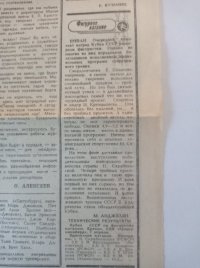
Figure Skating

(the article published in russian 'Sovetskiy Sport' on March 12, 1986)

Krasnoyarsk. "Yenisei" Palace of Sports. Pairs Skating
1. E. Kvitchenko — R. Kadyrkaev — 1.8;
2. E. Bechke — V. Kornienko (both pairs — Leningrad) — 2.4;
3. E. Leonova — G. Krasnitsky (Moscow) — 4.2.
Single Skating. Men.
1. V. Egorov (Ukraine) — 2.0;
2. L. Kaznakov (Leningrad) — 5.8;
3. A. Torosyan (Georgia) — 7.8.
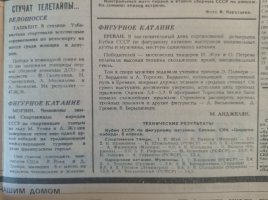
Day by Day

(the article published in russian 'Sovetskiy Sport' on March 12, 1986)

Yesterday, the last sets of honorary sports awards were contested at the Spartakiad finals.
FIGURE SKATING. The women's gold medal was won by 15-year-old athlete from Kyiv, Natalya Gorbenko. In second and third places were Leningraders Larisa Zamotina and Inna Krundysheva.
1781765679719.jpeg
1781765699169.jpeg
 
1986
WORLD CHAMPIONSHIPS

ALPINE BALLAD

(the article published in russian 'Sovetskiy Sport' on March 18, 1986)

Our special correspondent reports from Switzerland

The Geneva ice rink "Vernets" welcomes figure skaters from 24 countries—participants in the World Championships.


The ridges of the Alps, which occupy more than half of Switzerland's territory, sleep under a perpetual blanket of snow. But there is one place in the south where the mountains seem to have halted their march and frozen before a magical canvas of water expanse. The valleys surrounding the famous Lake Geneva sparkle under the spring sun.
Here, on the waterfront near the fountain, I suddenly spotted a very familiar profile: a girl's head with a small braid. Of course, it is 14-year-old blue-eyed Katya Gordeeva. She arrived in Geneva as part of our national team. (By the way, it is the largest at the World Championships, with 18 figure skaters in it). And there are only two debutants—this is precisely Katya Gordeeva and Sergei Grinkov, who managed to become the silver medalists of Europe this winter.
— "Katya, what have you managed to see on the ice at 'Vernets'?" I asked Gordeeva.
— "A lot of impressions. I watched the training sessions of European Champion Jozef Sabovčík, our World Champion Sasha Fadeev, and the Canadian Brian Orser. Sabovčík is doing quite well with a quadruple toe loop jump. And Fadeev also showed his trump card—a combination of a triple Axel and a triple toe loop. The Americans had an unpleasant surprise. Remember, Bowman came to Moscow and was a medalist at our tournament? He was preparing for Geneva after that, but he was unlucky: he broke his leg and arrived in Geneva on crutches. Now the Americans have only one hope—Brian Boitano..."
The tournament organizers suggested that guests and spectators take part in a lottery: predict who will become a medalist in all four disciplines of the program. A "Mercedes" car awaits the winner. At the draw, we met with the honored coach of the USSR, Tamara Moskvina. When we asked her to give her forecast, she threw up her hands:
— "I'm afraid the 'Mercedes' will remain with the tournament organizers. Naming the 12 best out of 129 figure skaters is a practically impossible task. I can only give a firm prediction in the women's singles. Here, Katarina Witt's chances are the highest..."
In total, 28 men, 15 pairs, 22 ice dance duos, and 27 women from 24 countries are participating in the competitions. Among the contenders named here is a familiar acquaintance—the American Caryn Kadavy, who won the Moscow tournament three months ago.
A. Fadeev performed the compulsory program better than anyone else and was awarded the small gold medal. Second place in the compulsory program was taken by J. Sabovčík, third by H. Fischer. In the top six are also B. Boitano (USA), Canadian B. Orser, and R. Zander (FRG). V. Petrenko is in seventh place, and V. Kotin is in ninth.​
A. SHELUKHIN.
GENEVA, March 17.
1781766923725.jpeg
 
1986
WORLD CHAMPIONSHIPS

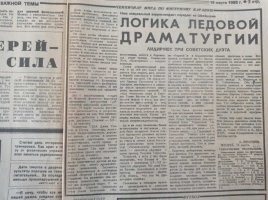
THE LOGIC OF ICE DRAMATURGY

(the article published in russian 'Sovetskiy Sport' on March 19, 1986)

Our special correspondent reports from Switzerland

THREE SOVIET DUOS ARE LEADING

A day when a short program is performed—skaters call it the "Hamlet day"—because the main question is decided: "to be or not to be" in the eyes of the judges, at the top, or to face a long path to the podium.
On the ice of the "Vernets" rink, everyone's attention was drawn to the charmingly coquettish 15-year-old Katrin Kanitz. Slipping out for the warm-up, she literally fluttered like a butterfly in her crimson dress and captivated the audience with her execution of the lift and the twist (by the way, her partner Tobias Schröter is also very confident and elegant).
— "They are trying too hard, overdoing it. Don't they want to win too much?" — I heard a remark from one of the coaches of our team, I. Ksenofontov, who knows a thing or two about the psychology of sports. And his observation turned out to be prophetic.
The hall follows the stormy finale of the GDR figure skaters' program with bated breath. Only the last element remains — the death spiral. And suddenly, the skaters' fingers unclasp, and the athletes fall onto the ice. All the advantage gained with such hard work melted away. Ratings — 5.0–5.1 for technique.
The Champions of the USA, Jill Watson and Peter Oppegard, perform a flawless step sequence, but then, at the moment of the lift, the female partner loses her orientation, flies straight into the boards, and the stunned Peter falls too. For such a clear mistake, they receive 5.1–5.3 for technique.
Perhaps never before had so many dramatic moments fallen upon the share of sports duos. The favorite of our national team, 14-year-old Katya Gordeeva, also made everyone worry. During the warm-up, she lost her balance while performing that same death spiral. Her partner Sergei Grinkov’s eyes grew large with worry. Both, frightened, rushed to the boards where coach Stanislav Zhuk was standing. "Repeat it!" — came the command.
Once again, a swift approach, and this time the death spiral goes perfectly. As it turned out, the entire emphasis in the battle shifted to the psychological aspect. Larisa Selezneva and Oleg Makarov, who returned to the team after a three-month break caused by an injury, knew no peace. Only world and European champions Elena Valova and Oleg Vasiliev walked into the hall where the press center was located, and under the flashes of camera strobes, calmly repeated their lifts, while even nodding their heads in response to greetings from acquaintances. What kind of nerves are needed to maintain such composure!
Yes, and on the ice, the champions were magnificent and made the judges be generous. What a subtle feeling of the rhythm of Raimonds Pauls' music, what a sense of style and line, what brilliant execution of all elements! "Championship inspiration," remarked Tatyana Tarasova, who was sitting with us.
Perhaps all of us had the feeling that Valova and Vasiliev, with scores of 5.7–5.9, would remain the leaders. But Elena Valova herself, having come up to the press box, reacted differently: "Oh, I'm afraid these are not ultimate scores."
Selezneva and Makarov lost slightly in lightness of skating to their teammates and, in the opinion of the majority of judges, conceded 0.1 points. A logic of ice dramaturgy required a culmination. Everyone anticipated it, waited for it. It struck when the last four pairs were called to the start. Among them were Gordeeva and Grinkov. About their original 'Charleston,' which combines both lyricism and humorous Chaplin-esque notes, specialists say: 'A rarely danceable composition.' Gordeeva and Grinkov had already performed it several times, but now, at the end of the season, it was as if they had caught a second wind.
Then followed a long ovation. And, as the final touch, the first bouquet of velvet roses on this world championship went to Katya Gordeeva. On the scoreboard, digits flared up — ten times - 5.8, three times - 5.9. First place went to Gordeeva and Grinkov. Now all three duos — the Moscow one and two Leningrad ones — closed the upper lines of the protocol. Which is to say, highest craftsmanship.
However, let's save our epithets for the final. It promises to be, oh, so difficult. In the next theatrical 'act,' there will be many new heroes. Much is expected from the strong Canadian duo of D. Benning (18 years old) and L. Johnston (25 years old). The Canadians possess a full arsenal of the most complex combinations, and their coach, Kerry Leitch, who specially came to Moscow to study the 'secrets of the Russians,' has succeeded greatly in this. His protégés could present a surprise. And, finally, two more 'tough nuts to crack' — the American duos.
The sharpest situations are developing in men's single skating. In the center of attention is the duel between A. Fadeev and J. Sabovčík. Both came to this meeting in their best form. After the execution of the "school," which was won by Fadeev, European Champion Sabovčík said: "As I expected, the competition in Geneva became much more interesting. The elite has gathered here, capable of showing miracles of complexity. And we will continue our duel in the short program."
Yesterday, another small gold medal was won by Kira Ivanova. She won the compulsory figures, ahead of D. Thomas (USA) and K. Witt (GDR). Anna Kondrashova is in sixth place.​

A. SHELUKHIN.
GENEVA, March 18.
TECHNICAL RESULTS
World Figure Skating Championships. Geneva. March 17. Palais des Sports "Vernets".
Pairs. Short program. 1. E. Gordeeva — S. Grinkov — 0.4; 2. E. Valova — O. Vasiliev — 0.8; 3. L. Selezneva — O. Makarov (all USSR) — 1.2; 4. C. Coull — M. Rowsom (Canada) — 1.6; 5. G. Wachsman — T. Waggoner (USA) — 2.0; 6. D. Benning — L. Johnston (Canada) — 2.4; 7. K. Kanitz — T. Schröter (GDR) — 3.2; 8. N. Seybold — W. Seybold (USA) — 3.6.
1781771825692.jpeg
 
1986
WORLD CHAMPIONSHIPS

THE LOGIC OF ICE DRAMATURGY

(the article published in russian 'Sovetskiy Sport' on March 19, 1986)

Our special correspondent reports from Switzerland

THREE SOVIET DUOS ARE LEADING

A day when a short program is performed—skaters call it the "Hamlet day"—because the main question is decided: "to be or not to be" in the eyes of the judges, at the top, or to face a long path to the podium.
On the ice of the "Vernets" rink, everyone's attention was drawn to the charmingly coquettish 15-year-old Katrin Kanitz. Slipping out for the warm-up, she literally fluttered like a butterfly in her crimson dress and captivated the audience with her execution of the lift and the twist (by the way, her partner Tobias Schröter is also very confident and elegant).
— "They are trying too hard, overdoing it. Don't they want to win too much?" — I heard a remark from one of the coaches of our team, I. Ksenofontov, who knows a thing or two about the psychology of sports. And his observation turned out to be prophetic.
The hall follows the stormy finale of the GDR figure skaters' program with bated breath. Only the last element remains — the death spiral. And suddenly, the skaters' fingers unclasp, and the athletes fall onto the ice. All the advantage gained with such hard work melted away. Ratings — 5.0–5.1 for technique.
The Champions of the USA, Jill Watson and Peter Oppegard, perform a flawless step sequence, but then, at the moment of the lift, the female partner loses her orientation, flies straight into the boards, and the stunned Peter falls too. For such a clear mistake, they receive 5.1–5.3 for technique.
Perhaps never before had so many dramatic moments fallen upon the share of sports duos. The favorite of our national team, 14-year-old Katya Gordeeva, also made everyone worry. During the warm-up, she lost her balance while performing that same death spiral. Her partner Sergei Grinkov’s eyes grew large with worry. Both, frightened, rushed to the boards where coach Stanislav Zhuk was standing. "Repeat it!" — came the command.
Once again, a swift approach, and this time the death spiral goes perfectly. As it turned out, the entire emphasis in the battle shifted to the psychological aspect. Larisa Selezneva and Oleg Makarov, who returned to the team after a three-month break caused by an injury, knew no peace. Only world and European champions Elena Valova and Oleg Vasiliev walked into the hall where the press center was located, and under the flashes of camera strobes, calmly repeated their lifts, while even nodding their heads in response to greetings from acquaintances. What kind of nerves are needed to maintain such composure!
Yes, and on the ice, the champions were magnificent and made the judges be generous. What a subtle feeling of the rhythm of Raimonds Pauls' music, what a sense of style and line, what brilliant execution of all elements! "Championship inspiration," remarked Tatyana Tarasova, who was sitting with us.
Perhaps all of us had the feeling that Valova and Vasiliev, with scores of 5.7–5.9, would remain the leaders. But Elena Valova herself, having come up to the press box, reacted differently: "Oh, I'm afraid these are not ultimate scores."
Selezneva and Makarov lost slightly in lightness of skating to their teammates and, in the opinion of the majority of judges, conceded 0.1 points. A logic of ice dramaturgy required a culmination. Everyone anticipated it, waited for it. It struck when the last four pairs were called to the start. Among them were Gordeeva and Grinkov. About their original 'Charleston,' which combines both lyricism and humorous Chaplin-esque notes, specialists say: 'A rarely danceable composition.' Gordeeva and Grinkov had already performed it several times, but now, at the end of the season, it was as if they had caught a second wind.
Then followed a long ovation. And, as the final touch, the first bouquet of velvet roses on this world championship went to Katya Gordeeva. On the scoreboard, digits flared up — ten times - 5.8, three times - 5.9. First place went to Gordeeva and Grinkov. Now all three duos — the Moscow one and two Leningrad ones — closed the upper lines of the protocol. Which is to say, highest craftsmanship.
However, let's save our epithets for the final. It promises to be, oh, so difficult. In the next theatrical 'act,' there will be many new heroes. Much is expected from the strong Canadian duo of D. Benning (18 years old) and L. Johnston (25 years old). The Canadians possess a full arsenal of the most complex combinations, and their coach, Kerry Leitch, who specially came to Moscow to study the 'secrets of the Russians,' has succeeded greatly in this. His protégés could present a surprise. And, finally, two more 'tough nuts to crack' — the American duos.
The sharpest situations are developing in men's single skating. In the center of attention is the duel between A. Fadeev and J. Sabovčík. Both came to this meeting in their best form. After the execution of the "school," which was won by Fadeev, European Champion Sabovčík said: "As I expected, the competition in Geneva became much more interesting. The elite has gathered here, capable of showing miracles of complexity. And we will continue our duel in the short program."
Yesterday, another small gold medal was won by Kira Ivanova. She won the compulsory figures, ahead of D. Thomas (USA) and K. Witt (GDR). Anna Kondrashova is in sixth place.​

A. SHELUKHIN.
GENEVA, March 18.
TECHNICAL RESULTS
World Figure Skating Championships. Geneva. March 17. Palais des Sports "Vernets".
Pairs. Short program. 1. E. Gordeeva — S. Grinkov — 0.4; 2. E. Valova — O. Vasiliev — 0.8; 3. L. Selezneva — O. Makarov (all USSR) — 1.2; 4. C. Coull — M. Rowsom (Canada) — 1.6; 5. G. Wachsman — T. Waggoner (USA) — 2.0; 6. D. Benning — L. Johnston (Canada) — 2.4; 7. K. Kanitz — T. Schröter (GDR) — 3.2; 8. N. Seybold — W. Seybold (USA) — 3.6.
View attachment 11550
I really doubt that line about "nodding to their friends while practising lifts". A bit of an exaggeration, I think. I've had friends speak to me while they're on the ice and I'm up in a lift, and had to explain later that I wasn't ignoring them. The movement of even just diaphragm muscles in speech could upset the balance at that particular point, so I hear and see them but don't respond until I'm back down on my feet. It's my partner who shouts "Don't talk to her!" when that happens.

We've all had death spirals come apart. At least it's not far to fall, but you do feel silly, sitting down abruptly (him) or sliding down the rink on your stomach (her) :oops:
 
1986
WORLD CHAMPIONSHIPS

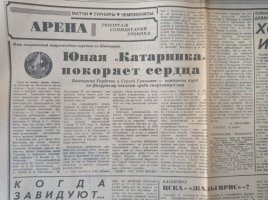
Young "Katarinka" Captures Hearts

(the article published in russian 'Sovetskiy Sport' on March 20, 1986)

Our special correspondent reports from Switzerland

Ekaterina Gordeeva and Sergei Grinkov — Pairs Figure Skating World Champions

Judging by everything, the pairs figure skating final at the Geneva World Championships will be remembered as unique in the history of world championships. On the eve of the event, no one could have predicted the podium setup. Even experts did not anticipate that young Soviet figure skaters E. Gordeeva and S. Grinkov, debutants of the world championship, students of coaches S. Zhuk and S. Leonovich, would win a convincing victory. Just a year ago, this pair was competing in the junior category, and today they embody a very elegant, aesthetic style of skating.
At midnight, the press conference hall at the Les Vernets rink was packed to capacity. With massive bouquets of flowers, the new world champions Gordeeva and Grinkov, and silver medalists E. Valova and O. Vasiliev, were welcomed. The applause greeted not only the athletes but also their coaches, Honored Coaches of the USSR S. Zhuk and T. Moskvina. Over the last 20 years, it is they who have done a great deal to establish the traditions of the domestic school.
"You ask how Gordeeva and Grinkov made the leap to gold medals within a year?" said Stanislav Zhuk to the journalists at the press conference. "But our school remembers a similar case. In 1973, A. Zaitsev received twelve 6.0 scores at the European Championships in Cologne just ten months after pairing up with I. Rodnina. This means the experience has been accumulated..."
Of course, the local public fell in love with the blue-eyed schoolgirl Katya Gordeeva right away. Spectators affectionately called her in their own way, "Katarinka." At just 14 years old, she is not afraid of any questions and gives completely sincere answers:
"About dolls, I have already forgotten how to think. I am interested in more than anything electronics and computers. Maybe I will learn to work on a display screen to write school essays on it..."
And she will learn!
Inevitably, one recalls that just as rapidly as they broke into the elite of world figure skating, so did their senior teammates from the national squad: Valova and Vasiliev, who debuted in 1983 at the World Championships in Helsinki. Back then, they also won gold medals.
"Stars" break out periodically like fireworks on the Geneva ice. A year ago, no one knew the American figure skaters Debi Thomas and Caryn Kadavy, and now they are competing with recognized virtuosos Kira Ivanova, and Katarina Witt — this is another main event of the tournament.
However, the path of young figures to the podium is far from a triumphant path. Roses are handed out for painstaking, titanic work and the will to win. It was enough for Gordeeva and Grinkov to falter in the short program, and a heavy price would have to be paid to make up for lost ground. After all, the competition in modern pairs skating is unusually high. It seems that the class of our pairs skating is embodied in the brilliant compositions of E. Valova and O. Vasiliev, A. Selezneva and O. Makarov.
We emphasize that the credit of the coaches, spouses Tamara Moskvina and Igor Moskvin, in the art of leading their students in various artistic directions is immense. One duo maximally dramatizes their compositions, while another emphasizes an athletic, sporting foundation.
A few words about how the battle unfolded. First in the leaders group came Gordeeva and Grinkov. Their free program, combining a gentle melody of old classical jazz, was flawless in execution technique. Not a single mistake! And as a result, 12 scores of 5.8, and three scores of 5.9 points. After this, the battle unfolded mainly for second and third places. Valova and Vasiliev skated with just as much temperament as at the European Championship, but made several mistakes. Selezneva and Makarov lost the bronze medals in a fierce battle to pairs champions from Canada: 20-year-old Cynthia Coull and 27-year-old Mark Rowsom.
The culmination in the men's event is near. The prediction of the multiple world champion E. Danzer from Austria was completely confirmed. On the eve of the event, he promised a grand spectacle and noted that at least ten athletes would participate in it. And so it turned out. Aleksandr Fadeev, Vladimir Kotin, and Viktor Petrenko set the tone in the dispute. They do not lack courage—in the short program, they fought with maximum dedication. As a result, Fadeev took second place with scores of 5.8 and 5.9. Kotin was third with scores of 5.6 and 5.8, and Petrenko finished sixth with scores of 5.5 and 5.6. The short program was won by 25-year-old Canadian Brian Orser. In technique he was inferior to Fadeev, but in the scores for artistry he had one tenth of a point more. The overall leader remains world champion Aleksandr Fadeev, followed by Jozef Sabovčík from Czechoslovakia, and in third place is Orser.​

A. SHELUKHIN.
GENEVA, MARCH 19.
TECHNICAL RESULTS
World Figure Skating Championships. Geneva. Rink "Les Vernets". March 18.
Pairs Skating. Overall Standings.
1. E. Gordeeva and S. Grinkov — 1.4; 2. E. Valova and O. Vasiliev (both USSR) — 2.8; 3. C. Coull and M. Rowsom (Canada) — 4.6; 4. L. Selezneva and O. Makarov (USSR) — 5.2; 5. D. Benning — L. Johnston (Canada) — 8.4; 6. J. Watson and P. Oppegard — 8.6; 7. G. Wachsman — T. Waggoner — 9.0; 8. N. Seybold — W. Seybold (all USA) — 11.2.
1782048980501.jpeg
 
1986
WORLD CHAMPIONSHIPS

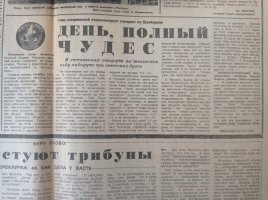
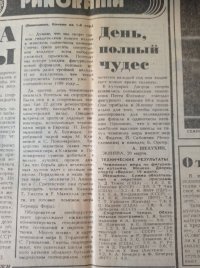
A Day Full of Wonders

(the article published in russian 'Sovetskiy Sport' on March 21, 1986)

Our special correspondent reports from Switzerland

In the Ice Dance Competition, Three Soviet Duos Take the Lead

The Geneva lake has wrapped itself in a shroud of fog. A light, persistent rain is drizzling. It is gloomy on the narrow streets. The weather, in a certain sense, matches the mood...
The Japanese skater Midori Ito wept, having started poorly in her short program. The reigning Olympic champion, Katarina Witt, who had lost her leadership, smiled sadly at autograph hunters. American figure skater Caryn Kadavy was escorted by the arms to a car, having suffered a painful, minor injury during her performance. How many hopes were dashed on this day! And how hard it is now for the coaches to rebuild the competitive spirit of their students. Perhaps, for the first time at this championship, we witnessed such an unprecedented cocktail of flights and falls.
But let us recount everything in order. In the group of strongest contenders, Natalia Lebedeva was the first to start—an athlete of powerful, athletic style. The judges are well familiar with her composition to the melody of the czardas (with which Natalia took 4th place at the European Championship) is familiar. She was close to a high result again, but at the last moment, a difficult element let her down—a combination with a triple jump. This unfortunate landing cost her dearly: only tenth place. Lebedeva was bypassed by very strong athletes from West Germany and Canada: Claudia Leistner and Tracy Wainman. They had scores at the level of 5.3–5.5.
The psychological tension in the tournament reached its highest peak when our Kira Ivanova, the leader of the championship, stepped onto the ice. A thunder of applause accompanied her as she flawlessly executed a cascade with a triple toe loop and spins to a lively Russian dance melody. And suddenly, on the next jump—a double Axel—Kira falls. The referees immediately lower her score: for technique—5.2, 5.3, and for artistry—5.5, 5.7.
What will be the response of the 19-year-old US Champion, Debi Thomas? The tall, slender African-American skater is master of all elements of the short composition. True, she consciously slows down the tempo of her skating, but all her movements are calibrated to the millimeter. And her double Axel and lutz, executed deep and easily, are particularly impressive. The American had the highest scores both for technique and for artistry—5.7, 5.8. For now, she leads the tournament.
But a challenge to her was thrown by our charming 20-year-old Muscovite, Anna Kondrashova. The sounds of the familiar 'Kalinka' at the beginning of the track stirred the entire audience. The Genevans passionately supported the figure skater, and she flawlessly made it through all the difficulties of the tough program. She perfectly executed a cascade of jumps and a dashing path of steps. Ten scores of 5.7 points propelled her to second position.
Both the American Caryn Kadavy and Olympic champion Katarina Witt made attempts to catch up with Kondrashova. However, both of them suffered a failure in the jumps. Kadavy received 5.1 (9th place) from the judges, and Witt received 5.2–5.3. However, Witt mesmerized the judges with the striking fluidity of her Oriental dance. At that moment, their hearts softened. They flashed two scores of 5.9 on the scoreboard, which ultimately secured fourth place for Witt. However, in the overall standings, she fell behind three skaters at once—Thomas, Ivanova, and America's T. Chin. And Kondrashova practically caught up with Witt: Anna's total score is 4.4, while Witt's is 3.4.
An express-commentary from the multiple European champion, Karol Divín (Czechoslovakia):
"I am amazed by the high level of mastery in the women's tournament. The best performers demonstrate an example of a synthesis of virtuoso technique and great artistic expression. I would like to highlight the programs of the leaders—Thomas, Witt, Kondrashova, Chin, Leistner. I do not remember a championship where so many original styles were presented."
And here is what the former world champion, Vladimir Kovalev, emphasized:
- I think that we will soon witness a new surge in women's singles skating. Right now, about ten female athletes possess the entire repertoire of complex jumps. Therefore, we will soon see figure skaters of a new formation, ready to perform even a triple axel. And it is not ruled out that such an athlete will appear as early as the 1988 Olympic Year."
Yes, the third day of the championship turned out to be rich in surprises. They were also present in the ice dance events, where 22 duos demonstrated the rumba, pasodoble, and Westminster waltz. Viewers greeted the ice miniatures performed by world and European champions N. Bestemianova and A. Bukin, as well as world silver medalists M. Klimova and S. Ponomarenko, with an ovation. The lead was taken by the most decorated couple, but Klimova and Ponomarenko managed to achieve the best scores of the day in the waltz. So the struggle between the two magnificent duos is in full swing. Our third couple —Muscovites H. Annenko and G. Sretenski—also brought joy; they managed to overtake Canadian champions T. Wilson and R. McCall (by the way, they are coached by world champion Bernard Ford).
Observers from Swiss newspapers continue to animatedly comment on the sensational outcome of the pairs competition. Many praises were sent toward world champions E. Gordeeva and S. Grinkov. Newspapers emphasize that the Soviet school of figure skating possesses a vast creative potential; practically every year it brings forward new bright talents.
In the lobbies of the Sports Palace, Olympic champion Peggy Fleming, a "star" of 1960s figure skating, appeared. She arrived in Geneva specifically to commentate on the two singles skating finals for television. Let me remind you that among the men, our A. Fadeev, J. Sabovčík (Czechoslovakia), and Canadian B. Orser have the highest chances for the world champion title.​
A. SHELUKHIN.
GENEVA, March 20.
TECHNICAL RESULTS
World Figure Skating Championships. Geneva. "Vernets" Sports Palace, March 19.
Women. Sum of compulsory and short programs. 1. D. Thomas (USA) — 1.6; 2. K. Ivanova (USSR) — 3.0; 3. T. Chin (USA) — 3.2; 4. K. Witt (GDR) — 3.4; 5. A. Kondrashova (USSR) — 4.4; 6. K. Leistner (FRG) — 7.4; 7. T. Wainman (Canada) — 7.4; 8. C. Kadavy (USA) — 7.8; 9. N. Lebedeva (USSR) — 8.8.
Ice Dance. Compulsory program. 1. N. Bestemianova and A. Bukin — 0.6; 2. M. Klimova and S. Ponomarenko — 1.2; 3. N. Annenko and G. Sretenski (all — USSR) — 1.8; 4. T. Wilson and R. McCall (Canada) — 2.4; 5. S. Semanick and S. Gregory (USA) — 3.0; 6. R. Roca and D. Adair (USA) — 3.6; 7. K. Beck and C. Beck (Austria) — 4.2; 8. A. Becherer and F. Becherer (FRG) — 4.8.
1782105244708.jpeg
1782105263565.jpeg
 
Last edited:
1986
WORLD CHAMPIONSHIPS

Duel with Oneself

(the article published in russian 'Sovetskiy Sport' on March 22, 1986)

Soviet Ice Dance Couples Continue to Set the Tone on the Geneva Ice

Our special correspondent reports from Switzerland

Vladimir Kotin stepped onto the ice and immediately began circling left and right, testing his edges, twirled his straw-blonde hussar-style mustache, and smiled at his teammates sitting in the stands. Our skaters gave him a warm round of applause. They understood that while the jumps and even the gestures had long been rehearsed down to the smallest detail, a mindset cannot be created in advance. Competition in singles skating is a kind of duel between the performer and their own emotions.
Kotin understood that so much depended on the very first minute of the performance. The strategy of the top masters is quite obvious—while their strength is still fresh, they must storm the most difficult elements. Kotin succeeded brilliantly, flawlessly executing a double axel, a triple lutz, and a cascade with a triple toe loop in a row. True, he made two mistakes in the middle of the program, but they did not trigger a chain reaction, and the athlete managed to compose himself.
For the first time at the World Championships, Kotin was awarded two scores of 5.9 for presentation (they were flashed on the scoreboard by the judges from Switzerland and Poland). Looking ahead, we note that our figure skater achieved the third-best result in the free program, ultimately finishing in fourth place overall. As a reminder, he began the competition from ninth position.
Alexander Fadeev fully experienced the psychological burden of leadership. For three days, he topped the standings and, defending his World Champion title, fought off fierce attacks from his rivals. He had two options: either simplify his free program to avoid falls, or take a risk and include elements such as a 3.5-revolution Axel (triple Axel) and a 4-revolution toe loop (quad toe loop). During practices, Fadeev performed fragments of his program with total commitment. But that was just a rehearsal, and on the fourth evening, everything changed.
The first minute. The most difficult one. Fadeev excellently performs a combination with a triple lutz, then attacks a triple axel, soars into the air, but touches the ice with his hand upon landing. He goes on to storm the four-revolution toe loop—another inaccuracy. This was immediately followed by a fall after a triple jump. What a shame! He skated stiffly, and although he executed the final part of the composition flawlessly, it became clear to everyone that he would unlikely remain in the lead. Scores for technique: 5.5 - 5.8; for presentation: 5.4 - 5.8.
Under modern judging, the clean execution of the entire program is valued especially high. At times, it creates the impression that the judges do not care whether the figure skater managed to demonstrate true complexity. They focused their main attention on showmanship, on the athlete's ability to present themselves. This manifested itself most clearly when the US champion Brian Boitano stepped onto the ice. The 22-year-old figure skater had already been competing in the World Championships for four years. Last season, he became the bronze medalist, and now he was determined to fight for the highest award. For him, the first minute was also decisive. Within it, three triple jumps executed with great amplitude, effortlessly and artistically, became the highlights. The culmination of the American's program was the central part of the composition set to the music of Gershwin. For 15 seconds, he executed a common element—the 'spread eagle'. But how much grace and taste there was in those beautiful glides! The audience was captivated. And here are the scores: for technique, seven scores of 5.8 and two of 5.9. For presentation, again 5.8 and two scores of 5.9.
Another attack on the pedestal was made by the European champion Jozef Sabovčík (Czechoslovakia). He, by the way, had significant chances for the world title, as he held the second position before the free skate. But this time the figure skater was out of luck: even during the warm-up, he landed awkwardly on his injured leg, and during his performance, he was mostly concerned about how to avoid a more serious injury. Naturally, his jumps failed. He struggled to finish his program and, with scores of 5.2–5.5, ended up in sixth place.
The 25-year-old Canadian champion Brian Orser lost confidence after a fall on his triple Axel. The fear of making new mistakes affected his skating speed.
One part of the Canadian's program was titled 'Optimistic,' and he tried to convey a feeling of cheerfulness and the thrill of the struggle. However, too much had already been lost. His first marks for technique (which is considered fundamental in figure skating) were mostly 5.7–5.8. As a result, the Canadian lost to the American Boitano by a narrow margin, with a 5:4 judges' split. Winning the free skate ultimately propelled the American athlete to first place overall.
The 17-year-old Viktor Petrenko can rightfully be called the hero of this championship. Just two years ago, he won the World Junior Championship. Last season, Viktor made his debut on the world stage and took ninth place. This season, Petrenko's preparation was focused on clean skating and the flawless technique of triple jumps. The figure skater significantly improved in power and amplitude of movement. All of this was vividly reflected in his current program set to melodies by Tchaikovsky. This time, Viktor brilliantly executed a unique element—the triple Axel—and a combination that included a triple toe loop. He literally soared during a highly difficult triple Salchow.
Petrenko delivered the fourth-best result in the free skate and ultimately took an honorable fifth place. Thus, the men's singles event at the World Championship was truly graced by the two Brіans from the USA and Canada, and three Soviet athletes: Fadeev, Kotin, and Petrenko....
The climax is also near in the ice dance tournament. Twenty-two duos competed in the original dance set to the rhythm of the polka. After the European Championship, Natalya Bestemianova and Andrei Bukin arrived in Moscow and risked taking a highly bold step. Together with their coach Tatyana Tarasova, they created a new version of the polka, one even more high-spirited and fast-paced than the first. This was the routine they brought to the ice of Geneva's Vernets rink. The judges highly praised the new dance, but here too we witnessed supreme competition. World and European silver medalists Marina Klimova and Sergei Ponomarenko challenged the leaders by demonstrating virtuoso technique and a sense of rhythm. One of the referees gave them a score of 6.0. As a result, Klimova and Ponomarenko placed first in this segment of the competition, while Bestemianova and Bukin came in second. Our third duo, Natalya Annenko and Genrikh Sretenski, also brought joy. The Soviet couple earned the third-highest scores of the day.​
A. SHELUKHIN.
GENEVA, March 21.
TECHNICAL RESULTS

World Figure Skating Championships. Geneva. "Vernets" Sports Palace, March 20.
Men. Final Standings. 1. B. Boitano (USA) — 5.4; 2. B. Orser (Canada) — 5.4; 3. A. Fadeev (USSR) — 6.4; 4. V. Kotin (USSR) — 9.6; 5. V. Petrenko (USSR) — 10.6; 6. J. Sabovčík (Czechoslovakia) — 11.8; 7. H. Fischer (FRG) – 14.6; 8. D. Doran (USA) — 15.6.
Ice Dance. The combined score of the compulsory and original dances. 1. N. Bestemianova and A. Bukin — 1.4; 2. M. Klimova and S. Ponomarenko — 1.6; 3. N. Annenko and G. Sretenski (all — USSR) — 3.0; 4. T. Wilson and R. McCall (Canada) — 4.0; 5. S. Semanick and S. Gregory (USA) — 5.0; 6. R. Roca and D. Adair (USA) — 6.0; 7. K. Beck and C. Beck (Austria) — 7.0; 8. A. Becherer and F. Becherer (FRG) — 8.0.
1782278059967.jpeg
 
Last edited:
1986
WORLD CHAMPIONSHIPS

SOMEONE LOSES, SOMEONE FINDS

(the article published in russian 'Sovetskiy Sport' on March 23, 1986)

Our special correspondent reports from Switzerland

...And a change of champion occurred in the women's tournament.


The 20-year-old Katarina Witt, a student from Karl-Marx-Stadt, surrendered her title to the new world champion—an athlete from the USA, Debi Thomas. It is interesting that in different years, female athletes from the GDR had already been awarded the title of the strongest at the world championships seven times in this discipline. Even now, Katarina Witt said that until the very last second, she believed that her hopes for success would be justified, although catching up with Thomas in the all-around total was practically impossible.
"I am happy that at the World Championships in Geneva I received two 6.0 scores," added Witt. " The new program, titled 'Black Flower' and set to the music of Bernstein, received unanimous acclaim. And this is inspiring..."
She spoke about her emotions, but tears glistened in her eyes. Although, even after losing, Witt proved that she remains the best in her crown discipline—the free skate.
A brilliant waltz opened her routine, and in this unique flight over the arena, Witt’s jumps sparkled like tiny diamonds. Later, Witt admitted that on the eve of the world championship, a thought had flashed through her mind to leave the sport. Now, however, her plans are changing. 'I will still challenge Thomas,' she noted.
On March 25, the new world champion Debi Thomas will turn 19 years old. She is from Los Angeles and has been figure skating since the age of six. At seventeen, she set a goal to become the strongest in the world, which she achieved with extraordinary speed—in just two seasons.
Debi's natural gifts are magnificent: she is slender, physically well-prepared. Here at the championship, she easily withstood full run-throughs of the program at all practices. I will add that Debi grew up in a very athletic family – her parents are fond of many sports.
Regarding the free skate of the champion, which earned four 5.9 scores, we can say that it was practically flawless. The Black athlete's every edge, every step were mathematically precise. At the press conference, Thomas noted that she does not consider her composition perfect and that she needs to enhance expressiveness and artistry. 'I hope to use the experience of the Russian ballet, which I adore,' Debi said. 'And I am very glad that Katarina Witt is not leaving the sport. Our duel, I hope, will bring a lot of joy to fans of figure skating.'
For now, it is difficult to explain how our two strongest athletes—Kira Ivanova and Anna Kondrashova—receded into the background. Perhaps the main reason is that the barrier in mastering difficult triple jumps has not been overcome. For example, Canadian figure skater Elizabeth Manley moved from tenth place overall to fifth. Moreover, she had chances to bypass Kira Ivanova as well. Achieving success helped her first and foremost due to her ability to master the entire arsenal of triple jumps. Manley, furthermore, very easily withstood the high pace of the program from beginning to end and received scores at the level of the world champion—5.7–5.8 points.
Once, our coaches set a task for the female figure skaters to master combinations of two or three elements. Elena Vodorezova was the first to do this successfully. However, many athletes who came to replace her still execute combinations with a very small amplitude, timidly and stiffly. As the saying goes, their hearts sink before a difficult task. But this is exactly what must not be shown to the judges and the public. And, receiving 5.3–5.4 points for the free skate, they lose very advantageous positions gained with such great difficulty in the first two 'stages' of the all-around.
It is no coincidence that Witt, Thomas, and Manley became the strongest in the free skate. They demonstrated high jump technique, which is so highly valued by the referees. The judges severely, and at times ruthlessly, penalized many athletes who made mistakes in jump combinations. And conversely, they very energetically supported those who freely master all triple jumps...
And here is how the Honored Coach of the USSR Stanislav Zhuk explained the vexing failure of Aleksandr Fadeev in the free program:
'Sasha built his tactical plan incorrectly. In a situation where six to eight athletes contend for medals, one needs to be able to choose the only correct technical arsenal and give the judges no reason to doubt one's stability. And this comes from the fact that athletes sometimes allow a lot of subjectivism in their own assessment of training, although this is best seen precisely from the outside...'
The competitions in the ice dance tournament are concluding. Here, the tension of the struggle is also great. Especially in the dispute for medals. A small amusing touch—during the last practice, world champions Natalya Bestemianova and Andrei Bukin executed one of their combinations with such a sweep that the partner caught the board with his skate and bent the blade. Urgent measures had to be taken to straighten the skate. Let us recall that Bestemianova and Bukin lead in ice dance, having a minimal advantage over the silver pair of the previous world championship, Marina Klimova and Sergei Ponomarenko.​
A. SHELUKHIN
GENEVA, March 22.
TECHNICAL RESULTS
World Figure Skating Championships. Geneva. Palace of Sports "Les Vernets". March 22.
Women. Combined Final Overall Standings
1. D. Thomas (USA) — 3.6; 2. K. Witt (GDR) — 4.4; 3. T. Chin (USA) — 7.2; 4. K. Ivanova (USSR) — 11.0; 5. E. Manley (Canada) — 12.4; 6. C. Leistner (FRG) — 13.4; 7. A. Kondrashova (USSR) — 13.4; 8. C. Kadavy (USA) — 14.8; 9. T. Wainman (Canada) — 18.4; 10. N. Lebedeva (USSR) — 18.8.
1782293499913.jpeg

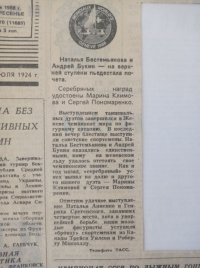
Natalya Bestemianova and Andrei Bukin are on the top step of the podium.

(the article published in russian 'Sovetskiy Sport' on March 23, 1986)


Marina Klimova and Sergei Ponomarenko were awarded the silver medals.

The World Figure Skating Championships in Geneva concluded with the performance of the ice dance duos. On the final evening, Soviet athletes performed brilliantly. Natalya Bestemianova and Andrei Bukin proved to be the only ones who managed to defend their world championship title on the Geneva ice. Just like a year ago, 'silver' success fell to our other duo—Marina Klimova and Sergei Ponomarenko.
We should also note the successful performance of Natalya Annenko and Genrikh Sretenski, who took fourth place, although in a fierce struggle, our young figure skaters yielded the 'bronze' to Canadian athletes Tracy Wilson and Robert McCall.
1782293546794.jpeg
 
1986
WORLD CHAMPIONSHIPS

AND TERPSICHORE APPLAUDS THE "STARS"

(the article published in russian 'Sovetskiy Sport' on March 25, 1986)

Our special correspondent reports from Switzerland

The world ice dancing championship title belongs once again to the Soviet duo Natalya Bestemianova and Andrei Bukin

"I think Terpsichore, the goddess of dance, is also applauding these beautiful masters of the ice at this very moment," concluded her report Austrian television commentator Ingrid Wendl, a former European champion, when the Soviet ice dance couples finished their performance with such triumph.
This season was remarkably difficult for our leaders Natalya Bestemianova and Andrei Bukin – the female partner was plagued by injuries. They were forced to withdraw from starting the national championship. And after the conclusion of the European Championship, where they achieved victory in a most difficult dispute, the figure skaters continued their search to determine the optimal version of the new original dance. That is exactly how a champion's character is tested!
They endured everything. Throughout the entire season, firmly believing in their chosen path. I asked Natasha: "After the dance 'Carmen' you turned to the complex music of Rachmaninoff. Was this dictated by a desire to form a new style?" She answered: 'No, our style will not change. A dramatic, emotional beginning remains the main thing in our dance. We always look for a path to the hearts of the audience.'
And indeed, the reaction of the audience in the Palace of Sports "Les Vernets" to the world champions' performance was amazingly ardent. However, the dialogue of ice artists always touches upon the most sacred strings in the human soul. A huge impression was left by the celebratory finale, where the female partner is all impulse, a cluster of feelings, dramatic gestures. Three judges lit up on the scoreboard the highest mark for artistry—6.0.
The coach of the figure skaters—Honored Coach of the USSR Tatyana Tarasova added:
"The competitions ended just half an hour ago, but we already live for tomorrow. We have music for a new free composition, new exhibition dances. I hope that for everyone this will be a big surprise. I will not name right now what works these are. After all, in creativity there are its own secrets.”
I think, the silver medalists of the world championship Marina Klimova and Sergei Ponomarenko, pupils of Honored Coach of the USSR Natalya Dubova, also possess their own secret of charm. The public welcomed them with a standing ovation when they came to the start. And when the immortal melody of a Strauss waltz began to play, silence fell over the arena. Everyone was enchanted by this almost magical picture of astonishing harmony, purity of lines. Klimova and Ponomarenko create in their fireworks of waltzes an unrepeatable mood of lyricism, conveying the music of gestures.
If in previous years we saw in them executors of the artistic intent of the coach, faithful to what and in what form was proposed to them by the choreographer, now they appeared before the audience at the Geneva ice as artists with a capital letter.
The artistry of the silver duo was also fairly assessed by the scores: the judges in Geneva gave them eight 5.9 scores and one—6.0.
After the competition Natalya Dubova said:
"My students are inspired with success. They had a victory in the original dance, where they already received a 6.0 score. And now a full recognition in the free program."
In comments and disputes caused by the past world championship, there is no shortage. At a press conference lasting twenty minutes, the multiple world champion in ice dance Bernard Ford spoke. Of course, he was very pleased with the success of his students—Canadian figure skaters Tracy Wilson and Robert McCall, who won "bronze". Ford—an Englishman to the core, who now trains the Canadian national team, continues to develop the traditions of the old English school of ice dance. Ford asserts:
"For the past twenty years, Canadians have achieved success for the first time by receiving bronze medals in ice dancing. This is due to the fact that they adopted the experience of the English school. And it preaches a classic principle — to show the art of mastering the entire variety of rhythms, synchronized execution of dance elements."
Ford is a supporter of technicism in dancing. But even he is forced to admit that the Soviet school is developing in several directions at once. And it is no coincidence that now every duo of our national team possesses its own zest. In particular, Ford spoke very flatteringly of our third couple — Natalya Annenko and Genrikh Sretenski, emphasizing their virtuoso technique.
But if we look objectively, this duo stands out not only for technique, but also for an original approach to the music of Shostakovich works. Here we see not only a combination of rhythms, but first and foremost the performers' desire for reincarnation. At first they showed a dance in the style of a Russian fair, and then brilliantly executed fragments in a lyrical, grotesque, and dramatic manner. The plastic pattern is very diverse, and in this, of course, is a great merit of the program's choreographer, Olympic champion Lyudmila Pakhomova.
Pity that the judges did not fully appreciate the originality of the composition. With scores of 5.6–5.7, our duo took fourth place.
Thus, on the Geneva ice, the Soviet national team won two gold, two silver, and one bronze medal. There is no such discipline of competition where our figure skaters would not have chances for medals. But these opportunities were not realized in the best way. The leaders of our team in pair skating rapidly attacked the pedestal. The victory of young E. Gordeeva and S. Grinkov is the main sensation of the competition.
At the same time, the ice of the 'Vernets' rink also reflected our mistakes in women's singles skating. A clear step backward has been made here. The focus on mastery in European championships, where our figure skaters quite often set the tone, does not give an idea of the real balance of power. And only a comparison with the best athletes of the USA, Canada, and Japan made it possible to fully understand how much has been missed in the preparation of our figure skaters, both in technical and psychological terms. This applies not only to those who competed in Geneva, but first and foremost to the athletes participating in our national championships.
The example of Debi Thomas, who managed to rise from a debutant to a world champion in just two seasons, speaks of a lot. This means it is necessary, in the process of selection, to search for and find female athletes capable of showing maximum results in a competitive environment. And, finally, under no circumstances should one forget that women's figure skating is, first and foremost, aesthetics. The Swiss television commentator called our Anna Kondrashova a model of elegance. And this quality was also very highly valued in the performances of the Olympic champion Katarina Witt.
In a word, the formula of a future Olympian is the highest stability of mastery plus elegance.​
A. SHELUKHIN.
GENEVA, March 24.
TECHNICAL RESULTS
World Figure Skating Championships. Palace of Sports "Les Vernets". March 22.
Ice Dance. Combined Final Standings.
1. N. Bestemianova and A. Bukin — 2.4; 2. M. Klimova and S. Ponomarenko (all — USSR) — 3.6; 3. T. Wilson and R. McCall (Canada) — 7.0; 4. N. Annenko and G. Sretenski (USSR) — 7.0; 5. S. Semanick and S. Gregory (USA) — 10.0; 6. R. Roca and D. Adair (USA) — 12.0; 7. K. Beck and C. Beck (Austria) — 14.0; 8. A. Becherer and M. Becherer (FRG) — 16.0; 9. K. Garossino and R. Garossino (Canada) — 18.0; 10. I. Micheli and R. Pelizzola (Italy) — 20.0.
1782299379426.jpeg
 
1986
Touches for a portrait of the champion

DUET OF AN AIRBORNE STYLE

(the article published in russian 'Sovetskiy Sport' on March 30, 1986)

The courage of youth... There is that happy age when an athlete seems to grow wings, when even the ice feels soft as butter, and a twist at the height of the second floor is executed in a single breath, as if in jest. This is the impression of freedom and uninhibitedness left by the programs of the new owners of the ice 'crown' — world champions in pair skating Ekaterina Gordeeva and Sergei Grinkov. The very first start in Geneva of the Moscow pair convinced everyone: the kids are not of a timid dozen, do not blend into the background before authorities, and fight with full dedication.
The ATTITUDE toward fame reveals the essence of a person's character, like a litmus paper. After their performance at the European Championship in Copenhagen, Katya Gordeeva and Serezha Grinkov were met at home at the CSKA rink with flowers. Of course, they were asked: 'Well, how do you feel yourselves in the role of silver medalists? After all, you are almost champions'...
Katya Gordeeva said: " We feel normal. And 'almost' in sports does not count. We must be first."
They have been training together for four years. It seems the time is not long. But four very intense years have been lived. And each of them was a discovery of the unknown. The choreographer and director of the program, Marina Zueva, in the recent past a competitor at the championships of Europe and world in ice dancing, immediately accustomed the kids to working on musical études in the hall. To act out with the help of facial expressions short scenes — for example, a walk through a museum, a meeting with parents after a separation, a playful fight of musketeers — was a fascinating business both for Katya and for Serezha. Here they found a common language, learned dialogue.
At the same time, in life they were still very different, in some ways opposites of each other. Katya was the embodiment of sensitivity, attention, and attentiveness. Serezha was carelessness and good nature themselves. Often the choreographer would invite the kids to the ballet barre. And Katya practiced with ecstasy for an hour or two. But Serezha, after 15 minutes, was already glancing out the window.
Going to the competition in another city, Katya does not forget to take anything with her – both a needle and thread, and shoe polish, and lemons. Later, both Serezha and Anna Kondrashova run to her and ask: 'Katya, lend me some thread! Katya, do you have scissors?'"
And everything is at hand, always neatly put away.
In February 1985, Marina Zueva finished composing their short program. The coaches invited the kids into the hall and let them listen to the music of the charleston.
— And this is our short program? — Serezha was amazed. — No way! Never in our lives will we skate to this music.
— But it is interesting, — Katya responded. — Maybe we could try?
In April, they executed a new composition еntirely, and the charleston began its journey across the rinks of the world.
Without a doubt, working on their previous programs helped the guys," Zueva later explained. "Back in 1983, they put on an excellent skate to the melody of 'Sirtaki.' And in 1984, they managed to master and truly feel a complex composition that the former European champion Igor Bobrin once performed, portraying a master of fencing. Back then, that program was called the 'Musketeer' one...
From the very beginning, Gordeeva and Grinkov grew to love the most difficult segment of the competition — the short program of pairs skating. Others tremble, stepping out to the start as white as a sheet, waiting for their own mistakes like an inevitable disaster. But for Gordeeva and Grinkov, these 120 seconds turn into a jubilant celebration. Daringly, with passion, Katia Gordeeva spins her three rotations in the twist lift. With a proud posture and a smile, Serezha Grinkov leads his partner into the death spiral.
The todes is a "death spiral"... During the warm-up at the Geneva rink 'Les Vernets', an emergency happened to Katia and Sergei — their death spiral fell apart. Katia, arching her back, fell on her side. This was a surprise for both of them. With eyes round from fright, they skated to the boards where their mentor was waiting — Honored Coach of the USSR Stanislav Zhuk. 'Guys, repeat immediately!' the order followed. Once again, they flew out to the center of the rink and, with musketeer-like bravery, spun five rotations of the death spiral. The arena erupted in applause. And after that, they stepped out to the start and inspirationally performed a lively Charleston. The judges gave them the highest marks of the day. And from this very evening began their ascent to the world podium.
For two decades, representatives of the Soviet school of pairs skating have dominated the world's ice rinks. There were only two cases when our duos achieved victory on the first try: first it was done by Irina Rodnina and Alexei Ulanov in 1969, then Elena Valova and Oleg Vasiliev in 1983. The third case—the Geneva one—is remarkable because the championship titles were won by the youngest figure skaters in the USSR national team: Gordeeva is only 14 years old, Grinkov is 19.
— I didn't get into sports by accident, — Katia says. — My father danced for many years in the Song and Dance Ensemble of the Soviet Army. And my mother works at the Telegraph Agency of the Soviet Union on a display, an electronic apparatus. Mama dreamed that I would dance on stage. And for her, figure skating is, above all, dance."
The young world champion, currently an 8th-grade student, collects records with classical music and is fond of poetry. Her ideal in art is Pushkin.
Serezha Grinkov is a first-year student at the Institute of Physical Culture. Naturally, his tastes are different. In literature, he likes works with humor, with a bit of spice, such as the short stories of O. Henry and Hašek's novel 'The Fates of the Good Soldier Švejk'." In music, his sympathies are on the side of contemporary variety music.
Since 1984, this young duo has been led by Master of Sports of International Class Stanislav Leonovich and Honored Coach of the USSR Stanislav Zhuk. The specialists are like-minded people, people deeply dedicated to their craft. For these coaches, ice has always been and will be their home. It was Zhuk who trained the USSR champions Marina Pestova and Stanislav Leonovich. At the CSKA school they spend whole days together, and at the same time the younger Stanislav easily "reads" the ideas of the older Stanislav.
"Nothing happens without difficulties in our work either," Stanislav Zhuk said later. "In the fall of last year, Gordeeva and Grinkov went to an international tournament in Canada and won against many famous pairs. Back then, it seemed to us that all problems were removed from the agenda. But later, in December, when the figure skaters started at an international tournament in Moscow, everything turned out differently. The short program was skated without the slightest flaws. But in the free program, Katia and Serezha could not withstand the psychological pressure, made many mistakes. And then we took a risky step: sharply updated the pattern of the program. But at the same time, we preserved its elegant dance style. We wanted the young pair to bring a fresh stream into figure skating, show new possibilities, force all specialists to be stirred up. And the fact that on the Geneva ice Gordeeva and Grinkov immediately achieved recognition confirms the correctness of our course..."
Our reader Svetlana Sukhova from Saransk rightly writes: "In the programs of Gordeeva and Grinkov, I really like the clarity and beauty of execution, the expressiveness of movements. Previously, it seemed to me that pairs skating was a slightly boring spectacle. Now I see that I was wrong. I looked at Katia like a gymnast on a podium, and caught myself thinking that all the combinations fuse into a single..."
On the final day of the championship at the Vernets Sports Palace in Geneva, I was talking with Katya and Seryozha. As we were saying goodbye, I asked Katya: 'Well, Katya, can you finally treat yourself to some pastries now?' She shook her head: 'No, I'll probably only allow myself a tiny, tiny piece of chocolate!'​
A. SHELUKHIN.
1782360647731.jpeg
 
1986
DETAILS OF INTEREST

WORKING TITLE — "EXERCISE", or How a Dance on Ice is Born

(the article published in russian 'Sovetskiy Sport' on April 6, 1986)

When I first saw this "ballet-style" exhibition dance performed by Marina Klimova and Sergei Ponomarenko, and still did not know whose ideas and talent it owed its existence to, I first of all thought of the choreography of Elena Matveeva. Remember, it was she who staged such brilliant premieres as "Carmen", "Romeo and Juliet" performed by Irina Moiseeva and Andrei Minenkov, the unforgettable Chaplin-themed program of Natalia Bestemianova and Andrei Bukin, and the seemingly air-woven free program of Klimova and Ponomarenko to the music of Kálmán... I have named only a small fraction of her works in figure skating, one of the latest among which turned out to be "Dedication to the Ballet", or, as this number is briefly called, "Exercise" — named after its first part, the exercises at the ballet barre.
"Dedication to the Ballet" is not just an original exhibition number performed by figure skaters whose skating technique was polished to a shine by trainer Natalia Dubova, and in which a deep understanding of choreography was instilled by Elena Kholina. It is now, when the dance exists, when it is alive, that you understand: Matveeva didn't just dare to do an experiment — she didn't just think something up out of nowhere. No, this was deeply felt and endured. The dance is like an exposed nerve. In purely visual terms, the art of a soloist from the Bolshoi Theater has expressed itself in a sport with which she has been "on a first-name basis" for ten years now. "Farewell to the Ballet" — this is her bow, her "thank you" to the artists, teachers, rehearsal directors, and ballet masters, thanks to whom such an unusual exhibition number could be born.
Well, and now, we give the floor to the Honored Coach of the RSFSR, Elena MATVEEVA, whose latest work still stirs the minds and hearts of figure skating fans.​


The main interest for me always lies in one thing—inventing something new. If during the creation of competitive programs I, as a choreographer, am tied like no one else to the sporting laws of figure skating, then in exhibition routines I step outside the boundaries of this obedience. I am overcome by complete freedom and an enduring sense of wonder—after all, I am the owner of a gigantic stage area that, for example, a ballet director can only dream of.
I look at the ice through the eyes of an athlete. There are no judges, no nerve-wracking scores and placements, no fear of making a mistake, which means no fear of losing.
Instead, I just sit in the stands like a regular spectator and know that I have come to a celebration where it is customary to give gifts.
Everything is very vital: if there is no experimentation in exhibition routines, then figure skating will stagnate. Its past will become its present and bleed into the future.
It is quite easy for the coach, the performers, and me to "work up" a routine for bouquets of flowers. You stage a "Gypsy Dance"—and there you go, applause. But I am for a thinking audience and for the cultivation of thought. Believe me, it was even pleasing to me that during the first run-throughs of "Dedication to the Ballet," the audience did not applaud right away. Although those seconds of silence stretched like hours, I felt the heartbeat of the stands and sensed the strengthening bonds of empathy behind their quiet reflection.
That is how it was at first with "Carmen" too, and later with "Romeo and Juliet." I remember the first performance of "Carmen" at the open championship of Moscow. Moiseeva and Minenkov finished—and not a single clap. Tatyana Anatolyevna Tarasova, who was training them at the time, turned pale from anticipation: the dance she had dreamed of was, yet there was no success. But then they applauded. They applauded well. True, it was nothing compared to what happened later, when "Carmen" was met and sent off with encores.
The idea for "Exercise" —to bring a ballet class out to the public, and moreover onto the ice—matured over a long time. The closer the parting with the theater came, the more often I thought about it. And then Natalya Ilyinichna Dubova suggested staging an exhibition number for her best students. And suddenly I realized that this was the only dance couple for whom "Exercise" would be natural. Moreover, I had never seen such balletic turnout of the legs in anyone else, where they are capable of both first and second positions, and without the slightest hint of artificiality. Marina and Sergei even visually are just external balletic refinements.
But I asked Dubova not to rush me. We still needed to think and think. I could not allow myself to make just another ordinary routine, especially for these kids. Although to myself, I already decided that I would offer them specifically "Exercise". In the spring we will begin, after the season, when they are psychologically free for creativity. By that time, I would be free too...
In the spring of '85, I was saying goodbye to the stage, to the Bolshoi Theater, which had been my home for twenty years. Add ten years of choreographic school, and you get an entire life. Despite everything, a happy, but, alas, already lived life. After "Dedication" was presented to the public, more than once or twice I happened to hear: the finale begs for something different, clearer, more logical. The figure skaters performed to "Don Quixote", again they would pick up the ballet barre, and again—ballet class. The circle would close. Everything would be clear and understandable to everyone.
With me, however, they bow out in slow motion, as if in broad-stroke plastic movement, and leave the ice-stage to quiet music. and I leave together with them. Out of the ballet class and the performance. Because in life, everything should be just like in life, where not only holidays end, but also weekdays, unnoticed by us, yet unique and irreversible. Later, remembering them, thinking about each fleeting day, you think as if it were a holiday...
And so, the beginning of the dance caused no doubts—a ballet class, work at the barre—"exercise". But what lies beyond that? A performance? I sit at home and rack my brain. I mentally and physically dance out a few things. But a cohesive composition, no matter how hard I try, does not come together. What was planned breaks apart into pieces.
Days pass, I calm down and start anew. Natalya Ilyinichna brought the music of Rachmaninoff for the middle part of the dance—let's call it conventionally the "performance". I turn on the record player, and for probably the hundredth time I listen to the recording, but I simply cannot "breathe life" into it with my own idea. My inner "self" keeps insisting that something balletically familiar is needed here, something that is on everyone’s mind and is associated, first and foremost, with ballet.
This means, after all—to the music of "Don Quixote". This time, the doubts vanish for good. And not as an automatic transfer of a ballet adagio onto the ice, but as a "performance" created specifically for the figure skaters.
I love telling people close to me about the dances I have planned. It just so happens that I try to surprise them in the process, and over the course of the story, I come up with things, add details, and fantasize. So, my friend and I are driving to the dacha. It is a long way, and the mood and the comfort of the car encourage conversation. Returning to "Dedication to Ballet". They come out onto the ice with a barre to work on "exercise"—I tell the story and right then and there come up with the idea that the kids are in bright red training jackets. Why do I need these jackets? I don't know yet. Fine, it will come in handy. It's getting interesting even to myself what happens next. And after the lesson at the barre, jumps and spins, a duet lesson arises, with lifts. Well, that's not bad. The music, Mozart's 40th symphony, fades out, a bell rings inviting everyone into the hall, and the atmospheric noise of an orchestra drifts in. A ball is coming. The figure skaters shed their jackets onto the ice, and the composition is completed by three bright spots—the black barre and the red jackets...
When I figured out the ending, I still didn't feel that I had found exactly what was needed. There is an inner freedom that finally everything is brought together, but there is no peace.
A new problem—we cannot find the music. Neither me, nor the kids. It turns out something is getting in the way. Meanwhile, "Exercise" and "Don Quixote" are already done. Summer is approaching, it's time to finish the dance. But with what and how?
I involved all my acquaintances in the music search. The one and only piece cannot be found. And then someone brought me a record with a recording of melodies performed by pianist Franco Crapelli and violinist Yehudi Menuhin. I remember it like it was today: I'm sitting in the morning in front of the mirror, combing my hair, listening to this music which I like very much, and suddenly on one of the melodies, I freeze. It is endlessly mine—in spirit, in mood, in that nostalgia that I experience for the theater.
And a new ending for the dance was born.
I arrived at the training session. The kids, poor things, were exhausted—asking when the routine would finally come together. They asked: "What if, after 'Don Quixote', we make a bravura ending, just right for applause?"
When I heard this, it felt like something inside me snapped. I thought—should I say it, or should I not... and I told them. The performance ends, you are tired, you perform one small step from a completely different dance, and that is it.
They accepted the idea. The next day with fear—I swear, with fear—I brought them the music. They listened to it. They fell into thought. Marina said: "This is exactly, exactly as you described it. Let's do the bows to this quiet, sad melody too. What do you think?"
And only at that moment, with both my mind and my heart, did I understand that the "dedication to ballet" had truly happened...​
Monologue recorded by A. ELISEYKIN.
1782566747729.jpeg
 
1986
USSR CUP

FIGURE SKATING

(the article published in russian 'Sovetskiy Sport' on April 6, 1986)

YEREVAN. In the "Tsitsernakaberd" sports and concert complex, the final tournament for figure skaters of the current season has started—the USSR Cup competition. More than 80 mostly young athletes are taking part in it.
For a long time, the champions of the VI Winter Spartakiad of the Peoples of the USSR among pairs, E. Kvitchenko and R. Kadyrkaev, were leading. Their scores in the short program were 5.5—5.6. However, the penultimate pair, L. Koblova and A. Kalitin, managed to overtake the Leningrad skaters with scores of 5.5—5.7. Third place is currently held by Yu. Bystrova and A. Tarasov from Sverdlovsk.
In the women's "school" (compulsory figures), the best was I. Krundysheva (Leningrad). Following her are N. Skrabnevskaya (RSFSR) and M. Serova (Leningrad).​
M. ANDZHELYAN.
1782567266717.jpeg
 
1986
USSR CUP

FIGURE SKATING

(the article published in russian 'Sovetskiy Sport' on April 8, 1986)

YEREVAN. Figure skaters continue their battle for the USSR Cup. The five-thousand-seat auditorium of the "Tsitsernakaberd" sports and concert complex is packed to capacity.
Each entrance of the athletes is accompanied by a thunder of applause. The highly experienced judges, unlike the spectators, are not as generous with their marks, but there is, of course, a reason for that.
Out of 12 pairs, only the champions of the Winter Spartakiad of the Peoples of the USSR—Leningraders E. Kvitchenko and R. Kadyrkaev—managed to avoid serious mistakes in the free program and received reasonably high scores: 5.6 and 5.7. Muscovites L. Koblova and A. Kalitin, who were leading after the short program and performed last, tried not to miss their chance. However, the confidence of the figure skaters "melted" right before everyone's eyes: first the female partner made a mistake, then their synchronicity fell apart. Scores of 4.8—5.1 allowed this pair to take only third place.
In seven tournaments of the current season, Kvitchenko and Kadyrkaev took part, students of the Honored Coach of the USSR I. Moskvin. In five of them, they secured a victory. Elena is 19 years old, Rashid is 22. By the way, a special prize established by the management of the sports complex was awarded precisely to these current owners of the USSR Cup.​
M. ANDZHELYAN.
TECHNICAL RESULTS
USSR Figure Skating Cup. Yerevan. Sports and Concert Complex "Tsitsernakaberd". April 6.
Pair skating: 1. E. Kvitchenko — R. Kadyrkaev (Leningrad) — 1.8; 2. Yu. Bystrova — A. Tarasov (RSFSR) — 3.2; 3. L. Koblova — A. Kalitin (Moscow) — 4.4.
1782568074927.jpeg
 
1986
FRIENDSHIP INTERNATIONAL YOUTH EVENT

"DRUZHBA" — TOURNAMENT OF HOPES

(the article published in russian 'Sovetskiy Sport' on April 8, 1986)

The "Druzhba" (Friendship) international youth figure skating competitions of socialist countries took place in Pyongyang, the capital of the DPRK. Athletes from the USSR, Bulgaria, Hungary, the GDR, Poland, Romania, Czechoslovakia, and the DPRK participated in them.
Performing excellently at the tournament were 15-year-old O. Grishchuk and 16-year-old A. Chichkov. They are students of the Olympic, World, and European champion N. Linichuk, who came here as a coach. They placed first after the execution of the compulsory dances, performed the original dance and free program to the music of Bach better than anyone else, and secured first place overall. Our second ice dance couple, I. Melnichenko and G. Kaskov, finished in third place.
In the men's singles event, victory was secured by Soviet athlete R. Kudryavtsev. In the women's event, the representative of the GDR, S. Lang, triumphed. In pairs skating, M. Hannebauer and M. Kreft (GDR) took top honors.
1782568794215.jpeg
 
1986
USSR CUP

FIGURE SKATING

(the article published in russian 'Sovetskiy Sport' on April 9, 1986)

YEREVAN. The female figure skaters contested the next set of awards for the USSR Cup. However, few of them pleased the fans with the execution of modern-level free programs.
For instance, E. Shmakova from Sverdlovsk quite confidently executed a highly complex jump—the triple lutz—at the very beginning. But this was a momentary success, followed by an entirely mediocre skate. The leader, I. Krundysheva, also disappointed. She managed to skate without any falls, but... also without any triple jumps. A single double axel certainly could not guarantee a victory. Scores of 4.9—5.2 landed her in only fifth place for the free program. The experienced Leningrad athlete M. Serova also failed to show anything remarkable...
Against this background, the performance of N. Skrabnevskaya, the winner of the national junior championship, was a true pleasure. She included four triple jumps in her free program. Although she missed the first one, she nevertheless did not give up on executing the rest. Success followed. The student of the Honored Coach of the USSR V. Kudryavtsev became the winner of the Cup.​
M. ANDZHELYAN.
TECHNICAL RESULTS
USSR Figure Skating Cup. Yerevan. Sports and Concert Complex "Tsitsernakaberd". April 7.
Singles skating. Women: 1. N. Skrabnevskaya (RSFSR) — 2.6; 2. I. Krundysheva (Leningrad) — 6.4; 3. T. Komissarova (RSFSR) — 7.6; 4. V. Kretova (Ukraine) — 8.4; 5. E. Shmakova (RSFSR) — 9.2; 6. M. Serova (Leningrad) — 10.2.
1782569444397.jpeg
 
1986
USSR CUP

FIGURE SKATING

(the article published in russian 'Sovetskiy Sport' on April 10, 1986)

YEREVAN. On the final day of the USSR Figure Skating Cup competition, ice dance duos and men's singles masters took to the ice.
The winners—Moscow ice dancers I. Zhuk and O. Petrov—stood out with their high-level skating technique and a bright, emotional style.
The tone of the men's rivalry was set by the students of coach E. Pliner—G. Vardanyan and A. Torosyan. Vardanyan, who began his sporting path in Yerevan, was taking an exam within his "home walls" for the first time. He managed to perform quite confidently, executing five triple jumps. His scores were 5.4—5.7. Torosyan’s program also contained quite a few highly complex jumps. Other skaters are also striving to expand their arsenal of triple jumps—A. Vaskovsky, D. Gromov, and V. Baryshevtsev.​
M. ANDZHELYAN.
TECHNICAL RESULTS
USSR Figure Skating Cup. Yerevan. Sports and Concert Complex "Tsitsernakaberd". April 8.
Ice dancing. 1. I. Zhuk — O. Petrov (Moscow) — 2.0; 2. I. Pronkina — I. Shpilband (RSFSR) — 4.0; 3. E. Solovieva — A. Filippov (Moscow) — 6.0; 4. E. Koltsova — O. Volkov (Ukraine) — 8.0; 5. E. Rafaenko — M. Ignatiev (RSFSR) — 10.0; 6. N. Zykova — A. Gorshkov (RSFSR) — 12.4.
Singles skating. Men. 1. G. Vardanyan (RSFSR) — 2.4; 2. A. Torosyan (Georgia) — 5.6; 3. V. Baryshevtsev (Ukraine) — 8.0; 4. D. Gromov (Leningrad) — 9.4; 5. V. Solodilov (Ukraine) — 12.6; 6. A. Vaskovsky (RSFSR) — 14.2.​

1986
MORZINE INTERNATIONAL

FIGURE SKATING

(the article published in russian 'Sovetskiy Sport' on April 10, 1986)

MORZINE. The champions of the Winter Spartakiad of the Peoples of the USSR in ice dancing, M. Usova and A. Zhulin, concluded their season with another brilliant victory at a traditional international tournament in this French city.
They managed to place ahead of the US champions R. Roca and D. Adair, who held 6th place at the World Championships in Geneva.
1782570187188.jpeg
 
1986
WE SHARE DETAILS


ALL COLORS IN THEIR DANCES

(the article published in russian 'Sovetskiy Sport' on April 12, 1986)

Recently, our newspaper published a short telegram: "...a convincing victory at the ice dance tournament in the French city of Morzine was won by Soviet athletes Maya Usova and Alexander Zhulin, students of Honored Coach of the USSR N. I. Dubova."
Now the details are known.
The competitions in Morzine unfolded according to the laws of melodrama. There was everything here—an unexpected meeting, and despair before a possible failure, and a happy ending...
But let us take everything in order.
The season turned out to be very successful for Maya and Sasha. Whichever competitions they started this year, they won—the "Danube" Cup, the "Alps Cup," they became the winners of the Winter Spartakiad of the Peoples of the USSR, and at the USSR Championship, they were fourth. They went to the tournament in Morzine when they were practically thinking about nothing else—these were the very last competitions of the season. Competitions that, it seemed, decided nothing.
Maya went into the locker room and froze. Hanging on the opposite wall on coat hangers were the dresses of Renée Roca. At the World Championships, the Americans Renée Roca and Donald Adair, champions of the USA, took only sixth place, although they had counted on more, and the duo came to Morzine specifically to finish the season on a winning note.
For Usova and Zhulin, this was a surprise. It is one thing to have a walkover tournament, but quite another to compete with a top American couple. A minor tournament turned out to be almost the most important one in their short sporting biography for our athletes.
But Dubova accepted the news with her usual coolness and composure. "Well, what can you do, a sixth couple is a sixth couple," she said. "We will fight."
They won, although the fight was sharp and stubborn. And the Americans could not hide their surprise. And many experts of figure skating could not hide it either.
"This is the first time I am shaking your hands," said ISU council member, British official Lawrence Demmy. "But if such a unique and beautiful couple continues to progress so quickly, it is not ruled out that I will be honored to congratulate you with an Olympic victory..."
Demmy is an authority among figure skating experts.
Usova and Zhulin are not even part of the main roster of the Soviet Union team yet. But at the exhibition performances in Morzine, during which the world championship winners and medalists participated, the dance 'Meeting in Buenos Aires' to the music of Argentine composer Astor Piazzolla, performed by our young couple, made many marvel and ponder. It was not inferior to the performances of famous masters, but was even more emotional, deeper, and more interesting than many dances.
Sasha says about Maya:
— She is very beautiful. She has an amazing shape of the eyes. And in ice dancing, everything matters, and appearance is not the least factor here.
Maya says about Sasha:
"Sasha in our couple is the absolute leader. He thinks a lot about the dance, searches for the meaning of the music, and puts that meaning into every movement."
I ask what season they love, and the kids answer in unison — summer. I ask what kind of music they love, and the kids just as much in unison answer — jazz.
Probably, this is that very "duetness," that very mutual understanding between partners, without which the Dance is impossible. Exactly like that — with a capital D.
It only seems that their destiny unfolded smoothly. In reality, they had to change coaches, train at many rinks, travel around various cities, and try themselves in different types of figure skating before, on a summer day in 1980, Natalya Dubova united them into a couple and they made their very first lap on the rink in Luzhniki.
They are sometimes compared to the couple Moiseeva—Minenkov. And in comparing them, people understand that they match. The style of their dance is just as deep and dramatic as the dance of our renowned masters.
They are still very young — both by life standards and by ice standards. That is probably why a full, real portrait of this couple has not turned out yet — only a sketch for a future portrait, which, I hope, will be beautiful.​
O. POLONSKAYA.
1782573836677.jpeg
 
1986
DEMAND BY OLYMPIC RECKONING


IT’S NOT JUST ABOUT JUMPS AND SPINS!

(the article published in russian 'Sovetskiy Sport' on April 18, 1986)

  • A season rich in surprises, and in new names in figure skating.
  • Why are we losing ground in women's competitions?
  • Peripheral schools and their prospects in nurturing reserves.
OUR sports fans are, to a certain extent, spoiled by the numerous successes of Soviet figure skaters. The past winter season was no exception: the USSR national team won 10 medals at the European Championships in Copenhagen (including two gold, four silver, and four bronze), and 5 medals at the World Championships in Geneva (two gold, two silver, and one bronze).
Perhaps the 1986 season turned out to be very rich in all kinds of surprises, and we will start with the most pleasant ones. The rise of the new world champions in pairs skating, Muscovites E. Gordeeva and S. Grinkov, is weighty proof of the powerful creative potential of our pairs skating school. Leningraders E. Valova and O. Vasiliev, who became European champions, continued the winning traditions. And their fellow townsmen, debutants of the national team E. Bechke and V. Kornienko, secured bronze medals at the European Championship.
Just like a year ago, two-time world champions N. Bestemianova and A. Bukin, as well as European and World silver medalists M. Klimova and S. Ponomarenko confidently established themselves as the trendsetters in ice dance. Also refining their individual style are N. Annenko and G. Sretenski, who became bronze medalists at the European Championship for the first time.
Men's singles skating was undergoing a sort of transition period this season. As a step forward, we should evaluate this fact: for the first time in history, all three of our athletes placed in the top five at the World Championship.
At the same time, losing the champion title in this section of the program causes serious concern. It has become even more obvious: to win, you have to be a head above your opponents. Unfortunately, all three medalists in Geneva did not reach the level of mastery displayed a year ago on the ice of Tokyo.
In our women's team, E. Vodorezova carried the heavy burden of leadership for many years. She fought decently at the European and World championships and was the first to win a "bronze" in the all-around. And then, unexpectedly for everyone, two athletes took over the baton — K. Ivanova and A. Kondrashova. Hard work and determination allowed them to become medalists at the World championships — first Kondrashova received a silver medal, then Ivanova.
The question arises: where are the talents we once pinned our hopes on? Where, for example, is A. Antonova? Where is M. Serova? After all, they were listed as members of the national team for many years. What hindered the blossoming of their talent? It seems that the unproductive work of coaches prevented these athletes from reaching a high level.
The point is that training high-class female figure skaters is a very complex, specific matter that requires great sensitivity from the educator. Here, one cannot orient oneself only toward success in domestic tournaments. It is necessary to prepare athletes with a long-term perspective, taking into account a multitude of factors at once, especially psychological and physiological ones. And it is necessary to increase competition, bringing to the forefront those who achieve success at the World Junior Championships. We are talking about such athletes as 16-year-old Kyiv resident N. Gorbenko, who has already become the champion of the Spartakiad of the Peoples of the USSR, and 14-year-old Muscovite E. Taranenko, who managed to place in the top six at the USSR Championship in 1986.
Our coaches expect help from the comprehensive scientific group in raising high-class athletes. But for scientific workers, it still remains a secret why dozens of young female athletes perform excellently at the age of 12–13, and then transition into the category of unpromising at 17–18 years old.
In our opinion, the main thing in the training process is not just counting the jumps and spins performed, but also monitoring the athlete's health, caring for the recovery of their strength, and preparing them for major psychological and physical loads.
A new approach to nurturing future Olympians has not yet been adopted by the majority of Olympic reserve schools.
More than 900 specialists in the country are engaged in nurturing young figure skaters. Excellent conditions have been created for many. I happened to visit training sessions at a sports school in Dnipropetrovsk. Usually, only 3–4 athletes practiced on the ice rink instead of 15–20. And this was considered a matter of course. The efficiency of using two training arenas is extremely low. Is it any wonder that in five years, not a single promising singles skater has emerged from this school? There used to be good pairs here at one time. Just last season, many pinned their hopes on the capable duo of G. Sorokina and I. Guenko. But this winter, the skaters lost their former positions. Recently, the schools of Alma-Ata, Riga, Minsk, Voskresensk, Gorky, Kazan, Saratov, Kuibyshev, Chelyabinsk, and Kharkiv have not shown anything brilliant either.
Another thing is worrying: peripheral coaches are rare guests in the leading centers of figure skating; they care little about expanding their knowledge and horizons.
For several years now, we have been asking: when will the geography of our figure skating expand? There are some shifts in this regard. In particular, representatives of Kyiv, Odesa, and Sverdlovsk have secured positions in the national team, and this is thanks to coaches L. Masliukova, G. Zmievska, I. Ksenofontov, B. Rublev, and A. Rennik. But are thirty other specialized schools worthy of being called true centers?
A big mistake made by the leaders of many schools is that they often include "raw" athletes, who lack solid technical foundations, into the society select teams. They rush to take 10–12-year-old children to competitions not for the sake of their future, but for the prestige of their school: as if to say, we are not born yesterday either! But the fate of these "premature" figure skaters is sad. Their coaches are most often passive observers. They admit into the school those who simply long to skate, rather than those who could reveal their natural talent.
Complex relationships now exist between peripheral schools and leading specialists in Moscow, who set the tone for the USSR national team. About 20 out-of-town figure skaters were invited to the capital's schools of CSKA, Dynamo, Trud, and Spartak. Some of them secured positions in the national team. But there are literally just a few of them. However, the links between the creative laboratory of the leading coaches and the Moscow reserve are weak. It turns out that the goal of these laboratories is not to cultivate new talents within their own walls, but mainly to acquire from the outside one or two athletes who have proven themselves well at major tournaments, and then to "test-run" them for the national team. But is such a system correct?
Without creating a tradition in a local school, it is difficult to expect great results from it in the future. This is an axiom.
At one time, the CSKA school had the same practice of inviting figure skaters from other centers, in particular, from Sverdlovsk. But on the whole, it did not justify itself. And today, the course in the coaches' work is completely different: to persistently raise young athletes in their own school, to instill in them a sense of patriotism and love for their team.
The orientation of the CSKA school coaches toward their own trainees has yielded quite obvious results: I. Rodnina and A. Ulanov, E. Vodorezova, A. Kondrashova, M. Cherkasova, and S. Shakhrai went from beginners to great masters within the walls of their school. Today, this tradition is continued by figure skaters of the new generation: world champions E. Gordeeva and S. Grinkov, winners of the World Junior Championship E. Leonova and G. Krasnitsky, and medalists of these competitions E. Murugova and A. Torgashev also grew up in their home club. The school ensures continuity of mastery and unity in teaching methods.
The deeper we study the experience of our predecessors, the stronger the foundation will be for conquering new heights. The secret of the success of our sports duos, especially the trainees of the CSKA school, lies precisely in the fact that they constantly rely on the experience and knowledge of their predecessors.
It is also worth taking a closer look at the training system of foreign masters, especially the leaders of US singles skating. After all, it is quite obvious that the technical arsenal of this year's world champions, B. Boitano and D. Thomas, is based on the study and utilization of the style of champions from previous years — D. Button, the brothers D. Jenkins and А. Jenkins, T. Wood, C. Heiss, P. Fleming, and S. Hamilton.
The World Championship in Geneva demonstrated increased competition in all disciplines of the program. For instance, while US figure skaters won two gold medals in singles skating, representatives of Canada became medalists in three disciplines at once. This suggests a fierce struggle at the upcoming 1987 World Championship in Cincinnati (USA) and at the 1988 Winter Olympic Games in Calgary (Canada).
The biggest contribution to the training of figure skaters this season was made by the sports schools of Moscow (12 athletes represented the capital in the USSR national team). By the way, Muscovites also managed to win the finals of the VI Winter Spartakiad of the Peoples of the USSR. I believe that a significant role in these successes is played by the immense experience of such specialists as S. Zhuk, T. Tarasova, N. Dubova, E. Chaikovskaia, A. Pakhomova, V. Kudryavtsev, E. Pliner, S. Leonovich, V. Zakharov, S. Alekseeva, and I. Liuliakova. However, the coaching staff of the capital's schools is capable of even more: the pace of training young masters must be higher.
Let me remind you that within literally just one or two seasons, new talents made a leap to global heights: Leningraders E. Valova and O. Vasiliev won the World Championship on their very first attempt in 1983, and became Olympic champions in 1984; the American D. Thomas also made a "jump" to a gold medal in just two years. And therefore, one must be prepared for new surprises.
A lot of debates are being held: is it possible to determine the team leader before the start, relying on their achievements from yesterday? But here is how life itself answers this question. Right after the USSR Championship, everyone saw that in pairs skating, the former leaders E. Valova and O. Vasiliev, due to a number of reasons, were not in a position to take on the leading role in the team. That is precisely when the coaching council should have made adjustments, rather than waiting for foreign judges to make their own corrections at the World Championship. Why do we beforehand—long before the European Championship, and sometimes even at the very beginning of the season—"hand over" the palm of supremacy to one duo or another? Let us wait for the results of the competitions, and only then will we draw conclusions.
Sports are strong through healthy competition and respect for every contender for the role of leader. And even more so toward teammates. Unfortunately, a spirit of unhealthy competition is introduced by those specialists who rush to obtain a "certificate of superiority" in advance. The nervous atmosphere created even in just one of the disciplines of the program often affects the results of the entire team. For the Soviet school of figure skating, and for the numerous fans of Soviet sports, the most important thing is that the representatives of our country stand on the podium. This is the main outcome of all efforts by both the athletes and their mentors. After all, the success of any given athlete is rightfully shared not only by the coaches who step out to the start, but also by their assistants — choreographers, program directors, music editors, fashion designers, and doctors.
Victory is the result of collective labor, and this needs to be reminded more often to those whose heads have been turned by victories and applause.​
V. RYZHKIN,
Honored Coach of the RSFSR.
1782641901211.jpeg
 
Last edited:
1986
RECORD HOLDERS OF THE XX CENTURY ON RECORDS OF THE XXI CENTURY

THERE WILL BE CASCADES LIKE LIGHTNING

(the article published in russian 'Sovetskiy Sport' on May 2, 1986)

Champion of the USSR and 1985 World Champion figure skater Aleksandr Fadeev reflects on the ice program of the coming century.

ALEKSANDR Fadeev has been cast in the role of a pioneer. Since 1980, he has been stubbornly storming the highest frontiers of modern figure skating. His arsenal includes a triple axel, a quadruple toe loop, and cascades of elements with a triple axel. In other words, he fills his program with "ultra-c" elements and simultaneously maintains highly aesthetic and musical qualities of the composition.
Fadeev has a difficult role—the role of a pioneer. And although setbacks and breakdowns happen, this role is to the skater's liking.
So, the word goes to Fadeev:
— Many people ask me the question: from what moment did I start mastering complex and 'ultra-c' elements of figure skating? I should note that the foundations of my technique were laid at the school of figure skaters of the 'Trud' society in Kazan, where I trained under the guidance of Coach Gennady Tarasov. I spent nine years in that team. Back then, the Kazan Palace of Sports was only just starting to function. We all really wanted to prove as quickly as possible that there were strong master skaters in Kazan as well. I worked conscientiously at every single training session, and by the age of 15, I had learned how to perform many triple jumps. In the autumn of 1979, I received an invitation to try out for the group of the coach Stanislav Alekseevich Zhuk, and since then, I have been training at the CSKA school. In January 1980, I managed to win the World Junior Figure Skating Championships in Megève, a small French town. When I returned to Moscow, Stanislav Zhuk told me: 'That's enough, Sasha, say goodbye to junior skating. We are going to prepare for the Senior World Championships!'
Of course, I was a bit surprised: isn't it too early? But I didn't show it. And indeed, in March 1980, as part of the USSR senior national team, I made my debut in Dortmund at the World Championships. Mainly, back then, I learned, watched all the training sessions of the leaders—the Englishman Robin Cousins, the Americans Charles Tickner and Scott Hamilton, and the figure skater from the FRG, Norbert Schramm.
Psychologically, these competitions were very important: they seemed to ignite a desire in me to go to the absolute limits, to try to raise the difficulty of many jumps by another step. That is why the 1980 season became a kind of springboard for future results...
— Aleksandr, you must have heard quite a few arguments about how figure skating is a subjective sport, where it is supposedly difficult to use precise instruments, such as a stopwatch or a tape measure. Are the concepts of 'record' and 'record holder' applicable to figure skating?
Fadeev:
I am deeply convinced that they are applicable here too, because the struggle for world and European titles on the ice arena in recent years has been very closely linked to achieving a new level of difficulty with 'ultra-c' elements. There are practically no such elements in single skating that cannot be further improved or made more complex.
In addition, I am ready to object to opponents on other issues as well. They say that we should not use a stopwatch. But this is a mistaken opinion. The stopwatch has long become a familiar tool in the hands of our coaches. When we prepare a new complex jump, the time in the future program is measured for the performer in tenths of a second. We calculate every step and every edge in centimeters.
A typical example is the work on the short program, which I performed in 1983. The rock 'n' roll rhythm is complex in every respect: it requires great speed and a high density of movements. Here, every fraction of a second counts. So, just try to execute the most difficult cascade with a triple lutz and maintain the clarity of the pattern and rhythm of the dance at the same time. You cannot do without a stopwatch here!
— Jumps of 3.5 turns have become the norm for leading figure skaters today; it is now obvious to everyone that the spectators of the 21st century will see them. However, discussions still surround the 'school' [compulsory figures]. It takes up a lot of time in training as well. Will it retain its significance in the coming century?
Fadeev:
'School' contains not only a purely sporting meaning, but also a psychological one. It tempers character, teaches you to endure, wait out, and accumulate the necessary qualities.
The all-around in figure skating is attractive precisely because it shows athletes in various aspects. After all, everyone understands that track and field would lose a lot if, say, the 1500-meter and 5000-meter distances were excluded. They hold their own 'highlight,' their own intrigue. Exactly the same kind of intrigue exists in the ice 'school'—it provides a unique momentum for the next storming of complex elements. I think that 'school' must remain in the 21st century as well...
— Let's return, Aleksandr, to the subject of our main conversation—to jumps and cascades. It is clear to everyone that they represent the 'highlight' of single skating. What can a 21st-century figure skater aim for in this regard?
Fadeev:
This season, I have been mastering a new cascade that includes a quadruple toe loop jump. I believe that in the next five years, other figure skaters will follow this example. Consequently, in the 21st century, masters will be able to solve unique tasks—for example, performing cascades of three elements, including a 3.5-turn axel and a quadruple toe loop. Elements such as a 4.5-turn axel, a quadruple loop, and a quadruple salchow should also appear in the programs of the future. The style of the entire free program will completely change. With 'ultra-c' elements present, the need for a large number of jumps disappears. If a skater demonstrates a confident execution of two or three unique cascades, this will be quite enough for success.
I will note that progress in athletic mastery has become particularly noticeable in the last two decades. In 1962, at the World Championships in Prague, the Canadian figure skater Donald Jackson executed a triple lutz for the first time, showing both power and a large amplitude of movements. Back then, his achievements were called 'fantastic.' Yet 13 years passed, and at the next World Championships, practically all participants were storming the triple lutz, and some were even setting their sights on the 3.5-turn axel. The recent 1985 World Championships in Tokyo revealed a new characteristic: now the majority of figure skaters executed the triple lutz in a cascade, and the leading top five contended in who would execute the triple axel more confidently.
— What influence does scientific and technological progress have, and will continue to have, on record achievements in figure skating? For example, the role of training equipment, video tape recorders machines for manufacturing skates and boots?"
Fadeev:
In the eighties, we have already felt the impact of the technical revolution—on many rinks, the figure of a camera operator has become a familiar sight. In just one training session, we manage to watch a short television film about our jumps and new combinations. Imagine how much valuable information a modest TV screen provides in a compressed timeframe!
Although with difficulty, but gradually training equipment is making its way into figure skating schools too. In our CSKA school, not a single session goes by without the 'Hercules' gym, which features a wide variety of equipment. Their number will increase in the coming century.
About skates. Yes, we are waiting for new models of skates made of ultra-high-strength steel. The time is not far off when we will receive skates with a whole set of blades for any variations of programs and jumps. There will also be new devices for the finest grinding and sharpening. Yet at the same time, nothing will replace the miracle of nature—the human mind. Only the experienced eye of a specialist will help determine exactly how to sharpen a skate for a specific performer."
Finally, costumes. Right now, jumpsuits made of clinging fabrics have started coming into fashion; they practically do not stretch and do not interfere with high-speed gliding. Perhaps the costume of a male figure skater will resemble this model to some extent."
As for recording the most difficult jumps and the level of their execution, here video tape recorders at the judges' panels should come to the aid of the officials. They allow not only capturing the swift, lightning-like cascades but also showing all phases of the jump from the takeoff approach to the landing. In short, the 21st century will be a good ally for figure skating in this regard as well. From us, it requires just a little bit: being able to invest the entire accumulated experience of decades into 4 and a half minutes of skating!​
The interview was conducted by A. Shelukhin.
1782714237708.jpeg
 
1986
RECORD HOLDERS OF THE XX CENTURY ON RECORDS OF THE XXI CENTURY

THERE WILL BE CASCADES LIKE LIGHTNING

(the article published in russian 'Sovetskiy Sport' on May 2, 1986)

Champion of the USSR and 1985 World Champion figure skater Aleksandr Fadeev reflects on the ice program of the coming century.

ALEKSANDR Fadeev has been cast in the role of a pioneer. Since 1980, he has been stubbornly storming the highest frontiers of modern figure skating. His arsenal includes a triple axel, a quadruple toe loop, and cascades of elements with a triple axel. In other words, he fills his program with "ultra-c" elements and simultaneously maintains highly aesthetic and musical qualities of the composition.
Fadeev has a difficult role—the role of a pioneer. And although setbacks and breakdowns happen, this role is to the skater's liking.
So, the word goes to Fadeev:
— Many people ask me the question: from what moment did I start mastering complex and 'ultra-c' elements of figure skating? I should note that the foundations of my technique were laid at the school of figure skaters of the 'Trud' society in Kazan, where I trained under the guidance of Coach Gennady Tarasov. I spent nine years in that team. Back then, the Kazan Palace of Sports was only just starting to function. We all really wanted to prove as quickly as possible that there were strong master skaters in Kazan as well. I worked conscientiously at every single training session, and by the age of 15, I had learned how to perform many triple jumps. In the autumn of 1979, I received an invitation to try out for the group of the coach Stanislav Alekseevich Zhuk, and since then, I have been training at the CSKA school. In January 1980, I managed to win the World Junior Figure Skating Championships in Megève, a small French town. When I returned to Moscow, Stanislav Zhuk told me: 'That's enough, Sasha, say goodbye to junior skating. We are going to prepare for the Senior World Championships!'
Of course, I was a bit surprised: isn't it too early? But I didn't show it. And indeed, in March 1980, as part of the USSR senior national team, I made my debut in Dortmund at the World Championships. Mainly, back then, I learned, watched all the training sessions of the leaders—the Englishman Robin Cousins, the Americans Charles Tickner and Scott Hamilton, and the figure skater from the FRG, Norbert Schramm.
Psychologically, these competitions were very important: they seemed to ignite a desire in me to go to the absolute limits, to try to raise the difficulty of many jumps by another step. That is why the 1980 season became a kind of springboard for future results...
— Aleksandr, you must have heard quite a few arguments about how figure skating is a subjective sport, where it is supposedly difficult to use precise instruments, such as a stopwatch or a tape measure. Are the concepts of 'record' and 'record holder' applicable to figure skating?
Fadeev:
I am deeply convinced that they are applicable here too, because the struggle for world and European titles on the ice arena in recent years has been very closely linked to achieving a new level of difficulty with 'ultra-c' elements. There are practically no such elements in single skating that cannot be further improved or made more complex.
In addition, I am ready to object to opponents on other issues as well. They say that we should not use a stopwatch. But this is a mistaken opinion. The stopwatch has long become a familiar tool in the hands of our coaches. When we prepare a new complex jump, the time in the future program is measured for the performer in tenths of a second. We calculate every step and every edge in centimeters.
A typical example is the work on the short program, which I performed in 1983. The rock 'n' roll rhythm is complex in every respect: it requires great speed and a high density of movements. Here, every fraction of a second counts. So, just try to execute the most difficult cascade with a triple lutz and maintain the clarity of the pattern and rhythm of the dance at the same time. You cannot do without a stopwatch here!
— Jumps of 3.5 turns have become the norm for leading figure skaters today; it is now obvious to everyone that the spectators of the 21st century will see them. However, discussions still surround the 'school' [compulsory figures]. It takes up a lot of time in training as well. Will it retain its significance in the coming century?
Fadeev:
'School' contains not only a purely sporting meaning, but also a psychological one. It tempers character, teaches you to endure, wait out, and accumulate the necessary qualities.
The all-around in figure skating is attractive precisely because it shows athletes in various aspects. After all, everyone understands that track and field would lose a lot if, say, the 1500-meter and 5000-meter distances were excluded. They hold their own 'highlight,' their own intrigue. Exactly the same kind of intrigue exists in the ice 'school'—it provides a unique momentum for the next storming of complex elements. I think that 'school' must remain in the 21st century as well...
— Let's return, Aleksandr, to the subject of our main conversation—to jumps and cascades. It is clear to everyone that they represent the 'highlight' of single skating. What can a 21st-century figure skater aim for in this regard?
Fadeev:
This season, I have been mastering a new cascade that includes a quadruple toe loop jump. I believe that in the next five years, other figure skaters will follow this example. Consequently, in the 21st century, masters will be able to solve unique tasks—for example, performing cascades of three elements, including a 3.5-turn axel and a quadruple toe loop. Elements such as a 4.5-turn axel, a quadruple loop, and a quadruple salchow should also appear in the programs of the future. The style of the entire free program will completely change. With 'ultra-c' elements present, the need for a large number of jumps disappears. If a skater demonstrates a confident execution of two or three unique cascades, this will be quite enough for success.
I will note that progress in athletic mastery has become particularly noticeable in the last two decades. In 1962, at the World Championships in Prague, the Canadian figure skater Donald Jackson executed a triple lutz for the first time, showing both power and a large amplitude of movements. Back then, his achievements were called 'fantastic.' Yet 13 years passed, and at the next World Championships, practically all participants were storming the triple lutz, and some were even setting their sights on the 3.5-turn axel. The recent 1985 World Championships in Tokyo revealed a new characteristic: now the majority of figure skaters executed the triple lutz in a cascade, and the leading top five contended in who would execute the triple axel more confidently.
— What influence does scientific and technological progress have, and will continue to have, on record achievements in figure skating? For example, the role of training equipment, video tape recorders machines for manufacturing skates and boots?"
Fadeev:
In the eighties, we have already felt the impact of the technical revolution—on many rinks, the figure of a camera operator has become a familiar sight. In just one training session, we manage to watch a short television film about our jumps and new combinations. Imagine how much valuable information a modest TV screen provides in a compressed timeframe!
Although with difficulty, but gradually training equipment is making its way into figure skating schools too. In our CSKA school, not a single session goes by without the 'Hercules' gym, which features a wide variety of equipment. Their number will increase in the coming century.
About skates. Yes, we are waiting for new models of skates made of ultra-high-strength steel. The time is not far off when we will receive skates with a whole set of blades for any variations of programs and jumps. There will also be new devices for the finest grinding and sharpening. Yet at the same time, nothing will replace the miracle of nature—the human mind. Only the experienced eye of a specialist will help determine exactly how to sharpen a skate for a specific performer."
Finally, costumes. Right now, jumpsuits made of clinging fabrics have started coming into fashion; they practically do not stretch and do not interfere with high-speed gliding. Perhaps the costume of a male figure skater will resemble this model to some extent."
As for recording the most difficult jumps and the level of their execution, here video tape recorders at the judges' panels should come to the aid of the officials. They allow not only capturing the swift, lightning-like cascades but also showing all phases of the jump from the takeoff approach to the landing. In short, the 21st century will be a good ally for figure skating in this regard as well. From us, it requires just a little bit: being able to invest the entire accumulated experience of decades into 4 and a half minutes of skating!​
The interview was conducted by A. Shelukhin.
View attachment 11586
Most of his predictions have come true, but so far not the one about each skater having an interchangeable set of blades for specific purposes. Partly that's true, but we still choose one blade that mostly suits what we do, and work around the aspects that don't quite suit the individual. Maybe some day...
 
Back
Top