Archive of newspaper articles | Page 33 | Golden Skate

Archive of newspaper articles

1986
VECHERNYAYA ODESSA PRIZE JUNIOR INTERNATIONAL

FIGURE SKATING

(the article published in russian 'Sovetskiy Sport' on October 24, 1986)

ODESA. Soviet athletes won in all disciplines of the international junior figure skating competition for the prizes of the "Vechernyaya Odessa" (Evening Odesa) newspaper, which concluded on the ice of the local Palace of Sports.
In pairs skating, success went to Evgenia Shishkova, a seventh-grade student from Leningrad school No. 206, and Vadim Naumov, a student at the Institute of Physical Education. In ice dance, a bright program was demonstrated by Odesa school students and trainees of the "Avangard" specialized children and youth sports school of Olympic reserve, Ilona Melnichenko and Gennady Kaskov. They became the winners for the second consecutive year. In this discipline, French figure skaters Sophie Moniotte and Pascal Lavanchy finished in third place.
In singles skating, Natalia Skrabnevskaya from the city of Elektrostal, Moscow Oblast, and Sergei Dudakov, a tenth-grade student from Moscow, distinguished themselves.
In addition to Soviet athletes, juniors from Bulgaria, the GDR, Poland, Czechoslovakia, Austria, France, and Finland participated in these competitions.
1783147804719.jpeg
 
1986
SKATE AMERICA
WE REPORT THE DETAILS


IT IS ALREADY CLEAR: THE SEASON WILL BE HOT

(the article published in russian 'Sovetskiy Sport' on October 28, 1986)

International judge Aleksandr Vedenin comments on the performances of figure skaters at the "Skate America" international tournament.

There is a very expressive ritual among American figure skating fans: after performances on the ice arena by outstanding athletes or performers of original compositions, all spectators rise from their seats and applaud enthusiastically. It was exactly this thrilling scene that we observed at the Palace of Sports in the American city of Portland (Maine) during the exhibition performances. Among the participants of the "Skate America" international tournament were athletes from 18 countries. But the 'headlining' routines were performed first and foremost by world champion Brian Boitano and Soviet figure skaters Viktor Petrenko and the sports pair Lyudmila Koblova and Andrey Kalitin. It was they who were greeted by the audience with a roaring ovation.
The "Skate America" tournament had several important sporting aspects. Many top skaters from Europe and America, who set the tone at the world championships, demonstrated their new compositions for the first time. Here, a test was undergone by figure skaters capable of securing spots on their national teams and competing at the Winter Olympic Games in Calgary. Finally, in Portland, the new trends of the starting winter season fully manifested themselves. Take a small example: European '85 bronze medalist G. Filipowski (Poland) showed the best version of his free program (he attempted to execute the most difficult axel in 3.5 rotations), and yet Gzegorz had to settle for only fourth place. The level of mastership among men was that high!
The central event was the duel between the world champion B. Boitano and our 17-year-old V. Petrenko. Last year, Viktor already competed at this tournament and was third. But this time, the figure skater from Odesa exceeded the expectations of specialists. It is fair to say that in the free skating, three judges gave Petrenko a 5.9 score for artistry, four other judges gave 5.8, and the same score went to Boitano.
Both masters left a bright impression in the short program. They managed to perform a unique element in the combination—a triple axel. Only a tiny fraction separated Petrenko from Boitano in the technical score. The fierce dispute continued in the free composition as well. Here, specialists noted the original compositional design in the program executed by Petrenko to the music of Khachaturian's ballet "Spartacus" (staged by Honored Coach of the USSR T. Tarasova). In the overall score, the trainee of Odesa coach G. Zmievskaya confidently took second place in the all-around event, which came as a pleasant surprise to the majority of experts. It must be noted that the audience at American rinks is very knowledgeable about the nuances of ice technique and choreography.
There was one more surprise in these competitions—the successful start of 19-year-old American D. Doran. His debut last year at the world championship brought him 8th place. But in Portland, Doran demonstrated a higher class in all three segments of the competition and confidently took third place, ahead of G. Filipowski and H. Fischer (FRG).
The US team has noticeably accelerated its preparation pace for the Winter Olympic Games. accelerated its training pace for the Winter Olympic Games. This manifested itself both in singles and pairs skating. Well-known coach John Nicks, who trained world champions T. Babilonia and R. Gardner, this time brought to the start a new duo—K. Keeley and J. Mero. A good technical arsenal and the entertainment value of the programs—all these qualities were fully present in Keeley and Mero, who won the tournament in Portland. Worthy competition was provided to them by our pair—A. Koblova and A. Kalitin, who possess a very beautiful, elegant style. In the short program, our masters were first. Only a lack of sufficient competitive experience and an unconfident execution of some elements did not allow them to maintain the lead.
The women's singles competition presented a special interest. We know that the US team currently possesses a large group of skaters of roughly equal class. World champion D. Thomas is preparing for the season (her first start is planned for the national championship). Meanwhile, in Portland, the host country was represented by world championship bronze medalist T. Chin. She has a rich history of performances, and even when not in her best athletic form, Tiffany Chin won confidently. But experts named 16-year-old US figure skater Tonya Harding as the brightest breakthrough of the competition. This was her debut in major international tournaments. But the young athlete, who possesses excellent natural talent, went through the tournament without errors. She was the strongest in the free program, executing all five types of triple jumps. In the height of her jumps, she is second to none of the men. And judging by everything, Tonya Harding will deliver more than one surprise in this Olympic cycle.
1783150739526.jpeg
 
1986
USSR TRADE UNIONS PRIZE INTERNATIONAL

AUTUMN SKETCHES

(the article published in russian 'Sovetskiy Sport' on October 31, 1986)

LIPETSK. International figure skating competitions for the prizes of the USSR trade unions are taking place on the ice of the local Palace of Sports.
In the pairs competition, the Olympic Games medalists L. Selezneva and O. Makarov from Leningrad won. Among women, a young athlete from Odesa, V. Kretova, performed more confidently than anyone else. Victory in the short program brought a native of Sverdlovsk, A. Efremov, into the lead of the men's tournament. Among ice dance couples, the leadership was seized by Muscovites O. Shalina and V. Grin.​
A. ANTONOV.
1783230042625.jpeg
 
Last edited:
1986
USSR TRADE UNIONS PRIZE INTERNATIONAL

FIGURE SKATING

(the article published in russian 'Sovetskiy Sport' on November 1, 1986)

LIPETSK. At the international figure skating tournament for the prize of the USSR trade unions, Soviet masters won: in women's singles — V. Kretova, in men's — A. Torosyan, in ice dance — O. Shalina and V. Grin.
In the women's competition, notable progress was achieved by the athlete from Odesa, Viktoria Kretova — she was the only one who managed to perform a program with three triple jumps. The 19-year-old figure skater from Tbilisi, A. Torosyan, is successfully mastering a unique element — a 3.5-revolution jump (triple Axel). Quite a few new, interesting figure skaters have appeared in the schools of Sverdlovsk, Kharkiv, Gorky, Arkhangelsk, and Kalinin.​
(From our special correspondent).
1783231233950.jpeg
 
1986
SKATE CANADA

FIGURE SKATING

(the article published in russian 'Sovetskiy Sport' on November 2, 1986)

OTTAWA. World pairs champions, Muscovites Ekaterina Gordeeva and Sergei Grinkov, are leading after the short program at the international figure skating tournament "Skate Canada-86," which started in the Canadian city of Regina.
Among the ice dancers, the champions' fellow citizens are ahead — Natalia Annenko and Genrikh Sretenski, who skated the compulsory dances better than anyone else. Among the men, Vitaliy Egorov from Kharkiv achieved the greatest success after the first type of program. Among the women, after the compulsory and short programs, Natalia Lebedeva from Sverdlovsk occupies second place, letting the tournament host Elizabeth Manley move ahead of her.
1783231659749.jpeg
 
1986
BEHIND THE SCENES OF ARENAS


DANCE — THE MOVEMENT OF THE SOUL

(the article published in russian 'Sovetskiy Sport' on November 2, 1986)

“Katyusha” finds new life on ice as performed by the world champions. Gordeeva and Grinkov discover the world of romantic imagery for themselves.

The rise of this pair began in December 1984 in the American city of Colorado Springs. Back then, 12-year-old Katya Gordeeva and 16-year-old Serezha Grinkov won the World Junior Figure Skating Championships in pairs. And in March 1986, on the ice of Geneva's "Les Vernets" rink, their joyful and airy style was recognized as the gold standard—the Muscovites were awarded gold medals at the senior World Championships. Victory on their very first attempt in a competition of such caliber!
For a time, spectators noted with concern that pairs skating was becoming somewhat dull. However, the fragile, elegant Katya Gordeeva and her slender, tall partner, who wins people over with his kind smile, completely transformed this spectacle: their faces glow during performances, their eyes reflect a play of genuine feelings, and every on-ice combination is filled with daring, courage, and passion.
When reflecting on the art of theater, Konstantin Sergeyevich Stanislavski said that the most important thing is to love the art in oneself, not oneself in art. The same commandments apply to the world of figure skating. Not self-admiration, but the movements of the soul—that is what the audience looks for in modern compositions. Gordeeva and Grinkov managed to achieve this in their brilliant "Retro" routine for their 1986 free program.
"Our life on ice is hard," says Sergei Grinkov, a student at the Moscow Institute of Physical Education. "When five years ago we started our training, there were many bruises, injuries, and tears. Now, falls don't scare us. We've grown used to it. Now we are solving other problems: searching for new images and new directions. There are plenty of sharp corners here, too. Just this autumn, we had to work on two short programs at once. We grew attached to one, but immediately started a new version in a completely different key. But again, it's an exciting task—after all, the program is set to the music of the famous 'Katyusha'..."
"We recently visited an art exhibition by Ilya Glazunov, a People's Artist of the USSR," Ekaterina Gordeeva continues the conversation. "It seems to me that in some of the portraits, we saw the image of the girl, the heroine of 'Katyusha.' Art helps us understand the intent of our programs more deeply..."
Katya, who has entered the ninth grade of secondary school, naturally has new interests. She enthusiastically studies specialized literature on ballet, including monographs on the unique Anna Pavlova and the notes of ballet master Fyodor Lopukhov. On Sergei Grinkov's bookshelf are novels by Hemingway and Vonnegut, and poems by Russian poets.
"Yes, our champions are growing up," notes Marina Zueva, a choreographer at the CSKA school. "Before, they gladly welcomed any proposal, any routine. Now they ponder interesting ideas and display a discerning taste. At one point, we staged a composition on the ice that had once been performed by European champion Igor Bobrin. The kids called it the 'musketeer' routine. But that was three years ago. The musketeer hats have been left in the locker room; the time has come to try on Olympic headwear..."
On November 1, Gordeeva and Grinkov performed their new free program across the ocean—at the "Skate Canada" tournament. Busy days have begun for the world champions.​
A. SHELUKHIN.
1783233516682.jpeg
 
1986
SKATE CANADA

FIGURE SKATING

(the article published in russian 'Sovetskiy Sport' on November 4, 1986)

OTTAWA. Soviet and Canadian figure skating masters achieved the greatest success at the international tournament in the Canadian city of Regina.
Muscovites N. Annenko and G. Sretenski won the ice dance event. Second place went to the American couple S. Semanick and S. Gregory, and third went to Karyn and Rod Garossino (Canada).
In the men's singles event, V. Egorov from Kharkiv emerged victorious. He was followed by American C. Bowman and G. Filipowski (Poland).
To the surprise of many, Canadian figure skaters C. Coull and M. Rowsom managed to perform their free program without serious errors and take the top prize. World champions E. Gordeeva and S. Grinkov from Moscow were awarded second place, while Natalie and Wayne Seybold (USA) took third.
1783233984822.jpeg
 
1986
START IN QUESTION

(the article published in russian 'Sovetskiy Sport' on November 4, 1986)

The famous Czechoslovak figure skater and European men's singles champion Jozef Sabovčík stated in an interview with the Bratislava newspaper Pravda that in September he returned to the ice following a complex knee surgery, which was performed five months ago at the insistence of his doctors. However, the knee still causes a degree of concern, so for now, the athlete can only warm up on the ice and perform simple spins. The European champion is focusing his main attention on general physical conditioning, which includes sessions in a swimming pool and bicycle rides.
Although medics state that the treatment is progressing normally, Sabovčík's participation in the biggest competitions of the season remains in question. The champion himself hopes to compete at the World Championships in Cincinnati. Despite his strong desire, he will most likely not be able to come to the European Championships.
1783234393952.jpeg
 
1986
FIGURE SKATING

(the article published in russian 'Sovetskiy Sport' on November 15, 1986)

GOLDEN SPIN
ZAGREB (Yugoslavia). Odesa native V. Petrenko leads after the compulsory program in the international figure skating tournament "Golden Spin."
In the women's event, American C. Kadavy is in first place after the "school" (compulsory figures), followed by Muscovite A. Kondrashova.​

BLUE SWORDS
KARL-MARX-STADT (GDR). At the international tournament "Blue Swords," which features 53 junior figure skaters from 20 countries, Australian J. Blee is ahead after the "school."
In the second and third positions are athletes from Odesa, Yu. Tsymbalyuk and V. Zagorodniuk. In the junior women's event, the host of the ice, I. Gauter, is ahead, with A. Pisarenko from Leningrad in second place.​

PRAGUE SKATE
PRAGUE.
Bronze medalists of the 86 European Championship, Leningrad natives Elena Bechke and Valeri Kornienko, took second place in the pairs competition at the traditional international figure skating tournament "Prague Skate."
(TASS).
1783316465851.jpeg
 
1986
FIGURE SKATING

(the article published in russian 'Sovetskiy Sport' on November 16, 1986)

GOLDEN SPIN
ZAGREB (Yugoslavia).
Odesa native Viktor Petrenko won the international figure skating tournament "Golden Spin."
The 17-year-old student of Galina Zmievskaya excelled in all program segments. French skater Philippe Roncoli finished in second place, and James Cygan (USA) took third.​

BLUE SWORDS
KARL-MARX-STADT (GDR). Irina Saifutdinova and Andrei Bardykin from Sverdlovsk took third place in pairs skating at the traditional international tournament "Blue Swords," which features junior figure skaters.
First and second places were taken by the hosts of the competition—athletes from the GDR, Mandi Hannebauer — Marno Kreft and Antje Schramm — Jens Müller.
In the men's junior event, Yuri Tsymbalyuk from Odesa leads after performing the short program. Riko Krahnert (GDR) is second, and Vyacheslav Zagorodniuk (Odesa) is third. Leningrad native Alina Pisarenko holds third place overall after the compulsory and short programs. Ahead of her are Inga Gauter and Tanja Krienke (both from the GDR).
1783317519664.jpeg
 
1986
PATTERNS ON THE ICE

(the article published in russian 'Sovetskiy Sport' on November 19, 1986)

BLUE SWORDS
KARL-MARX-STADT. The bronze medalist of the '86 World Junior Championship, Odesa native Yuri Tsymbalyuk, secured a victory in the men's singles event at the "Blue Swords" international figure skating tournament, which concluded in this GDR city. Second and third places went to Riko Krahnert and Mirko Eichhorn (both from the GDR). Vyacheslav Zagorodniuk (Odesa), who was in third place after the sum of the "school" (compulsory figures) and the short program, performed his free skate program unsuccessfully and failed to finish in the top six.
Success also favored the young hosts of the competition. Inga Gauter placed first in all three segments of the competition, Tanja Krienke took second place, and Leningrad native Alina Pisarenko finished third.​

GOLDEN SPIN
ZAGREB. Here, at the "Golden Spin" tournament, victory went to last year's winner of the "Moscow News" newspaper prize competition, American Caryn Kadavy. In second place was Muscovite Anna Kondrashova, and in third was Željka Čižmešija (Yugoslavia).​
(TASS).

USSR JUNIOR CHAMPIONSHIPS
DNIPROPETROVSK.
The USSR Junior Figure Skating Championship has concluded.
The most difficult program, set to music by Glière, was performed by 16-year-old Kharkiv native M. Shmerkin, a student of coach V. Kaprov. Success in both the free skate and short programs allowed him to become the junior national champion for the second consecutive year.
N. Skrabnevskaya, a 16-year-old skater from the Moscow region and student of Honored Coach of the USSR V. Kudryavtsev, competed very confidently throughout the tournament. Muscovites E. Leonova and G. Krasnitskiy (coached by V. Zakharov) became national champions in pairs skating, while Odesa athletes I. Melnichenko and G. Kaskov (coached by S. Alekseeva) triumphed in ice dance.
Specialists note that the skill level of the juniors has significantly increased overall, especially in singles skating. Leningrad native Yu. Kuzmina, Muscovite E. Lyubimova, Moscow region athletes S. Dudakov and I. Pashkevich, Muscovites R. Kudryavtsev and P. Chernousov, as well as Leningrad native A. Urmanov, all delighted everyone here with their craftsmanship.​
(From our special correspondent).
1783318500358.jpeg
 
1986
SKATE CANADA
WE REPORT THE DETAILS


“REHEARSAL” ON CANADIAN ICE

(the article published in russian 'Sovetskiy Sport' on November 19, 1986)

The world's strongest figure skaters held another pre-Olympic rehearsal at the "Skate Canada" tournament.
Mikhail Drey, an international category judge, shares his impressions of these competitions.


The international tournament "Skate Canada" has concluded in the Canadian city of Regina, featuring the strongest figure skaters from the USSR, Canada, USA, GDR, France, and other countries.
About 500 kilometers separate Regina from the sports center of Calgary, where the XV Olympic Winter Games will take place in February 1988. Naturally, many of those performing in Regina constructed their routines with the future alignment of forces on the Olympic ice in mind. It was a kind of "dress rehearsal."
The central event on Regina's arena was the performance of the pairs, led by world champions Ekaterina Gordeeva and Sergei Grinkov. The Muscovites were confronted by virtually all the top foreign pairs, elite athletes from Canada, the USA, and the GDR. More than a year ago, specialists took notice of the Canadian national team leaders, Cynthia Coull and Mark Rowsom. Back then at the world championship in Tokyo, they placed seventh. The hallmark of the pair is strong individual technique (both partners are experienced singles skaters). Now the pair possesses elements of the highest difficulty, among which are two triple jumps. It is no coincidence, I believe, that in March 1986 at the World Championship in Geneva, they looked significantly more confident and won the bronze medal of the world championship.
Everyone was interested in the question: what did they arrive with in Regina? At the very first practice sessions, it became clear that practically all the pairs had trump cards—jumps and complex triple "throws". The Soviet pairs—E. Gordeeva and S. Grinkov, as well as tournament debutants, Leningrad natives E. Kvitchenko and R. Kadyrkaev—made a great impression. It is worth noting that the Leningrad pair executed triple jumps with good amplitude. Literally on the second day, Coull and Rousom changed their program—replacing the triple toe loop with a 2.5-revolution axel and dropping the double lutz. The Canadians realized that it was too risky for them to take chances, so they hastily "simplified" their free skate routine.
The subsequent course of the competition confirmed this conclusion. Gordeeva and Grinkov brilliantly performed their short program to the melody of the well-known "Katyusha," receiving scores of 5.6–5.8 to secure first place. The Canadians were second, trailing in each score by 0.2. Third place was also taken by a Canadian duo—D. Benning and L. Johnson (fifth place at the World Championships), while fourth place went to Kvitchenko and Kadyrkaev.
The following day, our athletes also performed to the max, keeping all the most complex combinations in their arsenal. Yes, there was a risk of making a mistake, but they preferred the most difficult test on Canadian ice. The hosts of the rink chose a different path: they relied on the cleanliness of a simplified composition. In the end, the judges rated the technique of the Canadians slightly higher than that of Gordeeva and Grinkov.
Kvitchenko and Kadyrkaev fought a worthy battle and managed to beat the Canadians Benning and Johnston. Ultimately, they took fourth place after the Americans N. Seybold and W. Seybold.
The revelation of the men's tournament was the performance of two figure skaters: Vitaliy Egorov (USSR) and Christopher Bowman (USA). Kharkiv native Egorov was best in the school, second in the free skate.But in overall standings, he achieved victory, ahead of Bowman.
Bowman performed outstandingly in December 1985 in Moscow at the "Moscow News" tournament (taking fourth place right after Egorov). After that, however, an injury sidelined him from training for six months. In Regina, he demonstrated a return to the arena with a highly effective free program, for which he received ratings of 5.6–5.8.
After performing the Argentine tango, our ice dancers - medalists of the European Championship, Natalia Annenko and Genrikh Sretenski, were granted a special honor: the entire audience rose to their feet and gave a standing ovation. Our duo's technique was flawless, leaving no chance for success to their rivals from the USA, S. Semanick and S. Gregory.
Specialists noted that the romantic style of Annenko and Sretenski found a new development in their free dance program set to the music of Tchaikovsky's "Romeo and Juliet." The arena watched this dance with bated breath, and then a true ovation rolled through the stands. Five out of nine judges gave the winners a score of 5.8, while the judge from England gave a 5.9.
Overall, testing forces at the "Skate Canada" tournament proved highly beneficial. The athletes saw for themselves that the competition in all disciplines is steadily escalating. Many directly felt the effects and consequences of a challenging acclimatization after flying across the ocean. The situation at the ice arena held many surprises—the narrowed dimensions of the rink forced adjustments to be made to the programs, and the stopwatch on the scoreboard suddenly turned off during the pairs' warm-up. All these moments required exceptional stamina and strong will from the future Olympians.​
REGINA–MOSCOW.​
1783341938090.jpeg
 
1986
SINCE CHILDHOOD ON THE ICE

(the article published in russian 'Sovetskiy Sport' on November 24, 1986)

The newspaper recently reported on the notable success of Soviet figure skater Viktor Petrenko, who conquered the American public while competing in the international tournament "Skate America" on equal terms with world champion Brian Boitano. We would like to know where and how this 17-year-old athlete trains. And is his younger brother Vladimir, the world junior champion, preparing for the winter season?
The Barkovsky Family.
MOSCOW.

— Two very important events occurred in the life of Viktor Petrenko this year, says figure skater's coach Galina Zmievskaya. This summer he successfully passed his exams at the Odesa Pedagogical Institute. And on the ice arena, he endured an equally serious trial—he revealed himself in a new guise, performing a complex free program to the music of Khachaturian's ballet Spartacus.
The proposal to choreograph a composition to the melodies of Spartacus came from Honored Coach of the USSR Tatyana Tarasova.
Previously, many experts argued that Viktor Petrenko should find his path in a lyrical style. Therefore, his first performances during practice sessions with the new, dramatic program were met very skeptically by some. We also had quite a few doubts. Fortunately, with each new performance, Petrenko gained confidence. His start in October at the "Skate America" tournament was a success in every respect. Spectators approached Viktor after the competition and exclaimed with joyful surprise: "Why, this is Spartacus himself, the leader of the gladiators!"
As a coach, I was also pleased by another circumstance—despite all the difficulties of preparation, Viktor confidently performed a unique element in both the short and free programs: a 3.5-revolution triple Axel. One of the characteristics of my student is his sporting passion. He participates with great enthusiasm not only in skating, but also in running, swimming, tennis, and basketball. Football is also his hobby.
The Petrenko brothers—Viktor and Vladimir (who is now 15 years old)—are generously endowed by nature. Both started attending a general education school at the age of six and have been training at the figure skating school since the age of five. It surprises many that Vladimir, at his 15 years, has already moved on to the tenth grade. But the whole secret of the brothers' success lies in their immense hard work and sense of responsibility. In September, Vladimir suffered an injury and therefore could not perform in tournaments.
I hope that both figure skaters from Odesa will be able to start in the December international tournament for the prize of the Moskovskiye Novosti newspaper.
1783401398605.jpeg
 
1986
PANIN MEMORIAL

LENINGRAD

(the article published in russian 'Sovetskiy Sport' on November 25, 1986)

The traditional All-Union tournament for the prize of the first Russian Olympic champion N. Panin-Kolomenkin concluded with a grand ice festival.
Figure skaters of the USSR national team M. Klimova and S. Ponomarenko, E. Bechke and V. Kornienko, M. Usova and A. Zhulin, and L. Kaznakov performed on the ice of the "Yubileyny" Sports Palace.
More than a hundred figure skaters took part in the competitions. First places were taken by: in women's singles - L. Zamotina, in men's singles - O. Efremov (both Sverdlovsk), in pair skating - M. Eltsova and S. Zaitsev (Leningrad), in ice dance - O. Shalina and V. Grin (Moscow).
1783402349129.jpeg
 
1986
CLASH OF OPINIONS


How much do beauty and the triple axel cost?

(the article published in russian 'Sovetskiy Sport' on November 25, 1986)

— I think this athlete has no future! She will never perform a triple axel!
— What are you talking about, she will be on the national team in a year! Look at her flexibility!
— The trouble lies elsewhere—in her coach; he is completely passive. The mentor needs to be changed!

Three points of view. One excludes the other. Of course, such arguments are held constantly, especially in those arenas where there is no stopwatch, tape measure, or crossbar. But even without a struggle of views, trends, and schools, there can be no forward movement.
Truth is born in a healthy clash of opinions. That is why we are in favor of discussions, in favor of creative debates. And in the context of accelerating the socio-economic life of our society, such discussions will also serve the progress of our sports movement.
Opening our new column today, "CLASH OF OPINIONS," we have invited well-known figure skating specialists to our discussion club: Tamara MOSKVINA, Honored Coach of the USSR and Candidate of Pedagogical Sciences, and Valentin PISEEV, Honored Coach of the USSR.

Moskvina:
Recently, I had the opportunity to speak before the workers of the Novolipetsk Metallurgical Plant. It was a candid conversation about our everyday coaching routines, plans for the future, the human factor in speeding up progress, and the coach's sphere of influence. The workers asked a question: "Do you believe that Leningrad has its own original school of figure skating, distinct from the Moscow one, for example?". Igor Borisovich Moskvin, Honored Coach of the USSR—who, by the way, was also my mentor—answered. Thirty years ago, he was one of the first to represent the Leningrad school on the USSR national team, and later participated in creating new traditions and raising the young generation. Moskvin said that the Leningrad school has always brought up bright individualities.
During the meeting, I kept asking myself a question: what needs to be changed in our coaching profession to expand our sphere of influence and to enrich our school with new talents?
Personally, I think we have no right to focus solely on training the top skaters of the national team. This is detrimental even from a methodical point of view. I sometimes compare certain coaching techniques to the work of a surgeon. And if a surgeon performs operations more frequently, their methodology becomes more advanced and precise. Likewise, if a coach constantly tests themselves by teaching beginners the technique of complex elements, they also gain a deeper understanding of their art.
I started my own restructuring by inviting several young pairs into the group at once and working with them a lot personally. I am also thinking that it is time to open a small subscription-based group for children or a consultation bureau near my home. After all, surely there will be those who wish to learn the basics of figure skating from Moskvina?
Piseev: Tamara Nikolaevna, such an approach to your profession does you credit. And yet, allow me to argue with you. A subscription group? Paid services to the population? This is all in the spirit of the times. But you must agree that young assistants can be found for these tasks. However, for a specialist like you, an author of valuable textbooks and a mentor to Olympic champions, a much larger-scale task could be found.
I believe that Moskvina's work could have a double impact if she took patronage over an entire region of the country. For example, over the coaches of Kazakhstan or the Baltic states. After all, your students have performed more than once in the cities of Kazakhstan. And what a benefit it would be for local coaches and figure skaters to have close creative contact with you! Leading specialists from Moscow—Tatyana Tarasova, Natalya Dubova, Elena Chaikovskaya, Viktor Kudryavцев, and others—could also have a weighty say here. The impact, I am sure, would be grand.
Moskvina: There will be a benefit, of course. However, I still do not want to forget about my own creative growth, and I am changing a lot in the working style of my group. The social upbringing of the athlete is coming to the forefront. Very diverse youth are entering sports: one writes poetry, while another became acquainted with War and Peace only on a screen. There are quite a few egoistic attitudes: "Everything for myself, for my own benefit." It is precisely up to us, the coaches, to reshape the character of these self-centered individuals.
In our group, we base this reshaping on the principle of strict discipline. Not a single minute of lateness is acceptable—whether for the bus, onto the ice, or into the gym. In our group, it is the athlete, not the coach, who carries the tapes with the recordings. We have students who edit pieces of music themselves, and who take charge of warm-ups in the gym. And all of this is encouraged.
With whom does the restructuring in a school begin? I think, with the coach. Everyone looks up to them. That is why I have been looking for new ways to influence students for a long time, for many years now...​
Piseev: Finding paths for the creative growth of a coach is, in my opinion, one of the solutions to the problem of acceleration.
In figure skating, perhaps faster than anywhere else, people realized that by no means every graduate of a physical education institute can be considered a specialist. In 1979, with the support of the Ministry of Culture of the RSFSR, we managed to open a department for choreographers (ballet masters) of figure skating at the State Institute of Theatre Arts (GITIS).
I think that in the future, the day will come when it becomes necessary to merge the choreographers' department with the staff of the figure skating department at GTSOLIFK (Central State Institute of Physical Culture). That is where the direct connection between sport and art will be!
New forms of creativity are emerging now. A one-of-a-kind seminar was held recently: in Pervouralsk, over 60 choreographers of the RSFSR attended a course by a former soloist of the Bolshoi Theatre, Honored Coach of the RSFSR Elena Matveeva. The next step forward is the creation of artistic councils under republican federations, where art historians, musicians, directors, and choreographers will have their weighty say.
Moskvina: Let me remind you of one more important point. We want to change the psychology of the coach; we call them to new creative heights. But good appeals must be backed up by both moral and material incentives.
If we talk about the coaches of the USSR national team, it would be a sin for them to complain about their fate; they are constantly in the spotlight of the press and television, and they have the best rinks, as well as the help of choreographers and videographers at their disposal.
But how can we stimulate the creativity of rank-and-file coaches? They need ice. Yet they are forced to wage a constant struggle for every extra hour on the ice arena. It is harder for a grassroots coach to get the help of an experienced choreographer or music editor. Finally, there is also egalitarianism in labor remuneration. Quite often, one mentor in a local school merely puts in their hours at the rink. Meanwhile, another coach pours their soul into the students, staying awake at night thinking about new programs. Yet they receive the exact same salary.
It seems to me that some coaches in Leningrad and in other cities as well, have lost heart, feeling no incentive in their work. It is very good that today it is permitted to widely utilize part-time work (moonlighting). Now, working with a paid group and providing consultations can both become a means of rewarding enthusiasts.
Piseev: I agree, incentives are necessary. However, we also need to account more strictly for the costs of artificial rinks. Sometimes, only 8 to 10 low-ranking skaters train on excellent ice at a Sports Palace. And yet, no one calculates how much the rent for these "ice palaces" actually costs.
Currently, an effective path has been found—the construction of the simplest training rinks without grandstands and lobbies. They have already appeared in Odesa, Dnipropetrovsk, Perm, Chelyabinsk, and Sverdlovsk. We hope their number will continue to grow in the future.
At the same time, coaches are often placed in difficult conditions where hockey schools also exist. For instance, in Kazan, preference is given to hockey players; they are granted the best times, and the ice is prepared for them first. Meanwhile, figure skaters are forced to train on hard ice at inconvenient hours. And yet, it was here that world champion A. Fadeev began his journey.
But while in Kazan the complaints of the coaches are justified, the situation in other cities is different. We familiarized ourselves with the state of affairs in Ufa. There is an excellent hockey school there, and it is only fair that they are given the lion's share of ice hours. However, the students of the figure skating school have looked very weak for many years now, primarily because the coaches in Ufa are passive, show no interest in modern methodology, and do not fight to improve conditions. Before raising the question of increasing ice hours, the problem with coaching staff must be resolved.
Moskvina: I think there has been a certain distortion in views on figure skating. Everyone is used to perceiving the world of figure skating as a symbol of beauty and grace, and in doing so, they have completely forgotten about the immense health-improving significance of this sport. They also forget that a figure skating school is merely a stepping stone into the world of physical culture. The desire to drive all schools and sections under the roofs of Sports Palaces leads to a situation where the number of beginners in figure skating is practically not growing.
Piseev: I remember a time when there were almost no artificial rinks anywhere, and all the kids skated on outdoor rinks with pleasure. Turning back this mass work now would be a profound mistake, even if we had more than a hundred Sports Palaces. It is precisely in mass, paid schools that our true reserves are hidden!
Direct threads stretch from paid schools into elite sports as well. In Moscow alone, more than 12,000 children train in subscription-based groups.
In elite sports, we are talking about a system of nurturing talent in figure skating centers. Until recently, few had heard of figure skaters from Odesa, Yerevan, Dnipropetrovsk, Tbilisi, or Tashkent. But now, Viktor Petренко from Odesa is cheered at rinks in the USA, and high scores are awarded at rinks in Canada to Tashkent skater Rashid Kadyrkaev and his partner Elena Kvitchenko.
Let me remind you that since 1979, there have been specialized groups in the country led by the nation's leading specialists—Igor Moskvin, Tatyana Tarasova, Elena Chaikovskaya, Natalya Dubova, Eduard Pliner, and others. Coaches from various schools were invited to these groups along with their students. As a result, this season, sports fans speak with respect about the pursuit of such coaches as Galina Zmievskaya (Odesa), Lidiya Maslyukova (Kyiv), Ardo Rennik (Sverdlovsk), Gennady Akkerman (Moscow), Tatyana Mishina, and Nikolai Velikov (Leningrad).
Moskvina: In a scientific paper, I came across an interesting expression: a "rebellion of minds." It referred to moments in a complex creative process when there is an urgent need for new, even contradictory and paradoxical ideas. This "rebellion of minds" helps determine the future course and react more sharply to miscalculations and mistakes.
The ability to work at the intersection of different fields of knowledge, at the intersection of different spheres of labor—this is the trait of a modern specialist. One of my students works as a part-time instructor for the regional Komsomol committee. I asked him: "Does this work help you in sports?". He replied: "And how! Now I’ve started to understand the psychology of the kids in our group!"
Our figure skaters have had many brilliant achievements at the Olympic Games, and at the World and European Championships. So, it seems that reflecting on everything achieved—our "golden fund"—is also work in the spirit of the current restructuring.​
Piseev: In this, Tamara Nikolaevna, our opinions completely coincide!
1783425382477.jpeg
1783425411940.jpeg
 
1986
NHK TROPHY

FIGURE SKATING

(the article published in russian 'Sovetskiy Sport' on November 30, 1986)

TOKYO. Olympic pairs skating champions Elena Valova and Oleg Vasiliev from Leningrad are leading after the short program at the international figure skating tournament taking place in the capital of Japan. World champions Natalya Bestemianova and Andrey Bukin from Moscow have also outpaced their rivals after the compulsory dances.
In the women's event, the lead was taken by Olympic champion Katarina Witt from the GDR, while in the men's event, it was taken by US athlete Angelo D'Agostino. Due to a fall, the 1985 World Champion, Alexander Fadeev from Moscow, managed to secure only ninth place after the short program.​
(TASS).
1783426165301.jpeg
 
1986
UNFORGETTABLE NAMES


THE SMILE OF LYUDMILA PAKHOMOVA

(the article published in russian 'Sovetskiy Sport' on November 30, 1986)

Lyudmila Pakhomova... The brilliant victories of Soviet figure skaters on the international arena are closely tied to her name. It is enough to recall the collection of gold medals won by Pakhomova and Aleksandr Gorshkov at the World and European Championships from 1970 to 1976. And what a massive resonance the success of the Soviet school had in the sports world at the 1976 Olympic Games in Innsbruck! For the very first time, ice dancing was included in the Olympic program thanks to the innovative routines of Pakhomova and Gorshkov, which they created under the guidance of Honored Coach of the USSR Elena Chaikovskaya. And Pakhomova and Gorshkov became the first Olympic champions in this new discipline of figure skating.
The news of Lyudmila Pakhomova's untimely passing in the spring of this year echoed with pain in the hearts of thousands of fans of her talent—joyful and sunny. Pakhomova's name is not forgotten. The USSR Figure Skating Federation and the USSR State Committee for Sports have established a prize in memory of the Olympic champion, six-time World and European champion Lyudmila Pakhomova. It will be awarded to the best ice dance couple at the international tournament for the Moscow News newspaper prize.
We present to our readers the notes of USSR national team coach Gennady AKKERMAN, who worked in Lyudmila Pakhomova's group for ten years and continues to train her students.


April. Spring-resonant voices of children burst through the window of the hospital room. But inside this room with white walls, a special life of its own unfolds. A VCR is turned on. I brought the latest tape straight from a training session to show Lyudmila Alekseevna. She does not get out of bed. Yet, every morning she picks up the phone receiver and calls: "Gena, please don't forget the tape from yesterday's practice. I found a few amusing things in Natasha and Genrikh's new dance. We need to discuss everything, weigh everything..."
She worked. She lived the lives of her students until her very last breath. Her fierceness and thirst for creativity amazed me every single day—and after all, I had the chance to work in Lyudmila Alekseevna's group for a full ten years.
I recall another spring from five years ago. In May, together with a group of ice dancers, we arrived at a summer sports camp. All around was a mass of cheerful, carefree, tanned faces. It seemed everyone was thinking only about how to splash in the sea waves again as soon as possible. "Yes, yes," Lyudmila Alekseevna nods to me, "I will definitely go for a swim. But first, we will discuss the plan for the new season. Don't forget your suggestions either, Gena..."
Pakhomova... A unique, charming, emotional dancer, generous with her smile, and a very serious conversationalist who knew how to contemplate and verify her conclusions with mathematical precision. In her relationships with students, she was sometimes strict. And then she would quietly tell me: "It's so hard for me to be strict! I love them—these rebellious, coquettish, shy girls. The closer you get to know them, the stronger the inner connection becomes. We are a single whole. It's even hard for me to say which of them is more talented..."
There were no "outsiders" in our group. We formed young dance couples exclusively from the students of the CSKA school. We started working with children aged 9–10 and then gradually introduced them into the world of Pakhomova's "laboratory." An interesting psychological point: some of our students achieved victories at the World Junior Championships, yet Lyudmila Alekseevna never promised a "green light" (an easy path) to any of them. Everyone in the group was equal.
"A gold medal is an ordeal for the strength of one's character," Pakhomova once remarked. "I recall my own journey. When Sasha and I won our very first World Championship, it became much harder for us. For some, the burden of fame seems to weigh them down to the ground; they do not want to or are afraid to fly high. But others raise their heads, see further, and understand that even more complex, more exciting tasks exist. To work twice as hard—that is a champion's privilege!"
Her studies, and later her teaching work within the walls of the Lunacharsky State Institute of Theatre Arts (GITIS), helped Pakhomova evaluate the possibilities of elite sports in a new way. She joyfully rushed to lectures because sincere friends, like-minded people, and great masters in the fields of choreography, folk dance, directing, and music awaited her at the institute. The first to support Pakhomova, who proposed creating a department for figure skating choreographers, was People's Artist of the USSR and major choreographer Rostislav Zakharov. He immediately sensed a courageous person in her...
Her father, Aleksey Konstantinovich—a man of extraordinary destiny—played a massive role in shaping Pakhomova's character. A military pilot and a veteran of the Great Patriotic War, he perceived everything beautiful in life with exceptional sharpness: painting, poetry, music, singing, dancing...
Lyudmila herself talked about her life this way: "In some families, one can often hear: 'Daughter, go for a walk, get some fresh air!'. But I didn't know what simple strolling was in my childhood. Every hour was scheduled: school lessons, music and dance classes, ice practices, hiking, photography, singing. And in everything, her father was the main instigator.
"Returning from practice, I never once saw my father just sitting in front of the TV: every single time, he had some urgent work to do. He knew how to see the beautiful in small things. Developing a film, he rejoiced at the new shots. He painted landscapes and talked about the beauty of the surrounding forests. He read poems and would immediately sit down at the desk to write his own poetic message either to me or to my mother. Yes, he had a restless nature, and his passion in evaluating events always captivated and inspired..."
Pakhomova's courage and passion manifested themselves literally in everything. Lyudmila and Aleksandr Gorshkov unhesitatingly took on the performance of the most complex dances when they competed on the ice arena (among them were the tango "La Cumparsita," Alyabyev's "The Nightingale," "Vdol po Piterskoy" [Down Peterskaya Street], and Khachaturian's Waltz). And the exact same spirit of creative daring emanated from the new solutions of Pakhomova as a coach and choreographer. For her students, she chose Gershwin's "Rhapsody in Blue." And I will say directly: it was precisely thanks to this bold-in-concept dance that Natalya Annenko and Genrikh Sretensky managed to become medalists at the 1986 European Championships.
Many times I conducted training sessions at the Moscow "Kristall" rink with five or six couples at once. Our "assistant" was a cheerful, brisk girl, Yulia, the daughter of Lyudmila Pakhomova and Aleksandr Gorshkov. At her 7–8 years old, she was amazingly independent and outgoing, and I think that the influence of the vibrant, tireless Lyudmila Alekseevna played a role here. Everyone at the rink loved Yulia and surrounded her with care, attention. We—both coaches and athletes, as well as the rink staff—understood how little time Pakhomova had, and how much she wanted to spend time with her daughter.
In her ten years of performing on the ice arena and her incomplete ten years of coaching activity, she managed to accomplish so much that for others, it would suffice for two lifetimes. Her workday was scheduled literally by the minute. Yet not once did we hear her complain about fatigue or illness. Everything she engaged in brought her joy and pleasure.
Lyudmila Pakhomova's smile became a legend. No one knew how to gift their warmth to people so joyfully and passionately. Her optimism conquered difficulties and illnesses. She loved life very much...
And the fact that the world's best ice dancers will now compete for the prize named after Lyudmila Pakhomova is also a kind of victory for one of the most prominent standard-bearers of Soviet sport!​
G. AKKERMAN, coach of the USSR national team.
1783429078683.jpeg
 
1986
NHK TROPHY

Characteristics of the Pre-Olympic Winter

(the article published in russian 'Sovetskiy Sport' on December 3, 1986)

It is truly special—the last winter before the next White Olympics. Tense, rich in surprises and discoveries. With special attention, rivals look closely at each other, as in a little over a year they will compete for medals at the main tournament of the four-year cycle. They strive not to fall behind, while simultaneously trying not to reveal their cards ahead of the designated time...
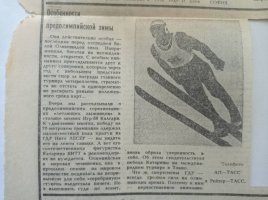
Yesterday, we reported on the pre-Olympic competitions of the "flying skiers" [ski jumpers] in the host city of the '88 Winter Games, Calgary. To the surprise of many, the victory on the 70-meter hill was claimed by a currently little-known jumper from the GDR, Ingo LESSER—you can see him in the photo on the left.
On the other hand, his compatriot, figure skater Katarina WITT, needs no introduction. An Olympic and World champion, she stepped onto an uncharacteristic "silver" step of the podium at last season's World Championships. However, in the current season, by all appearances, she has regained her self-confidence. This is evidenced by Katarina's victory at the international tournament in Tokyo.
Well, GDR athletes are always a formidable force in Olympic arenas. Therefore, they command paramount attention.​
Telephoto by AP—TASS and Reuters—TASS.
1783430563170.jpeg
 
Back
Top