1986
CLASH OF OPINIONS
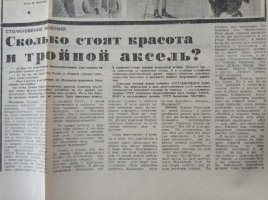
How much do beauty and the triple axel cost?
(the article published in russian 'Sovetskiy Sport' on November 25, 1986)
— I think this athlete has no future! She will never perform a triple axel!
— What are you talking about, she will be on the national team in a year! Look at her flexibility!
— The trouble lies elsewhere—in her coach; he is completely passive. The mentor needs to be changed!
Three points of view. One excludes the other. Of course, such arguments are held constantly, especially in those arenas where there is no stopwatch, tape measure, or crossbar. But even without a struggle of views, trends, and schools, there can be no forward movement.
Truth is born in a healthy clash of opinions. That is why we are in favor of discussions, in favor of creative debates. And in the context of accelerating the socio-economic life of our society, such discussions will also serve the progress of our sports movement.
Opening our new column today, "CLASH OF OPINIONS," we have invited well-known figure skating specialists to our discussion club: Tamara MOSKVINA, Honored Coach of the USSR and Candidate of Pedagogical Sciences, and Valentin PISEEV, Honored Coach of the USSR.
Moskvina: Recently, I had the opportunity to speak before the workers of the Novolipetsk Metallurgical Plant. It was a candid conversation about our everyday coaching routines, plans for the future, the human factor in speeding up progress, and the coach's sphere of influence. The workers asked a question: "Do you believe that Leningrad has its own original school of figure skating, distinct from the Moscow one, for example?". Igor Borisovich Moskvin, Honored Coach of the USSR—who, by the way, was also my mentor—answered. Thirty years ago, he was one of the first to represent the Leningrad school on the USSR national team, and later participated in creating new traditions and raising the young generation. Moskvin said that the Leningrad school has always brought up bright individualities.
During the meeting, I kept asking myself a question: what needs to be changed in our coaching profession to expand our sphere of influence and to enrich our school with new talents?
Personally, I think we have no right to focus solely on training the top skaters of the national team. This is detrimental even from a methodical point of view. I sometimes compare certain coaching techniques to the work of a surgeon. And if a surgeon performs operations more frequently, their methodology becomes more advanced and precise. Likewise, if a coach constantly tests themselves by teaching beginners the technique of complex elements, they also gain a deeper understanding of their art.
I started my own restructuring by inviting several young pairs into the group at once and working with them a lot personally. I am also thinking that it is time to open a small subscription-based group for children or a consultation bureau near my home. After all, surely there will be those who wish to learn the basics of figure skating from Moskvina?
Piseev: Tamara Nikolaevna, such an approach to your profession does you credit. And yet, allow me to argue with you. A subscription group? Paid services to the population? This is all in the spirit of the times. But you must agree that young assistants can be found for these tasks. However, for a specialist like you, an author of valuable textbooks and a mentor to Olympic champions, a much larger-scale task could be found.
I believe that Moskvina's work could have a double impact if she took patronage over an entire region of the country. For example, over the coaches of Kazakhstan or the Baltic states. After all, your students have performed more than once in the cities of Kazakhstan. And what a benefit it would be for local coaches and figure skaters to have close creative contact with you! Leading specialists from Moscow—Tatyana Tarasova, Natalya Dubova, Elena Chaikovskaya, Viktor Kudryavцев, and others—could also have a weighty say here. The impact, I am sure, would be grand.
Moskvina: There will be a benefit, of course. However, I still do not want to forget about my own creative growth, and I am changing a lot in the working style of my group. The social upbringing of the athlete is coming to the forefront. Very diverse youth are entering sports: one writes poetry, while another became acquainted with War and Peace only on a screen. There are quite a few egoistic attitudes: "Everything for myself, for my own benefit." It is precisely up to us, the coaches, to reshape the character of these self-centered individuals.
In our group, we base this reshaping on the principle of strict discipline. Not a single minute of lateness is acceptable—whether for the bus, onto the ice, or into the gym. In our group, it is the athlete, not the coach, who carries the tapes with the recordings. We have students who edit pieces of music themselves, and who take charge of warm-ups in the gym. And all of this is encouraged.
With whom does the restructuring in a school begin? I think, with the coach. Everyone looks up to them. That is why I have been looking for new ways to influence students for a long time, for many years now...
Piseev: Finding paths for the creative growth of a coach is, in my opinion, one of the solutions to the problem of acceleration.
In figure skating, perhaps faster than anywhere else, people realized that by no means every graduate of a physical education institute can be considered a specialist. In 1979, with the support of the Ministry of Culture of the RSFSR, we managed to open a department for choreographers (ballet masters) of figure skating at the State Institute of Theatre Arts (GITIS).
I think that in the future, the day will come when it becomes necessary to merge the choreographers' department with the staff of the figure skating department at GTSOLIFK (Central State Institute of Physical Culture). That is where the direct connection between sport and art will be!
New forms of creativity are emerging now. A one-of-a-kind seminar was held recently: in Pervouralsk, over 60 choreographers of the RSFSR attended a course by a former soloist of the Bolshoi Theatre, Honored Coach of the RSFSR Elena Matveeva. The next step forward is the creation of artistic councils under republican federations, where art historians, musicians, directors, and choreographers will have their weighty say.
Moskvina: Let me remind you of one more important point. We want to change the psychology of the coach; we call them to new creative heights. But good appeals must be backed up by both moral and material incentives.
If we talk about the coaches of the USSR national team, it would be a sin for them to complain about their fate; they are constantly in the spotlight of the press and television, and they have the best rinks, as well as the help of choreographers and videographers at their disposal.
But how can we stimulate the creativity of rank-and-file coaches? They need ice. Yet they are forced to wage a constant struggle for every extra hour on the ice arena. It is harder for a grassroots coach to get the help of an experienced choreographer or music editor. Finally, there is also egalitarianism in labor remuneration. Quite often, one mentor in a local school merely puts in their hours at the rink. Meanwhile, another coach pours their soul into the students, staying awake at night thinking about new programs. Yet they receive the exact same salary.
It seems to me that some coaches in Leningrad and in other cities as well, have lost heart, feeling no incentive in their work. It is very good that today it is permitted to widely utilize part-time work (moonlighting). Now, working with a paid group and providing consultations can both become a means of rewarding enthusiasts.
Piseev: I agree, incentives are necessary. However, we also need to account more strictly for the costs of artificial rinks. Sometimes, only 8 to 10 low-ranking skaters train on excellent ice at a Sports Palace. And yet, no one calculates how much the rent for these "ice palaces" actually costs.
Currently, an effective path has been found—the construction of the simplest training rinks without grandstands and lobbies. They have already appeared in Odesa, Dnipropetrovsk, Perm, Chelyabinsk, and Sverdlovsk. We hope their number will continue to grow in the future.
At the same time, coaches are often placed in difficult conditions where hockey schools also exist. For instance, in Kazan, preference is given to hockey players; they are granted the best times, and the ice is prepared for them first. Meanwhile, figure skaters are forced to train on hard ice at inconvenient hours. And yet, it was here that world champion A. Fadeev began his journey.
But while in Kazan the complaints of the coaches are justified, the situation in other cities is different. We familiarized ourselves with the state of affairs in Ufa. There is an excellent hockey school there, and it is only fair that they are given the lion's share of ice hours. However, the students of the figure skating school have looked very weak for many years now, primarily because the coaches in Ufa are passive, show no interest in modern methodology, and do not fight to improve conditions. Before raising the question of increasing ice hours, the problem with coaching staff must be resolved.
Moskvina: I think there has been a certain distortion in views on figure skating. Everyone is used to perceiving the world of figure skating as a symbol of beauty and grace, and in doing so, they have completely forgotten about the immense health-improving significance of this sport. They also forget that a figure skating school is merely a stepping stone into the world of physical culture. The desire to drive all schools and sections under the roofs of Sports Palaces leads to a situation where the number of beginners in figure skating is practically not growing.
Piseev: I remember a time when there were almost no artificial rinks anywhere, and all the kids skated on outdoor rinks with pleasure. Turning back this mass work now would be a profound mistake, even if we had more than a hundred Sports Palaces. It is precisely in mass, paid schools that our true reserves are hidden!
Direct threads stretch from paid schools into elite sports as well. In Moscow alone, more than 12,000 children train in subscription-based groups.
In elite sports, we are talking about a system of nurturing talent in figure skating centers. Until recently, few had heard of figure skaters from Odesa, Yerevan, Dnipropetrovsk, Tbilisi, or Tashkent. But now, Viktor Petренко from Odesa is cheered at rinks in the USA, and high scores are awarded at rinks in Canada to Tashkent skater Rashid Kadyrkaev and his partner Elena Kvitchenko.
Let me remind you that since 1979, there have been specialized groups in the country led by the nation's leading specialists—Igor Moskvin, Tatyana Tarasova, Elena Chaikovskaya, Natalya Dubova, Eduard Pliner, and others. Coaches from various schools were invited to these groups along with their students. As a result, this season, sports fans speak with respect about the pursuit of such coaches as Galina Zmievskaya (Odesa), Lidiya Maslyukova (Kyiv), Ardo Rennik (Sverdlovsk), Gennady Akkerman (Moscow), Tatyana Mishina, and Nikolai Velikov (Leningrad).
Moskvina: In a scientific paper, I came across an interesting expression: a "rebellion of minds." It referred to moments in a complex creative process when there is an urgent need for new, even contradictory and paradoxical ideas. This "rebellion of minds" helps determine the future course and react more sharply to miscalculations and mistakes.
The ability to work at the intersection of different fields of knowledge, at the intersection of different spheres of labor—this is the trait of a modern specialist. One of my students works as a part-time instructor for the regional Komsomol committee. I asked him: "Does this work help you in sports?". He replied: "And how! Now I’ve started to understand the psychology of the kids in our group!"
Our figure skaters have had many brilliant achievements at the Olympic Games, and at the World and European Championships. So, it seems that reflecting on everything achieved—our "golden fund"—is also work in the spirit of the current restructuring.
Piseev: In this, Tamara Nikolaevna, our opinions completely coincide!