Relative difficulty of types of jumps: triples versus quads | Page 4 | Golden Skate

Relative difficulty of types of jumps: triples versus quads

When I first took an interest in figure skating as a newby spectator, naturally I couldn't tell one jump from another. My friends told me that you can always tell an Axel because the skater is facing the wrong way. This was only moderately helpful because of pre-rotation on toe-loops.

But I could always tell a Lutz! The stater is curving THIS way, and then miraculously he leaps into the air and starts rotating THAT way. It seemed to defy the laws of physics (conservation of angular momentum).

As for edges, I remember back when Yuna Kim fans and Mao Asada fans would shout back and forth like a Greek chorus, "FLutzer!! "'Lip Jumper,!!!"
We don't see Lutzes like THAT anymore.

Oh, the good ole flutzing days. I might be crucified for this, but I do believe it might have been the Americans that brought in the flutzing. I remember Nicole Bobek. Her Flutz was immaculate...🤣
 
Last edited by a moderator:
I was not thinking of this issue dynamically. I've thought of a gyro but not a pressure sensor (so I was still thinking geometrically). How would the device measure the pressure specifically for jumps? I imagine there is a lot of variance with the skater's weight distribution anywhere throughout the program. What reading would it be giving when a take-off occurs?
It seems to me that the most straight-forward approach would be to set it at zero. When the pressure of the ice pushing up against the blade (both blades total) hits zero. the skater is in the air. When it stops registering zero she has landed.

If this is too unsophisticated and too hard on the skaters, they could set their calculation back by a tenth pf a second on the take-off and ahead by a tenth on the landing. Sort of like allowing a skater to cheat by a q in the current system.

I think this would be quite feasible with current technology -- either the ice is pressing up against the blade or not. The devices that measure, for instance, the length of a jump seem to be quite adequate and do not have a problem in determining exactly the starting point and the ending point of the arc in the air. Why not measure the rotation as well while they're at it?

The ISU would, however, be tasked with converting these readings into CoP points. How many base value points should be awarded to a hump that pre-rotates 112 degrees, achieves 926 degrees from zero to zero, and is short on the landing by 42 degrees?

The other question that you raised -- How do we prevent skaters from rewiring their boots to cheat the sensors -- I don't know. Fencers have been caught tinkering with their suits and blade so that they could score a phantom touch whenever they wanted to by pressing a button. In figure skating, the best plan would be for the assistant coach to be zapping the sensor with a laser rifle from the boards.
 
Last edited:
@Blades of Passion
Which skaters do not pre rotate a 4Lutz and a 3Lutz?
That's a good question. Here are two of the best quad Lutz's of all time. They are not pre-rotated and they have a fine, pure outside edge., But as wonderful as they are, they do not achieve anything much in the way of counter-rotation.

 
.Oh, the good ole flutzing days. I might be crucified for this, but I do believe it might have been the Americans that brought in the flutzing. I remember Nicole Bobek. Her Flutz was immaculate...🤣
Nah, you won't be crucified. All U.S. ladies of that era -- Michelle Kwan, Sasha Cohen, Sarah Hughes -- had Lutz edges that must gave given coaches the heebie-jeebies. I remember when Dick Button would be commentating on Michelle Kwan ( :love::love::love: ), he always was at pains to say, "Yes sir, that outside edge was just fine, No problems there."
 
@Blades of Passion
Which skaters do not pre rotate a 4Lutz and a 3Lutz?

Kurt Browning is the example of the most un-prerotated Lutz ever. His picking foot actually left the ice in the opposite direction of the rotation, "less than 0" pre-rotation. Now, that is not recommendable technique, and it's surely why the jump was inconsistent for him. Hanyu is example of someone with exactly 0 pre-rotation though, the toepick foot being completely backwards as he leaves the ice.

Kolyada and Boyang have the best Quad Lutzes ever: deep outside edges, very minimal pre-rotation, unbelievable amplitude, rotations completed entirely in the air.

Lutz and Flip shouldn't be more than 1/4 turn pre-rotation ideally. If you look at these jumps from pretty much any guy in the 90's and earlier, that's how it was.

The ones who do the Lutz the original way.
Denise Beillmann has between 1/4 and 1/2 pre-rotation on her Lutz. Not too bad, considering!

We discussed best Ladies Triple Lutzes here - https://www.goldenskate.com/forum/t...rding-to-the-judges.86444/page-2#post-2626621

All the best Ladies' Lutzes are 1/4 turn pre-rotation at most, except for Midori Ito sometimes, who'd be between 1/4 and 1/2.
 
Not to nitpick, but I think that it would be a trivial matter technologically to determine whether the top under-rotated or over-rotated a quad.... :devilish:
I feel as though the illegally prerotated triples and doubles are the bigger problem, and most of the top skaters do it.

Not only is it the bigger problem (in ISU senior women's only one skater in the world has a quad and it's unstable), but with an illegally prerotated double for instance where they are 270 degrees around before taking off, they are cheating 37.5% of the jump with a double, they are cheating 25% of the jump with a triple, and with a quad only cheating 18.75% of the jump.

As you can see cheating with triples and doubles is the bigger problem in terms of number of skaters doing it, and how much they stand to gain from cheating on their jump.

If there is a q, this probably should receive a bigger deduction for a double or triple, than with a quad because a higher percentage of the double or triple as been cheated than with a quad.

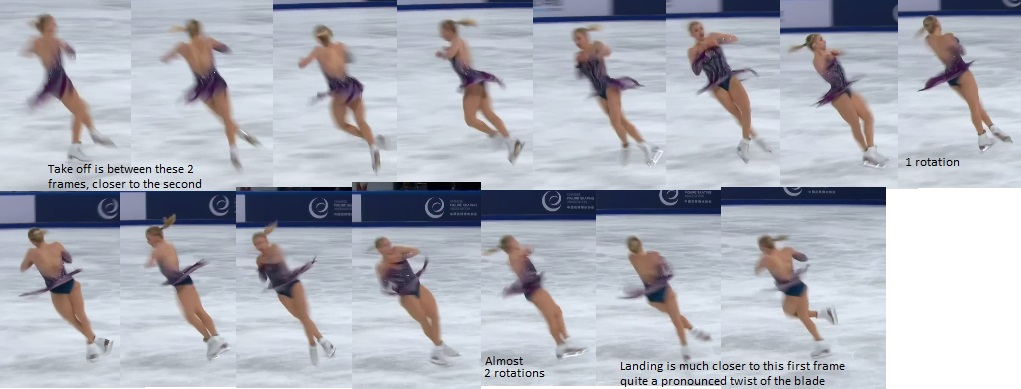
You're mistaken about both her takeoff and landing points, and don't show good knowledge about mechanics and counting rotation with these comments. Someone gliding into a jump is not necessarily the direction the jump rotation has to start, and a "twist" on the landing (which in this case wasn't even caused by a big turn on the ice, rather her landing going slightly to the inside edge) is not indicative of the total rotation.


There is far more "thorough" footage of this jump out there, which you continue to not look at. She landed at least 1/4 past the point where she left the ice, it was a sufficiently completed jump, and not hard to see on the Eurosport coverage that has a better, closer camera view.
I counted them for you. 2.25 rotations in the air. My diagram doesn't get more clear cut. Glenn uses a lot of twist of her body on the ice before the blades leave the ice to get a lot of momentum going before she launches into the air. Maybe you are looking at the wrong video :shrug:

It doesn't lie.

Glenn-loop-frame-by-frame.jpg
 
I counted them for you. 2.25 rotations in the air. My diagram doesn't get more clear cut. Glenn uses a lot of twist of her body on the ice before the blades leave the ice
I'm not going to keep going around in circles with this nonsense. There is a better camera angle of the jump and it's more "clear cut" than your diagram. The thing you're trying to saying about twisting her body is irrelevant, and pure hypocrisy anyway when you're trying to make some kind of argument about very pre-rotated quads deserving all the credit in the world.

Not to mention, 2.25 rotations in the air is a Triple jump, with the standard 1/2 turn pre-rotation! If you are suddenly admitting that's what she achieved, then she indeed did a Triple Loop that isn't <
 
As I wrote above, cheating the take off on a 2T is a much, much bigger problem than cheating the take off on the 4T both in terms of the number of skaters who cheat and how much they stand to gain from cheating.

I'm just using Glenn as an example because she's the top female in the world at ISU level.

This is her 2T where along with full blade assistance she's prerotating nearly 270 degrees meaning she only needs to another 1.25 rotations to complete the jump!

To me, this is a much bigger problem than with a quad because there are still 3.25 rotations they need to complete. This cheating with doubles is quite common.

Glenn-2T.jpg


And the punishment should be scaled up. If you cheat with a double you lose -5 GOE rather than -2 for instance with a quad.

In this instance 37.5% of the jump is completed while on the ice, while with a quad cheated with 270 degrees prerotation only 18.75% of the jump has been completed on the ice.
 
Last edited:
As I wrote above, cheating the take off on a 2T is a much, much bigger problem than cheating the take off on the 4T both in terms of the number of skaters who cheat and how much they stand to gain from cheating.

That's not true at all. Getting an underrotation call on a 2T loses barely any base value. Getting rotation credit for an underrotated Quad gives the skater 2+ extra points base value over what they deserve (plus the extra GOE on top of that).
 
I have resigned myself to the fact that judges and tech callers are more forgiving on high-powered elements than on easier ones, and the same is true of GOE and even PCS. The ISU, like every sports organization, wants to encourage higher, faster, stronger. I for one am not outraged.

It does make me somewhat annoyed when fans post stop-frame videos and stills with time stamps, protractors, rulers and compasses affixed to prove that individual skaters that they don't like, or who are from countries that they want to disparage, are getting away with murder. Ok, that's the Internet. But could we take it down a notch?
 
Last edited:
It does make me somewhat annoyed when fans post stop-frame videos and stills with time stamps, protractors, rulers and compasses affixed to prove that individual skaters that they don't like, or who are from countries that they want to disparage, are getting away with murder. Ok, that's the Internet. But could we take it down a notch?
I know what you mean but as a nerd I just love analyzing jumps in super slow-mo and discussing it, no matter if it's my faves or not. Not everyone uses these things as a weapon against skaters they don't like (I'm not implying that's what you said).

I'm not a fan of posting pics of jumps though, I prefer super slowed-down videos or GIFs.
 
It seems to me that the most straight-forward approach would be to set it at zero. When the pressure of the ice pushing up against the blade (both blades total) hits zero. the skater is in the air. When it stops registering zero she has landed.

If this is too unsophisticated and too hard on the skaters, they could set their calculation back by a tenth pf a second on the take-off and ahead by a tenth on the landing. Sort of like allowing a skater to cheat by a q in the current system.

I think this would be quite feasible with current technology -- either the ice is pressing up against the blade or not. The devices that measure, for instance, the length of a jump seem to be quite adequate and do not have a problem in determining exactly the starting point and the ending point of the arc in the air. Why not measure the rotation as well while they're at it?

The other question that you raised -- How do we prevent skaters from rewiring their boots to cheat the sensors -- I don't know. Fencers have been caught tinkering with their suits and blade so that they could score a phantom touch whenever they wanted to by pressing a button. In figure skating, the best plan would be for the assistant coach to be zapping the sensor with a laser rifle from the boards.
Oh, you mean the sensor would be detecting pressure between the ice and blade only? What would be the difference then in just defining take-off and landing by full blade contact? The blade is either in contact with the ice or not.

I also wasn't suggesting actual cheating like rewiring boots. There would be deterrent enough with the potential of a competitive ban. I had a different more complicated set-up in mind where you are detecting the weight distribution of the skater themselves, rather than just ice-blade contact, which I imagine could allow for jump technique where you specifically manipulate your weight distribution to affect the sensor's reading to give yourself a few extra fraction of time to pre rotation or over rotate without triggering the mechanism.

The ISU would, however, be tasked with converting these readings into CoP points. How many base value points should be awarded to a hump that pre-rotates 112 degrees, achieves 926 degrees from zero to zero, and is short on the landing by 42 degrees?

Well, it depends how much pre-rotation you allow. Say you allow a quarter of pre-rotation for the jump in above scenario, any further rotation with a non-zero reading is penalized. So you have 22 degrees of missing rotation at the start, and 42 at the end, which is less than a quarter total of under-rotation. The ISU rule-book specifically says "landed on the quarter" for a q, but regarding all other rotational penalties (like <<) there is no such wording, just total missing rotation. It also says pre-rotating a half and under-rotating a half offer the same penalty of <<. I suggest then that the use of "landed on the quarter" is just a colloquialism that made it into the rulebook, and we should really be considering the total rotation and how many degrees are missing without worrying if its at the take-off or landing (after accounting for allowed pre-rotation). We maintain the current rule which offers leniency to the skater, so if you are only missing 89 degrees of rotation you're safe. Thats how it works now as well and seems fine. So the above skater would not be penalized with a q (only 66 degrees missing), however they could be penalized in GOE (say, a standard GOE loss for every 10 degrees under 50, or something, until you hit full q with 90; just a random suggestion).

 
The blade is either in contact with the ice or not.
Yes. The blade is either in contact with the ice or it is not. The pressure sensor would detect the exact instant when the blade leaves the ice and the exact instant that it returned to contact with the ice. Fast cameras would be able to count the number of degrees of rotation between those time markers (although I suppose that other types of devises mounted in the blade could also perform this task electronically) .But a camera shooting a hundred thousand frames per second -- better yet, two cameras woking together -- would be adequate to get an accurate count of the number of degrees pf rotation between the two precisely determined times. Only the rotation of the blade counts, not gyrations of the upper body.

I think that the main reason for difficulty is that the human eye, even looking at slow motion replays, cannot determine whether the blade is still in contact with the ice at 1 minute 39.2345 seconds compared to 1 minute 39.2346 seconds.

A triple jump takes only half a second or so to rotate 1080 degrees, or 1 degree every .00046 second. These ten-thousants of a second add up.

I am not sure whether all this measuring would improve the sport or not. But in sports it is always better to measure the factors that can be measured before human judgment takes over the task of awarding points.

mathematician said:
Well, it depends how much pre-rotation you allow.
Yes, iit would be the ISU's job to take up that question, as they have-- in great and ever-changing detail -- in the case of short rotation on the landing.
 
Last edited:
I know what you mean but as a nerd I just love analyzing jumps in super slow-mo and discussing it, no matter if it's my faves or not. Not everyone uses these things as a weapon against skaters they don't like (I'm not implying that's what you said).
What gets tiresome is Johnnie-one-note posting beating the same dead horse over and over. It gets to seem like an obsession -- one from which, having said our piece, we could move on.

It can even give an impression of pursuing an agenda beyond figure stating.
 
Last edited:
Ok, that's the Internet.
The Internet is our creation. It is exactly the way we are making it to be.

Initially, the utilitarian side of digital technologies was limited to internal networks and the world wide web was basically a Westworld for people who followed their hobbies, pirated content, and went nasty anonymously. Nobody cared because only small part of population used it.
In the course of time, the Internet shows an unambiguous tendency to civilize itself. It is inevitable because it is now used by large numbers of businesses and communities and its role in the social organization is intrinsic in a developed society. The process is neither fast nor simple though. At the moment, the Internet is still an informative greyzone in which truth and lies are both equally treated as "opinions", which makes both information exchange and meaningful argument problematic if at all possible. [A part edited out because it would be too far journey off topic] Figure skating is a complicated sport that contains a lot of information and requires a lot of communication and information exchange... Conclusions?
My conclusion: sometimes we just need to be patient :biggrin:
 
I counted them for you. 2.25 rotations in the air.
2.25 rotations in the air is counted as a triple jump, per ISU rules, with 3A being the exception with 2.75 rotations in the air. It is nowhere stated that triple should be 3 or close to 3 rotations in the air. Exact measure of rotations in the air is the problem of quality of the jump, and judges 'count' that in GOE points, for example more rotated jump in the air will most likely get 4 GOE points, and less rotated jump will get 2 GOE points (if that jump doesn't have other features which add 'difficulty' to the jump itself, as jump being perform at exact time/musical note, or if jump is a part of a broader skating pattern, with difficult transitions in and out of the jump, or better to say if that jump is perceived as a part of a skaters programme and not as an isolated element).
 
Last edited:
Yes. The blade is either in contact with the ice or it is not. The pressure sensor would detect the exact instant when the blade leaves the ice and the exact instant that it returned to contact with the ice. Fast cameras would be able to count the number of degrees of rotation between those time markers (although I suppose that other types of devises mounted in the blade could also perform this task electronically) .But a camera shooting a hundred thousand frames per second -- better yet, two cameras woking together -- would be adequate to get an accurate count of the number of degrees pf rotation between the two precisely determined times. Only the rotation of the blade counts, not gyrations of the upper body.

I think that the main reason for difficulty is that the human eye, even looking at slow motion replays, cannot determine whether the blade is still in contact with the ice at 1 minute 39.2345 seconds compared to 1 minute 39.2346 seconds.

A triple jump takes only half a second or so to rotate 1080 degrees, or 1 degree every .00046 second. These ten-thousants of a second add up.

I am not sure whether all this measuring would improve the sport or not. But in sports it is always better to measure the factors that can be measured before human judgment takes over the task of awarding points.


Yes, iit would be the ISU's job to take up that question, as they have-- in great and ever-changing detail -- in the case of short rotation on the landing.
TBH, I have never found significant issues with speed specifically when it comes to determining the points of contact with the ice frame-by-frame. However, it is rather often you get a lot of snow kicked up or other factors which incorrectably occults the angle. Indeed blurry frames due to speed can also happen (though usually you can still tell within good reason where the blade left). In this case a detector which externally recognizes the rotations would be helpful, especially one looking horizontally and the other vertically.

I don't know about the measurements themselves, but the standardization of rotation would absolutely benefit the sport. We see it is a massive point of contention and it doesn't seem like anyone has a claim to an absolute interpretation.


2.25 rotation in the air is counted as a triple jump, per ISU rules, with 3A being the exception with 2.75 rotation in the air.

Really? Where does it say that?
 
Really? Where does it say that?
My point was it is nowhere stated how many rotations in the air triple jump should have, technically and in practice it can be from 2.25 to 2.75 rotations in the air to be called a triple jump by ISU, because you are counting the 'allowed' pre and post rotation of that jump on the ice.
 
Last edited:
My point was it is nowhere stated how many rotations in the air triple jump should have, technically and in practice it can be from 2.25 to 2.75 rotations in the air to be called a triple jump by ISU, because you are counting the 'allowed' pre and post rotation of that jump on the ice.
This is quite true. The ISU allows anything short of 180 degrees of pre-rotation on the take-off (at least on toe-loops and Salchows) without penalty and anything short of 90 degrees of under-rotation on the landing without penalty = 2.25 revolutions in the air for a valid triple jump. All coaches and skaters understand this and, as far as I can tell, have no beef with it. The rules are fair provided that everyone understands what the rules are and that everyone is held to the same standard (or lack of it).

I always got the feeling that the ISU is not too terribly interested in obtaining accurate measurements of rotation because if the public knew that a triple jump is not really three revolutions, that would make for bad publicity.
 
Back
Top