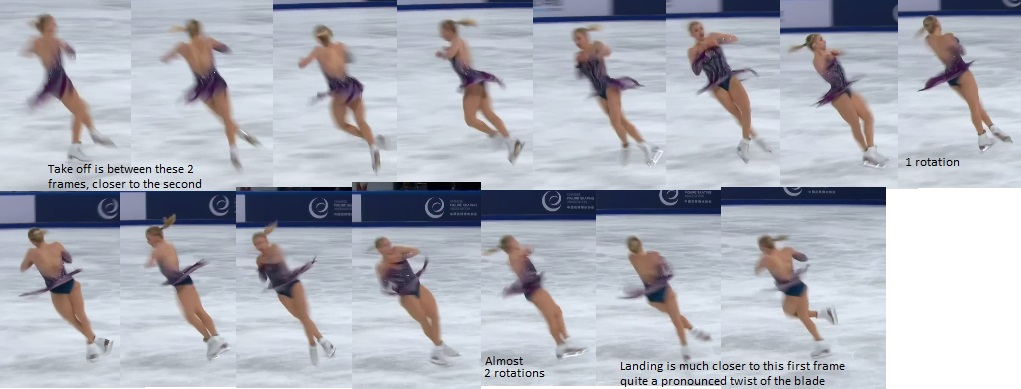
It seems to me that the most straight-forward approach would be to set it at zero. When the pressure of the ice pushing up against the blade (both blades total) hits zero. the skater is in the air. When it stops registering zero she has landed.
If this is too unsophisticated and too hard on the skaters, they could set their calculation back by a tenth pf a second on the take-off and ahead by a tenth on the landing. Sort of like allowing a skater to cheat by a q in the current system.
I think this would be quite feasible with current technology -- either the ice is pressing up against the blade or not. The devices that measure, for instance, the length of a jump seem to be quite adequate and do not have a problem in determining exactly the starting point and the ending point of the arc in the air. Why not measure the rotation as well while they're at it?
The other question that you raised -- How do we prevent skaters from rewiring their boots to cheat the sensors -- I don't know. Fencers have been caught tinkering with their suits and blade so that they could score a phantom touch whenever they wanted to by pressing a button. In figure skating, the best plan would be for the assistant coach to be zapping the sensor with a laser rifle from the boards.
Oh, you mean the sensor would be detecting pressure between the ice and blade only? What would be the difference then in just defining take-off and landing by full blade contact? The blade is either in contact with the ice or not.
I also wasn't suggesting actual cheating like rewiring boots. There would be deterrent enough with the potential of a competitive ban. I had a different more complicated set-up in mind where you are detecting the weight distribution of the skater themselves, rather than just ice-blade contact, which I imagine could allow for jump technique where you specifically manipulate your weight distribution to affect the sensor's reading to give yourself a few extra fraction of time to pre rotation or over rotate without triggering the mechanism.
The ISU would, however, be tasked with converting these readings into CoP points. How many base value points should be awarded to a hump that pre-rotates 112 degrees, achieves 926 degrees from zero to zero, and is short on the landing by 42 degrees?
Well, it depends how much pre-rotation you allow. Say you allow a quarter of pre-rotation for the jump in above scenario, any further rotation with a non-zero reading is penalized. So you have 22 degrees of missing rotation at the start, and 42 at the end, which is less than a quarter total of under-rotation. The ISU rule-book specifically says "
landed on the quarter" for a q, but regarding all other rotational penalties (like <<) there is no such wording, just total missing rotation. It also says pre-rotating a half and under-rotating a half offer the same penalty of <<. I suggest then that the use of "
landed on the quarter" is just a colloquialism that made it into the rulebook, and we should really be considering the total rotation and how many degrees are missing without worrying if its at the take-off or landing (after accounting for allowed pre-rotation). We maintain the current rule which offers leniency to the skater, so if you are only missing 89 degrees of rotation you're safe. Thats how it works now as well and seems fine. So the above skater would not be penalized with a q (only 66 degrees missing), however they could be penalized in GOE (say, a standard GOE loss for every 10 degrees under 50, or something, until you hit full q with 90; just a random suggestion).