Archive of newspaper articles | Page 30 | Golden Skate

Archive of newspaper articles

1986
School of Olympic Champions


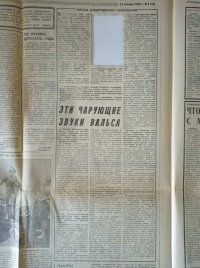
These Enchanting Sounds of the Waltz

(the article published in russian 'Sovetskiy Sport' on January 12, 1986)

ON THAT memorable day, our coach Elena Anatolievna Tchaikovskaia woke us up early — at 6:30 AM. We were rushing to practice at the sports palace in a festive mood: we were about to ‘compose’ a new original dance — the paso doble. And what an amazing atmosphere it was that morning — we were catching our coach’s thoughts literally on the fly. The coach herself was experiencing a true creative surge. During the two-hour lesson, we managed to think through and choreograph three-quarters of the dance. We imagined an arena in a Spanish city, half-jokingly portraying a bull and a toreador on the ice, ‘killing’ the ferocious bull. When the dance took its final shape, my partner Gennady Karponossov and I got the feeling that the paso doble would definitely become one of our best dances. It was then that I realized that an athlete can inherently feel and recognize the strongest, most successful moments of a program.
That is why today I tell my students: listen to your own inner evaluation, analyze your dances more by yourselves. People might tell you that you skate beautifully and artistically, but you must stay on your guard! Flattery is a poor ally, especially in figure skating, where there is so much subjectivity…
It was with this episode — the creation story of the paso doble, which received the highest score of 5.9 at the 1978 World Championship — that Natalia Linichuk, Honored Master of Sports, Olympic champion, and two-time world champion in ice dancing, began her conversation with the newspaper's readers. Young ice dancers are interested in a wide variety of aspects of mastery — including technical issues and psychological preparation.
D. Lagutin (Alma-Ata) asks whether a young athlete can get by without a painstaking study of compulsory dances once they have achieved the first or second adult rank in ice dancing?
N. Linichuk:
The first ice dances were created back in the 1930s, when the technique of most figure skaters was by no means the most brilliant. Today, the pattern of many dances can be learned in a very short time. But does this mean that the standard of mastery is easily achievable here? No, on the contrary, I have learned from my own experience: a dance from the compulsory program only begins to shine with all its colors when you display your own individuality in it.
A prime example is working on the waltz. I entered ice dancing at the age of 15, but I was still working on the waltz ten years later. It is a kind of litmus paper that reveals the strength and class of an ice dancer. The more performances you have, the more beauty, grace, and poetry you can convey in the waltz movements. I think there is no dance that brings more pleasure. It is precisely the simplicity of the steps and edges that makes the waltz very difficult, because here you have to feel the overall rhythm to your very fingertips.
What is the special psychological role of the original dance? This question is asked by figure skater Ya. Nechaeva (Moscow).
N. Linichuk:
From the standpoint of choreography—and I have been engaged in intense coaching work for the last three years—any original dance is the most complex creative task for figure skaters. Athletes are given a very limited time—just one minute, and within these seconds they must manage to show an entire choreographic miniature, where there is practically no lull in the action, and where every single gesture and step must be expressive.
People who are deeply emotional and impressionable are, in a special way, predisposed to creating very concise, small-scale miniatures and dances. I have witnessed several cases where working on an original dance led to very striking breakthroughs and enriched a duet's style. For instance, back in the day, when Olympic champions Lyudmila Pakhomova and Aleksandr Gorshkov were preparing an original dance, they and their coach Elena Tchaikovskaia created a dance of amazing beauty and lyrical mood to Khachaturian’s music for ‘Masquerade.’ It entered their repertoire as a magnificent exhibition number; it was later emulated, and new generations of dancers learned from this waltz.
It is toward this creative peak, toward solving this ultimate artistic goal, that those who set out to create an original ice dance today must strive.
A. Alymova (Ivanovo) is interested in how the problem of artistic appeal and spectacle is solved in a modern program at the Master of Sports level.
N. Linichuk
: We think about these problems constantly, from the very first sessions on the ice. Even in compulsory dances, the strongest duets prepare three different options for costumes right away to achieve a complete synthesis with one rhythm of the dance or another.
So what can we say then about the free dance program?!
Here is what the Olympic champion, American figure skater Dick Button, wrote in 1960: ‘A figure skater must make sure that they look good from every angle, which is achieved only by fully utilizing the entire surface of the ice rink equally in all directions. This is precisely where dance steps come to the rescue. It is known that dance steps are based on numerous turns and the gliding inherent to figure skating. Threes, brackets, rockers, counters, and changes of edge—under the condition of various combinations, changing feet, and altering the direction of flight—can make up a rather brilliant free program...’
A quarter of a century has passed. The basic principle formulated by Button has remained unchanged, but, say, in singles skating, the complexity of jumps has come to the skater's rescue. When an athlete takes off into the air and completes 3.5 revolutions, it inevitably takes your breath away and captivates the audience.
However, it is impossible to create a true spectacle based on technical difficulty alone. That is when choreographers and directors come to help the coaches. In recent years, an interesting trend has emerged — not only staff choreographers but also ballet dancers, variety stage performers, and circus artists are being brought in to choreograph programs. In short, people with a fresh perspective on the sporting spectacle. And they are creating a new kind of show — this is how we came to see brilliant programs choreographed with the help of ballet masters Dmitry Bryantsev and Elena Matveeva, variety artist Yuri Zamyatnin, and others.
Today, we understand the problem of artistic appeal this way: we need to reveal the skaters' individuality and show them in various emotional states — in lyrical, dramatic, comedic, and heroic segments. And there is another important principle: a composition is only strong when it has a cohesive core idea. A dance is all the more interesting the deeper and clearer its overall concept can be traced. Following exactly this principle, I suggested that my students perform a dance to the music of Bach’s ‘Toccata,’ and in this case, the young figure skaters O. Grishchuk and A. Chichkov received a great creative impulse: they realized that the most valuable thing in sports is to showcase a unique, distinct identity in every single program of yours...”
Figure skater E. Malyutin (Ryazan): I have watched many ice compositions. However, the aesthetic beauty of the free dance nowadays clearly leaves a stronger impression than in other disciplines of competition. What is the secret here?
N. Linichuk:
As is well known, in ice dancing, jumps and lifts above the waist are prohibited, and partners' spins must not exceed two to three revolutions. Power-based elements are also forbidden. It seems like there are quite a lot of restrictions. Yet, every season, the top duets of our national team work wonders, surprising us with dances full of playfulness, dynamics, and virtuoso step sequences.
I see the secret, first of all, in the rapid growth of the skaters' technique, especially among the ice dancers on our national team. At the same time, the aesthetic side of the dance has been brought to perfection by many couples. Here, a major factor is the choice of musical pieces with what we call a unified, through-line action.
And finally, the third point, which is by no means secondary, is the cultivation of artistic erudition, willpower, and purposefulness in many figure skaters. My own path in sports, for example, was not easy — in my youth, I 'migrated' from one coaching group to another. I changed 12 mentors. The reason was not my inability to get along with people. Not at all! I just wanted to work hard. I had a kind of motto: even if I don't know how to do it yet, I will execute it regardless.
The mistake of many beginners is precisely that they reason differently: if I don't know how, then nothing will work out. By the way, in all practical matters, in life itself, such an approach causes great psychological harm. Charge into any difficulties with your visor up! Believe that the fortress will be taken no matter what! That is the main secret that has allowed many of our young athletes to conquer fantastic heights, including in figure skating.
1781020323019.jpeg
 
I am afraid you mean another person. Peter Tchernyshev was a famous ice dancer. The article mentions Pavel Chernousov. This is what AI told me about this skater.
Pavel Nikolaevich Chernousov is a Russian figure skater who is primarily known today for his work as a coach, elite-level technical specialist, and national-grade judge in Russia. Unlike international stars, his career has been focused heavily on the domestic Russian skating circuit. [1, 3]

1. Competitive Background
  • Discipline: He competed in singles and pair skating.
  • Achievements: According to user discussions on Russian skating portals like View attachment 11505⁠Tulup.ru, he achieved domestic success earlier in his career, including winning a Russian championship title in younger/junior divisions. However, he did not transition into a major international senior competitor. [1, 2, 4, 5]

2. Judging and Technical Career
Chernousov built a highly active career behind the scenes in the Russian Figure Skating Federation (FSRussia): [, 2, 3]
  • Official Status: He holds the title of Sports Judge of the All-Russian Category (the highest domestic designation).
  • Specialized Roles: He serves as an official Technical Specialist for both singles and pairs skating. In the ISU judging system, technical specialists are responsible for identifying the exact elements performed (such as the level of a spin or the exact rotation of a jump) in real time.
  • Activity: He frequently works at domestic junior and senior events across Russia, including prominent events in the Moscow region. [1, 2, 3]

3. Coaching
Chernousov works as a coach for developmental and competitive skaters in Moscow. Elite skaters from smaller international federations also occasionally seek out his technical expertise. For instance, Cypriot skater Daniella Vanessa Ipsaridou noted in an View attachment 11506⁠interview with Philenews that she trained under him to improve her jump and spin technique. [1, 2, 3]
Interesting! I had assumed when I saw the name mentioned among other young Russian singles skaters that it was just one of several possible transliterations of the Cyrillic. (I saw in the Wikipedia article about the skater I knew that his father, with the same name, had also been a singles skater.) Thanks for the correction and some interesting new information. :thank:
 
1986
USSR CHAMPIONSHIPS
WHAT DO YOU KNOW ABOUT THIS?


TELEVISION SURPRISES

(the article published in russian 'Sovetskiy Sport' on January 19, 1986)

Many of my acquaintances, who rarely had the opportunity to attend figure skating competitions, suddenly surprised me in conversations with very interesting observations about the specifics of this sport. Moreover, they freely used professional terms. It was noticeable that they learned to distinguish all types of jumps and the sport itself somehow became closer to them.
Such awareness became possible thanks to television, which approached the coverage of the 50th USSR Figure Skating Championship in Leningrad in a new way.
"Yes, now the creative teams of Central Television, and following their example, we, workers of local studios, strive in our reports to reveal the unexpected and pay special attention to the psychological side of events," says the chief director of the sports broadcasts editorial office of the Leningrad Television and Radio Committee, Ernest Serebrennikov. "This time, for example, we used not four cameras, as usual, but nine. We had to find new viewpoints for the camera operators and new conditions for editing. We asked to remove part of the boards so that one of the operators, A. Onoshko, could lie almost directly on the ice with his camera. On the other side of the ice rink, the television camera was mobile—on rails. And operator Boris Dedenov needed to show all his skill to keep the figure skaters 'in frame'..."
"Many people noticed that you broadcasted the opinions of coaches on screen in the form of captions against the background of the performing athletes."
"Yes, editor K. Nabutov took these short interviews a few minutes before the athlete stepped onto the ice. It was interesting to juxtapose the expectations of the coaches with the realization of their ideas in life. This is exactly what helped reveal the psychology of the sporting struggle. Let me emphasize once again that very much depends on the conscious discipline and creative mutual understanding of the entire team involved in a 'live' broadcast. It is gratifying that the abilities of a whole group of operators were revealed in a new way, among whom were V. Bulaenko and Yu. Pendev. The Sports Palace created the most favorable conditions for television directors. And the sport and the television viewers gained the most from this..."
Ernest Serebrennikov, of course, said nothing about his own role as director in such a broadcast. Yet this role is one of the main ones. A wealth of experience helps Serebrennikov in this search. Serebrennikov himself acts as a commentator for Leningrad television. In short, he approaches the matter professionally.​
B. AVLAS, (Our correspondent).
LENINGRAD.
1781076301514.jpeg
 
1986
EUROPEAN CHAMPIONSHIPS

BASED ON THE TALES OF THE OLD STORYTELLER

(the article published in russian 'Sovetskiy Sport' on January 28, 1986)

Our special correspondent reports from Denmark

The European Figure Skating Championships have opened in Copenhagen

Five hundred meters remained before landing. Then three hundred... Two hundred... Trembling, vibrating, the airliner rapidly descended, but Copenhagen was still not visible beneath us. Not a single piece of land—only the leaden-gray surface of the Øresund Strait. Only one hundred meters remained... And only when our eyes suddenly caught a glimpse of the coastal strip, sharp as a razor blade, did the concrete of the runway appear, and the plane taxied along it.
It feels like Copenhagen is thoroughly soaked in water. From the windows of a tiny, old hotel where I am writing this report—and where, they say, the Prince of Wales once stayed while passing through (a reason to raise prices)—the roar of the sea surf does not quiet down for even a moment. Beyond the bridge rise steep, sharp tiled roofs, gray tufts of fog drift by, and the streets are "pierced" by the generous volleys of wind heavily laden with rain. Only upon arriving in Denmark do you begin to realize why there is so much warmth, domestic comfort, and hot fire in the fairy tales of the great wizard Hans Christian Andersen. He is still sitting today in his bronze chair in Copenhagen's central square, as if trying to warm the hearts of city residents with his smile...
However, during these days, Andersen's compatriots are awaiting a meeting with ice fairy tales—made, admittedly, in a modern style. Their heroes will be the best figure skaters from 19 European countries. Today, they stepped onto the ice of the Brøndby Hallen Sports Palace. For seven days, music will echo beneath its arches—it will be heard not only in Denmark, but also in 32 countries where the television broadcasts will be transmitted.
Brøndby is an area surrounded by forests and lakes, located 20 kilometers from the center of Copenhagen. This is the source of the Sports Palace's name. It is a structure with a domed roof, numerous corridors, walkways, and even a greenhouse.
The hall itself is cozy. Everyone is of a high opinion of its ice arena. Our coach Natalya Dubova looked and said: "The ice is worth a score of six-point-zero."
The stands of the palace have already witnessed quite a few major tournaments. Figure skaters have gathered here twice for their championships: in 1975 for the European, and in 1982 for the World Championships.
Since then, not much time has passed, but a new generation, new trends have emerged in figure skating. European and World Champions Natalya Bestemyanova and Andrei Bukin are the only ones from the current team who skated on this bluish ice in 1982. And when during the draw at the city hall the ISU President O. Poulsen called their names, the decorous and prim hall, contrary to etiquette, exploded with delight. The Danes had not forgotten their art, which was born before their eyes four years prior.
And then during the draw, a tiny little thing—Katya Gordeeva, the 14-year-old debutante of the championship and its youngest participant—pattered towards the bags with tiles in that enormous hall. She tried very hard to put on a detached face, but she failed: her large eyes were frightened, her look confused, her movements awkward. These were the natural fear and confusion of a representative of the new wave of figure skating, which is still forging its path.
Yes, times change, there is nothing you can do about that. But our hopes are built on the strength of traditions. We believe in what we call the bonds of continuity between generations, with which our figure skating school is so richly endowed. Past victories serve as a reminder of this.
The Soviet team has been in Copenhagen for three days. They are staying at the Scandinavia Hotel. Training sessions, training sessions, training sessions...
"Everything is going according to plan," says the honorary chairman of the USSR Figure Skating Federation Anna Sinilkina. " The roster changes compared to last season are minor: two pairs are debuting at the championship—E. Gordeeva and S. Grinkov, and E. Bechke and V. Kornienko. They will compete alongside world champions E. Valova and O. Vasiliev. Due to an injury, Leningrad skaters L. Selezneva and O. Makarov were unable to come to the championship. The men will be represented by A. Fadeev, V. Kotin, and V. Petrenko, and the women by A. Kondrashova, K. Ivanova, and N. Lebedeva. The dance tournament features N. Bestemyanova—A. Bukin, M. Klimova—S. Ponomarenko, N. Annenko—G. Stretensky. The draw was successful for us. Now—to business!"
All our main opponents have gathered in Copenhagen. I saw the European champion Jozef Sabovčík from Czechoslovakia: whistling, he was strolling around Tivoli Park like a tourist with long, crane-like strides. The Pole Grzegorz Filipowski—stiffed-collared starched shirt, bow tie around his neck—was telling something to his neighbors during the reception, apparently something very funny, because they were laughing until they cried. World champion Katarina Witt from the GDR, on the contrary, held herself with an air of feigned capriciousness—perhaps because she drew number one at the draw.
I told our regular judge Sergei Kononykhin about my impressions. He smiled:
"It's all a game. Like some kind of sedative pills. I saw all these skaters in training. On the ice, they look very strong. And their programs are beautiful. So it will be a very difficult championship."
...On Monday early morning, Hans Christian Andersen was "dozing" under light rain on a city-center bronze chair, while 20 kilometers away, new winter tales began to emerge on the ice of Brøndby Hallen. Traditionally, women were the first to begin their compulsory program in the "school."​
V. KUCHMІY.
COPENHAGEN, January 27.
.
In the women's singles event, the three compulsory figures were best executed by Kira Ivanova. In second place is Katarina Witt, and in third is Claudia Leistner from the FRG. Two other Soviet athletes—Anna Kondrashova and Natalia Lebedeva—took fourth and fifth places respectively.​
(TASS).
1781082086968.jpeg
 
1986
EUROPEAN CHAMPIONSHIPS

"BRØNDBY HALLEN" REJOICED...

(the article published in russian 'Sovetskiy Sport' on January 29, 1986)

Our special correspondent reports from Denmark

The European Figure Skating Championships continue in Copenhagen

...He was just slightly ahead, straight, trim, and in a tailcoat. She pattered alongside in a short black skirt, barely keeping up with his long, crane-like strides, and a tight bundle of hair on the back of her head funny-like bobbed in time with her movements. Then they took off the guards from their skate blades, glided onto the ice and froze in the center of the rink, as if enchanted. And then, a fountain of music burst forth—sharp, piercing, everything around came to life, and the charleston began.
The overflowing arena sat in stillness for a split second, as if listening and watching intently, but then someone's feet behind my back started tapping to the beat of the music, someone stomped to the left, then to the right. And already an ever-growing swell of cheerful rhythm swept through the stands. For 2 minutes and 20 seconds, Muscovites Ekaterina Gordeeva and Sergei Grinkov performed their short program. And all these 2 minutes and 20 seconds, the 'Brøndby Hallen' Sports Palace, infected by their genuine enthusiasm, fascinated by their temperament, danced along with them to this inimitable dance.
What happened in the stands when the music stopped! 'Brøndby Hallen' rejoiced. A Swedish correspondent sitting nearby, trying to shout over the crowd, wittily remarked:
'This 14-year-old girl should be resting by now—after all, it’s past 11 o’clock at night. Yet she brought so much energy into this arena!'
Both the public and the press enthusiastically received the debut in Copenhagen of Gordeeva and Grinkov, silver medalists of the USSR Championship. And the matter here, I am sure, is not only about regular emotions. Everyone was captivated by the charm of tiny Katya Gordeeva, and the complete transformation of the outwardly prim Sergei Grinkov.
It is difficult to look ahead (and I am not taking it upon myself to do so) as to how the fate of the debutants at the European Championship will turn out, for the situation in the leading group of pairs is too complex and tangled. Let us emphasize, however, that in the short program, our Olympic champions Elena Valova and Oleg Vasiliev stood out.
Evidently, it is only after the free program that everything will become clear. But even now it must be said that in the charleston of Gordeeva and Grinkov and indeed, in their skating in general bright traits of great artistry are visible. For them, every element is well-rehearsed, a well-staged mini-spectacle, each move logical and verified. Naturalness is felt in every gesture. This is both from nature, and from a serious attitude toward the matter.
We congratulate our national team on the birth of a unique pair. Let us only add that talent and original traits in a young duo should be carefully preserved.
Overall, the picture after the short program was as follows: Valova and Vasiliev, European and World Champions, were the first to take the ice in the group of leaders. Their composition to the music of Raymond Pauls was precisely calculated, swift, and the judges rightfully awarded them the highest marks. And yet there were moments when it seemed that our leaders were overcome by a barely perceptible sense of anxiety, a fear of a mistake. This manifested in a fall by Vasiliev in an innocent situation, and in some internal tension between the partners.
The explanation for this is simple. Almost all autumn the champions were plagued by injuries, and they began training just three weeks before the national championship. I remember a similar situation happened to Valova and Vasiliev last season as well: the same injuries, the same anxieties. Back then, they took the ice at our national championship not in their best shape, yet they turned out to be the best at both the European and World Championships. These athletes are experienced, people with enviable will, and everyone here in Copenhagen hopes to see this once again.
A small surprise was brought by a young pair from the GDR—Katrin Kanitz and Tobias Schröter. They are little known to the wider public yet. Nevertheless, they showed a reliable and original composition, and for artistic impression they were awarded three scores of 5.5 and two 5.7s. This opened their way to third place. Following right behind them come debutants of our team Elena Bechke and Valery Kornienko.
However, only the free program will settle everyone into their final places.
At the 'København' practice rink, 23 female figure skaters spent about seven grueling hours executing 'school figures.' Kira Ivanova turned out to be the most diligent and capable 'schoolgirl.'
Nervousness was felt this time in the performances of World Champion Katarina Witt from the GDR. Miraculously, she held onto second place. Hot on her heels are three figure skaters at once - Claudia Leistner from the FRG, as well as our Anna Kondrashova and Natalia Lebedeva.​
V. KUCHMІY.
COPENHAGEN, January 28.
TECHNICAL RESULTS
European Figure Skating Championship. Copenhagen. 'Brøndby Hallen' Sports Palace. January 27.
Women. Compulsory Program.
1. K. Ivanova (USSR) — 0.6; 2. K. Witt (GDR) — 1.2; 3. C. Leistner (FRG) — 1.8; 4. A. Kondrashova (USSR) — 2.4; 5. N. Lebedeva (USSR) — 3.0; 6. K. Wegelius (Finland) — 3.6.
Pairs. Short Program. 1. E. Valova — O. Vasiliev — 0.4; 2. E. Gordeeva — S. Grinkov (both pairs USSR) — 0.8; 3. K. Kanitz — T. Schröter (GDR) — 1.2; 4. E. Bechke — V. Kornienko (USSR) — 1.6; 5. M. Landgraf — І. Steuer (GDR) — 2.0; 6. M. Ocvirek — H. Maletz (FRG) — 2.4.
1781087201835.jpeg
 
1986
EUROPEAN CHAMPIONSHIPS

Russian Smiles are in Fashion

(the article published in russian 'Sovetskiy Sport' on January 30, 1986)

Our special correspondent reports from Denmark.

What a collection of beautiful and solemn epithets one would need to include in this report to worthily describe all of this! It is necessary to describe the entire gamut of feelings in the electrified arena: the spontaneous anxiety during someone's failure, the wild joy at the sight of a performance of rare beauty, and the genuine sadness when the music suddenly cut off on its final note.
So, what exactly happened on Tuesday at midnight Moscow time in Copenhagen’s "Brøndby Hall"? We witnessed a final worthy of the Soviet school of figure skating: the podium stood in the middle of the ice rink, and upon it were our three pairs—Elena Valova and Oleg Vasiliev, Ekaterina Gordeeva and Sergei Grinkov, and Elena Bechke and Valery Kornienko. We watched as three scarlet flags soared beneath the arches of the Sports Palace.
This was a complete, unconditional success. I heard a Spanish TV commentator nearby shout into his microphone: “You are attending a gala evening in honor of the Russian school of figure skating.” And it truly was our, Soviet evening in Copenhagen.
We have already involuntarily become accustomed—or more accurately, been trained to expect—the brilliant victories of our pairs, we have been conditioned since the days of Irina Rodnina. And we expect nothing but victories from them. This is probably natural and fair. Generations change, but the Soviet school of pair skating still knows no equal, continuing to show the world examples of true, genuine art. But do we always realize what each such triumph costs, and what is hidden behind the smiles and the flashes of camera lenses? Thinking about this, I recall over and over again the last two days in "Brøndby Hall"—just two evenings, so fleeting, yet so unforgettable.
I remember the sad eyes of Oleg Vasiliev, filled with a melancholy vulnerability, after he made two mistakes, like a novice, during the short program. And truth be told, the program of the leaders themselves carried a trace of nervousness and internal anxiety. A murmur of surprise had already rustled through the stands, and a whisper spread that the champions "are not the same anymore." Local newspapers flashed photos of that painful moment: Vasiliev lying helplessly on the ice at the feet of his partner. It was enough to make anyone despair...
In such cases, objective and subjective arguments are usually put forward like a shield. The Olympic champions are having a difficult season. It is well known that they were plagued by injuries in the autumn and only started training a month ago. Valova and Vasiliev themselves did not utter a single word about this here. Clearly, they felt that making excuses was inappropriate. You can only prove your class on the ice.
In a conversation with Tamara Moskvina, the champions' coach, I brought up this topic. She smiled slightly with the corners of her lips and joked it off:
"Nothing happened! Well, the program didn't come together, it happens to everyone! You'd better listen to the poem I wrote the other day about our figure skaters..."
You can imagine how much they all thought about—both the coach and her students—on the night from Monday to Tuesday while waiting for the free program. How much courage and mental fortitude it took for Valova and Vasiliev to step onto the ice on Tuesday evening with their usual smiles and, just like in the old days, captivate the arena.
In short, the plot of their performance to the music from the ballet "Shurale" is simple: the conflict between good and evil. But in this situation, the plot took on a new meaning—the two of them were fighting a passionate battle to restore faith in themselves, to reclaim their authority. They withstood this struggle and were proclaimed European Champions for the third consecutive time. It seemed that over the course of four and a half minutes, they poured out onto the ice all the agony of their anxieties and all of their restrained strength. And when they bowed to the audience, flowers flew to their feet. The first flowers at this championship.
At that moment, I glanced covertly at Tamara Moskvina. She stood by the boards, and her face was bright, yet sad and joyful, just like anyone who is capable of deep feelings and has just experienced a great deal.
Ekaterina Gordeeva and Sergei Grinkov (coached by Stanislav Zhuk and Stanislav Leonovich) drew a completely different fate. And indeed, what did they care, it seemed, about the hardships and the dramatic experiences of famous champions? Unburdened by fame or titles, they felt no fear before the risks, no fear of failure.
In Copenhagen, the newcomers behaved boldly, confidently bursting into the thick of events with their famous charleston. They seemed to rush to state: we only need victory and nothing but victory. This was youthful maximalism, but it was so obvious, and what they created on the ice was so fresh and young that the spectators immediately took to them. They accepted them and gave them their hearts.
After the performance in the short program, I unexpectedly met them in the square near Brøndby Hall. It was late, gusts of wind were blowing from the sea, wet snow was falling, and it was the most unsuitable time for a walk. I told them about this.
"We need to discuss something, a very responsible day is tomorrow..." Katia replied this. She answered very seriously.
The next day they performed miracles. They were like two opposite poles on the ice, two polar points: she was deeply passionate, insinuating, coquettish; he was cold-blooded, plastic, masculine. They did not make a single mistake in their free program, and the judges appreciated this as it deserved: with three marks of 5.9 and six marks of 5.8. This was an unconditional recognition of their art, for which they received silver medals at the European Championship. Yet, in Gordeeva's eyes, along with joy, one could sense a feeling of dissatisfaction. Such dissatisfaction, even in a moment of success, commands respect. In it lies the guarantee of future success.
Elena Bechke and Valery Kornienko (coached by T. Moskvina) also successfully accomplished their task. Although it cost them a fair amount of anxiety and effort as well. After the short program, third place was unexpectedly taken by a pair from the GDR, Katrin Kanitz and Tobias Schröter, students of coach Heidemarie Steiner-Walther. The pair is original and well-equipped with complex elements; they skated worthily in the free program too. But our figure skaters, who were also debutants at the Championship, outdid themselves that evening. Their performance was confident and reliable, and the judges, by a majority vote, awarded them third place.
...Now all three pairs of Soviet figure skaters stood on the podium, raising their hands with bouquets of flowers. A happy moment. But at the same time, let's not forget what such a happy moment costs, and what every victory costs, even if it has become familiar. Let's not forget about what remains behind the scenes...
Another pleasant event for us occurred on Tuesday at the championship. The women's short program was won in a beautiful style by USSR champion Anna Kondrashova. In the all-around total, she has now moved into third place. Meanwhile, Kira Ivanova continues to lead, having shown the second result in the short program. Right behind her comes the World and European Champion Katarina Witt from the GDR. In the men's event, after the "school" (compulsory figures), Jozef Sabovčík (Czechoslovakia) and our Alexander Fadeev are in the lead.​
V. KUCHMIY.
Copenhagen.
Technical Results
European Figure Skating Championships. Copenhagen. Brøndby Hall Sports Palace. January 28.
Pairs (Final Standings). 1. E. Valova / O. Vasiliev — 1.4; 2. E. Gordeeva / S. Grinkov — 2.8; 3. E. Bechke / V. Kornienko (all USSR) — 4.6; 4. K. Kanitz / T. Schröter (GDR) — 5.6; 5. M. Landgraf / T. Steuer (GDR) — 7.0; 6. L. Knapova / R. Novotny (Czechoslovakia) — 8.8.
Women. Combined compulsory figures and short program total. 1. K. Ivanova (USSR) — 1.4; 2. K. Witt (GDR) — 2.4; 3. A. Kondrashova (USSR) — 2.8; 4. C. Leistner (FRG) — 3.4; 5. N. Lebedeva (USSR) — 5.4; 6. A. Gosselin (France) — 8.2.
1781106733132.jpeg
 
1986
EUROPEAN CHAMPIONSHIPS

CLASH OF CHARACTERS

(the article published in russian 'Sovetskiy Sport' on January 31, 1986)

Our special correspondent reports from Denmark

The European Figure Skating Championships continue in Copenhagen.

Oh, how beautiful, charming, and colorful all this outer appearance is: gorgeous costumes, lovely music, flowers flying at the feet of the idols! For practically the entire day, 'Brøndby Hallen' hosts the noisy ball of the European championship, attracting with vibrant colors, enchanting melodies, and bright winter tulips.
The struggle, the true athletic battle in figure skating, is invisible – it is hidden behind mutual smiles and honeyed backstage conversations. But it exists; it forms the core and essence of what happens on the ice. And in such a battle, big and small dramas are born, and a clash of characters takes place.
...The women's short program concluded. "Brøndby Hallen" emptied out for a few hours. And only in the lobby did a girl sit alone, hiding her face in the collar of her jacket. Her eyes were tearful, full of grief and despair. I barely recognized her. It was... Katarina Witt. Yes, that very Witt, whose smile hasn't left television screens and newspaper pages for several years. That same Witt, whose unshakeable composure and cheerful disposition have inspired legends. What could have shaken her so deeply?
After the compulsory program, Witt occupied second place, trailing Kira Ivanova. There was no particular reason for concern—after all, the Olympic champion is traditionally strong in free skating. True, anyone who saw her short program to Eastern melodies this year was captivated by it. Colleagues, reporters from the GDR related that at the national championship, the judges unanimously evaluated her short program at 5.9 points. And suddenly an upset occurred in the Brøndby Hall: with her "eastern novelty," Witt remained only third.
The first reason for failure lies on the surface. The Olympic champion made a mistake while executing a double loop and as a result missed out on a few tenths of a point. But there is another explanation, in my opinion, more important. It lies in the fact that brilliant Soviet figure skaters performed ahead of her. And above all, USSR champion Anna Kondrashova.
How she skated that day! Her skates could momentarily sting the ice and stroke it, just like a cat with its paw, spinning and whirling like a top. And it seemed that the sweeping and daring melodies of 'Kalinka' and 'Korobeiniki' could barely keep up with the figure skater— so swift and light was she. Truly, if this were in a theater, such a program would be worth an encore. The judges gave her the highest marks: including three 5.8s and one 5.9. This meant that Kondrashova won the short composition and, pushing down Claudia Leistner from West Germany (FRG), took an important step up the tournament ladder—from fourth place to third.
Ivanova also showed a reliable, well-knit program, earning the second-highest result of the day. Thus, she maintained her lead in the championship.
Yes, yesterday Witt cried. Yesterday, as they say, everything fell out of her hands. But tonight, when the time comes for the decisive tests—the start of the free program—she will undoubtedly have a different attitude. She does not lack courage. So tonight in "Brøndby Hallen," things will be hot.
Surprises were also in store for the men—again in the short program. It is known that European Champion Jozef Sabovčík of Czechoslovakia is a great master of the "school." Following him came Aleksandr Fadeev, Heiko Fischer of West Germany, Vladimir Kotin, and Viktor Petrenko.
Then the dispute moved to the field of psychology: who has stronger nerves? The short program is, above all, a fight of nerves, characters. Two minutes are given to figure skaters for the execution of seven compulsory elements. One wrong step, just one mistake—and the mistake can no longer be corrected. The most dangerous reef is a combination of a triple and a double jumps. And yesterday, on these reefs, many hopes crashed. Petrenko fell, the Polish skater Grzegorz Filipowski got tangled in the labyrinth of a combination, and Fischer performed his jumps with uncertainty and fear.
Bad luck caught up with Fadeev as well. He masterfully 'danced' the Tsyganochka (Gypsy dance) in his signature style. The audience was generous with applause, and the judges with solid marks. However, the scores for technical merit turned out to be modest—mostly 5.4–5.5. And a single mistake was to blame. Having already executed a combination, Fadeev could not cleanly check out of it, coming to a halt for a split second...
But Sabovčík, sensing his chance, skated the rest of the program meticulously, cleanly, and without a single mistake. Later, stepping off the ice, he patted his knees out of joy. There was a reason to rejoice: he didn't just remain the leader by winning the short program, but also pulled ahead of Fadeev by a rather comfortable distance in the overall standings. It will be very, very hard to catch up with him now.
And one more figure skater was on top form that day. I am talking about Kotin. His program to the music from the ballet "Don Quixote" was amazingly artistic and fiery. It was exciting and soaring, never letting the audience rest; even in the music, it felt as though his heart was beating. Kotin narrowly lost the top spot to Sabovčík, but outperformed Fischer in overall points. Before the free program, he stands third in the standings. The final is scheduled for Friday.
Such are the passions boiling on the ice.
Yesterday, it was the ice dance couples' turn to compete. After the compulsory dances, all three Soviet duos are in the lead.​
V. KUCHMIY.
COPENHAGEN, 30 January.
TECHNICAL RESULTS
European Figure Skating Championships. Sports Palace "Brøndby Hall", 29 January.
Men. Sum of compulsory and short programs. 1. J. Sabovčík (Czechoslovakia) — 1.0; 2. A. Fadeev — 2.4; 3. V. Kotin (both USSR) — 3.2; 4. H. Fischer (West Germany) — 3.4; 5. V. Petrenko (USSR) — 5.6; 6. G. Filipowski (Poland) — 6.0.
Ice Dance. Compulsory Program. 1. N. Bestemianova - A. Bukin - 0.6; 2. M. Klimova - S. Ponomarenko - 1.2; 3. N. Annenko – G. Sretenski (all - USSR) - 1.8; 4. K. Beck - С. Beck (Austria) - 2.4; 5. A. Becherer - F. Becherer (FRG) - 3.0; 6. I. Micheli - R. Pelizzola (Italy) - 3.6.
1781167608300.jpeg
 
1986
EUROPEAN CHAMPIONSHIPS

SWALLOWS — BIRDS OF HOPE

(the article published in russian 'Sovetskiy Sport' on February 1, 1986)

Our special correspondent reports from Denmark

Sporting luck is as fickle as the weather in Denmark. The day before, a ferocious wind suddenly battered Copenhagen from the sea. It drove massive snow clouds ahead of it, while the frost instantly froze the wet snow to the asphalt. TASS correspondent Valery Loskutov mentioned that he counted about thirty car accidents on the way from the city center to the "Brøndby Hallen." But then, the sky suddenly cleared, and the city eagerly turned its face to the sun, which is so rare in these parts.
A similarly sharp shift in moods took place under the arches of the "Brøndby Hallen" itself at the European Championship. I previously described the despair with which Katarina Witt experienced her defeat in the short program—her first in recent years. Yesterday, tears were in Witt's eyes once again, and she did not even try to hide them from the lenses of the bristling TV and photo cameras. But this time, they were tears of joy. And how could she not rejoice—after so much anxiety, Witt nevertheless ascended the European podium for the fourth consecutive time. What a massive amount of passion and emotion all the skaters vying for medals had to pour out onto the ice! And among them were three Soviet athletes.
"I have never had such a difficult championship, and my rivals have never been so strong," the 1986 European Champion admitted later.
Yes, Kira Ivanova, trained by Vladimir Kovalev, and Anna Kondrashova, coached by Stanislav Zhuk, competed worthily and on equal footing with the Olympic champion Witt. Of course, it is a little disappointing that the long-held and highly desired hope—to capture the European "gold"—was not realized. And this time, that hope was closer and more real than ever. But is it worth grieving over what didn't happen? Let us instead remember that just two or three years ago, we could not even dream of such a decisive assault on the podium, settling instead for modest, low-ranking placements at major tournaments.
Furthermore, our women's team gathered an excellent collection of awards in Copenhagen—the silver and bronze medals in the overall standings, as well as small gold and silver medals for the compulsory and free programs. Finally, our third athlete, Natalia Lebedeva, climbed to a high fourth place in the overall standings.
Coach Galina Zmievskaya spoke accurately and vividly about our girls:
"These are the first swallows. And swallows, as everyone knows, bring hope."
But let us return to the stands of "Brøndby Hallen" and recall the events of the final. On the eve of the free program competition, Ivanova was in the lead. She was followed by Witt, Kondrashova, Claudia Leistner from West Germany (FRG), and Lebedeva.
This was the strongest group. When their turn came, even the police officers in black uniforms left their posts. They squeezed into the packed stands.
Leistner and Lebedeva were the first to settle the mini-dispute for fourth place. The skater from West Germany performed to the accompaniment of piano scales. She executed everything powerfully and aggressively, as if she herself were pounding the keys. After her jumps, snow spray flew from under her skates. Yet, behind this external determination, nervousness and barely concealed anxiety could be discerned. There was a feeling that Leistner was not creating or improvising, but merely working.
Lebedeva, from Sverdlovsk, was both more graceful in her movements and lighter in her jumps. Most importantly, she managed to weld the entire program into a single artistic composition. The arena showered her with a standing ovation. Even Igor Ksenofontov, Lebedeva's coach—a man normally reserved on the outside—could not hide his emotions. He applauded his student from behind the boards. Lebedeva, competing in only her second European Championship, received scores of 5.6–5.7. It became clear: Leistner had lost this dispute.
Ivanova, from the Moscow region, started her program confidently. She beautifully executed two triple jumps. Then, suddenly—an unfortunate fall occurred while performing a triple Salchow. Ivanova found the strength not to lose her rhythm. She carried the program through to the end. Undoubtedly, it was one of the best free programs of the day. However, the judges did not forgive her mistake. For technical merit, scores as low as 5.1 and 5.2 lit up on the scoreboard.
Katarina Witt was inimitable that evening. Wearing a black dress with wide sleeves, looking like a bat, she truly seemed to soar like a dark shadow over the smoky ice to the melodies of "West Side Story." In this flight of hers, one felt power and lightness, determination and vulnerability. It was the performance of a great actress. As Tamara Moskvina noted, she had never before seen such refined choreographic taste in Witt, such a harmonious weaving of difficult elements with artistic improvisation. For artistry, the Olympic champion received five scores of 5.9. These marks opened her path to victory.
But Witt did not leave the rink until the Muscovite Kondrashova finished her program. The Soviet champion skated confidently throughout the entire championship. Her free composition was imbued with that very same confidence. The first part, set to Wagner's music from "Ride of the Valkyries," was especially impressive. The figure skater managed to convey the complex, dramatic mood very accurately. From then on, the entire program was performed with a sense of proportion, and she practically never faltered. She never hit a wrong note. Four 5.8s and three 5.9s lit up on the scoreboard. This was better than Ivanova's score, but lower than Witt's. Meanwhile, Witt still stood by the boards, unable to believe that sporting luck had been kind to her this time.
In the ice dance competition, three Soviet duos continue to lead: Natalia Bestemianova and Andrei Bukin, Marina Klimova and Sergei Ponomarenko, Natalia Annenko and Genrikh Sretenski Yesterday, the original dance was won by Klimova and Ponomarenko. Their polka was executed so expressively and masterfully that eight out of nine judges awarded them the highest marks for artistry. The ice dancers' contest will conclude on Saturday.​
V. KUCHMIY.
COPENHAGEN, January 31.
TECHNICAL RESULTS
European Figure Skating Championships. Copenhagen. "Brøndby Hallen".
Women. Overall Standings. 1. K. Witt (GDR) — 3.4; 2. K. Ivanova (USSR) — 4.4; 3. A. Kondrashova (USSR) — 4.8; 4. N. Lebedeva (USSR) — 9.4; 5. C. Leistner (FRG) — 10.4; 6. C. Williger (Switzerland) — 14.6.
Ice Dance. Combined Compulsory and Original Dances. 1. N. Bestemianova — A. Bukin (USSR) — 1.4; 2. M. Klimova — S. Ponomarenko (USSR) — 1.6; 3. N. Annenko — G. Sretenski (USSR) — 3.0; 4. K. Beck — C. Beck (Austria) — 4.0; 5. A. Becherer — F. Becherer (FRG) — 5.0; 6. I. Micheli — R. Pelizzola (Italy) — 6.4.
1781171400762.jpeg
1781171420017.jpeg
 
1986
NEW NAMES


THE MOTTO, AS BEFORE, IS OLYMPIC

(the article published in russian 'Sovetskiy Sport' on February 1, 1986)

Four years separate the current finals of the Winter Spartakiad of the Peoples of the USSR from the previous ones. For figure skating, let's say, the past four-year period has been a highly important and crucial time. After all, during these years, a new wave of young talents has emerged. And the figure skaters who triumphed in March 1982 in Krasnoyarsk are now skating in the senior ranks of the national team. Odessa's Viktor Petrenko, a medalist in singles skating, and Muscovite Natalia Annenko, the winner of the Spartakiad ice dance tournament, are currently competing at the European Championships in Copenhagen.
It is all the more interesting to get acquainted with the heroes of the new Spartakiad wave—especially since a whole series of tournaments has lit up new "little stars" this season.
Vladimir Petrenko, Odesa, "Trud." Student of coach Galina Zmievskaya. In February, he will turn 15 years old. Vladimir is two years younger than his brother Viktor. But he is just as persistent in perfecting his skills. At the World Junior Championships in Sarajevo, he won the gold medal. As his coach notes, Volodya is a gentle and good-natured guy. But that is only in everyday life. On the ice rink, he knows how to compose himself and display strength of character. Most importantly, he is reliable in the overall standings, and skates flawlessly and confidently.
Elena Leonova and Gennady Krasnitsky, Moscow, CSKA. Students of coach Vladimir Zakharov. Leonova is 13 years old, and her partner is 17. The figure skaters mastered the basics of technique at the same CSKA school. On April 1, 1984, coach Zakharov suggested they try their hand at pair skating for the first time.
"My goal was to elevate my students to a new level of difficulty," says V. Zakharov. "Once, literally five years ago, an Axel jump of 2.5 revolutions in pair skating was considered a very difficult element. We went further in our pursuit—we included a triple toe loop jump, as well as lifts and twists with three and a half rotations into our program. Moreover, the majority of the combinations are executed at high speed. And, by the way, the judges of the World Junior Championships in Sarajevo were able to see this for themselves. For their free skate to the music from 'My Fair Lady,' our young figure skaters received scores of 5.5–5.6 and became world champions. Another pair from my group—Katya Murugova and Artem Torgashev—won bronze medals. While the first duo captivates with its energetic and lively tempo, the second stands out for its lyrical style..."
Natalia Gorbenko, Kyiv, "Trud." Student of coach Lidia Maslyukova. Figure skater, 16 years old. Two years ago, she won the national girls' championship for the first time. In 1985, she achieved a new success—winning the world junior title.
"A distinctive trait of my student," says coach L. Maslyukova, "is her bold execution of triple jumps. She has well absorbed the Olympic motto 'Faster, Higher, Stronger' and follows it in her programs. Natalia has already held several joint training sessions with leaders of our senior national team—Anna Kondrashova and Kira Ivanova—and I believe this has boosted her confidence in free skating."
We have named only representatives of three cities. However, it is expected that by the time of the finals, the voice of envoys from many republics will be heard. The approach of our new generation is confident and firm.​
A. ANTONOV.
1781195984367.jpeg
 
1986
EUROPEAN CHAMPIONSHIPS

Go All the Way

(the article published in russian 'Sovetskiy Sport' on February 2, 1986)

Our special correspondent reports from Denmark

From the center of Copenhagen to "Brøndby Hallen" is 20 km. The way is not close. Moreover, regular buses don’t run here, and electric trains bypass the venue from two sides. The venue stands somewhat isolated, avoiding the city's hustle and bustle. Nevertheless, its stands are not empty during these European Championship days, even though the competitions often run late into the evening.
Such interest and loyalty from the spectators are fully understandable. We are witnessing a very sharply contested, tightly wound plot of the current championship. Every day gives us events that are gripping, truly adventurous, where the outcome is impossible to predict, and the resolution comes only at the very end, with the final sound of the musical accompaniment. That was the case on the penultimate evening of the championship, when the men executing their free program became the masters of the ice.
The situation that had unfolded leading up to this evening held a deep mystery. At the very least, three figure skaters harbored serious hopes of "claiming" the European Champion title—Jozef Sabovčík from Czechoslovakia, and our own Alexander Fadeev and Vladimir Kotin. Interest was heightened by the fact that all of them, with all their distinct individual styles, are master craftsmen when it comes to the free program. All are endowed with high talent, courage, and ambition.
Kotin was clearing the path for himself and his opponents. I remember a year ago at the European Championship in Gothenburg, our sportsman created a real furor with his free composition. Not for nothing goes the fame about Kotin as a figure skater endowed with a delicate artistic taste and a rare gift of transformation. And this time he remained true to himself. In his performance there was its own twist, a certain unutterable play of feeling and passion. Every gesture, every movement, every executed element carried within itself a clear idea, a vividly expressed thought. In all of this—in his creativity, improvisation, in his refinement—the directorial skill of his coach Elena Chaykovskaya was felt.
Kotin received six scores of 5.8 and two of 5.9 from the judges. This served as a high benchmark for the others. It was a challenge: who could do better? And the first to face this challenge was Fadeev.
Back in December at the "Moscow News" tournament at Luzhniki, I interviewed Carlo Fassi—the famous American coach who has trained a whole galaxy of champions. Fassi lamented at the time that men's single skating had become somewhat conservative, lacking fresh creative discoveries and truly original elements. As an exception, he highlighted the program of Alexander Fadeev, a pupil of Stanislav Zhuk, calling it a program of the future, but immediately added a caveat:
"Such a composition can win over the judges and spectators only under one condition: if it is executed flawlessly. Otherwise, they simply won't understand it, and won't accept it."
For four and a half minutes while Fadeev was on the ice at "Brøndby Hallen," in the arena at times there stood an improbable, almost sterile silence. Fadeev shook the crowd with an incredibly dense program, packed with the most complex elements—cascades, spins, virtuoso footwork sequences, jumps. During these jumps, it seemed as though he took off without any preparation, launching straight into them from the steps. And all four and a half minutes, he did not give a single moment of rest either to himself or to the spectators. It was as if he were storming an invisible record barrier. Such a rhythm, accelerated by rock and roll, such a pace was beyond anyone else's reach that evening. And yet, Fassi's warning, alas, came true. In his 'program of the future,' as the American had called it, Fadeev committed many inaccuracies and minor slip-ups, and ultimately opted out of the 3.5-revolution jump. This very jump had already been successfully landed by our own Viktor Petrenko, Grzegorz Filipowski of Poland, Falco Kirsten from the GDR, and later, Jozef Sabovčík of Czechoslovakia... And the judges did not forgive his mistakes. His scores mostly landed in the 5.7 range. With marks like that, there was little hope for a top finish. As a result, Fadeev lost to both Kotin and Sabovčík, who took to the ice right after him.
Well, championing the new is never an easy path. But once this path is chosen, one must walk it to the very end...
And Sabovčík, replacing Fadeev on the ice and already knowing the hopelessness of his situation, skated with emphasized cleanness and precision (he had only one obvious slip-up). All his jumps were high and graceful—a true sight to behold. In a word, everything worked out perfectly for him that evening. The audience's applause accompanied his program right down to the final musical note. Not only were the spectators captivated, but it seemed the judges were too—for technical merit, they awarded him five scores of 5.9 and one highest mark of 6.0.
Thus, the 22-year-old student from Bratislava, a pupil of Agnesa Búřilová, became the best figure skater in Europe for the second consecutive year. By Sabovčík's own admission, his main dream is to repeat the success of his famous compatriot Ondrej Nepela, a five-time winner of the European Championships.
Among the main protagonists of yesterday’s spectacle was our own Petrenko, the 16-year-old student of Odessa coach Galina Zmievskaya. This is the second European Championship of his life. A year ago he finished sixth, but now he has taken two steps forward up the tournament ladder at once, appearing before us more mature, stronger, and confident in himself. It is only a pity that the expected duel between Petrenko and the experienced Heiko Fischer, who held fourth place going into the final day, did not happen. Due to an injury, the West German skater withdrew from the free program.
Thus, the men of our team repeated the achievement of the women: they secured silver and bronze medals, plus a fourth-place finish.
Today, the Danes will come to 'Brøndby Hallen' for the final part of the championship's official program. Ice dance couples will take to the ice to showcase their artistry in the free dance.​
V. KUCHMIY.
Copenhagen, February 1.

Technical Results
European Figure Skating Championships. Copenhagen. "Brøndby Hallen." January 31.
Men. Final Standings. 1. J. Sabovčík (Czechoslovakia) — 2.0; 2. V. Kotin (USSR) — 5.2; 3. A. Fadeev (USSR) — 5.4; 4. V. Petrenko (USSR) — 9.8; 5. G. Filipowski (Poland) — 12.0; 6. F. Kirsten (GDR) — 14.6.
1781247253778.jpeg
 
1986
EUROPEAN CHAMPIONSHIPS

SCARLET FLOWERS ON BLUE ICE

(the article published in russian 'Sovetskiy Sport' on February 4, 1986)

The last note cut off under the vaults. The snow splashes from under the last skate blade settled. The curtain at the entrance to backstage swayed for the last time. The blue ice of "Brøndby Hallen" became empty, and as if became orphaned the multi-colored stands. The employees of the rink were sweeping the fallen petals of scarlet tulips. And in memory the stormy events of the seven days of the European championship of figure skaters did not cool down, circling in a whirlwind.
The tournament in 'Brøndby Hallen' resembled not a championship of Europe, but rather, an open championship of the USSR with the participation of foreign athletes," wrote one Danish newspaper. Yes, even before the start of the tournament, few doubted that our figure skaters would play the leading roles in it.
But, admittedly, it was difficult to assume that their success would be so sweeping. Count for yourself: the Soviet team won ten medals out of twelve contested! Two gold, four silver, and four bronze. Without medals remained only two, and even they occupied high fourth places.
This grand success together with the figure skaters is shared by their coaches—those who came to Copenhagen, and those who remained at home, their choreographers, everyone who prepared the team for the championship. To finish with the statistics, we will give the last sequence: the USSR national team in the Olympic calculation scored 56 points—a fact in itself unprecedented. It acquires an especially high price now, when up to the games in Calgary remains to pass only half the way.
The peak of the championship, its highest point was the performance of the ice dance couples. This was truly a parting ball, which, it seemed, absorbed all the colors of the world, all its compelling sounds. The dances of eighteen couples—participants of the ball—were in their own way original and unique, like the ice dances themselves. But even against this background, the Soviet figure skaters did not know equals.
The talk here is not about the ups and downs of the tournament struggle. Already after the first day, after the compulsory program, the advantage of our ice dancers was so obvious that the question stood only about which places they would decide among themselves. The talk is about something else—about their unsurpassed art of dancing, their perfect mastery, inaccessible today to anyone else. It was possible not to hear the announcements of the announcer, it was possible not to look at the starting protocols, it was sufficient only to glance at the ice to unmistakably determine—these are representatives of the Soviet ice dance school.
The leaders of this school for several years already remain Natalia Bestemianova and Andrei Bukin. In Copenhagen, they for the third time became champions of Europe. Four judges (from Bulgaria, the USSR, France and Italy) considered the artistry of their free program perfect, having given the highest scores — 6.0. And there was a reason for it. Watching their dance to the music of Rachmaninoff "Variations on a Theme of Paganini", a feeling arose that before you appears not a rehearsed, memorized, hundreds of times suffered-through number, but an improvisation, something created only now, at the last moment, and in the music it is as if heard how loudly and abruptly the hearts of the figure skaters beat. They create on the ice, suffering and triumphing together with the violin of the great Paganini, and this is so truthful, so figurative and sharply outlined that their feelings are involuntarily transmitted to the public, — and it for four and a half minutes becomes a participant in the drama unfolding on the ice.
Seven years have passed since the time when Bestemianova and Bukin first appeared on the international arena. But, perhaps, precisely now their art has reached the highest point of maturity. Now it is even believed with difficulty that once, still at the beginning of the path, their dance, born of the coaching talent and refined taste of Tatiana Tarasova, was to many not understood and by many not accepted, because it did not fit into tight customary frameworks, but was directed forward, into tomorrow.
But this did not stop the coach and her pupils, and they continued from tournament to tournament to assert on the ice their innovative ideas, their understanding of the ideal of dance and in the end achieved after all their own goal. Now they are imitated, they serve as an example to follow.
Marina Klimova and Sergei Ponomarenko—those on the ice are completely different. Surprisingly airy, lyrical, I would say, spiritualized. In "Brøndby Hallen" they, it seemed, did not skate to the music of Strauss, but soared above the ice in strict white outfits, and the spectators in delight flew and whirled together with them.
This impression is created first of all by the character of Klimova’s talent, who, like every female partner, is the face of the duet. At times it seems that with just one look, with just one curve of her hand in a white glove, she can make hearts tremble.
And it is no coincidence, of course, that Klimova and Ponomarenko have become USSR champions two years in a row and silver medalists of the European Championships twice in a row. It is no coincidence that here, in Copenhagen, they received the highest scores for their original dance. In just a few seasons since their debut at the 1983 European Championship, this couple has won high authority among judges and recognition from the public.
After the championship, I spoke with Natalya Dubova, the coach of Klimova and Ponomarenko. We talked about the final events on the ice of the Brøndby Hall, about how the composition to the music of Strauss was born. And then Dubova suddenly said:
— And you know what I am thinking about right now? About next year's program. I already see it, I feel it, and it seems to me that I will like it more than the current Strauss one...
People with an unyielding spirit are characterized by thinking in categories of tomorrow, looking beyond their limits. One cannot help but feel a sense of respect for such people. And you believe that their dreams will definitely come true.
Thus, the creative dispute between our two beautiful duets has enriched and continues to enrich the world ice dancing school, inspires others, and opens up inexhaustible possibilities for the ice dance.
And next to the leaders, as is customary, grows the talent of their younger partners. Proof of this is the confident, original performance in Copenhagen of the bronze medalists of the championship, Natalya Annenko and Genrikh Sretenski. They received excellent lessons in upbringing from Lyudmila Pakhomova, who eleven years ago on the same ice of the Brøndby Hall won one of her brightest victories at the European Championships together with Aleksandr Gorshkov. And there is a deep meaning in this, there is also the fact that Annenko and Sretenski somehow subtly remind us of their coach—more precisely, of the fact that they also know how to deeply and sincerely experience the dance. And no matter how formidable the rivals of our couple were, led by the Austrian skaters Kathrin and Christoff Beck, they took two steps up the tournament ladder compared to last year's championship in Göteborg.
Yes, in "Brøndby Hallen" the USSR team was beyond competition. The Danish press is full of enthusiastic comments regarding the performances of both our leaders and our debutants. But this does not mean at all that all heights have been achieved, that all problems have been solved. We must not forget that two medals, which the team lacked, were gold. Despite the high class of our men and especially women in single skating, they again conceded to the European championship leaders—Katarina Witt from the GDR and Jozef Sabovčík from Czechoslovakia.
I recall this not to arouse a feeling of annoyance in anyone over lost medals—like, ah, if only we could win them all! We are talking about something else—in both cases, our figure skaters were not inferior to the champions in the complexity of the program, in mastery, or or, finally, in artistic expression—on the contrary, they surpassed them, as was the case, for example, with Aleksandr Fadeev. But they failed to fully realize and utilize their capabilities, primarily due to a certain previously noticed constraint, hesitation, and inability to fight to the end at the moment of crucial trials. And they will need this ability at the upcoming World Figure Skating Championships in Geneva at the end of March, where new, stronger competitors will appear, and all the more so at the future Olympic Games in two years. The cultivation of willpower and fortitude of character—this task remains on the agenda as the most important, decisive one.
…Wind is raging over Copenhagen. Deprived of tourists, lonely and forgotten, the Little Mermaid sits at the port pier, the symbol of the city. It seems that Hans Christian Andersen, the great storyteller, wrapped himself even tighter in his long coat on the central square. The bare trees in the famous Tivoli Park creak with dry branches. As we leave Copenhagen, we take with us the warmth of memories—it gave our figure skaters so many joyful and happy memories. But looking at how the staff of the Brøndby Hall sweep away the fallen tulip petals, let us remember that new flowers are already growing for those who will step onto the ice of the World Championship in Geneva.​
V. KUCHMIY.
COPENHAGEN, February 3.
TECHNICAL RESULTS
European Figure Skating Championship. Copenhagen. Brøndby Hall. February 1.
Ice Dance.
Total points. 1. N. Bestemianova — A. Bukin — 2.4; 2. M. Klimova — S. Ponomarenko — 3.6; 3. N. Annenko — G. Sretenski (all — USSR) — 6.0; 4. K. Beck — C. Beck (Austria) — 8.0; 5. A. Becherer — F. Becherer (FRG) — 10.0; 6. K. Engi — A. Tóth (Hungary) — 12.6.
1781271604391.jpeg
1781271621595.jpeg
 
Last edited:
1986
WINTER SPARTAKIAD of the UKRAINIAN SSR

A Confident Step Forward

(the article published in Ukrainian 'Sportyvna Hazeta' on February 11, 1986)

The 11th Winter Spartakiad of the Ukrainian SSR. Figure Skating. Odesa. Palace of Sports. February 5–9. Chief Referee — S. Shirokov (All-Union category, Kyiv).
Few doubted the victory of Natalia Gorbenko in the women's singles event. The Kyiv skater confidently led after the compulsory figures and short program. But suddenly she fell ill and did not make it to the start of the free program. Under these circumstances, the honor of the capital's figure skaters was upheld by her teammate Kateryna Denysenko. Before the final performance, she held fourth place, but here she managed to pull herself together and outpace her rivals. First place was her reward.
For the victory in the men's event, Odessa's Volodymyr Petrenko, Yuriy Tsymbaliuk, Kyiv's Viktor Baryshevtsev and Kharkiv's Mykhailo Shmerkin competed. First out of this quartet onto the ice for the free program was M. Shmerkin. He has always charmed spectators with his emotionality. But this time, when he had to perform as a senior master for the first time, a certain stiffness was felt in his actions. Mykhailo unsatisfactorily executed a triple lutz and loop. Accordingly, his scores were low.
But a more experienced Kyiv skater, Viktor Baryshevtsev, performed a triple salchow at the very beginning of his routine, and soon a triple lutz in a combination with a double toe loop. With this, the student of the Kyiv Institute of Physical Culture immediately signaled the seriousness of his intentions. And his subsequent skating was powerful and expressive. This was a strong claim for one of the prize-winning places.
Yuriy Tsymbaliuk made a pleasant impression by performing three triple jumps flawlessly in his routine. But still, he fell slightly short of the Kyiv skater.
Competing among seniors for the first time, the leader of the competition was Odesa's Volodymyr Petrenko. Regarding his performance, international referee Liudmyla Mykhailovska said: "Volodymyr demonstrated high-class skating; his technical equipment is reliable, and correctly executed. His skating is beautiful and attracts attention."
According to experts, a new wave of gifted figure skaters who have now taken leading positions in the republic significantly surpasses the mastery of their predecessors at the last Spartakiad of the Ukrainian SSR. This gives hope for a successful performance by Ukrainian figure skaters in Krasnoyarsk.
The tournament in Odesa was excellently organized and felt like a true celebration of figure skating.​
O. BORYSENKO.
Odesa (by telephone).
TECHNICAL RESULTS
Men's Singles. 1. Vol. Petrenko ("A", Od) — 2.0; 2. V. Baryshevtsev ("D", K) — 2.8; 3. Yu. Tsymbaliuk ("S", Od) — 4.2.
Women's Singles. 1. K. Denysenko ("D", K) — 4.6; 2. V. Kretova ("S", Od) — 5.6; 3. L. Yashchuk ("B" - "A", K) — 6.8.
Pairs Skating. 1. I. Myronenko — D. Shkidchenko (SC "Meteor", Dnp) — 1.4; 2. A. Diachenko — O. Parkhomenko ("A", Od) — 2.8; 3. N. Bilan — B. Khryschenko ("D", K) — 4.6.
Ice Dance. 1. O. Koltsova — O. Volkov ("A", Od) — 2.6; 2. L. Linets — O. Kyslytsyn ("S", Od) — 4.6; 3. O. Tonkonoh — K. Kaplan (SK "Meteor", Dnp) — 5.8.
Team Standings. 1. Odesa Oblast — 1003 points; 2. Dnipropetrovsk Oblast — 848; 3. Kyiv — 739; 4. Kharkiv Oblast — 722; 5. Donetsk Oblast — 250; 6. Voroshylovhrad Oblast — 222 points.
1781281418159.jpeg
 
Last edited:
1986
US NATIONAL CHAMPIONSHIPS

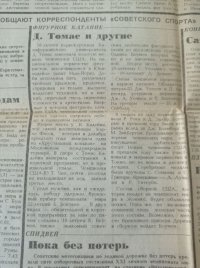
D. Thomas and Others

(the article published in russian 'Sovetskiy Sport' on February 11, 1986)

An 18-year-old freshman from California State University, D. Thomas, won the gold medal of the US Champion. At the national figure skating championship, which ended in Uniondale (New York state), Debi performed five various triple jumps, demonstrating not only high technical mastery but also a soft, lyrical style, and a harmony of complexity and artistry. For the first time in the history of US figure skating, a Black female athlete managed to win the singles skating event.
Second place went to C. Kadavy, the very same student of Carlo Fassi who won one of the "Crystal Skates" at the Moscow International Tournament last December. In the battle with Thomas, Kadavy won the short program competition, but fell during the free skate. The 1985 US Champion, T. Chin, who had barely stepped onto the ice for almost half a year, took third place.
Among the men, as expected, the victory was secured by the World Championship bronze medalist, 22-year-old B. Boitano. In both events—compulsory and short programs—he was closely followed by 18-year-old C. Bowman, who is also well-known to Soviet figure skating fans from the Moscow tournament. However, Bowman sustained an injury and did not finish the competition. Second place went to 20-year-old S. Williams, and third to 19-year-old D. Doran.
A change of champions occurred in pairs skating. The 1985 titleholders, J. Watson and P. Oppegard, conceded the championship to J. Wachsman and T. Waggoner. In third place were N. and W. Seybold.
In ice dance, the championship was won by R. Roca and D. Adair, who were runners-up last year following J. Blumberg and M. Seibert, the World Championship bronze medalists who have since left amateur sports. The new US champions competed in the World Championship in Tokyo last year but did not make it into the top ten. Silver medals were awarded to S. Semanick and S. Gregory, and bronze to L. Luciani and R. Witherby.
The roster of the US national team that will travel to the World Championship in Geneva will be announced later. So far, only the women's portion of this roster raises no doubts. It is possible that instead of bronze medalist Doran, Bowman will enter the national team.
1781686420406.jpeg
 
1986
CANADIAN NATIONAL CHAMPIONSHIPS

FIGURE SKATING
(the article published in russian 'Sovetskiy Sport' on February 15, 1986)
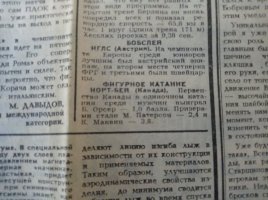
NORTH BAY (Canada). The Men's Singles Championship of Canada was won by B. Orser with 1.0 points. The runners-up were N. Paterson (2.4) and K. McQueen (3.8).
1781686949967.jpeg
 
1986
A QUESTION OF INTEREST TO MANY


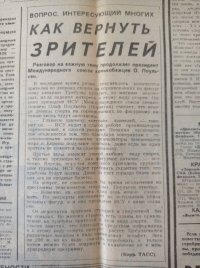
HOW TO BRING BACK THE SPECTATORS

(the article published in russian 'Sovetskiy Sport' on March 1, 1986)

The conversation on this important topic is continued by the President of the International Skating Union, O. Poulsen.
Recently, the number of spectators in sports arenas during figure skating competitions has dropped sharply. The stands are empty. According to some, this is due to a drop in interest toward this sport. However, the ISU (International Skating Union) President, Olaf Poulsen (Norway), believes that the sports arenas will soon be filled with spectators again during figure skating competitions.
"The main reason for the 'outflow' of spectators," he says, "the ISU sees in the poor work of competition organizers and bad advertising. The position of organizing committees is explained by the fact that thanks to contracts with television companies, the organizers of the World and European Championships make a profit even if not a single spectator shows up at the competitions."
Empty arenas cause harm to any sport, especially to such a spectacular one as figure skating. In the future, when commissioning anyone to host major tournaments, the ISU will require guarantees that the stands will be full. Even if it means significantly lower ticket prices.
To the question of whether excluding the 'school' [compulsory figures] from the championship programs would save time, Poulsen replied: "Of course, you could save one day on the 'school.' But experts insist on the execution of compulsory figures, and as the president of the ISU, I agree with them."
Speed skating also suffers from a lack of spectators. In many countries, there are plans to attract spectators to the stands for this sport. Poulsen noted that thanks to the media, interest in this sport is growing. Various innovations are being proposed, such as holding relays or 200-meter races, but they must first be tested, and only then can we think about including them in the international program.​
(TASS Corr.)
1781687639813.jpeg
 
1986
SPRINGTIME CONVERSATION

THE ART OF BEING HAPPY

(the article published in russian 'Sovetskiy Sport' on March 8, 1986)

The secrets of this art are shared on this festive spring day by World Rhythmic Gymnastics Champion GALINA BELOGLAZOVA and World Ice Dancing Champion NATALIA BESTEMIANOVA.

How do you usually spend this festive holiday?
Beloglazova: In the gym, at practice. Spring is not only my favorite time of year, but also the most demanding. It is the eve of major seasonal competitions, and we cannot afford even the slightest relaxation.
Bestemianova: For the last eight years, I have inevitably spent this holiday at competitions—at the World Championships. All my thoughts, naturally, were out on the ice. This year, March 8 is a pleasant exception: I am spending it at home. But in just three days, I will be flying to Geneva for the World Championships.
Sports life consists of more than just victories. How do you handle failures?
Beloglazova:
It varies. But on that day, it is best to leave me completely alone. If I made silly mistakes, I get terribly angry at myself. If, overall, something didn't work out, then it's both my own fault and everyone around me is to blame as well. To my great regret, I sometimes just cannot cope with negative emotions, and in those moments, it is best not to cross my path. But the next day, I hold myself accountable to the absolute highest standard. That is why all business conversations are always left 'for tomorrow' by my coach, Lyudmila Alexandrovna Tikhomirova.
Bestemianova: For failures, I criticize myself first of all. It is precisely in my own performance that I look for the causes of mistakes. I experience many different feelings. On one hand, there is fear and a sort of indifference to what will happen. But on the other hand, a desire builds up to work twice as hard and prove to myself that you are worth something! I emerge from failures completely renewed.​
Is it easy to get along with a coach?
Beloglazova: It would be more correct to ask: is it easy for Lyudmila Alexandrovna to get along with me? I think not very. Sometimes it happens that she and I speak as if in different languages, yet... about the exact same thing, and, of course, we arrive at the very same conclusion. Perhaps this happens because I am a doubting person by nature, so I just think, think, think, even though everything is already clearer than clear... Purposefulness and drive in achieving a goal—I dream of adopting these character traits from Tikhomirova.
Bestemianova: With Tatyana Anatolyevna Tarasova—a demanding, restless person—it is never easy, but from communicating with her, you always constantly experience the happiness of creativity.​
What is your attitude toward fashion in general, and sports fashion in particular?
Beloglazova: I follow fashion, but I do not blindly obey it. For example, I do not like pretentiousness and gaudiness in clothing. Everything is good in moderation. As for sports fashion, I see several 'components' to it. First, I believe that any sports suit, even the most beautiful one, is ultimately intended for playing sports, not for everyday wear. Second, I do not understand the fashion for certain 'prestigious' sports. The main thing is that a person enjoys what they are doing, because you cannot instill a love for sports by force. And third, I vote with both hands for the 'fashion of a beautiful physique.' I am sure that today's fashion, for example, for rhythmic gymnastics, is an everyday necessity that must grow stronger in our minds day by day.
Bestemianova: I admit, I like to be fashionably dressed, especially on a holiday. I am a supporter of costumes and dresses being in exact accordance with the setting and conditions. I am especially strict about the costumes in which I perform, striving for complete correspondence with the musical image and the emotional mood of the program.​
- Do you think the connection between the concepts of "femininity" and "modern woman" has been lost?
Beloglazova: "Of course not. In all times, a woman has always strived to be... a woman. And even the most seemingly absurd fashion could not prevent this. The desire for elegance and charm, and the concern for one's own attractiveness, always remained. After all, if we stop thinking about this, then believe me, it means something has gone wrong in the world. Among the sports that help a modern woman become more feminine, in my opinion, rhythmic gymnastics, figure skating, and synchronized swimming are the best fits.
Bestemianova: "Today, people debate a lot about what a modern woman is. Yes, women nowadays have probably gained many new traits. First of all, independence and the ability to advocate for their own opinion. And most importantly—as a rule, they have a fascinating, interesting job. At the same time, she lives not only with thoughts of work, but also of her home and family. She is the keeper of the hearth. This remains in her forever. Personally, I love my home very much; it warms my soul and heals me from fatigue and sadness. Home is an immense moral support!"​
– What do you value most in a woman and a man?
Beloglazova: "In a woman, femininity, the ability to carry oneself beautifully, and to communicate beautifully with people. In a man—intelligence and inner strength."
Bestemianova: "In my opinion, the concepts of femininity and a woman are inseparable. If a woman is loved, this most precious quality—femininity—will definitely manifest in her. In a man, I value intelligence and his chivalrous qualities above all else. This, by the way, is very visible in our sport as well. When a male partner on the ice knows how to highlight the strengths of his female partner, the duet instantly commands high interest."
(Interestingly, her partner Andrei Bukin, a thoughtful, discerning man, expressed his opinion of Natalia in three points: a) beautiful; b) possesses an optimistic, highly driven personality; c) an excellent homemaker. For your information, Bukin is married to Olga Abankina, and Natalia is married to Igor Bobrin, the 1981 European Figure Skating Champion, multiple USSR figure skating champion).​
– Which character trait appeals to you the most?
Beloglazova:
Kindness.
Bestemianova: Courage.
– Do you like doing housework?
Beloglazova:
"I love it, but there is a bare minimum of time left for it. My day consists of studies and a hobby called sports. For example, I like tidying up the house. I think that when I have time for proper, thorough cooking, I will like that too. Yes, don't laugh, I dream of pies. Of how I will make them myself and eat them to my heart's content. But, alas, it's not allowed. Even on March 8th. When it comes to excess weight, our rules are—oh, so strict."
Bestemianova: "I absolutely love to cook. Especially dishes like roasts, salads, and pies."
– What has sports given you?
Beloglazova: "More than I was able to give to it. First of all—meeting many interesting people and visiting countries I only knew about from geography lessons. And right now, it has provided me with the opportunity—and I hope Natasha Bestemianova will join me—to congratulate you, dear women, on our beautiful spring holiday from the pages of Sovietsky Sport."​
Bestemianova: "Sports helped me shape myself as a person and taught me to stand firm in difficult situations."

Interview conducted by A. ARSENYEV and A. ELISEIKIN.
1781704661365.jpeg
 
1986
A QUESTION OF INTEREST TO MANY


HOW TO BRING BACK THE SPECTATORS

(the article published in russian 'Sovetskiy Sport' on March 1, 1986)

The conversation on this important topic is continued by the President of the International Skating Union, O. Poulsen.
Recently, the number of spectators in sports arenas during figure skating competitions has dropped sharply. The stands are empty. According to some, this is due to a drop in interest toward this sport. However, the ISU (International Skating Union) President, Olaf Poulsen (Norway), believes that the sports arenas will soon be filled with spectators again during figure skating competitions.
"The main reason for the 'outflow' of spectators," he says, "the ISU sees in the poor work of competition organizers and bad advertising. The position of organizing committees is explained by the fact that thanks to contracts with television companies, the organizers of the World and European Championships make a profit even if not a single spectator shows up at the competitions."
Empty arenas cause harm to any sport, especially to such a spectacular one as figure skating. In the future, when commissioning anyone to host major tournaments, the ISU will require guarantees that the stands will be full. Even if it means significantly lower ticket prices.
To the question of whether excluding the 'school' [compulsory figures] from the championship programs would save time, Poulsen replied: "Of course, you could save one day on the 'school.' But experts insist on the execution of compulsory figures, and as the president of the ISU, I agree with them."
Speed skating also suffers from a lack of spectators. In many countries, there are plans to attract spectators to the stands for this sport. Poulsen noted that thanks to the media, interest in this sport is growing. Various innovations are being proposed, such as holding relays or 200-meter races, but they must first be tested, and only then can we think about including them in the international program.​
(TASS Corr.)
View attachment 11541
1986
A QUESTION OF INTEREST TO MANY


HOW TO BRING BACK THE SPECTATORS

(the article published in russian 'Sovetskiy Sport' on March 1, 1986)

The conversation on this important topic is continued by the President of the International Skating Union, O. Poulsen.
Recently, the number of spectators in sports arenas during figure skating competitions has dropped sharply. The stands are empty. According to some, this is due to a drop in interest toward this sport. However, the ISU (International Skating Union) President, Olaf Poulsen (Norway), believes that the sports arenas will soon be filled with spectators again during figure skating competitions.
"The main reason for the 'outflow' of spectators," he says, "the ISU sees in the poor work of competition organizers and bad advertising. The position of organizing committees is explained by the fact that thanks to contracts with television companies, the organizers of the World and European Championships make a profit even if not a single spectator shows up at the competitions."
Empty arenas cause harm to any sport, especially to such a spectacular one as figure skating. In the future, when commissioning anyone to host major tournaments, the ISU will require guarantees that the stands will be full. Even if it means significantly lower ticket prices.
To the question of whether excluding the 'school' [compulsory figures] from the championship programs would save time, Poulsen replied: "Of course, you could save one day on the 'school.' But experts insist on the execution of compulsory figures, and as the president of the ISU, I agree with them."
Speed skating also suffers from a lack of spectators. In many countries, there are plans to attract spectators to the stands for this sport. Poulsen noted that thanks to the media, interest in this sport is growing. Various innovations are being proposed, such as holding relays or 200-meter races, but they must first be tested, and only then can we think about including them in the international program.​
(TASS Corr.)
View attachment 11541
The angst over that problem this year on GS is obviously an old question. Interest just goes in waves in any sport, it seems.
 
1986
THE FATES OF FAMOUS HEROINES

(the article published in russian 'Sovetskiy Sport' on March 8, 1986)

They appeared on the ice of the largest international competitions almost simultaneously. Together they walked to the heights of sporting mastery, and together they ascended to the highest steps of the podium of honor. Their smiles were caught by the greedy lenses of photo and TV cameras, journalists dreamed of interviewing them, and spectators crowded near the boards of the rinks to hand them modest bouquets of winter flowers...
DENISE BIELLMANN:
"Having become the world champion in 1981, I decided to leave amateur sport and join the professional show 'Holiday on Ice'. Do I like my new life? Oh, what a nightmare! I only do what I am told, deprived of my own opinion. Nobody even tries to find out if I like the music I perform to. I go out on the ice and perform the rhumba, I perform because I was told to perform to this melody, even if I don't like it...
Previously, I either picked out the musical accompaniment for my programs myself or with the help of my mother, finding what was close to my soul, close to my temperament. Now such a thing cannot even cross my mind. I don't even dare to dream about it. Everything is decided for me by other people.
I have to perform in semi-darkness. And in such conditions, every jump is a risk. The spectators expect an excellent performance from me—after all, they paid a lot of money for tickets. I have no right to make a mistake. I am afraid. I am now always afraid. Once, during a performance in Geneva, they booed me.
What should I do, I do not know. I thought that by becoming an artist, I would gain freedom. But I lost it..."
ELENA VODOREZOVA:
"My sporting destiny did not turn out as successfully as it could have, and as I would have liked. A sudden illness disrupted all my plans. There was a moment when I thought I would never return to sport, to the ice. Despair, it seemed, took over me. But in difficult moments,—in our Soviet rules - people always appear nearby who stretch out a helping hand to you.
Friends... I have several thousand of them. This is our whole country. I remember what letters came to me in the hospital—warm, encouraging. People believed in me, they believed that I would be able to overcome the illness and return to the ice.
Now I continue to engage in my beloved profession—figure skating. I work as a coach at the CSKA school.
Perhaps I didn't achieve something, didn't manage to do something on the ice as Elena Vodorezova, but my students will do it. Many difficulties are still encountered on my path—I lack experience, sometimes knowledge, sometimes character. And again, as once before, I feel the supportive shoulder of a friend, many friends. Probably that is why I am happy."

TWO WORLDS — TWO DESTINIES. Why did the fates of these two women turn out so differently? The answer is simple. They live in different worlds, where completely different values exist.
In that world where Denise Biellmann lives, money decides everything, and for it, a person must sell themselves, their time, and their talent to whoever is richer, whoever pays for it.
In the world where Elena Vodorezova lives, people are bound by high goals, common ideals, and common interests. Here, a person feels like a part of the nation, a part of everyone. Like in a mirror, the fates of these two famous heroines reflect the essence of the status of women in two different worlds in which they live.
1781763418372.jpeg

P.S. It is a vivid example of disgusting Soviet propaganda.
 
1986
VI. WINTER SPARTAKIAD of the PEOPLES of the USSR
COMPETENT OPINION

"BUSINESS CARDS" PRESENTED

(the article published in russian 'Sovetskiy Sport' on March 8, 1986)

At the figure skaters' tournament, a review of the immediate reserve of the USSR national team is currently underway.
The men have completed the first part of the triathlon. The leading trio consists of: V. Egorov (Ukraine), A. Torosyan (Georgia), and G. Vardanyan (Moscow Oblast).
The pairs performed in the short program. Already, the preliminary results of the Spartakiad finals largely explain our consistent success in pairs skating on the international arena. On the ice of the "Yenisei" Sports Palace, 16 duets started, and almost all of them demonstrated interesting, contemporary compositions. Such a conclusion can be made right now, as the short program is the technical "calling card" of a pair. The referee panel registered practically not a single serious error in the execution of the core elements.
The leaders after the short program are European Championship medalists E. Bechke and V. Kornienko from Leningrad. Following them are their teammates, E. Kvitchenko and R. Kadyrkaev. We should note that Kadyrkaev is a product of the Tashkent figure skating school. In third place are the reigning World Junior Champions, Muscovites E. Leonova and G. Krasnitsky.​
A. GORELIK,
Honored Master of Sports.
1781764091019.jpeg
 
1986
VI. WINTER SPARTAKIAD of the PEOPLES of the USSR
COMMENTARY


Courage Takes Cities (Fortune Favors the Brave)

(the article published in russian 'Sovetskiy Sport' on March 11, 1986)

A difficult task lay ahead for Leningraders Elena Kvitchenko and Rashid Kadyrkaev in the pairs figure skating competition. It was precisely in the free program that they attempted to defeat their fellow countrymen, European Championship medalists Elena Bechke and Valery Kornienko. The fact was that, in terms of the set of elements of highest difficulty, the composition of Kvitchenko and Kadyrkaev met the strictest international requirements.
And the figure skaters passed the test with honor: they skated their program without a single mistake and, contrary to many predictions, became the champions of the Spartakiad. The Leningraders are students of the Honored Coach of the USSR, I. Moskvin.
Specialists called the young duo of the RSFSR team, I. Seyfutdinova and A. Bardykin, the discovery of the tournament. The students of coach A. Rennik were not afraid to include a number of difficult elements in their program and executed them at high speed.
In the men's competition, V. Egorov from the Ukrainian team confidently led in all types of the triathlon.​
A. GORELIK,
Honored Master of Sports.
KRASNOYARSK.
1781764756568.jpeg
 
Back
Top