Akiko Tanaka from gendai media published a two-part
Kassouya report, including quotes by Yuma Suzuki and photos from the show:
Part 1:
Part 2:
2024年福岡での上演に続き、2025年3月8日、9日に広島で再演された、高橋大輔さんフルプロデュースのアイスショー「滑走屋」。ゲネプロから広島で参戦したライター田中亜紀子さんが終演後に振り付けの鈴木ゆまさんにも話を聞き、レポートする後編。島田高志郎選手がソロを終え、戻ろうとした椅子には、少女の形をした「何か奇妙なもの」が座っていた。その正体と、さらなる「滑走屋」の魅力を伝えていく。

gendai.media
Machine translation of part 1:
Landing in Hiroshima... Daisuke Takahashi and the awakened ‘skating craftsmen’.
Kassouya 2025 report, part 1
Akiko Tanaka
Following the 2024 performance in Fukuoka, Daisuke Takahashi's fully-produced ice show ‘Kassouya’ was performed again in Hiroshima on 8 and 9 March 2025. The six performances of the show were a great success. Videos of the dark, cool and glamorous show are still making the rounds on social networks. What on earth was going on? Writer Akiko Tanaka, who attended the show in Hiroshima from the opening rehearsal, spoke to choreographer Yuma Suzuki after the performance and reports on the show.
Big ‘difference’ from 2024.
“Huh?” It was just as the dress rehearsal (public rehearsal) began on the night before the performance of "Kassouya" that I noticed something was "off". Although this time's "Kassouya" was a revival, the choreography had been revised in various places, some songs had more parts used, and there were new programs. In addition, six more ensemble skaters had been added, making the total number of skaters 26, and it was expected that the formation would also change. So it was natural that the impression was different, but there was "something" that was different from that.
As I was thinking about this, I noticed something. The speed and tempo of the performances, including those of the student ensemble skaters, had become much more varied overall. Leading the group, Takahashi Daisuke, always maintained a unique sense of timing, as well as speed and tempo, but the entire cast, while desperately dancing to speedy, danceable numbers, were conscious of the eyes of the audience, making them, so to speak, an entertainment group. Could this be a sign that the "skating craftsmen" have awakened and made great progress?
I will never forget the surprise I felt when I first saw "Kassouya," which was born in Fukuoka in 2024. Skaters wearing black cloaks and masks, like a dark group, appeared from the darkness. The group number, which featured both main and ensemble skaters, was simply cool, set to a dark and cool piece of music. The skaters were desperately trying to finish the show, which was created from scratch by general director Daisuke Takahashi and floor dancer and choreographer Yuma Suzuki, with many programs created from scratch in a short time frame.
Moreover, many of the young ensemble skaters, handpicked by Takahashi himself, were performing in a show for the first time. Nevertheless, their rough but energetic performances, as they desperately tried to keep up with the internationally experienced skaters, were shocking, as if they were caught in a whirlpool of energy from the rink. As it was a new endeavor, they faced various difficulties, but even these were transformed into overflowing tension and energy, and had the appeal of allowing viewers to experience the "moment of creation" both on-site and through the audience videos flooding social media.
‘I really want to thank the audience for uploading their videos.’
This time, there was a different charm to it. Inspired by the participation of the second-year students, the first-year students, both the main cast and the ensemble skaters, must have worked even harder. The whole group was awakened to the ability to "captivate," and the story and theme were conveyed more clearly. Illuminated by the improved lighting, a new chapter was opened for Kassouya.
After the dress rehearsal, when I passed choreographer Suzuki Yuma, I felt a glimpse of confidence in the depths of her eyes as she asked me how I felt.
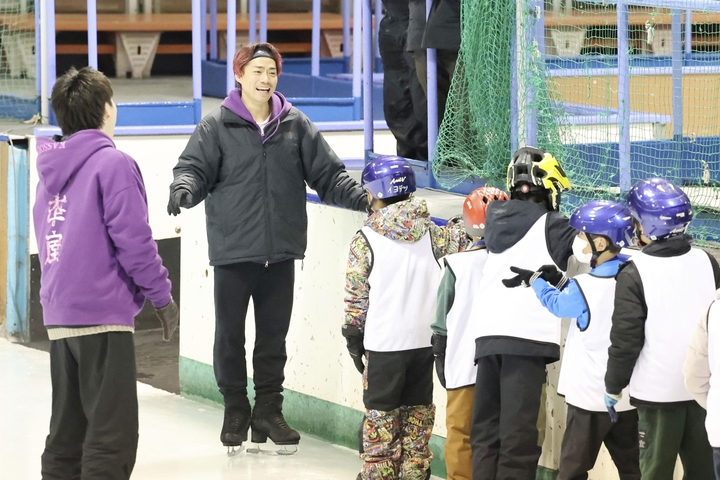
Yuma said, "practice started with the Kanto group, and the second-year Kanto skaters who were joining us this time were quite nervous at first. But Muramoto Kana and Murakami Kanako, as well as Oshima Kosho and Aoki Yuna, first-year skaters who joined us last time, volunteered to act as instructors and pull the second-year skaters along. At the Matsuyama training camp where the Kanto and Kansai groups joined together, the main skaters and first-year skaters took the initiative to pull the second-year skaters along, and even when it wasn't their turn, they were busy instructing the younger skaters so that no time was wasted. Thanks to this, Daisuke and I were able to concentrate on new choreography and creative work.
Also, during the Fukuoka performance, the skaters couldn't see the whole picture from a bird's-eye view, so there were parts where they didn't really understand what they were doing. However, because many of the audience members at the Fukuoka performance uploaded videos to SNS, this time the first and second generation skaters watched them, understood the worldview of the skaters, and analyzed what was expected of them and the pieces in their own way, which was great for them to come to practice with a better understanding than they had expected. I'm really grateful to the audience members who uploaded videos.”
Special "narration" from "Medalist"
Yuma-san said that the opening of the run-through on the last day of the Matsuyama training camp left a strong impression on her.
"For the re-run, Daisuke and I reviewed and reconstructed the entire program, wondering how we could more clearly communicate the worldview that we wanted to convey. The review of the opening resulted in an increase of about 1.3 times the amount of skating. The energy when we did it for the first time, and the skaters' sense of “we did it” and elation, made us all feel that we had created something great. At that moment, the skaters and staff naturally cheered and applauded, and I was so moved that I was moved to tears.”
From Takahashi's words at the press conference held after the dress rehearsal, it was clear that he was feeling confident.
The night before the big day, before the show, voice actress Natsumi Haruse, who was now the cheer leader for Kassouya, made the announcements in the venue. She was a so-called "shadow narrator," but different from the voice of Yuzuki Inori, one of the main characters in "Medalist," her calm voice blended in with the mood of Kassouya. It was so natural that, to my embarrassment, I didn't realize it was Haruse making the announcement at first.
Powerful performance by ‘chairperson’ Mr Takahashi.
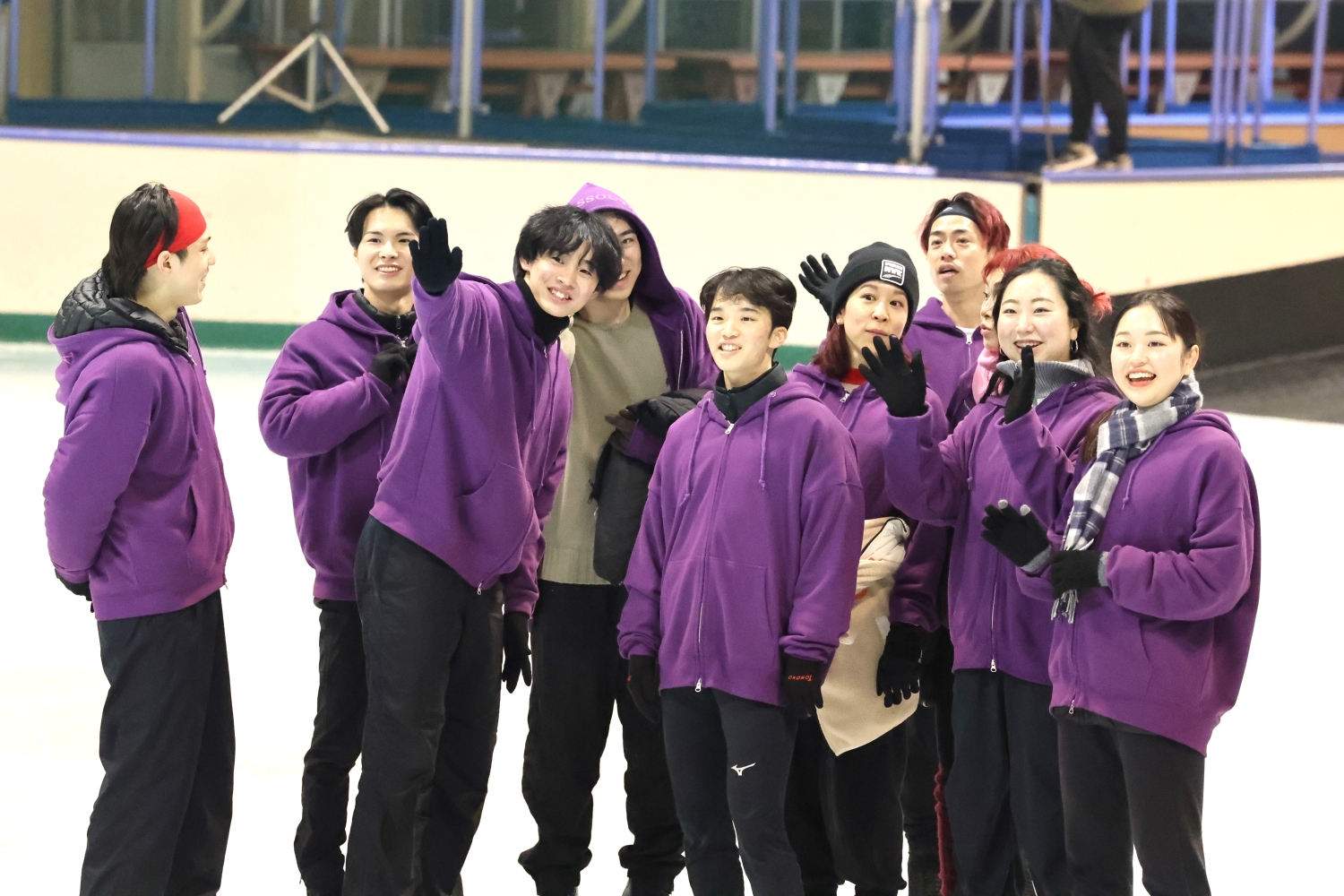
And then it was time for the main event. The curtain opened on a world of cold blue darkness, and to the sound of a bell, troupe leader Daisuke Takahashi appeared wearing a mask and black costume. The performers appeared one after another from the darkness wearing masks, not only to fulfil their own roles, but also to be aware of the audience's gaze and to ‘attract’ them even more. The power of the 26 members moving in complex formations on the rink at the same time and at high speed, and the many things happening here and there on the rink, with no time to catch one's breath, made the performance even more impressive.
Among them, the leader of the group, Daisuke Takahashi, seemed to be giving an especially powerful performance this time. An aura emanated from his standing back, his raised arms, and the way he skated on the ice. The excitement gradually rose, and the scene moved to a scene where male and female couples danced together. Last time, the young skaters seemed somewhat reserved, but this time they were fully engaged. Then, in the fourth song, "Blood Tears," Kazuki Kushida, as the leader, skated in a large circle at breakneck speed, and one by one the skaters joined him, running straight through the circle. This performance was even faster and more powerful than the last one, and the crowd was in a frenzy. Why is it that a simple performance of a skater skating in circles at high speed is so exciting? A primal urge to challenge the body wells up inside me, and I feel like an audience member at the Colosseum.
As the excitement in the venue grew even more, the program that was added after the opening began. This was a very uplifting program. Takahashi and Muramoto Kana faced each other in the center of the rink, and a composition was presented in which they faced off against each other. The song was the rock song "Centuries" by Fall Out Boy, a band whose music Takahashi had used in his final single short program, "Phoenix". It seemed as though a rivalry had broken out between Takahashi's team and Muramoto's team, and the two of them, accompanied by their young underlings, took turns showing off their skills as if to say, "Look at that!"
Athletes who came out of their shells after appearing in Kassouya
The Muramoto team sent out Kosho Oshima and Saki Miyake wa sent out from the Takahashi team, as if to say ‘You go ahead’. These two athletes seem to have come out of their shells after appearing in last year's Kassouya, and their results have improved. Miyake won the West Japan Championships and Kosho Oshima won the East Japan Championships. The fact that these two skaters had the opportunity to show their solo performances must have created a sense of tension and satisfaction for the skaters.
First, Oshima rode the rocks, skating as if to show off, performing tricks and landing a backflip. Not only were the tricks spectacular, but every movement, from the skating to the poses, showed perfect core strength. Next up was Miyake, who also skated as if to show off her skills, landing consecutive triple jumps to the music and showing off neat movements using her whole body. Above all, both of them had a charisma that drew the audience's attention, and I was truly amazed at how they transformed.
The first main skater, Sena Miyake, performed his solo after the powerful and exciting group number. In the name of the main skater, this was something he could not afford to lose. In fact, Miyake's performance was so powerful as if he tried to shake something off, Yuma says.
"It was Daisuke who decided to select Kosho and Saki-chan. I think he wanted to give back to them for the hard work they have put in over the past year outside of Kassouya. In fact, their performances were truly outstanding, and I felt that they have grown as people. Kosho also had a sense of freedom. I've told everyone this, but the line between main and ensemble skaters can be broken in more areas than just track record, so I'd like to see more ensemble skaters take on the challenge. I'll explain this later, but that was the feeling we had when we held the audition for Carmen."
The characteristic of Kassouya is that the group numbers and solo performances proceed without interruption, but there is a lot of energy right from the start. Anyway, the figure skating and the skaters are so cool. In the group number that only male skaters appear in, they dance lively, performing a wild and masculine dance, including skaters who are performing for the first time.
"Cocobongo" is packed with synchronized figure skating techniques, and the lighting is brighter and more elaborate than last time, so you can see how difficult it is, such as the perfect formation led by Yuto Kishina, and the breathtaking moment when the formation joins forces.
The narrative quality of group numbers
Among them, the group number "Cry Me a River" was the one that I personally felt was very narrative. The lyrics of the title song are about a woman who has been heartbroken, singing to her boyfriend with resentment. Aoki plays the woman, and her skating and dancing erupt with something like dark passion. The ensemble skaters dance fluidly outside the spotlight in their black caped costumes, and it seems as if the passion itself is the skaters wearing capes, or perhaps it has transformed into demons. Takahashi is quietly blending into the ensemble. His dynamic dancing with varying speeds really stands out. The other skaters are also skating beautifully, as if lifted by his skating, making it a pleasure to watch. Aoki's emotions grow, the world turns red, and it sparks with lightning. Then, with a rain that seems to purify the world, a blue silent world comes and leads to Kazuki Tomono's solo ‘Halston’. Tomono skated the only ‘quiet’ programme among the skaters again, this time with inner passion. He will return to this program for his free program next season, and I'm looking forward to seeing him evolve "Halston" with the addition of something he learned from his time at Kassouya.
The main skaters were all fired up. In the group numbers, they raised the base level with solid skating and dancing, and by taking leadership. Furthermore, Murakami Kanako and Aoki Yuna took on a new image in their solo programs. Muramoto Kana, who said she had just started learning floor dance, seemed to have improved the swell of her body. And Shimada Koshiro, who was unable to perform last time due to a sudden illness, used his whole body to dance powerfully on the ice in his solo performance, as if to release his sorrows. When it was over, he returned to the chair he had been sitting in at the start of the program, only to find a strange girl sitting there.






 ]
]


 of Kazuki Kushida in the "explosion".

 :
: .
.
 :
: :
:


 .
.
 .
. :
:


 .
.
 .
. :
:
 :
:


 While everyone gets their moments to stand out, this is first and foremost a 75 minute long high-energy ensemble piece, in which everyone is equally important regardless of competitive results and name recognition.
 :
:  Hopefully there are more performances to follow in other locations!
 :
: ️. Thanks to Haruna and Rina from the choreography team for your hard work.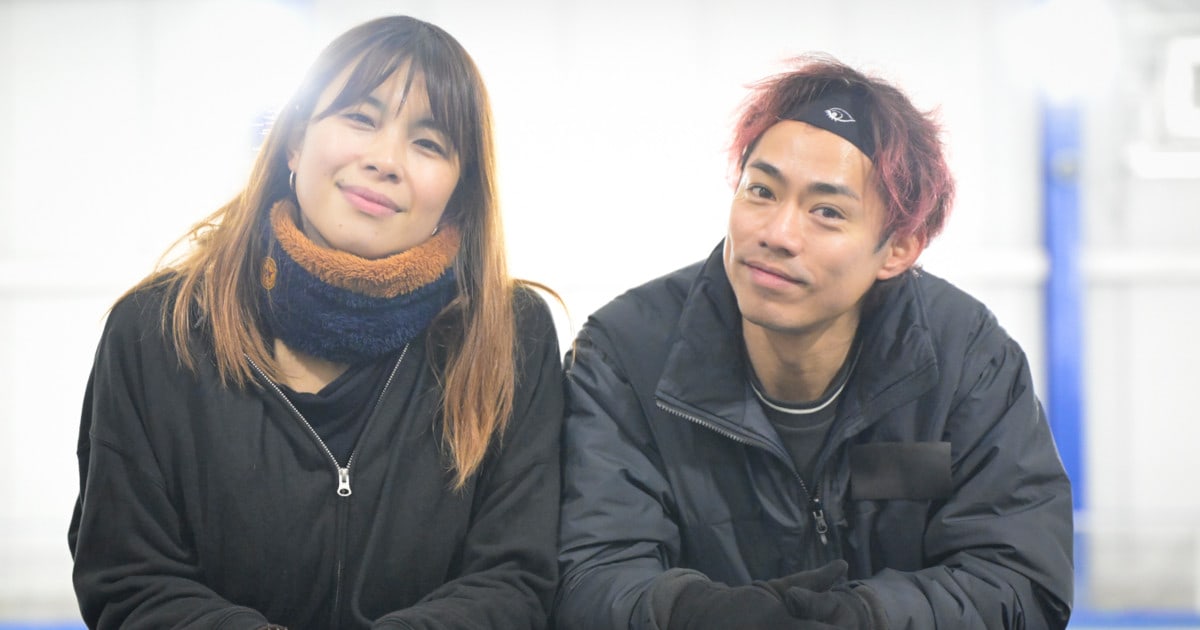







 :
:
