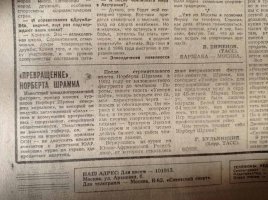
1984
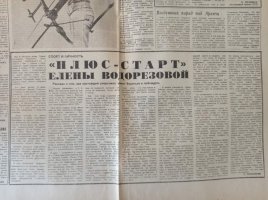
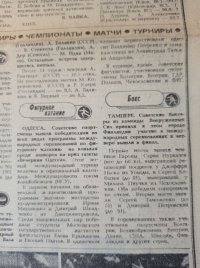
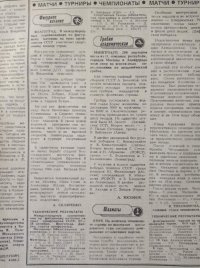
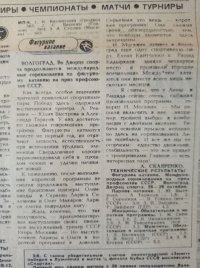
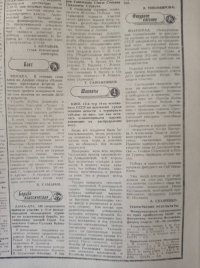
"PLUS-START" OF ELENA VODOREZOVA
(the article published in russian 'Sovetskiy Sport' on October 11, 1984)
A story about how a true athlete knows how to fight and win
So the evening has come. The most long-awaited one. Imperceptibly, as if stealing, it approached, and with it—a light and not yet at all alarming feeling of anticipation. And then the ice, flooded with fire, flashed, the light of the spotlights, smiles, flowers, kind words... Behind are months of difficult training. It remains to go out, gather oneself, and...
It was far from home. The Olympic figure skating team of the Soviet Union was touring Australia. And on that evening, Elena Vodorezova — multiple champion of the Soviet Union and medalist of World and European championships — turned 21. On her birthday, she was saying goodbye to competitive sports.
Lena, it seems, cannot recall a single even slightly significant episode in her athletic biography to which the phrase "sporting feat" could be applied. But not because they didn't exist. She simply grew accustomed to perceiving difficult moments of overcoming pain, weakness, and fatigue — overcoming herself — as something without which it is impossible to live life.
The illness seemed to approach suddenly. In reality, the daily strain, the falls, and the eternal cold emanating from the ice had done their work. The time for treatment, doctors, and diagnoses had arrived. Polyarthritis.
In hours of trial, reflections weigh down on a person all at once, with their full weight, as if they had waited for their moment when they could no longer be brushed aside. They only let go deep at night, when you drift into a heavy half-sleep.
— First training sessions with S. A. Zhuk. A few days before this, coach Galina Borisovna Titova called Lena over to the edge of the rink and asked, as if in passing: "Wouldn't you like to train with Zhuk?" Lena asked back in a childish way: "Who? I?"
She often fell when no one else was falling on those elements anymore; she couldn't jump because she was afraid when everyone else was jumping; she would fall ill at the most critical moments. When several people from the recreational skating group where Lena started training decided to apply to CSKA, everyone was accepted except Vodorezova. She came home in despair and flung her skates down the hallway. Her grandmother looked out at the noise, but Lena just shut her bedroom door tight. The next morning, she went back to CSKA. They accepted her, albeit on a probationary period.
And suddenly—the chance to train under Stanislav Alekseyevich Zhuk, the coach of the legendary Irina Rodnina herself. Lena simply couldn't believe it. But the next morning, she arrived at the 'Crystal' rink. She still remembers that first, most important training session in vivid detail. Nearby, Rodnina and Zaitsev were skating, along with Gorshkova and Shevalovsky. With trembling hands, Lena laced up her skates and stood quietly by the boards, placing her blade guards toe-to-toe, following a habit she never broke.
How hard she tried not to fall back then, yet she kept falling. She would get up, seeing nothing around her through the stinging resentment toward herself and the whole world because, at that very moment, nothing was working out.
...She is already awake and knows it is time to get up. She knows it by the way her joints begin to ache agonizingly. Suddenly, it seemed to her that she wasn't in the hospital but at home, and that in a few minutes, the alarm would go off—it was set for exactly 5:30. But before it could erupt with its optimistic chime, her mother would walk into the room and say, 'Lena, wake up.' How she dreamed back then of returning to her friends and the ice rink as soon as possible!
1975. The first international competitions in her biography. A tournament for the prize of the newspaper "Nouvelles de Moscou". The main rival of 12-year-old Vodorezova was Wendy Burge (USA). Ranked fourth in the world hierarchy of female skaters, Burge couldn't even imagine that this girl with funny childhood 'pigtails' would leave her behind.
After the compulsory program, Burge took the lead, just as many had expected. Vodorezova found herself in fifth place. But even then, it was clear that surprises awaited both participants and spectators. The competition was becoming increasingly fierce.
In the short program, Vodorezova performed before Burge. The driving, slightly anxious music from the film Taming of the Fire. High, daring jumps and—there’s no other word for it—dashing spins, her pigtails flying in all directions, blurring from the speed into a solid spiral around her head. The front rows, the tense gazes of the judges, and the intrigued eyes of the audience flashed before her. Though, at the time, she didn't see any of it.
Lena skated with broad strokes, bravely, and with great spirit. And Burge faltered; she performed tentatively and made a mistake. Before the free skate, Vodorezova had already moved up to second place, leaving even the USSR champion Lyudmila Bakonina behind.
And then came the final day of the all-around—the free program... As soon as Lena left the ice, she was surrounded by photojournalists, flashes began to pop... Stanislav Alekseyevich managed to say to her: 'You are stronger.' This victory became a sensation. 'Not a single Soviet female skater in recent years has been able to win the Nouvelles de Moscou in singles skating. And here is the first swallow,' the newspapers wrote in those days."
...It’s growing dark in the hospital ward. Winter evenings descend quickly. Perhaps that’s how a life in sports goes too... Is it really all over? She knows that after such long breaks in training—especially with a diagnosis like hers—people don't return to sports. The level of difficulty in figure skating rises every year; even active athletes find it hard to keep up. And what if you have two years of hospital wards behind you? No, it’s beyond her strength! And it wasn’t even about physical strength—she had long been used to grueling workloads, constant sleep deprivation, and the rest. She doubted something else: whether she had enough willpower. Moreover, she wasn't sure if she even needed this return to the ice. She would have to prove something to someone all over again, fall again, wake up at the crack of dawn again, and listen to her coach’s reprimands again.
But one day, her mother brought a letter to the hospital from strangers: 'Get well soon. We are eagerly looking forward to your new programs. See you on the ice!' And she realized: it wasn’t that she needed it—it was that she was needed. A simple shift in words, but behind it lay two opposing life philosophies. Lena knew that, for now, she was the only one in the country’s women's figure skating who could count on serious success. People were already tired of talking about the failures of our female singles skaters on the international stage—what was the point. Behind Vodorezova, there was no one who could support her, back her up, or who was equal to her in experience and skill at that moment. And so, she had to skate.
Lena stepped onto the ice. Some greeted her with thunderous, sincere applause; others with sparse, skeptical clapping.
Her return to the ice was grueling. It was 1980, and the European Championships were just around the corner. Lena trained long, hard, and relentlessly—so that no strength remained for despair. During practice, she couldn't land even half the elements she was supposed to perform at the championship. Yet the coaches weighed everything and said: 'You must go.'
Athletes have a concept called 'plus-start.' It’s when at home or in training, nothing seems to work; things just don’t click. But when you step out for the start, it’s as if a second wind opens up, and some hidden inner forces kick in. Lena skated her short program that time on that very 'plus-start.' The entire national team came to watch her performance. When Lena left the ice, gasping for breath and barely alive, everyone remained silent.
She never won a World or European title. But it was she, Elena Vodorezova, who became the first Soviet skater to earn recognition for the Soviet school of women's figure skating. It was Elena Vodorezova, and no one else, who had to build that prestige all by herself. In those days, there was no one else to do it.
Two bronze medals at the European Championships, then silver at the 1983 Europeans, and finally, her first 'World' bronze and a small gold medal at the 1984 European Championships. The bronze medal won at the Winter Games by Kira Ivanova and the silver medal won at the World Championships by Anna Kondrashova are, in a way, her medals too. Had it not been for Lena and her victories, they might not have had the right or the opportunity to compete in world championships at all.
Lena will be a coach. Of course, at her home school, CSKA. She understands perfectly well how difficult it is to teach—perhaps even harder than to learn.
'Stanislav Alekseyevich used to say,' Lena recalls, 'that the main trait of a true coach is to work harder than your pupil. And also—to know how to wait. You must be able to wait out and endure failures and defeats; they are natural occurrences in sports. You have to keep working, and then victory will come.'
In figure skating, very young people find themselves in the spotlight, with television cameras trained on them and millions of fans watching. Lena is grateful to all her coaches and choreographers who taught her, among other things, how to carry herself in the atmosphere of the ice carnival simply and naturally, without pretense. Modestly. Perhaps that is why Vodorezova doesn’t particularly stand out, and even though she’s been seen on TV dozens of times, she is rarely recognized on the street.
And so, that evening passed. The very last one. She stood on the embankment in Sydney and looked out at the ocean. It was vast and convex, making it easy to believe that the Earth really is round and large—immense, like life itself. And the sadness that had risen as a lump in her throat was quietly replaced by a new feeling: a sense of the fullness of life and the realization that everything is only just beginning.
O. POLONSKAYA
View attachment 10947





 .
.




 !
!