Archive of newspaper articles | Page 21 | Golden Skate

Archive of newspaper articles

1984
St Ivel International

Figure Skating

(the article published in russian 'Sovetskiy Sport' on September 29, 1984)

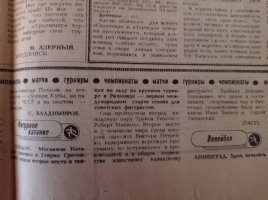
LONDON. Muscovites Natalia Annenko and Genrikh Sretenski took second place in ice dancing at a major tournament in Richmond—the first international start of the season for Soviet figure skaters.
They finished behind the Canadian pair Tracy Wilson and Robert McCall. Second place also went to the world junior champion, Viktor Petrenko from Odesa, who won the short program but lost in the free skate and overall standings to the famous Canadian figure skater Brian Boitano. As a reminder, earlier in the pairs competition in Richmond, the winners were Muscovites Inna Bekker and Sergei Likhansky.​
(TASS).
1771677894229.jpeg
P.S. A mistake in this article. The actual winner in men's single skating was the American not Canadian skater Brian Boitano.
 
Last edited:
1984
AND AGAIN THE WINTER TALE BREATHES

(the article published in russian 'Sovetskiy Sport' on August 15, 1984)

Figure skaters sound the assembly in August ● First starts in the "Alps Cup" ● Elena Valova and Oleg Vasiliev are completely updating their compositions ● French masters take lessons from Tamara Moskvina

The V.I. Lenin Sports and Concert Complex in Leningrad. These days, two winter stadiums have settled comfortably under its roof in the center. A rink for figure skaters, and around it an oval of an artificial running track. About a hundred athletes are training simultaneously. Speed skaters occasionally glance at the neighboring arena, where masters of pair skating glide to a lyrical melody. There are many duos. Honoured Coach of the USSR Tamara Nikolaevna Moskvina, after a quick count, tells us:
— Currently, there are four main pairs and seven youth pairs in my group. Plus two duos from France with their coach Anna-Marie Dorville, by invitation of our All-Union Federation, are conducting a training cycle on Leningrad ice...
Naturally, the eyes of everyone present — choreographer Valentina Wigant, cameraman Viktor Teslya, coach Nikolay Velikov (who is part of Moskvina's team), the French guests — are fixed on Olympic champions Elena Valova and Oleg Vasiliev.
The leaders of our national team have interesting creative plans for the coming season: they prepare to completely update the music, the technical arsenal, and the choreographic means in their future programs. Reflecting on trends in pair skating, Elena Valova notes:
— Spectacle of composition and originality of style have been our main trump cards in recent years. All the strongest sports pairs are searching in this same direction. At the same time, skaters' attention should be focused on complex elements. Apparently, spectators will see not one, but two parallel triple jumps in the majority of programs. Many pairs will also master the axel jump in 2.5 rotations. All this will give even greater beauty and dynamism to the competitions of the best duos. Oleg Vasiliev and I, as before, have a great attraction to modern music with its sharp rhythms and complex emotional plan. All this will find its reflection in the new programs...
Coach Tamara Moskvina plans their first start quite early — in October at a tournament in Tokyo. This is explained by the fact that it is in Tokyo where the next world championship is scheduled to take place. And for another of her pairs — USSR championship prize-winners Elena Bechke and Valery Kornienko — Moskvina has set an even more difficult task: to gain warm athletic form by August, when the "Alps Cup" begins in France and West Germany.
— In technical terms, — says Tamara Nikolaevna, — Bechke and Kornienko have achieved noticeable progress. They glide easily, with good amplitude, and work a lot on the expressiveness of movements. And now they must reach a new frontier, demonstrating psychological stability and reliability in every start — something that always distinguishes their fellow citizens Valova and Vasiliev...
Alongside experienced masters in Moskvina and Velikov's group, 12-15-year-old figure skaters train every day. And this constant communication brings very tangible benefits to the young athletes: they learn a deeper "penetration" into the spirit of musical compositions. Today, more than ever, it is important to learn to skate non-stop, without academic clichés. The group's choreographer Valentina Mikhailovna Wigant never tires of urging day after day: "Guys, love the art in yourselves, learn beauty from the great stage artists, such as Galina Ulanova! Everything you do on the ice must express your relationship to the music..."
Attention is also focused on the problems of music for those figure skaters who make up the group of Honoured Coach of the USSR Igor Borisovich Moskvin. The "Bolshevik" rink on Obukhovskoy Oborony Avenue hospitably opens its doors to many famous figure skaters of Leningrad. Bronze medalists of the Winter Olympics Larisa Selezneva and Oleg Makarov, as well as winners of All-Union tournaments Anna Antonova, Inna Krundysheva, and new pair Elena Kvitchenko and Rashid Kadyrkaev, are training here now. For each of his charges, coach Moskvin formulates precise individual tasks and plans.
— Performances in the past season for Selezneva and Makarov, — says Moskvin, — gave a lot in psychological terms. They finally felt like mature masters, allies in spirit, ready to support each other in any extreme situation. And with such an attitude towards the business, all the work on programs becomes different — more creative, more intense. I am sure that Larisa and Oleg will complete the creation of new compositions as early as October and perform at full strength at an international tournament in Holland.
Thus, by December, when the tournament for the "Moscow News" prize is held, we will have a clear picture of the balance of power.
Serious restructuring in technical and tactical terms awaits the European Championship participant Anna Antonova. In the past, qualities like her meticulousness played a positive role in developing her technical style. Later on, however, a fear of deviating from rules and instructions prevented her from finding her own voice and unique approach to technique, which ultimately stunted her growth. It is a cautionary tale. I believe that our Leningrad specialists and choreographers will help Anna find a new path.
Choreographer Yuri Potemkin has been working with Moskvin for more than a year. A well-known ballet artist in the past, he, by the way, participated in creating original free programs for European champion Igor Bobrin, and then for Selezneva and Makarov. Reflecting on the trends of the upcoming season, Potemkin expressed a very relevant thought: it is time to resolutely abandon those musical fragments that have already been heard dozens of times on sports arenas, and more boldly turn to the repertoire that is truly close to the individuality of the skaters. And this principle is embodied in the programs of the new pair of E. Kvitchenko and R. Kadyrkaev.
The new season, by all appearances, promises many interesting discoveries. And now, for figure skating fans, we will announce the dates of the main starts:
International tournament for the "Moscow News" prize, Moscow — December 5-9; World Junior Championship, Colorado Springs (USA) — December 11-16; USSR Championship, Dnipropetrovsk — January 7-13, 1986; European Championship, Gothenburg (Sweden) — February 7-13; World Championship, Tokyo (Japan) — March 5-10; USSR Cup, Alma-Ata — April 1-7.
A. SHELUKHIN.
View attachment 10933
Any mention of the Coupe des Alpes makes me a bit sad. Although we'd planned to retire after the 1982/83 season because we were both going on to grad school in different countries, and I was getting married in September also, we were still asked to do St Gervais/Oberstdorf in August 1983. But my partner got his nose broken playing rugby and we couldn't practise -- he had difficulty breathing, and we had to avoid moves like twists and pairs spins where I might whack him in the nose accidentally. So we withdrew and Canada sent someone else. And then we retired. We wouldn't have won anyway, but still I would have loved to skate in the Alps 😢.
 
1984
St Ivel International

Figure Skating

(the article published in russian 'Sovetskiy Sport' on September 29, 1984)

LONDON. Muscovites Natalia Annenko and Genrikh Sretenski took second place in ice dancing at a major tournament in Richmond—the first international start of the season for Soviet figure skaters.
They finished behind the Canadian pair Tracy Wilson and Robert McCall. Second place also went to the world junior champion, Viktor Petrenko from Odessa, who won the short program but lost in the free skate and overall standings to the famous Canadian figure skater Brian Boitano. As a reminder, earlier in the pairs competition in Richmond, the winners were Muscovites Inna Bekker and Sergei Likhansky.​
(TASS).
View attachment 10938
Brian ORSER. I guess the Russian reporter couldn't tell them apart. Orser is the shorter one ;)
 
1984
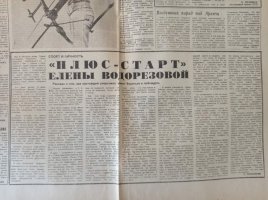
"PLUS-START" OF ELENA VODOREZOVA

(the article published in russian 'Sovetskiy Sport' on October 11, 1984)
A story about how a true athlete knows how to fight and win

So the evening has come. The most long-awaited one. Imperceptibly, as if stealing, it approached, and with it—a light and not yet at all alarming feeling of anticipation. And then the ice, flooded with fire, flashed, the light of the spotlights, smiles, flowers, kind words... Behind are months of difficult training. It remains to go out, gather oneself, and...
It was far from home. The Olympic figure skating team of the Soviet Union was touring Australia. And on that evening, Elena Vodorezova — multiple champion of the Soviet Union and medalist of World and European championships — turned 21. On her birthday, she was saying goodbye to competitive sports.
Lena, it seems, cannot recall a single even slightly significant episode in her athletic biography to which the phrase "sporting feat" could be applied. But not because they didn't exist. She simply grew accustomed to perceiving difficult moments of overcoming pain, weakness, and fatigue — overcoming herself — as something without which it is impossible to live life.
The illness seemed to approach suddenly. In reality, the daily strain, the falls, and the eternal cold emanating from the ice had done their work. The time for treatment, doctors, and diagnoses had arrived. Polyarthritis.
In hours of trial, reflections weigh down on a person all at once, with their full weight, as if they had waited for their moment when they could no longer be brushed aside. They only let go deep at night, when you drift into a heavy half-sleep.
— First training sessions with S. A. Zhuk. A few days before this, coach Galina Borisovna Titova called Lena over to the edge of the rink and asked, as if in passing: "Wouldn't you like to train with Zhuk?" Lena asked back in a childish way: "Who? I?"
She often fell when no one else was falling on those elements anymore; she couldn't jump because she was afraid when everyone else was jumping; she would fall ill at the most critical moments. When several people from the recreational skating group where Lena started training decided to apply to CSKA, everyone was accepted except Vodorezova. She came home in despair and flung her skates down the hallway. Her grandmother looked out at the noise, but Lena just shut her bedroom door tight. The next morning, she went back to CSKA. They accepted her, albeit on a probationary period.
And suddenly—the chance to train under Stanislav Alekseyevich Zhuk, the coach of the legendary Irina Rodnina herself. Lena simply couldn't believe it. But the next morning, she arrived at the 'Crystal' rink. She still remembers that first, most important training session in vivid detail. Nearby, Rodnina and Zaitsev were skating, along with Gorshkova and Shevalovsky. With trembling hands, Lena laced up her skates and stood quietly by the boards, placing her blade guards toe-to-toe, following a habit she never broke.
How hard she tried not to fall back then, yet she kept falling. She would get up, seeing nothing around her through the stinging resentment toward herself and the whole world because, at that very moment, nothing was working out.
...She is already awake and knows it is time to get up. She knows it by the way her joints begin to ache agonizingly. Suddenly, it seemed to her that she wasn't in the hospital but at home, and that in a few minutes, the alarm would go off—it was set for exactly 5:30. But before it could erupt with its optimistic chime, her mother would walk into the room and say, 'Lena, wake up.' How she dreamed back then of returning to her friends and the ice rink as soon as possible!
1975. The first international competitions in her biography. A tournament for the prize of the newspaper "Nouvelles de Moscou". The main rival of 12-year-old Vodorezova was Wendy Burge (USA). Ranked fourth in the world hierarchy of female skaters, Burge couldn't even imagine that this girl with funny childhood 'pigtails' would leave her behind.
After the compulsory program, Burge took the lead, just as many had expected. Vodorezova found herself in fifth place. But even then, it was clear that surprises awaited both participants and spectators. The competition was becoming increasingly fierce.
In the short program, Vodorezova performed before Burge. The driving, slightly anxious music from the film Taming of the Fire. High, daring jumps and—there’s no other word for it—dashing spins, her pigtails flying in all directions, blurring from the speed into a solid spiral around her head. The front rows, the tense gazes of the judges, and the intrigued eyes of the audience flashed before her. Though, at the time, she didn't see any of it.
Lena skated with broad strokes, bravely, and with great spirit. And Burge faltered; she performed tentatively and made a mistake. Before the free skate, Vodorezova had already moved up to second place, leaving even the USSR champion Lyudmila Bakonina behind.
And then came the final day of the all-around—the free program... As soon as Lena left the ice, she was surrounded by photojournalists, flashes began to pop... Stanislav Alekseyevich managed to say to her: 'You are stronger.' This victory became a sensation. 'Not a single Soviet female skater in recent years has been able to win the Nouvelles de Moscou in singles skating. And here is the first swallow,' the newspapers wrote in those days."
...It’s growing dark in the hospital ward. Winter evenings descend quickly. Perhaps that’s how a life in sports goes too... Is it really all over? She knows that after such long breaks in training—especially with a diagnosis like hers—people don't return to sports. The level of difficulty in figure skating rises every year; even active athletes find it hard to keep up. And what if you have two years of hospital wards behind you? No, it’s beyond her strength! And it wasn’t even about physical strength—she had long been used to grueling workloads, constant sleep deprivation, and the rest. She doubted something else: whether she had enough willpower. Moreover, she wasn't sure if she even needed this return to the ice. She would have to prove something to someone all over again, fall again, wake up at the crack of dawn again, and listen to her coach’s reprimands again.
But one day, her mother brought a letter to the hospital from strangers: 'Get well soon. We are eagerly looking forward to your new programs. See you on the ice!' And she realized: it wasn’t that she needed it—it was that she was needed. A simple shift in words, but behind it lay two opposing life philosophies. Lena knew that, for now, she was the only one in the country’s women's figure skating who could count on serious success. People were already tired of talking about the failures of our female singles skaters on the international stage—what was the point. Behind Vodorezova, there was no one who could support her, back her up, or who was equal to her in experience and skill at that moment. And so, she had to skate.
Lena stepped onto the ice. Some greeted her with thunderous, sincere applause; others with sparse, skeptical clapping.
Her return to the ice was grueling. It was 1980, and the European Championships were just around the corner. Lena trained long, hard, and relentlessly—so that no strength remained for despair. During practice, she couldn't land even half the elements she was supposed to perform at the championship. Yet the coaches weighed everything and said: 'You must go.'
Athletes have a concept called 'plus-start.' It’s when at home or in training, nothing seems to work; things just don’t click. But when you step out for the start, it’s as if a second wind opens up, and some hidden inner forces kick in. Lena skated her short program that time on that very 'plus-start.' The entire national team came to watch her performance. When Lena left the ice, gasping for breath and barely alive, everyone remained silent.
She never won a World or European title. But it was she, Elena Vodorezova, who became the first Soviet skater to earn recognition for the Soviet school of women's figure skating. It was Elena Vodorezova, and no one else, who had to build that prestige all by herself. In those days, there was no one else to do it.
Two bronze medals at the European Championships, then silver at the 1983 Europeans, and finally, her first 'World' bronze and a small gold medal at the 1984 European Championships. The bronze medal won at the Winter Games by Kira Ivanova and the silver medal won at the World Championships by Anna Kondrashova are, in a way, her medals too. Had it not been for Lena and her victories, they might not have had the right or the opportunity to compete in world championships at all.
Lena will be a coach. Of course, at her home school, CSKA. She understands perfectly well how difficult it is to teach—perhaps even harder than to learn.
'Stanislav Alekseyevich used to say,' Lena recalls, 'that the main trait of a true coach is to work harder than your pupil. And also—to know how to wait. You must be able to wait out and endure failures and defeats; they are natural occurrences in sports. You have to keep working, and then victory will come.'
In figure skating, very young people find themselves in the spotlight, with television cameras trained on them and millions of fans watching. Lena is grateful to all her coaches and choreographers who taught her, among other things, how to carry herself in the atmosphere of the ice carnival simply and naturally, without pretense. Modestly. Perhaps that is why Vodorezova doesn’t particularly stand out, and even though she’s been seen on TV dozens of times, she is rarely recognized on the street.
And so, that evening passed. The very last one. She stood on the embankment in Sydney and looked out at the ocean. It was vast and convex, making it easy to believe that the Earth really is round and large—immense, like life itself. And the sadness that had risen as a lump in her throat was quietly replaced by a new feeling: a sense of the fullness of life and the realization that everything is only just beginning.​
O. POLONSKAYA
1771873451237.jpeg
 
1984
"PLUS-START" OF ELENA VODOREZOVA

(the article published in russian 'Sovetskiy Sport' on October 11, 1984)
A story about how a true athlete knows how to fight and win

So the evening has come. The most long-awaited one. Imperceptibly, as if stealing, it approached, and with it—a light and not yet at all alarming feeling of anticipation. And then the ice, flooded with fire, flashed, the light of the spotlights, smiles, flowers, kind words... Behind are months of difficult training. It remains to go out, gather oneself, and...
It was far from home. The Olympic figure skating team of the Soviet Union was touring Australia. And on that evening, Elena Vodorezova — multiple champion of the Soviet Union and medalist of World and European championships — turned 21. On her birthday, she was saying goodbye to competitive sports.
Lena, it seems, cannot recall a single even slightly significant episode in her athletic biography to which the phrase "sporting feat" could be applied. But not because they didn't exist. She simply grew accustomed to perceiving difficult moments of overcoming pain, weakness, and fatigue — overcoming herself — as something without which it is impossible to live life.
The illness seemed to approach suddenly. In reality, the daily strain, the falls, and the eternal cold emanating from the ice had done their work. The time for treatment, doctors, and diagnoses had arrived. Polyarthritis.
In hours of trial, reflections weigh down on a person all at once, with their full weight, as if they had waited for their moment when they could no longer be brushed aside. They only let go deep at night, when you drift into a heavy half-sleep.
— First training sessions with S. A. Zhuk. A few days before this, coach Galina Borisovna Titova called Lena over to the edge of the rink and asked, as if in passing: "Wouldn't you like to train with Zhuk?" Lena asked back in a childish way: "Who? I?"
She often fell when no one else was falling on those elements anymore; she couldn't jump because she was afraid when everyone else was jumping; she would fall ill at the most critical moments. When several people from the recreational skating group where Lena started training decided to apply to CSKA, everyone was accepted except Vodorezova. She came home in despair and flung her skates down the hallway. Her grandmother looked out at the noise, but Lena just shut her bedroom door tight. The next morning, she went back to CSKA. They accepted her, albeit on a probationary period.
And suddenly—the chance to train under Stanislav Alekseyevich Zhuk, the coach of the legendary Irina Rodnina herself. Lena simply couldn't believe it. But the next morning, she arrived at the 'Crystal' rink. She still remembers that first, most important training session in vivid detail. Nearby, Rodnina and Zaitsev were skating, along with Gorshkova and Shevalovsky. With trembling hands, Lena laced up her skates and stood quietly by the boards, placing her blade guards toe-to-toe, following a habit she never broke.
How hard she tried not to fall back then, yet she kept falling. She would get up, seeing nothing around her through the stinging resentment toward herself and the whole world because, at that very moment, nothing was working out.
...She is already awake and knows it is time to get up. She knows it by the way her joints begin to ache agonizingly. Suddenly, it seemed to her that she wasn't in the hospital but at home, and that in a few minutes, the alarm would go off—it was set for exactly 5:30. But before it could erupt with its optimistic chime, her mother would walk into the room and say, 'Lena, wake up.' How she dreamed back then of returning to her friends and the ice rink as soon as possible!
1975. The first international competitions in her biography. A tournament for the prize of the newspaper "Nouvelles de Moscou". The main rival of 12-year-old Vodorezova was Wendy Burge (USA). Ranked fourth in the world hierarchy of female skaters, Burge couldn't even imagine that this girl with funny childhood 'pigtails' would leave her behind.
After the compulsory program, Burge took the lead, just as many had expected. Vodorezova found herself in fifth place. But even then, it was clear that surprises awaited both participants and spectators. The competition was becoming increasingly fierce.
In the short program, Vodorezova performed before Burge. The driving, slightly anxious music from the film Taming of the Fire. High, daring jumps and—there’s no other word for it—dashing spins, her pigtails flying in all directions, blurring from the speed into a solid spiral around her head. The front rows, the tense gazes of the judges, and the intrigued eyes of the audience flashed before her. Though, at the time, she didn't see any of it.
Lena skated with broad strokes, bravely, and with great spirit. And Burge faltered; she performed tentatively and made a mistake. Before the free skate, Vodorezova had already moved up to second place, leaving even the USSR champion Lyudmila Bakonina behind.
And then came the final day of the all-around—the free program... As soon as Lena left the ice, she was surrounded by photojournalists, flashes began to pop... Stanislav Alekseyevich managed to say to her: 'You are stronger.' This victory became a sensation. 'Not a single Soviet female skater in recent years has been able to win the Nouvelles de Moscou in singles skating. And here is the first swallow,' the newspapers wrote in those days."
...It’s growing dark in the hospital ward. Winter evenings descend quickly. Perhaps that’s how a life in sports goes too... Is it really all over? She knows that after such long breaks in training—especially with a diagnosis like hers—people don't return to sports. The level of difficulty in figure skating rises every year; even active athletes find it hard to keep up. And what if you have two years of hospital wards behind you? No, it’s beyond her strength! And it wasn’t even about physical strength—she had long been used to grueling workloads, constant sleep deprivation, and the rest. She doubted something else: whether she had enough willpower. Moreover, she wasn't sure if she even needed this return to the ice. She would have to prove something to someone all over again, fall again, wake up at the crack of dawn again, and listen to her coach’s reprimands again.
But one day, her mother brought a letter to the hospital from strangers: 'Get well soon. We are eagerly looking forward to your new programs. See you on the ice!' And she realized: it wasn’t that she needed it—it was that she was needed. A simple shift in words, but behind it lay two opposing life philosophies. Lena knew that, for now, she was the only one in the country’s women's figure skating who could count on serious success. People were already tired of talking about the failures of our female singles skaters on the international stage—what was the point. Behind Vodorezova, there was no one who could support her, back her up, or who was equal to her in experience and skill at that moment. And so, she had to skate.
Lena stepped onto the ice. Some greeted her with thunderous, sincere applause; others with sparse, skeptical clapping.
Her return to the ice was grueling. It was 1980, and the European Championships were just around the corner. Lena trained long, hard, and relentlessly—so that no strength remained for despair. During practice, she couldn't land even half the elements she was supposed to perform at the championship. Yet the coaches weighed everything and said: 'You must go.'
Athletes have a concept called 'plus-start.' It’s when at home or in training, nothing seems to work; things just don’t click. But when you step out for the start, it’s as if a second wind opens up, and some hidden inner forces kick in. Lena skated her short program that time on that very 'plus-start.' The entire national team came to watch her performance. When Lena left the ice, gasping for breath and barely alive, everyone remained silent.
She never won a World or European title. But it was she, Elena Vodorezova, who became the first Soviet skater to earn recognition for the Soviet school of women's figure skating. It was Elena Vodorezova, and no one else, who had to build that prestige all by herself. In those days, there was no one else to do it.
Two bronze medals at the European Championships, then silver at the 1983 Europeans, and finally, her first 'World' bronze and a small gold medal at the 1984 European Championships. The bronze medal won at the Winter Games by Kira Ivanova and the silver medal won at the World Championships by Anna Kondrashova are, in a way, her medals too. Had it not been for Lena and her victories, they might not have had the right or the opportunity to compete in world championships at all.
Lena will be a coach. Of course, at her home school, CSKA. She understands perfectly well how difficult it is to teach—perhaps even harder than to learn.
'Stanislav Alekseyevich used to say,' Lena recalls, 'that the main trait of a true coach is to work harder than your pupil. And also—to know how to wait. You must be able to wait out and endure failures and defeats; they are natural occurrences in sports. You have to keep working, and then victory will come.'
In figure skating, very young people find themselves in the spotlight, with television cameras trained on them and millions of fans watching. Lena is grateful to all her coaches and choreographers who taught her, among other things, how to carry herself in the atmosphere of the ice carnival simply and naturally, without pretense. Modestly. Perhaps that is why Vodorezova doesn’t particularly stand out, and even though she’s been seen on TV dozens of times, she is rarely recognized on the street.
And so, that evening passed. The very last one. She stood on the embankment in Sydney and looked out at the ocean. It was vast and convex, making it easy to believe that the Earth really is round and large—immense, like life itself. And the sadness that had risen as a lump in her throat was quietly replaced by a new feeling: a sense of the fullness of life and the realization that everything is only just beginning.​
O. POLONSKAYA
View attachment 10947
Colourful journalism! 📰✍️
 
1984
CONTOURS OF THE SPORTING WINTER


WHAT WILL THE DANCE OF THE FUTURE BE LIKE?

(the article published in russian 'Sovetskiy Sport' on October 14, 1984)

Olympic champion Lyudmila Pakhomova reflects on this current topic.

Eight years ago in Luzhniki, a farewell ball was held in honor of the first Olympic ice dance champions, Lyudmila Pakhomova and Aleksandr Gorshkov. But, as it turned out, the female partner in this duo was not going to say goodbye to the arena or hanging up her skates. Every evening, she takes to the ice in figure skates to conduct active training sessions with her proteges—ice dancers of the USSR national team. Her students, Natalia Annenko and Genrikh Sretenski, began the new season with a successful start at the international tournament in London.
— Lyudmila Alekseyevna, you have essentially been able to feel the mood and special concerns of the "dance corps" this season, having visited the London tournament. What is your impression of these starts?
— Courtney Jones, a multiple world ice dance champion, noted most clearly in a conversation with me. He stated that after the London review, the advantages of those duos that were most technical, glided most easily and freely, using the entire arsenal of dance steps, became even more obvious. This includes our Soviet pairs, including Annenko and Sretenski.
High individual technique was the main trump card of the young Viktor Petrenko, the world junior champion. Many judges already came to the morning training sessions to look at him. And Viktor amazed everyone: taking second place overall, he even beat the current leader of the US team, Brian Boitano, in the short program. The winners of the tournament in pair skating, our masters I. Bekker and S. Likhanski, students of Irina Rodnina, performed flawlessly.
— And what did the coaches and judges say after the end of the tournament?
— The general sense of their statements was that figure skating lives in expectation of images that do not repeat what was shown by the champions of the past Olympic Games in Sarajevo.
In the new four-year cycle, everyone wants to see not just a high-class dance, but new young talents with their own individuality. High technique plus original idea — this is the formula for the dance of the future.
In my opinion, leading Soviet duos have chosen this advanced path: Natalia Bestemianova and Andrei Bukin, Marina Klimova and Sergei Ponomarenko, Elena Batanova and Alexei Soloviev, and others. As for the recent starts, in London, Annenko and Sretenski performed a new dance to music by J. Gershwin, "Rhapsody in Blue." It was executed successfully; the choreography and conciseness of thought were noted. The score of votes in the dispute with Canadian champions Tracy Wilson and Robert McCall was 3:4. And the Canadians already had sixth place in the world championship.
— It would be interesting to know your opinion on the tasks of young Soviet ice dancers in the new Olympic cycle. What do you intend to undertake as a coach?
— From my own experience, I know that it is not easy for young ice dancers to gain recognition. Everyone knows the role of authority in figure skating. It is easier for a champion to assert new things on the ice his searching is precise, refined by the experience of past years. Younger skaters, however, are more susceptible to criticism from judges and spectators alike. They are forced to take constant risks, yet this is the only path that can guarantee future success. Their primary goal is to avoid even the slightest cliché and to compel both the audience and the coaches to embrace a new dance with enthusiasm. This is why I instill in my students: you cannot remain a perpetual pupil; you must feel like an individual!
Like many Soviet coaches, I strive to find new forms of training both on the ice and in the studio. Today, we place higher demands on our students—on their athletic abilities, their choreographic training, and their general erudition. Choreographers Lyudmila Pavlova and Tatyana Stepanova, along with ballroom dance masters Olga and Vladimir Andryukin, work actively with the ice dancers in our group. It is this collaboration that helps the athletes rise above the technicalities of figure skating and take a broader view of their compositions.
I will note that today's generation of our ice dancers is not only dedicated to their favorite sport but also knows how to value art and innovation. Curiosity, Observational skills, a ravenous interest in ballet premieres and new book releases—all of this inevitably impacts the quality of the dance and the aesthetics of the movements. We are currently witnessing an interesting process: as the performers' personalities unfold, more new facets appear in our duos' compositions, and more "creative sparks" begin to shine, foreshadowing a future peak in their artistry.​
Interview conducted by A. SHELUKHIN.


COMPETITION CALENDAR

A major international tournament will take place in Volgograd from November 28 to 30. USSR trade union figure skaters will compete for prizes.
Many famous athletes, including leaders of the USSR national team, will perform in traditional tournaments in Czechoslovakia (November 8–10), Holland (November 13–15), GDR (November 14–19), and Japan (November 23–25).
December 8–12: The Moscow Open Championship will take place.
Here are the dates for the main starts of the season:
December 3–9:
International tournament for the prize of the newspaper "Moscow News," Moscow.
December 11–18: World Junior Championships, Colorado Springs (USA).
January 7–13, 1985: USSR Championship, Dnipropetrovsk.
February 7–13: European Championship, Gothenburg (Sweden).
March 3–10: World Championship, Tokyo (Japan).
April 1–7: USSR Cup, Alma-Ata.
1772125377668.jpeg
 
1984
International junior competitions for the prize of the newspaper "Vechernyaya Odessa" (Evening Odesa)


Figure Skating

(the article published in russian 'Sovetskiy Sport' on October 23, 1984)

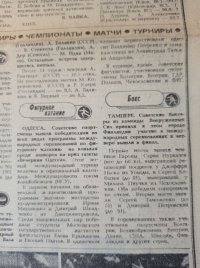
ODESA. Soviet athletes emerged as winners in all program disciplines at the international junior figure skating competitions for the prize of the newspaper "Vechernyaya Odessa" (Evening Odesa). This new international tournament has been included in the official calendar of the International Skating Union (ISU).
In Pairs Skating, Irina Mironenko and Dmitry Shkidchenko from Dnipropetrovsk demonstrated high skill in both the short and free programs. Among the Ice Dance couples, students from the Moscow State Institute of Physical Culture, Elena Krykanova and Evgeny Platov, were victorious. In Men's Singles, Odessa's Vladimir Petrenko took first place, while seventh-grader Tatyana Andreeva from Leningrad won the Women's Singles.
In addition to Soviet skaters, athletes from Bulgaria, Hungary, East Germany (GDR), Poland, Czechoslovakia, and West Germany (FRG) participated in the tournament.
1772125917807.jpeg
 
Last edited:
1984
International competitions for the prize of the USSR Trade Unions


Figure Skating

(the article published in russian 'Sovetskiy Sport' on October 30, 1984)

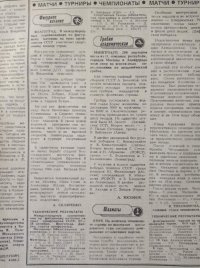
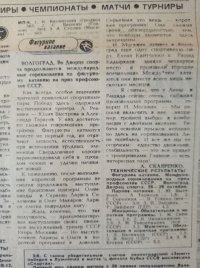
VOLGOGRAD. Athletes from eight countries are participating in the international figure skating competitions for the prize of the USSR Trade Unions.
The figure skaters are being hosted by the city’s finest Sports Palace. Adjacent to it is an indoor training rink.
The senior coach of the All-Union Council of the Trade Unions' Voluntary Sports Society (DSO), I. Filippov, notes:
"This tournament has fine traditions. It is being held for the 15th time. In their time, famous masters such as Igor Bobrin, Yuri Ovchinnikov, Natalia Bestemianova, and Andrey Bukin have been winners here..."
This time, the favorites on the ice were the Olympic bronze medalists from Sarajevo, Leningrad residents Larisa Selezneva and Oleg Makarov. In their new short program, they executed all technical elements cleanly and at high speed. The Leningraders are leading in the pairs competition.
In the men's singles, Andrey Efremov, a student at the Volgogard Institute of Physical Culture, has made a successful start to the struggle. In the compulsory figures, he managed to pull ahead of the 1984 national champion, Vitaly Egorov.
The ice dance duo from Moscow, Maya Usova and Alexander Zhulin, stands out. Pupils of coach Natalia Dubova, they demonstrate effortless gliding and a high level of choreographic preparation.​

A. SKLYARENKO.

TECHNICAL RESULTS
International Figure Skating Competitions for the Prize of the USSR Trade Unions. October 27–28. Volgograd. Palace of Sports of the Trade Unions.
Women (Compulsory Figures):
1. I. Ovchinnikova (USSR) – 0.6; 2. M. Serova (both USSR) – 1.2; 3. B. Kus (FRG) – 1.8.
Men: 1. L. Kaznakov (USSR) – 0.6; 2. N. Köpp (GDR) – 1.2; 3. A. Efremov (USSR) – 1.8.
Pairs (Short Program): 1. L. Selezneva / O. Makarov – 0.4; 2. Yu. Bystrova / A. Tarasov (both USSR) – 0.8; 3. P. Seidel / R. Seifert (GDR) – 1.2.
Ice Dance (Compulsory and Original Dance): 1. M. Usova / A. Zhulin – 1.0; 2. Yu. Romanova / D. Smirnov – 2.0; 3. E. Koltsova / O. Volkov (all USSR) – 3.0.
1772127529518.jpeg
 
Last edited:
1984
International competitions for the prize of the USSR Trade Unions


Figure Skating

(the article published in russian 'Sovetskiy Sport' on October 31, 1984)

VOLGOGRAD. International figure skating competitions for the prize of the USSR trade unions continue at the Palace of Sports.
As always, pairs attracted special attention from the audience. The victory here was won by the pupils of coach A. Rennick, Yulia Bystrova and Alexander Tarasov. They have a fairly complex modern program. The skaters have been skating together for more than a year; they are distinguished by lightness and naturalness when performing difficult elements. The Sverdlovsk athletes proved themselves well last season and are starting the new one successfully.
Unfortunately, after performing the short program, the bronze medalists of the Sarajevo Olympics, Larisa Selezneva and Oleg Makarov, were unable to continue their performance: Larisa slightly injured her leg.
"It's a pity, of course, that it happened," commented Igor Moskvin, Honored Coach of the USSR, on the performance of his students. "But I am pleased with Larisa and Oleg's performance in the short program. A short program is a serious thing! It is complex in its compulsory nature, because repeats of elements are prohibited here."
I. Moskvin brought another pair to Volgograd. Elena Kvitchenko and Rashid Kadyrkaev took fourth place and made a good impression. Meanwhile, they have been skating together for only a few months.
"I think that Lena and Rashid now have a very difficult free program," says I. Moskvin. "We decided to include in it, for example, a triple throw in combination with a double Axel. The kids mastered the jump quite well, but here at the competition, Lena made a mistake. And yet, we are not upset: unity of movement, stability—this will all come with training. The main thing is that an interesting pair exists!"​
A. SKLYARENKO.
TECHNICAL RESULTS
Figure skating. International competitions for the prize of the USSR trade unions. Volgograd. Palace of Sports. October 28–29.
Pairs skating:
1. Y. Bystrova — A. Tarasov: 1.8; 2. G. Sorokina — I. Guenko (all USSR): 3.6; 3. P. Seidel — R. Seifert (GDR): 4.2.
Women. Compulsory and short programs: 1. M. Serova: 1.6; 2. N. Ovchinnikova: 2.6; 3. M. Tveretinova (all USSR): 3.2.
Men. Compulsory and short programs: 1. L. Kaznakov (USSR): 1.0; 2. N. Köpp (GDR): 2.4; 3. V. Egorov (USSR): 3.2.
1772128444063.jpeg
 
1984
International competitions for the prize of the USSR Trade Unions


Figure Skating

(the article published in russian 'Sovetskiy Sport' on November 1, 1984)

VOLGOGRAD. The international figure skating competitions for the prize of the USSR Trade Unions concluded on a festive note. The original free dance performed by Muscovites Maya Usova and Alexander Zhulin left neither the spectators nor the specialists indifferent.
Summarizing the tournament, the head coach of the All-Union Council of the Trade Unions' Voluntary Sports Society (DSO), Igor Filin, noted:
— The ice dance competitions were held at a high sporting level. Both the winners and the prize-winners deserve praise, especially the pair from Odesa, Elena Koltsova and Oleg Volkov, who have noticeably improved compared to last season. The Odesa skaters are trained by Boris Rublev, who knows how to find talented figure skaters.
The winners in pair skating, Sverdlovsk residents Yulia Bystrova and Alexander Tarasov, demonstrated a confident style and synchronized jumps. The increased skill of the pair from Dnipropetrovsk, Galina Sorokina and Igor Guenko, who took second place, was a pleasant surprise.
The victory in men's singles was won by a figure skater from the GDR, Nils Köpp.
Alas, our girls did not please us this time. A pleasant exception was only the performance of Leningrader Inna Krupdysheva, who won the free program (coach I. Moskvin).​
A. SKLYARENKO.
TECHNICAL RESULTS
International figure skating competitions for the prize of the USSR Trade Unions. Volgograd, Sports Palace, October 28–30.
Ice Dance.
1. M. Usova — A. Zhulin — 2.0; 2. Yu. Romanova – D. Smirnov — 4.0; 3. E. Koltsova — O. Volkov (all — USSR) — 6.0.
Women's Singles. 1. M. Serova — 3.6; 2. I. Krundysheva — 6.2; 3. M. Tveretinova (all — USSR) — 6.2. Men's Singles. 1. N. Köpp (GDR) — 3.4; 2. L. Kaznakov — 4.0; 3. A. Efremov (both — USSR) — 5.8.
1772182280112.jpeg
 
1984
SKATE CANADA

Figure Skating

(the article published in russian 'Sovetskiy Sport' on November 2, 1984)

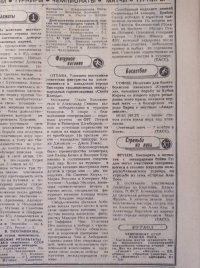
OTTAWA. Soviet figure skaters successfully performed at the traditional international competitions "Skate Canada," which concluded in the Canadian city of Victoria.
Muscovites Olga Volozhinskaya and Alexander Svinin emerged as winners in the ice dance tournament. In a contest with their closest rivals—the experienced duo from West Germany, Petra Born and Rainer Schönborn—they did not yield the lead in any of the types of the "dance triathlon." In third place were Canadian ice dancers Kelly Johnson and John Thomas.
Equally absolute was the advantage of Leningraders Elena Bechke and Valeriy Kornienko in the pair skating competition. A total of five duos competed in the pair skating tournament, including two Canadian pairs. Specialists in Canadian figure skating place high hopes on Cynthia Coull and Mark Rowsom, and Katherina Matousek and Lloyd Eisler, who took second and third places respectively.
Natalia Lebedeva from Sverdlovsk took third place in the women's singles, trailing behind Japanese skater Midori Ito and American Tiffany Chin. The 15-year-old Ito moved toward victory from "third position." After the compulsory and short programs, she was losing to Chin and Lebedeva. However, the young Ito charmed the judges and spectators with her performance of the free program and earned her first victory in a major international tournament.
The silver medalist of the '84 Winter Olympics, Canadian Brian Orser, won in the men's singles. In second place was Grzegorz Filipowski (Poland), and in third was Masaru Ogawa (Japan). Orser's main rival, Heiko Fischer (West Germany), who led after the "school" (compulsory figures), suffered a minor injury and withdrew from the competition. Soviet "singles" skaters did not participate in the tournament.​
(TASS).
1772184236576.jpeg
 
1984
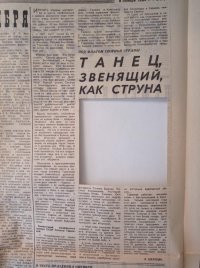
A DANCE RINGING LIKE A STRING

(the article published in russian 'Sovetskiy Sport' on November 8, 1984)

Many figure skaters strive to study the standards of mastery and somehow approach the level of world champions. But only a select few succeed. And the bolder the performers—the creators—depart from the canons, the more difficult their path becomes.
"No! No! Again you brought that path with splits to the middle of the rink," Tatiana Anatolyevna Tarasova stops her students. "And I ask you to lead diagonally. I ask once more..."
"I ask once more." This is easy to say. For about twenty seconds, Natalia Bestemianova and Andrei Bukin glide silently on the ice and listen to the music. They take up an absolutely precisely calculated position 15 meters from the boards of the rink and, from a certain beat of the music, they repeat the element that was there before. Again, they take a stormy start. A second for a semi-lift, a second for a circle, a second for rotations. Then a cascade of three splits across the entire length of the rink. But I am essentially only talking about the technical pattern of the dance. Yet in these same seconds, a dramatic dialogue between two lovers, two proud people, is played out. The dialogue of Carmen and José.
The idea of setting a competitive free program entirely to the music of Bizet-Shchedrin's "Carmen" looks typically "Tarasova-esque" in itself: it is both daring and powerful in concept. But it is also logical, if one recalls the previous dances of Bestemianova and Bukin—say, "The Russian Fair" last season, or the composition to Charlie Chaplin's melodies back in 1978. And it is no coincidence that Natasha Bestemianova admits that all the preceding years she and her partner were maturing internally and spiritually for "Carmen."
Appealing to a renowned work carries great responsibility. In the new dance of Tarasova's pupils, the most complex dramaturgy and a variety of intonations come to the fore, where the uniqueness of two parts is clearly traced: Carmen, with her impulse, her unbridled feelings, and her self-sacrifice; and José, with his devotion, his doubts, and his stoic endurance.
A year ago, Natasha and Andrei, together with Tarasova, began to think through the design of the future program. They reread Prosper Mérimée's prose, familiarized themselves with Spanish painting, went to ballet performances, and passed everything they saw through the prism of the future dance.
Commentary by Honored Coach of the USSR Tatiana Tarasova:
"We viewed the four-minute free dance as a small performance with a single storyline, with a beginning, a climax, and a resolution. Everything was dictated by a single musical theme. In my view, a dance of this type was demonstrated by four-time world champions Jayne Torvill and Christopher Dean. Only ideal technical equipment can accompany this decision, and that is probably why such a complex direction is currently chosen only by the leaders of ice dance."
Let's be blunt: the impression of Bestemianova and Bukin's "Carmen" is indelible. I witnessed many of Tarasova's former pupils—well-known figure skaters Tatiana Voitiuk, Natalia Karamysheva, Rostislav Sinitsyn, Igor Zavozin—coming to practice. They watched fragments of the new program several times in a row. Their interest in the dance did not wane; "Carmen," full of dynamics, sharp and unexpected collisions, kept everyone in suspense.
Tarasova's pedagogy (and she has dedicated 17 years of her life to coaching) is unique. In it, one must seek the origins of programs like "Carmen."
"My father, Anatoly Vladimirovich, used to say to me: 'Tanya, you must conduct a session as if it were your last training session in life! Do not spare yourself!'"
This, perhaps, is the essence of Tarasova's method. In the programs staged in recent years, the best qualities of Tarasova as a choreographer and Bestemianova and Bukin—silver medalists of the Sarajevo Olympics and European champions—as performers have been manifested.
"One of the principles in our work on a competitive dance is a constant search through 'I can't,'" emphasizes the coach. The performers achieve success by overcoming any technical, physical, or psychological discomforts. Programs are performed repeatedly at many practices, and after this labor, the figure skaters dance with even greater temperament, embodying the intended image.
Tarasova has been working with Bestemianova and Bukin for eight seasons. For the past four years, they have consistently been among the medalists of world championships. But it is not just about the stability of our national team's leaders. Both a year earlier and especially now, the duo remains faithful to their general direction: they treat their program as a complete and unified work with continuous action and an original plastic solution. They are not afraid to go beyond the generally accepted canons and they convince the judges and spectators: yes, this is the only correct decision! And, it seems, our audience loves the figure skaters precisely for this fidelity to their style, for a dance that always rings like a string.​
A. SHELUKHIN.
1772186386647.jpeg
 
1984
MOSCOW OPEN CHAMPIONSHIPS

WHAT WAS REFLECTED IN THE ICE MIRROR

(the article published in russian 'Sovetskiy Sport' on November 11, 1984)

Finally, the main forces of our national figure skating team have entered the fray. At the open Moscow championship in Luzhniki, both young and many eminent skaters have started.
A discussion has long been underway about how to interpret the concept of "entertainment value" in modern figure skating, and the compositions prepared for the new season provide plenty of food for thought. In the tournament for candidates for master of sports (where juniors competed), the Moscow duo of E. Gordeeva and S. Grinkov, candidates for the USSR youth national team, clearly stood out. Their short program was warmly received by both the audience of thousands and the judges. The skaters' coach, world championship medalist Stanislav Leonovich, and choreographer Marina Zueva, managed to find a very expressive, fluid plastic pattern for the program set to the music of a Strauss waltz. The main merit of the young pair is their ability to combine the purity of all technical elements with a clearly expressed lyrical style.
The pair of M. Pestova and S. Leonovich—mature masters—was also distinguished by lyricism in its time. It was much more difficult to identify the same qualities in the young duo (Gordeeva is 14 years old, Grinkov is 16). It is all the more pleasant to see that entertainment value has become an ally of these skaters as well.
The desire for entertainment value cannot be denied to such young pairs as G. Sorokina and I. Guenko (Dnipropetrovsk), T. Pashnina and M. Fedorenko (Sverdlovsk), who competed in the masters of sports tournament. But the first duo lost a lot because they chose disco-style music for their short program. Monotonous, rhythmic music did not allow the athletes' individuality to be revealed. Meanwhile, their physical data is excellent. Unfortunately, the pursuit of a "fashionable" novelty sometimes leads to the program losing its entertainment value.
The best result in the short program was shown by world championship participants Muscovites V. Pershina and M. Akbarov (coached by Olympic champion Irina Rodnina). Their choice of music was successful—a beautiful waltz made it possible to show both plasticity and purity of skating...
Great interest was aroused by the performances of the country's strongest female singles skaters: '84 Olympic medalist K. Ivanova, world championship silver medalist A. Kondrashova, and medalist of an international tournament in Austria M. Tveritinova. Their competition in the short program was a continuation of the discussion about entertainment value.
The compositions of Kondrashova and Ivanova represented a harmony of honed technique and artistry. Even in the short program, where everything is subject to the strict laws of tactics, the skaters' jumps resembled elegant calligraphy, reflecting the character of the performers. Kondrashova had scores of 5.5-5.7, and Ivanova had 5.5-5.6. The start of the season turned out to be spectacular.​

A. SHELUKHIN.
1772187514742.jpeg
 
1984
PRAGUE SKATE

FIGURE SKATING

(the article published in Ukrainian 'Sportyvna Hazeta' on November 13, 1984)
PRAGUE. Figure skaters from Sverdlovsk Yulia Bystrova and Alexander Tarasov took first place in the "Prague Skate" pairs competition. Muscovite Gurgen Vardanyan was third among the singles, while the athlete from Czechoslovakia Petr Barna won. Second place was taken by Richard Zander (FRG).
Young Muscovites Irina Zhuk and Oleg Petrov were fourth among the ice dance couples. The best here were the Japanese Noriko Sato and Tadayuki Takahashi.
1772187927226.jpeg
Figure Skating

(the article published in russian 'Sovetskiy Sport' on November 13, 1984)

PRAGUE. Sverdlovsk figure skaters Yulia Bystrova and Alexander Tarasov won first place in the pair skating competition for the "Prague Skate" prizes.
Muscovite Gurgen Vardanyan was third in the men's singles competition, while the winner was Czechoslovakian athlete Petr Barna. Second place went to Richard Zander (FRG).
Young Muscovites Irina Zhuk and Oleg Petrov finished fourth among ice dance pairs. First place was taken by the Japanese pair Noriko Sato and Tadayuki Takahashi, second were Kathrin and Christoff Beck (Austria), and third were Margaret Bodd and Rick Berg (USA).​
(TASS).
1772188245323.jpeg
 
1984
MOSCOW OPEN CHAMPIONSHIPS

COUNTING CASCADES IN AUTUMN

(the article published in russian 'Sovetskiy Sport' on November 13, 1984)

European champion Alexander Fadeev received ten scores of 5.9 while performing his new short program at the open Moscow figure skating championship in Luzhniki. He also won the free skate with scores of 5.9.
"Starts in November have become the rule for me," Fadeev said after the competition. "In 1982, I participated in an international tournament in Tokyo, where I met the multi-time world champion Scott Hamilton. Back then, he couldn't beat me in the short program. And that convinced me that it’s possible to reach good athletic form as early as autumn..."
Last season you performed a short composition to charleston music. Now you have a new program to Russian melodies. What do you see as the fundamental difference between these programs?
"Actually, I like both compositions. But, perhaps, in the current program there is more space, more opportunities for high-speed execution. Maybe this helped me to perform a jump cascade with a triple and a half axel already at the beginning of the season..."
Have you already had performances with the new composition this autumn?
"Yes, there was a test of strength at the exhibition performances in Helsinki. But the axel didn't work out then. The execution of this unique element requires many conditions. It is preceded by long physical and psychological preparation..."
Another Moscow figure skater, Yu. Bureiko, also performed successfully, executing a program with an original concept easily, in one breath. He confidently took second place.
The women completed their struggle in the free skate. In the master of sports tournament, the silver medalist of the world championship A. Kondrashova won. But let's note that her main rival K. Ivanova did not start on the last day of competition. Muscovites M. Tveritinova and I. Grigoryan stood out in this tournament with their artistic compositions. Among the juniors, the strongest was L. Grashoven, a student of the AZLK figure skating school (coach A. Eremin).​
A. SHELUKHIN.
1772189081637.jpeg
 
1984
MOSCOW OPEN CHAMPIONSHIPS

THE "WINGED SKATES" FESTIVAL

(the article published in russian 'Sovetskiy Sport' on November 14, 1984)

For several years now, the Moscow Figure Skating Federation (chaired by M. Barkan) has been delighting capital sports fans by organizing autumn open championships featuring leaders of the national team and many figure skaters from other cities. These "Winged Skates" festivals have become a true showcase of mastery for the youth and, especially importantly, for coaches from young figure skating centers. This time, athletes from Leningrad, Kharkiv, Dnipropetrovsk, Sverdlovsk, Riga, Tallinn, and Alma-Ata were represented on the Moscow ice in Luzhniki.
One of the notable features of the current season is the good readiness of our leaders for November. Practically the entire USSR national team took to the ice on the final day of the tournament for exhibition performances. They came out to demonstrate their new free programs at full strength.
Rimsky-Korsakov's melody "Flight of the Bumblebee" (which has resonated on ice arenas more than once) continues its sporting "chronicle": this time, it was chosen for their short program by Olympic champions from Leningrad, Elena Valova and Oleg Vasiliev. Their mentor, Honored Coach of the USSR T. Moskvina, in this instance displayed her rich experience as a choreographer and director, skillfully weaving all seven mandatory elements into the plastic design of the composition.
The multi-thousand-seat stands very warmly welcomed the silver medalists of the '84 Olympics—Natalia Bestemianova and Andrei Bukin. Their new free dance, "Carmen," to the music of Bizet-Shchedrin, can rightfully be called a work of choreographic art, performed at a high level of mastery, with sincere excitement and passion.
Recognized masters A. Fadeev, K. Ivanova, A. Kondrashova, O. Volozhinskaya and A. Svinin, N. Annenko and V. Sretensky, V. Pershina and M. Akbarov added fresh colors to this ice festival.
One cannot fail to note several new names discovered in the Moscow ice dance tournament. Pupils of Honored Coach of the USSR T. Tarasova—Yu. Romanova and D. Smirnov not only became the winners of the competition but also earned the most flattering reviews from specialists after their performance of the quickstep. I. Pronkina and I. Shpilband (coached by Olympic champion L. Pakhomova), who took second place, stood out for their lyricism and choreographic culture. E. Solovieva and A. Filippov, pupils of Honored Coach of the RSFSR N. Dubova, were distinguished by their temperament.​
A. SHELUKHIN.
1772190310887.jpeg
 
1984
SKATE CANADA

Figure Skating

(the article published in russian 'Sovetskiy Sport' on November 2, 1984)

OTTAWA. Soviet figure skaters successfully performed at the traditional international competitions "Skate Canada," which concluded in the Canadian city of Victoria.
Muscovites Olga Volozhinskaya and Alexander Svinin emerged as winners in the ice dance tournament. In a contest with their closest rivals—the experienced duo from West Germany, Petra Born and Rainer Schönborn—they did not yield the lead in any of the types of the "dance triathlon." In third place were Canadian ice dancers Kelly Johnson and John Thomas.
Equally absolute was the advantage of Leningraders Elena Bechke and Valeriy Kornienko in the pair skating competition. A total of five duos competed in the pair skating tournament, including two Canadian pairs. Specialists in Canadian figure skating place high hopes on Cynthia Coull and Mark Rowsom, and Katherina Matousek and Lloyd Eisler, who took second and third places respectively.
Natalia Lebedeva from Sverdlovsk took third place in the women's singles, trailing behind Japanese skater Midori Ito and American Tiffany Chin. The 15-year-old Ito moved toward victory from "third position." After the compulsory and short programs, she was losing to Chin and Lebedeva. However, the young Ito charmed the judges and spectators with her performance of the free program and earned her first victory in a major international tournament.
The silver medalist of the '84 Winter Olympics, Canadian Brian Orser, won in the men's singles. In second place was Grzegorz Filipowski (Poland), and in third was Masaru Ogawa (Japan). Orser's main rival, Heiko Fischer (West Germany), who led after the "school" (compulsory figures), suffered a minor injury and withdrew from the competition. Soviet "singles" skaters did not participate in the tournament.​
(TASS).
View attachment 10962
I went to that event as a spectator, since several of my friends in pairs were competing. There was another male pairs skater in Canada at the time named Kelly Johnston and the CFSA (as it was then) quite often got mail mixed up between him and the female ice dancer Kelly Johnson mentioned here. Their friends used to joke that one of them should switch to the other's discipline and then they should team up, and really cause confusion :scratch2::confused2:!
 
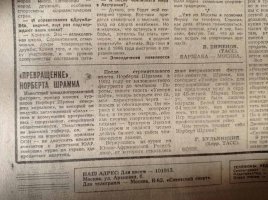
1984
THE "TRANSFORMATION" OF NORBERT SCHRAMM

(the article published in russian 'Sovetskiy Sport' on November 17, 1984)

The famous West German figure skater and winner of many tournaments, Norbert Schramm, has performed a "jump" that earned him a deserved "score": the anger and indignation of progressive athletes and the sports community. Tempted by a high fee, he—despite well-known UN appeals to prevent any contact with the racists of South Africa—went on a tour of the country where apartheid flourishes.
After Norbert Schramm's rapid rise in 1982 from an obscure figure skater to European champion, the newspaper Unsere Zeit writes, his most characteristic trait has now been revealed: a thirst for enrichment. He broke with the man to whom he was primarily "indebted for his sporting successes," coach Erich Zeller, and set out to do business on his championship title.
Returning from a tour of the Republic of South Africa, which even American amateur figure skaters had refused, Schramm, as Unsere Zeit reports, to popularize his persona, proposed his hand and heart to 40-year-old Marika Kilius. Kilius was stripped of her 1964 Winter Olympics medal after it was revealed she had signed a contract with a professional revue before the Games began.
How will Norbert Schramm manifest himself now?​
G. KULBITSKY. (TASS Corresp.).
BONN.
1772283798853.jpeg
 
Back
Top