Archive of newspaper articles | Page 27 | Golden Skate

Archive of newspaper articles

1985
How are you living, champion?


Ice Blizzard on Lilac Boulevard

(the article published in russian 'Sovetskiy Sport' on September 25, 1985)

Late Moscow evening. The streets are plunged into darkness. But on Lilac Boulevard, the house on the hill — the physical education institute’s new artificial ice rink — is all aglow with lights. Despite the late hour, life here is bustling just as it does during 'rush' hours. But, perhaps, the most curious thing about this situation is the appearance on the ice arena of guests from Leningrad: Olympic, World, and European pair skating champions Elena Valova and Oleg Vasiliev.
The figure skaters had a busy life in the capital: as members of the Soviet delegation at the World Festival of Youth and Students, Valova and Vasiliev took part in rallies, club meetings, and discussions about youth sports. But now, the 'Mayak' radio station call signs have finished chiming in the loudspeakers, counting down the time. 21:00 (9:00 PM). Time to hit the rink! From that moment on, the figure skaters' thoughts are on the ice arena…
Psychology of a Duo
— Oleg, both you and Elena happened to perform for several years in the role of singles skaters. Only the last five seasons of yours have been connected with pair skating. What has pair skating brought with it in a psychological sense?

My question did not catch the Olympic champions off guard. Oleg’s answer followed instantly:
— There is a difference, and a huge one at that! We constantly feel like a small collective, where everyone carries a double burden of responsibility — both for oneself and for the other. Every step on the ice immediately triggers a thought: you are not alone; how will your partner react to your movement? This 'sense of the elbow' (feeling of teamwork/support) does not disappear even when we leave the ice.
Elena Valova, completely agreeing with Oleg’s opinion, nonetheless wanted to expand on the topic of the role of psychology:
— To some sports fans, our path in pair skating resembles a labyrinth. For three seasons, we were, so to speak, in the shadows, behind the backs of the leading pairs. Yes, there were failures. But every defeat seemed to spur us on; we became 'meaner' (more determined), more cheerful, and more energetic in training. And perhaps that is why entering the arena of the European Championship did not present a psychological barrier for us. We skated easily, without inhibition. Having become more experienced, we very quickly understood that the main danger lies precisely in victories. Yes, the first moments of victory are very pleasant. But they are exactly what relaxes the will. That is why Oleg and I wanted to forget the past tournament as early as the next morning; we rushed to training with thoughts of a new program, a new dance. To forget the past is, in a way, to conquer oneself. Then you see the path to the future more clearly…
Does this mean that you believe in the infinite perfection of mastery and technique?
— We believe and have always believed, — remarked Elena Valova. — We, of course, understand that the higher you climb, the more difficult it becomes. In high-level sports, every new step is overcome with much greater effort than at the beginning of the journey. And yet, this path is captivating. And how could it be otherwise?​
Programs-86
Visually, they don't exist yet—these programs of the upcoming season. And yet they already exist in the creative imagination of the performers and the champions' mentor—Honored Coach of the USSR Tamara Moskvina.
— Moskvina’s favorite phrase is: 'Guys, it’s you who’s skating, not me. Think, think constantly!' — Oleg Vasiliev shared a secret. — And we do think. Every day we bring new musical fragments to the rink, trying out elements and transitions. Not a single question regarding future compositions is decided without our involvement. Elena, for example, has put together so many different programs that she could 'equip' an entire school of figure skaters for the season…
— And won't you whisper in my ear what you have already planned?
— Music by Georgy Sviridov. The dance 'The Blizzard,' — said Valova. — But this is a top secret because the dance won't be ready until September. There are many reasons for this. The Leningrad duo has planned to replace both competitive programs — the short and the free. Moreover, they plan to conduct a 'reconnaissance in force' very early: to take part in the November international tournament in Tokyo, and then literally ten days later start in the Moscow tournament. A tight schedule. Is this, perhaps, a novelty? A departure from the system tested over the years? The skaters themselves do not think so. That which has been developed over years cannot be replaced. The backbone of the original system always remains, but every season corrections are made to the system.
— Flexibility is one of the main pedagogical principles of Tamara Nikolaevna Moskvina, and we are learning from her, — notes Elena Valova.
— Is there something important that, so to speak, charges you for creative work in the upcoming season?
— Absolutely. For example, this summer — getting acquainted with new ballets in Leningrad. Our Kirov Theater showed two wonderful premieres — 'The Knight in the Tiger's Skin' and 'Spartacus.' The performers' technique was so brilliant that we also wanted to experience such a lift on the ice, the same freedom of movement. One of our mottos: 'Live for a century — learn for a century.' It helps our work...
— And what other catchphrases do you use?
— Hurry, but don't rush...
SKATES, PIANO AND MOVIE CAMERA
In the spring of this year, Oleg Vasiliev acquired a new profession: he became a cinematographer.
— Actually, I have dreamed of working with a movie camera since childhood, — he admits. — But it so happened that only in 1983 did I start filming the programs of pairs on film. Now I have been able to film the entire spring tour of our national team at various rinks around the world. In my plans several more films on a specific theme…
— And what is planned for the future for Elena?
— I dream of learning to play the piano. Music has entered my life so deeply that I am beginning to regret not having received a special education in my time. And yet, I am making up for lost time. I don't miss a single music competition. I follow very closely what is happening in related sports. For example, in rhythmic gymnastics. My sympathies are with Galina Beloglazova and Dalia Kutkaitė. Their performances, in my opinion, are very instructive for many figure skaters.
— Last question. How do you envision the near future of figure skating?
Elena:
I am convinced that the reserves of our sport are inexhaustible. Primarily in artistry and the revelation of musical images. I am sure that we will soon see compositions that are brilliant in both form and content.
Oleg: It seems to me that the time is coming for a new wave of talent in figure skating. Of course, it is difficult now to name someone, say, in women's single skating, where it is risky to make predictions. But in other disciplines, we can now talk about interesting phenomena. In ice dance today, Natalia Bestemianova and Andrei Bukin, Marina Klimova and Sergei Ponomarenko are clearly ahead, and behind them is an entire galaxy of gifted ice dancers—at least five or six young duos. In pair skating, the World Junior champions Katya Gordeeva and Sergei Grinkov have good prospects. There are two more interesting duos in the CSKA school. Well, and in men's single skating, in my opinion, our world champion Alexander Fadeev, the owner of uniquely difficult cascades, has secured leadership for several years ahead. The young Odessan Viktor Petrenko is catching up to him. In short, our coaches have plenty of reasons for optimism. I think our generation will also have its say. In any case, Elena and I believe in it!"​
Interview conducted by A. SHELUKHIN.
1778180108811.jpeg
 
Last edited:
1985
ST. IVEL INTERNATIONAL

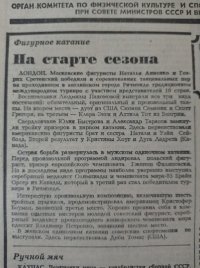
At the Start of the Season

(the article published in russian 'Sovetskiy Sport' on September 28, 1985)

LONDON. Moscow figure skaters Natalia Annenko and Genrikh Sretenski won the ice dance competition at the traditional international tournament held in the English city of Richmond, which featured representatives from 10 countries.
Students of Lyudmila Pakhomova won all three parts of the competition: the compulsory, original, and free dances. In second place was the American duo Suzanne Semanick and Scott Gregory, and in third were Klara Engi and Attila Tóth from Hungary.
Sverdlovsk skaters Yulia Bystrova and Alexander Tarasov rounded out the top three in pair skating. American skaters, siblings Natalie and Wayne Seybold, took first place here. The second-best result went to Christine Hough and Doug Ladret (Canada).
A fierce struggle unfolded in the men's singles event. Before the free program, Polish skater and European Championship medalist Grzegorz Filipowski was leading. However, in the final event, the Olympic and 1985 World Championship silver medalist Brian Orser from Canada performed most confidently, winning the Richmond tournament for the third time.
An interesting free program composition, including six triple jumps, was demonstrated by American Christopher Bowman, who took third place. Young Soviet figure skater Vladimir Petrenko, an Odessa native and silver medalist of last year's World Junior Championships, showed well among the experienced masters, taking sixth place.
Soviet athletes did not compete in the women's singles. Debi Thomas (USA) took first place here.
1778251724598.jpeg
 
1985
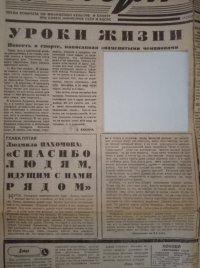
Lessons of Life

(the article published in russian 'Sovetskiy Sport' on September 29, 1985)

A story about sports, written by famous champions

A quiet, slightly sad smile dissolved in her eyes, which appeared completely dark in the twilight of a stormy day. Pakhomova fell into a long silence. The chair creaked ever so slightly.
"How difficult it is... I've lived through so much, seen so much, but to remember something main—it turns out, it's not simple at all," Lyudmila Alekseevna Pakhomova fell silent. "But anyway, I will tell you about what I cannot imagine myself without. Let it sound a bit high-flown, but it is very important for me—my figure skating and my family, my parents..."
I listened to Lyudmila Alekseevna, and in my memory, there arose that cold December day, the television screen and a close-up of her face, unusually sad, even though Pakhomova was smiling. The smile didn't help. On that day, the amazing ice dance duo Lyudmila Pakhomova and Alexander Gorshkov were leaving competitive sports. And now, just as then, I wondered: could it really be in the past—that eye-blinding spark, that energy of joy that broke through even in their lyrical, tender ice performances?
And suddenly, shattering all my doubts, Pakhomova remembered some funny episode. She burst out laughing. Dimples appeared on her cheeks, and there were "merry devils" (mischievous glints) in her eyes. No, she hadn't changed; it’s just that everything had hidden a little deeper—after all, it wouldn't be dignified; she is a coach now, after all...
Later, when the piece was finished, Pakhomova read it one last time and suddenly had doubts: 'Is it okay that there are no victories, defeats, or injuries in my memories... that it's all somehow very "at home" and personal?' But then she shook her head and answered the question herself: 'But then again, you asked for the most important thing!'"
E. KASHINA.
Chapter Five
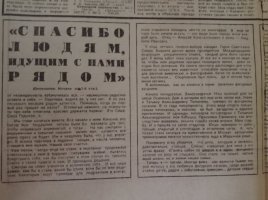
Lyudmila Pakhomova: "Thank You to the People Walking Beside Us"

The rink. A cold rectangle of ice. The rain had pressed a yellow leaf against the huge windowpane that stretched across the entire wall. Autumn. My favorite time of year. A time of 'sad optimism,' as I call it. A new season lies ahead, which means hoping for the best. Memories come more often to the sound of autumn rain—and even if they are happy, they inevitably carry a shade of sadness: what has passed will never happen again.
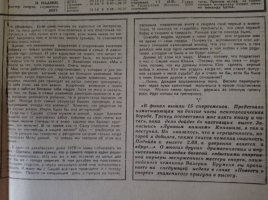
That year, I was left without a partner. We stopped competing together. There had been a couple. One person left, and it turned out that both of us ceased to exist on the ice. Because alone, I wasn't needed by anyone. The situation was trivial. So many couples in figure skating break up... And yet. Perhaps everyone in their life has lost, say, their keys at least once. 'What's the big deal?' you might exclaim. But imagine that it was you who lost the keys, and you are standing in despair before a locked door: it takes an hour and a half to get to friends who can take you in, it’s a dark, cold evening outside, and behind that indifferent door, which silently listens to your curses, it is warm and cozy. Can you imagine it? If you look at it that way, many of life’s zigzags are trivial, but until something similar happens to you, you suddenly feel through your own experience how hard it is to lose even an ordinary key. And I was losing my life's work. Day after day, I was tormented by thoughts that always ended with a single question. Sometimes it felt like everything around me consisted of nothing but those treacherously curved punctuation marks. What should I do next? To skate or not? If I skate, then with whom? I thought about this when I went to practice, when I skated restlessly and lonely on the ice, when I returned home...
I knew that sooner or later, the doubts would end. It was my father who finally dotted the 'i's. One evening at home, we were having yet another conversation on this topic, which tormented not only me but my family as well. My father remained silent for a long time and then said: 'If you have chosen "to be" over "not to be," then you must be to the fullest. You need to find a partner who can withstand the path you have set for yourself. Someone who can be a support for you. You must find such a person. Let your heart and your own human experience—small as it may be for now—guide you.'"
Perhaps my father felt exactly which words he needed to say to me then. Behind their outward simplicity and a certain obviousness lay the most important thing — they calmed me and gave me a sense of direction. And if before I had only been mentally asking, 'Who, who will skate with me?', now I knew firmly what my future partner should be like. And the moment I tried to imagine his face, I almost cried out from surprise. "I've worn myself out completely," I told myself mockingly and joyfully. "Look at her—she says she doesn't have a partner. But he's been skating right next to her for several months already. Remember when he first came to the rink? A bit awkward, but his posture—you noticed it yourself: he carried himself beautifully! It’s Sasha. Sasha Gorshkov..."
...We started skating together. We started from scratch. Of course, my titles at the time were too small for us to be called "famous" back then... People looked at us with bewilderment and hidden irony: why, they wondered, are they skating? There's no point anyway. They had no idea what lay ahead for us. I was looking for a partner in ice dance, but I found a person who became my husband. I found my happiness.
Later, when my father was gone, I mentally continued to consult with him in difficult life situations. I tried to imagine how he would have acted, asked for advice from my memory of him. And a solution would always come.
I look at my students and remember myself. And more and more often I think about what I would have become if not for my parents. Some look for role models in books, others try to resemble movie heroes. But I didn't need to look—these people were before my eyes every day. My father, Alexei Konstantinovich, and my mother, Lyudmila Ivanovna.
My father—a pilot, a Major General of Aviation, a Hero of the Soviet Union, and long-time president of the International Federation of Aeronautical Sports—had a thousand things to do every day. My mother also had plenty of worries. And yet, I never saw my parents spending time idly, even their rest was active. From his tight work schedule, my father somehow managed to find time for painting and photography. He went to all sorts of exhibitions... He was very athletic; a pilot couldn't be any other way.
I remember how he reacted to my figure skating.
The early fifties. Zamoskvorechye. Our noisy house on Osipenko Street—a house where everyone knew everything about everyone. They knew Tatyana Alexandrovna Tolmacheva, a figure skating coach. In those years, the popularity of this sport was just beginning, and therefore it was mysterious and doubly attractive. One day, after a neighborly chat with Tatyana Alexandrovna, my grandmother, Praskovya Efimovna, decided the fate of her granddaughter. My fate. And so, I went to the Young Pioneers Stadium rink—a simple, open-air rink, subject to snowfalls and thaws. A little later, I began to skate on the only tiny "patch" of artificial ice in Moscow, in Maryina Roshcha...
Gradually, my father became convinced that what I was doing was truly worthwhile. I never heard the phrase I feared most from his lips: "Chasing a dog around the yard" (wasting time) directed at figure skating. It became not just a part of my life, but of our family's life.
Now I am a coach. Sometimes I see how lonely a child can be in their favorite sport, among a cheerful flock of children, even next to a caring coach... A child's heart cannot be deceived. If at home none of the adults are interested in how dashingly you did your 'pistol squat' today and that your 'arabesque' is the best in the group; if a mother can’t manage to remember the name and patronymic of your coach, it becomes very, very sad.
I think that a parent's lack of attention to a child's sports activities is not just a flaw in the family relationship. Indifference goes further. And if adults don't know what their son or daughter is reading, or if they are reading at all, perhaps they are missing something very important in life? Saint-Exupéry said it correctly: "We are responsible for those we have tamed." Very true.
It is much easier for me to work with athletes whose parents find figure skating to be just as much of a joy. I am happy when adults, sacrificing their time and entertainment, come to the rink once again, watch a practice. I know from my own experience how important this is: the sincere attention to your affairs and concerns of the people close to you.
When Sasha and I became husband and wife, our families protected us from daily chores, taking all the domestic burdens upon their own shoulders (now I know how significant those "small things" are!). At that time, Sasha was asked if anything had changed in our lives. "Yes," he smiled. "Before, we only talked about figure skating when I was walking Mila home, but now we talk about it all the time..."
In one of those December days in 1976, my mother was getting ready to go to the dacha. She got dressed and took her bag. But at the very threshold, she suddenly turned around: "How can I leave you for two whole days! You'll starve to death." That December, we had said goodbye to competitive sports, and a few days later, I turned thirty. And yet, Sasha and I did see my mother off, and we didn't starve to death. It’s just that the next day, I went into the kitchen, opened a cookbook, and cooked my very first borscht. And I was never ashamed to admit that I cooked my first borscht at thirty. Before that, I simply didn't have the time.
Thank you to the people walking beside us; they gаve us not just time—but their hearts. For some reason, this funny culinary episode is what comes to mind. What is it? A memory of that December, or just another reminder of that love our parents had for us, which was and will be without end?
I think about this more and more often. Perhaps because our own Yulka [daughter Julia] is growing up. Because we are parents now, too. Because we must help Yulia make the right choice in life. Who could have guessed back then what figure skating would become in my fate? And would it have become that if my loved ones had a different attitude toward it?
...Autumn. Rain is lashing against the windows. A tiny boy in a bright plastic raincoat is jumping joyfully over puddles. You can jump safely while holding onto your father's strong hand. The child is going to practice.
1778256779979.jpeg
1778256797672.jpeg
1778256822370.jpeg
 
1985
"VECHERNYAYA ODESSA" PRIZE

Figure Skating

(the article published in russian 'Sovetskiy Sport' on October 22, 1985)

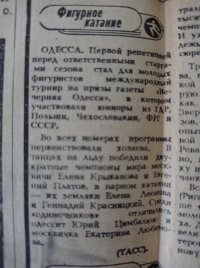
ODESA. The first rehearsal before the major starts of the season for young figure skaters was the international tournament for the prizes of the newspaper "Vechernyaya Odessa" (Evening Odesa), which featured juniors from the GDR, Poland, Czechoslovakia, West Germany, and the USSR.
The hosts dominated in all categories of the program. In ice dance, the winners were the two-time world junior champions from Moscow, Elena Krykanova and Evgeni Platov. In pair skating, their fellow Muscovites Elena Leonova and Gennady Krasnitsky took the top spot. Among the "singles" skaters, the standouts were Odesa native Yuri Tsymbalyuk and Muscovite Ekaterina Lyubimova.​
(TASS).
1778257413061.jpeg
 
1985
THE PALACE WAS FULL

(the article published in russian 'Sovetskiy Sport' on October 24, 1985)

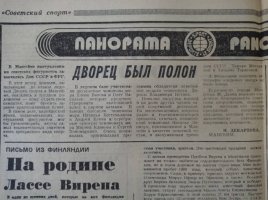
In Mannheim, performances by Soviet figure skaters concluded the "Days of the USSR in the FRG."
That evening, the spectators who filled Mannheim's Palace of Sports to capacity found themselves in a difficult position—deciding who to give their sympathies to and whom to toss their pre-prepared bouquets. Indeed, the kaleidoscope of bright, captivating performances could satisfy the tastes of even the most demanding connoisseurs of this beautiful sport.
Two-time world champions Elena Valova and Oleg Vasiliev participated in the ice ball, demonstrating the highest class in pair skating. World ice dance champions Natalia Bestemianova and Andrei Bukin, and world championship silver medalists Marina Klimova and Sergei Ponomarenko, also shone. The original program by European Championship silver medalist Vladimir Kotin was very well-received.
A significant load also fell to other members of our sports delegation. Olympic champion Natalia Linichuk, invited to Mannheim as a guest of honor, and Merited Coaches of the USSR Tamara Moskvina and Tatiana Tarasova had to answer numerous questions from radio and television commentators.
There was no end to those wishing to get autographs from the "stars of the ice."
The Mayor of Mannheim, M. David, expressed heartfelt gratitude to the Soviet athletes for giving the city's residents a wonderful sports festival, which will serve to further strengthen sports contacts.​
I. DEKARTOVA.
MANNHEIM.
1778258290286.jpeg
 
1985
SKATE AMERICA

Laconic Teletype

FIGURE SKATING

(the article published in russian 'Sovetskiy Sport' on October 25, 1985)

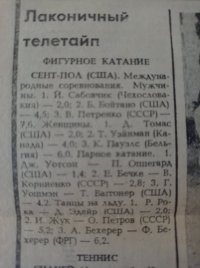
ST. PAUL (USA). International competitions.
Men. 1. J. Sabovčík (Czechoslovakia) — 2.0; 2. B. Boitano (USA) — 4.5; 3. V. Petrenko (USSR) — 7.6. Women. 1. D. Thomas (USA) — 2.0; 2. T. Wainman (Canada) — 4.0; 3. K. Pauwels (Belgium) — 6.0. Pairs Skating. 1. J. Watson — P. Oppegard (USA) — 1.4; 2. E. Bechke — V. Kornienko (USSR) — 2.8; 3. G. Wachsman — T. Waggoner (USA) — 4.2. Ice Dance. 1. R. Roca — D. Adair (USA) — 2.0; 2. I. Zhuk — O. Petrov (USSR) — 5.2; 3. A. Becherer — F. Becherer (FRG) — 6.2.
1778259174375.jpeg
 
1985
USSR TRADE UNION PRIZE


Prologue of the Season

(the article published in russian 'Sovetskiy Sport' on October 29, 1985)

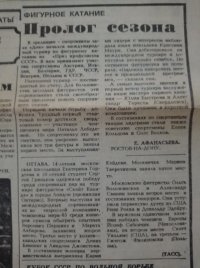
In the "Don" sports hall, an international figure skating tournament for the "USSR Trade Unions Prize" has begun. Athletes from Austria, Italy, Bulgaria, GDR, Czechoslovakia, Hungary, Poland, and the USSR are participating.
The current tournament is the sixteenth. For the majority of young figure skaters, these competitions have become a kind of prologue to the new sports season.
The girls were the first to start the struggle. Natalia Lebedeva, a participant of the world championship from Sverdlovsk, got the difficult first starting number. But this did not confuse the athlete; she confidently performed all three figures and took first place. A young Italian, Cristina Mauri, watched the leader's performance with interest. She was debuting at an international tournament and made several mistakes. However, the figure skater did not lose her optimism, saying: "I hope to make up for a lot in the free program."
The highest marks on the first evening of the tournament were earned by the masters of pair skating — Yulia Bystrova and Alexander Tarasov (Sverdlovsk). They were the best in the short composition.
In the ice dance competitions, the leaders were also Soviet athletes Elena Koltsova and Oleg Volkov.​
E. AFANASYEVA.
ROSTOV-ON-DON.


SKATE CANADA
OTTAWA. 14-year-old Moscow schoolgirl Ekaterina Gordeeva and 18-year-old student Sergei Grinkov won the sports pairs event at the "Skate Canada" figure skating tournament in London (Ontario). Competing for the first time in international competitions in "senior company," the 1985 World Junior Champions managed to beat the experienced Veronika Pershina and Marat Akbarov, who took second place. Third place went to the hosts—Canadian athletes Denise Benning and Lyndon Johnston.
In the women's competition, American Caryn Kadavy triumphed. Muscovite Marina Tveretinova took fifth place.
Moscow figure skaters Olga Volozhinskaya and Alexander Svinin took second place in the ice dance competition. They conceded the lead to the duo from the USA, Renee Roca and Donald Adair.
In the men's singles, European Champion Jozef Sabovčík (Czechoslovakia) won, with Scott Williams (USA) in second place and Grzegorz Filipowski (Poland) in third.​
(TASS).
1778260970166.jpeg
 
1985
USSR TRADE UNION PRIZE

Plot Variations

(the article published in russian 'Sovetskiy Sport' on October 30, 1985)

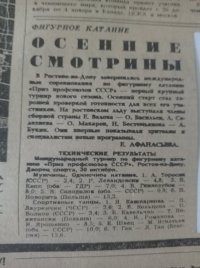
The international figure skating tournament for the "USSR Trade Unions Prize" continues in Rostov-on-Don.
The performances of the pairs are commented on by Merited Coach of the Country, I. Moskvin, whose students—E. Kvitchenko and R. Kadyrkaev—became the winners of the competition:
"Lena and Rashid demonstrated elements of unique complexity in their free program set to Bizet’s music from the opera Carmen. For instance, the sequence of a 'triple Salchow throw' immediately followed by a parallel double-axel jump is something no one else in the world is doing yet. Additionally, the pair showed great musicality and artistry, and I believe they deservedly took first place. I am also pleased with our other pair, S. Frantsuzova and O. Gorshkov, who took second place. The audience accompanied their 'Russian Dance' with applause. This duo also has many difficult elements: double-axel jumps and two types of throws—the Salchow and the now rarely seen Loop. Interestingly, these athletes perform all their rotations and jumps to the right, rather than to the left like other skaters.
Among the Soviet skaters' rivals, I liked the pair from the GDR, P. Schwarz and A. König, who are competing together for only their first season. They skate in the solid manner of their national school of figure skating and look good on the ice. I think this duo has an interesting future.
Our leaders from recent seasons—Leningraders L. Selezneva and O. Makarov, and E. Valova and O. Vasiliev—will participate in the tournament's exhibition performances, where they will present their new programs to the public for the first time. This year, Selezneva and Makarov have moved away from their usual classical style: their short program is set to Gypsy melodies, and the free program to modern music..."
In the women's competition, N. Lebedeva is leading confidently after two events. Among the ice dance duos (based on the sum of the compulsory and original dances), E. Koltsova and O. Volkov are in the lead.​
E. AFANASYEVA.
TECHNICAL RESULTS
International Figure Skating Tournament for the "USSR Trade Unions Prize." Rostov-on-Don. Palace of Sports.
Pair Skating (Sum of short and free programs).
1. E. Kvitchenko – R. Kadyrkaev (USSR) — 1.8; 2. S. Frantsuzova and O. Gorshkov (USSR) — 3.6; 3. P. Schwarz – A. König (GDR) — 4.2; 4. M. Eltsova – I. Bobrov (USSR) — 6.0; 5. S. Dragaeva – A. Sharov (USSR) — 7.8.
1778267439802.jpeg
 
1985
USSR TRADE UNION PRIZE

Figure Skating

(the article published in russian 'Sovetskiy Sport' on October 31, 1985)

ROSTOV-ON-DON. The international figure skating tournament for the "USSR Trade Unions Prize" continues.
In the women's competition, Natalia Lebedeva from Sverdlovsk emerged victorious. She was first in all three segments of the competition. She performed her new free program to the music of de Falla from the ballet "The Love for the Sorcerer." Admittedly, the figure skater is not yet performing some of her more complex elements, as this is essentially her first tournament following a complicated shoulder surgery. Natalia's performance was highly rated by Olympic champion of Lake Placid Anett Pötzsch-Witt (GDR), who appeared at the competition in the role of a judge.
In the men's event, figure skaters from the GDR provided serious competition for our athletes. R. Levandowsky won the short program, and his teammate N. Köpp was third. After two events, Andrei Torosyan (USSR) is in the lead.​
E. AFANASYEVA.
TECHNICAL RESULTS
International Figure Skating Tournament for the "USSR Trade Unions Prize." Rostov-on-Don. Palace of Sports. October 29.
Women. Final combined total. 1. N. Lebedeva — 2.0; 2. N. Ovchinnikova — 5.0; 3. L. Zamotina — 6.2; 4. E. Shmakova — 7.8; 5. S. Muravyeva — 9.0; 6. E. Abramova (all USSR) — 12.8.​
1778268460035.jpeg
 
1985
USSR TRADE UNION PRIZE

Plot Variations

(the article published in russian 'Sovetskiy Sport' on October 30, 1985)

The international figure skating tournament for the "USSR Trade Unions Prize" continues in Rostov-on-Don.
The performances of the pairs are commented on by Merited Coach of the Country, I. Moskvin, whose students—E. Kvitchenko and R. Kadyrkaev—became the winners of the competition:
"Lena and Rashid demonstrated elements of unique complexity in their free program set to Bizet’s music from the opera Carmen. For instance, the sequence of a 'triple Salchow throw' immediately followed by a parallel double-axel jump is something no one else in the world is doing yet. Additionally, the pair showed great musicality and artistry, and I believe they deservedly took first place. I am also pleased with our other pair, S. Frantsuzova and O. Gorshkov, who took second place. The audience accompanied their 'Russian Dance' with applause. This duo also has many difficult elements: double-axel jumps and two types of throws—the Salchow and the now rarely seen Loop. Interestingly, these athletes perform all their rotations and jumps to the right, rather than to the left like other skaters.
Among the Soviet skaters' rivals, I liked the pair from the GDR, P. Schwarz and A. König, who are competing together for only their first season. They skate in the solid manner of their national school of figure skating and look good on the ice. I think this duo has an interesting future.
Our leaders from recent seasons—Leningraders L. Selezneva and O. Makarov, and E. Valova and O. Vasiliev—will participate in the tournament's exhibition performances, where they will present their new programs to the public for the first time. This year, Selezneva and Makarov have moved away from their usual classical style: their short program is set to Gypsy melodies, and the free program to modern music..."
In the women's competition, N. Lebedeva is leading confidently after two events. Among the ice dance duos (based on the sum of the compulsory and original dances), E. Koltsova and O. Volkov are in the lead.​
E. AFANASYEVA.
TECHNICAL RESULTS
International Figure Skating Tournament for the "USSR Trade Unions Prize." Rostov-on-Don. Palace of Sports.
Pair Skating (Sum of short and free programs).
1. E. Kvitchenko – R. Kadyrkaev (USSR) — 1.8; 2. S. Frantsuzova and O. Gorshkov (USSR) — 3.6; 3. P. Schwarz – A. König (GDR) — 4.2; 4. M. Eltsova – I. Bobrov (USSR) — 6.0; 5. S. Dragaeva – A. Sharov (USSR) — 7.8.
View attachment 11382
Actually, Canadian pairs were doing various throw triples to SBS double Axels for at least five years before that, but we'll let that Russian pair claim to be the first ;). I've done it myself, but only in practice. It was a move that didn't gain much in the way of points, so it sort of died out in popularity.
 
1985
Actual Dialogue


On Grace, Complexity, and Music

(the article published in russian 'Sovetskiy Sport' on October 31, 1985)

Many years of shared creative interest have followed them—on the ballet stage and on the sports ice. Their first personal meeting occurred in the Leningrad correspondent office of Sovetsky Sport. Our correspondent recorded a dialogue between the famous Soviet ballerina, soloist of the Leningrad Academic Theatre of Opera and Ballet named after S. M. Kirov), the Honored Artist of the USSR, Hero of Socialist Labor Irina Aleksandrovna Kolpakova, and the Honored Master of Sport, the Honored Coach of the USSR Tamara Nikolayevna Moskvina, coach of Olympic, world and European champions and medalists in pair skating.
Tamara Moskvina:
Irina Alexandrovna, you probably know that in our work with Olympic champions Elena Valova and Oleg Vasiliev, and our other figure skaters—the artist of the Kirov Theater Aleksandr Matveev also takes part.
For many years, we have been working together with the choreographer Valentina Mikhailovna Vigant. Before the Winter Olympics in Sarajevo, it occurred to us that we needed to bring in fresh talent for our search. We invited the ballet master Natalya Volkova to our group, as well as Alexander Matveev. Sasha Matveev maintains a positive emotional atmosphere and knows how to stir the kids up. Together, we try to come up with something new all the time.
Irina Kolpakova: I think this is the right course. It is necessary to change and master things gradually so that everything comes across individually. Figure skaters need choreographers with imagination and energy. Of the type that the innovative ballet master Leonid Veniaminovich Yakobson was.
Moskvina: Our task is to express the choreographer's idea through "skating" means, and as imaginatively and originally as possible; otherwise, it is a bore.
Kolpakova: Your technical complexities sometimes break away from the choreographic concept. When saying "your," I do not mean you, Tamara Nikolaevna, and your students, but figure skaters in general. After all, dramaturgy should be visible in every performance of figure skaters.
Moskvina: Mastery is not yet ideal, and before some difficult element, there occurs a falling out from the general outline. And so, the coach finds themselves before a dilemma: to remove the choreographic design so that the athletes perform the element reliably, or to take a risk. Most often, we sacrifice beauty.
Kolpakova: But one could try when there are no strict judges.
Moskvina: We try during exhibition performances. Among everything else, exhibitions are a means of emotional release; here, figure skaters are more relaxed, they feel like actors. In my view, it is bad when the saturation of a program with difficult elements grows into oversaturation. One must move toward the artistic side—the narrative and the musical.
Kolpakova: It gladdens me that now, on the ice arenas, the music of a single composer is heard more often. Beethoven is good. But previously, it would happen that chastushki [folk ditty] were played right alongside. In my opinion, they are incompatible with the classics.
Moskvina: At one time, I graduated from a music school. That gave me a lot. We search for music for performances with the help of consultants, friends, and music collectors. It is improper to perform to "overplayed" music. It is better to find something new. For example, a year ago, for Valova and Vasiliev's long program, we chose a fragment from the ballet Shurale. And afterward, people abroad asked us: "Where did you get such wonderful music?"
Kolpakova: It is necessary for the character of the music to change. Stormy, emotional music cannot constitute a composition for all four and a half minutes.
Moskvina: I have noticed that there is much in common between the performances of a figure skating pair and a concert where numbers are interspersed according to the principle of contrast. This achieves a greater effect. In figure skating, one must win against everyone, but it is no less important to select appropriate music.
Kolpakova: In our ballet, everyone wants to win too. One—at the expense of emotionality, another—at the expense of lyricism, a third—at the expense of dynamism. Currently, the soloists of our theater, Natalia Bolshakova and Vadim Gulyaev, are performing a composition called "The Road" to the music of Elton John in a concert program. I advise you to pay attention: it is interesting!
Moskvina: Thank you. I have given Matveev a creative assignment: look at what can be transferred to figure skating from new ballet productions and concert programs. It is important that the composition is melodic and, to some extent, answers the spirit of the times. Having recently seen the ballet number "The Tennis Players," I thought: why not create a dance on ice with jump ropes? For now, it is only an idea.
Kolpakova: Lifts have become numerous in figure skating. Has ballet influenced this? Is that not so?
Moskvina: Now an inverse influence is also noticeable. For example, the dance "The Skating Rink" in the USSR State Academic Folk Dance Ensemble under the direction of Igor Moiseyev. This is pleasing to figure skaters.
Kolpakova: Technique has grown tremendously in figure skating. In our ballet too. At the same time, we are, admittedly, moving away from the harmony of classical dance. There is a certain danger in this. We must preserve the beauty and not move entirely into sport. The dynamics of the times, of course, present their own demands, but we must constantly think about preserving the "Leningrad style" in classical ballet.
Moskvina: We must not go to extremes either. Harmony is the main thing.
Kolpakova: Everything must be presented with the same artistry, the same delicacy, and grace as before. We must remain on our former—aesthetic and scenic—platform, and this is a concern for ballet masters, rehearsal directors, and ballet teachers.
Moskvina: It strikes us that ballet artists carry a performance through to the end with enviable ease.
Kolpakova: Observing figure skaters and talking with you now, Tamara Nikolaevna, I am thinking about this: perhaps we should move away from the usual, traditional exercises? Should we incorporate something else? Even in school, in the choreographic academy, we should engage in specialized physical training with children studying the art of ballet. And not just in the studio, but also in the fresh air.
Moskvina: We need to take some things from you, and you from us. In figure skating, in my opinion, a system of stage movement could play an important role. At one time, I actively worked on choreography with Elena Valova, correcting everything that had been missed. And now I hear the most flattering reviews about the Olympic champion. Here, the experience and school of our wonderful ballet helped us.
Kolpakova: One can only envy your audience: it is vast. For some reason, I remembered figure skating specifically when our theater's ballet troupe toured Greece in August-September and we performed in an open-air amphitheater at the foot of the Acropolis. I want to sincerely wish you and your students new creative achievements.
Moskvina: And to you as well, Irina Alexandrovna! Thank you for the kind wishes.​

Dialogue recorded by G. Popov
(Our Correspondent)
Leningrad
1778414393767.jpeg
 
1985
USSR TRADE UNION PRIZE

AUTUMN REVIEWS

(the article published in russian 'Sovetskiy Sport' on November 1, 1985)

In Rostov-on-Don, the international figure skating competitions for the "USSR Trade Unions Prize"—the first major tournament of the new season—have concluded. The autumn start served as a good test of readiness for all its participants. Members of the national team, E. Valova – O. Vasiliev, L. Selezneva – O. Makarov, and N. Bestemianova – A. Bukin, performed on the Rostov ice. They presented their new programs to spectators and specialists for the first time.​
E. AFANASYEVA.
TECHNICAL RESULTS
International figure skating tournament "USSR Trade Unions Prize." Rostov-on-Don. Palace of Sports, October 30.
Men. Singles. 1. A. Torosyan (USSR) — 2.4; 2. R. Lewandowski — 4.8; 3. N. Köpp (both — GDR) — 7.0; 4. V. Gnilozubov — 8.0; 5. V. Solodilov (both — USSR) — 9.8; 6. P. Noworyta (Poland) — 13.2.
Ice Dance. 1. J. Kašpárková — P. Laurenčík (Czechoslovak SSR) — 2.6; 2. E. Koltsova — O. Volkov (USSR) — 3.4; 3. B. Kawelczyk — T. Politański (Poland) — 6.0; 4. I. Romanova — I. Yaroshenko — 8.5; 5. E. Shvets — M. Ignatyev (both — USSR) — 10.0; 6. T. Gaál — L. Gaál (Hungary) — 12.6.
1778415128751.jpeg
 
1985
THE JUMP

(the article published in russian 'Sovetskiy Sport' on November 6, 1985)

FROM THE DOSSIER OF "SOVIET SPORT": SERGEY VOLKOV. HONORED MASTER OF SPORT, 1975 WORLD CHAMPION IN FIGURE SKATING.
World Championship, Colorado Springs. Telegraph messages from across the ocean were dispassionate and concise. For example, we already knew that in the men's tournament, after the execution of the compulsory figures and the short program, Sergey Volkov was leading. Truth be told, there was nothing unexpected in this. In the 'school' [compulsory figures], Volkov was always in excellent standing, he usually handled the 'short' at a high level, but in the 'free' program... and so the question arises: well, just how much bad luck can one person have?
And somehow the "points and places" eclipsed the short report that until the very last moment, Sergey Volkov's participation in the championship remained in doubt.
Our team arrived in Colorado Springs early so that the figure skaters could adapt to the high altitude. Training—every day. Here, the men habitually work on the short program. Before the start of the championship—another two weeks.
But on that day, Volkov was somehow "heavy" in the triple. However, he jumped and jumped, achieving total precision. One more approach... That jump he remembered for the rest of his life. First, it was as if everything was covered in sand, a crunch in the knee, and immediately, like an electric shock, pain pierced his body.
They were able to lift Volkov from the ice only after treating the leg with painkilling medication. In the clinic, the doctor said: "Suspicion of a meniscus tear." The prospect of getting on skates turned into a perspective for Sergey personally.
— I am already twenty-five, — Volkov mused in the hospital room, condemned at least to a three-day bed rest. — I've been figure skating for twenty years. Last year, I became the "silver" medalist at the European and World championships. But even then, it wasn't without adventure: I broke my toe, the foot could barely fit into the boot. It turns out, without external "irritants," there is no result. Funny...
But he didn't feel like laughing. Rather, he was ready to shout from helpless anger at himself. And what was the point?
On the fourth day, he came out into the light. On crutches. He was embarrassed by his visual disability. He watched the guys' practices through the vast windows of the hall as if through a keyhole, spying on someone else's life. One of the foreign judges, catching him at this activity, decided to show pity: "No need to be upset, Sergey. For the next championship, you'll be 'okay'." "Why the next one?"—Volkov suddenly got angry. — "For this one, everything will be okay."
We counted down the last days until the start of the championship. Even not suspecting that Sergey Volkov was making his first steps on the ice.
When he stepped out onto the arena stadium for the official start, the judges were stunned. And Volkov brilliantly skated the "school" [compulsory figures] and broke ahead by four points immediately. In the short program, he didn't jump the "triple." He was careful. He knew that he could allow himself this only in the free program, at the decisive moment, which was approaching with the speed of an express train.
He had to do the "triple" at the very beginning, while he still had strength. But one and the same thought followed: if the jump succeeded, then the entire program would work out. The music began to play, and Sergey Volkov rushed into the unknown...
Sitting in front of televisions thousands of kilometers from the American city of Colorado Springs, many of us, probably, said with satisfaction: "Yes, today Volkov is in top form."​
A. LEDNEV.
1778418726248.jpeg
 
1985
FIGURE SKATING-86

If in 1952 there was only a single artificial ice rink in our country, located in Moscow, then now, 33 years later, the number of sports facilities with artificial rinks has exceeded 100.
More than 300 sports schools for figure skating are engaged in training reserves; about 20 thousand ranked athletes are enrolled in them. Furthermore, figure skating is cultivated on the simplest rinks in parks of culture and recreation, at stadiums, and on courtyard grounds. Paid groups cover tens of thousands of children who are introduced to the world of music, plastics, and ice art.
National championships attract more than a hundred athletes competing in the Master of Sports program at the level of the strictest international requirements.
The first major success came to Soviet figure skaters at the 1958 European Championships, when N. Bakusheva and S. Zhuk won silver medals in pair skating. In singles skating, the first among Soviet figure skaters to enter the world's top ten was S. Chetverukhin (1968). He also became the runner-up of the European Championship and the third-place winner of the World Championship for the first time in 1971. Among ice dance duos, the first to achieve success were I. Grishkova and V. Ryzhkin, who entered the top ten at the World Championships (1967). The authority of the Soviet ice dance school was established by L. Pakhomova and A. Gorshkov, who won silver medals at the 1969 World Championships, and in the following season became World and European champions. In ladies' singles skating, the list of European championship medalists was opened by E. Vodorezova, who was awarded a bronze medal in 1978.
The most decorated athlete among Soviet figure skaters is I. Rodnina: she triumphed three times at the Winter Olympic Games and was the strongest ten times at World Championships in pair skating.​

WHAT, WHERE, WHEN

USSR Championship among girls and boys, Ufa — November 12–17.

International tournament for the prizes of the "Moskovskie Novosti" newspaper, Moscow — December 4–8.

International tournament for the prizes of "Stroitelnaya Gazeta", Arkhangelsk — December 10–15.

USSR Championship, Leningrad — January 4–8, 1986.

European Championship, Copenhagen — January 27 – February 2.

All-Union tournament "Olympic Hopes", Tallinn — February 18–23.

Winter Spartakiad of the Peoples of the USSR, Krasnoyarsk — March 4–9.

World Championship, Geneva — March 17–23.

All-Union competitions among girls and boys, Tashkent — March 24–29.

USSR Cup, Yerevan — April 7–13.

DANCE OF THE TRAILBLAZERS

(the article published in russian 'Sovetskiy Sport' on November 10, 1985)

The close connection with art and the aesthetic direction of many compositions created by the leaders of the USSR national team was frequently discussed last winter season. And it was said with good reason: the depth of meaning and brilliance of performance, the flight of fantasy in programs such as "Shurale" by E. Valova and O. Vasiliev, "Carmen" by N. Bestemianova and A. Bukin, and "Russian Fantasy" by A. Fadeev, conquered the judges and spectators at the 1985 World Championships in Tokyo. Three gold medals out of four—such was the achievement of our national team in Tokyo. Three gold medals out of four were also won by our juniors at the World Championships in Colorado Springs.
But we understand that in modern sport, past merits and established authority must be continuously reinforced with consistent, high-level mastery and relentless exploration in all areas of ice art.
Let us not forget that at the Winter Olympic Games in Calgary (Canada), a fierce struggle awaits our team. The hosts—the Canadians—already have future leaders emerging, such as B. Orser (men's singles), K. Matousek and L. Eisler, and C. Coull and M. Rowsom (pairs skating). In the US team, singles skaters B. Boitano and T. Chin stand out, as well as the pair J. Watson and P. Oppegard. The GDR team is led by World and European champion K. Witt, and the Czechoslovakian team by European champion J. Sabovčík.
Perhaps our strongest and most reliable positions are in competitive ice dancing. World and European champions N. Bestemianova and A. Bukin, along with their coach T. Tarasova, are full of desire to repeat last year's success.
Their new free dance, set to a specially arranged version of S. Rachmaninoff's "Rhapsody on a Theme of Paganini" written specifically for these skaters' performance, will likely leave neither the fans of their talent nor the most demanding judges indifferent.
Silver medalists of the European and World Championships M. Klimova and S. Ponomarenko, trained by coach N. Dubova, continue to develop and perfect their original style and interpretation of dance. In their new free dance, set to the music of J. Strauss, they demonstrate virtuosity, coordination, and a subtle sense of music.
As part of the USSR national team, coach L. Pakhomova’s students—N. Annenko and G. Sretenski—are preparing for the season. They already hold a victory from the prestigious "St. Ivel" tournament in England. Their new free dance, set to the music of D. Shostakovich, received high marks from foreign judges. M. Usova and A. Zhulin (coached by N. Dubova) also successfully showcased the strengths of their new free program, securing victories at the Alps Cup in France and West Germany.
Other well-known duos are testing their strength in autumn tournaments as well, notably O. Volozhinskaya and A. Svinin (coached by E. Chaikovskaya), I. Zhuk and O. Petrov, and S. Lyapina and G. Sur (coached by T. Tarasova and S. Alekseeva).
Undoubtedly, the performances of our "stars" attract the greatest interest—World and European champions Bestemianova and Bukin, alongside World and European silver medalists Klimova and Ponomarenko. Indeed, both duos continue to progress in their artistic mastery, searching for new forms of plastic expression, which can only be welcomed. At the same time, it seems that both our leaders and those following in their footsteps must carefully consider all the specific features of the upcoming season, especially regarding international rules. This refers to the increased focus on the full utilization of the technical arsenal and the complexity of ice dance elements. Requirements have also been heightened for strict compliance with all rules when creating original and free dances.
Already in the past 1980–1984 Olympic cycle, it became obvious to many that pairs skating had reached very high frontiers in terms of difficult elements: programs, as a rule, featured parallel triple jumps, triple throws, and 3.5-revolution twists. In this regard, our leading duos held many advantages, which they skillfully utilized at the 1985 World and European Championships.
The tendency to adopt "ultra-c" elements is preserved in the current Olympic cycle. At the same time, there is a very noticeable strive among trainers to raise new compositions to a higher artistic and creative level.
When preparing for the 1986 season, our mentors paid maximum attention to music. Here, every program is a surprise. Moreover, the best sports duos turn to Soviet operetta, folklore melodies, classical works, and modern pop music. For example, Olympic champions E. Valova and O. Vasiliev have prepared their short program to the music of R. Pauls, "Dance on a Drum", while World and European silver medalists L. Selezneva and O. Makarov have turned to gypsy melodies. In the compositions of young pairs, one can hear both fragments of the"Hussar Ballad" and melodies in the style of disco.
Today, we can speak not only about the plastic expression and elegance of the partners in the country's leading pairs, but also about the fact that the figure skaters perform their choreographic parts with a deep penetration into the creative concept, asserting an original approach to the music. In a special measure, this applies to the students of coach T. Moskvina—E. Valova and O. Vasiliev, and to the pupils of coach I. Moskvin—L. Selezneva and O. Makarov. Both Leningrad duos are, undisputedly, among the main contenders for medals at the World and European Championships. High skating speed, power in the execution of elements, and choreographic originality of programs—all of this is present in the compositions of the new season.
A noticeable progress in the technique of difficult combinations and artistic expressiveness of execution are characteristic of the experienced Moscow duo V. Pershina and M. Akbarov (coached by I. Rodnina). The originality of style, freshness, and enthusiasm of the World Junior champions E. Gordeeva and S. Grinkov (coached by S. Leonovich) are delightful. By the way, this young duo managed to win a major international senior tournament in Canada this October, competing against many experienced masters.
Such well-known pairs are ready to fight for spots on the national team as Leningraders E. Bechke and V. Kornienko (coached by T. Moskvina), Muscovites A. Koblova and A. Kalitin (coached by I. Rodnina), Sverdlovsk residents Y. Bystrova and A. Tarasov (coached by A. Rennik), and Leningraders E. Kvitchenko and R. Kadyrkaev (coached by I. Moskvin).
The presence of eight duos capable of competing at a high athletic level is a feature that testifies to the maturity of our school of pairs skating.
The long journey to the top made by our leaders S. Chetverukhin, S. Volkov, V. Kovalev, I. Bobrin, and A. Fadeev is a vivid illustration of how much strength of character, willpower, in mastering the secrets of craftsmanship mean.
It is well known that in singles skating, the journey to top craftsmanship is particularly difficult. The triathlon [the three-part event consisting of compulsory figures, short program, and free skate] requires the display of a wide variety of qualities—precision like a jeweler's in the "school" [compulsory figures], explosive energy in the short program, plasticity and expressiveness in the free program, and courage in executing jump combinations. In the 1985 season, World champion A. Fadeev (coached by S. Zhuk) proved to be the best all-around skater. A distinctive feature of this master is that he had virtually no weak points. It seems that it is precisely now that he has reached maturity of style. And his new program, "Dance Kaleidoscope", will allow him to reveal the full extent of his versatile mastery.
A spiritual depth and emotional drive have always distinguished our other singles skater as well, V. Kotin (coached by E. Chaikovskaya). He achieved significant progress in 1985, winning the silver medal at the European Championship and the gold medal at the USSR Championship. And, by all indications, broad perspectives are opening up before him in the current season, all the more because his new programs are original and interesting in their musical and choreographic concept.
With each start, young Odessa resident V. Petrenko (coached by G. Zmievskaya) gains confidence and class in executing difficult elements. By the way, he recently became a medalist at a major international tournament in the USA.
Among other candidates for the national team, we see Leningrader L. Kaznakov and Kharkiv resident V. Egorov (coached by A. Mishin), Muscovite Y. Bureiko (coached by E. Pliner), and D. Gromov from Leningrad (coached by A. Podgorny).
As for women's singles skating, the leading trio here consists of the eminent athletes—Muscovite and World Championship silver medalist K. Ivanova (coached by V. Kovalev), Muscovite and USSR champion A. Kondrashova (coached by S. Zhuk), and Sverdlovsk resident N. Lebedeva (coached by I. Ksenofontov). They have also prepared new compositions for the season.
Coaches of the Union Republics face many challenges in this Spartakiad winter, considering that many of them have accumulated quite a few "debts" in training reserves. Let me remind you that singles skating is developing very poorly in a number of our regions. For instance, figure skaters from Kazakhstan did not win a single scoring placement in men's singles skating last season; athletes from Uzbekistan scored zero points in junior singles skating; and Belarusian female athletes were also among the underdogs in the junior tier.
Indeed, our vanguard has earned great prestige on the international stage. But we must constantly remember the future, and that the national team, like a river, is strong because of its tributaries. And our goal is to make these tributaries deep and full-flowing!​
V. PISEEV,
Honoures Coach of USSR.
1778778093305.jpeg
 
1985
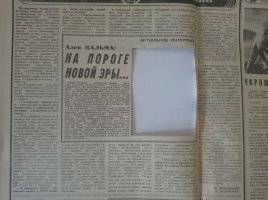
ALAIN CALMAT: ON THE THRESHOLD OF A NEW ERA...

(the article published in russian 'Sovetskiy Sport' on November 16, 1985)

"Alain Calmat—a Parisian medic—possesses a truly artistic nature, the soul of an artist. On the ice, he recreates the image of a man for whom the boundaries of the frozen mirror are too narrow, a man to whom the entire multicolored world belongs. When Calmat, inspired by music, races along, barely touching the ice with his skate, it seems as though the agony of training is unknown to him, and that it all comes alive in a single burst of improvisation. It is no coincidence that many figure skaters call Calmat their ideal of artistic, genuinely musical skating..."
This is how Sovietsky Sport wrote more than 20 years ago, on February 17, 1965, about the silver medalist of the European Figure Skating Championships then taking place in Moscow. Alain himself, who was extremely communicative—a fashionable word back then!—was unable to hide his bitterness over losing the title to the Austrian Emmerich Danzer. Nevertheless, he willingly gave interviews to journalists. At the same time, he did not forget to send greetings through the press to his friends at the medical institute in Paris, telling them how much he liked the Moscow frost and the Muscovites, and how glad he was to visit the Soviet capital once again...
According to Alain Calmat’s own calculations, his acquaintance with Moscow has lasted for at least a quarter of a century. A four-time French figure skating champion, three-time European champion, 1965 world champion, and silver medalist of the White Olympics in Innsbruck, he has visited us many times in various capacities—as a competitor, a judge, and an honored guest. However, on the final day of October, Muscovites had the opportunity for the first time to welcome their old and good acquaintance in the rank of France's Minister of Youth Affairs and Sports, who arrived in our country to sign the Agreement on Principles of Cooperation Between Sports Organizations of the USSR and France for the next five years, and the Protocol on Sports Exchange for 1986.
After signing the documents at the USSR State Sports Committee, the distinguished French guest kindly agreed to speak with correspondents from Sovietsky Sport.
"Mr. Minister, first of all, we would like to hear your comments on the content and significance of the Agreement and the Protocol…"
"To put it briefly, I believe these documents open up not just a new stage, but a new era in sports cooperation between France and the Soviet Union.
The signing of the Agreement and the Protocol between the USSR State Sports Committee and the Ministry of Youth Affairs and Sports of France demonstrated that our countries share an equally good understanding of the tasks for further developing relations on the basis of peaceful cooperation. Sports are assigned a special role in this cooperation, and I consider it by no means accidental that my current visit to the Soviet Union is the first visit to your country by a member of the French government following the visit to France by the General Secretary of the CPSU Central Committee, M. S. Gorbachev."
"Did your schedule for this current visit to the USSR also include trips to Leningrad and Yerevan?"
"Yes, I was delighted to visit these beautiful cities, tour their modern sports facilities, cultural, and historical landmarks, and meet and talk with the people. What did we discuss? In particular, I did not miss any opportunity to ask how Soviet people, especially sports fans, feel about Paris putting forward its candidacy to host the 1992 Olympic Games. I must admit: I understood that such conversations would in no way influence the International Olympic Committee's choice for the capital of the '92 Games, but nevertheless, it was pleasant that our initiative is viewed with such sympathy in your country...
In Leningrad, known worldwide as the cradle of the October Revolution, preparations for your country's main national holiday were underway during our visit. The hospitable hosts gave me the opportunity to see everything I wished for; they even 'took me out onto the ice' at the Yubileyny Sports Palace, where I observed the coaching work of Tamara Moskvina, alongside whom I had competed many times in European and world tournaments and met on judging panels... In France, we welcomed Leningrad's bid to host the 1996 White Olympics. In my opinion, this shows once again how much attention is paid to winter sports in your country. As a former figure skater, this is especially pleasing to me.
"By the way," Alain Calmat continues with a smile, "in Leningrad, I recalled a curious fact. When I used to come to competitions in Moscow in the '60s, I was almost always given a room at the Leningradskaya Hotel. I thought more than once: when will I actually make it to that city? And now, finally, it has happened..."
"Does your love and affection for figure skating reflect on your work as Minister Calmat?"
"The high post I currently occupy obligates me to dedicate equal attention, time, and effort to all sports cultivated in our country. But of course, my heart, so to speak, aches more for figure skating. I always attend figure skating tournaments with great pleasure and never miss them on television. And, by the way, I can say that—this time already as the Minister of Sports of France—I am troubled by the fact that in recent years French figure skaters have receded into the background on the international ice. We have talented, promising youth, but these hopes have not yet been realized. In this regard, the system for training high-class figure skaters in your country has been, and will continue to be, a model for us."
"You mentioned the heart... World sports history records the fact that the heartbeat of Alain Calmat set the pace for the Winter Olympic Games in Grenoble. You have given a great deal to sports and continue to serve them in your current post. What have sports given to you?"
"That is not so simple to answer. Perhaps I can provide one illustration... On July 13, on the eve of our national holiday, I witnessed Sergey Bubka clear the 6-meter height in Paris. I know, of course, that your press wrote extensively about this, but still—you had to see it to believe it, what an explosion of emotions the Soviet athlete's record-breaking flight triggered in the stands and on television screens. Tears of joy, embraces between complete strangers... Honestly, you would have thought France was celebrating its own national hero.
This is Sport with a capital S! My youth was spent in this atmosphere—one that brings together and unites uncompromising rivals in the arena, demanding purposefulness and the mobilization of your physical and spiritual strength to achieve new victories in a fair fight. I intend to practice this 'religion of sport' for the rest of my life, in any position and in any situation!"​
YU. ZEMLYANSKY,
O. POLONSKAYA
1778866392058.jpeg
 
1985
TOURS JUNIOR INTERNATIONAL

Figure Skating

(the article published in russian 'Sovetskiy Sport' on November 17, 1985)

PARIS. Victories at an international tournament taking place in the French city of Tours were claimed by young Soviet figure skaters.
The pair of Elena Kvitchеnkо and Rashid Kadyrkaev having demonstrated the best free program, outranked the Americans Christine Krivanek – Doug Williams; the Canadians Isabelle Courie – Guy Trudeau finished third.
The best free program also crowned the victory of Svetlana Lyapina and Georgy Sur among ice dance couples. And here the prize-winning spots right after them were claimed by representatives of the USA (Karen Courtland – Leif Erickson) and Canada (Jo-Anne Borlase – Scott Chalmers).
Leonid Kaznakov was third in the short program and continues the battle for victory with the competitors who outranked him in this portion of the schedule: Christopher Bowman (USA) and Richard Zander (FRG).​
(TASS).
USSR YOUTH CHAMPIONSHIPS
UFA.
The youth championship of the country continues here.
A high score of 5.5 points was awarded to the short program, which was temperamental and flawlessly performed by 15-year-old Kharkiv figure skater M. Shmerkin (coach V. Kaprov). This success allowed him to enter the top three leading group. Leading ahead are two Muscovites—S. Dudakov (coach V. Kudryavtsev) and P. Chernousov (coach M. Sokolova). Both of them also flawlessly coped with their compositions.
Olympic champion in ice dance N. Linichuk has been preparing young duos for two years. And now, her trainees have gained recognition: Muscovites O. Grishchuk and A. Chichkov confidently performed an extremely complex variation of the polka at the tournament, competing directly with the leaders. In the ice dancers' competition, the capital city Spartak members—the current junior world champions E. Krykanova and E. Platov (coach N. Dubova) set the tone.
The pairs performed their free programs. A synthesis of difficulty and danceability triumphed. New national youth champions E. Leonova and G. Krasnitsky from CSKA (coach V. Zakharov) achieved progress in complexity. Their arsenal includes a double Axel, a throw triple Lutz, and a triple Salchow.
Second place went to the duo from Dnipropetrovsk, I. Mironenko and D. Shkidchenko (coach V. Artyshchenko). Further down the rank are the representatives of CSKA E. Murugova and A. Torgashev.​
A. ANTONOV
1778869651995.jpeg
 
1985
USSR YOUTH CHAMPIONSHIPS

Figure Skating
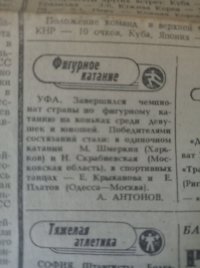
(the article published in russian 'Sovetskiy Sport' on November 19, 1985)
UFA. The national figure skating championship among girls and boys has concluded. The winners of the competition were: in singles skating — M. Shmerkin (Kharkiv) and N. Skrabnevskaya (Moscow Region), in ice dance — E. Krykanova and E. Platov (Odesa—Moscow).​
A. ANTONOV.
1778870096787.jpeg
 
1985
DYNAMO CHAMPIONSHIPS

Figure Skating

(the article published in russian 'Sovetskiy Sport' on November 21, 1985)

TALLINN. The "Dynamo" Figure Skating Championship has started on the ice arena of the V. I. Lenin Palace of Culture and Sports. About one hundred athletes are competing for the highest awards, including well-known masters V. Kotin, K. Ivanova, O. Volozhinskaya and A. Svinin, V. Pershina and M. Akbarov.
In pairs and men's singles skating, as expected, the championship favorites did not miss their chance. The students of Olympic champion I. Rodnina stood on the top step of the podium in pairs skating: V. Pershina — M. Akbarov, L. Koblova — A. Kalitin, and O. Neizvestnaya — S. Khudyakov (all from Moscow).
In men's singles skating, the national champion and European silver medalist, Muscovite V. Kotin, was beyond competition.
1778871021692.jpeg
 
1985
NHK TROPHY

Figure Skating

(the article published in russian 'Sovetskiy Sport' on November 24, 1985)

TOKYO. Silver medalists of the 1985 World Championships, Muscovites M. Klimova and S. Ponomarenko, triumphed among the ice dance duos at the international figure skating tournament taking place in the Japanese city of Kobe.
Muscovites V. Pershina and M. Akbarov, who held first place after the short program in the pairs competition, dropped to second place in the free program, losing to American figure skaters G. Wachsman and T. Waggoner.
In men's singles skating, Canadian figure skater B. Orser leads after the short program, while M. Ito from Japan leads the women's competition.
1778872038937.jpeg
 
1985
NHK TROPHY

Figure Skating

(the article published in russian 'Sovetskiy Sport' on November 26, 1985)

TOKYO. Soviet figure skaters have won their third medal at the international tournament that concluded in the Japanese city of Kobe.
Following Muscovites M. Klimova and S. Ponomarenko, and V. Pershina and M. Akbarov, who took first and second places respectively in the ice dance and pairs competitions, success was achieved by V. Petrenko from Odesa.
The 16-year-old student of coach G. Zmievskaya held fifth place after the short program in men's singles skating. However, a successful performance in the free program allowed him to take the third spot in the tournament standings. The victory went to the bronze medalist of last year's world championship, American B. Boitano, who outscored the leader after two programs, the silver medalist of the '85 world championship, Canadian B. Orser (Czechoslovak figure skater J. Sabovcik, who held second place after the short program, withdrew from the competition due to illness).
In women's singles skating, victory was claimed by Japanese figure skater M. Ito. In second place was Canadian skater C. Coull, and in third was Y. Ozawa (Japan). Soviet female athletes did not participate in this discipline.​
(TASS).
1778872535327.jpeg
 
Back
Top