Archive of newspaper articles | Page 39 | Golden Skate

Archive of newspaper articles

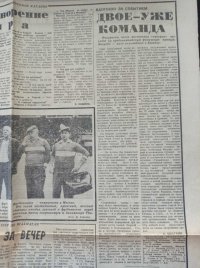
1987
WHO KEEPS THE SYSTEM RUNNING

NASTYA CALLS THE TUNE

(the article published in russian 'Sovetskiy Sport' on November 8, 1987)

Do you know what children love most during training? Even to annoy, to play pranks! For example, a few teenage figure skaters go out onto an open ice rink. Their task is not simple — to perform thirty to forty jumps each. They begin. But as soon as the coach turns away, they immediately accelerate — and hop, a jump into a snowbank! A lot of snow has been piled up, creating whole mounds along the edges of the ice.
Soon they all look like bear cubs — covered from head to toe in snow dust. After the lesson, parents with brooms in hand "discipline" their boys: "This is not yard games for you, this is not Petka and Vovka! This is a school. Here they teach big sports!".
Two-time world champion Vladimir Kovalev told us about this episode from his childhood. Now he is a coach himself. He leads a group of young figure skaters. Times change, and manners change with them. The kids of the new generation no longer do somersaults into snowdrifts, but they still misbehave. Someone went ahead and dyed his hair white, someone else lit a cigarette in a dark corridor...
The restless tribe of the young persistently knocks on the doors of big-time sports, bringing new problems along with them. Far from all coaches manage to direct the energy of the young, bold, and searching into the right channel. What is needed first and foremost for the life of young athletes in high-performance sports to be full-blooded and bright?
"Personally, I think that above all we need a kind heart," says two-time Olympic champion Aleksandr Zaitsev, now a coach at the Moscow school of the 'Dynamo' society. "We created our pair skating group in great agony. We searched for talents all over Moscow. It ended up with us taking kids who had been 'rejected' by other schools. It is very sad when a child at the age of 10–12 is labeled as "incapable." We took a risk by opening the doors to those who, despite everything, burned with a desire to train. Over the course of two seasons, we managed to form eight pairs. So far, everything is going well for them: they are establishing themselves on the ice arena...
Here is a small vignette. In the summer, the group went to Vilnius to prepare. Already on the second evening, 10-year-old Nastya Alimova timidly knocked on Zaitsev's room door:
"Aleksandr Gennadievich, I want to go home."
She repeated this every evening. He had to call home to Moscow over and over again to calm the girl down. Only after a week were the anxieties left behind. She became close with the kids, found friends. It became interesting for her.
"Once we were late for a competition," Zaitsev says. "The bus was delayed. I rushed to the hotel, put the young girls into taxis, and headed straight to the rink. Imagine my surprise: all five of the male partners were already in the locker room. I asked them, 'How were you planning to perform? Alone, without your female partners? Leaving them behind all alone!' This incident convinced me once again of how easily we sometimes treat moral concepts such as collectivism and a sense of camaraderie. No, these are not empty words — in sports, collectivism is where eveything begins - the mastery, courage, and dedication!
To be inspired by a common feeling, a shared interest—young athletes will be able to do this only if they are united by school and the road, shared joys and tears. Love for sport. For two years now, the group led by Aleksandr Zaitsev and Master of Sports Galina Motovilova has become, I am not afraid to say, like one big family. The kids successfully perform in all-union tournaments. What is important: success was forged not only on the ice, but primarily beyond its edge. All girls are now studying in one school, No. 220. That very same Nastya Alimova, it happens, asks to be accommodated in a hotel room only with five other girlfriends. And she also asks: "I want to read about world and Olympic champions!"
And here is the competent opinion of our famous champion with brilliant performances at the 1980 Winter Olympic Games in ice dance, Natalia Linichuk:
"This is my fifth season leading a group of young ice dancers. There are those among them who will soon leave the junior age behind. Let's say Oksana and Aleksandr Grishuk, silver medalists of the World Junior Championships, will compete among seniors in the near future. While Yaroslava Nechaeva and Dima Lagutin are just beginning their path to mastery. But both are searching for high examples to follow, their own ideal in sport and life. The kids are very different. They will have different styles on the ice as well. And yet, many things bring them close and unite them. What is it? The influence of the coach.
Everything that captivates a coach, all of their likes and dislikes, find an echo in the souls of their students. It is impossible to separate the personal life of a teacher with a stone wall from the life of their group. I do not simply tell the kids about gliding or ice dance secrets; I want to teach them how to walk correctly, how to dress with good taste, how to behave freely in a company of strangers, how to choose comrades and conversational partners with discretion. Out of these small details grows the personality of an athlete and a human being.
In the life of our group, there are two important principles. First, we are against greenhouse conditions of training. Second, a professional attitude toward your favorite life's work. One should not be afraid of this word, even when it comes to children. In sports, kids mature very quickly; they see a lot, they travel a lot. Is it worth shielding them from prose of life? Perhaps it is worth telling them right away how much he will have to pay for the sharpening of skates, that a sports suit will not be sewn for him out of simple cotton cloth, that some talented kids are poached and invited to another school not out of noble intentions, but quite often for the sake of profit.
High-performance sport is a school of harsh truth, and along with that, a world of real beauty where there must be no place for consumerism.
Naturally, between the groups of Olympic champions Aleksandr Zaitsev and Natalia Linichuk there are quite a few differences in the pedagogical plan. To begin with, for the former, the kids gathered are practically of the same age, while for the latter, they are of various ages. But more significant for us is something new that distinguishes them from the mass of sports schools. The instructors deliberately do not want to invite "ready-made" masters; they create novitiate duos that are unlike one another. Their groups are transforming before our eyes into micro-schools with their own moral climate and their own code of honor. 13-year-old Yuri Razgulyayev, a newcomer to the ice dance team, directly says: "In about five years, the whole country will know about us." And Nastya Alimova asks Zaitsev to make a program for her that is more complex than Katy Gordeeva's.
"Is it hard going?" I asked Kovalev.
"That's not the word for it! It seems you have anticipated everything, but still, something gets overlooked, and blunders happen. In psychology. Apparently, the school needs a specialized educator-psychologist. So that he could live side-by-side with the kids..."
Yes, many coaches already feel an organic need to merge two directions into one: so that a student grows up both as a great athlete and as an extraordinary personality with high moral standards. Three groups of young athletes organized under the "Dynamo" society banner are entrusted to quite young coaches, who nevertheless hold very high authority in sports. Linichuk, Zaitsev, and Kovalev, having gone through the school of many world and European championships, continue to pass on their best programs to their young pupils. They correctly grasped what their main task is: not to skim the cream off the top, but to test themselves in "draft" work, to go through all the steps of knowledge. Let there still be mistakes, and defeats.
Find the key to sports pedagogy, and then fame and even glory will not pass you by.​
A. Shelukhin.
1785947116480.jpeg
 
1987
ALL THE "STARS" ARE IN MOSCOW?

(the article published in russian 'Sovetskiy Sport' on November 10, 1987)

Reflections on How to Revive the Former Popularity of the Traditional Figure Skating Tournament
In recent times, one often hears conversations that the fashion for figure skating has passed. At first, such statements cause surprise. How can that be? Parents, just like before, bring their children to the sections; our athletes, just like in the past, successfully perform at international tournaments, European and World Championships, and the Olympic Games; and talented newcomers are constantly stepping up to replace the veterans. What lack of interest in figure skating can we possibly be talking about?
But if the fashion has not passed, why are the grandstands empty? It is remembered that some ten years ago, the traditional tournament sponsored by the newspaper Moskovskie Novosti (Moscow News) enjoyed immense popularity; those who failed to get a ticket to Luzhniki, attentively followed the twists and turns of the struggle on television. And what about now? The almost empty Luzhniki Palace of Sports is a sad sight. Once again, a sufficient audience gathers only on the days of the ice dance competitions and exhibition performances.
Why is it that the grandstands of Moskovskie Novosti have not been filled to capacity in recent years? Again and again, I ask myself this question, especially now, with very little time left before the start of the traditional tournament. There are a few reasons.The main one is a drop in the tournament's prestige. A sad tradition has taken root: our "native" competitions are ignored by our leading athletes; they believe, apparently, that this is beneath their dignity.
A lot has already been said and written about this problem. And now, it seems, things have started to move. The organizers of the competitions assure us that this time in the Moscow tournament, all—or almost all—of our leading skaters will take part: Ekaterina Gordeeva and Sergei Grinkov, Marina Klimova and Sergei Ponomarenko, Aleksandr Fadeev, Anna Kondrashova... Well, we will hope that our famous figure skaters will indeed step onto the ice of Luzhniki. But as for foreign "stars", judging by everything, we should not hold our breath. After all, there were times when Cranston himself performed at Moskovskie Novosti.
Specialists will find plenty of arguments, objections, and explanations. They will say that figure skating is a subjective sport, and therefore "pitting heads together" of contenders for podium spots before the European, World Championships is allegedly unfeasible. This is because the one who wins the tournament will receive a hidden preference from the judges, so to speak, at the next stage of the season.
This is all true. But what should be done? Is there really no way out? It cannot be that way. We must think, and look for options.
Sport is a spectacle. And a spectacle, as is well known, demands constant renewal. It is not for nothing that in recent times many new disciplines have appeared—freestyle skiing, short track, figure cycling, and canoe polo... The drop in fan interest in figure skating is a worrying signal, testifying that something has stalled in this sport—or to be more precise, in the organization of competitions. Every year, the exact same people skate, only their programs change (and even then, not always) and their costumes.
To attract, earn the audience's attention and interest once again, you must first of all intrigue them. How? I have an idea! For example, within the framework of Moskovskie Novosti, an exhibition tournament could be organized in the future with the participation of "stars" of figure skating who have already retired from competitive sports. Invitations could be sent out to legendary and beloved champions—Toller Cranston and Yuriy Ovchinnikov, Robin Cousins and Igor Bobrin, John Curry and Sergei Chetverukhin, Dorthy Hamill and Gabriele Seyfert, Jayne Torvill and Christopher Dean, Natalia Linichuk and Gennadi Karponossov... Naturally, on the condition that the competitions would be held only in the free program. Utopia? Nonsense? Absurdity? Or maybe, a project for the near future?
The rejuvenation of sport is a natural process. But to replace the experienced masters beloved by fans come younger and younger skaters, almost children, in whom the process of personality formation has not even finished yet. "Once I had a rare opportunity — says Honored Coach of the USSR N. Dubova. — Together with my athletes, I took part in the traditional tournament 'Danube Cup' in Budapest. A well-known Canadian figure skater, Toller Cranston, took part in it as a guest. And this is the conclusion I reached. The advantage of young athletes was precisely in their youth, freshness, and the fervor with which they stormed complex elements. But Cranston's performance was characterized by such a depth of penetration into the music, making every single element executed by the figure skater flawless, clear, and delivering true aesthetic pleasure." These words from a prominent figure skating expert are worth pondering.
By the way, in the West, there is something akin to a tournament of "stars", which we are proposing to organize within the framework of the competitions for the prizes of Moskovskie Novosti. Back in 1981, a group of enterprising businessmen from Toronto and New York decided to organize their own "ice" company named "Pro-Skate". The first championship of "Pro-Skate" took place in 1982 in Canada, and the next one in the New York Madison Square Garden. Many figure skating "stars"—something like a veteran match in hockey—took part in the competitions.
These championships gather under their banners representatives from dozens of countries, and the competition is sharp. Famous athletes of the past who have retired from competitive sports to become coaches, as well as performers from professional shows and ice revues, take part in the events. Information for reflection: across the ocean, such tournaments are now even more popular than regular figure skating competitions.
Perhaps it is worth taking a closer look at this foreign experience?​
O. Polonskaya.
1785998433386.jpeg
 
1987
MOSCOW NEWS PRIZE

FIGURE SKATING

(the article published in russian 'Sovetskiy Sport' on November 11, 1987)

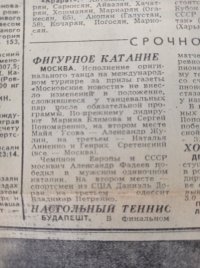
70 figure skaters from 14 countries will take part in the traditional international tournament for the prizes of the "Moscow News" newspaper, which starts on November 11 at Moscow's Luzhniki.
There are many renowned names among the participants of these 22nd Moscow competitions. Performing here will be the world pair skating champions, Muscovites E. Gordeeva and S. Grinkov; European champions from Leningrad, E. Valova and O. Vasiliev; their fellow citizens L. Selezneva and O. Makarov; Moscow ice dance duos M. Klimova and C. Ponomarenko, N. Annenko and G. Sretenskii; and Muscovite A. Fadeev.
Due to injuries, K. Ivanova from the Moscow region and Muscovites A. Kondrashova and V. Kotin will not be able to compete. World ice dance champions, Muscovites N. Bestemianova and A. Bukin, are preparing for a major tournament in Japan.
1785999053482.jpeg
 
1987
ALL THE "STARS" ARE IN MOSCOW?

(the article published in russian 'Sovetskiy Sport' on November 10, 1987)

Reflections on How to Revive the Former Popularity of the Traditional Figure Skating Tournament
In recent times, one often hears conversations that the fashion for figure skating has passed. At first, such statements cause surprise. How can that be? Parents, just like before, bring their children to the sections; our athletes, just like in the past, successfully perform at international tournaments, European and World Championships, and the Olympic Games; and talented newcomers are constantly stepping up to replace the veterans. What lack of interest in figure skating can we possibly be talking about?
But if the fashion has not passed, why are the grandstands empty? It is remembered that some ten years ago, the traditional tournament sponsored by the newspaper Moskovskie Novosti (Moscow News) enjoyed immense popularity; those who failed to get a ticket to Luzhniki, attentively followed the twists and turns of the struggle on television. And what about now? The almost empty Luzhniki Palace of Sports is a sad sight. Once again, a sufficient audience gathers only on the days of the ice dance competitions and exhibition performances.
Why is it that the grandstands of Moskovskie Novosti have not been filled to capacity in recent years? Again and again, I ask myself this question, especially now, with very little time left before the start of the traditional tournament. There are a few reasons.The main one is a drop in the tournament's prestige. A sad tradition has taken root: our "native" competitions are ignored by our leading athletes; they believe, apparently, that this is beneath their dignity.
A lot has already been said and written about this problem. And now, it seems, things have started to move. The organizers of the competitions assure us that this time in the Moscow tournament, all—or almost all—of our leading skaters will take part: Ekaterina Gordeeva and Sergei Grinkov, Marina Klimova and Sergei Ponomarenko, Aleksandr Fadeev, Anna Kondrashova... Well, we will hope that our famous figure skaters will indeed step onto the ice of Luzhniki. But as for foreign "stars", judging by everything, we should not hold our breath. After all, there were times when Cranston himself performed at Moskovskie Novosti.
Specialists will find plenty of arguments, objections, and explanations. They will say that figure skating is a subjective sport, and therefore "pitting heads together" of contenders for podium spots before the European, World Championships is allegedly unfeasible. This is because the one who wins the tournament will receive a hidden preference from the judges, so to speak, at the next stage of the season.
This is all true. But what should be done? Is there really no way out? It cannot be that way. We must think, and look for options.
Sport is a spectacle. And a spectacle, as is well known, demands constant renewal. It is not for nothing that in recent times many new disciplines have appeared—freestyle skiing, short track, figure cycling, and canoe polo... The drop in fan interest in figure skating is a worrying signal, testifying that something has stalled in this sport—or to be more precise, in the organization of competitions. Every year, the exact same people skate, only their programs change (and even then, not always) and their costumes.
To attract, earn the audience's attention and interest once again, you must first of all intrigue them. How? I have an idea! For example, within the framework of Moskovskie Novosti, an exhibition tournament could be organized in the future with the participation of "stars" of figure skating who have already retired from competitive sports. Invitations could be sent out to legendary and beloved champions—Toller Cranston and Yuriy Ovchinnikov, Robin Cousins and Igor Bobrin, John Curry and Sergei Chetverukhin, Dorthy Hamill and Gabriele Seyfert, Jayne Torvill and Christopher Dean, Natalia Linichuk and Gennadi Karponossov... Naturally, on the condition that the competitions would be held only in the free program. Utopia? Nonsense? Absurdity? Or maybe, a project for the near future?
The rejuvenation of sport is a natural process. But to replace the experienced masters beloved by fans come younger and younger skaters, almost children, in whom the process of personality formation has not even finished yet. "Once I had a rare opportunity — says Honored Coach of the USSR N. Dubova. — Together with my athletes, I took part in the traditional tournament 'Danube Cup' in Budapest. A well-known Canadian figure skater, Toller Cranston, took part in it as a guest. And this is the conclusion I reached. The advantage of young athletes was precisely in their youth, freshness, and the fervor with which they stormed complex elements. But Cranston's performance was characterized by such a depth of penetration into the music, making every single element executed by the figure skater flawless, clear, and delivering true aesthetic pleasure." These words from a prominent figure skating expert are worth pondering.
By the way, in the West, there is something akin to a tournament of "stars", which we are proposing to organize within the framework of the competitions for the prizes of Moskovskie Novosti. Back in 1981, a group of enterprising businessmen from Toronto and New York decided to organize their own "ice" company named "Pro-Skate". The first championship of "Pro-Skate" took place in 1982 in Canada, and the next one in the New York Madison Square Garden. Many figure skating "stars"—something like a veteran match in hockey—took part in the competitions.
These championships gather under their banners representatives from dozens of countries, and the competition is sharp. Famous athletes of the past who have retired from competitive sports to become coaches, as well as performers from professional shows and ice revues, take part in the events. Information for reflection: across the ocean, such tournaments are now even more popular than regular figure skating competitions.
Perhaps it is worth taking a closer look at this foreign experience?​
O. Polonskaya.
View attachment 11847
"The fans are disappearing!" is obviously an old lament. And that Pro-Skate didn't live long. Interesting to read these predictions from the other end of time, so to speak.
 
1987
Calgary: Signs of the Winter Olympics — The Faces of Competitors

Looking for Ice Dancers

(the article published in Ukrainian 'Sportyvna Hazeta' on November 12, 1987)

After a 16-year break, figure skating officials in the GDR (East Germany) have once again taken up the development of ice dancing. After all, back in 1970 at the European Championships in Leningrad, the charming pair of Annerose Baier and Eberhard Rüger finished fourth.
I REMEMBER, once during the 'Moscow News' tournament I interviewed them, asking about their plans and suddenly Eberhard said with a wry smile: 'What plans! Our ice dancing program is being shut down...'"
In the GDR, they focused on developing singles and pairs. And now, the news: they are reviving ice dancing.
The task is being carried out in two ways. In Berlin, the enthusiast of ice dancing is Uwe Kagelmann. The very same Kagelmann who, paired with Manuela Groß, repeatedly became a medalist at World and European Championships... in pair skating. While working at Berlin's "Dynamo," he put out a call: "Looking for ice dancers!" At children's competitions of various levels, Uwe closely watched the youngsters. The head coach of the capital's club is traveling around the country with this exact purpose.
Recruitment is carried out among children from six years old who already know how to skate either on ice or on roller skates (which are also very popular in the republic). Together with other experts, Kagelmann chose the most talented ones. "Young children like dancing," he says. "After all, its range is very wide. We use modern motives, folk melodies, and classical music. Many are inspired by the example of such great masters of this genre as Moiseeva—Minenkov, Linichuk—Karponosov, Bestemianova—Bukin, as well as Olympic champions from Great Britain, Torvill and Dean. Television comes to our rescue."
The matter is approached slightly differently in another GDR figure skating center, Karl-Marx-Stadt (now Chemnitz). Jochen Kaiser is a doctor by profession. After his shift at the city hospital, he rushes to the ice rink every day, where the melodies of the polka, the Kilian, and rock are heard. By the way, he demonstrates these dances on the ice beautifully himself.
"We have six couples of seven to ten-year-old children studying with us," says Kaiser. "In the first season, we focused their attention exclusively on the compulsory dances that Olympic skaters perform: tango, blues, waltz, quickstep. The first international start for our pupils is planned for autumn 1987 in the ČSSR (Czechoslovakia)—at tournaments in Olomouc and Banská Bystrica. I hope that by then they will be able to master an original and free dance."
Meanwhile, young GDR ice dance skaters are already competing in the program of the Winter Youth Games of the GDR. Many spectators watched these performances with unfeigned interest. Naturally, this discipline of figure skating has a good future in the country.​
YU. SALOMAKHIN.
1786005162351.jpeg
 
1987
MOSCOW NEWS PRIZE

FIGURE SKATING

(the article published in Ukrainian 'Sportyvna Hazeta' on November 14, 1987)

At the Moscow international tournament for the prizes of the Moscow News newspaper, ice dance duos have entered the competition. The lead after the performance of three compulsory dances—the "Romantica" tango, the Viennese waltz, and the pasodoble—was taken by World and European silver medalists, Muscovites Marina Klimova and Sergei Ponomarenko. In second and third places are also duos from the capital: Maya Usova and Alexander Zhulin, and Natalia Annenko and Genrikh Sretenski.
After the short program in men's singles skating, USSR champion, Muscovite Alexander Fadeev, continues to lead. On Friday, he performed his new short program to the music of Boris Asafiev from the ballet The Fountain of Bakhchisarai practically without errors, receiving straight 5.9 marks for artistic impression.
In second place is American figure skater Daniel Doran, and in third is Volodymyr Petrenko from Odesa.​
Staff report.
1786005673418.jpeg
 
1987
MOSCOW NEWS PRIZE
FOLLOWING UP ON THE EVENT

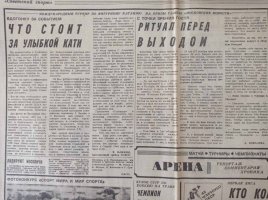
WHAT LIES BEHIND KATYA'S SMILE

(the article published in russian 'Sovetskiy Sport' on November 14, 1987)

The electronic scoreboard in Luzhniki lit up with impressive numbers: seven 5.8 marks and six 5.9 marks. That was the finish of the two-time world pair skating champions Ekaterina Gordeeva and Sergei Grinkov, who became winners of the international tournament for the prizes of the Moscow News newspaper for the first time.
Later, at the press conference, Grinkov modestly said:
— We did everything in our power. Our coach Stanislav Leonovich will tell you about the rest...
It was this "rest" that I wanted to ponder, since the training process of the strongest skaters at the CSKA school might be instructive for many athletes and coaches.
Let us look at two facts from Ekaterina and Sergei's biography. In December 1985, they started in Luzhniki and immediately lost in the free program to several duos. Right then, with the help of coaches and choreographers, they began rebuilding the entire composition, and as a result, their skating was transformed in a very short time. Autumn 1986. Again, the first version of their program fell under the "fire" of criticism from many specialists. And again, the young partners did not get discouraged; they took the suggestions of their coaches, completely changed the pattern of the program, and found a new artistic approach.Was it a risk? Of course! But he who doesn't risk doesn't win. All subsequent events on the ice rinks of Geneva and Cincinnati, where the world championships took place, confirmed this strategy.
The current season was no exception for Ekaterina and Sergei. Once again, there were endless arguments and doubts. Once again, a decisive change of "scenery" in future compositions. Preparing for the start in Moscow, Gordeeva and Grinkov set ultra-complex goals for themselves, counting on the competition being higher than ever. And that is exactly how it turned out: Olympic champions E. Valova and O. Vasiliev skated excellently in the free program (two 5.9 marks speak for themselves), and European champions L. Selezneva and O. Makarov stood out with their signature power and complexity of elements (six 5.7 marks).
No, there was no easy walk to the pedestal, and there could not be one in an Olympic season. In September, the first versions of Gordeeva and Grinkov's short composition had many shortcomings, causing a lot of debate. Most importantly, the athletes knew that the other top pairs had already made significant progress in their preparation. It was necessary to find the most optimal composition in the shortest possible time and work to the point of utter exhaustion. The "Toreador" melody appealed to the figure skaters more than any other music. Therefore, they were ready to change the pattern of their movements a hundred times, as long as they could skate to this piece of Bizet!
That was when coach S. Leonovich and choreographer M. Zueva turned for advice and help to musicologists, radio operators, specialists from the "Melodiya" record company, and friends from various sports schools. They needed to find a first-class recording of Bizet's music and then compile the arrangement completely anew. People responded with open hearts. Sound engineers worked through their lunch breaks, and artists came to their workshops on Saturdays to create new costume sketches, and do fittings in the shortest possible time. No one wanted to hear a word about compensation for their labor.
— We are doing this for our kids; they are like a son and daughter to us, — they said.
The "Toreador" program and their free composition, which is deeply permeated with lyricism, were born literally on the eve of the Moscow tournament. Coach Stanislav Leonovich said an interesting phrase after the pair skating finals.
— But we have not finished our search yet. It is too early to say who is stronger and who is weaker. The main events lie ahead, and by the way, Katya and Sergei understand this very well. They are still at the very beginning of their journey...​
V. RYZHKIN,
Honored Coach of the RSFSR.

MUSCOVITES LEAD

(the article published in russian 'Sovetskiy Sport' on November 14, 1987)

On November 13, ice dance duos entered the competition at the Moscow international figure skating tournament for the prizes of the Moscow News newspaper. As expected, after the performance of three compulsory dances—the "Romantica" tango, the Viennese waltz, and the pasodoble—the lead was taken by World and European silver medalists, Muscovites Marina Klimova and Sergei Ponomarenko. In second and third places are also duos from the capital: M. Usova and A. Zhulin, and N. Annenko and G. Sretenskii.​
(TASS).

FROM A GUEST'S POINT OF VIEW

A RITUAL BEFORE TAKING THE ICE

(the article published in russian 'Sovetskiy Sport' on November 14, 1987)

Christina Hough removed her skate guards and, leaning on the arm of her partner Doug Ladret, kissed coach Don Tobin. The kiss was almost symbolic. The coach of the Canadian pair confirmed this himself after the competition:
— It is a specific ritual of ours. They say it makes it easier for the athletes to skate...
— Yes, we performed with an excellent mood both at home, in Calgary, during pre-Olympic week, and here in Moscow, — stated the ever-smiling 18-year-old Christina.
The Canadian figure skaters' program could not fail to arouse interest in the arena of the Moscow Palace of Sports. Hough and Ladret became winners of the competition in Calgary, and in their compositions now, we saw several original and elegant combinations. True, under conditions of the sharpest competition, they conceded to five Soviet duos.
— Christina and Doug possess an abundance of energy and a thirst for battle, — explained the coach. — The female partner has been figure skating for 11 years, and the male partner for 19 years (on November 13, he turned 26). Together, they have been skating for three seasons. Heading to Moscow, we knew it would be difficult to count on success, because the world champions, Olympic champions, fought against us. And the reserves are strong as well.
— You have been involved in coaching for 35 years. What makes the Soviet school of figure skating interesting to you?
— For many years, we Canadian coaches have been studying the experience of the Soviet school, — emphasized Don Tobin. — There have always been many strong masters with an original style in the Soviet national team. Now I saw again quite a few promising young athletes. In particular, I am following the performances of Elena Kvitchenko and Rashid Kadyrkaev — they were second in Calgary...
— What, in your opinion, is the difference between the Canadian and Soviet schools of pair skating?
— Oh, each of your pairs has an unforgettable, unique style! Soviet coaches have the opportunity to train three or four pairs; they work more deeply. We, on the other hand, are forced to simultaneously train 10–12 duos, because our payment depends on the number of students. This affects the level of preparation.
— Do you hope that your pupils will make it into Canada's Olympic team?
— We set this as our goal. Christina is a very temperamental figure skater. She is involved in alpine skiing and ballet. She studies at a college, and her parents are pharmacists by profession. Doug Ladret comes from a family of hereditary fishermen. He grew up in Waterloo, a small town, but it has a good rink. Doug’s older brother is an artist of an ice revue. Doug himself is currently working as a sound technician in our sports school in Vancouver, and he always finds interesting music for us, he is a professional at this...
— What is your opinion on the tournament in Moscow?
— No complaints whatsoever. An excellent organization, they prepare the ice beautifully. The acoustics in the arena are especially striking. I have never seen anything better. We will ask our national federation to send our pair to a similar tournament again...
— Your people are very kind, — remarked Christina. — Muscovites — in a single word...​
L. KOVALEVA.
1786008562813.jpeg
 
1987
MOSCOW NEWS PRIZE

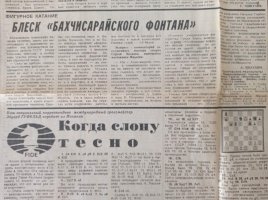
THE BRILLIANCE OF "THE FOUNTAIN OF BAKHCHISARAI"

(the article published in russian 'Sovetskiy Sport' on November 15, 1987)

Moscow choreographer Vasily Myntyan, who worked for many years in the famous ensemble directed by People's Artist of the USSR Igor Moiseyev, possesses a special sense of rhythm and an understanding of dance imagery.
— I sit in the stands, look at the figure skaters' performances, and feel every musical tact with my very cells. I do not tolerate the thought of performing "to music." You only need to live with the music, dance with your heart. That is exactly how I worked this season with Alexander Fadeev...
The choreographer's credo found full expression in the new short program of European champion and ex-world champion Alexander Fadeev. It seemed that none of the previous "Fadeev-esque" monotonous gestures remained, which used to evoke silent protests from connoisseurs of ice dance miniatures. Yes, a new Fadeev style was born, in which no strain or labor was felt — it was replaced by the joy and effortless lightness of flying over the ice. Asafiev's music for the ballet The Fountain of Bakhchisarai allowed the master to approximate the ideal in plasticity and gliding technique. True beauty allowed even a unique element in terms of complexity to fit naturally into the program, where the figure skater performs a 3.5-revolution axel. Here, too, the clatter of the blades was hidden, hidden away like the hard "rough" work, which is why the plastic in the new composition truly shone. The judges' marks were straight 5.9s.
An express commentary by Honored Master of Sports Sergei Volkov, the current mentor of Fadeev:
— Preparing for the Olympic season with Alexander, we did not lose sight of the main thing for a single minute: what makes figure skating spectacular, attractive — the purity of the skating, the precision of every jump.
Fadeev became the unconditional leader of the tournament, while his rival, American Daniel Doran, and our V. Petrenko firmly secured second and third places, respectively.
The 16-year-old American figure skater Cindy Bortz won the Moscow News tournament quite confidently, without making a single error in her complex combinations. Her success leads to certain reflections on why we need to urgently look for talent in our sports schools. Cindy does not stand out with sophisticated plasticity; she just races across the ice like a grasshopper, but the most important thing is that she doesn't make mistakes, because since childhood, she has been hardwired with a proper understanding of jumping technique and edge work.
Only three of our sports girls could compete with the American in the execution technique of their jumps — 17-year-old Kyiv resident Natalia Gorbenko (second prize-winner of the competition), athlete from the Moscow region Natalia Skrabnevskaya (third prize-winner), and Sverdlovsk resident Larisa Zamotina.
Gorbenko, a student of young coach L. Maslyukova, had real chances to fight for victory in the overall standings, especially since she performed a triple lutz, but she has yet to acquire that same "Fadeev-esque" hardness of character which allows achieving 100% stability.​
A. SHELUKHIN.
TECHNICAL RESULTS
International tournament for the prizes of the newspaper "Moscow News". Moscow. Sports Palace. November 12–13.
Pair skating.
1. E. Gordeeva and S. Grinkov — 1.4; 2. E. Valova and O. Vasiliev — 3.2; 3. L. Selezneva and O. Makarov (all — USSR) — 3.8.
Women's singles. 1. C. Bortz (USA) — 2.4; 2. N. Gorbenko — 4.4; 3. N. Skrabnevskaya (both — USSR) — 6.4.
1786010142831.jpeg
 
1987
MOSCOW NEWS PRIZE
TALK AT THE BOARDS

JUST LIKE A BALL...

(the article published in russian 'Sovetskiy Sport' on November 15, 1987)

— I wasn't thinking about victory; I simply wanted to show good skating,—this was how 16-year-old Cindy Bortz, a figure skater from the USA, commented on her successful debut at the international tournament for the prizes of the Moscow News newspaper.
It seems the athlete's words were entirely sincere. She truly wanted to please the Moscow public. I happened to watch how Cindy was preparing for her free program behind the scenes. Believe me, it was a curious sight.
Cindy appeared in the hall for the warm-up long before the start. She was jumping like a rubber ball, a hundred times in a row, doing handstands, only she didn't do a handstand on the barrier. This resembled a gymnastic warm-up rather than a skating one. Strongly built, Cindy Bortz did not stay still for a single minute. Due to her short haircut, her face looked completely childlike, and all the time there was a feeling that Cindy's coach, 32-year-old Wendy Holzer-Olson, would get up at any moment and scold the mischievous girl.
— Indeed, Cindy seems to be made of gutta-percha,—agreed Wendy.—Triple jumps come easily to her, and I think that was precisely the reason why she became the sixth athlete in the country this year. For her, that is a great success.
— Is Cindy always this energetic during training?
— I am pleased with this athlete more than anyone else. I have about 20 students of different ages in my group. But Cindy is the most hardworking.
— Besides the triple jumps, which the judges appreciated at their true worth, there was another moment in the free program that caught my attention: a lot of Russian music. Is this a coincidence?
— No, we prepared the free program specifically for Muscovites. It includes a fragment of a Gypsy romance by Galperin and Nekrasov, Tchaikovsky's Swan Lake, and Chesdel's Kyiv Evening. In short, this is a gift for your spectators.
— And what is the next competition you have planned for Cindy?
— On January 1, 1988, the US Senior Figure Skating Championships will be held in Colorado Springs. I hope that Cindy will move forward from sixth place. And from there, we will see...​
L. KOVALEVA.
1786010829205.jpeg
 
1987
MOSCOW NEWS PRIZE

FIGURE SKATING

(the article published in russian 'Sovetskiy Sport' on November 15, 1987)

MOSCOW. The performance of the original dance at the international tournament for the prizes of the Moscow News newspaper brought no changes to the standings established among the ice dance duos after the compulsory program. Continuing to lead are Marina Klimova and Sergei Ponomarenko; in second place are Maya Usova and Alexander Zhulin; in third are Natalia Annenko and Genrikh Sretenskii (all from Moscow).
European and USSR champion, Muscovite Alexander Fadeev, won the men's singles event. In second place is Daniel Doran, an athlete from the USA, and in third is Volodymyr Petrenko from Odesa.
1786011247719.jpeg
 
1987
MOSCOW NEWS PRIZE

Some things came true, and some did not...

(the article published in Ukrainian 'Sportyvna Hazeta' on November 17, 1987)

The 22nd International Figure Skating Tournament for the prizes of the Moscow News newspaper. Moscow. Sports Palace of the Central Stadium named after V.I. Lenin. November 11–15.
How quickly the scenery changes! Just five years ago, one could only dream of Ukrainian representatives competing in these prestigious competitions. Today, summarizing the results, we state with satisfaction: two of our compatriots became medalists. Moreover, in the women's competition, we counted on even more.
By the way, the female skaters were the first to take the ice. After the "school" (compulsory figures), the leadership was seized by two athletes: last year's world junior champion, American Cindy Bortz, and Kyiv resident Natalia Gorbenko, who previously held this title before her. It was in this exact order that they stepped onto the podium, significantly ahead of the bronze medalist of the national championship, Natalia Skrabnevskaya from the Moscow region. The pupil of Kyiv coach L. Masliukova won a medal at a representative tournament in Moscow for the first time. Could Natalia have challenged for the top spot? I think so. She significantly complicated her composition by introducing such a difficult element as the triple lutz, demonstrating a fully developed technique of skating and jumping. But the 17-year-old athlete lacked a bit of character. Or maybe she just lacked experience competing at the international level?
Meanwhile, 18-year-old Viktor Petrenko, a pupil of Halyna Zmievska, arrived in Moscow after competing in the pre-Olympic week in Calgary. He, along with Gorbenko, would satisfy himself by fighting for high placements in one of the season's main events. However, he was unable to step onto the Moscow ice; fatigue took its toll. Therefore, not he, but his younger brother—16-year-old Volodymyr Petrenko—tried to compete with the renowned figure skater, European Champion Alexander Fadeev, and American Daniel Doran.
Let us recall that last year at this tournament, Volodymyr was third, but Viktor won bronze at the continental championship and silver at the national championship. Will history repeat itself? We shall not judge. But the year did not pass in vain for the younger Petrenko. The tracings from his blades on the Moscow ice have become sharper and more beautiful.
However, Fadeev allowed no one to surpass him. Together with his mentor, Honored Master of Sports Sergei Volkov, he proved that he is capable of a great deal. His short program will be remembered by many for its cascade of tricks and improvisation. The music from the ballet The Fountain of Bakhchisarai allowed the tournament winner to combine these two concepts into a single whole.
We should also note the performance of another student of the Zmievska school—the bronze medalist of the European Junior Championship, Yurii Tsymbaliuk, who took fifth place here as well.
And what conclusions can be drawn after the performance of the duos? Here, Ukrainian figure skaters, unfortunately, do not yet claim leading positions. For example, in pair skating, the Soviet national team was entirely presented by Muscovites and Leningraders. Ekaterina Gordeeva and Sergei Grinkov being in the rank of two-time world champions, managed to win the prize of the Moscow News. In ice dancing, no one was left indifferent by the performance of Marina Klimova and Sergei Ponomarenko.
When all the crystal skates, manufactured at the Diadkovo plant in the Bryansk region, found their owners, the traditional gala performances took place in the packed Sports Palace. After each number, there was passionate applause. Meanwhile, we stood near the edge of the ice and looked at the faces of the athletes. How can one find out which of them will become an Olympic champion? Is it worth indulging in forecasts today? One can only dream...​
I. TROFYMENKO.
Moscow (by telephone).
1786013921819.jpeg
 
1987
MOSCOW NEWS PRIZE
FAMILIAR PORTRAITS

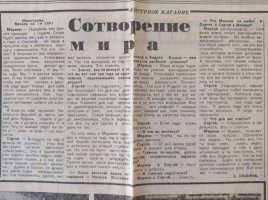
The Creation of the World

(the article published in russian 'Sovetskiy Sport' on November 17, 1987)

The sound died down and disappeared, returning only for a moment as an echo.
An anxious and sweet fracture of her wrist. His gaze. And silence throughout the universe... He and she. Adam and Eve...
She raised her head and looked somewhere into the upper rows of the stands. He offered her his hand and bowed to the audience, scratching the ice with the blade of his skate. She and he. Marina Klimova and Sergei Ponomarenko.
And the arena went wild, refusing to believe that this little miracle had ended. This dance. And Marina was no longer Eve, and Sergei was not Adam.
The judges brought everyone back to earth. The scores lit up on the scoreboard. "But wait, this is a competition," everyone suddenly remembered. And the arena exploded with applause again. Marina Klimova and Sergei Ponomarenko—winners of the tournament for the "Moscow News" prize—smiled for the TV and photo cameras.
And I remembered our last conversation. A gloomy morning. A chilly training rink in Sokolniki.

Your new free program is completely unlike your previous dances...

Marina:
— It differs primarily because modern music plays in it. Pieces from songs by "The Beatles."
A dream had lived in us for a long time to create a dance about Adam and Eve and call it "The Creation of the World." The origin of life out of love. And love in the name of life. But we didn't know what kind of music it would be. Chance decided everything. Sergei and I bought a record where "The Beatles" songs were recorded in a symphonic arrangement. We listened to it and realized: this is our music!
But now the training sessions are over, during which you skated your dance dozens of times. And here is the arena, the judges, the rivals. You step onto the ice and live the dance. And then they will give you scores... Creative flight and the reality of competition—how do you manage to combine this? And do you succeed?
Marina:
— Perhaps this ability comes with age. It will soon be eight years since I started skating in a pair with Seryozha, but only last year did I learn to truly feel the competition. What is it? I get incredible pleasure from it. The atmosphere of the arena, the festive backstage bustle, the scent of perfume, the sparkle of costumes... And we are on the ice. We are the center of attention. And we can make it so that the person sitting out there in the tenth row suddenly discovers something new, something previously unknown about themselves. We are capable of this. And the awareness of this joy makes us forget about the scores altogether.
I know this from my past self. If you get too obsessed with fighting for a place, you will walk around all day thinking only about how you must skate, and that's it. Something crucial leaves you, and no matter how much you call for it, it won't come back.
Sergei: — To step onto the ice and think about scores? Our discipline of figure skating is so subjective... In singles or pairs, mistakes are visible to the naked eye, but in ice dance, the judging criteria are so blurred... Whether you think about points or not, the judges are still unpredictable: what one liked might provoke dislike from another. So when you step onto the ice—live the dance. That is the main thing.
Does it mean you aren't even bothered by the fact that you have finished second in the major competitions of the season for three years now?
Sergei:
— Don't think we are being hypocritical. But for us, indeed, who is ahead, on the top step of the podium, is unimportant. However, the satisfaction we get from how we skated our program is much more valuable to us. The most terrible thing is when you win, even though you know that on that day, absolutely everything you did went wrong.
Over our entire career with Marina in ice dance, we have overtaken five couples in fair competition to reach the second step. But this was never our sole purpose—to overtake someone at all costs. Our skill simply grew, and it helped us move upward.
What qualities of your rivals—Natalia Bestemianova and Andrei Bukin—do you find most valuable?
Marina:
— I have always been amazed by their ability to give their absolute all. The atmosphere of competition paralyzes many people, preventing them from fully opening up. You look at Natasha and Andrei during practice and they look terrible, as they say, everything falls out of their hands... But then they step onto the competitive ice... It's as if they aren't the same people from yesterday. Everything burns, everything sparkles—every gesture, every step. We definitely have something to learn from this quality of theirs.
Sergei: — Everyone needs to learn this.
What do you dream about?
Marina:
— That the audience never grows tired of us.
Sergei: — And that we always surprise them. Which means moving forward.
What is the most important trait in human character, in your opinion?
Marina and Sergei:
— Honesty and kindness.
And the main flaw?
Marina and Sergei:
— Envy.
What does Marina dislike in Sergei, and Sergei in Marina?
Marina (smiling):
— Seryozha loves telling all kinds of stories. He is generally a wonderful storyteller. But what drives me absolutely crazy is his habit of embellishing his stories with all sorts of details that never actually happened. I understand that with these tall tales, he is trying to make his story funnier and more expressive, and there's nothing wrong with that. But still, I just can't help myself...
Sergei (with emphasized seriousness): — Marina likes to talk during training sessions. You need to skate. But all she wants to do is talk: why it isn't working, how it needs to be done... But everything needs to be done very simply: just skate. And then everything will work out.
What is happiness to you?
Sergei:
— Peace and reliability. That is happiness.
Marina: — Sometimes a certain feeling appears... It's hard to explain... It's as if everything you ever knew, were capable of, loved, or saw suddenly comes to you in a single moment, and you feel that everything is under your control, that you can do anything. It's like all the little streams merge into one big, deep river. That very moment is happiness.​

E. KASHINA.
1786021394992.jpeg
1786021422891.jpeg
 
1987
MOSCOW NEWS PRIZE
FOLLOWING UP ON THE EVENT

TWO IS A TEAM

(the article published in russian 'Sovetskiy Sport' on November 17, 1987)

Figure skaters after the Moscow "showcase" enter the pre-Olympic final stretch. Ahead lies the clash of the strongest in Yerevan.

One popular actor recently visited a hockey match and, seeing the half-empty stands, exclaimed: 'Give us actors seven or eight good pairs of figure skaters, and we will create such a mini-spectacle that the stands will be packed to capacity!'
He is very close to the truth, because on the final day of the tournament, it was precisely eight dance duos that made the audience empathize, shout 'bis' and 'bravo.' There is still gunpowder in the powder kegs: two people step onto the ice and create a miracle of dance art, a miracle of acting transformation...
The ice dance tournament was won by Marina Klimova and Sergei Ponomarenko (with a five-point evaluation of 5.9 for their free dance, choreographed to melodies arranged from "The Beatles" songs). For four years, this small and close-knit team has been preparing and performing, aimed at the maximum result, at the highest award, and this maximalism with iron logic leads the duo to creative successes.
Standing on the second step of the podium for the first time were Maya Usova and Alexander Zhulin (by the way, both couples are pupils of coach N. Dubova). At the press conference, the female partner said:
— I would not want to seem immodest, but our new program "Persian Bazaar" was intended by the choreographers first and foremost for me. The thing is, in one of the past seasons, Alexander and I experienced the joy of a true creative discovery when we performed an exhibition dance to Indian melodies. It resonated very well with the audience. That is why the idea arose—to develop an Eastern theme on a grand scale, taking our individuality into account. The dance brought us immense joy, and with it, success in the tournament...
Ice dancing is an all-around event, and a intense competition took place at Luzhniki across all sections, including compulsory and original tango dances. Three leading Soviet duos—Klimova and Ponomarenko, Usova and Zhulin, and the European Championship bronze medalists Natalia Annenko and Genrikh Sretenski—impressed with a high level of performance.
For quite a few years behind the scenes of the arenas, there has been a debate about what the choreographer's contribution to the piggy bank of victories should be, and whether it is time for them to have equal rights with the main coach? So, perhaps the success of Usova and Zhulin in Luzhniki (and Honored Artist of the RSFSR Elena Kholina put all her knowledge and mastery into their Eastern dance) will serve as a very serious argument in this discussion?...
How should we view the third place of Annenko and Sretenski? No, they have not become weaker—this is shown by the scores of 5.6 and one 5.7 point for their free program (for comparison, let us note that Usova and Zhulin had six scores of 5.7 and two scores of 5.8). The mentor of this duo, G. Akkerman, emphasized that compulsory dances were and remain the skaters' trump card, while in the free program, a complete 'change of scenery' took place—the lyrical style was dismissed, and long live eccentricity, verve, and humor!
The November start for those who claim places on the national team is a very early milestone. Many reserves are not yet fully revealed. And only in a month will we see our 'stars' in full splendor during the match of the strongest in Yerevan. And it is all the more striking what an ability to gather together will, knowledge, experience, and mastery is possessed by the three-time world ice dance champions Natalia Bestemianova and Andrei Bukin, who performed their new program 'Polovtsian Dances' with utmost dedication during the exhibition performances; European champion Aleksandr Fadeev, who at the Moscow tournament was not afraid to include more than thirty (!) elements into his new composition 'Ukrainian Rhapsody'; and European silver medalist Vladimir Kotin, who also presented a magnificent fragment of his future Olympic program to the judgment of Muscovites.
The Moscow tournament laid down the beginning of a new tradition—named prizes for the best foreign figure skaters were established by three-time Olympic champion Irina Rodnina, the first Olympic champion in ice dance Aleksandr Gorshkov, and the first among our athletes to become a world champion in singles skating, Sergei Volkov. The prizes were solemnly presented to masters from the national teams of Canada and the USA. They, in turn, performed original dances for the Muscovites. It was pleasant to realize that the spirit of the Goodwill Games continues to live on our sports arenas.​
A. SHELUKHIN.
TECHNICAL RESULTS
International Figure Skating Tournament for the "Moscow News" Prizes. November 14–15.
Men.
1. A. Fadeev (USSR)—2.0; 2. D. Doran (USA)—4.0; 3. Vl. Petrenko (USSR)—6.0.
Ice Dance. 1. M. Klimova and S. Ponomarenko—2.0; 2. M. Usova and A. Zhulin—4.0; 3. N. Annenko and G. Sretenski (all—USSR)—6.0.

1786030245478.jpeg
 
1987
Trophée Lalique

FIGURE SKATING

(the article published in russian 'Sovetskiy Sport' on November 17, 1987)

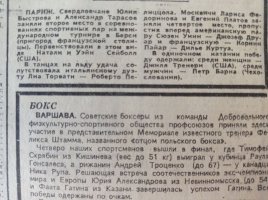
PARIS. Sverdlovsk residents Yulia Bystrova and Aleksandr Tarasov took second place in the pairs competition at the international tournament in Bercy (a suburb of the French capital). Victory in this discipline went to Natalie and Wayne Seybold (USA).
In ice dance, success favored the Italian duo Lia Trovati — Roberto Pelizzola. Muscovites Larisa Fedorinova and Evgeni Platov took fourth place, letting ahead the American couple Susan Wynne — Joseph Druar and the French couple Corinne Paliard — Didier Courtois.
In singles skating, victories were achieved by: among women — Jill Trenary (USA), among men — Petr Barna (Czechoslovakia).
1786030777085.jpeg
 
1987
MAKING A PROPOSAL

What is there, beyond the finish line?...

(the article published in russian 'Sovetskiy Sport' on November 21, 1987)

My long-time companion, a well-known past hockey player, once noted half-jokingly, half-seriously: "Previously, I used to enter presidential palaces for receptions, but now I sit for two hours in the reception room of a district chief."
Yes, this moment is not simple—parting with great sport. And far from all athletes find the strength within themselves to painlessly, without losses, adapt to a new lifestyle, in which bursts of admiration and the respectful attention of those around them are rare.
I want to immediately expand the scope of the conversation and touch upon one more aspect of the problem. Right now, veterans in sports are turning out to be those very guys who still continue to train intensely and compete, but are already doomed to tournament failure and stripped of championship prospects. Every year, dozens of teenagers are dismissed or leave sports schools on their own after practicing in them for four to five years. They have already formed specific character traits inherent to athletes, they have found friends from the sporting circle, and they subordinate their life to a specific rhythm—all in the name of a dream. And suddenly, the dream turns out to be unrealistic, and they have to say goodbye to it. Disappointment, despondency, and at times bitterness—at oneself, at coaches, at the whole wide world—all of this can noticeably deform the character of a young person whose sporting life is ending, but who is entering, I repeat, a new, independent life that requires no less strength and optimism...
Meanwhile, energy is still bubbling inside yesterday's athletes; they are still possessed by the fervor of competition. So how do we help them channel this energy into a useful cause? After all, far from everyone becomes a trainer. We do have a council of sports veterans, but it is generally oriented toward people of an advanced age. There are sports federations, however, young but already "former" athletes are put off by the fact that the activity of the federations consists primarily of conversations at numerous meetings.
...Last summer, many spectators admired the magnificent program of the ice festival in Luzhniki "All Stars," in which Olympic champions Jayne Torvill and Christopher Dean performed alongside our figure skaters, despite having left the competitive arena quite some time ago. It made me think: for them, sports do not end because they are "stars." But then both things came to mind. In the sports program of the XII World Festival of Youth and Students, the performance of the children's ice theater of the Moscow Automotive Plant named after the Leninist Komsomol enjoyed great success. The performances of the young figure skaters were received with encores, even though most of them had already completed their sporting "career" somewhere on the approach to the first rank. But the kids found themselves in a favorite hobby and found an application for their skill.
I think that in children's sports schools of all categories—from ordinary to specialized ones designed to train the Olympic reserve—it is possible to create a special kind of teams, or departments, that give an opportunity to prove themselves to athletes who do not claim high-profile titles but can still delight spectators with their mastery. We are talking about sports-artistic groups that prepare exhibition performances, shows, and unusual spectacles. Of course, it is easiest of all to do this in figure skating, gymnastics, acrobatics, and synchronized swimming, where elements of circus and variety arts are initially present.
Now the question is being raised more and more often about how to make competitions in all types of sports more striking, spectacular events, because the interest of the public in many tournaments is declining. Before the competitions and during pauses, young athletes often perform, but they cannot surprise the spectator with anything special. And the matter lies not in their athletic preparation, but in the elementary absence of creativity. Do you remember when a mandatory attribute of competitions in water sports once used to be the so-called comic dives from the high board, when some simpleton in a bathrobe, glasses, and with an umbrella (but in reality, of course, a well-trained athlete) would fall into the water with a shriek? The spectators liked this very much. But now we have completely forgotten about these kinds of scenes; everything has been reduced solely to the battle for "points, goals, seconds..."
But the matter, understandably, should not be limited to the creation of entertainment routines and exhibition performances. We must take up the organization of a coherent program of athletic competitions. Within the framework of official tournaments, it is possible to hold competitions for veterans in several age groups — abroad, and specifically in the GDR, this has already become customary. In this way, people do not part with sports and, feeling their utility, continue to serve it faithfully and truly.
I believe that in connection with this, the movement "Soviet Athletes to Schools!" should come alive. Announced a few years ago by the Komsomol, it died out because experienced athletes — the active veterans of sport — could not overcome the barrier of passivity, and did not become frequent guests on school and neighborhood sports fields, as organizers and participants of mass competitions.
Recently, workers of the sports department of the Gorky Regional Committee of the VLKSM [Komsomol] told me about the idea of creating a sportsmen's club. What is meant by this? The club will unite mostly those who have already left sports, or rather, finished competing in major tournaments. For now, the Gorky team has no real incarnation of the idea, or more precisely, no premises. It was suggested that members of the club meet from time to time in the sports committee... But this is not a way out. A club is a house where you can come at any time of the evening, find friends there, remember the past, and discuss the vital topics. A library and a video library could be located here. In such a house, guests from other cities — famous champions — could come to visit. And when the club gains popularity, like the Actor's House or Cinema House that have existed for many years, it will attract youth and become a magnificent propaganda tool for a healthy lifestyle.
This work probably needs centralized management, a specific regulation. Funds will be required. But they are necessary for the benefit of the cause. To all these reflections, I would like first of all to draw the attention of the All-Union Voluntary Physical Culture and Sports Society of Trade Unions — it was created recently, is actively searching for new forms of work, including educational and promotional work. And there will be plenty of allies, with the Komsomol among the very first.​
E. SHEVALOVSKY,
Master of Sports of International Class, Deputy Chairman of the Figure Skating Federation of the USSR.
1786035196441.jpeg
 
1987
FUJIFILM TROPHY

FIGURE SKATING

(the article published in russian 'Sovetskiy Sport' on November 22, 1987)

BONN. M. Klimova and S. Ponomarenko continue to lead at the international figure skating tournament in Frankfurt.
The silver medalists of the European and World Championships, following the compulsory program, won the competition in the original dance.
Japanese athlete M. Ito is ahead of US champion J. Trenary and J. Arsenault (Canada) after the short program. N. Gorbenko from Kyiv is in fourth place.
The men's competition has concluded. Odesan Vl. Petrenko took second place. The victory was achieved by C. Bowman (USA).​
1786078504720.jpeg
 
1987
FUJIFILM TROPHY

FIGURE SKATING

(the article published in Ukrainian 'Sportyvna Hazeta' on November 24, 1987)

Soviet athletes performed successfully on the final day of the international competition in Frankfurt (FRG).
Silver medalists of the European and World Championships, Muscovites Marina Klimova and Sergei Ponomarenko, secured victory in the ice dance competition.
Kyiv resident Natalia Gorbenko, who held fourth place after the short program, finished in third place in the final standings. She placed behind two very strong rivals—Japanese athlete Midori Ito and US champion Jill Trenary, who took first and second places respectively.
As a reminder, in the men's competition, Christopher Bowman (USA) was first, while Odesan Volodymyr Petrenko was second.
Among the pairs, World Championship bronze medalists Jill Watson and Peter Oppegard (USA) won.​
Own info.
1786079625167.jpeg
 
1987
FIGURE SKATING

(the article published in russian 'Sovetskiy Sport' on November 24, 1987)

FUJIFILM TROPHY
FRANKFURT. At the international competitions in this West German city, silver medalists of the European and World Championships, Muscovites M. Klimova and S. Ponomarenko, won the ice dance tournament.
Kyiv resident N. Gorbenko, who held fourth place after the short program, moved up one spot in the final standings. She was outperformed by only two rivals—Japanese athlete M. Ito and US champion J. Trenary, who took first and second places respectively.
In the men's competition, C. Bowman (USA) triumphed, while Odesan Vl. Petrenko was second.​

GRAND PRIX SNP JUNIOR INTERNATIONAL
BANSKÁ BYSTRICA. At the traditional international junior tournament for the prizes of the Czechoslovak Figure Skating Federation currently taking place here, French skaters C. Descolis and L. de Ville won the ice dance competition. Moscow athletes L. Berezova and V. Fedorov performed the free dance best of all and ultimately took second place, while M. Anikanova and S. Gezalyan finished in third place.
1786079917869.jpeg
 
1987
MOSCOW NEWS PRIZE
FOLLOWING UP ON THE EVENT

...And a Seething of Passions

(the article published in russian 'Sovetskiy Sport' on November 25, 1987)

When flights and Aeroflot schedules were delayed or canceled due to heavy fog, figure skaters Larisa Selezneva and Oleg Makarov simply could not fly out of Yerevan home to Leningrad. In the pauses between possible flights, they rushed from the airport to the ice rink to train. Truly, the athletes valued minutes like gold!
This episode, in my view, reflected the general mood that prevailed among the country's strongest figure skaters on the eve of the international tournament for the prizes of the Moscow News newspaper. It was particularly characteristic of the masters of pair skating. It is no coincidence that the subsequent performance of 13 pairs at the Luzhniki Arena was named a mini-World Championships, because everyone poured their mastery, and true passion into their programs.
And for World Champions E. Gordeeva and S. Grinkov, and Olympic Champions E. Valova and O. Vasiliev, and European Champions L. Selezneva and O. Makarov, there was only one tactic—to fight with an open visor, to reveal their full arsenal. Retaining lightness and freedom of movement, Gordeeva and Grinkov impressed everyone with their acting qualities, mature and meaningful plasticity. Valova and Vasiliev in previous years attracted the audience's attention with the spectacularity of their compositions and original dialogue—and they remain strong in this even now—but the renowned skaters are conducting their search more broadly and sweepingly, infusing every ice combination with athletic excitement and energy. As for Selezneva and Makarov, they did not reduce the tremendous heat and power of their programs by even a single iota; they made the spectators' hearts skip a beat when they spun in camel spins literally centimeters away from each other...
A lot of work and creative ideas were invested into preparing our best pairs by coaches Stanislav Leonovich, Tamara Moskvina, and Igor Moskvin. What is also very important, their designs were developed, colored, and enriched with the most vivid emotional hues by experienced choreographers. In Moscow, this is Marina Zueva; in Leningrad—Alexander Matveev, Valery Pechersky, Natalia Volkova, and Valentina Vigant. Surely, only collective efforts could achieve the desired effect in such a difficult process - the birth of future Olympic programs. And the discoveries in them, undoubtedly, stand out: "The Toreador, Bolder into Battle," and "Sirtaki."
And how can one not rejoice for the rapidly progressing Leningrad skaters Natalia Mishkutenok and Artur Dmitriev, who trained in the same group with Valova and Vasiliev. The Olympic champions attended every test skate of the young duo, critiqued, advised, and warned them against the mistakes they themselves had gone through. And here is the result: the newcomers took a fourth-place spot in the final standings of the "Moscow News" tournament. How much more could our sport win if a uniform form of "mentorship"—this relay of generations—was established in every sports school!
I would also like to touch upon organizational problems in hosting our tournaments. Why are spectators so reluctant to attend international competitions at Luzhniki? Why was it that only on one of the evenings during the exhibition performances did we see stands where there was nowhere for an apple to fall? And what does today's spectator actually want to see on the ice?
The psychology of the spectator has changed significantly—everyone recognizes this. But the trouble lies in the fact that for many years, incompetent, irresponsible advertising has misled the public, undermining the spectator's trust in the belief that they will see the absolute finest of our figure skating at Luzhniki. By tradition, the open Moscow Championship is held in autumn, and then posters with the names of World and European Champions flash through the city. But none of them actually start at this tournament, nor do they plan to due to timing. Why then do we promise the audience a grand spectacle? If we gave an advertisement a "roster" of big names—keep your word! The audience needs to be respected.
Something similar happened in previous years at the Moscow News competitions themselves. One premiere after another was canceled: some athletes fell ill, others performed abroad, others changed plans. Yes, and a significant portion of the public preferred to see only "shows"—the exhibition performances. That is how the authority of our largest winter season competition was degraded. It is no secret to anyone that the very essence, the whole drama of a major event is formed by the "spring" of the struggle between "magnificent masters," a "star" status in all disciplines of figure skating. Previously, spectators rushed to see the duels of Vladimir Kovalev and Yuri Ovchinnikov, Alexander Fadeev and Igor Bobrin, Irina Moiseeva and Andrei Minenkov, Natalia Linichuk and Gennadi Karponosov. This excited the minds of even specialists in other sports.
Perhaps it is this sporting "nerve" that needs to return to our tournament. Then, following the overture—good advertising—a grand spectacle of high-performance sport will follow. And this is entirely realistic, which was once again proven by our masters of pair skating.​
M. Drey,
International Category Judge
1786083595549.jpeg
 
1987
NOVARAT TROPHY

FIGURE SKATING

(the article published in russian 'Sovetskiy Sport' on November 26, 1987)

BUDAPEST. At the tournament that recently concluded here, American athletes triumphed in the men's and women's singles events. In the men's competition, 1986 World Champion B. Boitano was the best, while T. Damigella won the women's event. The ice dance competition was won by Hungarian figure skaters K. Engi and A. Toth.
1786085214680.jpeg
 
Last edited:
Back
Top