


No. She is my favourite actually…. But, that program doesn’t highlight her strengthsThen we know you aren't rooting for Valieva, it's already been said she's keeping Bolero


Follow along with the video below to see how to install our site as a web app on your home screen.
Note: This feature may not be available in some browsers.
No. She is my favourite actually…. But, that program doesn’t highlight her strengthsThen we know you aren't rooting for Valieva, it's already been said she's keeping Bolero

That might be true in some cases. However, I've encountered skaters/coaches who actually adopt Rippon arms on certain jumps to improve their consistency. Rationale given varies from having the arms closer to the body (rotate faster), to correcting a tendency for the upper body to be lopsided (due to dropping one arm/shoulder in the conventional position - naturally, Tano wouldn't help in these cases). That last reason is what I mean by Rippon arms improving axis - not the position itself per se, but avoidance of habits that would otherwise be present. Ted Barton's also mentioned multiple times in commentary that it helps some skaters to feel straighter in the air.actually since it creates a longer axis and higher center of gravity for the skater, it's a lot harder to control in the air. its really easy to get sideways in the air, you really have to be precise in your takeoff.
Sasha's 4S looks amazing.
Yes, I agree it's not so straightforward. Besides the caveat you mentioned (complexity of musculoskeletal system), I think variation between individuals (not just physical features such as limb proportions, but also mental factors e.g. nuances of the technique they were taught) might also be a factor in determining what arm position they find easier.Personally, I think it's a simplification of what's happening. Humans aren't rigid bodies. I was actually discussing this with someone, because I was all confident about the mechanics, and suddenly doubted myself due to a discussion that I think @Vilord was having here, about how it can help to jump higher - because essentially you are applying muscle power to get up into the air (even if incorrectly, because "jumping from the arms" is bad technique in skating).

 www.1tv.ru
 I had confidence in her, I’m very happy she’s back!
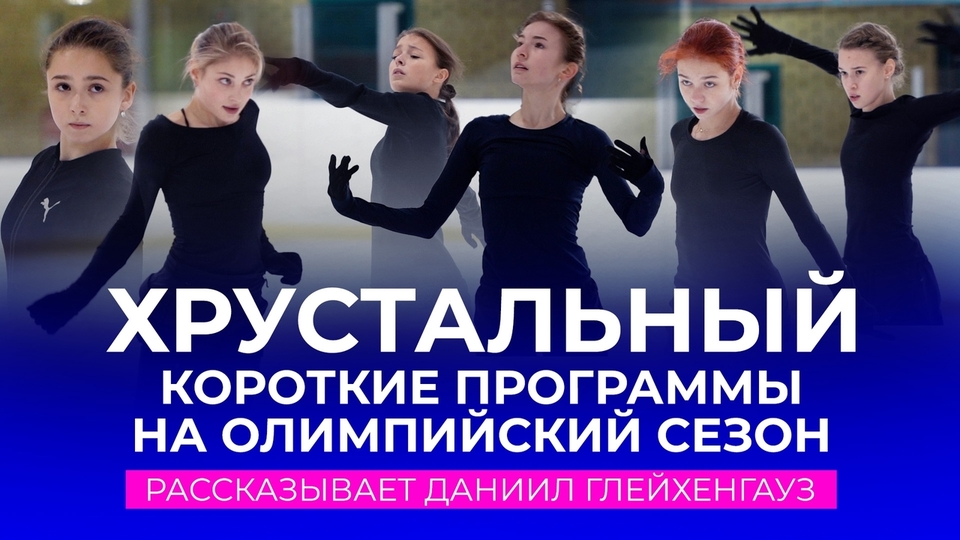
I think part two should be expected soon.Хрустальный: короткие программы на Олимпийский сезон
С какими короткими программами в Олимпийском сезоне будут выступать ученицы группы Этери Тутберидзе Александра Трусова, Камила Валиева, Майя Хромых, Дарья Усачева, Алена Косторная и Анна Щербакова? Рассказывает заслуженный тренер России, постановщик программ Даниил Глейхенгауз.
Exclusive footage from 1Tv on Sambo Short programs.
As I predicted, Aliona’s 3A is back and well

LOL, Anna, Alena and Sasha on the ice together again like last season didn't happen...Хрустальный: короткие программы на Олимпийский сезон
С какими короткими программами в Олимпийском сезоне будут выступать ученицы группы Этери Тутберидзе Александра Трусова, Камила Валиева, Майя Хромых, Дарья Усачева, Алена Косторная и Анна Щербакова? Рассказывает заслуженный тренер России, постановщик программ Даниил Глейхенгауз.
Exclusive footage from 1Tv on Sambo Short programs.
As I predicted, Aliona’s 3A is back and well
Personally, I am rooting for her to be back in form, and that she makes the team. Would much rather have clean, strong skating make the podium at Beijing, than what we saw happen at Stockholm with what Trusova and Tuktamysheva delivered.As I predicted, Aliona’s 3A is back and well
Quite intense music choices across the board; really curious about the full choreo, and the costumes, too!Хрустальный: короткие программы на Олимпийский сезон
С какими короткими программами в Олимпийском сезоне будут выступать ученицы группы Этери Тутберидзе Александра Трусова, Камила Валиева, Майя Хромых, Дарья Усачева, Алена Косторная и Анна Щербакова? Рассказывает заслуженный тренер России, постановщик программ Даниил Глейхенгауз.
Exclusive footage from 1Tv on Sambo Short programs.
As I predicted, Aliona’s 3A is back and well
Alena:

Not really true. Something isn't difficult just because it's unfamiliar for them. That's like saying triple Lutz isn't difficult because the skater's used to doing them, and something like double Lutz is more unfamiliar to them, etc.I don't think you've understood what I've said.
One of the difficulty for a person doing a "difficult variation" is that they literally are attempting a jump that is unusual for them. Hence Boitano's tano Lutz being difficult for him, because he never learned the Lutz that way from the ground up, nor the other jumps.
The difficulty is debatable for a person if this is the way they've literally learned that jump and all their other jumps, and in general look like they literally cannot jump a different way.
If this is what you are also saying, we agree. Otherwise, we do not.
Disagreed.Not really true. Something isn't difficult just because it's unfamiliar for them. That's like saying triple Lutz isn't difficult because the skater's used to doing them, and something like double Lutz is more unfamiliar to them, etc.
All what you're saying means is that they simply learned to do the jump in a more difficult manner. If it even is more difficult: Ff it makes the aerodynamics such that rotating becomes more difficult, then it should objectively indeed be more difficult. Then the other point is, "does it actually need to be more difficult to deserve bonus points?" I'm not sure if that's true, either.
Alena:
Actually a good one, I think.Anna:
On what point, and how?Disagreed.
It WAS NOT heavily underrotated, maybe q.Well, that was heavily underrotated, and looked pretty chaotic in the air. It remains to be seen whether that can actually be consistent.
It's possible I didn't explain correctly, or I didn't understand what you said. The point I was trying to make, simply, is that some people literally learn to straighten their axis using the rippon variation. If they learn it like that, then no it's not difficult anymore.On what point, and how?
Yes, my opinion is that what a person learned or didn't learn does not affect the innate difficulty of something. For example, a skater can be practicing jumping all day and doing no practice on spins, that doesn't make the jumps innately less difficult than spins, and doesn't make them require less points than spins. Additionally, I also disagree on tailoring difficulty skater to skater, like "this skater finds spins difficult, we should increase the point value of spins for them", as an example.It's possible I didn't explain correctly, or I didn't understand what you said. The point I was trying to make, simply, is that some people literally learn to straighten their axis using the rippon variation. If they learn it like that, then no it's not difficult anymore.
If you are disagreeing with this point, then we do disagree. This was the context. The Brian Boitano post, maybe I shouldn't have replied to, since I'm not sure what they meant, and seems I did a bad job explaining anyway. Beyond that, I don't have anything to add.
But that's not the same as what I'm saying. I guess I read your post correctly before.Yes, my opinion is that what a person learned or didn't learn does not affect the innate difficulty of something. For example, a skater can be practicing jumping all day and doing no practice on spins, that doesn't make the jumps innately less difficult than spins, and doesn't make them require less points than spins. Additionally, I also disagree on tailoring difficulty skater to skater, like "this skater finds spins difficult, we should increase the point value of spins for them", as an example.


