SSHOR Moskvich | Page 2 | Golden Skate

SSHOR Moskvich

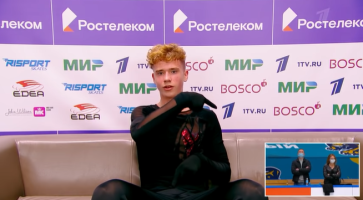
Team Moskvich takes home the full set of medal colours from Cup of Russia in Sochi. Congrats to Kirill Andrusik for taking silver 🥈 in the junior men's competition!


Edit: I almost forgot to mention, coach Viktoria also brought out another boy, Ruslan Nazarov. He previously skated with Sergei Dobrin in Krasnodar and must have switched to Moskvich only this season. I watched his SP to the Game of Thrones soundtrack and thought he showed some very promising skating. Then Vika turned up for him behind the boards and I just had to laugh to myself. She really is collecting some very special skaters!

Edit 2: Unfortunately, Stasya Konstantinova had to miss this CoR stage since she had Covid a few weeks ago. According to her instagram she is already on the mend and testing negative for the virus again. Speedy recovery to Stasya! 💐 I hope we'll get the chance to see her in some competitions still this season, doesn't matter to me if it is RusNats or some small inter-club comp (in fact, a Moskvich inter-club comp might well be one of the highlights of the season 😋)
 
Last edited:
More Medals for Moskvich!
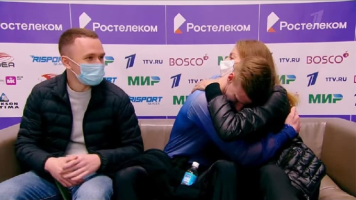
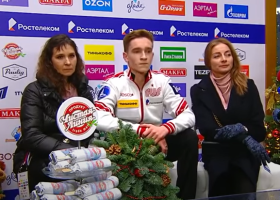
Andrei Anisimov takes home a bronze from Cup of Russia stage 4 and more importantly also secured himself a spot at senior Nationals!


And there is even a chance for Many More Medals for Moskvich as coach Vika is currently bringing out another pack of boys for the junior competition, wearing a huge puffy red Russian national team jacket. 🥰
 
Kirill Andrusik wins another silver medal at Cup of Russia! :cheer2:
Congratulations also to Moskvich athletes Ruslan Nazarov and Kirill Kropylev for their performances in the junior men's competition!


Some more pictures from CoR stage 4:
Kirill A. SP: https://www.instagram.com/p/CWLe7bioqY6/?utm_source=ig_web_copy_link
Andrei A. SP: https://www.instagram.com/p/CWETnb6IUIy/?utm_source=ig_web_copy_link
Andrei A. on the podium: https://www.instagram.com/p/CWIGXSXotqw/?utm_source=ig_web_copy_link

Also, fingers crossed 🤞 this week for Alexey Erokhov and Ilya Yablokov (and Vladimir Samoilov, who is listed as a substitute but mentioned he'll skate in Poland iirc) at the ISU Challenger Cup of Warsaw. Priority one is to get senior minimums for Europeans and Worlds, but it would be nice if by doing that the guys could also win #MoreMedalsforMoskvich!
 
To follow up on the Warsaw Challenger, unfortunately, neither Alexey nor Ilya could deliver clean skates and finished off the podium. In their defense, the men's SP took place at an ungodly hour so the guys had to skate at around 1am Moscow time, and get up very early the next morning for their FS practise. Their FS warm-ups actually looked quite promising, so maybe their competition nerves just got the best of them in the end. It was Ilya's international senior debut after all, and Alexey spent the last three years in the wilderness.
Samoilov also did not make an appearance. I checked his profile on allskaters and saw that he had already withdrawn from two local Polish competitions this season, so hopefully he is not injured. :pray:
Anyway, I hope the guys arrived back home safely and can regroup and focus on their next competitions. Ilya of course will be at JGPF starting on 9th December, and Erokhov (edit: withdrawn :( ), Anisimov, and Andrusik are on the preliminary entry list for the Moscow City Championships taking place from 30th November to 3rd December. Smooth ice and clean skates!
I also wanted to see Stasia Konstantinova listed for Moscow City Champs, but sadly, still no sign of her. :(
 
Last edited:
I'd like to borrow that line for my avatar signature during the upcoming Russian Nationals if it's ok with you. :)
Go for it! :LOL:

Well on the bright side, you can't be a dark horse if you're winning too much 🙈 And yeah, they definitely must have suffered a bit from sleep deprivation/nerves/lack of Vika (not to mention the men's event had sooo many entrants). Better luck next time Ilya and Alexei!
 
I finally got around to typing the articles from this summer's Московский фигурист. Fair warning though, the texts are mostly based on machine translation because a) my Russian is only rudimentary, and b) the articles were really long. But I cleaned up the quad sheepskin coats and such stuff so it should be readable. There are some interesting insights in both interviews, but what I found most impressive is how well Vika knows her athlete's characters and uses that knowledge to motivate them. It is quite remarkable how similar some of the answers are when you compare the two interviews.

Interview with Viktoria Butsaeva
- Victoria Evgenievna, how did it happen that you train mainly boys? Is this an accident or did you deliberately go this way?

As for the boys - it just happened. I am not trying to give any explanation for this. I like working with boys, I see the result, and I want even better results, just like the athletes themselves.

- Is there a difference in working with boys and girls?
Unlikely. In any case, the figure skating teaching system is the same. Maybe there is a difference in the loads, but otherwise, everything is the same. Stasya Konstantinova has now come to our group, and she calmly joined, because the system is the same and the principles of the training process do not differ: you must first ideally skate one program, and then also skate another. All work comes down to just this.

- Coaches usually complain that boys care about themselves more, are more careless in learning technique, because they are physically stronger, that they are capricious and so on. Do you agree with that?
No, I disagree. In my group there are guys who have such a desire to work that they have to be stopped so that they do not overstrain, because their legs and backs are not made of iron. There are, of course, guys who have to be forced into something, but if you find an approach to them, then in the end they all work. I have a group born in 2012, with lots of girls - 13 girls and 2 boys. There is a middle group born in 2008-2009, in which there are five girls, and the rest are guys. This is the age when they are already applying for the Moscow team and the Russian team. That is, I work with both. Not that I do not see the difference, but if the athlete is motivated, then whether it is a boy or a girl - there is no difference. Here Kirill Kropylev was selected and went this year to the younger Russian championship, after which he was already interested in working. He now understands why he urgently needs a triple Axel, why he needs a quadruple by the next season, otherwise he will be uncompetitive, and he already wants to fight for high places. Probably, it is important to get to a start at the right age that will motivate the athlete for further work. It seems to me that it has always been this way: until a certain age, parents and a coach force, and then at some point - at the age of 16–17, not earlier, - there is a conscious motivation. I look at Ilya Yablokov, who has been skating with me for a little over four years: he had a period when his grandmother and parents forced him, then a moment came when no one could force him at all. Half of the season, if not the season, he dangled, then, thank God, the moment came when he realized what he wanted. So it all depends on age. But these guys who want to work and work since childhood, I have not really met.

- In your opinion, do all the guys realize what challenges are now facing men's single skating? Do they understand that without mastering 3-4 quads there is no point in continuing to skate?
Of course they do. Erokhov is now working on the free program and plans to insert a third quadruple, the jump is a rittberger, and will insert a quadruple into the second half of the program. All this suggests that there is no other way. Together with the younger generation, we train triple jumps as preparatory to quadruple jumps, otherwise they will not be competitive.

- What do you think, in which direction will go further development of men's single skating? Will it be technical skating or artistic skating?
I like the skating that Nathan Chen shows. His skating is undoubtedly power, because he rushes the whole program in one breath, performing the most difficult jumps, but there is so much charming negligence, so much liberation in him that it is definitely artistic skating. Or take our guys - Semenenko, Kondratyuk, Kovalev, Anisimov, Yablokov, they went out on the ice and also rushed. Maybe their skating is not as neat and lingering as we would like, maybe there is no emotion yet, but they show men's skating on the ice.

- If you do not take jumps into account, how strong have our men become, interesting and diverse in other elements?
Now, from an early age, they require complex positions in all spins, which are immediately worked out on the ice and in the hall at the choreography. It is required to do all the difficult turns on the ice: loops, twizzles, etc. When I was an athlete it was just the end of the era of school figures and there really was a decline in skating skills, so the introduction of testing (of young skaters’ skating skills) was sensible. Now the situation has more or less leveled off, but it's too early to calm down. It is good that at domestic competitions our technical team treats its athletes harder than when they go to international tournaments. It is generally difficult to get the 4th level with us, it is easier to get it at the stages of the Grand Prix than at home. And it is right. Specialists demand severely from our guys, which can only be welcomed. Especially if these athletes are promising and apply for participation in international competitions. Technical specialists periodically visit us to watch trainings, who rather severely criticize the guys for performing the elements.

- Have you ever regretted that as an athlete you skated in the era of only triple jumps?
I can say that I had wonderful teachers, both in St. Petersburg and in Moscow. When I skated with Mishin - it was one and a half seasons, I managed to catch the time when he worked with Urmanov, Yagudin and Plushenko. Then I moved to Moscow to the Kudryavtsevs, and over the seven years of work that I had, they gave me tremendous knowledge and experience not only as an athlete, but also as a future coach. All my coaches who worked with me did everything so that I, as a coach, could succeed, so that I became the coach I am, and so that I knew where to develop further. Regarding regret, I never even thought about it. Everything has its time. In our time, the 3–3 combo was something outrageous in terms of complexity, but I can say that thanks to the mentors, I can teach my guys quadruple jumps and triple Axel.

- Do you practice sparring techniques in training?
You know, you don't even need to apply such a technique, because they themselves are like roosters. They charge from each other, compete in a natural way. If one succeeds, the others will not calm down. They will not sleep, but they will catch up. Andrei Anisimov, for example, when he came to the group, the guys did not react to him in the training process, but when in the second season he learned the quadruple salchow and toeloop, and then showed them at competition, the guys tensed, felt the competition from him.

- Did Anisimov already have quadruple jumps before?
He came to me two years ago in August, and during such a period when we had passed the training camp and had staged all the programs. He was expelled from the previous group as unpromising, they said that he would not jump quadruples. Andrei is a rather tall guy, he is already 185 cm, so he was recommended to go to pair skating. His mother called me and asked to give her son a chance. I repeat that I am interested in working with guys of any age and any level. At that moment, he had only triple jumps in his arsenal. He surrendered himself entirely to our hands. Already in February/March, Andrei jumped a quadruple salchow and showed his first quadruple at the Moscow Cup in Medvedkovo. And so he began. Then in this pandemic, he grew a lot, we had to restore the salchow for a long time, but in November 2020 he returned this jump and added three and a half Axel. At the Russian Championship, he already did two quads. And this is not the limit: he knows where to develop, where to move. Anisimov is a very interesting athlete, and a good guy himself. He grew up and became very mature by the end of the season.

- What qualities would you especially like to develop in him?
His style is classic long lines, but I don't want to overuse it. True, with such leverage and height as Andrei's, fine motor skills are not for him. But for a start we will learn something danceable in jazz classes, perhaps someday it will come in handy. For example, some dance rhythms can be tried in exhibition numbers. So, in any case, we will try to change the music, we will look for some new stylistic solutions even for classical pieces, we will pay attention to the work of the body.

- Alexey Erokhov has also recently joined you from another group. Why did he choose you as his coach?
No idea. Maybe because I give all the guys a second chance. I enjoy working with them, extending their sports careers. Plus, they are all friends with each other, share their impressions about the training process, about life and about their interests. I am very glad that they have a comfortable and healthy atmosphere within the group. Moreover, they all compete with each other, but this is a productive competition.

- What was the second chance for Erokhov?
Alexey had to overcome the consequences of a leg injury that knocked him out of competition, and for a long time. A stress fracture. In the 2018/19 season, he qualified for the junior world championship in Perm, but could not go, because problems began with his leg. This injury did not allow him to train in full, some half measures did not help, the doctors decided to operate, after which his trainers allowed his leg to heal and recover. As a result, rehabilitation took time, and he missed the season. Alexey came to my group in July 2020, we started the season with him, planned for three starts - two stages of the Cup of Russia and the Championship of Russia, but the issue with the leg became aggravated again. The doctors said that if he wants to save his career, now he has to stop. He did not skate for a month and a half, went on the ice three weeks before the Russian Cup final, at which he performed poorly. I understood that there could be failed starts, but this one turned out to be special. In a word, it was not easy.

- In what form is Alexey entering the new season? What mood?
Lyosha is essentially a ploughman. This is just the case when an athlete must be stopped, otherwise he will break from effort. Sometimes, as a coach, I feel like one more try and he could get hurt. In terms of work, he pulls the whole group with him.

- Do you need to pull the group?
Sometimes it is necessary. Athletes are people like everyone else: they have recessions. For example, the past season was difficult enough for Ilya Yablokov. For him, the last season has become a transitional one. If the other guys recovered from quarantine very quickly, then Ilya recovered hard and for a long time, because he himself had had coronavirus. And all this coincided with the growth and changes in the body, he began to turn from a boy into an adult guy, which is probably why he lacked strength. Every time he started to train, Ilya got sick. Before the championship of Russia, he had been ill, he could not go to the final of the Cup of Russia, because for 10 days he fell ill with a cold, and he could not recover in two or three days. If earlier, after an illness or some kind of break, he could return to his working condition in two or three days and go to the competition, now – no way.

- How did he experience all this? Is he still motivated to work?
To be honest, it was hard, and above all for him. It was the same situation when the season did not go like planned, not as we would have liked. Although in technical terms he made significant progress: he jumped quad ritterberger, and salchow, and a toeloop, but at the starts he did not manage to show everything that he could. I clearly know that he did not finish the season physically, and not only for objective reasons. During the three years that I have worked with him, he has always been trouble-free. He said, two skates of a free program, and if something doesn't work out, then by the third skate, it will. He went and worked.
But this season it was no longer like that. He began to feel sorry for himself. It was even unexpected for me, because Ilya has a masculine character. At the start, he shows everything he can, and even a little more. Loves to compete, loves starting on adrenaline, courage. This is very captivating, because every coach knows how important it is to be able to compete. Now, I hope, over the summer period he will get a little stronger, he will have the strength to plugh in the season. Hopefully everything will turn out and he will prove himself.

- Who puts the programs on for the guys?
From year to year, Nikita Mikhailov puts our programs on. This season he directed both programs for Anisimov and Yablokov. Now Zhenya Vlasov began to try himself in the choreography business, and it is already clear that he, too, can develop in this direction in an interesting way. He delivered the programs to Erokhov and Murashov, and Lyosha Erokhov wanted to stage a new free program with Vlasov, and if Alexey keeps all his ideas in the program, it will be very interesting.

- Is there a recipe that allows you to make each program interesting?
Sasha Zhulin and I once discussed this topic, and he expressed the idea that you can put on an excellent program, but you still have to skate so that the viewer cannot take their eyes off it - for this, the skater must have charisma, inside. If you have it, you can skate any program. Such an athlete may be somewhat careless, even somewhere clumsy, but everyone will be delighted. Right now, Yablokov was given a dance short program, because we wanted to radically change his image. We immediately agreed with Nikita Mikhailov about the chosen music for Ilya, because we understood that it would show him from another side. Ilya is really different in this program. Maybe in some movements he is a little untidy and understated, but he dances. If he can skate this program with all the complex elements in the same way as he is now skating in practise, it will be just a bomb. I would like it to preserve the rhythm and tempo, and all the details of the program. I can say the same about Lyosha Erokhov, whom everyone is used to seeing without emotion, with such a stony expression on his face, although in fact he has a very interesting smile: charming and a little mischievous at the same time. Now in the new free program Alyosha is discovering himself anew. It remains to show the program to the audience in all its glory, because in the new program he has very interesting storytelling. I hope he can handle it all.

- At the beginning of your career as a coach, after some time you suddenly disappeared from sight. Why?
When I started my career as a coach, my group included such athletes as Sonya Biryukova, Polina Korobeinikova, Anna Shershak, on whom I was so focused that I did not recruit junior groups. Because, firstly, I then worked alone without a second coach, there was only a choreographer, and secondly, during that period I went to competitions a lot. Biryukova skated among the seniors, and Korobeinikova and Shershak skated juniors, and every week I went somewhere with them to a competition. I had two suitcases: one was packed with things for a country in which it is warm, in the other were things for a country in which it is cold. I travelled in this way from mid-August to mid-December, that is, from the first stages of the Junior Grand Prix series to the Grand Prix finals. I was practically not in Moscow. Then Sonya went to pair skating, Polina retired after the European Championship, Anya too, and it so happened that I did not have a new generation of skaters to replace them.

- And now you are recruiting the younger group?
Yes, I learned from my mistakes. I recruited athletes from 2012 and took Sonya Biryukova as my assistant, and now we are recruiting children from 2014–2015, with whom Sasha Kondakov will help, Murad Kurbanov helps me with the older guys, because it’s hard to handle such a large group alone. The older group - two workouts a day, the middle group - two workouts a day: I spend whole days on the ice. There are, of course, training sessions, where programs are skated, where I can sit on the boards with a video camera, with a notebook, but as for the middle and junior groups, there is only skating. Almost all of my assistants are my own athletes, I trust them, I know that they can work and I see what they want. In a word, we are now all divided into groups in such a way as to work without omissions. We also made good contact with the coach Julia Shmiller, who has been working with groups of initial training from the first years of study. Our team includes choreographers Galina Ischenko, Christina Stepanova, as well as Evgeny Vlasov. Lyudmila Alekseeva and Irina Strakhova are also with us, and God grant them good health so that they work as long as possible. We have a large and healthy team, which, I am sure, is able to keep our school at a good level and create competition in Moscow.

Interview with Andrei, Alexey, and Ilya

- How do people react to you being a skater?
Andrei Anisimov:
Everyone is so surprised! They say "Wow! Cool!" They ask: "How does it feel to rotate in the air?"
Alexey Erokhov: By the way, everyone is different. I was never ashamed that I was engaged in figure skating, I always spoke about it openly. Reaction? It's usually a surprise that it's not football or hockey or some kind of martial arts. They immediately begin to ask what successes I have achieved, what I can do, whether I jump jumps like Yagudin or Plushenko, and so on. This is a classic.
Ilya Yablokov: They usually say: "Wow!" And then the questions begin, how did you get into figure skating, is it a difficult sport, are you worried at competitions, and so on. Always there’s keen interest.

- Continue the phrase "To be a skater means ..."?
Andrei Anisimov:
It is to overcome yourself every time. Move on through pain and fatigue. Continue exercising. Always finish the program. Don't quit what you started.
Alexey Erokhov: You have to constantly work on yourself, because working on elements is still working on yourself. In your work, you do not just improve the elements, you improve yourself, your technique in order to fulfill elements. Figure skating is a rather boring sport, since you have to hone some of the same movements, micromotions, and there are many of them for years.
Ilya Yablokov: Be responsible. This means to observe the diet, sleep. You must be responsible to yourself, because only you need it. And self-education. A person must educate himself in order to work. So that not someone forced him, but that he himself worked. We must take life into our own hands.

- What is the first thing a skater should be able to do?
Andrei Anisimov:
Well, probably, to be able to gather at competitions, to smile at the judges and spectators. And not being nervous is the main thing.
Alexey Erokhov: Feeling the skate on the ice is the most important thing, but not every athlete succeeds.
Ilya Yablokov: As our coaches tell us, first of all there should be sliding. Because everything in figure skating is built on arcs. We also enter the jump from these arcs, it depends on this whether it will work out or not. And the jump itself is such a moment between the arcs of entry and exit.

- What would you recommend to young skaters? What should they learn first?
Andrei Anisimov:
The main thing is to learn to listen to the coach and not be lazy to complete tasks.
Alexey Erokhov: First of all, the slide. This should be given time and attention. It seems to me that in the old days, when there were school figures, this issue was solved by itself, but now this needs to be specially studied, since sliding is very important.
Ilya Yablokov: I would start with sliding, with setting the legs, with the center of gravity. That is, with the skill of sliding. You need to care about that. Figure skating is not only jumping, but also the program must be skated. You have to think about the audience who came to watch the competition, and your program should be like a show. You must show your skating skills and present yourself on the ice.

- What would you like to learn in the future?
Andrei Anisimov:
Improve skating itself - glide, rotation and stability in jumping. I’d like to learn another quadruple. So far I have only salchow and toeloop. I also want to further stabilize the Axel. And collect all this in the program. And in general, if you take jumps, then quad lutz I want to jump. We have already tried it, I even rotated it, but I fell.
Alexey Erokhov: I would like to master all quadruple jumps and successfully perform them in the program. Already there are salchow, rittberger and toeloop. As for the flip, I jumped it a couple of years ago before the injury on my right leg. This season I want to bring it back and insert it into the programs. As for the lutz, it needs a lot of work. There is a reserve, but in order to stably jump a quadruple, this is not yet available. Need to work. In general, my whole future life I want to associate with figure skating, I want to be a coach.
Ilya Yablokov: I would like to improve the integrity of my programs, when I insert three or four quadruple jumps into it, the program usually loses in entertainment, because I concentrate on the jumps, and not on the program. I would like the jumps to not take up so much strength, so that jumps and skating do not look separate from each other, but are an integral program. Like a salad: we eat it as a whole, and not each ingredient separately. I would also like to graduate from a financial institution one day - this will most likely be my second higher education. Now I have passed my final exams and applied to the Russian State University of Physical Culture, but in the future I plan to become an investment banker, as it were. Because I like everything related to investment. I really like it, I know a little about it.

- Tell us about the turning point in your life.
Andrei Anisimov:
Probably, this was the case this season, when I skated at the second stage of the Russian Cup. I had to show a triple Axel and two quadruples in the programs. I skated the short one well and was second. But in the free program I collapsed and was so upset that I began to think that I would never collect all the elements in the program at all. I just thought: why do I need this figure skating! I train for many hours every day, but then I went out and did nothing. And if you start thinking how all the world leaders skate, that they have five quadruple jumps in the program, then I ask myself the question: “Where am I going? Is it possible to take them over or at least catch up with them? Will I be able to?" I experience failure acutely. I blame myself deeply inside. It happens to me after terrible skates, but the main thing is - get ready and continue to work. Because in fact, anything is possible. Not everyone can, probably, but it is possible. And I want to get involved in this story. The main thing is to make these jumps.
Alexey Erokhov: Honestly, I can't remember anything like that. Maybe an episode: when I had an operation on my leg in 2019, I didn't really want to return to sports, I thought it was time to finish. But then my coaches at Khrustalniy gave me a guest ticket for the national team's test skates. I went, looked at everyone and realized that I couldn't do without figure skating yet.
Ilya Yablokov: Probably, this was the previous season, which was difficult for me. I had to collect my thoughts, but I couldn't do it. I wanted to give up everything and do nothing. I had to think about what I need and what needs to be done for this, and how to do it. That is, to change my attitude to work.

- Tell us about the hardest decision you have ever made.
Andrei Anisimov:
Probably, this has not happened yet. I always wanted to skate in single skating, but Sergei Dmitrievich (Davydov) recommended me to go to pair skating, because I am tall, I have a height of 185 cm. Like, it is difficult to jump with such height. But I didn't want to at all. I realized that I had to look for a coach who would not give up on me.
Alexey Erokhov: The transition to this group was not easy for me. I made this decision very hard for me and thought for a long time. Because at "Khrustalniy" I spent 10 years in the group, and this is a long time. And the coaches there are not strangers to me. I was thinking about this for several weeks. But I crossed over and don't regret it. I have good relations with the new team and with the guys, and I am glad that I decided to make the transition.
Ilya Yablokov: I had coronavirus, although they said all the time that young people do not get sick. The illness itself passed quite easily: I had a temperature for two days and, as it were, a weakness for some time. The lungs were affected by 20-25%. But when I started training, it was very, very difficult to get into shape, to gain it. I've been making a decision all last season. Continue to skate or finish - that was not the question. That is, I understood that I wanted to continue skating, but the question was where to find the strength to continue skating. There was no enthusiasm. I skated like an amoeba. And this is also uninteresting. It's interesting when you get involved in work, when everything works out for you, it turns you on, spurs you on. It's like a snowball. So I thought about how to change my attitude and start again.

- Tell us about the best advice you have received that has been helpful.
Andrei Anisimov:
Once someone told me that in a competition it is better to fall from a jump than to do a butterfly (pop). Because you will at least get some points. And that over time confidence will come and there will be no "butterflies" at all. I try to follow this advice because I am prone to "butterflies", especially on the triple Axel and especially at competitions, under stress. In training, this can also happen if you haven't jumped for a long time. You walk in and you're scared. Or the entry to the jump was technically incorrect and you are thrown out.
Alexey Erokhov: I don't remember who gave me advice, but I remember the advice: if you want to achieve results, you just have to work every day and nothing else. To work when there is no mood, to work when it is hard or there is fatigue. Pain and fatigue must be relegated to the background if you want to be the first. Work and that's it.
Ilya Yablokov: There were a lot of such tips, especially last season. I myself understood that something was wrong. I think that I have been ill with coronavirus more than once. In that season, I generally had a lot of colds, the usual cold knocked me out for a week, I was constantly on pills, my throat was constantly sore, snot pestered me. The motivation was really gone. I thought a lot about everything. Then the coaches told me that I need to change my attitude to this and everything will work out. That helped. And there was also one very good piece of advice: you need to learn from other people's mistakes, not from your own. This is difficult to accomplish alone.

- Tell us about the most interesting gift you have received in your life.
Andrei Anisimov:
Yes, I am actually happy with any gift, whatever it may be.
Alexey Erokhov: I am always pleased when something is presented, like everyone else, I guess. I remembered how at competitions in Japan at the Grand Prix finals each athlete had boxes where toys were put, which fans threw on the ice. When I approached them after the competition, they contained notes from Japanese fans in Russian, written by hand in a clumsy handwriting with errors, but it was very pleasant and very touching that they tried to write pleasant words to the skater in his native language. This is very cool.
Ilya Yablokov: Hmm. For gifts to surprise or delight? Usually, I know what they will give me. So this has not happened yet. It didn't catch me by surprise.

- Do you have your own secret of success?
Andrei Anisimov:
The secret of my success? Probably not. The whole secret is in training. You have to work and that's it.
Alexey Erokhov: Only work. But this is not a secret of success, everyone knows that.
Ilya Yablokov: I am not worried before the start and at the start I am not worried either. I calmly go out with a cool head, I know what to do. It doesn't kick me out. I know how much energy needs to be spent, how much it will take me. I made a jump and continue to skate.

- What motivates you to work?
Andrei Anisimov:
Mom motivates me very much. And two more younger brothers, they are both basketball players, are engaged in CSKA.
Alexey Erokhov: I really love figure skating. This is for the love of art. I like to improve every day, so far I'm happy with my results at this stage, but I want to become even better. I think about it every day, and it helps me.
Ilya Yablokov: New programs always inspire me. Here is a new short program for this season - it really inspires me: a new pace, new movements. If we take separate elements, then in the track I really dance and enjoy it, but all together is already difficult. This is my hardest short program so far. There is work to do here. It's a challenge. And we left the free program, because there were few starts last season and I did not show in it what I had to show. I managed to show myself only 20%.

- What helps you cope with competitive stress or fatigue stress?
Andrei Anisimov:
I am inspired by clean skating at competitions. This is generally cool! It's just pure joy. A clean skate gives a powerful burst of energy, especially when there is a chance to win.
Alexey Erokhov: The coaches help me cope with this. Victoria Evgenievna and Murad (Kurbanov). Build training not on the same type of sharpening of some elements, but every day something different. It happens, of course, that you get tired, but then I leave for the city of Elektrostal. My grandmother once lived there and I still have many childhood friends there. Let's just say: for me it is a city of psychological relief. Small, quiet, you can go around it all in half an hour, and I have a mental rest there.
Ilya Yablokov: In general, it is difficult to renew and be inspired during the season when there is monotonous work. This moment must be endured. An ordinary necessity. But each new start gives some kind of charge. If you have a good start, then the mood is generally on the rise and you want to continue to work. If the start is unsuccessful, then all the more you want to work to fix what did not work out. Competitions inspire me.

- What qualities do you consider to be the most striking and useful?
Andrei Anisimov:
Perseverance and aspiration. If I have taken on something, then I will pull it out. I will not give up, even if it doesn’t work right away.
Alexey Erokhov: When I get tired, I start to work even harder and harder. I start to get even more involved in the training process and, as Viktoria Evgenievna says, I need to be stopped at these moments. If you don't stop me, then I can train until morning. I have no explanation for this. At this moment I feel some kind of euphoria, as if a thrill. But thanks to the coaches, who very clearly see that I have crossed a certain line, they let me know that I need to slow down now. They can see right away as soon as I start to get turned on. I consider it my useful quality to understand with my head what I need to do and why. I understand very precisely what the coaches expect from me.
Ilya Yablokov: One good quality is a cool head.

- What qualities are the most harmful or useless?
Andrei Anisimov:
It's hard for me to get up in the morning. Often.
Alexey Erokhov: This can be attributed to the fact that it is difficult to stop me, because from the point of view of the training process, this can lead to injury, because against the background of fatigue, reactions become worse, the legs do not obey, the brain too.
Ilya Yablokov: My worst quality is laziness. It's hard for me to get involved in the training process at the beginning of the season. In the beginning, everything is always lazy for me, and when I work, it already becomes easier. Even if everything hurts, it is still easier. I turn on for a very long time, swing for a long time. I also like to eat. I’m probably continuing to grow.

- What don't you like to do?
Andrei Anisimov:
Get up early.
Alexey Erokhov: I don't like lying down a lot. I'm getting tired. Even on vacation on the beach, I can lie on a lounger for two days, and then that's it.
Ilya Yablokov: I don’t like to do what I don’t like. And on the rink I don't like spinning. This is the hardest thing for me. Due to the fact that you have to work on spins for a very long time, gain speed, centering, hold positions - all this is very dreary. And when I leave the spins, my head is dizzy.

- Describe your character in a few different words.
Andrei Anisimov:
I am hard-working, I like to communicate, but I do not like to leave the house, stay-at-home, sympathetic, love animals, calm.
Alexey Erokhov: I am cheerful, joyful, positive, sociable. But at some moments I am quite closed. For example, during a competition, I concentrate on what I need to do, and there is no time for communication. Hard working. Demanding and hard on myself. I demand a lot from myself and treat myself in certain aspects harshly.
Ilya Yablokov: Lazy. Kind, cheerful, resistant to stressful situations, sociable, because I like to communicate with people and I can find a common language with a large number of people. At first I am a little shy, but then no longer.

- What is the greatest pride in your life?
Andrei Anisimov:
Basically, when I skated cleanly at competitions.
Alexey Erokhov: So far, my biggest achievement was winning the junior world championship. I am very glad that I was able to win the gold medal, because at that time I had such a goal, and I achieved it. I understand that there is no need to dwell on this and stop, but I put a tick behind it.
Ilya Yablokov: Good training. In general, I quite achieve the goals that I set for myself. Recently I set myself the task of entering the training process. And I did it.

- What action would you need to muster up the courage to do?
Andrei Anisimov:
I have not yet had such a situation that I had to gain courage, since there was no inner fear of anything. So far, there is enough courage that is.
Alexey Erokhov: I had to muster up courage and determination to move from the group (Khrustalniy).
Ilya Yablokov: If you confess your love to someone.

- What can you not do without in a day?
Andrei Anisimov:
Watch a movie or TV series. Pet the cat (😻).
Alexey Erokhov: No phone. I can't live without the music that I have on my phone. But I don't really like to update social networks, I think that it can be seen from them.
Ilya Yablokov: In principle, there is nothing like that. If I don't talk to the guys for one day, then nothing terrible will happen.

- What must every person do at least once in their life?
Andrei Anisimov:
I want to jump with a parachute.
Alexey Erokhov: I don't know about everyone, but I would definitely like to jump with a parachute.
Ilya Yablokov: I never thought about it.

- What supernatural ability would you like to have?
Andrei Anisimov:
Either super speed or fly.
Alexey Erokhov: Either accelerated regeneration and lack of fatigue or teleportation. Traffic jams in Moscow are a pain.
Ilya Yablokov: I thought about it and there were options. If you choose, then ... I definitely don’t want to read thoughts, it’s tiresome. Either move in space, or in time in any direction.

- How do you spend your free time?
Andrei Anisimov:
I rest after training, sleep, watch TV series, study. I listen to different music.
Alexey Erokhov: Most often with friends. I also love listening to music, it resonates with me. I listen to a lot of rock music, rock classics: Scorpions, Pink Floyd, Guns N' Roses and others. I also like to read, or rather, listen to books.
Ilya Yablokov: I used to spend it like this: I came home from training, had time to take a nap for literally half an hour, then do my homework, then to the tutors, then dinner and sleep. And now it’s summer and I’m still breathing out after passing the exams. I walk, meet with the guys. I don't really like social networks, although recently I started using them, because everyone is on social networks, but I like to communicate more live. That's more interesting.

- What topics do you like to talk about with your friends?
Andrei Anisimov:
On various topics. My friends are universal.
Alexey Erokhov: Different topics. I have several close friends, with some I talk about life, with others about football, because we support different teams, we compete and we have something to discuss, with the third we can talk about counter-strike (a computer game) and also about life.
Ilya Yablokov: There are a lot of different topics. We are talking about everything.

- What topics will you never talk to your friends about?
Andrei Anisimov:
Probably there are none.
Alexey Erokhov: I can talk about everything with my relatives, maybe, with the exception of a couple of topics that I don't want to talk about in general.
Ilya Yablokov: I didn't think about it. We communicate freely.

- How much time per day do you spend on social media?
Andrei Anisimov:
I surf the net, spend time on Instagram, mostly.
Alexey Erokhov: Quite a bit.
Ilya Yablokov: Now I began to spend more time, but I’m still not a fan. I post one photo every six months on Instagram and that's it.

- How do you react to criticism directed at you (on the internet)?
Andrei Anisimov
: I have a good attitude. Once they criticize, it means that they are interested in me. Good to listen to. But in general, I listen to coaches more.
Alexey Erokhov: Positively. Anyone has a right to their personal opinion, but if a person expresses criticism constructively, I always listen. I rarely, but sometimes read comments on social media. Whether they like my skating or not. What will they say at all. I am calm about criticism.
Ilya Yablokov: Before, I did not like to listen to criticism, but now I have become more relaxed about it. If this is the correct criticism, then it must be accepted, digested and moved on. It's like a guide to action. Usually criticism from parents happens. Previously, I did not want to talk to them about it at all, but now I realized that they are not telling me some garbage, but because they love me and want everything to work out.

- Is there anything good about envy?
Andrei Anisimov:
If someone did something great, and you wanted to do it, then it is hardly envy. I would like to skate like Chen, for example.
Alexey Erokhov: The only question is what kind of envy is it. So I look at the skating of Nathan Chen and I understand that I would like to be in his place, to be the same. Jump four quadruple jumps, skate the program cleanly, win the world championships. Any skater would like it too. But I do not envy, because I go my own way.
Ilya Yablokov: Honestly, I did not envy anyone at all. My life is my life. I solve my problems. I am the creator of my destiny.

- What do you consider the most valuable and important in life?
Andrei Anisimov:
Family: mom, dad, grandmothers, grandfathers.
Alexey Erokhov: Family. I believe that the family should always come first.
Ilya Yablokov: Probably children. Descendants as an extension of you.

- What wish would you ask a goldfish to fulfil if you caught it?
Andrei Anisimov:
I need to think about it. Superpower I will ask. Fly or super speed. Probably fly.
Alexey Erokhov: Health to loved ones most likely. So that everything is good for them. Joyful and calm.
Ilya Yablokov: I probably won't even be able to answer you this question. Because you can do without the fulfilment of desires from the fish, if there is something to strive for, if you see the goal. Obstacles will, of course, be encountered, but they must be overcome. My life is my adventure. Why should I deprive myself of the joy of overcoming my adventures? But if we talk about desires, then the biggest desire is to remove laziness to move on, not stopping at what has been achieved. Overcome my ceiling.
 
Last edited:
I finally got around to typing the articles from this summer's Московский фигурист. Fair warning though, the texts are mostly based on machine translation because a) my Russian is only rudimentary, and b) the articles were really long. But I cleaned up the quad sheepskin coats and such stuff so it should be readable. There are some interesting insights in both interviews, but what I found most impressive is how well Vika knows her athlete's characters and uses that knowledge to motivate them. It is quite remarkable how similar some of the answers are when you compare the two interviews.

Interview with Viktoria Butsaeva
- Victoria Evgenievna, how did it happen that you train mainly boys? Is this an accident or did you deliberately go this way?

As for the boys - it just happened. I am not trying to give any explanation for this. I like working with boys, I see the result, and I want even better results, just like the athletes themselves.

- Is there a difference in working with boys and girls?
Unlikely. In any case, the figure skating teaching system is the same. Maybe there is a difference in the loads, but otherwise, everything is the same. Stasya Konstantinova has now come to our group, and she calmly joined, because the system is the same and the principles of the training process do not differ: you must first ideally skate one program, and then also skate another. All work comes down to just this.

- Coaches usually complain that boys care about themselves more, are more careless in learning technique, because they are physically stronger, that they are capricious and so on. Do you agree with that?
No, I disagree. In my group there are guys who have such a desire to work that they have to be stopped so that they do not overstrain, because their legs and backs are not made of iron. There are, of course, guys who have to be forced into something, but if you find an approach to them, then in the end they all work. I have a group born in 2012, with lots of girls - 13 girls and 2 boys. There is a middle group born in 2008-2009, in which there are five girls, and the rest are guys. This is the age when they are already applying for the Moscow team and the Russian team. That is, I work with both. Not that I do not see the difference, but if the athlete is motivated, then whether it is a boy or a girl - there is no difference. Here Kirill Kropylev was selected and went this year to the younger Russian championship, after which he was already interested in working. He now understands why he urgently needs a triple Axel, why he needs a quadruple by the next season, otherwise he will be uncompetitive, and he already wants to fight for high places. Probably, it is important to get to a start at the right age that will motivate the athlete for further work. It seems to me that it has always been this way: until a certain age, parents and a coach force, and then at some point - at the age of 16–17, not earlier, - there is a conscious motivation. I look at Ilya Yablokov, who has been skating with me for a little over four years: he had a period when his grandmother and parents forced him, then a moment came when no one could force him at all. Half of the season, if not the season, he dangled, then, thank God, the moment came when he realized what he wanted. So it all depends on age. But these guys who want to work and work since childhood, I have not really met.

- In your opinion, do all the guys realize what challenges are now facing men's single skating? Do they understand that without mastering 3-4 quads there is no point in continuing to skate?
Of course they do. Erokhov is now working on the free program and plans to insert a third quadruple, the jump is a rittberger, and will insert a quadruple into the second half of the program. All this suggests that there is no other way. Together with the younger generation, we train triple jumps as preparatory to quadruple jumps, otherwise they will not be competitive.

- What do you think, in which direction will go further development of men's single skating? Will it be technical skating or artistic skating?
I like the skating that Nathan Chen shows. His skating is undoubtedly power, because he rushes the whole program in one breath, performing the most difficult jumps, but there is so much charming negligence, so much liberation in him that it is definitely artistic skating. Or take our guys - Semenenko, Kondratyuk, Kovalev, Anisimov, Yablokov, they went out on the ice and also rushed. Maybe their skating is not as neat and lingering as we would like, maybe there is no emotion yet, but they show men's skating on the ice.

- If you do not take jumps into account, how strong have our men become, interesting and diverse in other elements?
Now, from an early age, they require complex positions in all spins, which are immediately worked out on the ice and in the hall at the choreography. It is required to do all the difficult turns on the ice: loops, twizzles, etc. When I was an athlete it was just the end of the era of school figures and there really was a decline in skating skills, so the introduction of testing (of young skaters’ skating skills) was sensible. Now the situation has more or less leveled off, but it's too early to calm down. It is good that at domestic competitions our technical team treats its athletes harder than when they go to international tournaments. It is generally difficult to get the 4th level with us, it is easier to get it at the stages of the Grand Prix than at home. And it is right. Specialists demand severely from our guys, which can only be welcomed. Especially if these athletes are promising and apply for participation in international competitions. Technical specialists periodically visit us to watch trainings, who rather severely criticize the guys for performing the elements.

- Have you ever regretted that as an athlete you skated in the era of only triple jumps?
I can say that I had wonderful teachers, both in St. Petersburg and in Moscow. When I skated with Mishin - it was one and a half seasons, I managed to catch the time when he worked with Urmanov, Yagudin and Plushenko. Then I moved to Moscow to the Kudryavtsevs, and over the seven years of work that I had, they gave me tremendous knowledge and experience not only as an athlete, but also as a future coach. All my coaches who worked with me did everything so that I, as a coach, could succeed, so that I became the coach I am, and so that I knew where to develop further. Regarding regret, I never even thought about it. Everything has its time. In our time, the 3–3 combo was something outrageous in terms of complexity, but I can say that thanks to the mentors, I can teach my guys quadruple jumps and triple Axel.

- Do you practice sparring techniques in training?
You know, you don't even need to apply such a technique, because they themselves are like roosters. They charge from each other, compete in a natural way. If one succeeds, the others will not calm down. They will not sleep, but they will catch up. Andrei Anisimov, for example, when he came to the group, the guys did not react to him in the training process, but when in the second season he learned the quadruple salchow and toeloop, and then showed them at competition, the guys tensed, felt the competition from him.

- Did Anisimov already have quadruple jumps before?
He came to me two years ago in August, and during such a period when we had passed the training camp and had staged all the programs. He was expelled from the previous group as unpromising, they said that he would not jump quadruples. Andrei is a rather tall guy, he is already 185 cm, so he was recommended to go to pair skating. His mother called me and asked to give her son a chance. I repeat that I am interested in working with guys of any age and any level. At that moment, he had only triple jumps in his arsenal. He surrendered himself entirely to our hands. Already in February/March, Andrei jumped a quadruple salchow and showed his first quadruple at the Moscow Cup in Medvedkovo. And so he began. Then in this pandemic, he grew a lot, we had to restore the salchow for a long time, but in November 2020 he returned this jump and added three and a half Axel. At the Russian Championship, he already did two quads. And this is not the limit: he knows where to develop, where to move. Anisimov is a very interesting athlete, and a good guy himself. He grew up and became very mature by the end of the season.

- What qualities would you especially like to develop in him?
His style is classic long lines, but I don't want to overuse it. True, with such leverage and height as Andrei's, fine motor skills are not for him. But for a start we will learn something danceable in jazz classes, perhaps someday it will come in handy. For example, some dance rhythms can be tried in exhibition numbers. So, in any case, we will try to change the music, we will look for some new stylistic solutions even for classical pieces, we will pay attention to the work of the body.

- Alexey Erokhov has also recently joined you from another group. Why did he choose you as his coach?
No idea. Maybe because I give all the guys a second chance. I enjoy working with them, extending their sports careers. Plus, they are all friends with each other, share their impressions about the training process, about life and about their interests. I am very glad that they have a comfortable and healthy atmosphere within the group. Moreover, they all compete with each other, but this is a productive competition.

- What was the second chance for Erokhov?
Alexey had to overcome the consequences of a leg injury that knocked him out of competition, and for a long time. A stress fracture. In the 2018/19 season, he qualified for the junior world championship in Perm, but could not go, because problems began with his leg. This injury did not allow him to train in full, some half measures did not help, the doctors decided to operate, after which his trainers allowed his leg to heal and recover. As a result, rehabilitation took time, and he missed the season. Alexey came to my group in July 2020, we started the season with him, planned for three starts - two stages of the Cup of Russia and the Championship of Russia, but the issue with the leg became aggravated again. The doctors said that if he wants to save his career, now he has to stop. He did not skate for a month and a half, went on the ice three weeks before the Russian Cup final, at which he performed poorly. I understood that there could be failed starts, but this one turned out to be special. In a word, it was not easy.

- In what form is Alexey entering the new season? What mood?
Lyosha is essentially a ploughman. This is just the case when an athlete must be stopped, otherwise he will break from effort. Sometimes, as a coach, I feel like one more try and he could get hurt. In terms of work, he pulls the whole group with him.

- Do you need to pull the group?
Sometimes it is necessary. Athletes are people like everyone else: they have recessions. For example, the past season was difficult enough for Ilya Yablokov. For him, the last season has become a transitional one. If the other guys recovered from quarantine very quickly, then Ilya recovered hard and for a long time, because he himself had had coronavirus. And all this coincided with the growth and changes in the body, he began to turn from a boy into an adult guy, which is probably why he lacked strength. Every time he started to train, Ilya got sick. Before the championship of Russia, he had been ill, he could not go to the final of the Cup of Russia, because for 10 days he fell ill with a cold, and he could not recover in two or three days. If earlier, after an illness or some kind of break, he could return to his working condition in two or three days and go to the competition, now – no way.

- How did he experience all this? Is he still motivated to work?
To be honest, it was hard, and above all for him. It was the same situation when the season did not go like planned, not as we would have liked. Although in technical terms he made significant progress: he jumped quad ritterberger, and salchow, and a toeloop, but at the starts he did not manage to show everything that he could. I clearly know that he did not finish the season physically, and not only for objective reasons. During the three years that I have worked with him, he has always been trouble-free. He said, two skates of a free program, and if something doesn't work out, then by the third skate, it will. He went and worked.
But this season it was no longer like that. He began to feel sorry for himself. It was even unexpected for me, because Ilya has a masculine character. At the start, he shows everything he can, and even a little more. Loves to compete, loves starting on adrenaline, courage. This is very captivating, because every coach knows how important it is to be able to compete. Now, I hope, over the summer period he will get a little stronger, he will have the strength to plugh in the season. Hopefully everything will turn out and he will prove himself.

- Who puts the programs on for the guys?
From year to year, Nikita Mikhailov puts our programs on. This season he directed both programs for Anisimov and Yablokov. Now Zhenya Vlasov began to try himself in the choreography business, and it is already clear that he, too, can develop in this direction in an interesting way. He delivered the programs to Erokhov and Murashov, and Lyosha Erokhov wanted to stage a new free program with Vlasov, and if Alexey keeps all his ideas in the program, it will be very interesting.

- Is there a recipe that allows you to make each program interesting?
Sasha Zhulin and I once discussed this topic, and he expressed the idea that you can put on an excellent program, but you still have to skate so that the viewer cannot take their eyes off it - for this, the skater must have charisma, inside. If you have it, you can skate any program. Such an athlete may be somewhat careless, even somewhere clumsy, but everyone will be delighted. Right now, Yablokov was given a dance short program, because we wanted to radically change his image. We immediately agreed with Nikita Mikhailov about the chosen music for Ilya, because we understood that it would show him from another side. Ilya is really different in this program. Maybe in some movements he is a little untidy and understated, but he dances. If he can skate this program with all the complex elements in the same way as he is now skating in practise, it will be just a bomb. I would like it to preserve the rhythm and tempo, and all the details of the program. I can say the same about Lyosha Erokhov, whom everyone is used to seeing without emotion, with such a stony expression on his face, although in fact he has a very interesting smile: charming and a little mischievous at the same time. Now in the new free program Alyosha is discovering himself anew. It remains to show the program to the audience in all its glory, because in the new program he has very interesting storytelling. I hope he can handle it all.

- At the beginning of your career as a coach, after some time you suddenly disappeared from sight. Why?
When I started my career as a coach, my group included such athletes as Sonya Biryukova, Polina Korobeinikova, Anna Shershak, on whom I was so focused that I did not recruit junior groups. Because, firstly, I then worked alone without a second coach, there was only a choreographer, and secondly, during that period I went to competitions a lot. Biryukova skated among the seniors, and Korobeinikova and Shershak skated juniors, and every week I went somewhere with them to a competition. I had two suitcases: one was packed with things for a country in which it is warm, in the other were things for a country in which it is cold. I travelled in this way from mid-August to mid-December, that is, from the first stages of the Junior Grand Prix series to the Grand Prix finals. I was practically not in Moscow. Then Sonya went to pair skating, Polina retired after the European Championship, Anya too, and it so happened that I did not have a new generation of skaters to replace them.

- And now you are recruiting the younger group?
Yes, I learned from my mistakes. I recruited athletes from 2012 and took Sonya Biryukova as my assistant, and now we are recruiting children from 2014–2015, with whom Sasha Kondakov will help, Murad Kurbanov helps me with the older guys, because it’s hard to handle such a large group alone. The older group - two workouts a day, the middle group - two workouts a day: I spend whole days on the ice. There are, of course, training sessions, where programs are skated, where I can sit on the boards with a video camera, with a notebook, but as for the middle and junior groups, there is only skating. Almost all of my assistants are my own athletes, I trust them, I know that they can work and I see what they want. In a word, we are now all divided into groups in such a way as to work without omissions. We also made good contact with the coach Julia Shmiller, who has been working with groups of initial training from the first years of study. Our team includes choreographers Galina Ischenko, Christina Stepanova, as well as Evgeny Vlasov. Lyudmila Alekseeva and Irina Strakhova are also with us, and God grant them good health so that they work as long as possible. We have a large and healthy team, which, I am sure, is able to keep our school at a good level and create competition in Moscow.

Interview with Andrei, Alexey, and Ilya

- How do people react to you being a skater?
Andrei Anisimov:
Everyone is so surprised! They say "Wow! Cool!" They ask: "How does it feel to rotate in the air?"
Alexey Erokhov: By the way, everyone is different. I was never ashamed that I was engaged in figure skating, I always spoke about it openly. Reaction? It's usually a surprise that it's not football or hockey or some kind of martial arts. They immediately begin to ask what successes I have achieved, what I can do, whether I jump jumps like Yagudin or Plushenko, and so on. This is a classic.
Ilya Yablokov: They usually say: "Wow!" And then the questions begin, how did you get into figure skating, is it a difficult sport, are you worried at competitions, and so on. Always there’s keen interest.

- Continue the phrase "To be a skater means ..."?
Andrei Anisimov:
It is to overcome yourself every time. Move on through pain and fatigue. Continue exercising. Always finish the program. Don't quit what you started.
Alexey Erokhov: You have to constantly work on yourself, because working on elements is still working on yourself. In your work, you do not just improve the elements, you improve yourself, your technique in order to fulfill elements. Figure skating is a rather boring sport, since you have to hone some of the same movements, micromotions, and there are many of them for years.
Ilya Yablokov: Be responsible. This means to observe the diet, sleep. You must be responsible to yourself, because only you need it. And self-education. A person must educate himself in order to work. So that not someone forced him, but that he himself worked. We must take life into our own hands.

- What is the first thing a skater should be able to do?
Andrei Anisimov:
Well, probably, to be able to gather at competitions, to smile at the judges and spectators. And not being nervous is the main thing.
Alexey Erokhov: Feeling the skate on the ice is the most important thing, but not every athlete succeeds.
Ilya Yablokov: As our coaches tell us, first of all there should be sliding. Because everything in figure skating is built on arcs. We also enter the jump from these arcs, it depends on this whether it will work out or not. And the jump itself is such a moment between the arcs of entry and exit.

- What would you recommend to young skaters? What should they learn first?
Andrei Anisimov:
The main thing is to learn to listen to the coach and not be lazy to complete tasks.
Alexey Erokhov: First of all, the slide. This should be given time and attention. It seems to me that in the old days, when there were school figures, this issue was solved by itself, but now this needs to be specially studied, since sliding is very important.
Ilya Yablokov: I would start with sliding, with setting the legs, with the center of gravity. That is, with the skill of sliding. You need to care about that. Figure skating is not only jumping, but also the program must be skated. You have to think about the audience who came to watch the competition, and your program should be like a show. You must show your skating skills and present yourself on the ice.

- What would you like to learn in the future?
Andrei Anisimov:
Improve skating itself - glide, rotation and stability in jumping. I’d like to learn another quadruple. So far I have only salchow and toeloop. I also want to further stabilize the Axel. And collect all this in the program. And in general, if you take jumps, then quad lutz I want to jump. We have already tried it, I even rotated it, but I fell.
Alexey Erokhov: I would like to master all quadruple jumps and successfully perform them in the program. Already there are salchow, rittberger and toeloop. As for the flip, I jumped it a couple of years ago before the injury on my right leg. This season I want to bring it back and insert it into the programs. As for the lutz, it needs a lot of work. There is a reserve, but in order to stably jump a quadruple, this is not yet available. Need to work. In general, my whole future life I want to associate with figure skating, I want to be a coach.
Ilya Yablokov: I would like to improve the integrity of my programs, when I insert three or four quadruple jumps into it, the program usually loses in entertainment, because I concentrate on the jumps, and not on the program. I would like the jumps to not take up so much strength, so that jumps and skating do not look separate from each other, but are an integral program. Like a salad: we eat it as a whole, and not each ingredient separately. I would also like to graduate from a financial institution one day - this will most likely be my second higher education. Now I have passed my final exams and applied to the Russian State University of Physical Culture, but in the future I plan to become an investment banker, as it were. Because I like everything related to investment. I really like it, I know a little about it.

- Tell us about the turning point in your life.
Andrei Anisimov:
Probably, this was the case this season, when I skated at the second stage of the Russian Cup. I had to show a triple Axel and two quadruples in the programs. I skated the short one well and was second. But in the free program I collapsed and was so upset that I began to think that I would never collect all the elements in the program at all. I just thought: why do I need this figure skating! I train for many hours every day, but then I went out and did nothing. And if you start thinking how all the world leaders skate, that they have five quadruple jumps in the program, then I ask myself the question: “Where am I going? Is it possible to take them over or at least catch up with them? Will I be able to?" I experience failure acutely. I blame myself deeply inside. It happens to me after terrible skates, but the main thing is - get ready and continue to work. Because in fact, anything is possible. Not everyone can, probably, but it is possible. And I want to get involved in this story. The main thing is to make these jumps.
Alexey Erokhov: Honestly, I can't remember anything like that. Maybe an episode: when I had an operation on my leg in 2019, I didn't really want to return to sports, I thought it was time to finish. But then my coaches at Khrustalniy gave me a guest ticket for the national team's test skates. I went, looked at everyone and realized that I couldn't do without figure skating yet.
Ilya Yablokov: Probably, this was the previous season, which was difficult for me. I had to collect my thoughts, but I couldn't do it. I wanted to give up everything and do nothing. I had to think about what I need and what needs to be done for this, and how to do it. That is, to change my attitude to work.

- Tell us about the hardest decision you have ever made.
Andrei Anisimov:
Probably, this has not happened yet. I always wanted to skate in single skating, but Sergei Dmitrievich (Davydov) recommended me to go to pair skating, because I am tall, I have a height of 185 cm. Like, it is difficult to jump with such height. But I didn't want to at all. I realized that I had to look for a coach who would not give up on me.
Alexey Erokhov: The transition to this group was not easy for me. I made this decision very hard for me and thought for a long time. Because at "Khrustalniy" I spent 10 years in the group, and this is a long time. And the coaches there are not strangers to me. I was thinking about this for several weeks. But I crossed over and don't regret it. I have good relations with the new team and with the guys, and I am glad that I decided to make the transition.
Ilya Yablokov: I had coronavirus, although they said all the time that young people do not get sick. The illness itself passed quite easily: I had a temperature for two days and, as it were, a weakness for some time. The lungs were affected by 20-25%. But when I started training, it was very, very difficult to get into shape, to gain it. I've been making a decision all last season. Continue to skate or finish - that was not the question. That is, I understood that I wanted to continue skating, but the question was where to find the strength to continue skating. There was no enthusiasm. I skated like an amoeba. And this is also uninteresting. It's interesting when you get involved in work, when everything works out for you, it turns you on, spurs you on. It's like a snowball. So I thought about how to change my attitude and start again.

- Tell us about the best advice you have received that has been helpful.
Andrei Anisimov:
Once someone told me that in a competition it is better to fall from a jump than to do a butterfly (pop). Because you will at least get some points. And that over time confidence will come and there will be no "butterflies" at all. I try to follow this advice because I am prone to "butterflies", especially on the triple Axel and especially at competitions, under stress. In training, this can also happen if you haven't jumped for a long time. You walk in and you're scared. Or the entry to the jump was technically incorrect and you are thrown out.
Alexey Erokhov: I don't remember who gave me advice, but I remember the advice: if you want to achieve results, you just have to work every day and nothing else. To work when there is no mood, to work when it is hard or there is fatigue. Pain and fatigue must be relegated to the background if you want to be the first. Work and that's it.
Ilya Yablokov: There were a lot of such tips, especially last season. I myself understood that something was wrong. I think that I have been ill with coronavirus more than once. In that season, I generally had a lot of colds, the usual cold knocked me out for a week, I was constantly on pills, my throat was constantly sore, snot pestered me. The motivation was really gone. I thought a lot about everything. Then the coaches told me that I need to change my attitude to this and everything will work out. That helped. And there was also one very good piece of advice: you need to learn from other people's mistakes, not from your own. This is difficult to accomplish alone.

- Tell us about the most interesting gift you have received in your life.
Andrei Anisimov:
Yes, I am actually happy with any gift, whatever it may be.
Alexey Erokhov: I am always pleased when something is presented, like everyone else, I guess. I remembered how at competitions in Japan at the Grand Prix finals each athlete had boxes where toys were put, which fans threw on the ice. When I approached them after the competition, they contained notes from Japanese fans in Russian, written by hand in a clumsy handwriting with errors, but it was very pleasant and very touching that they tried to write pleasant words to the skater in his native language. This is very cool.
Ilya Yablokov: Hmm. For gifts to surprise or delight? Usually, I know what they will give me. So this has not happened yet. It didn't catch me by surprise.

- Do you have your own secret of success?
Andrei Anisimov:
The secret of my success? Probably not. The whole secret is in training. You have to work and that's it.
Alexey Erokhov: Only work. But this is not a secret of success, everyone knows that.
Ilya Yablokov: I am not worried before the start and at the start I am not worried either. I calmly go out with a cool head, I know what to do. It doesn't kick me out. I know how much energy needs to be spent, how much it will take me. I made a jump and continue to skate.

- What motivates you to work?
Andrei Anisimov:
Mom motivates me very much. And two more younger brothers, they are both basketball players, are engaged in CSKA.
Alexey Erokhov: I really love figure skating. This is for the love of art. I like to improve every day, so far I'm happy with my results at this stage, but I want to become even better. I think about it every day, and it helps me.
Ilya Yablokov: New programs always inspire me. Here is a new short program for this season - it really inspires me: a new pace, new movements. If we take separate elements, then in the track I really dance and enjoy it, but all together is already difficult. This is my hardest short program so far. There is work to do here. It's a challenge. And we left the free program, because there were few starts last season and I did not show in it what I had to show. I managed to show myself only 20%.

- What helps you cope with competitive stress or fatigue stress?
Andrei Anisimov:
I am inspired by clean skating at competitions. This is generally cool! It's just pure joy. A clean skate gives a powerful burst of energy, especially when there is a chance to win.
Alexey Erokhov: The coaches help me cope with this. Victoria Evgenievna and Murad (Kurbanov). Build training not on the same type of sharpening of some elements, but every day something different. It happens, of course, that you get tired, but then I leave for the city of Elektrostal. My grandmother once lived there and I still have many childhood friends there. Let's just say: for me it is a city of psychological relief. Small, quiet, you can go around it all in half an hour, and I have a mental rest there.
Ilya Yablokov: In general, it is difficult to renew and be inspired during the season when there is monotonous work. This moment must be endured. An ordinary necessity. But each new start gives some kind of charge. If you have a good start, then the mood is generally on the rise and you want to continue to work. If the start is unsuccessful, then all the more you want to work to fix what did not work out. Competitions inspire me.

- What qualities do you consider to be the most striking and useful?
Andrei Anisimov:
Perseverance and aspiration. If I have taken on something, then I will pull it out. I will not give up, even if it doesn’t work right away.
Alexey Erokhov: When I get tired, I start to work even harder and harder. I start to get even more involved in the training process and, as Viktoria Evgenievna says, I need to be stopped at these moments. If you don't stop me, then I can train until morning. I have no explanation for this. At this moment I feel some kind of euphoria, as if a thrill. But thanks to the coaches, who very clearly see that I have crossed a certain line, they let me know that I need to slow down now. They can see right away as soon as I start to get turned on. I consider it my useful quality to understand with my head what I need to do and why. I understand very precisely what the coaches expect from me.
Ilya Yablokov: One good quality is a cool head.

- What qualities are the most harmful or useless?
Andrei Anisimov:
It's hard for me to get up in the morning. Often.
Alexey Erokhov: This can be attributed to the fact that it is difficult to stop me, because from the point of view of the training process, this can lead to injury, because against the background of fatigue, reactions become worse, the legs do not obey, the brain too.
Ilya Yablokov: My worst quality is laziness. It's hard for me to get involved in the training process at the beginning of the season. In the beginning, everything is always lazy for me, and when I work, it already becomes easier. Even if everything hurts, it is still easier. I turn on for a very long time, swing for a long time. I also like to eat. I’m probably continuing to grow.

- What don't you like to do?
Andrei Anisimov:
Get up early.
Alexey Erokhov: I don't like lying down a lot. I'm getting tired. Even on vacation on the beach, I can lie on a lounger for two days, and then that's it.
Ilya Yablokov: I don’t like to do what I don’t like. And on the rink I don't like spinning. This is the hardest thing for me. Due to the fact that you have to work on spins for a very long time, gain speed, centering, hold positions - all this is very dreary. And when I leave the spins, my head is dizzy.

- Describe your character in a few different words.
Andrei Anisimov:
I am hard-working, I like to communicate, but I do not like to leave the house, stay-at-home, sympathetic, love animals, calm.
Alexey Erokhov: I am cheerful, joyful, positive, sociable. But at some moments I am quite closed. For example, during a competition, I concentrate on what I need to do, and there is no time for communication. Hard working. Demanding and hard on myself. I demand a lot from myself and treat myself in certain aspects harshly.
Ilya Yablokov: Lazy. Kind, cheerful, resistant to stressful situations, sociable, because I like to communicate with people and I can find a common language with a large number of people. At first I am a little shy, but then no longer.

- What is the greatest pride in your life?
Andrei Anisimov:
Basically, when I skated cleanly at competitions.
Alexey Erokhov: So far, my biggest achievement was winning the junior world championship. I am very glad that I was able to win the gold medal, because at that time I had such a goal, and I achieved it. I understand that there is no need to dwell on this and stop, but I put a tick behind it.
Ilya Yablokov: Good training. In general, I quite achieve the goals that I set for myself. Recently I set myself the task of entering the training process. And I did it.

- What action would you need to muster up the courage to do?
Andrei Anisimov:
I have not yet had such a situation that I had to gain courage, since there was no inner fear of anything. So far, there is enough courage that is.
Alexey Erokhov: I had to muster up courage and determination to move from the group (Khrustalniy).
Ilya Yablokov: If you confess your love to someone.

- What can you not do without in a day?
Andrei Anisimov:
Watch a movie or TV series. Pet the cat (😻).
Alexey Erokhov: No phone. I can't live without the music that I have on my phone. But I don't really like to update social networks, I think that it can be seen from them.
Ilya Yablokov: In principle, there is nothing like that. If I don't talk to the guys for one day, then nothing terrible will happen.

- What must every person do at least once in their life?
Andrei Anisimov:
I want to jump with a parachute.
Alexey Erokhov: I don't know about everyone, but I would definitely like to jump with a parachute.
Ilya Yablokov: I never thought about it.

- What supernatural ability would you like to have?
Andrei Anisimov:
Either super speed or fly.
Alexey Erokhov: Either accelerated regeneration and lack of fatigue or teleportation. Traffic jams in Moscow are a pain.
Ilya Yablokov: I thought about it and there were options. If you choose, then ... I definitely don’t want to read thoughts, it’s tiresome. Either move in space, or in time in any direction.

- How do you spend your free time?
Andrei Anisimov:
I rest after training, sleep, watch TV series, study. I listen to different music.
Alexey Erokhov: Most often with friends. I also love listening to music, it resonates with me. I listen to a lot of rock music, rock classics: Scorpions, Pink Floyd, Guns N' Roses and others. I also like to read, or rather, listen to books.
Ilya Yablokov: I used to spend it like this: I came home from training, had time to take a nap for literally half an hour, then do my homework, then to the tutors, then dinner and sleep. And now it’s summer and I’m still breathing out after passing the exams. I walk, meet with the guys. I don't really like social networks, although recently I started using them, because everyone is on social networks, but I like to communicate more live. That's more interesting.

- What topics do you like to talk about with your friends?
Andrei Anisimov:
On various topics. My friends are universal.
Alexey Erokhov: Different topics. I have several close friends, with some I talk about life, with others about football, because we support different teams, we compete and we have something to discuss, with the third we can talk about counter-strike (a computer game) and also about life.
Ilya Yablokov: There are a lot of different topics. We are talking about everything.

- What topics will you never talk to your friends about?
Andrei Anisimov:
Probably there are none.
Alexey Erokhov: I can talk about everything with my relatives, maybe, with the exception of a couple of topics that I don't want to talk about in general.
Ilya Yablokov: I didn't think about it. We communicate freely.

- How much time per day do you spend on social media?
Andrei Anisimov:
I surf the net, spend time on Instagram, mostly.
Alexey Erokhov: Quite a bit.
Ilya Yablokov: Now I began to spend more time, but I’m still not a fan. I post one photo every six months on Instagram and that's it.

- How do you react to criticism directed at you (on the internet)?
Andrei Anisimov
: I have a good attitude. Once they criticize, it means that they are interested in me. Good to listen to. But in general, I listen to coaches more.
Alexey Erokhov: Positively. Anyone has a right to their personal opinion, but if a person expresses criticism constructively, I always listen. I rarely, but sometimes read comments on social media. Whether they like my skating or not. What will they say at all. I am calm about criticism.
Ilya Yablokov: Before, I did not like to listen to criticism, but now I have become more relaxed about it. If this is the correct criticism, then it must be accepted, digested and moved on. It's like a guide to action. Usually criticism from parents happens. Previously, I did not want to talk to them about it at all, but now I realized that they are not telling me some garbage, but because they love me and want everything to work out.

- Is there anything good about envy?
Andrei Anisimov:
If someone did something great, and you wanted to do it, then it is hardly envy. I would like to skate like Chen, for example.
Alexey Erokhov: The only question is what kind of envy is it. So I look at the skating of Nathan Chen and I understand that I would like to be in his place, to be the same. Jump four quadruple jumps, skate the program cleanly, win the world championships. Any skater would like it too. But I do not envy, because I go my own way.
Ilya Yablokov: Honestly, I did not envy anyone at all. My life is my life. I solve my problems. I am the creator of my destiny.

- What do you consider the most valuable and important in life?
Andrei Anisimov:
Family: mom, dad, grandmothers, grandfathers.
Alexey Erokhov: Family. I believe that the family should always come first.
Ilya Yablokov: Probably children. Descendants as an extension of you.

- What wish would you ask a goldfish to fulfil if you caught it?
Andrei Anisimov:
I need to think about it. Superpower I will ask. Fly or super speed. Probably fly.
Alexey Erokhov: Health to loved ones most likely. So that everything is good for them. Joyful and calm.
Ilya Yablokov: I probably won't even be able to answer you this question. Because you can do without the fulfilment of desires from the fish, if there is something to strive for, if you see the goal. Obstacles will, of course, be encountered, but they must be overcome. My life is my adventure. Why should I deprive myself of the joy of overcoming my adventures? But if we talk about desires, then the biggest desire is to remove laziness to move on, not stopping at what has been achieved. Overcome my ceiling.
It's cool how distinctly their characters come across in the interviews - Andrei still has a sort of big kid-like quality (I relate to his dislike of early mornings), while Alexei's conscientiousness gives me dad vibes, and Ilya is somewhere in between with a hint of cheekiness 😊
 
Weekly medal round-up 🥈🥈🥉:

Andrei Anisimov skated to a second place finish in seniors at the Moscow City Championships, while Timofey Stolyarenko took the bronze in juniors with a really fun Alice in Wonderland program. Kirill Andrusik also performed well in his senior debut.

Short program:
Anisimov - https://www.instagram.com/p/CW5rkJGoEMM/?utm_source=ig_web_copy_link
Andrusik - https://www.instagram.com/p/CW6NZ8loOAA/?utm_source=ig_web_copy_link

Free skating:
Anisimov - https://www.instagram.com/p/CW-U5i-ofA5/?utm_source=ig_web_copy_link
Andrusik - https://www.instagram.com/p/CW-TqblIKz1/?utm_source=ig_web_copy_link

Senior men's podium: https://www.instagram.com/p/CW8c6Zuo4z4/?utm_source=ig_web_copy_link
Junior men's podium: https://www.instagram.com/p/CXBs_N9Imra/?utm_source=ig_web_copy_link

Meanwhile in Switzerland, Egor Murashov became the Swiss vice national champion. :laugh:
SP - https://youtu.be/oqzPOGsR42s
FS - https://youtu.be/m59N4CT-TFs

And we may yet see Vladimir Samoilov this season, as he is entered for Golden Spin of Zagreb. So still a chance for him to get tech minimums and represent Poland at Euros or Worlds, I guess. 🤞
 
My first time seeing Timofey Stolyarenko, somehow he reminds me of Matvei Vetlugin (probably the platinum blond hair and nice presentation) but with 50% extra leg :LOL: Some impressive spins too!

Moskvich juniors are so fun to watch, you never know who will rise up in the next couple of years (like Kirill A, this time last season who'd have thought he'd be dipping his toes in seniors with a 4T and 3A!)
 
Egor Murashov gave an interview to sport-express. He talks about his coaching situation, training with Shoma Uno, life in Switzerland, and new ideas for the Skating Skills channel.

"My homeland has always been and will always be Russia." Our figure skater moved to Switzerland to Lambiel, but remains a patriot.​

by Rustam Imamov, 14.12.2021

This year, the number of Russian skaters who decided to compete for other countries has increased dramatically. Our guys choose completely different teams - from the Philippines to Germany, from Georgia to the United States. Not everyone has a smooth transition, and so far some of the athletes who wish to change their sports citizenship cannot get permission to perform in another country from Russia. Egor Murashov went to Switzerland to see Stephane Lambiel, and he was released without much difficulty.
In Russia, he was considered a talented and promising figure skater, but one of many. In the new team, namely as a change of the sports club which Murashov considers the change of the national team, Egor has every chance to become a leader. In an interview with "SE", he spoke in detail about the reasons for the transition, impressions of life in Lausanne and working with Lambiel, and also shared his opinion about the restrictions on changing the sports residence permit from the Figure Skating Federation of Russia.

Now you train in parallel in Moscow and Switzerland, right?
That's right. I continue to work with Viktoria Evgenievna Butsaeva when I am in Russia, and I train in Switzerland with Stephane Lambiel. I will call Viktoria Evgenievna the main coach, Stephane rather supports my form.

How did you even get the option with Switzerland?
Switzerland began to be discussed immediately after I decided to change my sports citizenship in principle. The idea arose to try myself in another team, and Stephane's team suggested that I skate for Switzerland. Lambiel helped with the registration of the transition, documents. Many are surprised by my decision, but here is rather a story about the coincidence of interests. I needed to find a country, and there was an option with Switzerland. Why not?

And yet, they usually choose when changing the citizenship of a country where there are practically no competitors. Does Switzerland have its own singles skaters, are you afraid to go into a competitive environment?
Competition does exist, even if it is not comparable to the one that is now in Russia. From the first time I failed to win the Swiss championship, only the second place. Next year we will think about how to avoid the mistakes that we made this year. Both in preparation and in competition.

Were you very upset about this outcome?
I won't say I was upset. I deservedly took second place, it's my own fault for what happened. Of course, with my content on the FS, I could well fight for the first place. But, again, it's all because of my own mistakes. In addition, the opponent was strong, he prepared well. Gave the best skate of the season, no questions. I fully agree with the judges and congratulate Lucas on his success.

At the same time, even if you win the Swiss championship, the way to the Olympics would be barred for you, right?
For Switzerland, I can compete in any competition, except for the Olympics. To get to the Games, you need to get a passport, you need to become a citizen of the country. The ISU does not require this at its starts.

Are there any plans for the future to obtain Swiss citizenship?
In the future, it is possible, but definitely not in the near future. Swiss citizenship can only be obtained if you have lived in the country for more than 10 years, now I cannot apply for a passport. So that's the idea of the tenth plan. Now I need to go to international competitions more often and start showing results. To prove that I was not believed in in vain.

This season, Switzerland has only one quota for the World Cup and the European Championship. Accordingly, are you missing the main starts of next year?
That's right, there's only one men's quota, so Lucas is coming. That's fair. We'll see how he performs. If he is in the top ten, then next year there will already be two quotas. If it does not work, then we will fight with him for the right to go to big competitions. Now it's profitable for me to cheer for him. But it's not just about personal motivation, he and I represent the same country, so I sincerely wish him luck.

Is this a caveat, or do you really perceive Switzerland as your new homeland?
No, for me Switzerland is like a sports team. I cannot perceive Switzerland as a new homeland, after all, I do not even have a passport, I am not a citizen. My country has been and will be Russia. Another thing is sports citizenship, I changed it. But in my heart, I do not intend to change the country.

Did Russia easily let you go to another team?
I am not aware of all the details of the negotiations. The transition was handled by my coach and representatives of the Swiss Federation. I know that I was given the go-ahead to move from the first time, from the very first meeting of the federation, for which I am grateful to the officials. In addition, I was allowed to continue training in Moscow with Viktoria Evgenievna, which was no less important.

You were lucky, because recently there was a case when the Russian Figure Skating Federation did not let Maria Talalaikina go. Isn't there a semblance of serfdom here?
I've heard of this. Of course, if there is an understanding that a figure skater is unable to compete at home, then why not give him a chance to prove himself in a new place and change his sports citizenship? But each story is unique and our federation has the final say. It doesn't look like serfdom, I don't agree with that. Every country should be able to protect its interests. If there is a strong athlete, then I would also not want to let him go to play for another country.

And yet it's about people's careers and lives. How correct are such restrictions?
Let's just say I see logic in them. Let's see how the story with Talalaikina will develop, she only has strength, patience and luck. And yet, if she is not released, then there were serious reasons for this. For example, if I had not been approved for the transition, I would have stayed in Russia and continued to skate. I would have understood that and not even been too upset. Moving to another team wasn't a fundamental goal, I just decided to give it a try. It turned out, which means that now we will develop in this direction.

So the transfer to the Swiss national team is not the last opportunity to save your career? Did you have any thoughts of ending your sports career?
No, I definitely didn't think about retirement. Perhaps a random thought arose in difficult moments, when not everything worked out. But I didn't seriously consider it. I'm only 21 years old, and I'm only now beginning to be psychologically aware of myself in sports. You need to perform as much as possible to gain experience, self-confidence. Everything is definitely yet to come.

What is your key sports task now?
It doesn't exist as such. I now need to skate cleanly and steadily. Of course, I would like to participate in large competitions, such as the World Championship, the European Championship, the stages of the Grand Prix series. But first, perform cleanly at every start.

At the Grand Prix next season, will you play for Switzerland?
I don't know yet, the plan for the next season will appear only in April.

Of the quads, you own only two quads so far - salchow and toeloop. Are there plans to strengthen content and learn new ultra-si?
To begin with, you need to learn how to skate cleanly with these jumps, and then think about the complication of the program. Make two clean skates - short with one quadruple and free with two. And only then can we talk about adding a third quadruple. Another toeloop, salchow or a new jump.

Do quads come out consistently in training?
Before the competition, I skate confidently, but I do not come out at the start. It's a matter of psychology, self-confidence. So far, I can't gather myself in this regard, because there are practically no problems in training. There are difficulties, but insignificant.

Do you spend most of your time in Europe or in Russia?
About equally. Now I am in Moscow. I will definitely spend the New Year in Russia, then I will look at the situation.

Do you miss your family and friends when you leave?
Sure. I miss my parents and my friends. But I myself chose this path for myself and understand the goals for which I went for it.

How would you assess Switzerland in everyday terms?
The first reaction it is very expensive here. But what can you do, they have such a standard of living, such earnings. For me, as a visitor from Russia, this is uncomfortable. People here are conservative for the most part. They do not accept everyone into their society. And at the same time, they are always happy to see new people and are ready to help them.

So, you are faced with everyday xenophobia?
I am a complete stranger to them with an incomprehensible culture. And in everyday terms, when receiving documents, they are not very willing to solve emerging issues. Still, the standard of living in the country is high, and they do not want everyone to move to them.

Have you had time to at least a little trip to different regions of the country?
In fact, I've been to a lot of places in Switzerland. An incredibly beautiful country with clean lakes, stunning views, gorgeous nature. The truth is told about Switzerland, that it is a fairy tale in reality. Each city here is different, but beautiful in its own way. I found my zest everywhere, even in a small village. There will still be something to catch your eye on and why you want to spend more time there.

Are there no language barriers?
I speak English, I can easily support a conversation on various topics, but this is not fluent English. I probably have a strong accent in the pronunciation of various words. I live in a French canton, but I know just a couple of phrases in French. Just a little bit, but the main language for communication for me in Switzerland is English.

In what language are the trainings in Lambiel's group held?
Mostly in English. If these are local guys, then Stephane speaks French to them. He knows many languages, and it is not a problem for him to conduct classes in several languages at once. He knows a couple of phrases in Russian, but when he explains to me the task of training in English, there are no difficulties.

How would you assess the experience of working in the team of Stephane Lambiel in general?
He is a very interesting coach, inspires new achievements. He loves to create, he has a lot of energy, a desire to help the athlete. It is interesting to work with him, but in addition to Stephane in his team there are other specialists who are well versed in jumping, sliding. He is not alone and is strong with his team. A team of a very high level, capable of preparing a skater for the most prestigious tournaments. This can be seen in the example of Shoma Uno, Deniss Vasilyevs.

Is it interesting to see Shoma Uno in terms of sparring partner?
A normal, good guy. A genius on the ice, but in life I can't say that there is anything special in him. He does not have special rituals, daily routine. A talented person who lives an ordinary life. I can't explain why he's so good, but he goes out and does magic on the ice. Apparently, he was given figure skating from above. Shoma is not very tall, like most Japanese, and this helps him physically to perform complex quads.

Does it motivate you to learn new elements when Uno is preparing complex cascades on the ice?
I used to think that I would be turned on in a sporty way when there are guys with difficult quads on the rink next to me. Looking at them, I will be eager to start jumping faster. I've now realized that in my case it doesn't work. It doesn't matter to me who coaches what next to me, and as an athlete, Shoma doesn't motivate me. I admire him, I am glad for his successes, but I find motivation exclusively in myself and my skating. I may be motivated by a coach, but not by another strong athlete. In training, usually in myself, I think about my tasks.

Shoma repeatedly tried to perform an unusual set of jumps, for example, to add a quadruple to a triple axel or jump four turns with a second jump in a combination. In training, does he often prepare such surprises?
In fact, everything is strict in his training work, I did not notice much invention. He turns up, skates the program according to plan, finalizes difficult moments and leaves the ice. Maybe it wasn't with me around. I know he can jump cascade with triple axel and quadruple and can do it in competitions. He can.

Did you not catch Kihira in training?
I saw her in March of this year, when she came to training in Lausanne. I haven't seen her since and I don't know about Rika's fate.

You run your own YouTube channel. Should we expect blogs from Switzerland?
I'm working on YouTube with Roman Savosin. In the near future we plan to prepare a lot of interesting things, at least we hope that it will be interesting to the viewer. As an athlete, I have not previously seen such blogs where there would be detailed stories about the everyday life of a figure skater. The material was collected, it remains only to process it.

How did the idea to open a YouTube project come about?
That's Roman's idea. He told me it, I immediately supported him. Then everything happened spontaneously. The plan was to make content in the image and likeness of 2DROTS, the same content, only on ice. As always happens with such ideas, discussed and forgotten. And then one day I dialled Roma and called him to shoot the first issue before the end of the week. We did everything quickly enough, and it turned out quite well. And then we decided to continue to deal with the channel on a regular basis. Try to lead it.

Do you want to bring the channel to a more serious level?
There were no global goals, we tried. Hopefully the next videos will get more views. The problem is the organization of the shoots. All the skaters we invite to shoot are still active, like ourselves. And it's not always possible to find much time and do everything super cool. Once the season is over, we'll have a lot of new videos. And really cool videos, viewers should have a lot of cool videos "come in". Accordingly, the views will certainly be better. I will not say what exactly will happen, since Roma Savosin is responsible for the ideas. I'm not as good creatively as he is, but I can support with an unexpected initiative on the fly. Soon we will see each other and discuss all further plans. There will be challenges for sure, we wanted to call the guys from pair skating. Soon there will be couples.

Do you plan other formats? Interviews, for example. Or podcasts.
Everything will be there, there are plans. I'm not sure about podcasts, but we definitely plan an interview.

Who helped you in the filming?
The cameraman was Vadim Morus, he is a former professional figure skater and skates very well and at the same time treats the camera coolly. There are almost no such guys.

With such an organization, you will soon become serious competitors for Channel One.
Very loudly said, but we'll see. Anything can happen, we will try. We are not against working together. It would be cool to make a collab, but we would first be good to recruit an audience to make proposals to big media.

The attention of the First Channel to figure skating is generally a blessing, or are there any disadvantages in the fact that they have so tightly taken up the coverage of this sport?
This is a big plus for us in terms of popularizing sports. Figure skating deserves more attention and popularity than we have now. This is a difficult sport, but at the same time beautiful and interesting. Very spectacular, if it is shown correctly. And the First organizes everything very coolly. There may be cons, too, but I don't notice them.

Watch their behind the scenes content on YouTube? I don't mean skating recordings, but other formats.
Sometimes, I go in, I look. Rarely, not always there is time, but the videos I've come across I like. Sometimes done simply, but tastefully. They popularize sports, bring a new audience. Why not? That's great.
 
I was very much hoping for a Russian Nationals 2022 Team Moskvich group picture to appear on the interwebs, but they like to shroud themselves in secrecy, so screen shots will have to do for the competition round-up. :ROFLMAO:

Andrei Anisimov: Andrei did himself proud at his Senior National Championship debut. He stood up on all his jumps in the FS, including two quads and three backloaded combos for a 15th place in the FS and a 17th place overall. Next season it will already by easier with more experience in senior competitions.
1640438482377.png

Ilya Yablokov: Well, he didn't disappoint us and went for the ice cream. Even coach Viktoria had to laugh. :ROFLMAO: Ilya is a born entertainer and his programs improve with every skate. I especially like the second half of his FS, once the difficult elements are done he performs the heck out of it and the StSq is a thing of beauty.
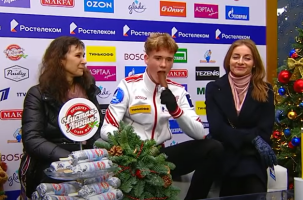
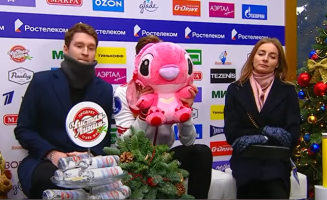
1640440246595.png

Moskvich Mystery Skater: The audience was totally on board with Alexey's FS. Pity about the mistakes, but the cheers and support he got were really sweet. Just keep up the good work with the coaches and one day soon it will all work out.
1640440341815.png

Btw, was that Evgeni Vlasov with them in the Kiss&Cry?
 
After Christmas break the Moskvich Juniors were back in action at the Moscow City Cup. Kirill Korpylev and Genrikh Gartung narrowly missed out on the medals, coming fourth and fifth respectively. But as always they gave lovely performances! I might be a little biased, but the Moskvich skaters usually have among the best programs. For the Junior skaters, the level of artistic demands is just right without coming across as pretentious. A joy to watch. 🥰

 
Back
Top