Women's FS - 2022 Olympics: Thoughts? | Page 23 | Golden Skate

Women's FS - 2022 Olympics: Thoughts?

Put my bias aside, I think Wakaba has the best Free Program overall this season. Her Lion King music choice, choreography, 3A, step sequence, costume....everything is perfect (except one fall). Wakaba is better than Kaori IMO. Kaori is queen of GOE, I got it but ....Kaori's LP is boring ......nothing special about it.
It didn't prevent her to get 74 PCS.
I get that her SS are stellar but speed isn't all, multidirectional skating matter too. She is charismatic but CO and IN should count too. But PCS are now more consistency points than anything else.
Anyway, this Kaori vs Wakaba (or even Shcherbakova vs Trusova) debate proves again that any system so far promote quality or difficulty. Having the hardest layout doesn't necessarily pays off, especially if the skater consistently get calls. This is like Yuna vs Mao. Even when Mao wasn't getting crushed with UR calls, the GOEs were making a huge difference. Yuna collecting +2s and +3s while Mao was mostly getting +1s.
The lesson: Skate fast, jump high and long, don't bomb too much and you will be rewarded.
 
Last edited:
Hey GS Family!

Please keep this thread related to the women who competed at the 2022 Olympics and their performances.

Feel free to start a new thread if your post is not topic-related.

Thanks!
 
No, the competitions 10-15 years ago were really boring. I know people are nostalgic and everything, but it was slow and pretentious, with few risks and surprises. Might as well listen to Sinatra and watch 1950’s movies. Now it’s fast and energetic and fun. And there will be less competition now, because it’s just 2 countries instead of 3. And I love quads. They are what puts the skating at the boundary of physics and physical probability. They are irresistible. They are crazy. They are cool. They show what women actually are, not what we are told they should be. Spirals with a sweet smile, not so much.
There really needs to be a balance though. We had superb athleticism and artistry with Kaetlyn Osmond, e.g. She was just a bit nervous competitively, coupled with having come back from injuries, so she was not considered a favorite for Olympic gold in 2018. However, the overall quality of Osmond's skating both athletically and artistically was far, far superior to that of Zagitova and Medvedeva. While I have a soft spot for Medvedeva, she had terrible jump technique, which damaged her back, and is the main reason she can't skate any longer. Eteri had Zagitova packaged like a baby ballerina with all the bells and whistles, but it was mostly camouflage. Eteri had them backloading their jumps to gain points. They weren't doing quads at that point, of course. But all anyone could talk about in the lead-up to the 2018 Olympics, were these two ladies. It was a given that one of them were going to win gold, and the other silver.

Both are no longer skating. A lot of Zagitova's appeal was her gorgeous looks and the carefully calibrated bells and whistles. She fell apart after winning Olympic gold in her debut season. Poor judging IMO. Medvedeva should have won, if it was going to be between the two of them alone for gold. If Osmond had possessed a bit more confidence and less nerves at the start of the season, and had she been able to utilize that confidence when she went head-to-head with Zagitova and Medvedeva during the
GP, then there might have been more buzz about her chances for Olympic gold. As it was, there wasn't any certainty that Osmond would medal. But she brought it during the sp, which placed her in a great position. Plus, judges did love Osmond's gorgeous skating, with great jump technique and height.

In any case, Zagitova, as the reigning Olympic gold medalist, had to go through a huge downside the next season after a growth spurt. Suddenly, her cross-overs were laid bare and they looked horrid. But to her credit, she kept working hard with determination, and by the end of the season, with generous help from the judges who were interested in justifying her Olympic win, Zagitova prevailed to at least win Worlds.

Frankly, the way things have gone, the Russian ladies are like a dime a dozen, which is sad. I admire Trusova's grit and athleticism, but there seems to also be a lot of physical and emotional damage that goes on in Eteri's camp. I think Valieva is a gorgeous skater who could have shined without Eteri's influence, and certainly without help from drugs. Despite her prowess, I have rarely enjoyed watching Valieva, because it never seemed like she truly had passion for what she was doing. Her handlers had squeezed all the joy out of her skating. Look what happened to Kostornaia over the years too. She was formerly such a lovely skater.

Even Sotnikova in 2014 (though she wasn't coached by Eteri), won Olympic gold prematurely, and then, she no longer had any motivation to improve. I appreciate the way Liza Tuk has kept trying so hard after her precocious youthful triumphs. While Liza is not a great aesthetic skater, her determination and athleticism are very inspiring.

I never liked Scherbakova's skating. She always seemed so thin, brittle, and desperate to please Eteri. But I haven't seen her in awhile, so at the Olympics, Scherbakova actually looked like she'd grown a bit, and matured somewhat emotionally, Plus, I guess she had to fight so hard to make the team, perhaps that helped her. I actually enjoyed her skating this time. However, I thought Trusova would win with all the quads, but Scherbakova's clean performances were deserving, under the circumstances. Too bad that Trusova went off the deep end emotionally when she didn't win gold. There's something likeable about Trusova -- her spirited personality and her desire, perhaps. But once again, there's also something missing in her skating; she's not well-rounded. It was great seeing Kaori Sakamoto on the podium! Her skating has matured too, and with her clean, solid performances, her bronze medal was very deserving. Even without quads, there's such a delicious quality to the skating of Sakamoto and Wakaba Higuchi.

I also enjoy Loena Hendrickx, because she's not a cookie cutter skater. I'm sorry that Bradie Tennell was injured this season. She's a fighter. Although Karen Chen is such a lovely skater, maybe she should have tried a different coach to see if she could improve technically and competitively. I think Chen certainly has wonderful abilities, but too much self-doubt, IMO, especially under pressure. I wish Amber Glenn had been given more opportunities and encouragement. She has self-doubts too and seemingly a sensitive personality. U.S. fed did not demonstrate much confidence in Glenn, which can be devastating, in addition to dealing with injury setbacks.

ETA:
I also want to say that although the South Korean ladies (Young You and Ye-lim Kim) are wonderful skaters, there's such a reticence about their skating, that might be cultural, or something to do with the training methods and pressure of expectations. I find that I'm disconnected emotionally watching their skating. While there is evidence of passion there, somewhat, they mostly seem to skate with a determined focus that detaches them emotionally from their music. They aren't exactly robotic, but just not fully connected, even though they have lovely choreography and generally nice music selections. It seems as if they are bent on getting through all the tough technical content to the point where it's hard for them to focus on skating fully developed artistic performances.
 
Last edited:
I live for Trusova’s skat8ng and personality, yes, even with the melt down. The only thing I wish she’d change, is to start skating in body-suits and keep getting the fighting programs to be even more different from the rest. I dislike Scherbakova because she seems to me a complete opposite, the grey dove, and she gets rewarded for being so grey.

I liked Valieva as a junior, and overtraining her on meds is something that is a completely vile strategy.

I tuned into Zagitova vs Medvedeva too late to see Medvedeva at her best, and Zagitova was so bold and brush that I immediately fell in love with her, and don’t even remember Medvedeva. Then I saw Medvedeva live in 2019, in Skate Canada, and it didn’t live much impression on me.

From non-Russian skaters I love Sakomoto and celebrate her medal. I also loved Schizas, Liu, Gubanova and Kurakova. And, Hendricks when she is on.

I saw Tennell live, and she is so much better live, I think it makes the biggest difference.
 
I live for Trusova’s skat8ng and personality, yes, even with the melt down. The only thing I wish she’d change, is to start skating in body-suits and keep getting the fighting programs to be even more different from the rest. I dislike Scherbakova because she seems to me a complete opposite, the grey dove, and she gets rewarded for being so grey.

I liked Valieva as a junior, and overtraining her on meds is something that is a completely vile strategy.

I tuned into Zagitova vs Medvedeva too late to see Medvedeva at her best, and Zagitova was so bold and brush that I immediately fell in love with her, and don’t even remember Medvedeva. Then I saw Medvedeva live in 2019, in Skate Canada, and it didn’t live much impression on me.

From non-Russian skaters I love Sakomoto and celebrate her medal. I also loved Schizas, Liu, Gubanova and Kurakova. And, Hendricks when she is on.

I saw Tennell live, and she is so much better live, I think it makes the biggest difference.
Thanks for sharing. We all have our likes and dislikes, our faves, and skaters who don't pull us in as much, which is understandable. You sound rather young, or relatively new to figure skating if you aren't that familiar with Medvedeva's skating. It's not a problem being young. We all live through the various stages and ages we live through. As a senior and a long-time fan of figure skating over decades, I think it's possible to learn a lot from conversing with young people. But young people should keep in mind that on some issues and aspects of the sport of figure skating, their perspectives are limited, simply because of not being around long enough to have developed a broader understanding and experience of everything that has happened in the sport, and the trajectory of events over the years. In fact, I'm still learning all the time about the intricacies and multiple facets of this sport/ art.

Of course, there are some less young people who are really attached to the jumps too. I'm not attached to the jumps. I wish all fans could recognize that it's the foundational basics of blade mastery which must be taught and fully developed first before launching erratically with poor technique into jumps. Blade mastery and edge control aids speed and ice coverage. Proper jump technique combined with talent allows for rare skaters like Nathan Chen (ETA: and Patrick Chan) to arise. The advancement of jumps in figure skating has been a botched, random process. You get someone like Mikhail Kolyada who has gorgeous technique and wonderful skating skills, but who has seemingly felt too much pressure to incorporate quads quickly to the point where he developed bad habits mentally and physically. That's a shame. You have very young skaters like Stephen Gogolev who was allowed to crank out too many quads at too young an age without full development of proper jump technique and little attention to developing blade mastery (skating skills). There are many more examples like this, especially now among the Russian ladies who should not be over-pressured and over-worked with no emphasis on developing blade skills and proper jump technique. They only have a small window of opportunity to produce before being thrown on the scrap heap.

I'm also frustrated and disappointed that the sport of figure skating is so disconnected from its history, and that its not covered in a comprehensive way which might help grow the sport. As I said earlier, there needs to be a balance between technical and artistic development, as well as an appreciation for and a willingness to learn the foundational basics of figure skating. Jumps are not all that jazz they are made out to be without fully honing other important aspects of one's skating. Having better foundational skills can actually help improve the development of jumps.

The fully realized skating of Kaori Sakamoto and many others who don't wield quads, is 'fast, energetic, dynamic and fun!' The effective growth of the sport can only be achieved through balancing proper technique and blade skills with expressive artistry. Eteri's methods are not growing the sport in the best way. Her training methods are causing emotional and physical problems for many athletes. Yet, she is lauded and revered, while the questionable aspects of her training camp are ignored. Her charges receive over-adulation and over-rewards because so little is understood in the larger skating community about what constitutes good skating. There's too much awe and overdone admiration for multiple rotations, which ignores, dismisses, and thus limits a richer understanding of many other important aspects of figure skating. I prefer complete, expressive, fully realized skating that incorporates technically proficient jumps in a way that inspires. Jumps should be weaved into programs in a seamless way.
 
Last edited:
There is more than ET’s women skaters who jump quads and 3As. To me it looks like quads are actually easier for women than 3A, and it seems to rely on different principles than men’s quads. I am tired of artistry used as a punishing stick against the skaters that do not comply with gender stereotypes. I also like performances that are openly athletic by both women and men. I like music themes and performances that emphasize something beyond saccharine or mellow romantic stuff. I want more of that, and that’s what I see in Trusova far more than in any other women. That’s why I miss Trusova. That’s why I don’t like Higuchi because she tries to comply with those music choices and tiaras to almost a satiric level in my view.
 
To me it looks like quads are actually easier for women than 3A, and it seems to rely on different principles than men’s quads. I am tired of artistry used as a punishing stick against the skaters that do not comply with gender stereotypes.
??? I'm really not sure what you're saying exactly. Artistry is part of the sport of figure skating. It's not used in any way as 'a punishing stick.' That's just your perception for whatever reason. Are you trying to say that Trusova is seen as 'not complying with gender stereotypes.' That doesn't make sense. I also don't see what you mean by women performing quads as 'relying on different principles' than men performing quads. These kinds of conversations, when we throw out a lot of different generalizations using terminology that everyone might not understand in the same way, really muddies art vs sport debates.

In order to respond, I'm only guessing at what you're trying to say. It might be helpful if you could be more specific about what exactly you mean.

As far as I can see, Trusova is respected as an accomplished athlete and a very determined competitor. But trying to land all those quads has hampered her programs quite often, because that focus keeps her from paying attention to music interpretation and expressive moves. It's a challenge for all skaters these days with the technical requirements to master and combine artistic skill with top-notch technique. Kudos to Trusova for managing to land those jumps at the Olympics without falling. That was her goal, and I'm glad she achieved it. However, it's too bad that her coaches told her she could win gold if she landed 5 quads without any mistakes. I do not see Trusova as 'defying gender stereotypes,' simply because she's a good jumper. There have been a lot of great female jumpers in the sport of figure skating down through the years. It's not a new phenomenon simply because Eteri's girls are pioneering multiple quads and 3-axels. Quads and 3-axels have been landed by a number of different women previously, just not at the quantity and consistency we see in Eteri's camp. Different skaters simply have different attributes, different body types, personalities, styles, approaches, and abilities. Sure, there has been this notion of 'pretty princess' in women's skating, but that's largely a cliche if you take a close look at all the different female competitors over the years.

For me personally, I have not been that interested in women's skating in recent years because of the over-emphasis on jumps, combined with a kind of stereotypical lyrical approach. Michelle Kwan impacted and revolutionized women's skating in her time, in terms of demonstrating how to skate expressively; how to naturally exhibit graceful arms; how to select unique music; how to be a well-rounded athlete and artist; and how to compete with fire and consistency, etc. Kwan inspired her peers and so many skaters who came after her. But there needs to now be something new -- and I'm not just talking about jumps. There needs to be a different approach to what women can do on the ice.

In looking for something new, I like watching Wakaba Higuchi, Loena Hendrickx, Kaori Sakamoto, Amber Glenn (though she needs more self-belief and creativity), and even Llza Tuktamysheva (because she's inspirational, if not exactly an expressive artist) -- Liza is courageous and ambitious, and she's refused to give up in the face of obstacles. I've come to admire how Alysa Liu grew under the tutelage of Massimo Scali and Jeremy Abbott (who both should have had the chance to accompany her to the Olympics). Had Kamila Valieva's natural talent not been corrupted by Eteri's methods and this suspicion of doping, she has wonderful abilities that could have flourished. But I have never enjoyed watching Valieva skate, because it seems overly performative and tense. She doesn't exude joy in her skating. I could never understand that fp costume. It's awful -- and it has no connection to the strange music choice.

RegardingTrusova, perhaps with the right coach, she could meld her talents better, but she's just not there completely. Yes, it was kind of exciting watching Trusova land all her jumps, but that was not due to the revolutions being landed, but mostly because of some inner quality she has -- I could feel her spirited determination. While, I see Scherbakova as improved in terms of maturity, and I found her skating okay this time and a little bit more interesting, there was still a distanced quality that was performative and perfunctory (in a similar way to the Korean ladies who have great technical talent, but don't move me because there is something missing).

Kaori exhibits such dynamic flow and athleticism, combined with spirited emotion when she skates. Her soft knees are incredible. This is exciting skating:

This is an improved Scherbakova to my eyes. Not as brittle and desperate as I used to find her. But the jumps are still muscled with not the best technique, and her skating does not flow or have as much depth and substance as Kaori's skating. So, the extra revolutions on jumps, while admirable and difficult, does not actually make this a better program, nor is it a more interesting program to watch:
 
Last edited:
When artistry is mentioned, it's a term that might mean different things to different people. Breaking it down, artistry has to do with musical interpretation, also good skating skills which allow for greater speed and ice coverage, which just looks better. When skaters have these aspects mastered, it allows them to be more expressive, if they are skilled in hearing the music, if they have good posture, soft knees, and good flow over the ice.

Now, some skaters (like many Japanese skaters) have soft knees to die for, and others might not. For e.g., I don't think Nathan Chen has particularly soft knees, but he lands into the ice well enough combined with his other extraordinary abilities (musicality, expressive style, good blade skills, superb technique, decent flow out of jumps, good music selection and excellent choreography). Nathan has his own rare style, that's different from other top skaters. But some people don't pick up on his artistic nuances because he's known for jumping. Nathan has just managed to pace himself and lay out his programs in a way that he doesn't completely sacrifice expressive artistry, in favor of point-gathering revolutions.
 
If I won't consider the circumstances, then I think complex and balanced ability has won. Anna is a perfect combination of technical and artistic abilities. Many skaters have particular qualities, but sometimes, if they are too highlighted at the expense of the rest (whether it is a focus on jumps or skating skills), it might not be enough against someone who doesn't lack behind so much in those particular aspects and is better in the rest. Also this complexity and balance among all aspects is one of the reasons why Anna became my favourite skater and why I enjoy her skateing so much.
 
Last edited:
I am sorry, I just don't have the time, desire or energy to read this whole thing right now. I am going to use agree to disagree principle and just leave. None of it even matters any more.
 
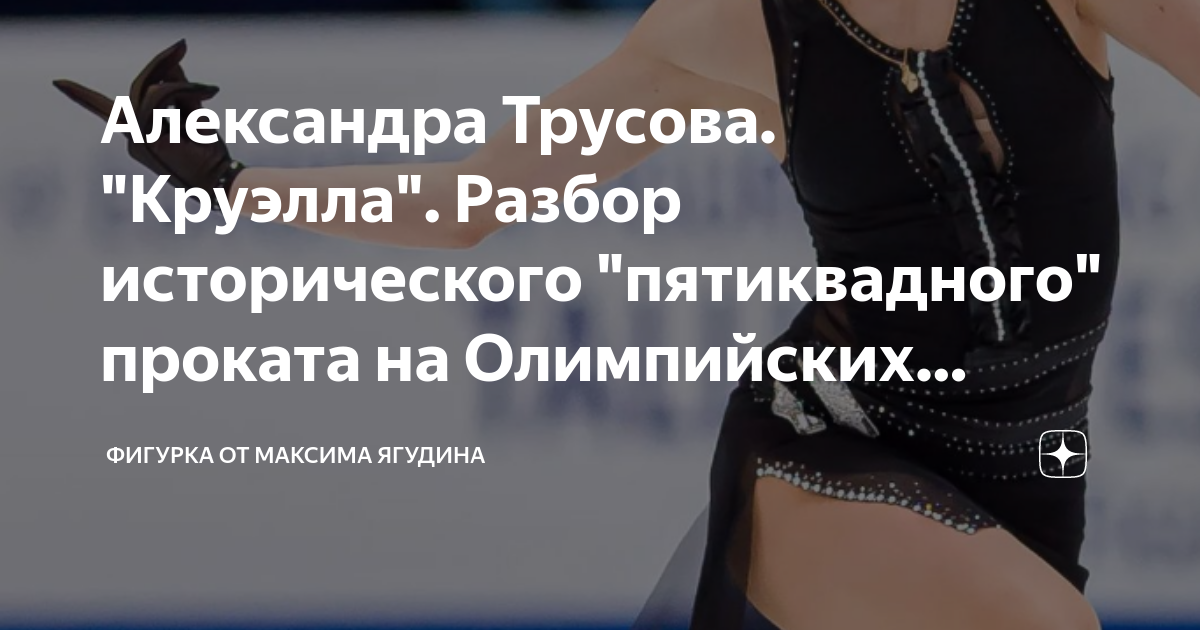
Detailed analysis of Alexandra Trusova's performance


Video:


0:45 we see a spectacular pose that will be repeated at the end of the program. Often Team Tutberidze programs are built on the principle of "where we start, we end there"

0:52 Choctaw

1:00 unique, taking into account the complexity of the jumping element, the entry to the jump - rocker + counter (with a touch with the free leg) + three turn

1:02 Jump ultra-c quadruple flip

The first of five quadruple jumps in Sasha's program. It is extremely important and sets the mood for all further rentals. The jump is executed simply superbly, the ideal position in the tuck with a straightened left leg is already taken after 1.5 spins, a very even axis, arms above the head, the height is visually higher than 60 cm, landing occurs on a full edge almost a move back, underrotation is less than 30 degrees, very soft exit on the outer edge of the right leg. GOE scores from judges from +2 to +4. Subsequently, these scores were reduced by 1 point after the technical team marked an obscure edge (!). Sasha performs his difficult entry (rocker + counter + three turn) on the outer edge of the left leg, after which there should be change of edge, i.e. in this case, the edge is changed to the correct internal one, but we don’t see this in the video, so the technical team had a reason to mark at least an obscure edge. Exit is complicated by a rocker. Average GOE score per item + 2.

1:17 a counter in the first phase of the entry to the next ultra-c jump

1:27 Jump ultra-c quadruple salchow

The second quadruple jump in Sasha's program. Let me remind you that it was the salchow that became Trusova's first landed quadruple jump at official tournaments, it was 4 years ago at the Junior World. Now the quad-salchow, according to statistics, is the most unstable quad in Sasha's program, which here and now turned out just fine, and for the second tournament in a row. We see a standard technique with the same standard thoughtful entry without complex steps, which is how quad-salchows are now performed by 99% of skaters. The jump stands out for its back twist, which was also noted by the judges - the average score of GOE + 3.5. The exit is complicated by a fan spiral and a rocker with a further emphasis on the judges.

1:36 choctaw + three turn as a complication before the next jump

1:47 mohawk + three turn as an ultra-c jump entry

1:50 Jump ultra-c quad toe loop

The third quadruple jump in Alexandra's program. We again see a perfect fast tuck, rippon, a very good aesthetic position in the air, the jump is wonderfully rotated, but on the landing there was a little lack of control, the skate tooth went forward a little, which led to a stop and an inevitable step out. A shameful loss of points, according to the judges we see scores of -2 -3, with a clean performance, Sasha would have received 5 points more for this element.

1:54 three turn + fan spiral when entering the cascade

1:56 Cascade double axel + triple toe loop

Unusual, frankly, a cascade for a Russian figure skater. Usually axels are performed exclusively solo, but here is a special case, the last jump element in the first half, it was necessary to insert a triple toe loop somewhere in the cascade, and since. the quadruple toe loop turned out with not the most convenient exit, then the axel became this jump. We see a double axel performed with a huge margin of height, followed by an elementary triple toe loop for Sasha, where unexpected problems with the technique of execution arose - almost two legs on the landing and a very hard turn in order to maintain balance. The opinions of the judges varied from +1 to -4, and the average GOE score was about -2.

2:01 choctaw + rocker + counter on spin entry

2:03 Combination spin with change of leg

This spin in the end gets only the 3rd level. I will name the features that should have provided this spin with the maximum 4th level: a difficult entry into the spin (rocker + counter), change of edge in the camel spin on the right leg, complex positions of a sit spin forward and a sit spin to the side on the left leg. In the review a little earlier, I found it difficult to name what exactly the judges didn’t like, but now after the review I can say that this is most likely a change of edge in camel spin from inside to outside, where two required minimum full turns were not made on the outside edge.

2:33 The beginning of the choreo sequence. Let's see what steps and spirals are included in Alexandra's program

2:34
ultra-c spiral cantilever

2:39 counter + change of edge + choctaw

2:46 Arabesque spiral

2:49 Bracket

The choreo sequence cannot be called "resting" in any way, although it certainly serves, in particular, to "take a breath" before the second half, but it is performed at the highest speed. The average GOE rating from the judges is +3.

2:56 choctaw + three turn + choctaw + choctaw as an entry to the ultra-c cascade

3:02 Cascade ultra-c quadruple lutz + triple toe loop

The second half of the program is going on, and for a long time, behind 6 elements, including 4 jumps with 3 ultra-c, and meanwhile Sasha performs his fourth quad, her favorite. A quadruple lutz from a long run with several choctaws at once turns out to be perfect - all phases of the jump, including the pronounced outer edge of the supporting leg, are exemplary, the triple toe loop in the cascade was also performed without judges' complaints, the under-rotation is obviously less than 45 degrees. The average judge's score on the goe scale is + 2.5, I can assume that up to the average +3, a full rotation on the toe loop was not enough.

3:19 choctaw + rocker in the first phase of the jump entry

3:21 choctaw + choctaw in the second phase of entry to solo quadruple lutz

3:24 Jump ultra-c quadruple lutz

Here we can fully appreciate the degree of outward inclination of the edge of Alexandra's supporting left leg, but unfortunately this is not reflected in the GOE according to the rules. The jump was performed slightly worse in rotation than the first lutz, very close to 90 degrees, which gives the technical team a reason to put a Q mark, and this in turn leads to a decrease in GOE from each of the judges by -2. The average score on the GOE scale is -1, here Alexandra with a slightly better rotation could score at least 3.5 points more.

3:31 Besti squat when entering the final jump element

3:33 Cascade triple lutz + euler + triple salchow

One of the two jump elements where we do not see a quadruple jump, however, according to the height of both the triple lutz and the triple salchow, we can conclude that Sasha could well show here another, sixth quadruple jump.))

3:38 Regular flying camel

We list the features on the basis of which the spin received the 4th level: Butterfly as a complex entry into the spin (1 line), 8 turns in the camel position to the side (2 and 3 lines), camel forward (4 lines). The average GOE score from the judges is slightly less than +3

3:54 Beginning of the step sequence. Let's highlight the difficult steps, the quality of which is assessed when determining the level

3:54
block of steps (bracket + counter + twizzle) (on the left leg, counterclockwise)

4:01 block of steps (rocker + counter + loop) (on the right leg, clockwise)

4:04 rocker (on the left leg, counterclockwise)

4:09 twizzle (on the right leg, clockwise)

4:13 bracket (on the right leg, clockwise)

4:15 loop (on the left leg, counterclockwise)

4:18 choctaw (from left leg to right leg)

4:21 choctaw (from right leg to left leg)

In total, we see 12 complex steps / turns in the sequence, all 6 varieties of complex steps are performed twice, on different legs and in different directions. However, some of the steps may have questions in terms of accentuation of the display of exit arcs. First of all, the judges must have noticed the loop in the second block of steps. The step sequence is fast and dynamic, it gets the 3rd level from the technical team, and +3.5 from the judges on the GOE scale.

4:24 Combination spin with a change of leg with a jump entry

Here we see the maximum amplitude Butterfly as a mandatory entry into this type of spin. However, the Butterfly cannot be taken as a feature, since this feature has already been used in the camel jump spin. Sasha receives levels for the following positions: on the right leg camels up and not the basic position "Illusion spin", on the left leg for a complex variation of the layback spin and for Bielmann.

4:49 The end of the program, where we see Sasha's spectacular pose from the beginning of the program. The total time of the free program is 4 minutes. 7 seconds at the maximum allowed 4.10.

This, from a technical point of view, turned out to be the Olympic silver skating of Alexandra Trusova. History was happening before our eyes, let's remember this moment, these 5 quadruple jumps. However, as we can see in the program, not only jumps, but also a lot of combinations, steps, spirals, choreo elements, and their total number is as large as it is in principle possible with 5 quadruple jumps.
 
You can say it doesn't matter, but nearly 20 points is an enormous margin for two programs of similar content. It's not like Anna did 3 quads and Sasha 1. It was even more obvious in the SP where neither Sasha nor Anna did a 3A and where Anna had a level 2 spin, but was somehow 5 points ahead afterwards. In other words Sasha would have scored closer to Anna if she'd done at 3A and FELL.
this, of course, is already in the past, and does not even have a direct relation to the Olympics, but in general it is interesting to compare these two short programs, because they are identical in content, except for the cascade. I will list all the elements with their original (not revised) scores for Anna and Sasha.

Sasha: 2A BV 3.30 GOE 0.99 4.29

Anna: 2A BV 3.30 GOE 1.27 4.57

You can already see the difference here. I can’t say for sure what it is due to, but I assume that Sasha overrotated her jump. Such a mistake for other skaters is most often impossible, but Sasha sometimes overrotated even quadruple jumps. Outwardly, this double axel looked very impressive - energetic, high.

Sasha: 3F BV 5.30 GOE 1.80 7.10

Anna: 3F BV 5.30 GOE 1.94 7.24

Here the difference is extremely small, but later it was this element that was overestimated by the judges. But more about that later.

Sasha: CCoSp4 3.50 GOE 1.05 4.55

Anna : CCoSp4 3.50 GOE 1.50 5.00

Here it is difficult for me to say something definite, but it also seemed to me that Anna was better in this element.

Sasha: FCSp4 3.20 GOE 1.12 4.32

Anna: FCSp2 2.30 GOE 0.17 2.47

Here it is - the spin, on which Anna almost fell, but saved the element. As you can see, the level of difficulty immediately dropped sharply, plus the minimum GOE. As a result, she lost to Trusova by almost two points.

Sasha: 3Lz+3T 11.11 GOE 2.16 13.27

Anna: 3Lz+3Lo 11.88 GOE 2.07 13.95

In this case, Sasha has even a little more GOE, but Shcherbakova won due to the higher base value of the cascade.

Sasha: StSq3 3.30 GOE 1.10 4.40

Anna: StSq4 3.90 GOE 1.82 5.72

The step sequence is traditionally Sasha's weak point. Only the third level of difficulty, and the same thing happened at the Olympics

Sasha: LSp4 2.70 GOE 1.04 3.74

Anna: LSp4 2.70 GOE 1.31 4.00

Again, the minimum difference is in favor of Shcherbakova.

If you sum up all these scores, it turns out that Anna scored 42.95, and Sasha - 41.76. In the protocol, however, other numbers appear, namely 42.51 and 40.31. That is, after the revision, Sasha's score was lowered by 1.45 points. As I understand it, this was mainly due to the 3F (and perhaps to some extent due to the double axel). For me, Sasha's mistake on this element remained imperceptible, however, commentators spoke about this mistake in the broadcast even before the announcement of the score. And at the Olympics, Sasha also made a mistake not on the most difficult element - again some kind of fatal similarity.

The second part of Anna's score was always higher than Sasha's, so it is not surprising that the gap eventually grew to five points.

I have to say that in terms of artistry, Sasha's two programs at that Russian Championships make a much better impression than many of her other performances (although the Olympic program with five quads is not at all as bad from an artistic point of view as some people claim). Here, as I think, a certain contribution of Plushenko is noticeable, although he himself recently said that Sasha did not wanted to listen to him.
 
Back
Top